
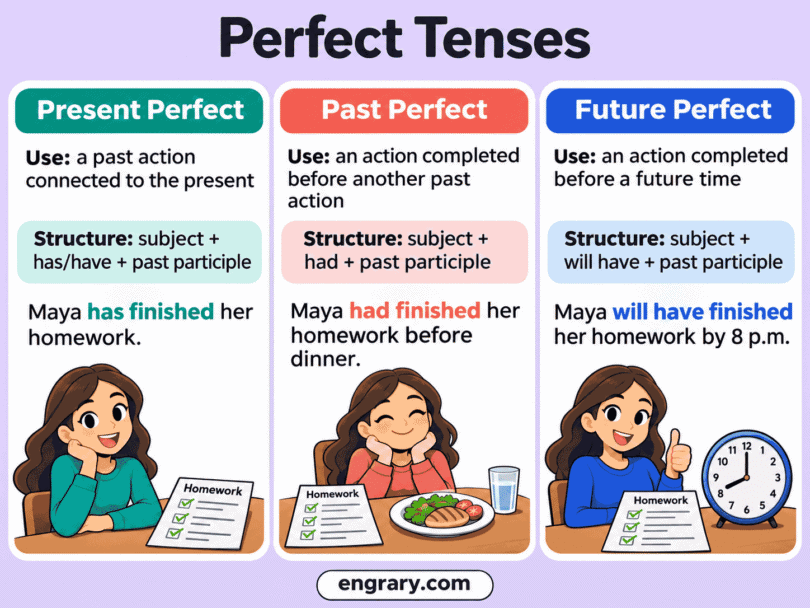
Perfect tenses connect an earlier action or state with a later reference point. The present perfect looks back from now, the past perfect looks back from a later past moment, and the future perfect looks back from a future point. Therefore, these forms express relationships between times rather than time alone.
This guide explains the present, past, and future perfect tenses separately. It covers structures, past participles, affirmative and negative sentences, questions, time expressions, tense comparisons, perfect continuous forms, passive constructions, common mistakes, and natural examples.
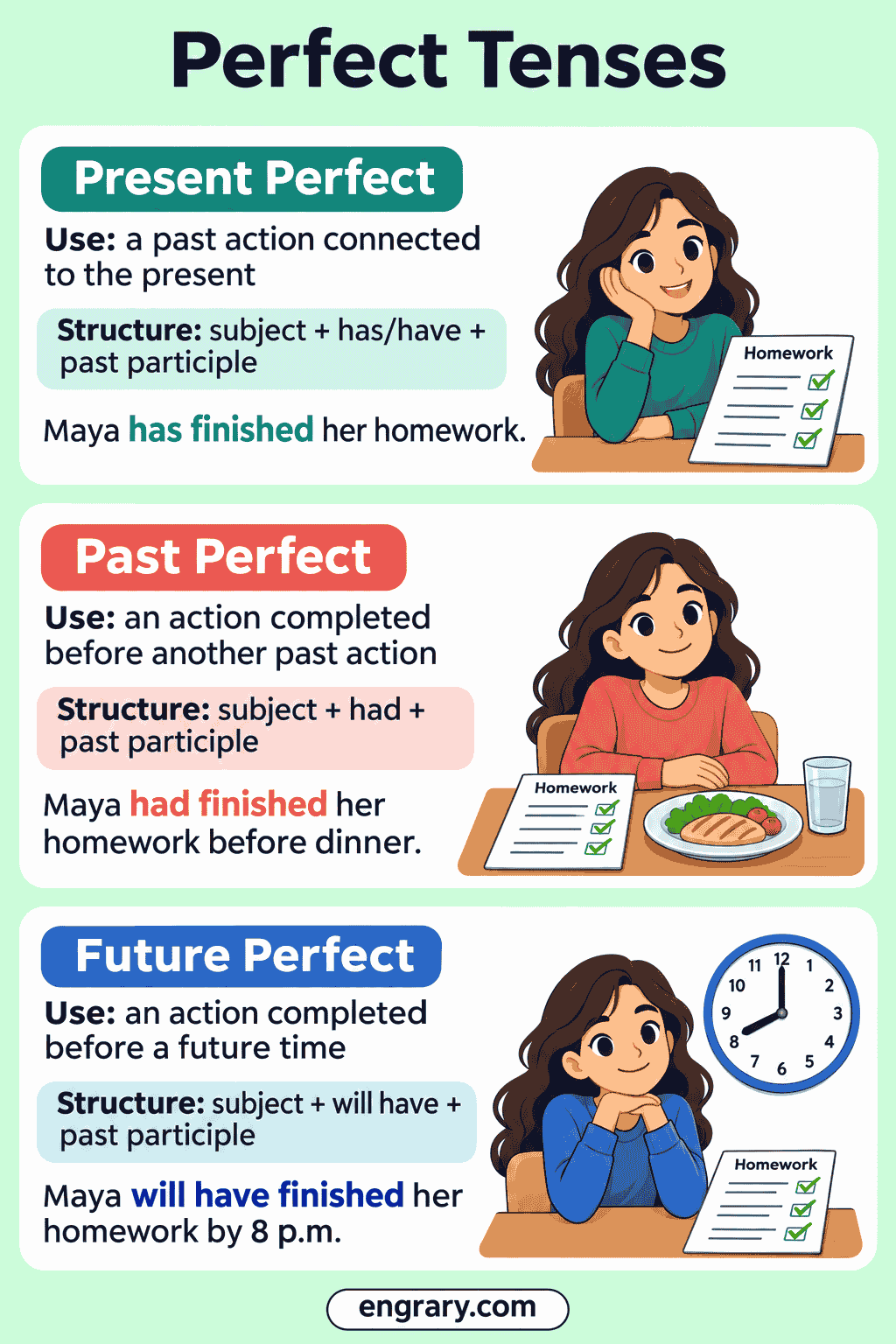
Perfect Tenses and Their Time Relationships
Every perfect tense uses a form of have followed by a past participle. The form of have identifies the reference point, while the past participle identifies the earlier action or state.
| Perfect tense | Structure | Reference point | Example |
|---|---|---|---|
| Present perfect | have/has + past participle | The present | She has completed the report. |
| Past perfect | had + past participle | A point in the past | She had completed the report before the meeting. |
| Future perfect | will have + past participle | A point in the future | She will have completed the report by Friday. |
The same action changes its relationship to time in these examples:
- Present perfect: Ali has finished the assignment, so he can relax now.
- Past perfect: Ali had finished the assignment before the class began.
- Future perfect: Ali will have finished the assignment by tomorrow.
| Form | Earlier action or state | Later reference point |
|---|---|---|
| Present perfect | Before now | Now |
| Past perfect | Earlier past | Later past |
| Future perfect | Earlier future event | Later future point |
Perfect forms often describe completion, but completion is not their only meaning. For example, I have known her for ten years describes a state that began in the past and continues now. The central idea is the connection between an earlier situation and a later reference point.
Perfect Tense Structures
All three perfect tenses follow this shared pattern:
Subject + form of have + past participle
Affirmative Sentences
| Tense | Structure | Example |
|---|---|---|
| Present perfect | Subject + have/has + past participle | They have arrived. |
| Past perfect | Subject + had + past participle | They had arrived. |
| Future perfect | Subject + will have + past participle | They will have arrived. |
Negative Sentences
Add not after the first auxiliary to make a perfect form negative.
| Tense | Structure | Example |
|---|---|---|
| Present perfect | Subject + have/has not + past participle | They have not arrived. |
| Past perfect | Subject + had not + past participle | They had not arrived. |
| Future perfect | Subject + will not have + past participle | They will not have arrived. |
Questions and Short Answers
Move the first auxiliary before the subject to form a question.
| Tense | Question | Positive answer | Negative answer |
|---|---|---|---|
| Present perfect | Have they arrived? | Yes, they have. | No, they haven’t. |
| Past perfect | Had they arrived? | Yes, they had. | No, they hadn’t. |
| Future perfect | Will they have arrived? | Yes, they will. | No, they won’t. |
Information questions place a question word first:
- What have you completed?
- Where had they gone?
- How much will she have saved?
Perfect constructions do not use do, does, or did as question or negative auxiliaries.
| Incorrect | Correct |
|---|---|
| Do you have finished? | Have you finished? |
| She doesn’t have arrived. | She hasn’t arrived. |
| Did they had left? | Had they left? |
Negative questions often express surprise, expectation, or a request for confirmation:
- Haven’t you finished yet?
- Hadn’t they met before?
- Won’t she have completed the course by June?
Past Participles in Perfect Tenses
A past participle is the third principal form of a verb. Regular verbs generally use the same form for the simple past and the past participle. However, many irregular verbs use a different participle.
| Base verb | Simple past | Past participle |
|---|---|---|
| work | worked | worked |
| finish | finished | finished |
| go | went | gone |
| see | saw | seen |
| write | wrote | written |
| take | took | taken |
| break | broke | broken |
| do | did | done |
| eat | ate | eaten |
| speak | spoke | spoken |
| choose | chose | chosen |
| begin | began | begun |
The auxiliary already carries the tense, so the main verb must remain a past participle.
| Incorrect | Correct |
|---|---|
| She has went home. | She has gone home. |
| They had wrote the report. | They had written the report. |
| He has ate breakfast. | He has eaten breakfast. |
| We will have saw the results. | We will have seen the results. |
Present Perfect Tense
The present perfect looks back from now. It can describe a current result, a life experience, an action at an unspecified time, a continuing state, a repeated event, or an action within an unfinished period.
Present Perfect Structure
| Sentence type | Structure | Example |
|---|---|---|
| Affirmative | Subject + have/has + past participle | She has finished her work. |
| Negative | Subject + have/has not + past participle | She has not finished her work. |
| Question | Have/Has + subject + past participle? | Has she finished her work? |
| Information question | Question word + have/has + subject + past participle? | What has she finished? |
Use has with he, she, it, and singular nouns. In contrast, use have with I, you, we, they, and plural nouns.
Uses of the Present Perfect
Present Results
Use the present perfect when an earlier action has an important result now.
- I have lost my keys, so I cannot open the door.
- She has broken her glasses, so she cannot read.
- The rain has stopped, and the sun is shining now.
- We have completed the report, so we can submit it.
Life Experiences
The present perfect describes experiences up to now when the exact time remains unstated or unimportant.
- I have visited Turkey twice.
- She has never traveled by plane.
- Have you ever eaten Korean food?
- They have seen that film before.
If the sentence states a finished time, use the simple past instead:
- Correct: I visited Turkey in 2024.
- Incorrect: I have visited Turkey in 2024.
Continuing States
The present perfect can describe a state that began in the past and continues now.
- We have lived here for six years.
- I have known Ahmed since school.
- She has owned that shop for a decade.
- They have been married since 2015.
These examples show why perfect forms do not always describe finished situations.
Repeated Actions Up to Now
- He has called three times today.
- We have visited the museum several times.
- She has written four emails this morning.
- The team has won five matches this season.
Unfinished Time Periods
Use the present perfect when a period still includes the present.
- I have attended two meetings today.
- We have received many orders this week.
- She has read three books this month.
- Sales have increased this year.
Recent Events and News
The present perfect can announce new information without stating a finished time.
- The company has opened a new branch.
- Scientists have discovered a new species.
- The police have arrested two suspects.
- The government has announced a new policy.
Later sentences often switch to the simple past when they provide finished-time details: The police have arrested two suspects. Officers arrested them early this morning.
First-Time and Superlative Patterns
- This is the first time I have flown alone.
- It is the second time she has visited Lahore.
- That is the best meal I have ever eaten.
- He is the most patient teacher I have ever met.
Open and Finished Time Periods
Expressions such as today, this morning, and this week do not automatically require the present perfect. The speaker’s viewpoint determines whether the period remains open or feels finished.
| Open period | Finished period |
|---|---|
| I have answered five emails this morning. | I answered five emails this morning. |
| It is still morning. | The morning has ended. |
| We have had two meetings today. | We had two meetings earlier today. |
| She has called twice this week. | She called twice at the start of the week. |
Finished Lives and Historical Periods
Use the simple past for events inside a finished life or clearly completed historical period.
| Incorrect | Correct |
|---|---|
| Shakespeare has written many plays. | Shakespeare wrote many plays. |
| Einstein has developed important theories. | Einstein developed important theories. |
| Ancient Romans have built long roads. | Ancient Romans built long roads. |
Compare The author has written ten novels, which suggests that the author may write more, with The author wrote ten novels, which presents the writing career as finished.
Present Perfect and Simple Past
The present perfect connects an earlier event with now, while the simple past places a completed event inside a finished past period.
| Present perfect | Simple past | Difference |
|---|---|---|
| I have visited Lahore. | I visited Lahore last year. | Unspecified versus stated finished time |
| She has lost her keys. | She lost her keys yesterday. | Present result versus dated event |
| We have lived here for six years. | We lived there for six years. | Continuing versus finished situation |
| Have you eaten yet? | Did you eat at noon? | Present relevance versus stated past time |
| He has written three emails today. | He wrote three emails yesterday. | Unfinished versus finished period |
Use the simple past with yesterday, last week, ago, in 2020, and other finished past times. Use the present perfect when the exact time is unstated, the period remains unfinished, or the result matters now.
For and Since with Perfect Tenses
Use for with a duration and since with a starting point.
| Expression | Purpose | Example |
|---|---|---|
| for | Length of time | We have lived here for six years. |
| since | Starting point | We have lived here since 2020. |
Common duration expressions include for two hours, for several months, and for a long time. Starting points include since Monday, since 2020, and since I left school.
A clause after since commonly uses the simple past:
- I have worked here since I graduated.
- She has known him since they met at university.
The present perfect can also describe how long an event has not happened:
- I haven’t seen her for two weeks.
- He hasn’t called since Monday.
- We haven’t visited Lahore in years.
- It has been months since they spoke.
Been and Gone in the Present Perfect
| Form | Meaning | Example |
|---|---|---|
| has been to | Visited and returned | Sara has been to Dubai. |
| has gone to | Went and has not returned | Sara has gone to Dubai. |
| has been in | Remained in a place | Sara has been in Dubai for a week. |
Therefore, Ali has been to the bank means that he returned, whereas Ali has gone to the bank means that he is still there or traveling there.
Already, Yet, Just, Ever, and Never
| Expression | Main use | Common position | Example |
|---|---|---|---|
| already | Earlier than expected | Before the participle | She has already left. |
| yet | Expected action in questions and negatives | End of sentence | Has she left yet? |
| just | Very recent action | Before the participle | She has just left. |
| ever | At any time up to now | Before the participle | Have you ever flown? |
| never | At no time up to now | Before the participle | I have never flown. |
Already can appear at the end of a question to express surprise: Have you finished already? Other common present perfect expressions include recently, lately, so far, up to now, and until now.
How Long with Perfect Tenses
Questions with how long focus on duration up to a reference point.
| Tense | Example |
|---|---|
| Present perfect | How long have you lived here? |
| Past perfect | How long had they lived there before they moved? |
| Future perfect | How long will she have worked here by June? |
Perfect Forms of Have
The main verb have uses had as its past participle. As a result, perfect forms can contain two forms of have.
| Tense | Example |
|---|---|
| Present perfect | I have had lunch. |
| Past perfect | I had had lunch before she arrived. |
| Future perfect | I will have had lunch by noon. |
The first have, had, or will have acts as the auxiliary. The second had carries the main meaning.
Present Perfect in Future Time Clauses
The present perfect can show that one future action must finish before another action begins.
- I will call you when I have finished.
- We can leave after she has arrived.
- Submit the form as soon as you have completed it.
| Simple present | Present perfect | Difference |
|---|---|---|
| I will call when I finish. | I will call when I have finished. | The perfect emphasizes prior completion. |
Both forms can work, but the present perfect places stronger emphasis on the first action being complete.
Past Perfect Tense
The past perfect looks back from a past reference point. It usually identifies an event or state that occurred before another past situation.
Past Perfect Structure
| Sentence type | Structure | Example |
|---|---|---|
| Affirmative | Subject + had + past participle | She had finished the report. |
| Negative | Subject + had not + past participle | She had not finished the report. |
| Question | Had + subject + past participle? | Had she finished the report? |
| Information question | Question word + had + subject + past participle? | What had she finished? |
The auxiliary had remains the same with every subject.
Uses of the Past Perfect
Earlier Past Actions
- The train had left before we reached the station.
- She had finished the report when the manager called.
- They had eaten dinner before the guests arrived.
- I had locked the door before I went to bed.
Continuing States Before a Past Point
- She had lived there for ten years before she moved.
- They had been married for twenty years when they separated.
- I had known him since childhood.
- The family had owned the house for generations.
Experiences Before a Past Point
- I had never seen snow before that trip.
- She had visited France twice before she moved there.
- Had you ever flown before your journey to Dubai?
- It was the best meal I had ever eaten.
Causes of Past Results
- He was tired because he had not slept.
- The ground was wet because it had rained.
- She felt confident because she had prepared carefully.
- They were hungry because they had missed lunch.
Reported Speech
| Direct speech | Reported speech |
|---|---|
| “I have finished.” | She said that she had finished. |
| “We have seen the film.” | They said that they had seen the film. |
| “I lost my keys.” | He said that he had lost his keys. |
Backshifting depends on context and is not always necessary when the information remains current.
Third Conditionals, Wishes, and Regrets
- If I had known, I would have called.
- If she had studied, she would have passed.
- I wish I had studied harder.
- If only we had booked the tickets earlier.
Unfulfilled Hopes and Plans
- We had hoped to visit, but the office was closed.
- She had intended to call, but she forgot.
- They had expected the journey to be shorter.
Past Perfect Without Time Conjunctions
The past perfect does not require before, after, or by the time. Context can establish the later past point:
I arrived at the station. The train had left.
Sara looked tired. She had not slept well.
In each case, the second sentence looks back to an event before the first sentence’s past situation.
Past Perfect and Simple Past
| Past perfect | Simple past | Relationship |
|---|---|---|
| The train had left | before we arrived. | Earlier event followed by later event |
| She had completed the work | when the manager called. | Earlier completion followed by call |
| They had eaten dinner | before the guests arrived. | First event followed by second event |
When before or after already makes the order clear, the past perfect may become optional:
| With past perfect | Without past perfect |
|---|---|
| After she had finished, she went home. | After she finished, she went home. |
| Before he had left, he locked the door. | Before he left, he locked the door. |
Both versions can work, although the past perfect emphasizes earlier completion.
Past Perfect in Narratives
Writers often use the past perfect once to move back to an earlier time. After establishing that time, they normally return to the simple past:
Ali explained that he had missed the bus. He walked to the next stop and called a taxi.
Using had walked and had called would sound unnecessarily heavy unless the narrative shifted to another reference point.
Future Perfect Tense
The future perfect looks back from a future reference point. It commonly expresses completion before a deadline, achievement by a future time, or duration up to that point.
Future Perfect Structure
| Sentence type | Structure | Example |
|---|---|---|
| Affirmative | Subject + will have + past participle | She will have finished the report. |
| Negative | Subject + will not have + past participle | She will not have finished the report. |
| Question | Will + subject + have + past participle? | Will she have finished the report? |
| Information question | Question word + will + subject + have + past participle? | What will she have finished? |
Uses of the Future Perfect
Completion Before a Deadline
- I will have finished the report by Friday.
- She will have submitted the form before noon.
- They will have built the bridge by next year.
- We will have completed the project by the deadline.
Future Achievements
- She will have graduated by next summer.
- By thirty, he will have written three novels.
- The company will have opened ten branches by 2030.
- The team will have played fifty matches by the end of the season.
Duration Up to a Future Point
- By June, we will have lived here for ten years.
- Next month, they will have been married for twenty years.
- By Friday, she will have owned the shop for a decade.
Assumptions and Deductions
The future perfect can express a confident assumption about an event that the speaker believes is already complete:
- The guests will have arrived by now.
- She will have heard the news already.
- They will probably have reached the hotel.
- He will have received your message by this time.
Here, will have expresses deduction rather than a literal future action.
Future Perfect and Simple Future
| Future perfect | Simple future | Difference |
|---|---|---|
| I will have finished by six. | I will finish the report. | Completion before a point versus future action |
| She will have arrived by noon. | She will arrive at noon. | Completion by noon versus event at noon |
| They will have built the bridge by 2030. | They will build the bridge. | Completed result versus future plan |
By, Before, Within, In, and Until
| Expression | Example | Meaning |
|---|---|---|
| by Friday | I will have finished by Friday. | No later than Friday |
| before Friday | I will have finished before Friday. | Earlier than Friday |
| within two days | I will have finished within two days. | During the stated period |
| in two days | I will finish in two days. | Two days from now or after two days |
| until Friday | I will work until Friday. | Continuation up to Friday |
In future time clauses, use the simple present rather than will:
- Correct: By the time she arrives, we will have eaten.
- Incorrect: By the time she will arrive, we will have eaten.
Differences Between Perfect Tenses
| Point | Present perfect | Past perfect | Future perfect |
|---|---|---|---|
| Reference point | Now | A later past time | A later future time |
| Auxiliary | have/has | had | will have |
| Main relationship | Earlier event connected to now | Earlier past before later past | Completion before future point |
| Example | She has left. | She had left before I arrived. | She will have left by noon. |
Using one action makes the contrast especially clear:
- Present perfect: Hina has completed the course.
- Past perfect: Hina had completed the course before she applied for the job.
- Future perfect: Hina will have completed the course by December.
Perfect Simple and Perfect Continuous Forms
The perfect simple usually emphasizes a result, completed amount, state, or achievement. In contrast, the perfect continuous emphasizes activity, duration, repetition, or recent effort.
| Perfect simple | Perfect continuous | Main contrast |
|---|---|---|
| I have written three emails. | I have been writing emails all morning. | Quantity versus duration |
| She has painted the room. | She has been painting the room. | Completed result versus recent activity |
| He had cleaned the house. | He had been cleaning the house. | Result versus earlier ongoing activity |
| I have worked here for ten years. | I have been working here for ten years. | Fact versus emphasis on duration |
| She has lived here since 2020. | She has been living here since 2020. | Neutral or permanent versus activity-focused or temporary |
Some verbs allow both forms with a subtle change of focus. However, stative verbs normally prefer the perfect simple:
- Correct: I have known her for years.
- Incorrect: I have been knowing her for years.
Perfect Tenses in a Short Paragraph
Perfect tenses often work together naturally:
Ayesha has completed most of her research this week. Before she met her supervisor yesterday, she had organized all the survey results. By Friday, she will have written the first draft of her report.
| Verb phrase | Tense | Purpose |
|---|---|---|
| has completed | Present perfect | Achievement during an unfinished week |
| had organized | Past perfect | Earlier action before a past meeting |
| will have written | Future perfect | Expected completion before Friday |
Contractions in Perfect Tenses
| Contraction | Meaning | Example |
|---|---|---|
| I’ve | I have | I’ve finished. |
| she’s | she has or she is | She’s finished. / She’s working. |
| I’d | I had or I would | I’d finished. / I’d leave. |
| he’ll | he will | He’ll have arrived. |
| haven’t | have not | We haven’t started. |
| hadn’t | had not | They hadn’t eaten. |
| won’t | will not | She won’t have finished. |
The following word reveals the intended meaning. She’s finished means she has finished, whereas she’s working means she is working. Likewise, I’d left means I had left, while I’d leave means I would leave.
Perfect Tenses in the Passive Voice
Perfect passive forms use form of have + been + past participle.
| Form | Example |
|---|---|
| Present perfect affirmative | The report has been approved. |
| Present perfect negative | The report has not been approved. |
| Present perfect question | Has the report been approved? |
| Past perfect affirmative | The room had been cleaned. |
| Past perfect negative | The room had not been cleaned. |
| Future perfect affirmative | The bridge will have been completed by June. |
| Future perfect question | Will the bridge have been completed by June? |
Perfect Infinitives and Modal Perfects
These constructions use perfect forms, but they are not the three main perfect tenses.
| Form | Example | Meaning |
|---|---|---|
| Perfect infinitive | She seems to have left. | Earlier action |
| Modal perfect | He must have forgotten. | Past deduction |
| Modal perfect | You should have called. | Past criticism or regret |
| Conditional perfect | I would have helped. | Unreal past result |
British and American Usage
American English sometimes uses the simple past where British English commonly favors the present perfect, particularly with recent actions and already, yet, or just.
| Common British English | Common American English |
|---|---|
| Have you eaten yet? | Did you eat yet? |
| I’ve already finished. | I already finished. |
| She has just arrived. | She just arrived. |
Both varieties use the present perfect. These examples show a difference in preference rather than a universal rule.
Common Mistakes with Perfect Tenses
| Incorrect | Correct | Explanation |
|---|---|---|
| She have finished. | She has finished. | Use has with a singular third-person subject. |
| He has went home. | He has gone home. | Use the past participle after has. |
| They had wrote the report. | They had written the report. | Use written, not wrote. |
| Do you have finished? | Have you finished? | Perfect questions do not use do. |
| I have seen her yesterday. | I saw her yesterday. | Use the simple past with a finished time. |
| We have lived here since five years. | We have lived here for five years. | Use for with a duration. |
| We have lived here for 2020. | We have lived here since 2020. | Use since with a starting point. |
| Sara has been to Dubai and is still there. | Sara has gone to Dubai and is still there. | Gone shows that she has not returned. |
| The train left before we had arrived. | The train had left before we arrived. | Use the past perfect for the earlier action. |
| By Friday, I will finish the report. | By Friday, I will have finished the report. | Use the future perfect for completion by a deadline. |
| I will work by Friday. | I will work until Friday. | Until expresses continuation. |
| By the time she will arrive, we will have eaten. | By the time she arrives, we will have eaten. | Use the simple present in the time clause. |
| I have been knowing her for years. | I have known her for years. | Know is normally stative. |
Perfect Tense Usage Tips
- First, identify the later reference point.
- Next, identify the action or state that occurs before it.
- Use a past participle after every perfect auxiliary.
- Use the present perfect when an earlier event connects with now.
- Use the past perfect when the order of past events needs clarification.
- Use the future perfect for completion before a future point.
- Use the simple past with finished past times.
- Choose for for duration and since for a starting point.
- Distinguish been from gone according to whether someone returned.
- Finally, use a perfect continuous form when activity or duration matters more than the result.
FAQs
The three core perfect tenses are the present perfect, past perfect, and future perfect. The present perfect looks back from now, the past perfect looks back from a later past time, and the future perfect looks back from a future point.
Every perfect tense uses a form of have followed by a past participle. The present perfect uses have or has, the past perfect uses had, and the future perfect uses will have.
Perfect tenses is a familiar teaching term for forms such as the present, past, and future perfect. Perfect aspect more precisely describes how these forms connect an earlier action or state with a later reference point.
The simple past places an event at a finished past time, as in I visited Lahore last year. The present perfect connects an earlier event with now and usually leaves the exact time unstated, as in I have visited Lahore several times.
Yes. For example, I have known her for ten years describes a state that continues now. Likewise, past and future perfect forms can describe states continuing up to past or future reference points.
You May Also Like

Leave a Comment