

Simple tenses show when actions, events, and situations happen. The simple present describes routines, facts, and regular events; the simple past reports completed actions; and the simple future expresses predictions, decisions, promises, and other future meanings.
This guide provides 120 simple tense examples in sentences. It separates the simple present, simple past, and simple future, while also covering affirmative statements, negative sentences, questions, short answers, structures, time expressions, comparisons, and common mistakes.
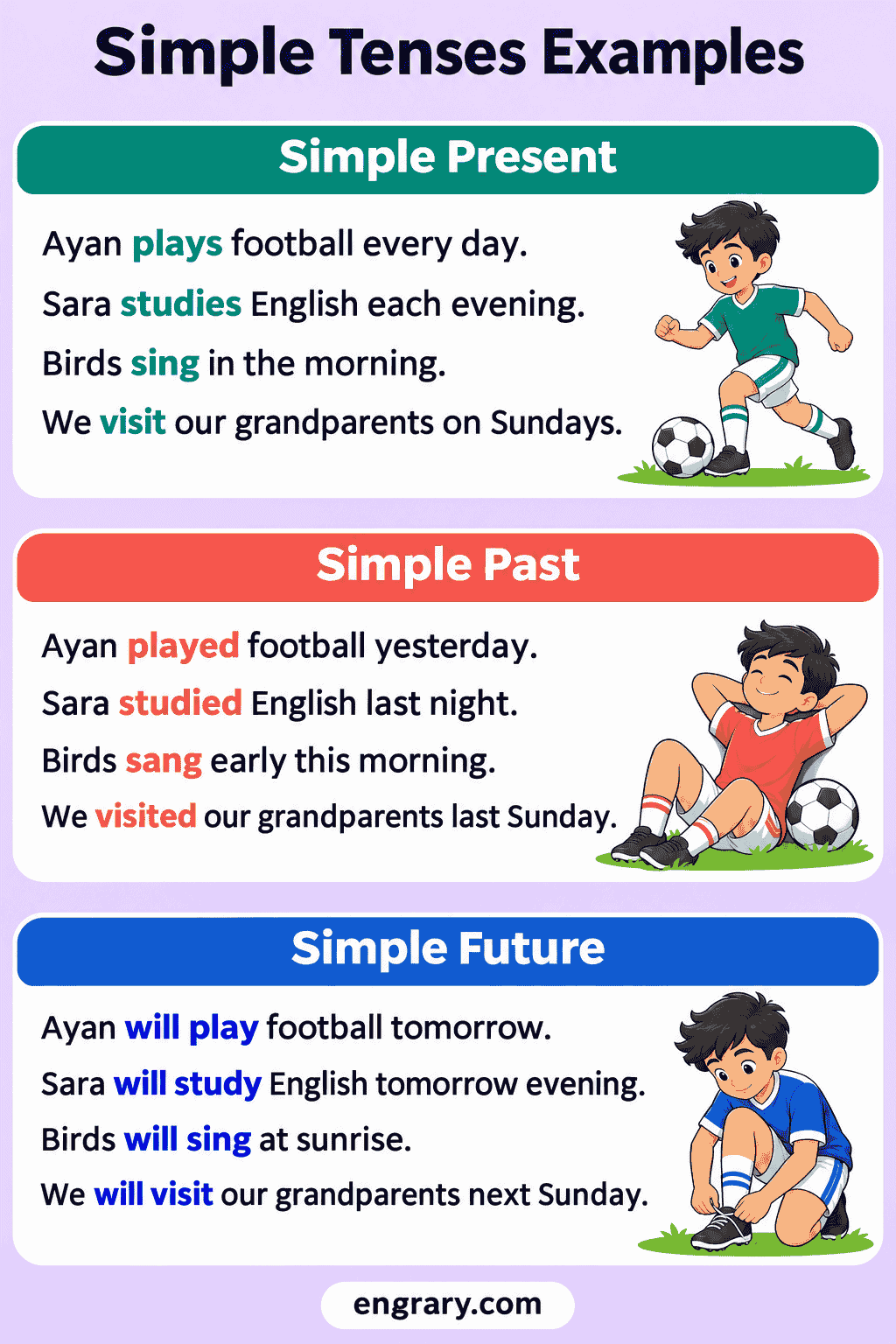
Everyday Simple Tense Examples Across Present, Past, and Future
The three simple tenses often describe the same action at different times. Notice how the verb changes while the basic meaning remains clear:
- Simple present: Aisha prepares breakfast every morning.
- Simple past: Aisha prepared breakfast yesterday morning.
- Simple future: Aisha will prepare breakfast tomorrow morning.
| Simple tense | Main purpose | Example |
|---|---|---|
| Simple present | Habits, facts, and regular actions | He walks to school every day. |
| Simple past | Completed past actions and events | He walked to school yesterday. |
| Simple future | Predictions, decisions, and future actions | He will walk to school tomorrow. |
These opening examples show the central time contrast. However, each simple tense has several additional uses and its own sentence patterns.
Simple Present Tense Examples in Sentences
The simple present describes habits, repeated actions, facts, general truths, long-term situations, and states. In addition, it can describe timetables, schedules, instructions, and live demonstrations.
Simple Present Tense Structure
Most simple present sentences use the base form of the verb. However, affirmative sentences add -s or -es when the subject is he, she, it, or a singular noun.
| Sentence type | Structure | Example |
|---|---|---|
| Affirmative | Subject + base verb or verb-s/es | She teaches English. |
| Negative | Subject + do/does not + base verb | She does not teach science. |
| Question | Do/Does + subject + base verb? | Does she teach English? |
| Short answer | Yes/No + subject + do/does | Yes, she does. |
The verb be follows a different pattern:
| Sentence type | Structure | Example |
|---|---|---|
| Affirmative | Subject + am/is/are | They are ready. |
| Negative | Subject + am/is/are not | They are not ready. |
| Question | Am/Is/Are + subject? | Are they ready? |
| Short answer | Yes/No + subject + am/is/are | Yes, they are. |
Affirmative Simple Present Examples
The following sentences illustrate routines, facts, states, schedules, and other common simple present meanings:
- I drink a glass of water after I wake up. — This sentence describes a daily habit.
- Bilal walks to college every morning. — The verb walks shows a regular action by a third-person singular subject.
- We visit our grandparents twice a month. — The action happens repeatedly.
- My sister watches the news after dinner. — Watches takes -es because the verb ends in -ch.
- Hamza studies mathematics in the evening. — Studies changes the final consonant plus y to -ies.
- The children play cricket in the park on Fridays. — The sentence expresses a routine.
- Our teacher gives us a short quiz every Monday. — The action follows a regular schedule.
- The sun rises in the east. — This is a general truth.
- Water freezes at zero degrees Celsius. — The sentence states a scientific fact.
- Plants need sunlight and water. — Need expresses a continuing state.
- Sara knows the answer. — The stative verb knows describes knowledge rather than an action in progress.
- I prefer tea without sugar. — Prefer expresses a stable preference.
- This blue backpack belongs to Ahmed. — Belongs describes possession.
- My uncle works at a textile factory. — The sentence describes a long-term situation.
- She has two younger brothers. — Has is the third-person singular form of have.
- Usman does his homework before dinner. — Does is the third-person singular form of do.
- The library opens at nine tomorrow morning. — The simple present describes a scheduled future event.
- Our flight leaves at 6:30 a.m. on Saturday. — A fixed timetable allows the simple present to refer to the future.
- First, you add the flour to the bowl. — The simple present can explain a process or instruction.
- The striker passes the ball and runs toward the goal. — A commentator may use the simple present for fast-moving action.
- I am ready for the meeting. — Am describes the subject’s present state.
Negative Simple Present Examples
Use do not or don’t with I, you, we, and they. Use does not or doesn’t with he, she, it, and singular nouns. After do or does, the main verb stays in its base form.
- I do not check my phone during class. — The sentence describes something that is not part of the speaker’s routine.
- We don’t eat dinner late on weekdays. — Don’t is the contraction of do not.
- They do not live near the city center. — The sentence describes a negative long-term situation.
- Mariam does not drive to work. — The base verb drive follows does not.
- My brother doesn’t watch television in the morning. — The main verb does not take -es after doesn’t.
- This shop does not accept credit cards. — The sentence states a general policy.
- I am not tired today. — A form of be does not require do.
- The classroom isn’t empty. — Isn’t is the contraction of is not.
- Our neighbors are not at home. — Are not makes the sentence negative.
Simple Present Questions
Use do or does before the subject in most simple present questions. In contrast, place am, is, or are directly before the subject when be is the main verb.
- Do you read before bed? — Yes, I do.
- Does Farah speak Arabic? — No, she doesn’t.
- Do the buses stop near your office? — Yes, they do.
- Is your father a doctor? — No, he isn’t.
- Where do your cousins live? — They live in Karachi.
- Why does the baby cry at night? — The question asks for a reason.
- When does the first lesson begin? — It begins at eight o’clock.
- How often do you exercise? — I exercise four times a week.
- Who teaches this class? — Ms. Khan teaches it.
In Example 42, who is the subject, so the question does not use do or does. Compare Who teaches Ali?, which asks about the teacher, with Who does Ali teach?, which asks about the person receiving Ali’s teaching.
Simple Past Tense Examples in Sentences
The simple past describes actions, events, and situations that began and ended in the past. It commonly appears with finished-time expressions such as yesterday, last week, two hours ago, and in 2024. Moreover, it can describe a sequence of completed events or a past habit.
Simple Past Tense Structure
Regular verbs usually add -ed, whereas irregular verbs have special past forms. Nevertheless, all ordinary verbs use did not + base verb in negatives and did + subject + base verb in questions.
| Sentence type | Structure | Example |
|---|---|---|
| Affirmative | Subject + past form of verb | She visited Lahore. |
| Negative | Subject + did not + base verb | She did not visit Lahore. |
| Question | Did + subject + base verb? | Did she visit Lahore? |
| Short answer | Yes/No + subject + did/didn’t | Yes, she did. |
The verb be uses was or were and does not take did:
| Sentence type | Structure | Example |
|---|---|---|
| Affirmative | Subject + was/were | They were ready. |
| Negative | Subject + was/were not | They were not ready. |
| Question | Was/Were + subject? | Were they ready? |
| Short answer | Yes/No + subject + was/were | Yes, they were. |
Affirmative Simple Past Examples
These examples include regular verbs, irregular verbs, past states, finished actions, and sequences of events:
- I cleaned my desk after lunch. — Cleaned is a regular past-tense verb.
- Sana visited her aunt last weekend. — The visit happened during a finished period.
- We watched a documentary yesterday evening. — Yesterday evening establishes a definite past time.
- The mechanic repaired our car in two hours. — The action reached completion in the past.
- They moved to Islamabad in 2022. — The date places the completed action in the past.
- My mother baked bread on Sunday. — Baked follows the regular -ed pattern.
- Ali went to the market before breakfast. — Went is the irregular past form of go.
- I saw an old friend at the station. — Saw is the irregular past form of see.
- The team won its final match. — Won is the irregular past form of win.
- Nadia wrote three emails before noon. — Wrote is the irregular past form of write.
- We had a productive meeting yesterday. — Had is the past form of have.
- The child broke his toy by accident. — Broke marks a completed past event.
- I woke up, opened the curtains, and made tea. — Three simple past verbs show a sequence of completed actions.
- The rain stopped, and the children returned to the playground. — The actions occurred one after another.
- She called the office and explained the problem. — Both actions finished in the past.
- We played outside every evening when we were young. — The simple past describes a repeated past habit.
- My grandfather walked five kilometers every morning. — The routine belonged to an earlier period.
- I believed that story as a child. — Believed describes a past state of mind.
- The old house belonged to a local merchant. — The sentence describes past possession.
- Hina was nervous before her interview. — Was describes a past state.
- The roads were quiet after midnight. — Were agrees with the plural subject roads.
Negative Simple Past Examples
Use did not or didn’t with the base form of an ordinary verb. However, use was not or were not when be is the main verb.
- I did not hear the alarm this morning. — The irregular past form heard does not follow did not.
- We didn’t finish the report yesterday. — Finish remains in the base form.
- Ahmed did not bring his notebook to class. — The correct pattern is did not bring, not did not brought.
- The guests didn’t arrive on time. — The sentence reports a past event that did not happen as expected.
- She did not understand the instructions. — Understand follows the auxiliary did.
- They didn’t buy anything at the market. — The negative auxiliary carries the past meaning.
- I was not angry with you. — Was not directly negates the verb be.
- The office wasn’t open on Friday. — Wasn’t is the contraction of was not.
- The players were not ready for the match. — The plural subject takes were not.
Simple Past Questions
Most simple past questions begin with did. Meanwhile, questions with be begin with was or were.
- Did you lock the front door? — Yes, I did.
- Did Adeel submit his application? — No, he didn’t.
- Did the children enjoy the trip? — Yes, they did.
- Were your parents at the ceremony? — Yes, they were.
- Where did you put my keys? — I put them on the table.
- Why did the meeting end early? — It ended because the manager felt ill.
- When did Fatima start her new job? — She started it last Monday.
- How did the glass break? — It fell from the shelf.
- Who called you last night? — My cousin called me.
Example 81 is a subject question; therefore, it does not use did. By contrast, the object question Who did you call last night? needs did and the base verb call.
Simple Future Tense Examples in Sentences
The will + base verb pattern expresses predictions, decisions made at the moment of speaking, promises, offers, willingness, and expected future events. Unlike the simple present and simple past, its form does not change with the subject.
Simple Future Tense Structure
| Sentence type | Structure | Example |
|---|---|---|
| Affirmative | Subject + will + base verb | They will arrive soon. |
| Negative | Subject + will not + base verb | They will not arrive early. |
| Question | Will + subject + base verb? | Will they arrive soon? |
| Short answer | Yes/No + subject + will/won’t | Yes, they will. |
In conversation, speakers often contract will to ’ll and will not to won’t. Still, the main verb always remains in its base form.
Affirmative Simple Future Examples
The following examples cover predictions, immediate decisions, offers, promises, expectations, and future facts:
- I think our team will win the match. — The speaker makes a prediction.
- The weather will become cooler next month. — The sentence predicts a future change.
- People will use more renewable energy in the future. — The speaker expresses a general prediction.
- The new bridge will reduce travel time. — The statement describes an expected result.
- I hear the doorbell; I will answer it. — The speaker decides at the moment of speaking.
- We are out of milk, so I will buy some. — The decision responds to the present situation.
- That bag looks heavy; I will carry it for you. — Will expresses an offer.
- I will help you prepare for the interview. — The speaker willingly offers help.
- We will send you the updated schedule tonight. — The sentence makes a promise.
- I will never share your private information. — Will expresses a firm promise.
- The manager will call you after lunch. — The sentence states an expected future action.
- Sara will join us at the restaurant later. — The action will occur later.
- My parents will visit us next weekend. — The sentence refers to a future visit.
- The course will begin in September. — The event belongs to a future time.
- The children will be tired after the journey. — Will be predicts a future state.
- You will enjoy this book. — The speaker predicts the listener’s reaction.
- I am sure Nadia will understand the situation. — The sentence expresses confidence about the future.
- This medicine will make you feel better. — The speaker expects a future result.
- Technology will continue to change the way we work. — The sentence makes a broad prediction.
- The sun will rise at 6:12 tomorrow morning. — The statement refers to a future fact.
- I will be twenty-five next year. — Will be describes a future age.
Negative Simple Future Examples
Use will not or won’t before the base verb. The negative form may express a prediction, refusal, promise, or expected absence of an action.
- I will not forget your kindness. — The speaker makes a negative promise.
- We won’t arrive before sunset. — The sentence predicts a late arrival.
- She will not attend the conference tomorrow. — The action will not happen.
- The shop won’t open on Sunday. — The sentence describes a future closure.
- They will not change their decision. — The speaker expects the decision to remain the same.
- Ahmed won’t tell anyone your secret. — The sentence offers reassurance.
- I will not accept such rude behavior. — Will not expresses refusal.
- This old printer won’t connect to the network. — Won’t can describe an object’s refusal or failure to function.
- The roads will not be busy early tomorrow morning. — The sentence predicts a future state.
Simple Future Questions
Place will before the subject to form a question. For information questions, place the question word before will.
- Will you attend the workshop tomorrow? — Yes, I will.
- Will Sana bring the documents? — No, she won’t.
- Will the package arrive today? — Yes, it will.
- Will your parents stay with us? — No, they won’t.
- Where will you spend the holidays? — We will spend them in Murree.
- When will the results appear online? — They will appear on Friday.
- Why will the office close early tomorrow? — It will close for maintenance.
- How will the team solve this problem? — It will review the data first.
- Who will lead the next meeting? — Hira will lead it.
In Example 120, who is the subject. Consequently, no other subject appears between will and lead.
Differences Between the Simple Tenses
The clearest way to compare simple tenses is to use the same subject and verb while changing the time reference.
| Verb | Simple present | Simple past | Simple future |
|---|---|---|---|
| work | I work at a bank. | I worked at a bank last year. | I will work at a bank next year. |
| go | They go to the park on Sundays. | They went to the park yesterday. | They will go to the park tomorrow. |
| study | She studies English every evening. | She studied English last evening. | She will study English this evening. |
| be | He is busy today. | He was busy yesterday. | He will be busy tomorrow. |
| have | We have a meeting every Monday. | We had a meeting last Monday. | We will have a meeting next Monday. |
The simple present usually connects an action with a routine, fact, or stable situation. The simple past places a completed action inside a finished period. Finally, the simple future looks ahead through will + base verb.
Simple Present and Present Continuous Examples
The simple present generally describes routines or stable situations, whereas the present continuous highlights an action in progress or a temporary situation.
| Simple present | Present continuous | Difference |
|---|---|---|
| She reads every evening. | She is reading now. | Routine versus current activity |
| I work from home. | I am working from home today. | Regular situation versus temporary situation |
| The bus leaves at six. | The bus is leaving now. | Timetable versus action in progress |
| He always wears a cap. | He is wearing a cap today. | Habit versus present appearance |
Stative verbs such as know, believe, need, prefer, and belong usually appear in the simple present because they describe states rather than deliberate actions.
Simple Past and Present Perfect Examples
The simple past focuses on a finished event at a finished or stated past time. In contrast, the present perfect connects a past action with the present and normally avoids finished-time expressions such as yesterday.
| Simple past | Present perfect | Difference |
|---|---|---|
| I visited Multan last year. | I have visited Multan several times. | Finished time versus life experience |
| She lost her keys yesterday. | She has lost her keys. | Dated past event versus present result |
| They completed the project on Friday. | They have completed the project. | Stated past time versus current relevance |
| We lived there from 2018 to 2020. | We have lived here since 2020. | Finished situation versus continuing situation |
Will and Going To Examples
Both will and be going to refer to the future, but they often express different viewpoints. Use will for instant decisions, offers, promises, and many general predictions. Meanwhile, use going to for prior intentions and predictions based on present evidence.
| Will | Going to | Main distinction |
|---|---|---|
| I will answer the phone. | I am going to call Ahmed tonight. | Instant decision versus prior plan |
| I think it will rain tomorrow. | Look at those clouds. It is going to rain. | General prediction versus present evidence |
| I will help you carry the bags. | We are going to move next month. | Offer versus existing intention |
| I promise I will return the book. | She is going to study engineering. | Promise versus prior intention |
The 120 main examples in this guide use will + base verb for the simple future pattern. Therefore, the going to sentences appear only in this supporting comparison.
Subject and Object Questions in Simple Tenses
A subject question asks who or what performs an action. An object question asks who or what receives the action. This difference affects the word order and the use of do, does, or did.
| Question type | Example | Explanation |
|---|---|---|
| Subject question | Who teaches this class? | Who performs the action. |
| Object question | Who does Sana teach? | Sana performs the action; who receives it. |
| Subject question | Who called you? | No did is necessary. |
| Object question | Who did you call? | Did is necessary because you is the subject. |
| Subject question | Who will lead the team? | Who performs the future action. |
| Object question | Who will you invite? | You performs the action; who receives it. |
Negative Questions in the Simple Tenses
Negative questions often express surprise, an expectation, or a request for confirmation. Although their tone depends on context, their grammatical patterns remain consistent.
- Doesn’t Ali work here? — The speaker expects that Ali works here.
- Isn’t the office open today? — The speaker asks for confirmation.
- Didn’t they receive the message? — The speaker sounds surprised.
- Weren’t the children at school yesterday? — The speaker expects that they were there.
- Won’t you join us? — The question functions as an invitation.
Common Time Expressions for Simple Tenses
Time expressions help readers understand when an event happens. Nevertheless, context and verb structure—not the time expression alone—determine the tense.
| Simple present | Simple past | Simple future |
|---|---|---|
| every day | yesterday | tomorrow |
| usually | last week | next week |
| often | two days ago | soon |
| sometimes | in 2020 | later |
| on Mondays | when I was young | in a few days |
| once a week | this morning | one day |
| rarely | last night | next year |
Some expressions can accompany more than one tense. For instance, today can appear with a present fact, a completed past action earlier today, or a future action planned for later today. The surrounding context clarifies the meaning.
Simple Tenses in a Short Paragraph
Simple tenses frequently work together in connected writing:
Hamza works at a community library and helps visitors find books. Yesterday, he organized a new reading area and placed several chairs near the windows. Tomorrow, he will welcome a group of students and will show them how the library works.
| Verb phrase | Tense | Purpose |
|---|---|---|
| works, helps | Simple present | Describes Hamza’s regular work |
| organized, placed | Simple past | Reports completed actions from yesterday |
| will welcome, will show | Simple future | Describes actions expected tomorrow |
Future Time Clauses with the Simple Present
English normally uses the simple present after future time conjunctions such as when, before, after, until, and as soon as. The main clause can use will, but the time clause generally does not.
| Correct sentence | Incorrect sentence |
|---|---|
| I will call you when I arrive. | I will call you when I will arrive. |
| She will leave after the meeting ends. | She will leave after the meeting will end. |
| We will wait until the bus comes. | We will wait until the bus will come. |
| They will begin as soon as the teacher arrives. | They will begin as soon as the teacher will arrive. |
| I will finish this task before I go home. | I will finish this task before I will go home. |
This rule also applies to many future condition clauses with if: If it rains, we will stay inside, not If it will rain, we will stay inside.
Common Mistakes with Simple Tenses
Many simple tense errors occur because learners add two tense markers or omit a required auxiliary. The following corrections show the proper patterns:
| Incorrect | Correct | Explanation |
|---|---|---|
| She walk to school. | She walks to school. | A third-person singular subject requires -s. |
| He doesn’t likes tea. | He doesn’t like tea. | Use the base verb after doesn’t. |
| Do she work here? | Does she work here? | Use does with she. |
| Did you went home? | Did you go home? | Use the base verb after did. |
| They didn’t arrived early. | They didn’t arrive early. | Use the base verb after didn’t. |
| We was tired. | We were tired. | Use were with we. |
| She will goes tomorrow. | She will go tomorrow. | Use the base verb after will. |
| I will call when I will arrive. | I will call when I arrive. | Use the simple present in a future time clause. |
| I visit him yesterday. | I visited him yesterday. | A finished past action requires the simple past. |
| I have seen her yesterday. | I saw her yesterday. | Use the simple past with a finished past time. |
Simple Tense Usage Tips
- First, identify whether the sentence describes a routine, completed event, state, prediction, decision, or promise.
- Next, check the time context and any time expression.
- Use the base verb after do, does, did, and will.
- Add -s or -es to most affirmative simple present verbs with he, she, it, or a singular noun.
- Learn common irregular past forms such as went, saw, wrote, had, and brought.
- Use am, is, and are for present forms of be; use was and were for past forms.
- Form questions with be by reversing the subject and verb instead of adding do or did.
- Finally, use a clear time expression when the context might otherwise be uncertain.
FAQs
The three simple tenses are the simple present, simple past, and simple future. The simple present commonly describes habits and facts, the simple past reports completed past events, and the simple future often uses will + base verb for predictions, decisions, offers, and promises.
Look at both the verb structure and the meaning. A simple present verb normally uses the base form or the -s/-es form, while a simple past verb uses a regular or irregular past form. A simple future construction uses will + base verb. However, context remains important because time words alone do not always determine the tense.
The primary difference is time and viewpoint. The simple present connects an action or state with the present, a routine, or a general fact. The simple past places it in a finished past period. The simple future presents it as a prediction, decision, offer, promise, or expected future event.
Yes. The simple present can describe fixed schedules and timetables, as in The train leaves at seven tomorrow. It also appears in future time and condition clauses, as in I will call when I arrive and If it rains, we will stay home.
Many learning materials group be going to with future forms because it expresses future plans and predictions. However, its grammatical structure differs from will + base verb. It usually presents a prior intention or a prediction based on current evidence, whereas will commonly expresses instant decisions, promises, offers, and general predictions.
You May Also Like

Leave a Comment