
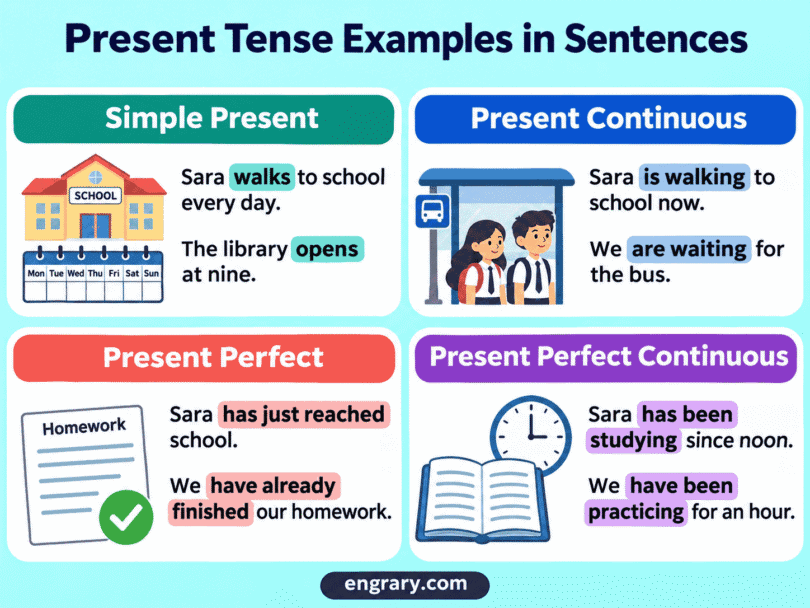
At a school bus stop, one person might describe the usual route, another might point out the bus coming around the corner, and a third might tell a latecomer that it has already left. All three speakers use a present tense form. What changes is the information each person wants to share.
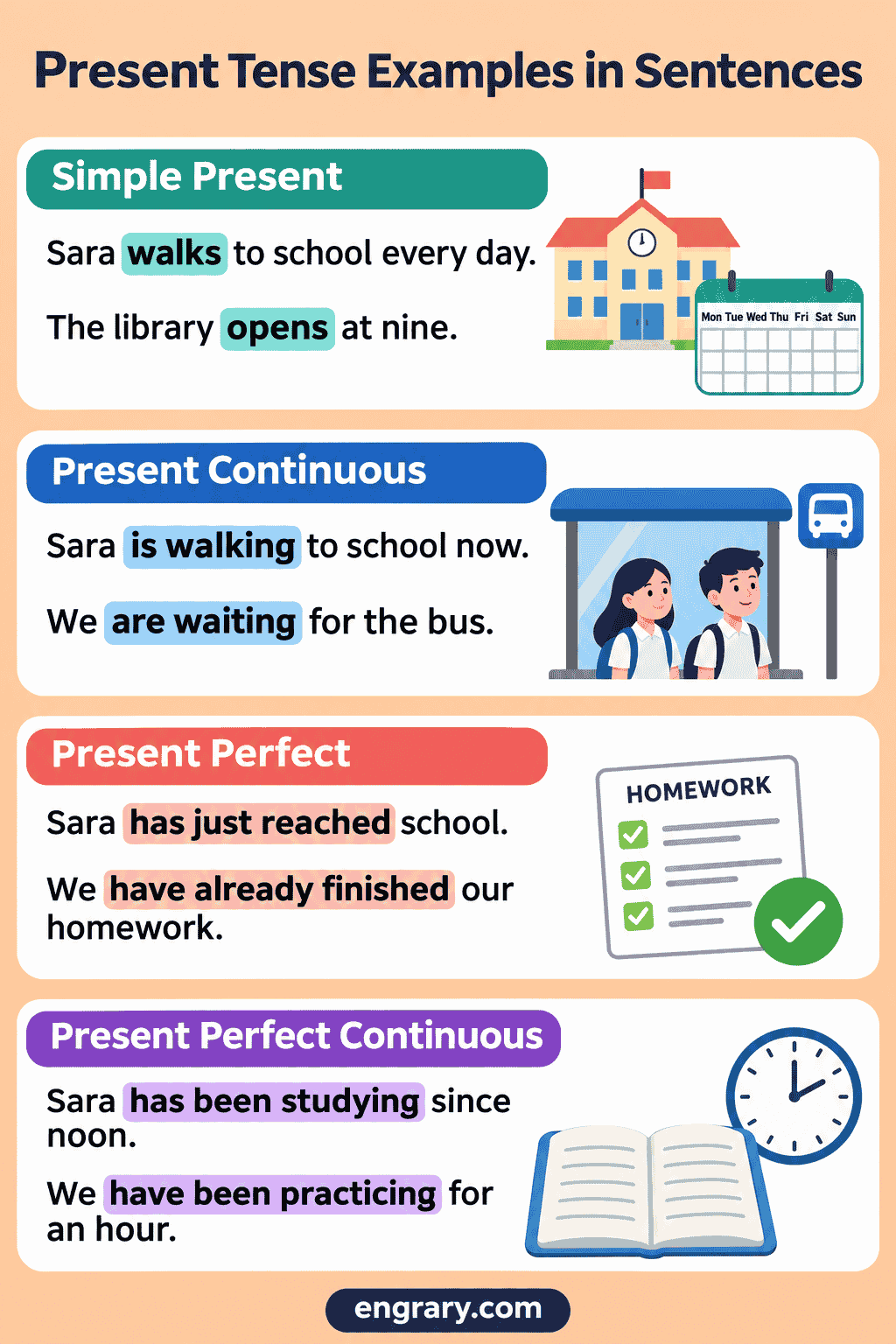
These 100 present tense examples cover the simple present, present continuous, present perfect, and present perfect continuous. Each form has its own section with affirmative sentences, negative sentences, and questions. Follow the bold verbs to see how to build a sentence of your own.
Everyday Present Tense Examples Across the Four Forms
Start with four things you might hear at the bus stop. Notice how every morning, already, and since seven help you understand what the speaker means.
| No. | Present tense form | Example sentence | What it tells you |
|---|---|---|---|
| 1 | Simple present | The school bus stops outside our gate every morning. | Where it usually stops |
| 2 | Present continuous | The school bus is coming around the corner. | What the speaker can see now |
| 3 | Present perfect | The school bus has already left. | Why the bus is no longer there |
| 4 | Present perfect continuous | We have been waiting for the school bus since seven. | How long the wait has lasted |
guide.png
Simple Present Tense Examples for Habits, Facts, and Schedules
Use the simple present to say what usually happens, what someone thinks or likes, or when a scheduled event takes place. With he, she, or a singular noun, most verbs take -s or -es. In negatives and questions with does, the main verb returns to its base form.
Affirmative Sentences
- I take the bus to school on weekdays.
- My brother packs his lunch the night before.
- Our science teacher keeps a bowl of shells on her desk.
- The bakery opens at seven each morning.
- We share a table by the window at lunch.
- Lemons taste sour.
- My grandparents live above their bookshop.
- This key fits the side gate.
- Hina prefers tea without sugar.
- The last train leaves at eight tomorrow.
- My cousins play badminton on Friday evenings.
- The tickets are in the top drawer.
Negative Sentences
- I don’t drink coffee after dinner.
- This lift doesn’t stop on the first floor.
- Our neighbors don’t own a car.
- Hamza doesn’t wear glasses.
- The museum isn’t open on Mondays.
- These shoes don’t fit me anymore.
Questions
- Do you walk home after school?
- Does your sister speak Urdu?
- Is the shop open on Sundays?
- What time does the library close?
- Where do you keep the spare key?
- Which bus goes to the railway station?
In sentence 28, which bus is the subject. That is why the question uses goes directly. In sentence 26, the library is the subject, so the question uses does with close.
Present Continuous Tense Examples for Actions and Arrangements
Use the present continuous for something happening now, a temporary situation, a gradual change, or a future arrangement. Choose am, is, or are to match the subject, then add the -ing form.
Affirmative Sentences
- I am cycling to school this week.
- The kettle is boiling.
- Maya is holding the ladder for her dad.
- We are using the art room while our classroom dries.
- The days are getting shorter.
- I am meeting Hina at the station at seven tomorrow.
- The children are drawing a map of their neighborhood.
- My phone is charging beside the sofa.
- You are standing on my shoelace.
- Our neighbors are moving into their new flat on Saturday.
- I am looking for the lid that fits this jar.
- The soup is cooling on the counter.
Negative Sentences
- I am not wearing my new shoes today.
- The printer isn’t working this morning.
- We aren’t staying overnight.
- The baby isn’t sleeping anymore.
- You aren’t interrupting me.
- The buses aren’t running along this road today.
Questions
- Are you listening to the announcement?
- Is Ali bringing his camera tomorrow?
- Are we waiting at the right entrance?
- What are you cooking for dinner?
- Why is the dog barking at that empty box?
- Who is leading the school choir this term?
Present Perfect Tense Examples for Results and Experience
Use the present perfect to report a result, count experiences, or describe a state that continues into the present. The pattern is have or has followed by a past participle, such as packed, written, seen, or taken.
Affirmative Sentences
- Mina has packed six boxes so far.
- I have written the address on the envelope.
- We have visited the science museum twice.
- My aunt has owned this shop since 2018.
- Someone has taken my seat.
- The team has won three matches this season.
- I have known our neighbor since childhood.
- The rain has stopped, so we can eat outside.
- You have left your notebook on the kitchen table.
- Both guests have arrived.
- My sister has just found her missing earring.
- We have saved enough money for the trip.
Negative Sentences
- I haven’t received the new timetable yet.
- Omar hasn’t tried sushi before.
- We haven’t chosen a name for the kitten.
- The price hasn’t changed since last month.
- My parents haven’t seen the photos yet.
- I haven’t finished the last chapter.
Questions
- Has your parcel arrived yet?
- Have you ever ridden a horse?
- Has anyone seen my blue scarf?
- How many pages have you read so far?
- Where have you put the scissors?
- How long have you known your best friend?
Sentence 76 shows why how long can go with the present perfect simple. Knowing someone is a continuing state, so have known is the natural choice.
Present Perfect Continuous Tense Examples for Duration and Recent Activity
Choose the present perfect continuous when you want to emphasize time spent on an activity, repeated effort, or the cause of something you can see now. Use have or has, then been and the -ing form.
Affirmative Sentences
- Mina has been packing all morning.
- I have been using my aunt’s camera since breakfast.
- We have been practicing the same song after school all week.
- It has been raining since midnight.
- My hands are green because I have been painting the gate.
- The twins have been taking turns reading to their little brother.
- You have been humming that tune all day.
- Our teacher has been collecting postcards for years.
- I have been looking everywhere for this receipt.
- The builders have been repairing the footbridge since Monday.
- We have been trying a different recipe each weekend.
- My eyes feel tired because I have been staring at this screen for hours.
Negative Sentences
- I haven’t been sleeping well this week.
- The tap hasn’t been leaking since the repair.
- We haven’t been using the front entrance lately.
- Nadia hasn’t been cycling to work during the road repairs.
- The players haven’t been training outdoors in this heat.
- I haven’t been waiting long, so take your time.
Questions
- Have you been working on the puzzle without me?
- Has the baby been waking up early lately?
- Have they been sending updates all week?
- How long have you been learning the guitar?
- What has Sara been growing on her balcony?
- Why has the smoke alarm been beeping every few minutes?
Present Tense Sentence Comparisons
Sometimes two forms fit the same situation. The choice depends on which detail you want the listener to notice.
| Numbered examples | Sentences to compare | Difference in meaning |
|---|---|---|
| 5 and 29 | “I take the bus to school on weekdays.” / “I am cycling to school this week.” | The first gives the usual routine. The second explains this week’s change. |
| 53 and 77 | “Mina has packed six boxes so far.” / “Mina has been packing all morning.” | The first counts finished boxes. The second tells us how Mina spent the morning, leaving the number of boxes open. |
| 14 and 34 | “The last train leaves at eight tomorrow.” / “I am meeting Hina at the station at seven tomorrow.” | Both refer to tomorrow. The train follows a timetable, while the meeting is a personal arrangement. |
| 76 and 98 | “How long have you known your best friend?” / “How long have you been learning the guitar?” | Both ask about duration. The first concerns a relationship, while the second concerns an activity. |
FAQs About Present Tense Sentences
Look at the whole verb phrase. In the opening table, stops shows the simple present, is coming shows the present continuous, has left shows the present perfect, and have been waiting shows the present perfect continuous. In questions, look on both sides of the subject to find the complete phrase.
For most verbs, put do or does before the subject and use the base form of the main verb. Sentence 24 shows the pattern Does your sister speak …? With be, move the verb itself before the subject, as in sentence 25: Is the shop open …?
Yes. Sentence 14 uses leaves for tomorrow’s scheduled train. Sentence 34 uses am meeting for a personal arrangement. In both cases, tomorrow makes the future meaning clear.
Look at the words that follow. In she’s packing, she’s means she is. In she’s packed six boxes, it means she has. Likewise, she’s been packing expands to she has been packing.
No. In sentence 4, the speakers are still at the stop waiting for the bus. In sentence 81, the speaker’s green hands are evidence of recent painting. The speaker could have put the brush down before showing someone the paint.
You May Also Like



Leave a Comment