
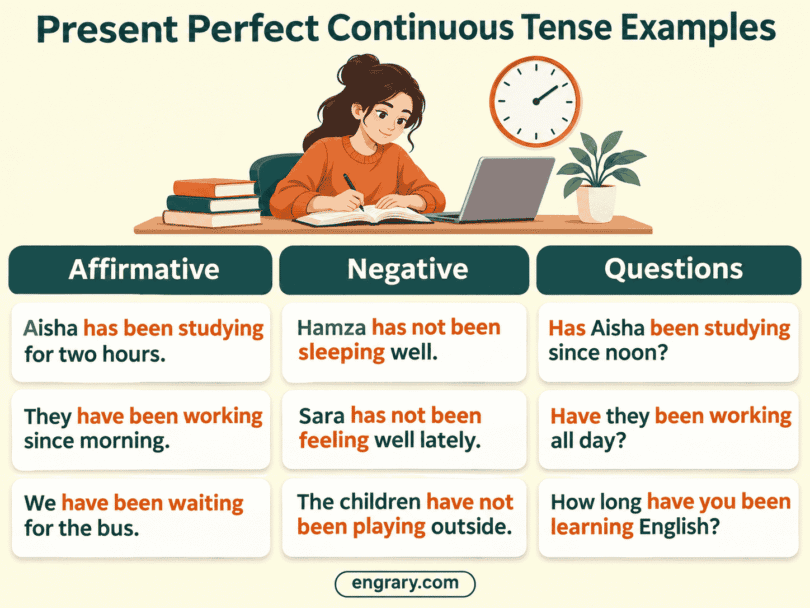
The present perfect continuous tense describes an activity that began in the past and continues now or stopped recently with a result that matters in the present. It follows the structure subject + have/has been + verb-ing, as in They have been studying since morning. Although this tense often emphasizes duration, it can also describe repeated actions, temporary situations, developing trends, and recent activities with visible evidence.
Below, you will find 145 present perfect continuous tense examples arranged by sentence type and meaning. The examples include affirmative and negative statements, yes/no questions, Wh-questions, expressions with for and since, continuing activities, recently stopped actions, and advanced everyday uses.
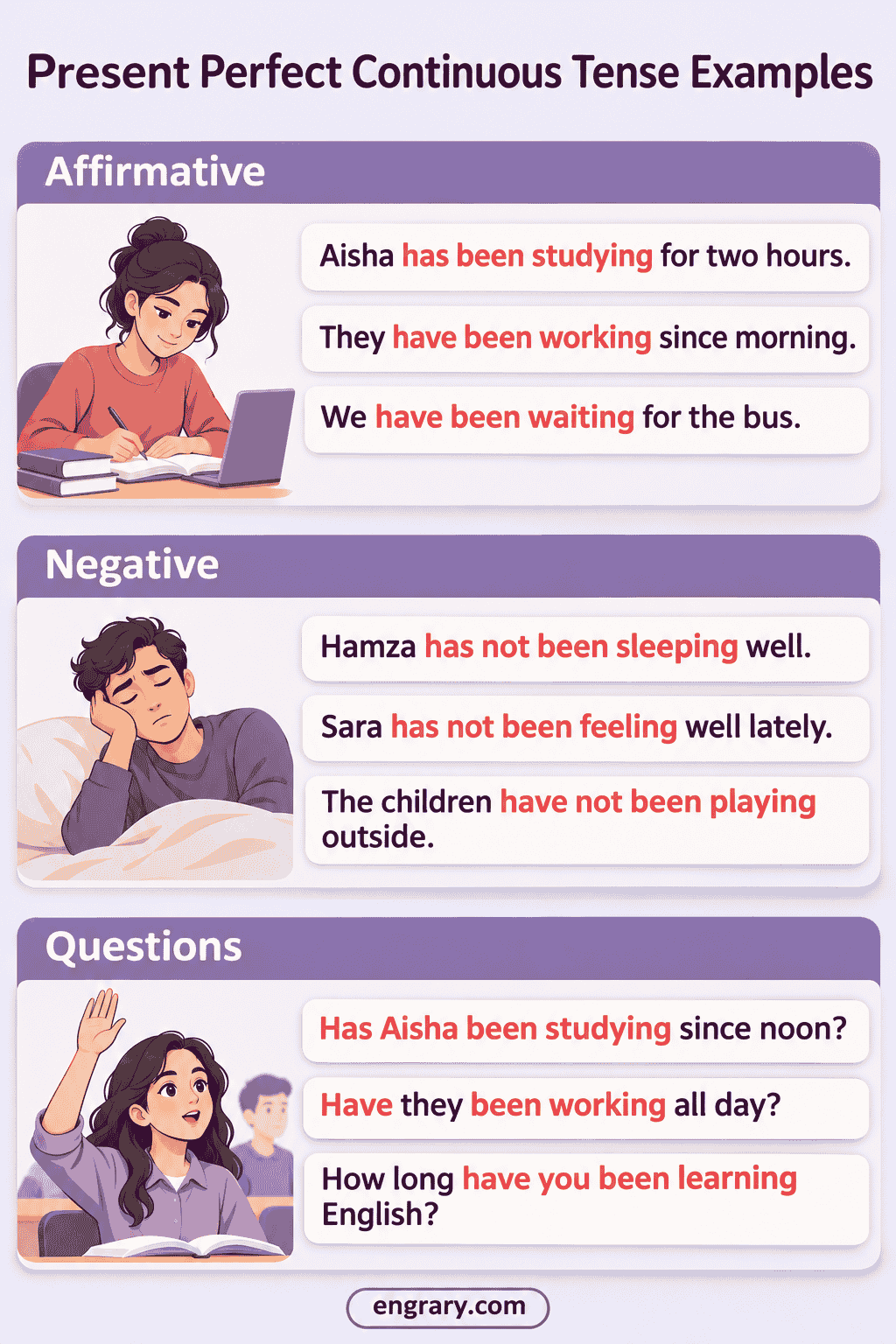
Present Perfect Continuous Examples at a Glance
The present perfect continuous connects an earlier activity with the present. In affirmative sentences, use have been with I, you, we, and they. However, use has been with he, she, it, and singular nouns.
| Sentence type | Structure | Example |
|---|---|---|
| Affirmative | Subject + have/has been + verb-ing | They have been preparing dinner. |
| Negative | Subject + have/has not been + verb-ing | They have not been preparing dinner. |
| Yes/no question | Have/Has + subject + been + verb-ing? | Have they been preparing dinner? |
| Wh-question | Wh-word + have/has + subject + been + verb-ing? | What have they been preparing? |
The tense has two central meanings:
- Continuing activity: I have been reading for an hour. The activity started earlier and continues now.
- Recently stopped activity: Your eyes are red because you have been crying. The activity may have stopped, but its present evidence remains.
Structure of Present Perfect Continuous Sentences
A present perfect continuous construction contains four essential parts:
- Subject: the person or thing performing the activity
- Have or has: the present-tense auxiliary
- Been: the past participle of be
- Verb-ing: the present participle of the main verb
Affirmative Sentences
Structure: Subject + have/has been + verb-ing + remaining information.
- I have been learning Spanish.
- Farah has been working since eight o’clock.
In conversation, contractions sound more natural: I’ve been learning and Farah’s been working.
Negative Sentences
Structure: Subject + have/has + not + been + verb-ing + remaining information.
- We have not been sleeping well.
- He has not been attending class.
The contracted forms are haven’t been and hasn’t been.
Yes/No Questions
Structure: Have/Has + subject + been + verb-ing + remaining information?
- Have you been waiting long?
- Has the baby been sleeping?
Move have or has before the subject. Keep been after the subject.
Wh-Questions
Structure: Wh-word + have/has + subject + been + verb-ing + remaining information?
- What have you been reading?
- Why has he been avoiding us?
- How long have they been living here?
When the question word itself is the subject, do not add another subject: Who has been using my laptop?
Contractions and Short Answers
| Full form | Contraction | Example |
|---|---|---|
| I have been | I’ve been | I’ve been practicing. |
| You have been | You’ve been | You’ve been improving. |
| She has been | She’s been | She’s been studying. |
| We have not been | We haven’t been | We haven’t been waiting. |
| He has not been | He hasn’t been | He hasn’t been listening. |
In she’s been working, she’s means she has. By contrast, she’s working means she is working. Short answers repeat only have or has: Yes, I have and No, she hasn’t.
145 Present Perfect Continuous Tense Examples
The following sentences move from common patterns to more detailed uses. Each numbered item contains a present perfect continuous construction and maintains a clear connection to the present.
Common Present Perfect Continuous Examples
- I have been studying for two hours.
- She has been working from home this week.
- They have been waiting outside since noon.
- It has been raining all morning.
- We have been learning English together.
- He has been cooking dinner for the family.
- You have been using my pen.
- The children have been playing in the garden.
- My brother has been reading that novel lately.
- I have been exercising regularly this month.
- Sara has been practicing the piano since breakfast.
- Our neighbors have been renovating their house.
Affirmative Present Perfect Continuous Sentences
- I have been organizing my notes for tomorrow’s class.
- You have been making excellent progress in mathematics.
- Ahmed has been repairing his bicycle in the garage.
- Hina has been preparing for her final examination.
- The dog has been barking at passing cars.
- We have been discussing the new project since Monday.
- They have been saving money for a family holiday.
- My parents have been growing vegetables in the backyard.
- The company has been developing a new mobile application.
- Scientists have been studying the effects of air pollution.
- I’ve been looking for my glasses everywhere.
- She’s been teaching at this school for six years.
- We’ve been following the instructions carefully.
- The mechanic has been checking the engine for faults.
- Local volunteers have been collecting food for families in need.
- Prices have been rising steadily over the past few months.
Negative Present Perfect Continuous Sentences
- I have not been feeling well lately.
- She has not been sleeping enough this week.
- We have not been receiving your messages.
- He has not been taking his medicine regularly.
- They have not been following the safety rules.
- The printer has not been working properly since yesterday.
- You haven’t been answering my questions.
- Bilal hasn’t been attending the morning meetings.
- The students haven’t been submitting their assignments on time.
- My phone hasn’t been charging correctly.
- I haven’t been spending much time outdoors.
- The team hasn’t been performing well this season.
- Our neighbors have not been making noise recently.
- The bus service has not been running on schedule this week.
Yes/No Questions in the Present Perfect Continuous
- Have you been waiting for me?
- Has she been studying all evening?
- Have they been living here for long?
- Has it been raining in your area?
- Have we been following the correct route?
- Has your brother been looking for a job?
- Have the children been watching television?
- Has the machine been making that noise all day?
- Have you been practicing your pronunciation?
- Has the teacher been explaining this topic clearly?
Wh-Questions and How-Long Questions
- What have you been doing since lunch?
- Where has Sana been working lately?
- Why have they been arguing?
- How has your father been feeling recently?
- Who has been using my computer?
- What has been causing the delay?
- How long have you been learning English?
- How long has he been waiting at the station?
- Which book have the students been discussing?
- Why hasn’t the baby been sleeping well?
- Who has been calling you every evening?
- How long have the engineers been testing the system?
Present Perfect Continuous Examples with For and Since
- I have been working on this report for three hours.
- She has been learning to drive for six months.
- We have been standing in this line for forty minutes.
- The farmers have been waiting for rain for several weeks.
- My cousin has been staying with us for a few days.
- The children have been practicing their play for a month.
- He has been wearing glasses for most of his life.
- I have been thinking about your suggestion for some time.
- They have been running this shop since 2018.
- Nadia has been studying since early morning.
- We have been using this software since January.
- The baby has been crying since you left.
- I have been working remotely since the office closed.
- She has been sleeping better since she changed her routine.
- They have been saving more money since they moved closer to work.
- The river has been rising since the heavy rain began.
Examples of Continuing Activities
- I have been writing an email, and I still need a few more minutes.
- She has been cleaning the kitchen, but she has not finished yet.
- We have been walking along the trail since sunrise.
- The technicians have been installing the equipment all afternoon.
- He has been painting the bedroom, and one wall remains unfinished.
- The researchers have been analyzing the data throughout the week.
- You have been talking for nearly an hour.
- Our teacher has been reviewing the final chapter with us.
- The construction crew has been widening the road this month.
- I have been watching the lecture, and I am only halfway through it.
- The nurse has been monitoring the patient since midnight.
- We have been searching for a solution, but the problem remains.
Examples of Recently Stopped Activities
- I am out of breath because I have been running.
- Her hands are covered in flour because she has been baking.
- The ground is wet because it has been raining.
- Your eyes are red; have you been crying?
- The children’s clothes are muddy because they have been playing outside.
- He looks tired because he has been working all night.
- The kitchen smells wonderful because my mother has been cooking.
- There is paint on your sleeve because you have been decorating.
- My hair is wet because I have been swimming.
- The room is warm because we have been exercising here.
- Her voice is weak because she has been speaking for hours.
- The roads are slippery because snow has been falling.
Repeated and Temporary Activity Examples
- I have been visiting the gym three times a week.
- She has been calling her grandmother every evening.
- They have been meeting online twice a month.
- Our teacher has been giving us short quizzes every Friday.
- The alarm has been going off at random times.
- We have been staying with relatives while our house is repaired.
- He has been working the night shift this month.
- I have been taking the bus while my car is at the workshop.
- The café has been serving breakfast on weekends this summer.
- My classmates have been sharing study notes in our group.
- The internet connection has been dropping several times a day.
- She has been helping at the clinic during her semester break.
Examples of Trends, Changes, and Complaints
- The weather has been getting warmer each year.
- Online sales have been increasing steadily.
- The city has been expanding toward the north.
- Her confidence has been growing since she joined the course.
- The days have been getting shorter as winter approaches.
- Our electricity bills have been rising recently.
- You have been constantly interrupting me.
- He has been leaving his dirty dishes in the sink again.
- The neighbors have been playing loud music every night.
- My computer has been freezing more frequently lately.
Advanced Present Perfect Continuous Examples
- The university has been revising its admission policy to make the process more accessible.
- Environmental groups have been urging the government to protect the wetlands.
- Our design team has been gathering customer feedback before releasing the next version.
- Doctors have been encouraging patients to adopt healthier daily habits.
- The museum has been digitizing its historical records for public access.
- I have been reconsidering my career goals since completing the internship.
- Several departments have been cooperating to reduce unnecessary expenses.
- The community has been working together to restore the public park.
- Researchers have been examining how screen time affects sleep quality.
- The manufacturer has been improving its packaging to reduce plastic waste.
- We have been adapting our plans as new information becomes available.
- Local businesses have been supporting the campaign through donations and volunteer work.
- The committee has been consulting residents before making a final recommendation.
- Teachers have been experimenting with new ways to keep online lessons engaging.
- I have been trying to understand why the same error keeps appearing.
- The organization has been providing emergency supplies wherever flooding has displaced families.
- Engineers have been investigating whether extreme heat caused the equipment failure.
- Public attitudes toward remote work have been changing over the past few years.
- The two teams have been negotiating a solution that addresses both sides’ concerns.
Present Perfect Continuous Questions with Short Answers
Short answers use have or has. They do not repeat been or the main verb.
| Question | Affirmative answer | Negative answer |
|---|---|---|
| Have you been studying? | Yes, I have. | No, I haven’t. |
| Has she been working today? | Yes, she has. | No, she hasn’t. |
| Have they been waiting long? | Yes, they have. | No, they haven’t. |
| Has it been raining? | Yes, it has. | No, it hasn’t. |
Negative questions can express surprise, concern, or an expectation:
- Haven’t you been sleeping well?
- Hasn’t Hamza been attending the meetings?
- Why haven’t they been answering their phones?
Subject questions follow a simpler order because the question word functions as the subject:
- Who has been using my desk?
- What has been making that sound?
- Who has been sending these messages?
Ongoing and Recently Stopped Activity Examples
Both uses connect an earlier activity with the present. However, context reveals whether the action continues.
| Meaning | Example | Present connection |
|---|---|---|
| Continuing activity | We have been painting the bedroom since noon. | The painting remains in progress. |
| Recently stopped activity | You have paint on your shirt because you have been painting. | The painting stopped, but evidence remains. |
| Continuing activity | She has been reading for an hour. | She is still reading. |
| Recently stopped activity | Her eyes are tired because she has been reading. | She may have stopped reading. |
Short exchanges make the second meaning especially clear:
- “Why are your shoes muddy?” “I have been walking in the fields.”
- “Why is the kitchen so warm?” “Mariam has been baking.”
- “Why are you out of breath?” “I have been running.”
For, Since, and How Long in Present Perfect Continuous Sentences
Use for with a period of time and since with a starting point. Meanwhile, use how long to ask about duration.
| Expression | Function | Example |
|---|---|---|
| for | Introduces a duration | We have been waiting for thirty minutes. |
| since | Introduces a starting point | We have been waiting since noon. |
| since + clause | Introduces an event that marks the starting point | We have been waiting since the office opened. |
| how long | Asks about duration | How long have you been waiting? |
The tense does not require for or since. Other expressions can show duration or a period leading to the present:
- We have been waiting all morning.
- She has been studying throughout the week.
- Prices have been increasing over the past few months.
- I have been receiving unusual calls recently.
Furthermore, an activity can repeat during the stated period rather than continue without interruption. I have been visiting the gym for six months usually means that the speaker has visited regularly, not that the person has remained inside the gym for six months.
Time Expressions and Adverb Placement
Common expressions include recently, lately, all day, all week, this month, over the past few days, and since then. Their position depends on meaning and emphasis.
| Expression | Natural example |
|---|---|
| recently | We have been working from home recently. |
| lately | She has been feeling tired lately. |
| all day | It has been raining all day. |
| this month | He has been traveling frequently this month. |
| constantly | They have been constantly changing the schedule. |
| still | Have you still been experiencing problems? |
| just | It has just been raining, so the pavement is wet. |
Recently and lately commonly appear at the end of a sentence. In contrast, frequency adverbs such as constantly usually appear between been and the main verb. Speakers may move an adverb when they want to change the emphasis.
Repeated Activities, Rates, and Completed Results
The present perfect continuous emphasizes an activity, its duration, or its repetition. In contrast, the present perfect simple often emphasizes a completed result, number, or quantity.
| Activity or duration | Completed result |
|---|---|
| She has been writing emails all morning. | She has written twelve emails. |
| We have been painting the rooms. | We have painted three rooms. |
| He has been reading the report. | He has read the entire report. |
| They have been repairing bicycles today. | They have repaired six bicycles today. |
Therefore, use the simple form when the completed total matters. Use the continuous form when the process, duration, or repeated effort matters more.
Stative and Dynamic Verb Examples
Stative verbs describe possession, knowledge, belief, preference, or another condition rather than an activity. Consequently, they do not normally take a continuous form.
| Unnatural or incorrect | Natural correction |
|---|---|
| I have been knowing her for years. | I have known her for years. |
| He has been owning this shop since 2015. | He has owned this shop since 2015. |
| We have been believing that story. | We have believed that story. |
| She has been wanting a new laptop for months. | She has wanted a new laptop for months. |
However, some verbs become dynamic when their meanings change:
| Stative or result-focused meaning | Dynamic activity |
|---|---|
| I have had this car for years. | I have been having trouble with the engine. |
| I have thought carefully about the issue. | I have been thinking about the issue. |
| The soup has tasted strange today. | The chef has been tasting the soup. |
The expression I’ve been wanting to ask you something is also common in informal English, although want usually functions as a stative verb.
Present Perfect and Present Perfect Continuous Examples
| Present perfect simple | Present perfect continuous | Main contrast |
|---|---|---|
| She has written the report. | She has been writing the report. | Completed result versus ongoing activity |
| I have read three chapters. | I have been reading for two hours. | Quantity versus duration |
| They have lived here for ten years. | They have been living here for ten years. | Stable fact versus emphasis on continuing experience |
| He has called five times. | He has been calling all morning. | Completed number versus repeated activity |
Sometimes both forms are correct. Nevertheless, the speaker’s focus changes: the simple form highlights a result or fact, while the continuous form highlights an activity, duration, repetition, or temporary quality.
Present Continuous and Present Perfect Continuous Examples
| Present continuous | Present perfect continuous | Main contrast |
|---|---|---|
| She is studying now. | She has been studying since noon. | Current action versus activity continuing from the past |
| We are staying with relatives. | We have been staying with relatives this month. | Temporary present situation versus its duration |
| It is raining. | It has been raining all morning. | Current weather versus weather over a period |
The present continuous focuses on what is happening around now. The present perfect continuous, however, looks backward from the present and emphasizes the preceding period.
Simple Past and Present Perfect Continuous Examples
| Simple past | Present perfect continuous | Main contrast |
|---|---|---|
| She worked there last year. | She has been working there since last year. | Finished past employment versus employment continuing now |
| It rained yesterday. | It has been raining since yesterday. | Finished event versus activity extending to the present |
| We waited for an hour and then left. | We have been waiting for an hour. | Completed wait versus a wait that continues now |
Do not use a finished-time expression to define the complete period of a present perfect continuous activity.
- Incorrect: She has been working here last year.
- Correct: She worked here last year.
- Correct: She has been working here since last year.
Present Participle Spelling Examples
| Base verb | Present participle | Spelling rule |
|---|---|---|
| work | working | Add -ing. |
| write | writing | Remove the final silent e. |
| run | running | Double the final consonant. |
| lie | lying | Change ie to y. |
| panic | panicking | Add k before -ing. |
| travel | travelling/traveling | British English often doubles l; American English usually does not. |
Rare Passive Forms and Natural Alternatives
The passive present perfect continuous is grammatically possible, but it often sounds heavy and unnatural.
| Awkward passive form | Natural alternative |
|---|---|
| The road has been being repaired. | Workers have been repairing the road. |
| The system has been being tested. | Engineers have been testing the system. |
| The building has been being renovated. | The building has been under renovation. |
Whenever possible, use an active subject or choose a more natural construction.
Common Mistakes in Present Perfect Continuous Sentences
| Mistake | Incorrect sentence | Correct sentence |
|---|---|---|
| Omitting been | She has working all day. | She has been working all day. |
| Using the wrong auxiliary | He have been studying. | He has been studying. |
| Using a past participle | They have been worked outside. | They have been working outside. |
| Confusing been and being | I have being waiting. | I have been waiting. |
| Incorrect negative order | She has been not sleeping well. | She has not been sleeping well. |
| Incorrect question order | You have been waiting long? | Have you been waiting long? |
| Confusing for and since | We have been waiting since two hours. | We have been waiting for two hours. |
| Using a stative verb unnaturally | I have been knowing him since school. | I have known him since school. |
| Using a finished past period | We have been traveling last week. | We traveled last week. |
| Using the continuous for a total | She has been completing five tasks. | She has completed five tasks. |
| Incorrect participle spelling | He has been runing daily. | He has been running daily. |
Also remember that how long does not automatically require the continuous form. Use the present perfect simple with stative verbs: How long have you known her?—not How long have you been knowing her?
Quick Reference for Present Perfect Continuous Examples
| Feature | Rule or example |
|---|---|
| Basic form | Subject + have/has been + verb-ing |
| Negative | Subject + have/has not been + verb-ing |
| Question | Have/Has + subject + been + verb-ing? |
| Main meaning 1 | An activity began earlier and continues now. |
| Main meaning 2 | An activity stopped recently but has a present result. |
| Other uses | Repetition, temporary situations, trends, and complaints |
| Common expressions | for, since, how long, lately, recently, all day |
| Short answers | Yes, I have. No, she hasn’t. |
| Main restriction | Avoid most stative verbs and completed past periods. |
FAQs
Examples include I have been studying for two hours, She has been working since Monday, It has been raining all morning, and They have been calling us repeatedly. Each sentence uses have or has, followed by been and a verb ending in -ing.
No. A sentence can use another time expression, such as all day, lately, or this week. It may also omit a time expression when the context shows a recent activity or present result, as in Your hands are dirty because you have been gardening.
For introduces a duration, such as for three hours. In contrast, since introduces a starting point, such as since noon or since the lesson began. Therefore, say I have been waiting for an hour but I have been waiting since ten o’clock.
Yes, when the activity stopped recently and still has a visible or relevant present result. For example, She is tired because she has been running suggests that the running may have stopped, but its effect remains. The tense does not state whether the activity finished completely, so context supplies that information.
The present perfect often emphasizes a completed result, achievement, or quantity, as in He has written five pages. However, the present perfect continuous emphasizes the activity or its duration, as in He has been writing for two hours. In some situations, both forms are possible, but they present the situation from different perspectives.
You May Also Like

Leave a Comment