
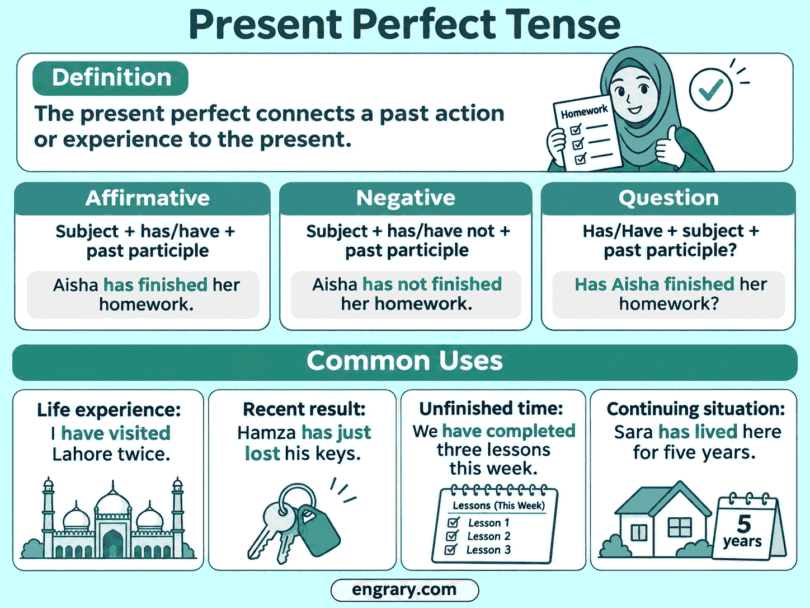
The present perfect tense connects an earlier action, event, experience, or state with the present. It can show a result that matters now, describe an experience at an unspecified time, or express a situation that began in the past and continues today. For example, Mina has lost her keys tells us not only that the loss happened earlier but also that she does not have her keys now.
English forms the present perfect with have or has followed by a past participle. Although the basic structure is simple, choosing this tense requires attention to time, context, and the speaker’s viewpoint. This guide explains its forms, uses, time expressions, comparisons, and common mistakes through clear tables and natural examples.
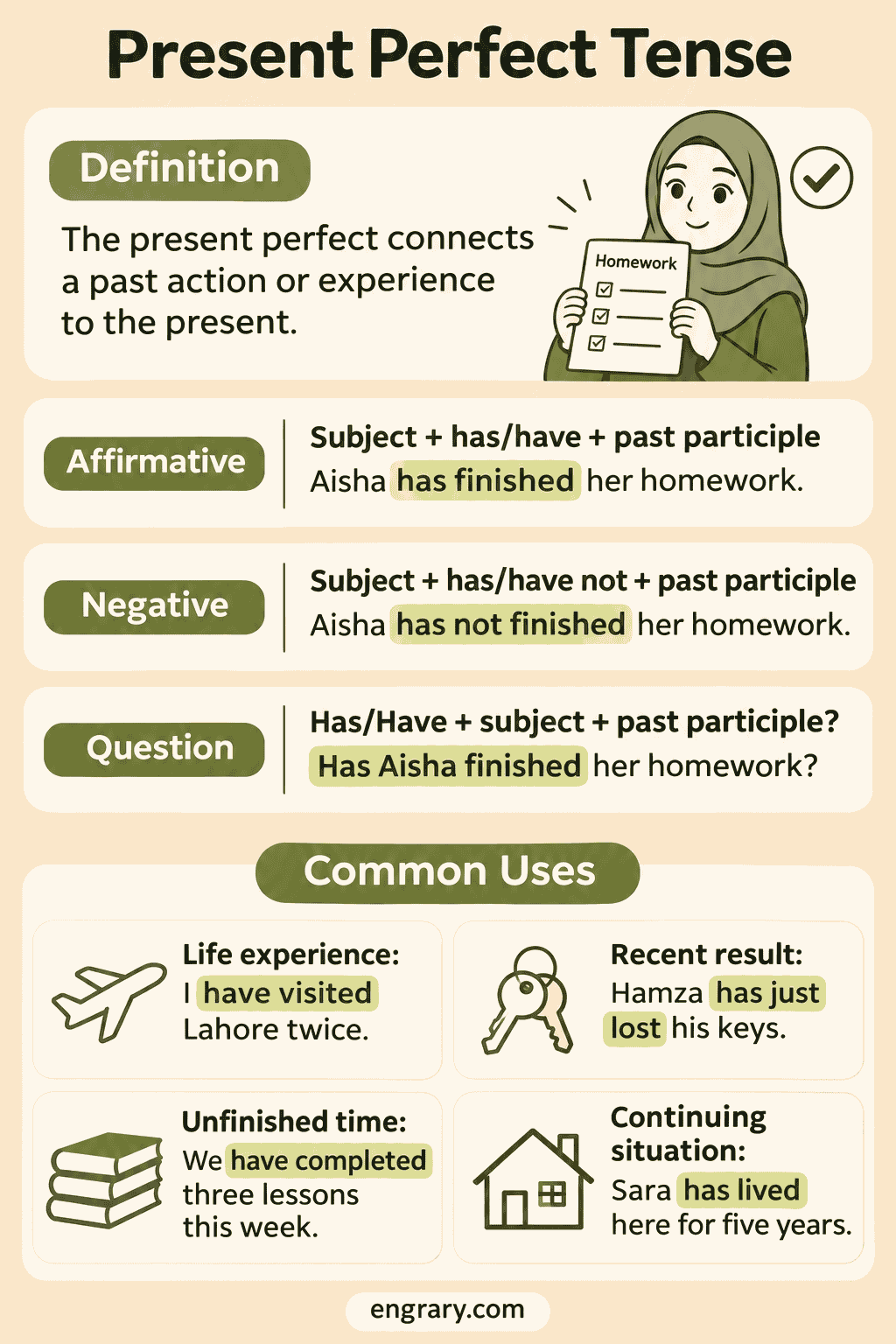
Present Perfect Tense at a Glance
The present perfect looks back from the present to an earlier time. Therefore, the exact past time is often unstated or unimportant. What matters is the experience, result, duration, or development up to now.
| Point | Explanation |
|---|---|
| Basic structure | Subject + have/has + past participle |
| Affirmative example | She has completed the report. |
| Negative example | She has not completed the report. |
| Question example | Has she completed the report? |
| Main time reference | A period leading from the past to the present |
| Common uses | Results, experiences, continuing states, recent events, and repeated actions |
| Common expressions | for, since, just, already, yet, ever, never, and so far |
The present perfect does not merely report that something happened in the past. Instead, it presents that event as relevant to the current situation.
| Simple past | Present perfect |
|---|---|
| I lost my keys yesterday. | I have lost my keys. |
| The sentence places the loss at a finished past time. | The sentence emphasizes the present result: I do not have the keys now. |
Structure of the Present Perfect Tense
The auxiliary verb changes according to the subject, while the past participle remains the same. Use have with I, you, we, and they. However, use has with he, she, it, and singular nouns.
| Sentence type | Structure | Example |
|---|---|---|
| Affirmative | Subject + have/has + past participle | They have arrived. |
| Negative | Subject + have/has + not + past participle | They have not arrived. |
| Yes-or-no question | Have/Has + subject + past participle? | Have they arrived? |
| Wh-question | Wh-word + have/has + subject + past participle? | Where have they gone? |
| Negative question | Haven’t/Hasn’t + subject + past participle? | Haven’t they arrived? |
Affirmative Form
In affirmative sentences, place have or has after the subject and before the past participle.
- I have finished my assignment.
- You have made excellent progress.
- Bilal has found his wallet.
- The weather has become warmer.
- Our neighbors have moved to a new apartment.
In conversation and informal writing, full forms commonly become contractions:
| Full form | Contraction | Example |
|---|---|---|
| I have | I’ve | I’ve read the message. |
| You have | You’ve | You’ve helped us greatly. |
| He has | He’s | He’s completed the course. |
| She has | She’s | She’s written three articles. |
| We have | We’ve | We’ve met before. |
| They have | They’ve | They’ve sold their house. |
Negative Form
To form a negative sentence, add not after have or has. The contractions are haven’t and hasn’t.
- I have not seen that film.
- She hasn’t answered my email.
- We haven’t decided yet.
- The bus has not arrived.
- They haven’t completed the repairs.
Yes-or-No Questions
For a yes-or-no question, move have or has before the subject.
- Have you finished your lunch?
- Has Hamza called you?
- Have the children gone to sleep?
- Has the package arrived?
Short answers repeat the auxiliary rather than the main verb.
| Question | Affirmative answer | Negative answer |
|---|---|---|
| Have you finished? | Yes, I have. | No, I haven’t. |
| Has she arrived? | Yes, she has. | No, she hasn’t. |
| Have they left? | Yes, they have. | No, they haven’t. |
Wh-Questions
Wh-questions begin with a question word, followed by have or has, the subject, and the past participle.
- Where have you put my glasses?
- Why has the screen stopped working?
- What have they decided?
- How many books has she written?
- Who has taken the last chair?
When who is the subject, it comes directly before has and the participle, as in Who has called?
Negative Questions
Negative questions can communicate surprise, concern, or an expectation that something should already have happened.
- Haven’t you finished yet?
- Hasn’t Ayesha arrived?
- Why haven’t they replied?
- Haven’t we met before?
Contractions with ’s
The contraction ’s can mean has or is. The following verb form usually reveals its meaning.
| Sentence | Full form | Explanation |
|---|---|---|
| She’s finished her work. | She has finished her work. | Finished is a past participle. |
| She’s working now. | She is working now. | Working is an -ing form. |
| He’s been very patient. | He has been very patient. | Been is the past participle of be. |
| He’s tired. | He is tired. | An adjective follows is. |
Past Participles in the Present Perfect
Every present perfect construction contains a past participle. Regular verbs usually add -ed, although spelling changes may occur. In contrast, irregular verbs use forms that learners need to recognize and remember.
Regular Past Participles
| Pattern | Base form | Past participle | Example |
|---|---|---|---|
| Add -ed | work | worked | We have worked all day. |
| Add -d after e | live | lived | She has lived here since 2022. |
| Change consonant + y to -ied | study | studied | He has studied French. |
| Double the final consonant | stop | stopped | The rain has stopped. |
Irregular Past Participles
| Base form | Simple past | Past participle | Present perfect example |
|---|---|---|---|
| be | was/were | been | I have been busy. |
| go | went | gone | She has gone home. |
| do | did | done | They have done the work. |
| see | saw | seen | We have seen that show. |
| write | wrote | written | He has written a letter. |
| eat | ate | eaten | The children have eaten. |
| take | took | taken | Someone has taken my seat. |
| speak | spoke | spoken | I have spoken to the manager. |
| know | knew | known | We have known her for years. |
| break | broke | broken | The branch has broken. |
Do not use the simple-past form after have or has. For example, write has gone, not has went, and have written, not have wrote.
Uses of the Present Perfect Tense
The present perfect covers several related meanings. In every case, the speaker views the situation from the present rather than placing it entirely inside a finished past period.
Past Actions with Present Results
Use the present perfect when an earlier event has a visible or important consequence now.
- Sara has lost her phone, so she cannot call us.
- The rain has flooded the road, so traffic cannot pass.
- I have forgotten my password, and I cannot sign in.
- Someone has broken the window.
- The baby has fallen asleep, so please speak quietly.
The focus rests on the current result. If the speaker later gives a specific past time, the simple past normally follows: Someone has broken the window. A ball hit it during yesterday’s match.
Life Experiences
Use the tense for experiences at an unspecified time in a person’s life up to the present.
- I have visited Malaysia twice.
- Nadia has never ridden a horse.
- Have you ever tried Korean food?
- My parents have travelled across Central Asia.
- He has met several famous athletes.
The exact date does not matter here. However, once a finished time appears, use the simple past: I visited Malaysia in 2024.
Continuing States and Situations
The present perfect can describe a state that began in the past and remains true now.
- We have lived here for six years.
- She has known Farah since childhood.
- I have owned this laptop since March.
- They have been married for twenty years.
- The shop has remained closed since Monday.
These examples commonly use stative verbs because the emphasis falls on an enduring state rather than an ongoing activity.
Recently Completed Actions
Use the present perfect for a recent event when its connection with the present remains important.
- The guests have just arrived.
- Our teacher has recently introduced a new reading plan.
- I have just sent the document.
- Scientists have lately reported encouraging results.
Although the action is complete, the speaker treats it as current news or immediately relevant information.
Repeated Actions Up to the Present
The tense can count actions that have happened more than once during a period continuing to now.
- He has called three times today.
- We have visited our grandparents several times this month.
- The printer has stopped twice this morning.
- She has won four matches so far.
- I have watched that documentary more than once.
Actions During Unfinished Time
Use the present perfect with a period that still includes the present, such as today, this week, this month, or this year.
| Unfinished period | Finished period |
|---|---|
| I have attended two meetings today. | I attended two meetings yesterday. |
| She has read four books this month. | She read four books last month. |
| We have received many orders this year. | We received many orders last year. |
However, the speaker’s viewpoint also matters. This morning can be open during the morning but closed later in the day.
- At 10 a.m.: I have answered six emails this morning.
- At 6 p.m.: I answered six emails this morning.
Changes and Achievements
The present perfect often describes developments, progress, and accomplishments up to now.
- Technology has changed the way people communicate.
- The city has grown rapidly.
- Doctors have developed better treatments.
- Our team has improved its performance.
- She has completed her degree.
Superlatives and First-Time Experiences
The tense frequently follows superlatives and expressions such as the first time, the second time, and the only time.
- This is the best meal I have ever eaten.
- It is the first time she has travelled alone.
- That is the second mistake he has made today.
- He is the kindest teacher I have ever had.
- This is the only time we have disagreed.
Time Expressions Used with the Present Perfect
Time expressions help clarify duration, experience, recency, and progress. Nevertheless, context determines the tense; a signal word alone does not create the meaning.
For and Since
Use for with a length of time and since with the point at which a situation began.
| Expression | Function | Example |
|---|---|---|
| for three hours | Period of time | I have waited for three hours. |
| for many years | Period of time | They have worked together for many years. |
| since Monday | Starting point | She has been absent since Monday. |
| since 2021 | Starting point | We have lived here since 2021. |
Do not say since three years. Instead, use for three years or give a starting point after since.
How Long with For and Since
Use how long to ask about the duration of a continuing state or situation.
- How long have you lived here?
- How long has she known him?
- How long have they owned the business?
Possible answers include for six years, since 2020, and since I left school.
Since Followed by a Clause
When since introduces a clause, the main clause often uses the present perfect, while the since clause commonly uses the simple past.
- I have lived here since I graduated.
- She has felt better since she changed her diet.
- We have not spoken since the meeting ended.
- Business has improved since the store opened online.
Just, Already, Yet, and Still
| Expression | Main use | Example |
|---|---|---|
| just | A very recent action | She has just left. |
| already | Completion earlier than expected | We have already eaten. |
| yet | An expected event in questions and negatives | Has the train arrived yet? |
| still | An expected event remains incomplete | The train still hasn’t arrived. |
Ever and Never
Use ever mainly in questions about experience and never to say that an experience has not happened at any time up to now.
- Have you ever seen a whale?
- That is the funniest story I have ever heard.
- I have never flown in a helicopter.
- She has never missed a deadline.
Because never is already negative, avoid a double negative such as I haven’t never seen snow. Say I have never seen snow or I haven’t ever seen snow.
Recently, Lately, and So Far
Recently and lately refer to a period close to the present, while so far, until now, and up to now measure progress before the current moment.
- We have recently changed our schedule.
- Have you spoken to Omar lately?
- The plan has worked well so far.
- No one has solved the problem until now.
- Up to now, the project has remained within budget.
Position of Common Adverbs
| Adverb | Usual position | Example |
|---|---|---|
| just | Between have/has and the participle | She has just arrived. |
| already | Usually between the auxiliary and participle | I have already paid. |
| ever | Between the auxiliary and participle | Have you ever climbed a mountain? |
| never | Between the auxiliary and participle | He has never driven abroad. |
| yet | Usually at the end | We haven’t decided yet. |
| still | Before haven’t/hasn’t | They still haven’t replied. |
| recently | In the middle or at the end | She has recently moved. |
Been, Gone, and Been In
These expressions describe different relationships with a place.
| Form | Meaning | Example |
|---|---|---|
| has been to | Visited and returned | Ali has been to Lahore. |
| has gone to | Went and has not returned | Ali has gone to Lahore. |
| has been in | Has stayed in the place for a period | Ali has been in Lahore for a week. |
Therefore, Sara has been to the bank means she visited it and returned. In contrast, Sara has gone to the bank means she is probably still there or on her way.
Present Perfect with Stative Verbs
Stative verbs describe states, possession, thoughts, emotions, or relationships. They usually appear in the present perfect simple rather than the continuous form.
- I have known Ahmed for ten years.
- She has owned the shop since 2019.
- We have always believed her.
- He has wanted a bicycle for months.
- This bag has belonged to my family for decades.
Common stative verbs include know, believe, understand, own, belong, love, want, and need. Consequently, I have been knowing her for years is normally incorrect; use I have known her for years.
Have Had and Has Had
Forms such as have had and has had are correct. The first word is the auxiliary, while had is the past participle of the main verb have.
- I have had this phone for two years.
- She has had three meetings today.
- We have had enough time to prepare.
- The school has had several new teachers this year.
Present Perfect Passive
The passive form emphasizes the receiver or result of an action rather than the person who performed it.
Structure: subject + have/has + been + past participle
| Active sentence | Passive sentence |
|---|---|
| The team has completed the project. | The project has been completed. |
| Someone has stolen my bicycle. | My bicycle has been stolen. |
| They have cancelled the flight. | The flight has been cancelled. |
| The workers have repaired the road. | The road has been repaired. |
Use the passive only when the action or result matters more than the performer.
Present Perfect in News and Announcements
News reports often use the present perfect to introduce a recent development. Then, the simple past provides specific details.
- The company has announced a new policy. It released the details this morning.
- A storm has damaged several homes. Emergency workers arrived at dawn.
- The council has approved the plan. Members voted on it yesterday.
This sequence first presents the event as current news and then places its details in a finished past time.
Present Perfect for Living and Deceased People
The present perfect can summarize the experiences or achievements of a living person because that person’s life or career continues. In contrast, use the simple past for a deceased person’s completed life.
| Continuing life or career | Completed life |
|---|---|
| The living author has written twelve novels. | Shakespeare wrote many plays. |
| The athlete has won three international titles. | Pelé won three FIFA World Cups. |
Likewise, a specific finished date still requires the simple past: My grandfather visited Japan in 1980.
Present Perfect and Simple Past
The present perfect connects an earlier situation with now, whereas the simple past places an event within a completed past period.
| Present perfect | Simple past |
|---|---|
| The exact time is unstated or unimportant. | The time is stated or understood as finished. |
| It describes experience up to now. | It reports an event at a particular past time. |
| It can describe a state continuing now. | It can describe a state that has ended. |
| It often uses an unfinished period. | It normally uses a finished period. |
| I have seen that film. | I saw that film last Friday. |
| She has worked here for six years. | She worked there from 2015 to 2021. |
Expressions such as yesterday, last week, two days ago, and in 2019 refer to finished past time. Therefore, they normally take the simple past.
- Incorrect: I have seen him yesterday.
- Correct: I saw him yesterday.
- Correct: I have seen him today. (Today is still continuing.)
Present Perfect Simple and Present Perfect Continuous
Both forms connect the past with the present. However, the simple form usually emphasizes a result, total, completion, or state, while the continuous form emphasizes an activity, process, or duration.
| Focus | Present perfect simple | Present perfect continuous |
|---|---|---|
| Result | She has cleaned the room. | She has been cleaning the room. |
| Quantity or duration | He has written five pages. | He has been writing for two hours. |
| Completion or process | They have repaired the road. | They have been repairing the road. |
| Stative verb | I have known her for years. | I have been knowing her is normally incorrect. |
Sometimes both tenses are possible, although their emphasis differs:
- I have lived here for ten years. (Focus on the continuing state.)
- I have been living here for ten years. (Focus on the ongoing experience or duration.)
Present Perfect in British and American English
British English commonly uses the present perfect with just, already, and yet. Informal American English sometimes uses the simple past in the same contexts.
| Common British form | Common informal American alternative |
|---|---|
| Have you eaten yet? | Did you eat yet? |
| I’ve already finished. | I already finished. |
| She has just left. | She just left. |
Both varieties use and understand the present perfect. Therefore, learners can follow the variety required by their audience, teacher, or publication.
Common Mistakes with the Present Perfect Tense
| Incorrect | Correct | Explanation |
|---|---|---|
| I have met him yesterday. | I met him yesterday. | Use the simple past with a finished time. |
| She has went home. | She has gone home. | Use the past participle after has. |
| He have finished. | He has finished. | Use has with a third-person singular subject. |
| Did you ever visit Japan? | Have you ever visited Japan? | Use the present perfect for an unspecified life experience. |
| I live here since 2020. | I have lived here since 2020. | The situation began earlier and continues now. |
| We have stayed here since three days. | We have stayed here for three days. | Use for with a period. |
| She hasn’t arrived already. | She hasn’t arrived yet. | Yet normally fits an expected incomplete action. |
| I have been knowing him for years. | I have known him for years. | Know is normally stative. |
| I haven’t never seen snow. | I have never seen snow. | Avoid a double negative. |
| Have you finished your work last night? | Did you finish your work last night? | Last night is a finished period. |
Present Perfect Tense Examples
The following examples review the tense across different forms and uses.
Affirmative Sentences
- I have completed the application.
- She has learned three languages.
- We have known each other since school.
- The children have grown quickly.
- Our train has arrived.
Negative Sentences
- I haven’t received the parcel.
- He hasn’t chosen a topic yet.
- We haven’t visited the new museum.
- The pain hasn’t disappeared completely.
- They have never missed a payment.
Questions and Short Answers
- Have you read this book? — Yes, I have.
- Has she sent the invitation? — No, she hasn’t.
- Where have they parked the car?
- How many lessons has he completed?
- Why haven’t you called me?
Continuing Situations and Experiences
- My aunt has taught at this school for fifteen years.
- I have never tasted dragon fruit.
- The family has owned this house since 1995.
- Have you ever spoken in front of a large audience?
- We have used the same supplier for a decade.
Present Perfect Tense Quick Reference
| Feature | Rule or example |
|---|---|
| Basic formula | Subject + have/has + past participle |
| Negative | Subject + haven’t/hasn’t + past participle |
| Question | Have/Has + subject + past participle? |
| Continuing state | She has lived here for five years. |
| Experience | I have visited Rome. |
| Present result | He has broken his glasses. |
| Duration | Use for with a period and since with a starting point. |
| Finished past time | Use the simple past. |
| Common markers | for, since, just, already, yet, ever, never, and so far |
FAQs
The present perfect is a verb tense that connects an earlier action, event, experience, or state with the present. It uses have or has followed by a past participle, as in They have arrived and She has written the report. Depending on the context, it can emphasize a present result, experience, duration, repetition, or recent development.
The present perfect connects the past with now and usually leaves the exact time unstated, whereas the simple past places an action in a completed past period. For example, I have visited Karachi describes an experience up to now, while I visited Karachi last summer tells when the finished visit occurred.
Use for with a period, such as for two hours or for many years. In contrast, use since with a starting point, such as since Monday, since 2020, or since I graduated. Both commonly accompany situations that began in the past and remain true in the present.
Has been to means that someone visited a place and returned, while has gone to means that the person went there and has not yet returned. Meanwhile, has been in describes time spent in a place, as in She has been in Islamabad for a week.
The present perfect does not normally appear with finished past-time expressions such as yesterday, last week, two days ago, or in 2020. Use the simple past with those expressions. However, the present perfect can appear with an unfinished period such as today, this week, or this year when that period still includes the present.
You May Also Like

Leave a Comment