
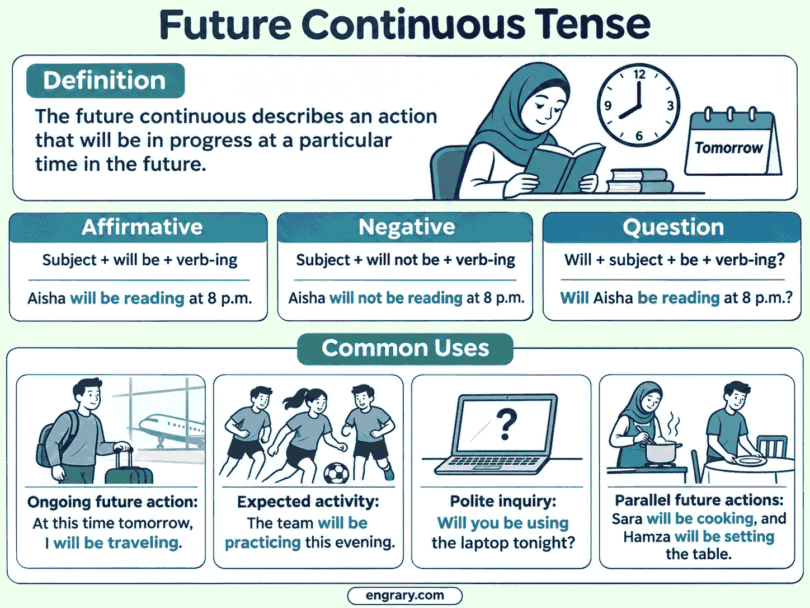
The future continuous tense describes an action or situation that will be in progress at a particular time in the future. It uses will be followed by the -ing form of the main verb, as in I will be working, she will be travelling, and they will be waiting. The tense presents a future activity as it will be unfolding rather than as a complete event.
This guide explains future continuous structures, uses, questions, contractions, time clauses, conditional clauses, stative verbs, passive forms, and common time expressions. In addition, comparison tables show how the tense differs from the future simple, present continuous, going to, future perfect, future perfect continuous, and other related forms.
Future Continuous Tense at a Glance
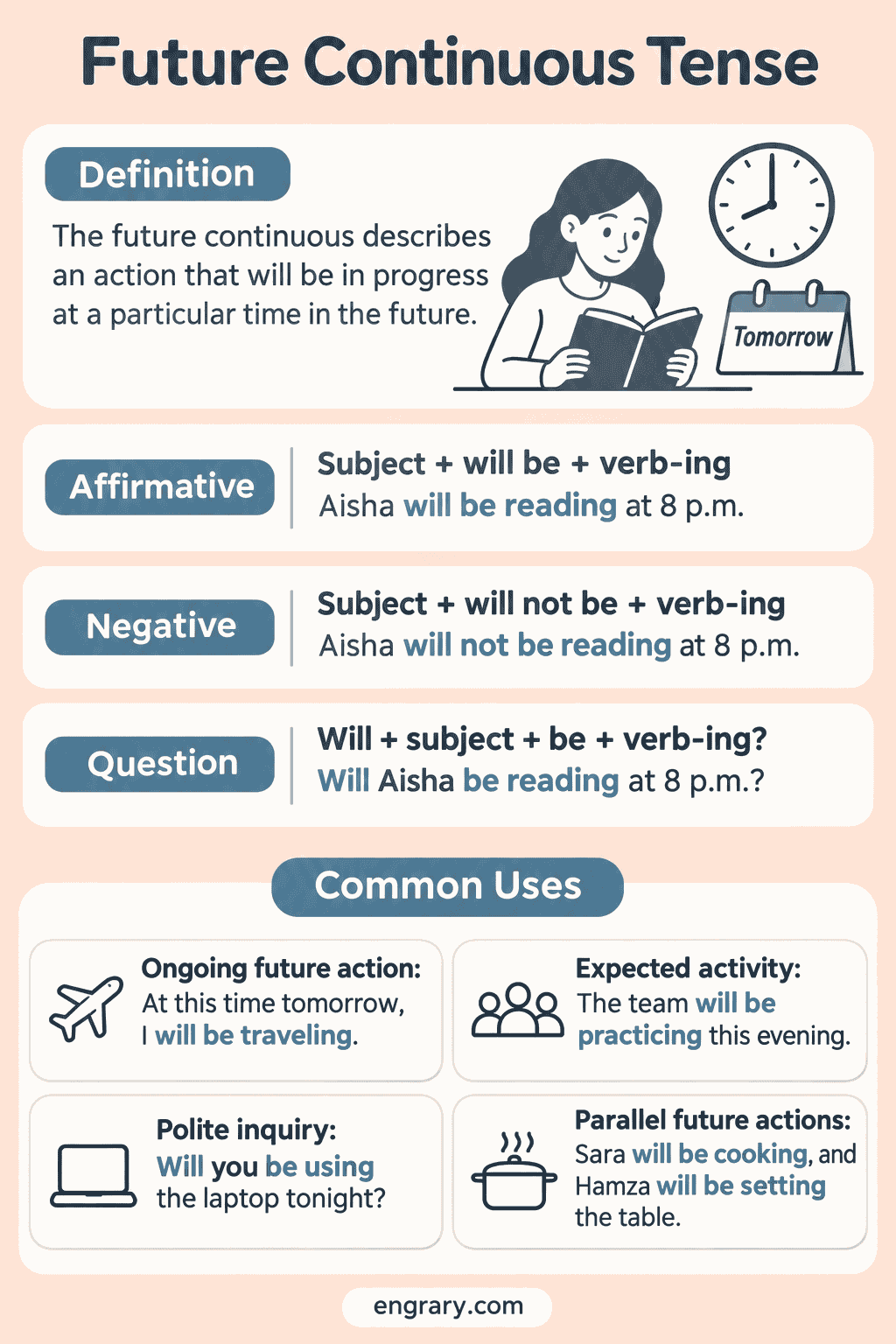
The future continuous, also called the future progressive, combines will, the base form be, and a present participle. The modal will remains the same with every subject.
| Sentence type | Structure | Example |
|---|---|---|
| Affirmative | Subject + will be + verb-ing | She will be studying. |
| Negative | Subject + will not be + verb-ing | She will not be studying. |
| Yes-or-no question | Will + subject + be + verb-ing? | Will she be studying? |
| Wh-question | Wh-word + will + subject + be + verb-ing? | Where will she be studying? |
The tense commonly describes:
- An activity in progress at a future time
- A temporary future situation
- Two activities occurring during the same future period
- An expected event or routine
- A neutral or polite inquiry about someone’s plans
- A predicted trend or development
Examples include:
- At eight tonight, I will be preparing dinner.
- This time tomorrow, we will be flying to Dubai.
- The manager will be meeting clients all morning.
- Will you be using the car this evening?
Importantly, the future continuous does not require a long activity. It simply presents an event as ongoing at a future reference point: At that moment, she will be pressing the button.
Forms of Will in the Future Continuous
Because will is a modal verb, it does not change according to the subject.
| Subject | Structure | Example |
|---|---|---|
| I | will be + verb-ing | I will be working. |
| He, she, it | will be + verb-ing | She will be working. |
| You | will be + verb-ing | You will be working. |
| We | will be + verb-ing | We will be working. |
| They | will be + verb-ing | They will be working. |
Traditional grammar sometimes uses shall with I and we: I shall be working or we shall be travelling. However, will is now more common in everyday English with all subjects. Shall still appears in formal, legal, and deliberately traditional styles.
Affirmative Sentences
Form an affirmative sentence with the subject, will, be, and the -ing form of the main verb.
Structure: Subject + will be + verb-ing + rest of the sentence
- I will be studying at eight tonight.
- She will be travelling this time tomorrow.
- The children will be sleeping when we return.
- We will be discussing the budget tomorrow morning.
- They will be staying near the city centre.
- The technicians will be testing the system overnight.
A useful extended word order is:
Subject + will + adverb + be + verb-ing + object + place + time
For example, She will probably be meeting the client at the office tomorrow morning. However, speakers often place a longer time expression first: Tomorrow morning, she will be meeting the client at the office.
Negative Sentences
Place not after will to form a negative sentence.
Structure: Subject + will not be + verb-ing + rest of the sentence
- I will not be working on Friday.
- She will not be attending the conference.
- We will not be using the meeting room.
- They will not be waiting outside.
- The machine will not be running overnight.
In ordinary speech and informal writing, will not usually becomes won’t:
- I won’t be working on Friday.
- She won’t be attending the conference.
- They won’t be waiting outside.
The order will be not working is unnatural in standard English. Use will not be working instead.
Yes-or-No Questions and Short Answers
Place will before the subject to form a yes-or-no question.
Structure: Will + subject + be + verb-ing?
- Will you be working tomorrow?
- Will she be travelling alone?
- Will they be staying overnight?
- Will the machine be running at noon?
- Will our guests be arriving before dinner?
Short answers repeat will, not be or the main verb.
| Question | Affirmative answer | Negative answer |
|---|---|---|
| Will Sara be working? | Yes, she will. | No, she won’t. |
| Will they be waiting? | Yes, they will. | No, they won’t. |
No, she won’t be sounds incomplete unless more information follows, as in No, she won’t be working tomorrow.
Wh-Questions and Subject Questions
For most information questions, place a Wh-word before will.
Structure: Wh-word + will + subject + be + verb-ing?
- What will you be doing tomorrow?
- Where will she be staying?
- Why will they be leaving early?
- When will the team be practising?
- Who will you be travelling with?
- Which project will he be managing?
- What will she be working on?
When who or what asks about the subject, no additional subject appears.
- Who will be leading the meeting?
- What will be causing the delay?
| Question type | Example | Requested information |
|---|---|---|
| Subject question | Who will be leading the meeting? | The person performing the action |
| Object question | Who will you be meeting? | The person receiving the action |
Questions ending in prepositions sound natural in conversation: Which hotel will they be staying at? and Who will he be speaking to?
Negative Questions and Question Tags
Negative questions can express surprise or check an expectation.
- Won’t you be attending the ceremony?
- Won’t they be staying for dinner?
- Will she not be joining the group?
Question tags use the opposite polarity of the main statement:
- You will be attending, won’t you?
- They will be staying here, won’t they?
- She won’t be driving, will she?
- We won’t be waiting long, will we?
Contractions with Will and Won’t
| Full form | Contraction |
|---|---|
| I will | I’ll |
| you will | you’ll |
| he will | he’ll |
| she will | she’ll |
| it will | it’ll |
| we will | we’ll |
| they will | they’ll |
| will not | won’t |
Examples include:
- I’ll be working from home.
- She’ll be waiting near the entrance.
- They’ll be travelling throughout the night.
- We won’t be using the main hall.
The contraction ’ll attaches to the subject, whereas won’t replaces will not.
Present-Participle Spelling Rules
Most verbs take -ing, but several spelling patterns require attention.
| Rule | Base verb | Present participle |
|---|---|---|
| Add -ing to most verbs | work | working |
| Remove final silent e | write | writing |
| Keep e in verbs ending in -ee | see | seeing |
| Change -ie to -y | lie | lying |
| Double the final consonant when required | run | running |
| Do not normally double w, x, or y | snow | snowing |
Additional examples include make → making, sit → sitting, begin → beginning, and open → opening. British English commonly uses travelling, while American English commonly uses traveling. Both spellings are correct within their respective systems.
Actions in Progress at a Future Time
Use the future continuous for an activity that will be underway at a stated or understood future time.
- At ten tomorrow, I will be attending a meeting.
- This time next week, we will be travelling through Turkey.
- At midnight, most people will be sleeping.
- When you arrive, she will be preparing dinner.
- From eight to ten, the students will be taking their final examination.
The action may begin before the reference point and continue afterward. However, the sentence does not need to state its exact beginning or end.
| Expression | Typical meaning | Example |
|---|---|---|
| at eight | At that exact future time | I will be working at eight. |
| by eight | Before or no later than eight | I will have finished by eight. |
| from eight to ten | During a future period | I will be working from eight to ten. |
The distinction between at and by matters. At often supports the future continuous because it identifies a moment during an activity. In contrast, by often supports the future perfect because it sets a deadline for completion.
Temporary Future Situations
The tense can describe an activity or situation limited to a future period.
- I will be working from home next week.
- She will be staying with her aunt during the holidays.
- They will be using a rented office for a few months.
- He will be taking the bus while his car is under repair.
- We will be living near the university during the academic year.
Expressions such as all morning, all evening, and throughout the week emphasize duration:
- She will be working all morning.
- They will be travelling throughout the night.
- We will be testing the system all week.
Nevertheless, these expressions do not prove that an activity will remain unfinished.
Simultaneous Future Actions
The future continuous can describe two or more activities that will overlap.
- While I am cooking, my sister will be setting the table.
- The children will be playing while their parents are preparing lunch.
- As the team is presenting, the judges will be taking notes.
- This time tomorrow, I will be travelling while you are attending the conference.
The activities do not need to start or finish at exactly the same time. They only need to overlap during the relevant future period.
Expected Events and Normal Course
The future continuous often describes an event expected to happen as part of a schedule, routine, arrangement, or normal process.
- The manager will be meeting clients all morning.
- You will be receiving a confirmation email.
- Our technicians will be checking the system overnight.
- The delivery team will be contacting you before arrival.
- The new employees will be completing their training next week.
This use sounds neutral because it presents the event as expected rather than emphasizing a new decision.
Announcements and Service Language
Travel providers, businesses, and customer-service teams often use the future continuous in announcements.
- We will be boarding passengers shortly.
- The train will be departing from Platform 4.
- Flight 204 will be arriving at 6:30.
- You will be receiving an email within 24 hours.
- A representative will be contacting you tomorrow.
The construction presents these events as part of an organized process. As a result, it often sounds professional and reassuring.
| Register | Example |
|---|---|
| Conversational | I’ll be staying with my cousin. |
| Neutral | She will be working at noon. |
| Formal announcement | Passengers will be boarding shortly. |
| Customer service | A representative will be contacting you. |
Polite Questions About Plans
The future continuous can ask about someone’s plans without directly requesting a decision or willingness.
- Will you be using the car tonight?
- Will you be staying for dinner?
- Will you be visiting the office tomorrow?
- Will you be bringing anyone with you?
| Future continuous | Future simple |
|---|---|
| Will you be using the car tonight? | Will you use the car tonight? |
| Neutral inquiry about an expected plan | Can ask about intention or willingness |
| Will you be staying for dinner? | Will you stay for dinner? |
| Asks about an existing plan | Can sound like an invitation or request |
Therefore, the future continuous often feels less pressuring because it asks what is already expected to happen.
Future Arrangements and Predictions
The tense can describe expected arrangements and activities that the speaker predicts will be underway.
- We will be meeting the regional director tomorrow.
- She will be working with the design team next month.
- More people will be working remotely in the future.
- Businesses will be using more automated systems.
- Temperatures will be rising throughout the week.
An arrangement in the future continuous often sounds neutral or expected. By contrast, other future forms may emphasize a personal intention, a firm arrangement, or present evidence.
Repeated Future Behavior
With adverbs such as always, constantly, and continually, the future continuous can add annoyance, criticism, affection, or admiration.
- He will always be forgetting his password.
- They will constantly be asking for updates.
- She will always be helping new employees.
- The children will continually be looking for new games.
| Sentence | Effect |
|---|---|
| He will forget his password again. | Prediction about one event |
| He will always be forgetting his password. | Repeated behavior with emotional emphasis |
Present Assumptions with the Future Continuous
Although the form usually refers to the future, it can express a confident assumption about an activity probably happening now.
- Don’t call Sara now; she’ll be sleeping.
- Ahmed will be travelling home at the moment.
- The children will be having lunch now.
- The manager will be speaking to the new employees.
In these examples, will expresses probability or confident expectation, while the continuous form presents the assumed activity as ongoing.
Future Time Clauses
After conjunctions such as when, while, before, after, until, and as soon as, English usually uses a present form rather than will to refer to the future.
| Incorrect | Correct |
|---|---|
| I will be working when you will arrive. | I will be working when you arrive. |
| She will be sleeping while we will be travelling. | She will be sleeping while we are travelling. |
| They will be waiting until the office will open. | They will be waiting until the office opens. |
| We will be eating after the guests will come. | We will be eating after the guests come. |
The event in the time clause does not necessarily interrupt the continuing activity. In I will be working when you arrive, the arrival simply provides a future reference point during the work.
Punctuation depends on clause order:
- When you arrive, I will be working.
- I will be working when you arrive.
- While we are travelling, the children will be sleeping.
- The children will be sleeping while we are travelling.
Use a comma when the dependent clause comes first. Usually, no comma is necessary when it follows the main clause.
Conditional Clauses
After if and unless, English normally uses a present form when the clause states a future condition.
| Incorrect | Correct |
|---|---|
| If you will arrive at six, I will be working. | If you arrive at six, I will be working. |
| Unless she will call first, we will be waiting outside. | Unless she calls first, we will be waiting outside. |
| If the system will fail, staff will be using the backup. | If the system fails, staff will be using the backup. |
However, will can appear in an if-clause when it expresses willingness rather than neutral future time: If you will be patient, I will explain the process.
Adverb Placement
Adverbs of probability, continuation, and emphasis commonly appear after will and before be.
| Adverb | Example |
|---|---|
| still | She will still be working. |
| probably | They will probably be waiting. |
| always | He will always be complaining. |
| just | We will just be finishing dinner. |
| definitely | I will definitely be attending. |
A manner adverb usually follows the main verb or its object: She will be working quietly or They will be checking the figures carefully. Meanwhile, longer time expressions often appear first or last: Tomorrow morning, she will be working from home.
Stative and Dynamic Verbs
Stative verbs usually describe conditions, possession, knowledge, beliefs, or preferences. Therefore, they normally avoid continuous forms.
- Natural: I will know the result tomorrow.
- Usually unnatural: I will be knowing the result tomorrow.
- Natural: She will own the property.
- Usually unnatural: She will be owning the property.
- Natural: He will understand the instructions.
- Usually unnatural: He will be understanding the instructions.
However, some verbs can take continuous forms when their meanings become dynamic.
| Stative meaning | Dynamic meaning |
|---|---|
| I will think the plan is sensible. | I will be thinking about the plan. |
| She will have enough time. | She will be having lunch. |
| He will see the mountains. | He will be seeing a specialist. |
| The soup will taste salty. | The chef will be tasting the soup. |
| The parcel will weigh five kilograms. | The assistant will be weighing the parcel. |
Advertising, informal speech, and some regional varieties occasionally use stative verbs continuously for emphasis, as in You’ll be loving the new design. Learners should master the standard patterns before adopting these stylistic exceptions.
Future Continuous with Being
The form will be being can describe temporary future behavior:
- He will be being unusually careful during the inspection.
- The children will be being very quiet during the performance.
Although grammatical, these forms often sound awkward. Natural rewrites usually work better:
- He will act unusually carefully during the inspection.
- The children will remain very quiet during the performance.
Future Continuous Passive
Form the future continuous passive with:
Subject + will be being + past participle
- The road will be being repaired tomorrow.
- The applications will be being reviewed during the meeting.
This construction is grammatically possible but often cumbersome. Therefore, active or non-continuous alternatives usually sound more natural.
| Awkward continuous passive | Natural alternative |
|---|---|
| The bridge will be being repaired. | Workers will be repairing the bridge. |
| The hall will be being decorated. | Staff will be decorating the hall. |
| The applications will be being reviewed. | The committee will be reviewing the applications. |
| The building will be being renovated. | The building will be under renovation. |
Future Continuous and Future Simple
The future continuous presents an activity as ongoing or expected. In contrast, the future simple can express a decision, promise, willingness, prediction, or complete future event.
| Future continuous | Future simple |
|---|---|
| I will be working at eight. | I will work tomorrow. |
| Activity in progress at a future time | Future action viewed as a whole |
| Will you be using the car? | Will you use the car? |
| Neutral inquiry about a plan | Can ask about willingness |
Context sometimes allows either form, but the viewpoint changes. I will work at eight can present a scheduled action or decision, whereas I will be working at eight places the listener inside the activity at that time.
Future Continuous and Present Continuous
| Future continuous | Present continuous |
|---|---|
| I will be meeting the director tomorrow. | I am meeting the director tomorrow. |
| Expected activity viewed as occurring | Firm personal arrangement |
| She will be flying to Lahore next week. | She is flying to Lahore next week. |
| Neutral prediction or expected schedule | Arrangement already organized |
Both forms may describe an arrangement, so context and emphasis often determine the speaker’s choice.
Future Continuous and Present Simple
The present simple commonly states an official timetable, whereas the future continuous often presents the scheduled event as approaching or expected.
| Future continuous | Present simple |
|---|---|
| The train will be arriving at six. | The train arrives at six. |
| Expected event or announcement | Official timetable |
| The conference will be starting shortly. | The conference starts at nine. |
| Focuses on the event as it approaches | States the scheduled time |
Future Continuous and Going To
| Future continuous | Going to |
|---|---|
| We will be staying near the beach. | We are going to stay near the beach. |
| Neutral or expected future activity | Present plan or intention |
| It will be raining later. | It is going to rain. |
| Predicted activity in progress | Prediction often based on present evidence |
English also uses am/is/are going to be + verb-ing:
- We are going to be staying near the beach.
- She is going to be working late.
This alternative often emphasizes a present plan or evidence, whereas will be doing can sound more neutral or expected.
Future Continuous and Future Perfect
| Future continuous | Future perfect |
|---|---|
| She will be writing the report at noon. | She will have written the report by noon. |
| Activity in progress at noon | Action complete before noon |
| They will be travelling at six. | They will have arrived by six. |
| Focuses on an ongoing journey | Focuses on completed arrival |
Thus, the future continuous does not confirm completion. I will be reading the report at eight only shows that the reading will be in progress. By contrast, I will have read the report by eight presents the reading as complete before that time.
Future Continuous and Future Perfect Continuous
| Future continuous | Future perfect continuous |
|---|---|
| At noon, she will be working. | At noon, she will have been working for four hours. |
| Activity at a future point | Duration leading to that future point |
| They will be waiting at ten. | They will have been waiting for two hours by ten. |
| Shows what will be happening | Shows how long it will have continued |
Future Continuous and Modal Continuous Forms
Forms with may, might, or could can describe possible ongoing future activities, but they are not the standard future continuous with will.
| Form | Example | Meaning |
|---|---|---|
| Future continuous | She will be working tomorrow. | Expected future activity |
| Modal continuous | She may be working tomorrow. | Possible future activity |
| Modal continuous | They might be travelling tonight. | Uncertain future activity |
| Modal continuous | He could be staying with friends. | One possible situation |
Future Continuous in Reported Speech
When a future continuous statement is reported from a past viewpoint, will be doing commonly changes to would be doing.
| Direct statement | Reported statement |
|---|---|
| “I will be working late.” | She said that she would be working late. |
| “We will be travelling tomorrow.” | They said that they would be travelling the next day. |
| “He will be staying here.” | She explained that he would be staying there. |
Time and place expressions may also change, such as tomorrow → the next day and here → there.
Future Continuous and Would Be Doing
| Future continuous | Would be doing |
|---|---|
| She knows she will be working late. | She knew she would be working late. |
| Future viewed from the present | Future viewed from a past point |
| I expect they will be travelling. | I expected they would be travelling. |
| Present expectation | Past expectation |
The would be + verb-ing construction is often called the future continuous in the past or future-in-the-past continuous.
Common Time Expressions
The future continuous often appears with:
- this time tomorrow
- this time next week
- at eight tonight
- tomorrow morning
- tomorrow afternoon
- tomorrow evening
- next week
- next month
- all day tomorrow
- throughout the evening
- when you arrive
- while you are travelling
- at that time
- in a few hours
- from eight to ten
These expressions support the meaning, but context still determines which future form fits best. A clear reference point is especially useful because a sentence such as She will be working may leave the listener expecting to hear when.
Common Mistakes with the Future Continuous
| Incorrect | Correct | Explanation |
|---|---|---|
| She will be work tomorrow. | She will be working tomorrow. | Use a present participle after be. |
| They will working at eight. | They will be working at eight. | Include be after will. |
| Will be you travelling? | Will you be travelling? | Place the subject after will. |
| I won’t working tonight. | I won’t be working tonight. | Keep be in the negative form. |
| When you will arrive, I will be sleeping. | When you arrive, I will be sleeping. | Use a present form in the time clause. |
| If she will call, I will be waiting. | If she calls, I will be waiting. | Use a present form for a normal future condition. |
| I will be knowing the answer tomorrow. | I will know the answer tomorrow. | Know is normally stative. |
| She will be writeing. | She will be writing. | Remove the final silent e. |
| He will be lieing down. | He will be lying down. | Change -ie to -y. |
| Will she be works tomorrow? | Will she be working tomorrow? | Use the -ing form after be. |
| The road will being repaired. | The road will be being repaired. | The continuous passive needs both forms of be. |
Practical Tips for Accurate Use
- First, identify the future reference point.
- Decide whether the activity will be in progress at that time.
- Use will be + verb-ing with every subject.
- Place not after will in negative sentences.
- Move will before the subject in questions.
- Use a present form after future time conjunctions and normal conditional conjunctions.
- Avoid continuous forms with stative meanings.
- Use the future continuous for neutral inquiries about expected plans.
- Choose the future perfect when completion matters.
- Distinguish standard will be doing from modal forms such as may be doing.
- Finally, rewrite the future continuous passive when a simpler form sounds more natural.
FAQs
The future continuous tense describes an action or situation that will be in progress at a particular time in the future. It is also called the future progressive and follows the structure will be + verb-ing, as in She will be studying at eight tomorrow evening. It can also describe temporary future situations, expected events, and neutral inquiries about plans.
Form an affirmative sentence with subject + will be + verb-ing. Add not after will for a negative sentence: She will not be working. For a question, place will before the subject: Will she be working? The modal will remains the same with every subject.
Use it for an activity in progress at a future time, a temporary future situation, simultaneous future activities, expected events, professional announcements, polite questions about plans, repeated future behavior, and predicted trends. In addition, the same form can express a confident assumption about an activity probably happening now.
The future continuous presents an activity as ongoing or expected, whereas the future simple can present an event as a whole or express a decision, promise, willingness, or prediction. For example, I will be working at eight places the activity in progress at eight, while I will work tomorrow presents the future action more generally.
Stative meanings normally avoid continuous forms, so I will know the answer sounds more natural than I will be knowing the answer. However, some verbs can appear in the future continuous when they express dynamic activities. For example, She will be having lunch and He will be seeing a specialist describe actions rather than possession or automatic perception.
You May Also Like
- Present Tense in English
- Present Tense Examples
- Past Tense in English
- Past Tense Examples in Sentences
- Future Tense in English
- Future Tense Examples in Sentences
- Simple Tenses in English
- Simple Tenses Examples
- Continuous Tenses in English
- Continuous Tenses Examples
- Perfect Tenses in English
- Perfect Tenses Examples

Leave a Comment