
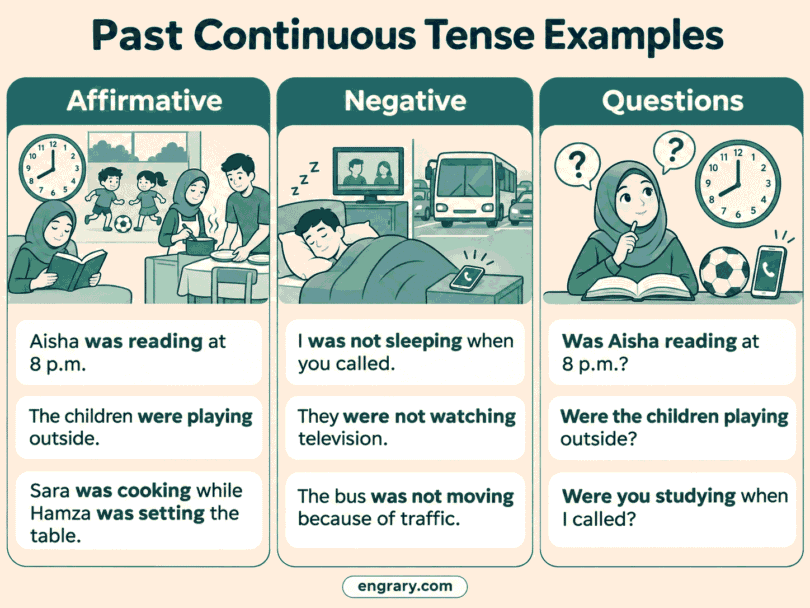
The past continuous tense describes an action or situation that was in progress at a particular time in the past. It uses was or were followed by the -ing form of the main verb, as in I was reading, she was working, and they were waiting. It focuses on an activity as it was unfolding rather than presenting it as a complete event.
Below are 120 past continuous tense examples organized by form and use. They include affirmative sentences, negatives, questions, actions in progress, shorter past events, simultaneous activities, narrative background, temporary situations, passive forms, reported speech, and polite expressions. In addition, concise tables explain the structure, spelling rules, comparisons, and common mistakes.
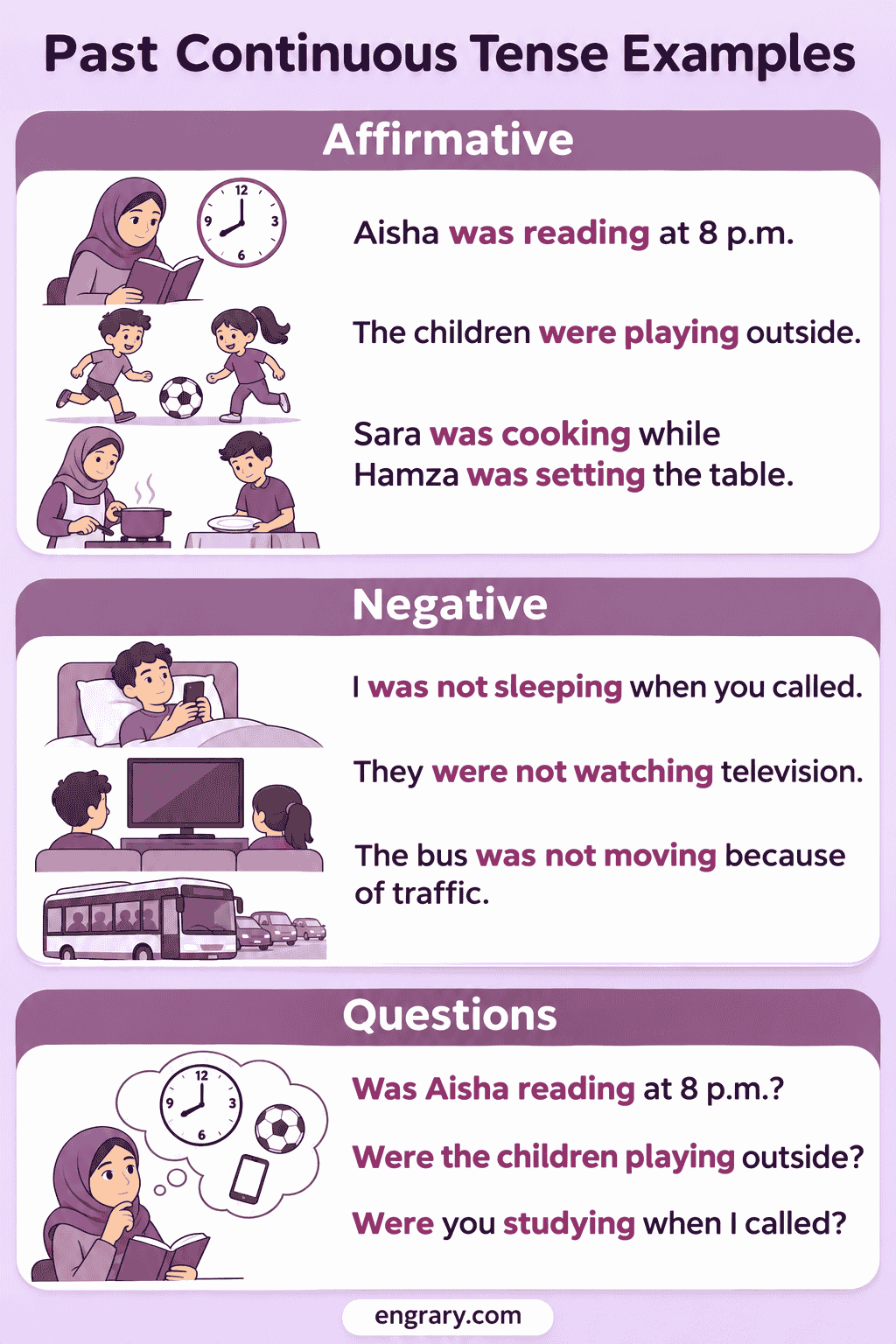
Common Past Continuous Tense Examples
These common examples show how the tense appears in everyday conversations and descriptions. Notice that every bold verb phrase contains was or were followed by a present participle.
- I was preparing breakfast when the doorbell rang.
- Sara was reading a novel in the library yesterday afternoon.
- The children were playing in the garden after lunch.
- We were waiting for the bus at seven o’clock.
- Hamza was talking to his teacher near the entrance.
- My phone was charging while I was having dinner.
- The workers were repairing the road outside our house.
- It was raining heavily when we left the office.
- You were speaking very quietly during the meeting.
- The baby was sleeping when the guests arrived.
- I was not using the computer at that time.
- Nadia wasn’t wearing her glasses yesterday morning.
- The shops weren’t opening because of the power cut.
- Was Ali studying in his room?
- Were the students taking notes during the lecture?
- What were you doing at lunchtime?
- Why was the dog barking so loudly?
- While my mother was cooking, I was setting the table.
- As the sun was setting, the air was becoming cooler.
- This time last week, we were travelling through the mountains.
Past Continuous Structure
The past continuous combines the past form of be with the -ing form of a verb.
| Form | Structure | Example |
|---|---|---|
| Affirmative | Subject + was/were + verb-ing | She was studying. |
| Negative | Subject + was/were not + verb-ing | She was not studying. |
| Yes-or-no question | Was/Were + subject + verb-ing? | Was she studying? |
| Wh-question | Wh-word + was/were + subject + verb-ing? | Where was she studying? |
Use was with I, he, she, and it. In contrast, use were with you, we, and they.
| Subject | Auxiliary | Supporting example |
|---|---|---|
| I | was | I was working. |
| He, she, it | was | She was working. |
| You | were | You were working. |
| We | were | We were working. |
| They | were | They were working. |
A useful extended word order is:
Subject + was/were + verb-ing + object + place + time
For example, Sara was reading a novel in the library yesterday afternoon. A time expression may also appear first: Yesterday afternoon, Sara was reading a novel in the library.
Present-Participle Spelling
Most verbs simply take -ing. However, some verbs require a spelling change.
| Rule | Base verb | Present participle |
|---|---|---|
| Add -ing | work | working |
| Remove final silent e | write | writing |
| Keep e in -ee verbs | see | seeing |
| Change -ie to -y | lie | lying |
| Double a final consonant after a stressed short vowel | begin | beginning |
| Do not double w, x, or y | snow | snowing |
British English commonly uses travelling, whereas American English commonly uses traveling. Both forms are correct when the article follows one spelling system consistently.
Affirmative Past Continuous Examples
Affirmative sentences present an activity as ongoing at a past reference time.
- I was writing an email when the internet stopped working.
- Amina was making tea for her visitors.
- Bilal was running around the track at sunrise.
- The manager was explaining the new policy to the staff.
- We were discussing the budget in the conference room.
- The mechanic was checking the engine for unusual sounds.
- My cousins were staying with us during the school holidays.
- The train was moving slowly through the fog.
- I was listening to a podcast on my way home.
- The chef was tasting the soup before serving it.
- Several customers were browsing the shelves near the counter.
- She was lying on the sofa and reading a magazine.
- The wind was blowing dust across the empty road.
- Our team was practising for the final match.
- More families were choosing online banking at the time.
These examples show that the tense does not require a long action. Even a brief activity can appear in the past continuous when the speaker views it as ongoing.
Negative Past Continuous Examples
Add not after was or were. In everyday English, was not commonly becomes wasn’t, while were not becomes weren’t.
- I was not expecting a delivery that morning.
- She wasn’t paying attention to the announcement.
- The printer wasn’t producing clear copies.
- We were not arguing about the final decision.
- They weren’t waiting at the correct platform.
- You weren’t driving too fast when I saw you.
- The children were not sleeping during the storm.
- He wasn’t carrying an umbrella in the rain.
- My laptop was not connecting to the office network.
- The players weren’t following the coach’s instructions.
- I wasn’t looking for a new apartment at the time.
- The company was not hiring additional staff that month.
- Fatima wasn’t feeling well during the journey.
- The birds weren’t singing because the weather was cold.
- Our neighbours were not holding a party that evening.
English has no standard affirmative contractions for combinations such as I was or they were. Moreover, they’re working means they are working in the present, not they were working in the past.
Yes-or-No Question Examples
Place was or were before the subject to form a yes-or-no question.
- Was your brother working at the shop yesterday?
- Was the teacher explaining the final assignment?
- Was it snowing when the flight landed?
- Was Mariam waiting outside the clinic?
- Was the machine making that unusual noise?
- Were you watching the news at eight?
- Were the guests enjoying the music?
- Were we travelling in the right direction?
- Were the technicians testing the new software?
- Were those children playing near the road?
Short answers repeat the auxiliary rather than the main verb:
| Question | Affirmative answer | Negative answer |
|---|---|---|
| Was Aisha studying? | Yes, she was. | No, she wasn’t. |
| Were the children sleeping? | Yes, they were. | No, they weren’t. |
Negative questions often express surprise or check an expectation:
- Wasn’t she attending the meeting?
- Weren’t they waiting outside?
Question tags use the opposite polarity:
- She was working, wasn’t she?
- They weren’t travelling, were they?
Wh-Question Examples
For most information questions, place a Wh-word before was or were. However, when who or what asks about the subject, no additional subject follows the auxiliary.
- What were you reading on the train?
- Where was the driver taking the passengers?
- Why was your sister laughing during the film?
- When were they leaving for the airport?
- Who was knocking at the door so late?
- Who were you talking to after the meeting?
- What was causing the delay on the motorway?
- What was he looking for under the desk?
- Which company were they working with?
- How was the patient responding to the treatment?
| Question type | Supporting example | Requested information |
|---|---|---|
| Subject question | Who was calling you? | The person performing the action |
| Object question | Who were you calling? | The person receiving the action |
Past Continuous Examples with When
The past continuous often describes an activity already underway when a shorter event occurred. The shorter event commonly takes the simple past.
- I was taking a shower when the telephone rang.
- She was walking home when she found a lost wallet.
- We were eating dinner when the lights went out.
- The goalkeeper was moving forward when the striker kicked the ball.
- I was opening the door when the key broke.
- The students were completing the test when the bell sounded.
- Ahmed was driving to work when he heard the warning on the radio.
- The cat was sleeping by the window when a bird landed outside.
- The audience was becoming restless when the speaker returned.
- I was reading quietly when Sara entered the room.
People often call this pattern an interrupted action. Nevertheless, the shorter event does not always stop the ongoing activity. In the final example, Sara’s entrance may simply occur during the reading or shift the narrative focus; the reading could continue.
Past Continuous Examples with While and As
While commonly introduces an ongoing activity, whereas as often highlights actions or changes developing together. However, neither conjunction automatically requires the past continuous; the intended viewpoint determines the tense.
- While I was washing the dishes, my sister dried them.
- The alarm rang while everyone was sleeping.
- While the guide was describing the monument, tourists took photographs.
- We saw several deer while we were hiking through the forest.
- While the nurse was checking my temperature, the doctor entered.
- As I was crossing the street, the traffic light changed.
- The crowd became quieter as the singer was approaching the stage.
- As the boat was leaving the harbour, passengers waved from the deck.
- The roads became slippery as snow was falling more heavily.
- As we were discussing the problem, a better solution emerged.
Use a comma when the dependent clause comes first: While I was cooking, the phone rang. Usually, no comma is necessary when it follows the main clause: The phone rang while I was cooking.
Moreover, while can appear with the simple past when the speaker presents a complete period: While I lived in London, I walked to work.
Examples of Simultaneous Past Actions
Two past continuous clauses can show activities that overlapped during the same period. They do not need to start or finish at exactly the same moment.
- While I was cooking, my brother was setting the table.
- The children were drawing while their teacher was reading a story.
- I was taking notes while the trainer was demonstrating the equipment.
- While customers were shopping, assistants were arranging new displays.
- The band was performing as the audience was dancing.
- We were discussing the route while the driver was checking the map.
- As the sun was rising, fishermen were returning to the shore.
- My parents were preparing dinner while I was helping my younger brother.
Narrative and Background Examples
Writers use the past continuous to establish scenery and background activity. In contrast, the simple past usually advances the main events.
- Rain was hitting the windows as the family gathered inside.
- People were hurrying home before the storm reached the city.
- Streetlights were shining through the thick evening fog.
- A musician was playing softly near the station entrance.
- Several passengers were checking the departure board.
- A small child was holding a red balloon beside the ticket office.
- Two guards were watching the crowd from the main gate.
- An old clock was striking midnight as the last train arrived.
Here is the pattern in a short narrative:
The wind was blowing, rain was hitting the windows, and people were hurrying home. A young man stepped off the bus, looked around, and ran toward the station.
| Language in the narrative | Function |
|---|---|
| was blowing, was hitting, were hurrying | Establishes the continuing background |
| stepped, looked, ran | Reports the main completed events |
Temporary and Changing Situation Examples
The tense can describe a temporary past situation or a development occurring around a past period.
- I was living with my aunt while my apartment was under repair.
- She was working at a bookshop during the summer.
- The company was using a rented office at the time.
- The weather was getting warmer each day.
- Food prices were rising rapidly that winter.
- His spoken English was improving with regular practice.
Expressions such as all morning or all evening can emphasize duration: I was working all morning. However, they do not prove that the activity remained unfinished.
Past Continuous Passive and Reported-Speech Examples
Form the passive with was/were being + past participle. It focuses on the receiver of an ongoing action. Meanwhile, reported speech often changes a present continuous form to a past continuous form after a past reporting verb.
- The main road was being repaired when we visited the town.
- Several applications were being reviewed by the selection committee.
- Hira said that she was preparing for her final examination.
- The passengers explained that they were waiting for another bus.
| Active form | Passive form |
|---|---|
| Workers were repairing the road. | The road was being repaired. |
| Staff were checking the documents. | The documents were being checked. |
Similar forms can express different meanings:
| Form | Supporting example | Meaning |
|---|---|---|
| State or adjective | The door was closed. | It was not open. |
| Simple past passive | The door was closed at six. | Someone closed it at six. |
| Past continuous passive | The door was being closed. | The closing process was underway. |
In reported speech, “I am studying” can become She said that she was studying. However, speakers may keep a present form when the situation remains current and they want to emphasize that fact.
Polite, Planned, and Repeated-Action Examples
The past continuous can soften an inquiry, describe a fixed arrangement viewed from the past, or add emotional emphasis to repeated behavior.
- I was wondering if you could help me with this form.
- We were meeting the regional manager the following morning.
- He was always losing his office keys.
- My grandmother was constantly helping families in the neighbourhood.
With always, constantly, or continually, the tense may express annoyance, criticism, affection, or admiration. In addition, a past arrangement does not guarantee that the planned event eventually happened.
Adverb Placement
Mid-position adverbs usually appear after was or were and before the main participle.
| Adverb | Supporting example |
|---|---|
| still | She was still working. |
| just | I was just leaving. |
| always | He was always complaining. |
| probably | They were probably waiting outside. |
| carefully | We were carefully checking the figures. |
Longer time expressions commonly appear at the beginning or end: At that moment, the audience was becoming restless or The team was practising after school.
Stative and Dynamic Meanings
Stative verbs describe states and usually avoid continuous forms. Therefore, use I knew the answer, not I was knowing the answer. Common stative verbs include know, believe, understand, own, belong, need, and prefer.
However, some verbs can express either a state or an activity. Their meaning determines the form.
| Stative meaning | Dynamic meaning |
|---|---|
| I had a car. | I was having lunch. |
| I thought the plan was sensible. | I was thinking about the plan. |
| I saw the mountains. | I was seeing a doctor. |
| The soup tasted salty. | The chef was tasting the soup. |
Similarly, was being often describes temporary behaviour: He was being rude during the meeting.
Verbs of perception also require care:
| Automatic perception | Deliberate activity |
|---|---|
| I could hear music. | I was listening to music. |
| I could see the lights. | I was watching the lights. |
Consequently, I was hearing music often sounds unnatural when sound simply reached the speaker’s ears.
Completion and Ongoing Viewpoint
The past continuous focuses on an activity in progress, so it does not confirm completion. The simple past, by contrast, often presents the action as a complete event.
| Past continuous | Simple past |
|---|---|
| I was writing the report. | I wrote the report. |
| She was reading the book. | She read the book. |
| They were repairing the road. | They repaired the road. |
| Focuses on the unfolding activity | Often presents the event as a whole |
Nevertheless, the past continuous does not mean an activity never ended. I was working all evening may describe work that finished later, although the sentence highlights the ongoing activity.
Past Continuous and Past Perfect Continuous
Both forms can describe ongoing past activity, but they use different reference points.
| Past continuous | Past perfect continuous |
|---|---|
| She was studying at eight. | She had been studying for two hours before dinner. |
| They were waiting when I arrived. | They had been waiting for an hour when I arrived. |
| Shows activity in progress at a past time | Emphasizes duration leading to a later past time |
Related Constructions
Some structures contain was or were but should not be counted as standard past continuous examples.
| Construction | Example | Meaning |
|---|---|---|
| Past intention | I was going to call her. | I intended to call her. |
| Movement in progress | I was going to the office. | I was travelling toward the office. |
| Imminent event | We were about to leave. | We expected to leave immediately. |
| Hypothetical continuous | If I were working there, I would resign. | Imagined present situation |
By contrast, I was working there in 2020 describes an actual past situation. Also, If I were you is not past continuous because no -ing verb follows were.
Common Mistakes with Past Continuous Sentences
| Incorrect | Correct | Explanation |
|---|---|---|
| She were studying. | She was studying. | Use was with she. |
| They was waiting. | They were waiting. | Use were with they. |
| I was read a book. | I was reading a book. | Use the -ing form. |
| Were you worked yesterday? | Were you working yesterday? | Questions still require a participle. |
| I was knowing the answer. | I knew the answer. | Know is normally stative. |
| She was writeing. | She was writing. | Remove the final silent e. |
| He was lieing down. | He was lying down. | Change -ie to -y. |
| The road was repairing. | The road was being repaired. | The continuous passive needs being. |
| I was going call her. | I was going to call her. | Past intention needs going to + base verb. |
| While I cooked, the phone was ringing once. | While I was cooking, the phone rang. | Use the continuous for background and simple past for the single event. |
Practical Tips for Using the Examples
- First, locate was or were and the following -ing verb.
- Next, identify the past reference time or surrounding event.
- Use was with singular third-person subjects and I.
- Use were with you, we, and they.
- Choose the simple past when you want to present an event as complete.
- Avoid continuous forms with stative verbs unless their meaning becomes dynamic.
- Remember that a shorter event does not necessarily stop the ongoing action.
- Keep was going to and was about to separate from standard past continuous examples.
- Finally, use the past continuous for background and the simple past for main narrative events.
FAQs
Examples include I was reading at eight, she was preparing dinner, they were waiting outside, and we were travelling when the storm began. Every standard past continuous construction contains was or were followed by a present participle. The tense presents the activity as ongoing at a past reference time.
Use subject + was/were + verb-ing for an affirmative sentence. Add not after the auxiliary to form a negative, as in She wasn’t working. For a question, place the auxiliary before the subject: Was she working? Use was with I, he, she, and it, and use were with you, we, and they.
Examples include I wasn’t sleeping, she was not listening, and they weren’t waiting outside. In each case, not follows was or were, while the main verb remains in its -ing form. The contractions wasn’t and weren’t commonly appear in conversation and informal writing.
Examples include Was Ali studying?, Were they travelling?, What were you doing?, and Who was knocking? Yes-or-no questions place was or were before the subject. Most Wh-questions place the question word first, but subject questions such as Who was knocking? do not add another subject.
When often introduces a shorter simple-past event, as in I was sleeping when the alarm rang. Meanwhile, while often introduces an ongoing activity, as in While I was sleeping, the storm began. However, neither word automatically determines the tense. Speakers choose a form according to whether they view an event as ongoing, complete, temporary, or repeated.
You May Also Like
- Present Tense in English
- Present Tense Examples
- Past Tense in English
- Past Tense Examples in Sentences
- Future Tense in English
- Future Tense Examples in Sentences
- Simple Tenses in English
- Simple Tenses Examples
- Continuous Tenses in English
- Continuous Tenses Examples
- Perfect Tenses in English
- Perfect Tenses Examples


Leave a Comment