
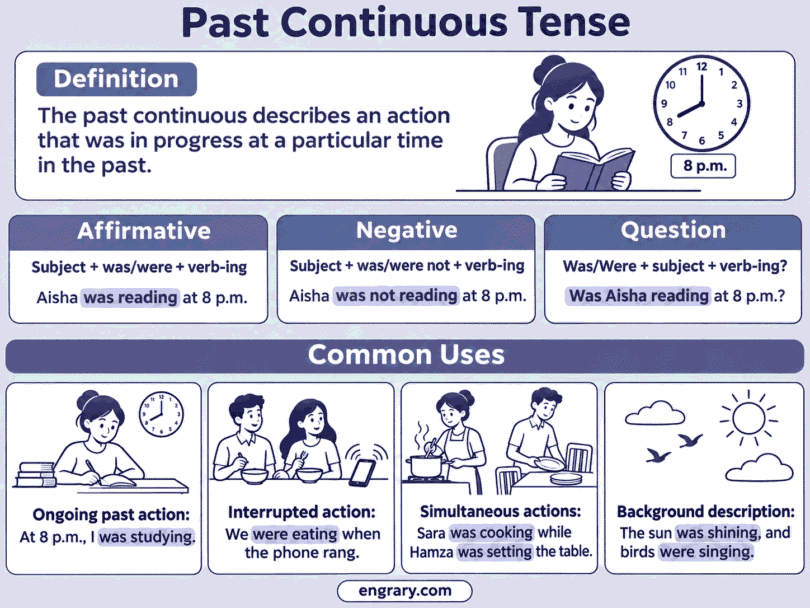
The past continuous tense describes an action or situation that was in progress at a particular time in the past. It uses was or were followed by the -ing form of the main verb, as in I was reading, she was working, and they were waiting. The tense focuses on an activity as it was unfolding rather than presenting it as a complete event.
This guide explains the forms and uses of the past continuous, including affirmative sentences, negatives, questions, interrupted actions, simultaneous activities, narrative background, stative verbs, passive forms, and common time expressions. In addition, comparison tables show how the tense differs from the simple past, past perfect continuous, used to, and would.
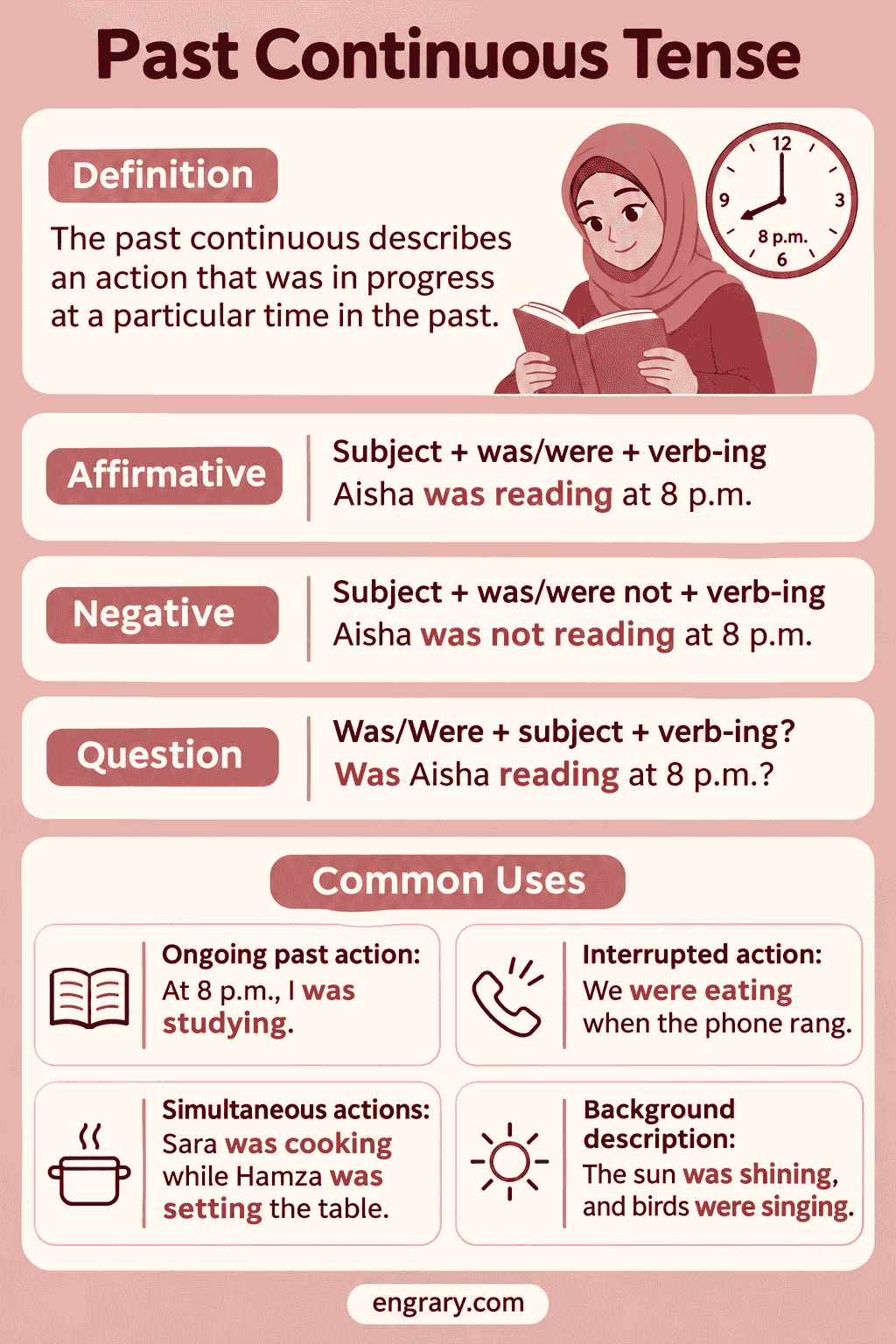
Past Continuous Tense at a Glance
The past continuous, also called the past progressive, combines the past form of be with a present participle. Use was with I, he, she, and it. In contrast, use were with you, we, and they.
| Sentence type | Structure | Example |
|---|---|---|
| Affirmative | Subject + was/were + verb-ing | She was studying. |
| Negative | Subject + was/were not + verb-ing | She was not studying. |
| Yes-or-no question | Was/Were + subject + verb-ing? | Was she studying? |
| Wh-question | Wh-word + was/were + subject + verb-ing? | Where was she studying? |
The tense usually presents an action from the inside. In other words, it shows what was happening at a particular moment without emphasizing the beginning or end.
- At 8 p.m., I was preparing dinner.
- The children were sleeping when we arrived.
- While Amir was driving, Nadia was checking the map.
- It was getting colder as the sun went down.
Importantly, the past continuous does not automatically describe a long action. Even a brief event can appear in this tense when the speaker views it as ongoing: I was opening the door when the key broke.
Forms of Be in the Past Continuous
The auxiliary verb changes according to the subject, but the main verb always remains in its -ing form.
| Subject | Auxiliary | Example |
|---|---|---|
| I | was | I was writing. |
| He, she, it | was | He was writing. |
| You | were | You were writing. |
| We | were | We were writing. |
| They | were | They were writing. |
Therefore, subject–verb agreement depends on was and were, not on the main verb.
- Correct: The student was listening.
- Correct: The students were listening.
- Incorrect: The students was listening.
- Incorrect: She were listening.
Although you can refer to one person or several people, it always takes were: You were speaking clearly.
Affirmative Sentences
Form an affirmative sentence with the subject, was or were, and the -ing form of the main verb.
Structure: Subject + was/were + verb-ing + rest of the sentence
- I was reading the newspaper.
- Hina was preparing a presentation.
- The baby was sleeping peacefully.
- We were discussing the new schedule.
- You were standing near the entrance.
- The players were warming up on the field.
A useful extended word order is:
Subject + was/were + verb-ing + object + place + time
For example, Sara was reading a novel in the library yesterday afternoon. However, speakers often move a time expression to the beginning for emphasis: Yesterday afternoon, Sara was reading a novel in the library.
Negative Sentences
Add not after was or were to form a negative sentence.
Structure: Subject + was/were + not + verb-ing + rest of the sentence
- I was not expecting a visitor.
- She was not wearing her glasses.
- It was not raining at noon.
- We were not arguing about the decision.
- They were not paying attention.
In everyday English, was not commonly becomes wasn’t, while were not becomes weren’t.
- He wasn’t using the computer.
- We weren’t waiting for a bus.
English has no standard affirmative contractions for combinations such as I was or they were. Therefore, forms such as I’s working and they’re working cannot express the past continuous. They’re working means they are working in the present continuous.
Yes-or-No Questions and Short Answers
To form a yes-or-no question, place was or were before the subject.
Structure: Was/Were + subject + verb-ing + rest of the sentence?
- Was I speaking too quickly?
- Was she waiting outside?
- Was the machine making that noise?
- Were you working yesterday evening?
- Were they staying at the same hotel?
Use was, wasn’t, were, or weren’t in short answers. Do not repeat the main verb.
| Question | Affirmative short answer | Negative short answer |
|---|---|---|
| Was Ali studying? | Yes, he was. | No, he wasn’t. |
| Was the dog barking? | Yes, it was. | No, it wasn’t. |
| Were you listening? | Yes, I was. | No, I wasn’t. |
| Were they travelling? | Yes, they were. | No, they weren’t. |
Wh-Questions and Subject Questions
For most information questions, place a question word before was or were.
Structure: Wh-word + was/were + subject + verb-ing?
- What were you doing at lunchtime?
- Where was Hamza going?
- Why was the child crying?
- When were they leaving?
- Who were you talking to?
- What was she looking for?
- Which company were they working with?
Questions with who or what can also ask about the subject. In that case, the question word itself functions as the subject, so no additional subject appears.
- Who was knocking at the door?
- What was making that sound?
- Who was using my desk?
| Question type | Example | Requested information |
|---|---|---|
| Subject question | Who was calling you? | The person who called |
| Object question | Who were you calling? | The person who received the call |
Negative Questions and Question Tags
Negative questions can express surprise, confirm an expectation, or request agreement.
- Wasn’t she attending the meeting?
- Weren’t you waiting for me?
- Wasn’t the printer working earlier?
Question tags use the opposite polarity of the main statement.
- He was joking, wasn’t he?
- They were waiting, weren’t they?
- She wasn’t driving, was she?
- You weren’t sleeping, were you?
Present-Participle Spelling Rules
Most verbs take -ing, but several spelling patterns require attention.
| Rule | Base verb | Present participle |
|---|---|---|
| Add -ing to most verbs | work | working |
| Remove a final silent e | write | writing |
| Keep e in verbs ending in -ee | see | seeing |
| Change -ie to -y | lie | lying |
| Double the final consonant after a stressed consonant–vowel–consonant ending | begin | beginning |
| Do not usually double w, x, or y | snow | snowing |
Additional examples include make → making, come → coming, run → running, sit → sitting, prefer → preferring, and open → opening. In British English, writers commonly double the final l in forms such as travelling, whereas American English usually uses traveling. Both forms are correct within their respective spelling systems.
Actions in Progress at a Past Time
Use the past continuous for an action that was unfolding at a stated or understood time in the past.
- At seven yesterday morning, I was getting ready for work.
- This time last week, we were travelling through the mountains.
- She was meeting a client at noon.
- The shop assistants were arranging the displays all morning.
The action may have started before the reference time and continued afterward. However, the sentence does not need to tell us when the activity began or ended.
| Sentence | View of the action |
|---|---|
| I worked from eight to five. | The speaker presents the period as complete. |
| I was working at ten. | The activity was in progress at ten. |
| I was working all morning. | The speaker views the activity as ongoing during that period. |
An expression such as all morning does not prove that the action remained unfinished. Instead, it emphasizes duration or presents the activity as a continuing background situation.
Ongoing Actions and Shorter Past Events
The past continuous often describes an action already in progress when a shorter event occurred. The shorter event usually takes the simple past.
- I was taking a shower when the phone rang.
- She was walking home when she saw the accident.
- We were eating dinner when the lights went out.
- The goalkeeper was moving forward when the striker kicked the ball.
- I was opening the door when the key broke.
People often call this pattern an interrupted action. Nevertheless, the shorter event does not always stop the ongoing activity. In I was reading when Sara entered, Sara’s entrance may simply occur during the reading or shift the listener’s attention to a new event. The reading could continue.
| Part of the sentence | Typical tense | Function |
|---|---|---|
| I was reading | Past continuous | Ongoing background activity |
| when Sara entered | Simple past | Shorter event or new focus |
Simultaneous Past Actions
Use the past continuous for two or more activities that were happening during the same period.
- While I was cooking, my brother was setting the table.
- The children were playing while their parents were talking.
- As the band was performing, the audience was dancing.
- I was taking notes while the trainer was explaining the procedure.
Both actions do not need to begin or end at exactly the same moment. They only need to overlap during the relevant period.
Background and Scene Setting
Writers frequently use the past continuous to create background before introducing the main events of a story. Meanwhile, the simple past usually advances the plot.
The wind was blowing, rain was hitting the windows, and people were hurrying home. A young man stepped off the bus, looked around, and ran toward the station.
| Language in the passage | Role in the narrative |
|---|---|
| was blowing, was hitting, were hurrying | Establishes the setting and continuing background |
| stepped, looked, ran | Reports the main completed events |
Therefore, alternating between these tenses helps a writer control pace and focus. The past continuous slows the scene and shows conditions in progress, whereas the simple past moves the story forward.
Temporary and Changing Past Situations
The past continuous can describe a temporary situation around a past period.
- I was living with my aunt while my apartment was being repaired.
- She was working at a bookshop during the summer.
- They were using a rented office at the time.
It can also show a developing or changing situation.
- The weather was getting warmer.
- Prices were rising quickly.
- His English was improving every week.
- More customers were choosing online payment.
In each case, the speaker presents the situation as temporary, developing, or limited to a particular past context.
Repeated Behavior with Emotional Emphasis
The past continuous can describe repeated behavior, especially with adverbs such as always, constantly, and continually. This pattern often expresses annoyance, criticism, amusement, or admiration.
- He was always losing his keys.
- They were constantly interrupting the teacher.
- My grandmother was always helping her neighbours.
- The children were continually asking for another story.
In contrast, the simple past presents a repeated habit more neutrally.
| Sentence | Usual effect |
|---|---|
| He always lost his keys. | Neutral statement about a past habit |
| He was always losing his keys. | Emotional emphasis, often annoyance |
Planned Events Viewed from the Past
The past continuous can describe a fixed arrangement that was future from a past viewpoint.
- I was meeting the manager the following morning.
- We were flying to Karachi on Friday.
- She was starting her new job the next week.
- They were having dinner with us that evening.
This use often appears in stories and reported accounts because the arrangement existed at that past time. However, the sentence alone does not guarantee that the event eventually happened.
Past Intentions with Was/Were Going To
Use was/were going to + base verb for a past plan, intention, or prediction that looked likely at the time.
- I was going to call you, but I forgot.
- They were going to buy a new car, but they changed their minds.
- We thought it was going to rain.
- She was going to apply for the position.
Although this construction contains was or were, its final verb stays in the base form. Therefore, it differs from the ordinary past continuous.
| Sentence | Meaning |
|---|---|
| I was going to call him. | I intended to call him. |
| I was going to the office. | I was travelling toward the office. |
The second example uses the genuine past continuous of the movement verb go. The first uses the special going to construction for a past intention.
Imminent Actions with Was/Were About To
Use was/were about to + base verb for an action expected to happen almost immediately. Another event often delays or prevents it.
- We were about to leave when the phone rang.
- She was about to speak, but the teacher interrupted her.
- I was about to send the message when I noticed an error.
- The match was about to begin when heavy rain started.
This related structure is useful when discussing past events, but it is not the standard was/were + verb-ing form of the past continuous.
Polite and Tentative Expressions
In conversation, the past continuous can make a request, explanation, or inquiry sound less direct.
- I was wondering if you could help me.
- I was hoping to speak to the manager.
- We were thinking you might join us.
- I was wondering whether the room was available.
These forms do not necessarily refer to an activity that ended in the past. Instead, the past form creates distance and softens the speaker’s tone.
When, While, and As
The conjunctions when, while, and as connect past events, but they do not automatically determine the tense.
- When often introduces a shorter event: I was sleeping when the alarm rang.
- While often introduces an ongoing activity: While I was sleeping, the storm began.
- As often emphasizes that two events developed together: As we were leaving, the rain was getting heavier.
| Pattern | Example | Main focus |
|---|---|---|
| Past continuous + when + simple past | I was driving when I heard the news. | A shorter event occurred during an activity. |
| While + past continuous, simple past | While I was driving, I heard the news. | The ongoing activity provides the background. |
| While + past continuous, past continuous | While I was driving, Ali was checking the map. | Two activities overlapped. |
| As + past continuous, past continuous | As night was falling, the air was getting colder. | Two changes developed together. |
However, while does not always require the past continuous.
| Sentence | Viewpoint |
|---|---|
| While I lived in London, I walked to work. | The speaker views the period and habit as complete facts. |
| While I was living in London, I was studying art. | The speaker views both situations as ongoing and temporary. |
Completion and Ongoing Viewpoint
The past continuous focuses on the activity, so it does not confirm completion. By contrast, the simple past often presents an action as a whole.
| Past continuous | Simple past |
|---|---|
| I was writing the report. | I wrote the report. |
| She was reading the book. | She read the book. |
| They were repairing the road. | They repaired the road. |
The first sentence in each pair shows an activity in progress. The second presents the event as complete in its context. Nevertheless, real-world completion still depends on context. I was working all evening may refer to work that eventually ended, even though the grammar highlights the ongoing activity.
Stative Verbs
Stative verbs usually describe states rather than deliberate actions. Therefore, speakers do not normally use them in continuous forms. Common stative verbs include know, believe, understand, remember, own, belong, need, prefer, love, and hate.
- Correct: I knew the answer.
- Incorrect in ordinary use: I was knowing the answer.
- Correct: She owned two shops.
- Incorrect in ordinary use: She was owning two shops.
- Correct: We understood the problem.
- Incorrect in ordinary use: We were understanding the problem.
Nevertheless, some verbs can express either a state or an activity. Their meaning determines whether the continuous form works.
Stative and Dynamic Meanings
| Stative meaning | Dynamic meaning |
|---|---|
| I had a car. | I was having lunch. |
| I thought the plan was sensible. | I was thinking about the plan. |
| I saw the mountains clearly. | I was seeing a doctor regularly. |
| The soup tasted salty. | The chef was tasting the soup. |
| She appeared tired. | She was appearing in a play. |
Similarly, was being usually describes temporary behavior rather than a permanent quality.
- He was being rude during the meeting.
- The children were being unusually quiet.
- I knew she was being honest with me.
Compare He was rude with He was being rude. The first can describe his behavior as a complete past fact or suggest a general quality in that situation. The second emphasizes temporary behavior at that time.
Verbs of Perception
English commonly uses see and hear as stative perception verbs. For deliberate activities, it often uses dynamic verbs such as watch and listen.
| Natural stative form | Natural dynamic form |
|---|---|
| I could hear music. | I was listening to music. |
| I could see the lights. | I was watching the lights. |
| I noticed a strange smell. | I was smelling the flowers. |
As a result, I was hearing music sounds unnatural when it simply means that sound reached the speaker’s ears. However, special contexts can allow continuous uses, particularly when a verb takes a different meaning: She was hearing several legal cases that week.
Adverb Placement
Adverbs such as still, just, always, probably, and carefully add useful detail. Mid-position adverbs usually appear after was or were and before the main verb.
- She was still working.
- I was just leaving.
- He was always complaining.
- They were probably waiting outside.
- We were carefully checking every figure.
Longer time expressions often appear at the beginning or end.
- At that moment, the audience was becoming restless.
- The team was practising after school.
- We were still discussing the problem at midnight.
The Past Continuous in Reported Speech
When a present continuous statement moves into reported speech after a past reporting verb, it commonly changes to the past continuous.
| Direct speech | Reported speech |
|---|---|
| “I am studying.” | She said that she was studying. |
| “We are waiting outside.” | They said that they were waiting outside. |
| “The baby is sleeping.” | He explained that the baby was sleeping. |
However, context and the reporting situation can affect backshifting. If the situation remains current and the speaker wants to emphasize that fact, present forms may sometimes remain unchanged.
Actual Past and Hypothetical Forms
A form containing were + verb-ing does not always describe real past time. In a conditional sentence, it can describe an unreal or imagined present situation.
| Sentence | Meaning |
|---|---|
| I was working there in 2020. | An actual situation in the past |
| If I were working there, I would resign. | An imagined present situation |
| They were staying with us last week. | An actual temporary past situation |
| If they were staying with us, we would need another room. | A hypothetical situation |
Moreover, were can mark a hypothetical meaning in forms such as If I were you. That construction is not past continuous because no -ing verb follows were.
The Past Continuous Passive
Form the past continuous passive with was/were being + past participle. Use it when an action was in progress and the receiver of the action matters more than the performer.
Structure: Subject + was/were + being + past participle
- The road was being repaired.
- The documents were being checked.
- Dinner was being served when we arrived.
- Several houses were being built near the river.
This form can sound heavy, so use it only when the ongoing process or receiver deserves emphasis.
| Form | Example | Meaning |
|---|---|---|
| State or adjective | The door was closed. | The door was not open. |
| Simple past passive | The door was closed at six. | Someone closed it at six. |
| Past continuous passive | The door was being closed when I entered. | The closing process was in progress. |
Past Continuous and Simple Past
The simple past usually presents an event as complete, a sequence of events, or a past habit. In contrast, the past continuous shows an activity in progress or supplies background.
| Past continuous | Simple past |
|---|---|
| I was reading at nine. | I read the article last night. |
| She was cooking when I arrived. | She cooked dinner and washed the dishes. |
| They were living in Lahore that summer. | They lived in Lahore for ten years. |
| He was always borrowing my pen. | He borrowed my pen yesterday. |
When both forms appear together, the past continuous usually sets the scene, while the simple past introduces a completed event: We were walking through the market when we found an old bookshop.
Past Continuous and Past Perfect Continuous
Both tenses describe ongoing past activity, but they use different reference points.
| Past continuous | Past perfect continuous |
|---|---|
| She was studying at eight. | She had been studying for two hours before dinner. |
| They were waiting when I arrived. | They had been waiting for an hour when I arrived. |
| Focuses on what was in progress at a past time | Focuses on duration or activity leading up to a later past time |
Use the past perfect continuous when the earlier duration or its effect on a later past event matters. Otherwise, use the past continuous to show the activity unfolding at that time.
Past Continuous, Used To, and Would
These forms can all refer to the past, but they serve different purposes.
| Form | Main use | Example |
|---|---|---|
| Past continuous | Activity in progress at a past time | I was walking home at six. |
| Used to | Past state or repeated habit that no longer applies | I used to live near the station. |
| Would | Repeated past action, usually after the time frame is established | Every evening, we would walk by the river. |
Use used to for both states and habits. However, use habitual would mainly for repeated actions, not states. Therefore, I used to know him sounds natural, whereas I would know him does not express the same past state.
Common Time Expressions
The past continuous often appears with expressions that establish a past moment or period.
- at that moment
- at 6 p.m. yesterday
- this time last week
- all morning
- all evening
- while
- when
- as
- still
- just
- at the time
- throughout the afternoon
Examples include:
- At that moment, everyone was looking at the screen.
- This time last year, I was preparing for my final exams.
- We were working in the garden all morning.
- She was still sleeping when I left.
- As the train was approaching, people were moving toward the platform.
These expressions support the intended meaning, but they do not choose the tense by themselves. Context and viewpoint still determine whether the past continuous, simple past, or another past form works best.
Common Mistakes with the Past Continuous
| Incorrect | Correct | Explanation |
|---|---|---|
| She were studying. | She was studying. | Use was with she. |
| They was waiting. | They were waiting. | Use were with they. |
| I was read a book. | I was reading a book. | Use the -ing form after was. |
| Were you worked yesterday? | Were you working yesterday? | A past continuous question needs a present participle. |
| I was not knew the answer. | I did not know the answer. | Know is normally stative. |
| While I cooked, the phone was ringing once. | While I was cooking, the phone rang. | Use the ongoing form for the background and simple past for the single event. |
| She was owning a car. | She owned a car. | Own normally describes a state. |
| They were being repaired the road. | They were repairing the road. | Use active word order when they perform the action. |
| The road was repairing. | The road was being repaired. | The passive continuous needs being and a past participle. |
| I was going call you. | I was going to call you. | Past intention requires going to + base verb. |
Another common error involves unnecessary use of the past continuous for a finished sequence. For example, I was entering the room, was sitting down, and was opening my laptop sounds awkward when the speaker simply lists completed events. Use the simple past instead: I entered the room, sat down, and opened my laptop.
Practical Tips for Accurate Use
- First, identify the past reference point. Decide what was happening at that moment.
- Next, use the simple past for a completed event that occurred during the ongoing activity.
- Choose was or were according to the subject.
- Always place an -ing form after was or were in a standard past continuous construction.
- Avoid continuous forms with stative verbs unless the verb has a dynamic meaning.
- Remember that an interruption does not always stop the ongoing action.
- Use was/were going to for past intentions and was/were about to for imminent past events.
- In narratives, use the past continuous for background and the simple past for main events.
- Finally, check whether the sentence emphasizes an activity in progress, a complete event, or a duration leading to another past point.
FAQs
The past continuous tense describes an action, situation, or development that was in progress at a particular time in the past. For example, They were travelling at noon presents the journey as ongoing at noon. The tense can also establish narrative background, connect simultaneous actions, describe temporary situations, and add emotional emphasis to repeated behavior.
Form the past continuous with was or were followed by the -ing form of the main verb. Use was with I, he, she, and it, and use were with you, we, and they. For example, She was reading is affirmative, She was not reading is negative, and Was she reading? is a question.
Use it for an activity in progress at a past time, an ongoing action during a shorter event, simultaneous past activities, narrative background, temporary situations, developing changes, and repeated behavior with emotional emphasis. It can also describe fixed arrangements viewed from a past perspective and soften expressions such as I was wondering if you could help me.
The past continuous presents an action as ongoing, whereas the simple past usually presents an event as complete. In I was cooking when Ali arrived, was cooking supplies the continuing background and arrived reports the shorter completed event. However, the shorter event does not necessarily stop the ongoing activity; it may simply occur during it.
When often introduces a shorter simple-past event, as in I was sleeping when the alarm rang. By contrast, while often introduces an ongoing activity, as in While I was sleeping, the storm began. Nevertheless, neither word automatically requires a particular tense. Speakers choose the tense according to whether they view an event as ongoing, complete, repeated, or temporary.
You May Also Like
- Present Tense in English
- Present Tense Examples
- Past Tense in English
- Past Tense Examples in Sentences
- Future Tense in English
- Future Tense Examples in Sentences
- Simple Tenses in English
- Simple Tenses Examples
- Continuous Tenses in English
- Continuous Tenses Examples
- Perfect Tenses in English
- Perfect Tenses Examples


Leave a Comment