
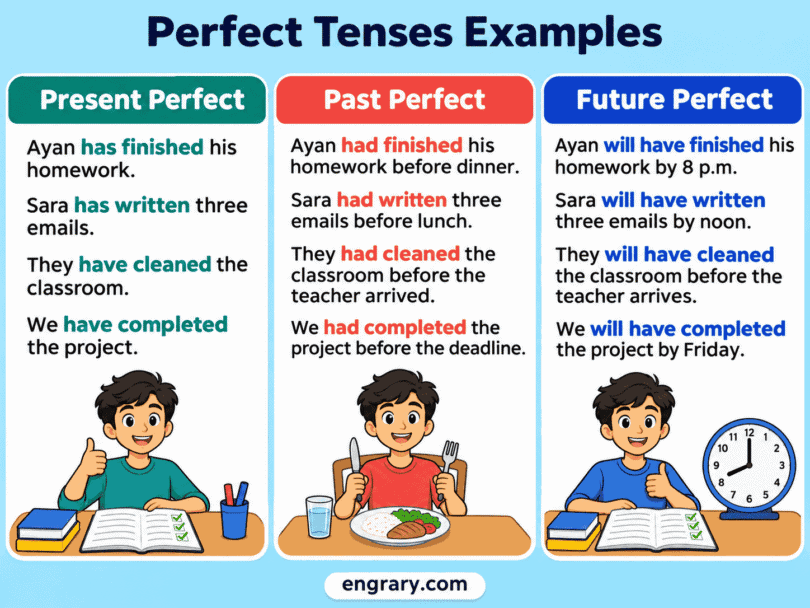
Perfect tenses connect an earlier action, event, or state to a later reference point. They use a form of have followed by a past participle, as in has written, had arrived, and will have finished. Although these forms often describe completed actions, they can also express experiences, continuing states, repeated events, and duration.
Below are 150 perfect tense examples divided equally among the present perfect, past perfect, and future perfect. You will find affirmative sentences, negative sentences, questions, and short answers for each form. In addition, clear comparison tables show how the three tenses express different relationships in time.
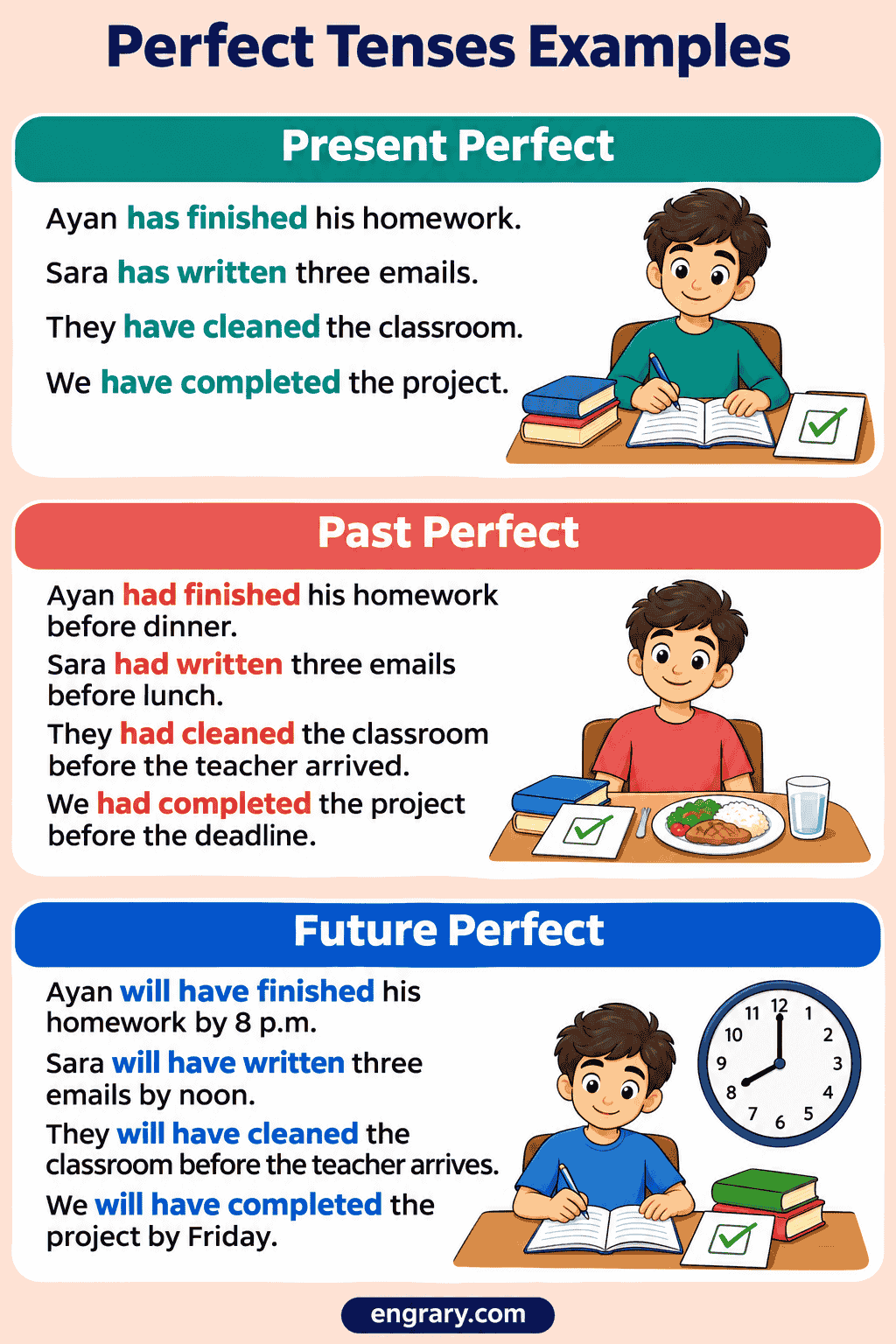
Perfect Tenses Examples at a Glance
Perfect tenses show how something earlier relates to the present, a past moment, or a future point. Therefore, the reference point—not completion alone—determines the meaning.
| Perfect tense | Structure | Main time relationship | Example |
|---|---|---|---|
| Present perfect | have/has + past participle | Before or up to the present | She has completed the report. |
| Past perfect | had + past participle | Before a past reference point | She had completed the report before noon. |
| Future perfect | will have + past participle | Before a future reference point | She will have completed the report by noon. |
- The present perfect looks back from now.
- The past perfect looks back from a point in the past.
- The future perfect looks back from a point in the future.
Structures of Perfect Tenses
Every perfect tense combines an auxiliary form of have with the past participle of the main verb. However, the auxiliary changes according to the reference time.
Affirmative Structures
| Tense | Structure | Example |
|---|---|---|
| Present perfect | Subject + have/has + past participle | They have started the meeting. |
| Past perfect | Subject + had + past participle | They had started the meeting. |
| Future perfect | Subject + will have + past participle | They will have started the meeting. |
Negative Structures
| Tense | Structure | Example |
|---|---|---|
| Present perfect | Subject + have/has not + past participle | They have not started the meeting. |
| Past perfect | Subject + had not + past participle | They had not started the meeting. |
| Future perfect | Subject + will not have + past participle | They will not have started the meeting. |
Question Structures
| Tense | Structure | Example |
|---|---|---|
| Present perfect | Have/Has + subject + past participle? | Have they started the meeting? |
| Past perfect | Had + subject + past participle? | Had they started the meeting? |
| Future perfect | Will + subject + have + past participle? | Will they have started the meeting? |
Perfect-tense negatives and questions do not require do, does, or did. Instead, move the first auxiliary before the subject to form a question: She has arrived becomes Has she arrived?
Past Participles in Perfect Tenses
The main verb in every perfect construction takes its past-participle form. Regular past participles commonly end in -ed, while irregular participles must be learned individually.
Regular Past Participles
| Base form | Past participle | Perfect-tense example |
|---|---|---|
| finish | finished | She has finished her work. |
| clean | cleaned | They had cleaned the room. |
| complete | completed | We will have completed the project. |
| study | studied | He has studied the chapter. |
| repair | repaired | The mechanic had repaired the car. |
Irregular Past Participles
| Base form | Simple past | Past participle | Perfect-tense example |
|---|---|---|---|
| go | went | gone | Ali has gone home. |
| write | wrote | written | She had written the email. |
| eat | ate | eaten | We have eaten lunch. |
| see | saw | seen | I have seen that film. |
| take | took | taken | He had taken the keys. |
| speak | spoke | spoken | They have spoken to the manager. |
| choose | chose | chosen | We will have chosen a winner. |
| break | broke | broken | The child has broken the toy. |
| begin | began | begun | The program has begun. |
| do | did | done | She has done her homework. |
Always place a past participle—not a simple-past form—after the perfect auxiliary. For example, write has gone, not has went.
50 Present Perfect Tense Examples
The present perfect connects an earlier action or state to the present. For instance, it can describe a current result, a life experience, a continuing situation, a repeated action, or an event within an unfinished period.
Affirmative Present Perfect Sentences
- She has already submitted her application.
- I have visited Islamabad several times.
- They have lived in this neighborhood since 2018.
- The children have just finished lunch.
- Our English has improved considerably this year.
- Ahmed has written three reports today.
- We have known each other for ten years.
- My sister has recently started a new job.
- The weather has become warmer this week.
- I have never ridden a horse.
- Sara has won two competitions so far.
- The mechanic has repaired the car, so we can drive it now.
- Scientists have discovered a new species in the region.
- He has always wanted to learn Arabic.
- We have watched that documentary twice.
- The city has grown rapidly over the past decade.
- My parents have owned this house since 2005.
- The teacher has explained the rule clearly.
- I have read five chapters today.
- This is the best meal I have ever tasted.
- Ayesha has lost her keys, so she cannot open the door.
- The team has achieved all its goals this season.
- You have made excellent progress so far.
- Our guests have arrived, and they are waiting downstairs.
- Prices have increased several times this month.
These sentences demonstrate results, experiences, duration, repetition, and unfinished time. Notice that expressions such as today, this week, and this month work when the speaker views those periods as unfinished.
Negative Present Perfect Sentences
- I have not finished the assignment yet.
- She has not called me today.
- We haven’t seen that new film.
- Hamza hasn’t visited his grandparents recently.
- The bus has not arrived yet.
- They have never tried Pakistani food.
- My phone hasn’t worked properly since Monday.
- The students have not completed the final unit.
- He hasn’t made a decision so far.
- I have not spoken to the manager this week.
- The shop hasn’t opened yet.
- We have not received any complaints this month.
- Nadia hasn’t felt well for several days.
- The company has not changed its policy.
- You haven’t answered my question yet.
Present Perfect Questions and Short Answers
- Have you finished the report yet? Yes, I have.
- Has Sana ever traveled abroad? No, she hasn’t.
- Have they received our message? Yes, they have.
- Has the rain stopped yet? No, it hasn’t.
- How long have you known your best friend? I have known her for eight years.
- Have we met before? Yes, we have.
- Has Bilal completed the course? Yes, he has.
- Have the children eaten breakfast? No, they haven’t.
- How many books has she written? She has written four.
- Have I explained the instructions clearly? Yes, you have.
In present perfect questions, ever commonly asks about experience, whereas yet asks whether an expected action has happened. Moreover, how long asks about duration up to the present.
50 Past Perfect Tense Examples
The past perfect places an action, experience, or state before another past reference point. It often clarifies which of two past events happened first. Nevertheless, speakers may omit it when words such as before or after make the sequence completely clear and no emphasis is necessary.
Affirmative Past Perfect Sentences
- The train had left before we reached the station.
- She had never seen snow before she moved north.
- They were tired because they had walked for hours.
- By midnight, the team had completed the installation.
- I wish I had accepted the offer.
- Ahmed had already eaten when his friends invited him to dinner.
- The ground was wet because it had rained during the night.
- We had lived in Lahore for six years before moving to Karachi.
- The students had studied the topic before the test began.
- She said that she had misplaced the documents.
- Once the guests had arrived, the host served dinner.
- He recognized the village because he had visited it previously.
- By that time, the doctor had treated more than twenty patients.
- The children had fallen asleep before their father returned.
- I had never spoken in public until then.
- The workers had repaired the bridge by the end of May.
- After we had checked the figures, we sent the report.
- Her plants died because she had forgotten to water them.
- The shop had closed by the time we arrived.
- If they had followed the map, they would not have become lost.
- He had planned to study abroad, but his circumstances changed.
- The audience applauded after the singer had finished the song.
- We had known each other for years before we became business partners.
- The police discovered that someone had broken a window.
- She felt confident because she had prepared thoroughly.
Negative Past Perfect Sentences
- I had not seen the warning before I entered the room.
- She hadn’t finished the report when the meeting began.
- They had never flown before their trip to Dubai.
- The team had not scored by the end of the first half.
- We hadn’t received the invitation before the event.
- He had not learned to drive by that time.
- The guests hadn’t arrived when dinner was served.
- Mariam had not visited the museum until then.
- I hadn’t realized how late it was.
- The mechanic had not repaired the engine before the owner returned.
- They hadn’t saved enough money to buy the house.
- The teacher had not explained that rule before the test.
- We hadn’t met each other before that conference.
- The snow had not melted by the time the road reopened.
- He hadn’t completed the application before the deadline passed.
Past Perfect Questions and Short Answers
- Had the guests arrived before dinner began? Yes, they had.
- Had Ali completed the form by then? No, he hadn’t.
- Had you ever visited the city before that trip? Yes, I had.
- Why had she left before the ceremony ended? She had received an urgent call.
- Had the workers repaired the road before winter? No, they hadn’t.
- How long had they lived there before moving? They had lived there for five years.
- Had the film started when you entered the cinema? Yes, it had.
- Had we discussed that problem earlier? No, we hadn’t.
- What had he done before joining the company? He had worked as a teacher.
- Had the children eaten before they went to school? Yes, they had.
50 Future Perfect Tense Examples
The future perfect describes an action or achievement that will be complete before a specified future time. It can also measure duration up to a future point or express an assumption about an event that has probably occurred by now.
Affirmative Future Perfect Sentences
- She will have completed the course by June.
- We will have lived here for ten years by next spring.
- The workers will have repaired the road before winter begins.
- By Friday, I will have written all five reports.
- He will have arrived by now.
- The students will have finished their exams by noon.
- By next year, the company will have opened three new branches.
- They will have saved enough money by the end of the year.
- The chef will have prepared dinner before the guests arrive.
- By 2030, she will have taught at the school for twenty years.
- We will have reached the airport before rush hour begins.
- The builders will have completed the house within six months.
- By the time you wake up, I will have left for work.
- Researchers will have collected enough data by the next review.
- The team will have played thirty matches by the end of the season.
- By tomorrow evening, you will have received the confirmation email.
- My parents will have been married for forty years next month.
- The river will have risen considerably after two days of rain.
- By the end of this lesson, we will have learned all three perfect forms.
- The technicians will have installed the equipment before Monday.
- In another hour, the travelers will have crossed the border.
- By age sixty, he will have worked in medicine for thirty-five years.
- The committee will have chosen a winner by then.
- Before the shop closes, I will have bought everything we need.
- By the time the guests arrive, Sana will have decorated the hall.
Negative Future Perfect Sentences
- I will not have finished the book by tonight.
- She won’t have arrived before the meeting starts.
- They will not have completed the bridge by June.
- We won’t have saved enough money within three months.
- The children will not have returned before sunset.
- He won’t have learned all the vocabulary by Friday.
- The team will not have played ten matches by then.
- You won’t have received the parcel before Monday.
- The builders will not have painted every room by tomorrow.
- I won’t have worked here for a full year until August.
- The snow will not have melted before morning.
- She won’t have read the entire report by lunchtime.
- They will not have reached the village before dark.
- The company won’t have opened its new office by the end of May.
- We will not have solved every problem within one meeting.
Future Perfect Questions and Short Answers
- Will you have finished the assignment by Friday? Yes, I will.
- Will they have arrived before sunset? No, they won’t.
- Will she have completed the course by June? Yes, she will.
- How many chapters will you have read by tomorrow? I will have read six.
- Will the workers have repaired the road before winter? Yes, they will.
- How long will he have lived abroad by next year? He will have lived there for a decade.
- Will we have saved enough money by December? No, we won’t.
- By what time will the train have arrived? It will have arrived by nine.
- Will the students have taken all their exams by then? Yes, they will.
- Will I have learned enough to hold a conversation? Yes, you will.
Perfect Tenses with Common Time Expressions
Time expressions often help establish the reference point. However, they serve as clues rather than automatic tense selectors, so the surrounding meaning still matters.
| Time expression | Common tense | Purpose | Example |
|---|---|---|---|
| already | Present or past perfect | Earlier than expected | She has already called. |
| yet | Present perfect | Expected action | He hasn’t arrived yet. |
| just | Present perfect | Very recent event | We have just eaten. |
| ever | Present or past perfect | Experience at any time | Have you ever flown? |
| never | Any perfect tense | No experience or occurrence | I have never tried it. |
| for | Any perfect tense | Duration | They have lived here for years. |
| since | Present or past perfect | Starting point | She has worked here since May. |
| before | Past or future perfect | Earlier event | He had left before noon. |
| by | Past or future perfect | Completion deadline | We will have finished by Friday. |
| by the time | Past or future perfect | Reference event | She had gone by the time I arrived. |
| so far | Present perfect | Up to the present | We have completed four units so far. |
- For introduces a duration: for three hours or for six years.
- Since introduces a starting point: since Monday or since 2020.
- By sets a deadline or endpoint: by noon or by next week.
- Until emphasizes continuation up to a point and does not always imply completion.
Perfect Tenses in a Short Paragraph
Zara has researched her presentation topic thoroughly, so she now understands its main arguments. Before meeting her teacher yesterday, she had collected several reliable examples and had organized her notes into sections. By the time she gives the presentation next Monday, she will have prepared every slide and will have practiced her speech several times.
| Sentence extract | Tense | Reference point | Meaning |
|---|---|---|---|
| has researched | Present perfect | Now | The earlier research supports her present understanding. |
| had collected | Past perfect | Yesterday’s meeting | The collection happened before the meeting. |
| had organized | Past perfect | Yesterday’s meeting | The organization happened before the meeting. |
| will have prepared | Future perfect | Next Monday | The slides will be ready before the presentation. |
| will have practiced | Future perfect | Next Monday | The practice will occur before the presentation. |
Differences Among the Three Perfect Tenses
The same main verb can express three different relationships when the reference point changes.
| Tense | Example | Time meaning |
|---|---|---|
| Present perfect | Sara has written the report. | The completed report matters now. |
| Past perfect | Sara had written the report before the meeting. | The writing happened before a past meeting. |
| Future perfect | Sara will have written the report by noon. | The writing will be complete before a future deadline. |
A simple memory guide can help:
- Have/has + past participle refers to something before or up to now.
- Had + past participle refers to something before a past point.
- Will have + past participle refers to something before a future point.
Present Perfect and Simple Past Examples
The present perfect connects the past with now, whereas the simple past places an event in a finished past period.
| Present perfect | Simple past | Difference |
|---|---|---|
| I have visited Karachi several times. | I visited Karachi last year. | Unspecified experience versus a finished time |
| She has completed the assignment. | She completed the assignment yesterday. | Present result versus a dated past event |
| We have known him for years. | We met him in 2020. | Continuing state versus a finished event |
Consequently, finished-time expressions such as yesterday, last month, and in 2022 normally require the simple past. An unfinished expression such as today can take the present perfect when the speaker views that period as continuing.
Past Perfect and Simple Past Examples
When two past events appear together, the past perfect can mark the earlier event, while the simple past commonly marks the later one.
| Earlier event in the past perfect | Later event in the simple past | Event order |
|---|---|---|
| The bus had left | we arrived at the stop. | The bus left first. |
| She had cooked dinner | the guests came at eight. | Cooking happened first. |
| They had saved enough money | they bought the car. | Saving happened first. |
However, the past perfect is not compulsory in every sequence. For example, After she finished dinner, she washed the dishes already presents the order clearly.
Future Perfect and Simple Future Examples
The future perfect looks back on a completed future result, whereas the simple future merely states a future action, decision, prediction, or promise.
| Future perfect | Simple future | Difference |
|---|---|---|
| I will have completed the work by Friday. | I will complete the work on Friday. | Completion before a deadline versus an action scheduled for that day |
| She will have arrived before noon. | She will arrive at noon. | Earlier completion versus a scheduled arrival |
| They will have built the house by June. | They will build a house next year. | A completed future result versus a future plan |
Perfect Simple and Perfect Continuous Forms
Perfect simple forms usually emphasize a result, quantity, achievement, or state. In contrast, perfect continuous forms commonly emphasize an activity, its duration, or its temporary nature.
| Perfect simple | Perfect continuous | Main focus |
|---|---|---|
| She has written five articles. | She has been writing articles all day. | Result or quantity versus ongoing activity |
| He had repaired the machine. | He had been repairing the machine. | Completed result versus an earlier process |
| They will have completed three projects. | They will have been working for six hours. | Achievement versus duration |
Some stative verbs, including know, own, and believe, rarely appear in continuous forms. Therefore, We have known her for years sounds natural, while We have been knowing her for years does not.
Common Errors in Perfect Tense Sentences
Most perfect-tense mistakes involve an incorrect participle, an unsuitable time expression, or an unnecessary form of do.
| Incorrect sentence | Correct sentence | Explanation |
|---|---|---|
| She has went home. | She has gone home. | Use the past participle gone. |
| He has wrote a letter. | He has written a letter. | The past participle of write is written. |
| I have seen him yesterday. | I saw him yesterday. | Use the simple past with a finished time. |
| They had ate before we arrived. | They had eaten before we arrived. | Use eaten, not ate. |
| We will have finish by noon. | We will have finished by noon. | Use a past participle after will have. |
| Did she have completed the form? | Had she completed the form? | Do not use did in a past perfect question. |
| He has lived here since five years. | He has lived here for five years. | Use for with a duration. |
| She has worked here for 2020. | She has worked here since 2020. | Use since with a starting point. |
| They will has arrived by then. | They will have arrived by then. | Use have after will. |
| I haven’t never visited it. | I have never visited it. | Avoid a double negative. |
Tips for Recognizing Perfect Tenses
- First, find have, has, had, or will have.
- Next, check whether a past participle follows the auxiliary.
- Then, identify the present, past, or future reference point.
- Look for signals such as already, yet, since, before, and by.
- Do not choose a tense from a time word alone; instead, consider the complete meaning.
- Check irregular verbs carefully because their simple-past and past-participle forms may differ.
- Remember that perfect tenses express time relationships, not only completed actions.
- Finally, use the surrounding context to decide whether the form connects to now, a past event, or a future deadline.
FAQs
The three perfect tenses are the present perfect, past perfect, and future perfect. The present perfect connects an earlier action to now, the past perfect places an action before another past point, and the future perfect describes something completed before a future point. For example: has arrived, had arrived, and will have arrived.
All perfect tenses contain a form of have followed by the past participle of the main verb. The present perfect uses have or has, the past perfect uses had, and the future perfect uses will have. For instance, has written, had written, and will have written all contain the past participle written.
No. Perfect tenses often describe completed actions, but they can also express experiences, repeated events, continuing states, and duration. For example, She has lived here for five years describes a state that began in the past and continues now. Therefore, the connection to a reference point matters more than completion alone.
The simple past places an action in a finished past period, while the present perfect connects an earlier action or state to the present. For example, I visited Lahore last year includes a finished time. In contrast, I have visited Lahore several times describes an experience without specifying a finished past time.
The present perfect commonly appears with already, yet, just, ever, never, for, and since. The past perfect often uses before, already, and by the time, while the future perfect frequently uses by, before, and by the time. However, context determines the correct tense because these expressions do not select a tense by themselves.
You May Also Like
- Perfect Tenses in English
- Present Perfect Tense
- Past Perfect Tense
- Future Perfect Tense
- Perfect Continuous Tenses
- Past Participles
- Simple Tenses Examples
- Continuous Tenses Examples

Leave a Comment