
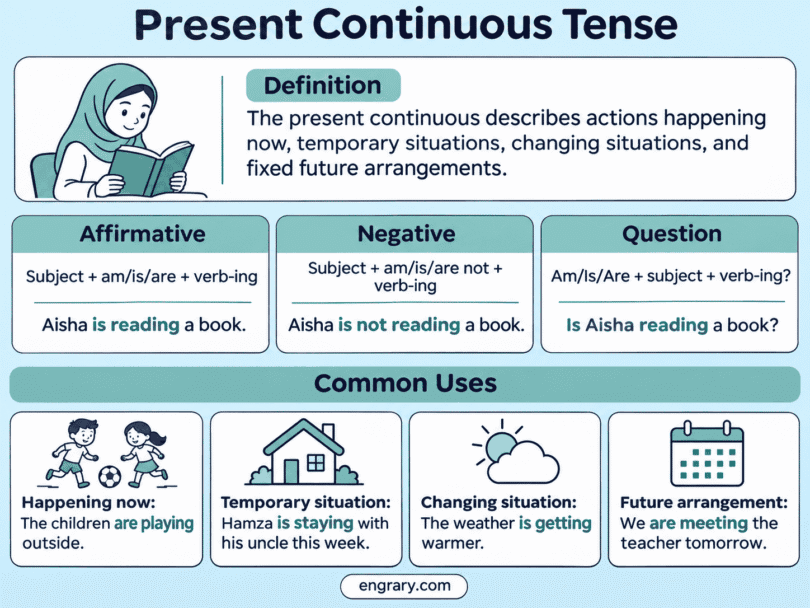
The present continuous tense describes actions in progress, temporary situations, developing changes, and definite future arrangements. It uses a present form of be—am, is, or are—followed by the -ing form of the main verb, as in I am reading, She is working, and They are waiting.
This guide explains present continuous structures, uses, spelling rules, contractions, questions, stative verbs, passive forms, and common time expressions. In addition, comparison tables show how the tense differs from the present simple, be going to, and other related forms.
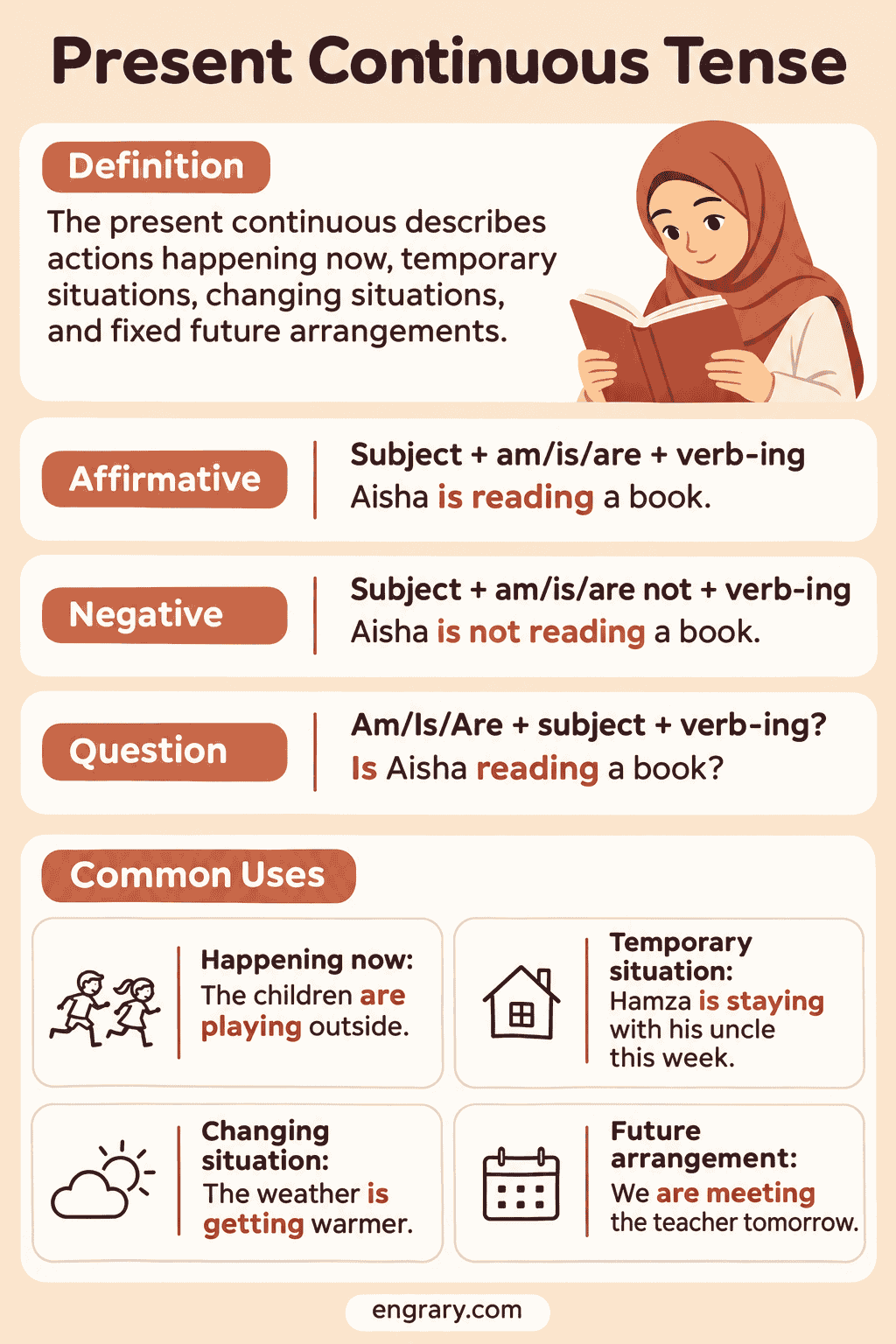
Present Continuous Tense at a Glance
The present continuous, also called the present progressive, presents an action or situation as ongoing, unfinished, temporary, or developing. Although it often describes something happening now, it can also refer to a wider current period or an arranged future event.
| Sentence Type | Structure | Example |
|---|---|---|
| Affirmative | Subject + am/is/are + verb-ing | She is studying. |
| Negative | Subject + am/is/are + not + verb-ing | She is not studying. |
| Yes-or-no question | Am/Is/Are + subject + verb-ing? | Is she studying? |
| Wh-question | Wh-word + am/is/are + subject + verb-ing? | What is she studying? |
| Subject question | Who/What + is + verb-ing? | Who is studying? |
| Short answer | Yes, subject + am/is/are. | Yes, she is. |
Three points matter in every present continuous construction:
- The subject determines whether the auxiliary is am, is, or are.
- The main verb takes the -ing form.
- The intended meaning determines whether the form refers to the present or an arranged future event.
Present Continuous Forms of Be
The auxiliary verb must agree with the subject. Therefore, learners need to choose am, is, or are before adding the present participle.
| Subject | Form of Be | Example |
|---|---|---|
| I | am | I am working. |
| he, she, it | is | She is working. |
| singular noun | is | The teacher is working. |
| you, we, they | are | They are working. |
| plural noun | are | The teachers are working. |
The verb be carries the tense and agrees with the subject, while the -ing verb expresses the activity. Consequently, changing the subject may change the auxiliary, but it does not change the main verb: I am reading, he is reading, and they are reading.
Subject–Verb Agreement with Am, Is, and Are
Some subjects create agreement problems because their grammatical number may not match their apparent meaning.
| Subject | Correct Example |
|---|---|
| everyone | Everyone is waiting. |
| nobody | Nobody is listening. |
| each student | Each student is working. |
| one of the students | One of the students is presenting. |
| the people | The people are leaving. |
| Ali and Sara | Ali and Sara are studying. |
| my family | My family is travelling. |
| the police | The police are investigating the complaint. |
Indefinite pronouns such as everyone, someone, nobody, and each normally take is. In contrast, coordinated subjects joined by and usually take are. Collective nouns may vary by dialect and meaning, but singular agreement is common when the group acts as one unit.
Present Continuous Tense Structures
Affirmative Sentences
Affirmative sentences follow this pattern:
Subject + am/is/are + verb-ing
- I am checking the report.
- You are speaking too quickly.
- Hamza is preparing dinner.
- The dog is sleeping near the door.
- We are discussing the new schedule.
- The children are playing outside.
When two activities share the same subject and time, one auxiliary can support both participles:
- She is reading and taking notes.
- They are singing and dancing.
- I am cleaning the kitchen and preparing dinner.
Negative Sentences
Place not after am, is, or are:
Subject + am/is/are + not + verb-ing
- I am not using the computer.
- She is not attending the meeting.
- We are not changing the plan.
- The children are not sleeping.
In conversation and informal writing, is not usually becomes isn’t, while are not becomes aren’t:
- He isn’t feeling well.
- They aren’t waiting for us.
English has no widely accepted affirmative contraction amn’t. Therefore, speakers say I’m not leaving, not I amn’t leaving.
Yes-or-No Questions
Move the auxiliary before the subject:
Am/Is/Are + subject + verb-ing?
- Am I speaking clearly?
- Are you waiting for someone?
- Is Nadia working today?
- Is the bus coming?
- Are the students taking notes?
Do not add do or does. The auxiliary be already forms the question.
Short Answers
Short answers repeat the appropriate form of be, not the main verb.
| Question | Positive Answer | Negative Answer |
|---|---|---|
| Are you working? | Yes, I am. | No, I’m not. |
| Is she studying? | Yes, she is. | No, she isn’t. |
| Is he coming? | Yes, he is. | No, he isn’t. |
| Are they waiting? | Yes, they are. | No, they aren’t. |
Positive short answers normally use the full auxiliary. For example, Yes, she is sounds natural, whereas Yes, she’s is incomplete.
Wh-Questions
Place the question word before the auxiliary:
Wh-word + am/is/are + subject + verb-ing?
- What are you reading?
- Where is she staying?
- When are they leaving?
- Why is the baby crying?
- Who are you calling?
- Which route are we taking?
- How are the children coping?
Subject Questions
In a subject question, who or what performs the action. Therefore, no separate subject follows the auxiliary:
- Who is calling?
- What is making that noise?
- Which student is presenting first?
| Subject Question | Information Question |
|---|---|
| Who is calling you? | Who are you calling? |
| What is making that sound? | What are they making? |
| Which student is helping you? | Which student are you helping? |
Negative Questions
Negative questions can express surprise, expectation, concern, criticism, or a request for confirmation.
- Isn’t she coming with us?
- Aren’t they waiting outside?
- Is he not attending the interview?
- Are you not feeling well?
Contracted forms usually sound more natural in conversation. Full forms can sound more formal or emphatic.
Question Tags
Present continuous question tags repeat the auxiliary and reverse the polarity of the statement.
| Statement | Question Tag |
|---|---|
| You’re working, | aren’t you? |
| She’s coming, | isn’t she? |
| They aren’t waiting, | are they? |
| He isn’t sleeping, | is he? |
| I’m late, | aren’t I? |
Although I’m contains am, standard English normally uses aren’t I? as its question tag.
Present Continuous Contractions
Contractions make the tense sound natural in conversation and informal writing.
| Full Form | Contraction |
|---|---|
| I am | I’m |
| you are | you’re |
| he is | he’s |
| she is | she’s |
| it is | it’s |
| we are | we’re |
| they are | they’re |
| is not | isn’t |
| are not | aren’t |
The forms he’s, she’s, and it’s can also represent he has, she has, and it has. The following word reveals the meaning: She’s working means She is working, while She’s finished may mean She has finished.
Present-Participle Spelling Rules
Most verbs simply take -ing. However, several spelling patterns require a change.
| Verb Pattern | Rule | Examples |
|---|---|---|
| Most verbs | Add -ing | work → working; read → reading |
| Final silent e | Remove e | make → making; write → writing |
| Final -ee, -ye, or -oe | Usually keep final e | see → seeing; dye → dyeing |
| Final -ie | Change ie to y | lie → lying; die → dying |
| Short stressed vowel + consonant | Double the final consonant | run → running; sit → sitting |
| Two syllables with final stress | Double the final consonant | begin → beginning; prefer → preferring |
| Unstressed final syllable | Do not normally double | open → opening; visit → visiting |
| Final -c | Add k before -ing | panic → panicking; picnic → picnicking |
Do not double final w, x, or y: snowing, fixing, and playing. In addition, British English commonly uses travelling and cancelling, while American English usually uses traveling and canceling.
Several easily confused forms deserve special attention:
| Base Verb | Correct -ing Form |
|---|---|
| age | aging or ageing |
| dye | dyeing |
| die | dying |
| lie | lying |
| singe | singeing |
| traffic | trafficking |
| mimic | mimicking |
| ski | skiing |
The distinction between dying and dyeing changes the meaning: a plant may be dying, while someone may be dyeing a shirt.
Main Uses of the Present Continuous Tense
Actions Happening Now
Use the present continuous for an activity occurring at the moment of speaking:
- The baby is sleeping.
- I am answering your question.
- The students are taking a test.
- Listen! Someone is knocking at the door.
- Look! The bus is coming.
Expressions such as now, right now, and at the moment often clarify this meaning. Nevertheless, the surrounding situation can make the current meaning clear without a time expression.
Actions Happening Around Now
An action can be in progress during the current period without occurring at this exact second:
- I am reading a book about climate change.
- She is learning Turkish.
- We are developing a new website.
- My brother is looking for a job.
For example, someone who says I am reading a long novel may not have the book open while speaking. The activity remains unfinished within the current period.
Temporary Situations
The tense can present a situation as limited or temporary:
- He is staying with his uncle this week.
- I am working from home for now.
- They are using a rented office this month.
- The family is living in Islamabad during the renovation.
The speaker’s viewpoint matters. A situation can last for months or even years and still feel temporary in contrast with a more permanent arrangement.
Temporary Habits
The present continuous can also describe actions repeated during a limited current period:
- I am walking to work this week.
- She is eating lunch at home these days.
- We are attending evening classes this month.
- He is taking the bus while his car is being repaired.
These actions occur repeatedly, but they do not represent permanent routines.
Changing and Developing Situations
Use the tense for changes, trends, and gradual developments:
- The weather is getting warmer.
- Food prices are rising.
- Her English is improving.
- More people are working remotely.
- The city is becoming increasingly crowded.
- The days are getting shorter.
Verbs such as become, change, grow, get, increase, decrease, improve, rise, and fall frequently appear in this use.
Definite Future Arrangements
The present continuous can describe a future arrangement that has already been organized:
- I am meeting the dentist at three.
- We are flying to Karachi on Monday.
- Sara is having lunch with her manager tomorrow.
- They are staying at a hotel next weekend.
A specific time, place, booking, ticket, appointment, or agreement often supports the arrangement. Importantly, the event does not have to happen in the near future: We are moving abroad next year can still describe a firm arrangement.
Repeated Behavior with Emotional Emphasis
Words such as always, constantly, continually, and forever can combine with the present continuous to show the speaker’s attitude:
- He is always losing his keys.
- She is constantly interrupting people.
- They are forever changing the schedule.
- You are always helping others.
This construction may express annoyance, criticism, surprise, affection, or praise. By contrast, the present simple usually reports a repeated action more neutrally.
Present Continuous for Scene Descriptions
The tense works naturally when someone describes a picture or a visible scene:
- A woman is standing near the window.
- Two children are playing with a ball.
- A bus is approaching the station.
- Several people are waiting in a queue.
- A man is carrying a large suitcase.
It also appears in demonstrations, live observations, and some sports commentaries. For example, a cook might say, I am adding the onions now, while a reporter might say, People are gathering outside the building.
In informal storytelling, speakers sometimes use the form to create a vivid scene:
I’m walking down the street, and this man is following me.
This narrative use feels immediate, although the events may belong to an earlier story.
Present Continuous with Be
The form am/is/are being usually describes temporary behavior rather than a general characteristic.
| General Characteristic | Temporary Behavior |
|---|---|
| He is rude. | He is being rude. |
| You are careless. | You are being careless today. |
| Sara is helpful. | Sara is being especially helpful. |
| The children are quiet. | The children are being unusually quiet. |
The continuous form often suggests that the person can control the behavior. Consequently, expressions such as I am being tall are normally incorrect because height is not temporary behavior.
Stative Verbs and the Present Continuous
Stative verbs describe conditions, knowledge, feelings, possession, relationships, perception, or appearance rather than dynamic activities. Therefore, they usually take the present simple.
Thoughts and Knowledge
Common verbs include know, understand, believe, remember, forget, mean, realize, and suppose:
- I know the answer.
- She understands the problem.
- We believe your explanation.
Feelings and Preferences
Common verbs include love, hate, like, dislike, prefer, want, need, and wish:
- He wants a glass of water.
- I prefer the blue design.
- They need more time.
Possession and Relationship
Common verbs include have, own, possess, belong, contain, include, and consist:
- This bag belongs to Nadia.
- She owns two apartments.
- The box contains old photographs.
Perception and Appearance
Common verbs include see, hear, smell, taste, seem, appear, and resemble:
- I can see a bird outside.
- We can hear music.
- The soup tastes delicious.
- Your idea seems practical.
With involuntary perception, English often uses can see, can hear, and can smell instead of a continuous form.
Stative and Dynamic Meanings
Some verbs can take either the present simple or present continuous because their meanings change.
| Stative Meaning | Dynamic Meaning |
|---|---|
| I think the plan is sensible. — hold an opinion | I am thinking about the plan. — consider |
| She has a new car. — possess | She is having lunch. — eat or experience |
| I see what you mean. — understand | I am seeing the dentist tomorrow. — meet |
| The soup tastes salty. — have a flavor | The chef is tasting the soup. — test |
| The flowers smell lovely. — have an odor | She is smelling the flowers. — use her nose deliberately |
| He appears tired. — seem | He is appearing in a play. — perform |
| She is polite. — characteristic | She is being polite. — temporary behavior |
| I feel the rule is unfair. — hold an opinion | The doctor is feeling my wrist. — examine by touch |
| She looks tired. — appear | She is looking at the screen. — direct her eyes |
| The parcel weighs two kilograms. — have a weight | The assistant is weighing the parcel. — measure |
| The room measures five metres across. — have a measurement | They are measuring the room. — calculate |
| This jacket fits me. — be the correct size | The tailor is fitting me for a jacket. — adjust or measure |
Modern advertising and informal speech sometimes use stative verbs continuously for emotional emphasis. However, learners should first master the standard patterns before adopting stylistic exceptions.
Adverb Placement in Present Continuous Sentences
Adverbs such as still, always, currently, probably, and definitely usually follow the form of be and precede the main participle.
| Adverb | Normal Position | Example |
|---|---|---|
| still | after be | She is still working. |
| always | after be | He is always complaining. |
| constantly | after be | They are constantly arguing. |
| currently | after be or initially | She is currently studying abroad. |
| probably | after be | We are probably leaving early. |
| definitely | after be | I am definitely attending. |
In negative sentences, currently often follows not: She is not currently working. Meanwhile, longer time expressions usually appear at the beginning or end: This week, I am working from home or I am working from home this week.
Word Order in Complete Sentences
A useful extended pattern is:
Subject + am/is/are + verb-ing + object + place + time
- She is reading a book in the library today.
- They are playing football at school this afternoon.
- We are discussing the budget in the conference room now.
Not every sentence needs all these elements. Still, the pattern helps learners place information naturally without separating the auxiliary from the main participle.
Present Continuous Passive Voice
The passive structure is:
Subject + am/is/are + being + past participle
It focuses on the receiver of an ongoing action rather than the performer.
| Form | Structure | Example |
|---|---|---|
| Affirmative | Subject + am/is/are being + past participle | The road is being repaired. |
| Negative | Subject + am/is/are not being + past participle | The hall is not being used. |
| Yes-or-no question | Am/Is/Are + subject + being + past participle? | Is the equipment being tested? |
| Wh-question | Wh-word + am/is/are + subject + being + past participle? | Why is the road being closed? |
| Active Form | Passive Form |
|---|---|
| Workers are repairing the road. | The road is being repaired. |
| The committee is reviewing the applications. | The applications are being reviewed. |
| Technicians are testing the equipment. | The equipment is being tested. |
State, Passive, and Continuous Passive Forms
Similar-looking constructions may express different meanings.
| Construction | Example | Meaning |
|---|---|---|
| State or adjective | The shop is closed. | The shop is not open. |
| Simple passive | The shop is closed at nine every night. | Someone closes it regularly. |
| Present continuous passive | The shop is being closed now. | The closing action is in progress. |
Therefore, is closed does not automatically mean the same thing as is being closed. The word being marks the ongoing passive action.
Present Continuous with Modal Meanings
Modal verbs do not combine directly with am, is, or are in one verb phrase. Instead, English uses:
modal + be + verb-ing
- She may be working.
- They could be waiting outside.
- He must be joking.
- The children might be sleeping.
These are modal continuous constructions rather than ordinary present continuous forms. Nevertheless, understanding the pattern prevents errors such as She may is working.
Present Continuous for Future Arrangements
The present continuous works best when the future event feels definite and organized. Evidence may include:
- An agreed time
- A specific place
- Another person’s involvement
- A booking or reservation
- A purchased ticket
- An appointment
For example:
- I am meeting Amina at the library at four.
- We are staying at the Pearl Hotel next weekend.
- The manager is interviewing three candidates tomorrow.
- My parents are flying to Dubai in December.
Do not use this form for every future meaning. Predictions, general intentions, and fixed timetables often require different constructions.
Present Continuous and Related Future Forms
Present Continuous and Be Going To
| Present Continuous | Be Going To |
|---|---|
| Emphasizes an organized arrangement | Emphasizes a prior intention |
| Often involves another person | Does not require an outside arrangement |
| Commonly includes a time or place | May remain general |
| I’m meeting Ali at six. | I’m going to visit Ali soon. |
Present Continuous and Present Simple for Future Events
| Present Continuous | Present Simple |
|---|---|
| Personal arrangement | Fixed timetable or official schedule |
| We are flying on Monday. | The flight leaves at 9:00. |
| I am meeting the teacher tomorrow. | The class begins tomorrow. |
Present Continuous and Will
| Present Continuous | Will |
|---|---|
| Definite arrangement | Prediction or spontaneous decision |
| I’m meeting Sara after work. | I’ll call Sara now. |
| We’re having dinner at eight. | I think dinner will be ready at eight. |
Present Continuous and Present Simple
The present simple generally presents a situation as regular, permanent, factual, or stative. In contrast, the present continuous presents it as ongoing, temporary, changing, or arranged.
| Present Simple | Present Continuous |
|---|---|
| Habits and routines | Actions happening now |
| General or permanent situations | Temporary situations |
| Facts and general truths | Changing situations |
| Stative meanings | Dynamic activities |
| Fixed schedules | Personal future arrangements |
| Neutral repeated behavior | Repetition with emotional emphasis |
| Present Simple Example | Present Continuous Example |
|---|---|
| She works at a bank. | She is working from home this week. |
| I read before bed. | I am reading a historical novel. |
| He is rude. | He is being rude today. |
| The train leaves at six. | We are leaving at six. |
| I think you are right. | I am thinking about your suggestion. |
Present Continuous and Present Perfect Continuous
| Present Continuous | Present Perfect Continuous |
|---|---|
| Focuses on an activity happening now or around now | Connects an earlier starting point to the present |
| I am studying English. | I have been studying English for two years. |
| She is waiting outside. | She has been waiting since noon. |
| Can describe a temporary period | Commonly emphasizes duration with for or since |
The present continuous can still include a planned duration: I am staying here for two weeks. However, when for or since identifies how long an action has continued up to now, the present perfect continuous is usually more natural.
Present Participle, Gerund, and Adjective Forms
Words ending in -ing can perform different grammatical jobs. Therefore, not every be + -ing sequence represents the present continuous.
| Form | Function | Example |
|---|---|---|
| Present participle | Forms a continuous verb construction | She is swimming. |
| Gerund | Functions as a noun | Swimming is good exercise. |
| Adjective | Describes a person or thing | The lesson is confusing. |
Compare the following pairs:
| Present Continuous Action | Adjective after Be |
|---|---|
| The speaker is boring the audience. | The speaker is boring. |
| The film is frightening the children. | The film is frightening. |
| The lesson is confusing the students. | The lesson is confusing. |
In The speaker is boring the audience, boring expresses an action with an object. In The speaker is boring, it describes the speaker.
Present Continuous Time Expressions
Time expressions provide useful context, but they do not automatically determine the tense.
| Context | Common Expressions |
|---|---|
| Happening now | now, right now, at the moment, currently |
| Temporary period | today, this week, this month, these days, for now |
| Continuing action | still |
| Developing change | gradually, increasingly, more and more |
| Future arrangement | tonight, tomorrow, this weekend, next week |
| Immediate observation | Look! Listen! |
Expressions such as any longer, anymore, and no longer can describe a temporary situation that is ending or has changed:
- She isn’t working there any longer.
- We aren’t using that system anymore.
- They are no longer living in the city.
Common Present Continuous Mistakes
| Incorrect | Correct | Explanation |
|---|---|---|
| She working now. | She is working now. | Add the correct form of be. |
| They is waiting. | They are waiting. | Use are with plural subjects. |
| Everyone are leaving. | Everyone is leaving. | Everyone takes singular agreement. |
| I am work today. | I am working today. | Use the -ing form. |
| He is runing. | He is running. | Double the final consonant. |
| She is writeing. | She is writing. | Remove the final silent e. |
| He is lieing down. | He is lying down. | Change final ie to y. |
| I am knowing the answer. | I know the answer. | Know usually describes a state. |
| This bag is belonging to me. | This bag belongs to me. | Belong is stative. |
| Where you are going? | Where are you going? | Place be before the subject. |
| Do you are working? | Are you working? | Do not add do to a question with be. |
| I am live here permanently. | I live here permanently. | Use the present simple for a permanent situation. |
| The road is repairing. | The road is being repaired. | Use being + past participle for the passive. |
| She may is working. | She may be working. | Use be after a modal verb. |
| I am meet Sara tomorrow. | I am meeting Sara tomorrow. | Use the present participle. |
| I’m not understand. | I don’t understand. | Use the present simple with stative understand. |
| She currently is not working. | She is not currently working. | Place the adverb naturally. |
Tips for Using the Present Continuous
- Choose am, is, or are according to the subject.
- Keep the main verb in its -ing form.
- Use the tense for actions happening now or around now.
- Use it for situations that the speaker views as temporary.
- Use it to describe changes and developing trends.
- Use it for future arrangements that already have specific details.
- Check whether a verb describes a state or an action.
- Pay attention to meaning-changing verbs such as think, have, and see.
- Do not add do or does to present continuous questions.
- Place frequency and certainty adverbs between be and the main participle.
- Treat time expressions as clues rather than automatic tense markers.
- Distinguish continuous verbs from gerunds and -ing adjectives.
FAQs
The present continuous tense, also called the present progressive, describes an action or situation that the speaker views as ongoing, temporary, changing, or arranged for the future. It uses am, is, or are followed by the -ing form of the main verb, as in She is studying.
Use subject + am/is/are + verb-ing for affirmative sentences. Add not after the form of be to create a negative. To form a question, place am, is, or are before the subject. For example, compare They are waiting, They are not waiting, and Are they waiting?
The present continuous describes actions happening now, unfinished activities occurring around the present, temporary situations, changing conditions, and definite future arrangements. It can also describe repeated behavior with words such as always when the speaker wants to express annoyance, criticism, surprise, affection, or praise.
Stative verbs such as know, understand, believe, want, need, prefer, own, and belong do not normally take continuous forms. However, some verbs can become dynamic when their meanings change. For example, I think you are right expresses an opinion, while I am thinking about the problem describes an active mental process.
The present simple generally describes habits, facts, permanent situations, and states. In contrast, the present continuous describes ongoing actions, temporary situations, changes, and personal future arrangements. Compare She works at a bank, which describes her regular employment, with She is working from home this week, which describes a temporary situation.
You May Also Like
- Present Tense in English
- Present Tense Examples
- Past Tense in English
- Past Tense Examples in Sentences
- Future Tense in English
- Future Tense Examples in Sentences
- Simple Tenses in English
- Simple Tenses Examples
- Continuous Tenses in English
- Continuous Tenses Examples
- Perfect Tenses in English
- Perfect Tenses Examples


Leave a Comment