
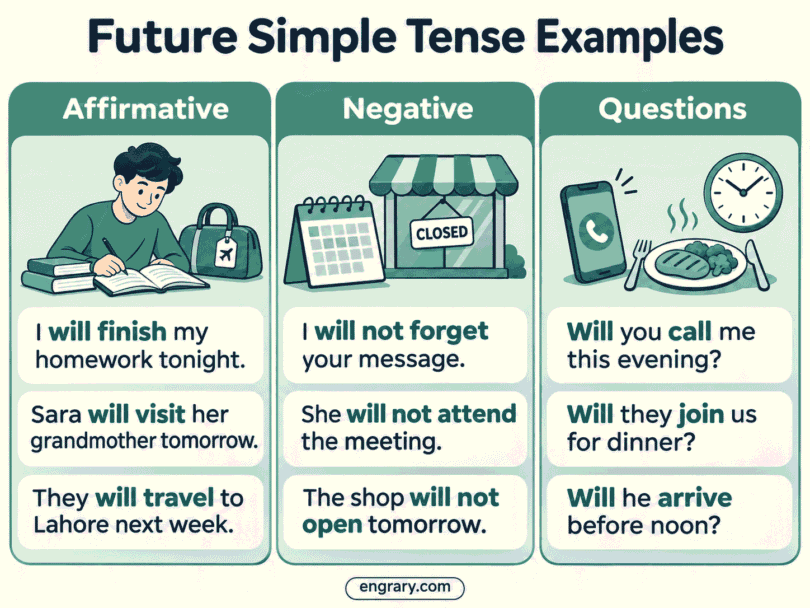
The future simple tense commonly uses will + the base form of a verb to express predictions, spontaneous decisions, promises, offers, requests, willingness, and expected future events. For example, I will call tonight, She will help you, and They won’t arrive early show different ways to discuss the future.
Below are 120 future simple tense examples organized by sentence type and purpose. The numbered collection includes affirmative sentences, negative sentences, questions, short answers, question tags, dialogues, conditional sentences, time clauses, and passive constructions. Additional sentences in the explanatory tables support the lesson but do not count toward the numbered total.
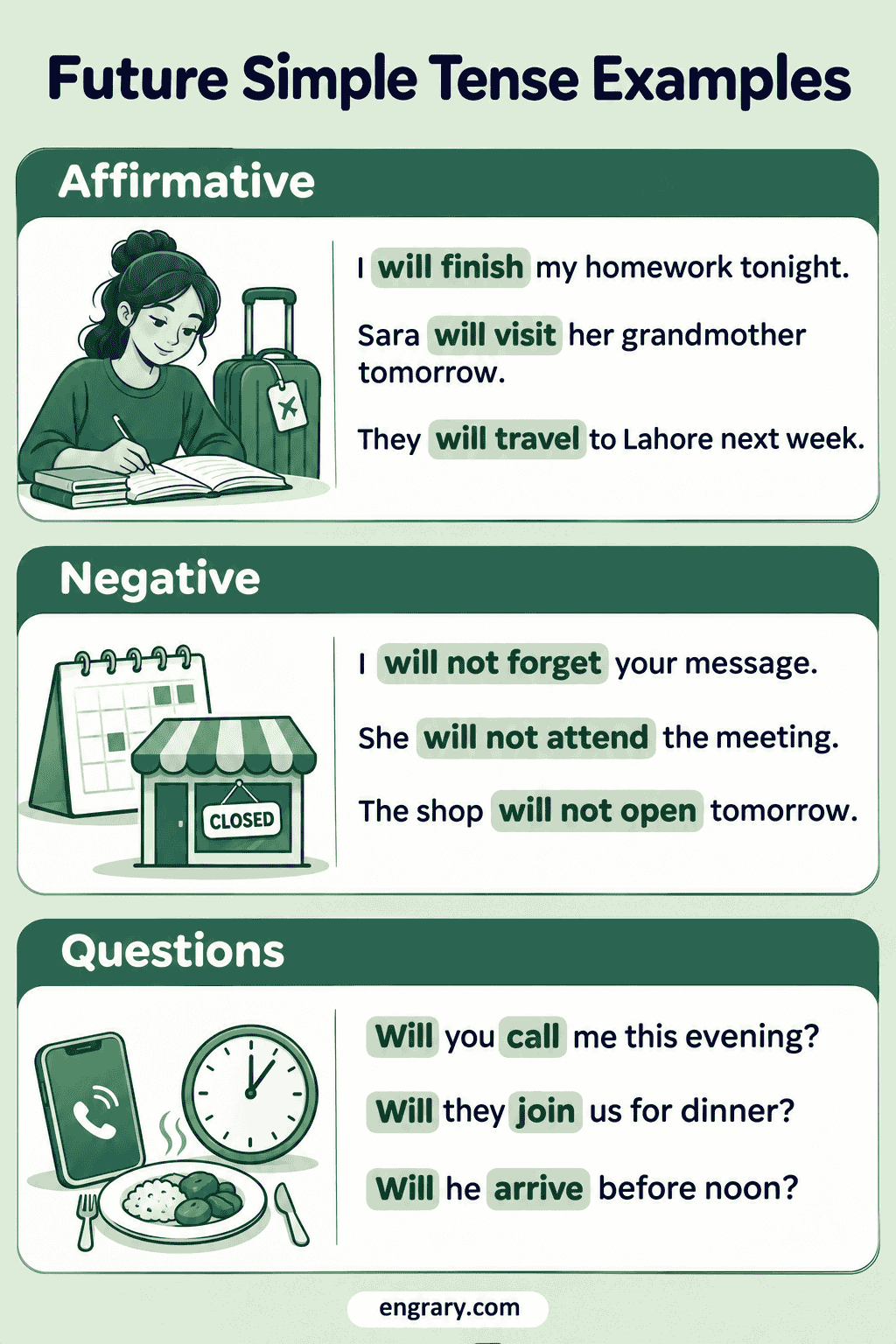
Future Simple Tense Examples at a Glance
The future simple has one main advantage: will stays the same with every subject. Moreover, the main verb always remains in its base form.
| Form | Structure | Example |
|---|---|---|
| Affirmative | Subject + will + base verb | She will call tomorrow. |
| Negative | Subject + will not + base verb | She will not call tomorrow. |
| Yes-or-no question | Will + subject + base verb? | Will she call tomorrow? |
| Wh-question | Wh-word + will + subject + base verb? | When will she call? |
| Short answer | Yes, subject + will. / No, subject + won’t. | Yes, she will. |
In everyday speech and informal writing, people often contract will to ’ll and will not to won’t. However, the full forms remain useful for emphasis and formal writing.
| Full Form | Contraction |
|---|---|
| I will | I’ll |
| you will | you’ll |
| he will | he’ll |
| she will | she’ll |
| it will | it’ll |
| we will | we’ll |
| they will | they’ll |
| will not | won’t |
35 Affirmative Future Simple Tense Examples
Affirmative future simple sentences follow the pattern subject + will + base verb. The examples below move from everyday actions to predictions, promises, immediate decisions, and offers.
Everyday Actions and Future Events
- I will call my parents after dinner.
- You will receive the confirmation email this afternoon.
- Hamza will bring the documents to the office.
- Ayesha will prepare lunch for the guests.
- The baby will sleep after her bath.
- We will visit the museum on Saturday.
- They will move into their new apartment next month.
- The school will reopen after the holidays.
- My cousins will stay with us for two nights.
- The bus will reach the city before sunset.
Predictions and Expectations
- I think our team will win the final.
- You will probably enjoy this novel.
- The weather will improve by the afternoon.
- Sara will certainly recognize your voice.
- Online learning will continue to influence education.
- The new bridge will reduce travel time.
- Perhaps the shop will offer a discount tomorrow.
- Scientists will discover more efficient energy sources.
Promises and Assurances
- I will return your book tomorrow.
- We will keep your information private.
- I will never forget your kindness.
- The company will replace the damaged product.
- I will explain everything when you are ready.
- We will support you throughout the project.
- The technician will solve the problem as quickly as possible.
Spontaneous Decisions
- I’ll answer the ringing phone.
- I’ll make some tea for everyone.
- We’ll take a taxi because the bus is late.
- I’ll check the address on my phone.
- I’ll pay for lunch today.
Offers and Willingness
- I’ll carry that heavy bag for you.
- We’ll help you decorate the hall.
- I’ll show you how the application works.
- Nadia will gladly guide the new students.
- My brother will drive you to the station.
25 Negative Future Simple Tense Examples
Negative sentences use will not + base verb. In conversation, won’t is much more common. Besides negating a future event, won’t can express refusal or describe something that fails to operate.
Negative Future Statements
- I won’t attend the workshop tomorrow.
- You won’t need a jacket in this weather.
- Bilal will not stay at the office after six.
- Mariam won’t take the early flight.
- The library won’t open during the public holiday.
- We will not change the schedule again.
- They won’t finish the building this month.
- My parents won’t travel during the rainy season.
- The children won’t watch television tonight.
- This ticket will not cover the return journey.
Negative Predictions
- I don’t think the rain will last all day.
- The team probably won’t lose another match.
- Prices will not remain this low for long.
- That small mistake won’t affect the final result.
- The road won’t be busy after midnight.
Refusal and Unwillingness
- He won’t admit that he made a mistake.
- The manager won’t discuss private employee records.
- My cat won’t eat this brand of food.
- They won’t cooperate without a written agreement.
- She won’t change her decision easily.
Malfunctions and Unavailable Services
- The car won’t start on cold mornings.
- My printer won’t connect to the wireless network.
- The door won’t close properly.
- The payment system won’t accept my card.
- The lift won’t operate during the power cut.
20 Future Simple Question Examples
To form a yes-or-no question, place will before the subject. For a Wh-question, put the question word first, followed by will + subject + base verb.
Yes-or-No Questions
- Will you attend the training session tomorrow?
- Will Ahmed collect the children from school?
- Will she remember to bring her passport?
- Will the hotel provide breakfast?
- Will we have enough time to visit the fort?
- Will they accept an online application?
- Will your sister join us for dinner?
- Will the package arrive before Friday?
- Will this medicine make me sleepy?
- Will there be enough seats for everyone?
Wh-Questions
- What will you cook for the guests?
- Where will they stay during the conference?
- When will the new term begin?
- Why will the shop close early today?
- Who will lead the next meeting?
- Which route will the driver take?
- How will we contact you during the journey?
- How long will the repairs take?
- How soon will the doctor see me?
- What time will your flight land?
10 Short Answers, Negative Questions, and Question Tags
Short answers repeat will or won’t, not the main verb. Meanwhile, negative questions can express expectation, surprise, persuasion, or an invitation. Question tags seek confirmation and reverse the polarity of the main statement.
Short Answers
- “Will Hina join the class?” “Yes, she will.”
- “Will the children need lunch?” “No, they won’t.”
- “Will there be a meeting?” “Yes, there will.”
- “Will your parents stay overnight?” “No, they won’t.”
Negative Questions
- Won’t you join us for dinner?
- Won’t the students need more time?
- Won’t she be tired after the journey?
Question Tags
- You’ll send me the details, won’t you?
- The shop will open tomorrow, won’t it?
- They won’t cancel the event, will they?
15 Future Simple Examples in Short Dialogues
Context makes the purpose of will clearer. In each dialogue, the bold sentence is the numbered target example.
- “The phone is ringing.” “I’ll answer it.”
- “These boxes are very heavy.” “I’ll carry one for you.”
- “We have run out of bread.” “I’ll buy some on my way home.”
- “Do you think Ali can pass the test?” “Yes, I think he will do well.”
- “Please don’t tell anyone.” “I won’t share your secret.”
- “The room feels warm.” “I’ll open the window.”
- “Can anyone meet the new employee?” “I’ll meet her at reception.”
- “Will the rain stop soon?” “It will probably clear up this evening.”
- “I can’t understand this form.” “I’ll help you complete it.”
- “Why is Usman still outside?” “He won’t come in until the meeting ends.”
- “We need someone to take notes.” “Fatima will do it.”
- “The guests are arriving early.” “Then I’ll prepare the room now.”
- “Will you be free after lunch?” “Yes, I’ll call you at two.”
- “The printer still isn’t working.” “I’ll ask the technician to check it.”
- “I’m nervous about the interview.” “You’ll perform better than you expect.”
10 First Conditional and Future Time-Clause Examples
The first conditional commonly follows if + present simple, will + base verb. Likewise, future time clauses normally use the present simple after when, before, after, until, once, and as soon as. Although the dependent clause uses a present form, the whole sentence refers to the future.
- If you study regularly, you will improve your vocabulary.
- We will postpone the picnic if it rains.
- If Sana calls, I will give her your message.
- They won’t complete the project unless everyone cooperates.
- If the traffic is light, we will arrive before noon.
- I will call you when I reach the hotel.
- We will eat after your father comes home.
- She won’t leave until the doctor gives her permission.
- I will submit the form before the office closes.
- The children will run outside as soon as the rain stops.
5 Future Simple Passive Examples
The future simple passive follows will be + past participle. It emphasizes the receiver of an action rather than the person or organization performing it.
- The final results will be announced tomorrow.
- Your order will be delivered within three working days.
- The damaged road will not be reopened this week.
- Will the winning design be displayed in the main hall?
- When will the new timetable be published?
Future Simple Examples by Use
The following table summarizes why speakers choose will. These supporting examples are separate from the numbered collection.
| Use | Example | Meaning |
|---|---|---|
| Prediction | I think the team will win. | The speaker gives an opinion about the future. |
| Spontaneous decision | I’ll take the blue one. | The speaker decides while speaking. |
| Promise | I will return the money tomorrow. | The speaker makes a commitment. |
| Offer | I’ll carry your suitcase. | The speaker offers help. |
| Request | Will you close the window? | The speaker asks someone to act. |
| Invitation | Will you join us for lunch? | The speaker invites someone. |
| Willingness | I’ll gladly help with the event. | The speaker agrees to act. |
| Refusal | He won’t answer the question. | The subject refuses to act. |
| Warning | You will regret ignoring the rules. | The speaker warns of a likely result. |
| Future fact | She will be twenty next month. | The sentence states a future fact. |
| Expected result | The new system will save time. | The speaker anticipates an outcome. |
Future Simple Examples with Time Expressions
Time expressions help establish a future context. Nevertheless, they do not automatically require will because English can express the future through several structures.
| Time Expression | Supporting Example |
|---|---|
| tomorrow | We will finish the report tomorrow. |
| tonight | I will call you tonight. |
| soon | The doctor will see you soon. |
| later | She will explain everything later. |
| next week | They will begin training next week. |
| next month | Our rent will increase next month. |
| next year | He will graduate next year. |
| in an hour | The shop will close in an hour. |
| someday | I will visit Türkiye someday. |
| by then | Everyone will know the result by then. |
| this evening | We will discuss the plan this evening. |
| in the future | Homes will use cleaner energy in the future. |
Future Simple with There Will Be
Use there will be to introduce a future event, situation, person, or thing. The form does not change for singular, plural, countable, or uncountable nouns.
| Form | Structure | Supporting Example |
|---|---|---|
| Affirmative | There will be + noun | There will be a meeting tomorrow. |
| Negative | There will not be + noun | There won’t be enough time. |
| Question | Will there be + noun? | Will there be any refreshments? |
| Short answer | Yes, there will. / No, there won’t. | Yes, there will. |
Future Simple with Be, Have, and Do
The verbs be, have, and do retain their base forms after will. They can describe future states, possession, circumstances, or actions.
| Verb | Supporting Example | Purpose |
|---|---|---|
| be | She will be ready by noon. | Future state |
| be | It will be cold tonight. | Future weather condition |
| be | He will be eighteen in June. | Future age |
| have | We will have enough time. | Future possession or circumstance |
| do | I will do the shopping tomorrow. | Future action |
Stative verbs also work naturally with the future simple. For instance, speakers can say I will know the answer tomorrow, She will understand later, and They will need more time.
Future Ability and Necessity
English does not normally place will directly before another modal such as can or must. Instead, use longer constructions for future ability and necessity.
| Meaning | Correct Structure | Supporting Example |
|---|---|---|
| Future ability | will be able to + base verb | She will be able to drive soon. |
| Future necessity | will have to + base verb | We will have to leave early. |
| Future need | will need to + base verb | You will need to show your ticket. |
Position of Certainty Adverbs
Adverbs help speakers express different levels of certainty. Usually, probably, definitely, and certainly follow will. However, probably normally comes before won’t in a negative sentence.
| Meaning | Natural Position | Supporting Example |
|---|---|---|
| Probability | will + probably | She will probably attend. |
| Strong certainty | will + definitely | They will definitely notice. |
| Strong certainty | will + certainly | He will certainly remember. |
| Negative probability | probably + won’t | She probably won’t attend. |
| Possibility | perhaps/maybe at the beginning | Perhaps she will call. |
Future Time Clauses and Embedded Questions
Do not normally use will inside a future time clause introduced by when. In contrast, an embedded question can contain will because it represents information that someone does not know or asks about.
| Construction | Supporting Example | Explanation |
|---|---|---|
| Future time clause | I’ll call when she arrives. | The clause identifies the time of the call. |
| Embedded question | I don’t know when she will arrive. | The clause represents unknown information. |
| Direct question | When will she arrive? | Will comes before the subject. |
Similarly, will can follow if when it expresses willingness rather than an ordinary condition. For example, If you will wait here, I’ll find the manager politely asks the listener to wait.
Future Simple and Related Future Forms
English uses several constructions to discuss the future. Therefore, the meaning and context—not merely the future time—determine the most natural form.
Will and Be Going To
| Meaning | Preferred Form | Supporting Example |
|---|---|---|
| Spontaneous decision | will | I’ll answer the phone. |
| Prior intention | be going to | I’m going to study tonight. |
| Opinion-based prediction | will | I think it will rain. |
| Evidence-based prediction | be going to | Look at those clouds. It’s going to rain. |
| Promise | will | I’ll help you. |
The forms sometimes overlap. Still, will often presents a prediction as an opinion, whereas be going to connects it to current evidence or an earlier intention.
Will and the Present Continuous
| Form | Main Use | Supporting Example |
|---|---|---|
| will + base verb | Prediction or immediate decision | I’ll call Sara now. |
| Present continuous | Organized personal arrangement | I’m meeting Sara at six. |
Will and the Present Simple
| Form | Main Use | Supporting Example |
|---|---|---|
| will + base verb | Prediction or expected result | The journey will take two hours. |
| Present simple | Fixed schedule or timetable | The train leaves at eight. |
Will and Would
| Form | Meaning or Tone | Supporting Example |
|---|---|---|
| will | Direct or neutral request | Will you help me? |
| would | Softer or more tentative request | Would you help me? |
| will | Future viewed from the present | She says she will call. |
| would | Future viewed from a past point | She said she would call. |
Future Simple with Will and Shall
Modern English generally uses will with every subject. However, shall remains common with I and we in offers and suggestions, particularly in British English. In formal or legal writing, shall may express an obligation rather than ordinary future time.
| Form | Common Use | Supporting Example |
|---|---|---|
| will | General future meaning | I will contact you tomorrow. |
| shall I | Offer or request for guidance | Shall I open the window? |
| shall we | Suggestion | Shall we begin? |
| formal shall | Obligation | The tenant shall pay the stated fee. |
The contraction shan’t means shall not, but it is uncommon outside British English.
Active and Passive Future Simple Forms
Active sentences focus on the performer of an action, whereas passive sentences focus on the receiver. Because these forms emphasize different information, the best choice depends on the context.
| Active Form | Passive Form |
|---|---|
| The committee will announce the results. | The results will be announced by the committee. |
| The company will deliver the order. | The order will be delivered by the company. |
| The school will publish the schedule. | The schedule will be published by the school. |
Common Mistakes with Future Simple Examples
| Incorrect | Correct | Explanation |
|---|---|---|
| She will goes home. | She will go home. | Use the base verb after will. |
| He wills call later. | He will call later. | Will does not change with the subject. |
| I will to help you. | I will help you. | Do not place to after will. |
| They don’t will come. | They won’t come. | Form the negative with will not. |
| Will she arrives early? | Will she arrive early? | Use the base verb in questions. |
| I will can help. | I will be able to help. | Do not combine will directly with can. |
| We will must leave. | We will have to leave. | Use will have to for future necessity. |
| I’ll call when I will arrive. | I’ll call when I arrive. | Use the present simple in a future time clause. |
| If it will rain, we’ll stay home. | If it rains, we’ll stay home. | Use the present simple in an ordinary condition clause. |
| She won’t probably attend. | She probably won’t attend. | Place probably before won’t. |
| I think she won’t come. | I don’t think she will come. | The corrected version often sounds more natural. |
| The meeting will starts soon. | The meeting will start soon. | Keep the main verb in its base form. |
Tips for Using Future Simple Sentences
- Keep the main verb in its base form after will.
- Use will for spontaneous decisions, promises, offers, and opinion-based predictions.
- Use be going to for prior intentions and evidence-based predictions.
- Use the present continuous for organized personal arrangements.
- Use the present simple for fixed schedules and timetables.
- Use won’t for negative future events, refusal, and failure to operate.
- Prefer contractions in conversation and informal writing.
- Use the present simple in ordinary future time and condition clauses.
- Place probably before won’t but after will.
- Consider the speaker’s viewpoint before choosing a future construction.
FAQs
The future simple tense is a construction commonly used for predictions, spontaneous decisions, promises, offers, requests, willingness, and expected future events. English normally forms it with will + the base form of a verb, as in She will call tomorrow. Traditional grammar calls it a tense, although modern grammar often analyzes will as a modal auxiliary.
An affirmative sentence follows subject + will + base verb. Add not after will to create a negative sentence, or place will before the subject to form a question. For example, compare They will arrive, They will not arrive, and Will they arrive? The main verb remains in its base form in every structure.
Common examples include I will call you tonight, She will probably accept the offer, They won’t arrive before noon, and Will you help me with this box? These sentences express an expected action, a prediction, a negative expectation, and a request. Therefore, the meaning of will depends on the surrounding context.
Will commonly expresses spontaneous decisions, promises, offers, and predictions based on opinions. In contrast, be going to usually describes prior intentions or predictions supported by present evidence. For instance, I’ll answer the phone expresses an immediate decision, whereas I’m going to buy a new phone describes an intention formed earlier.
Ordinary future time and condition clauses usually take the present simple, as in I’ll call when I arrive and If it rains, we’ll stay home. However, will can follow if when it expresses willingness, as in If you will wait here, I’ll get the manager. It also appears after when in embedded questions, such as I don’t know when she will arrive.
You May Also Like

Leave a Comment