

The present simple tense describes habits, routines, repeated actions, facts, states, and situations that usually remain true. It also appears in schedules, instructions, stories, commentaries, and future time clauses. Although its basic form looks simple, learners must understand subject–verb agreement, third-person spelling, auxiliary verbs, word order, and stative verbs to use it accurately.
This guide explains every major present simple structure and use with clear rules and practical examples. In addition, it covers the verb be, have and do, adverbs of frequency, pronunciation, passive forms, future meaning, common mistakes, and important comparisons. Therefore, learners can use the article both as an introduction and as a complete reference.
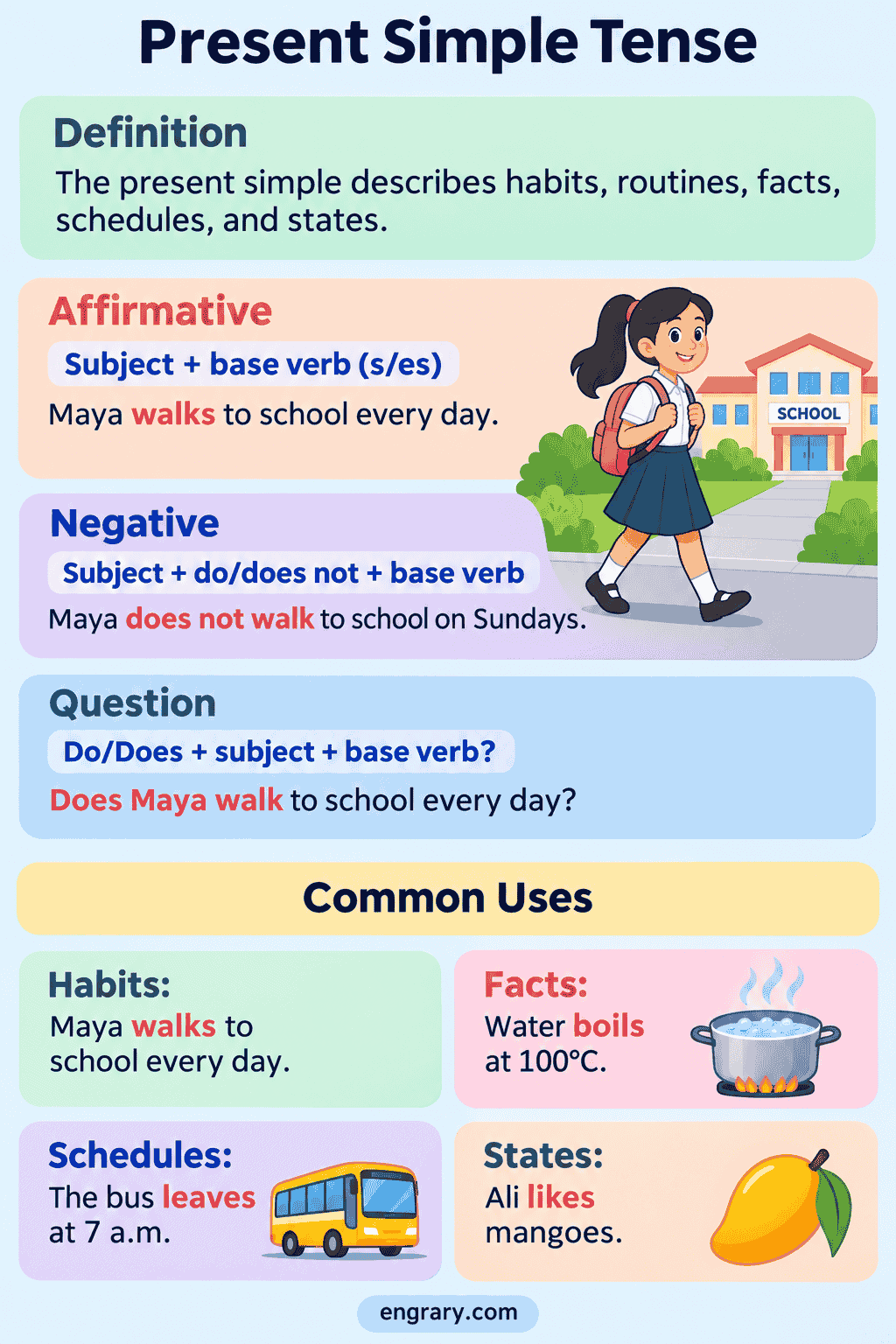
Present Simple Tense at a Glance
The present simple places an action or situation in the general present rather than at one specific moment. For example, I walk to work describes a routine, while Water freezes at 0°C states a general fact. Similarly, The train leaves at six refers to a fixed future schedule.
| Main use | Example | Meaning |
|---|---|---|
| Habit | I drink tea every morning. | The action happens regularly. |
| Routine | She starts work at nine. | The action forms part of a schedule. |
| Repeated action | They visit us twice a month. | The action occurs more than once. |
| General truth | Plants need sunlight. | The statement is generally true. |
| Long-term situation | We live near the coast. | The situation continues over time. |
| State or opinion | He believes your story. | The verb describes a state, thought, or feeling. |
| Fixed timetable | The flight arrives at 8:30. | An official schedule controls the event. |
| Future time clause | I will call when I arrive. | The present form follows a future time conjunction. |
Present Simple Tense Structures
Most present simple sentences use a base verb. However, affirmative sentences with he, she, or it require a third-person singular form, usually ending in -s or -es.
Affirmative Sentences
| Subject | Structure | Example |
|---|---|---|
| I, you, we, they | Subject + base verb | They play tennis. |
| He, she, it | Subject + verb-s/-es | She plays tennis. |
Additional examples include:
- I check my email after breakfast.
- You speak clearly.
- We study together on Fridays.
- They grow vegetables in their garden.
- Amir drives to the office.
- My sister teaches mathematics.
- The baby sleeps in this room.
- This machine produces clean water.
Negative Sentences
Use do not or don’t with I, you, we, and they. Use does not or doesn’t with he, she, and it. After doesn’t, always use the base verb.
| Subject | Structure | Example |
|---|---|---|
| I, you, we, they | Subject + do not + base verb | We do not work on Sundays. |
| He, she, it | Subject + does not + base verb | He does not work on Sundays. |
- I don’t eat meat.
- You don’t need an appointment.
- We do not accept cash.
- They don’t watch television at night.
- She doesn’t drive to work.
- Bilal does not remember my name.
- The printer doesn’t make much noise.
- This key does not open the back door.
The auxiliary does already carries the third-person marker. Therefore, She doesn’t likes coffee is incorrect; write She doesn’t like coffee.
Questions and Short Answers
Place do or does before the subject to form most present simple questions.
| Question structure | Example | Short answer |
|---|---|---|
| Do + I/you/we/they + base verb? | Do they live nearby? | Yes, they do. / No, they don’t. |
| Does + he/she/it + base verb? | Does she live nearby? | Yes, she does. / No, she doesn’t. |
- Do you speak Urdu?
- Do we have enough time?
- Do they deliver on weekends?
- Does Hamza play cricket?
- Does your phone support wireless charging?
- Does this bus stop near the station?
Short answers normally repeat the auxiliary rather than the main verb. For example, answer Does Sara work here? with Yes, she does, not Yes, she works.
Negative Questions
Negative questions can express surprise, confirmation, or an expectation.
- Don’t you know her?
- Don’t they open on Fridays?
- Doesn’t he work with you?
- Doesn’t this road lead to the airport?
In formal writing, the full forms are also possible: Do you not agree? and Does she not understand the rule?
Question Tags
An affirmative statement usually takes a negative tag, while a negative statement takes an affirmative tag.
| Statement | Tag |
|---|---|
| You live nearby, | don’t you? |
| She speaks French, | doesn’t she? |
| They don’t know us, | do they? |
| He doesn’t drive, | does he? |
Third-Person Singular Verb Forms
In affirmative sentences, verbs change with he, she, it, and singular noun subjects. Consequently, spelling rules matter.
| Verb type | Rule | Examples |
|---|---|---|
| Most verbs | Add -s | work → works, read → reads |
| Verbs ending in -s, -ss, -sh, -ch, -x, or -o | Add -es | pass → passes, wash → washes, go → goes |
| Consonant + y | Change y to i and add -es | study → studies, carry → carries |
| Vowel + y | Add -s | play → plays, enjoy → enjoys |
| Irregular forms | Learn separately | have → has, be → is |
- He works from home.
- She watches the evening news.
- The mechanic fixes bicycles.
- My cousin studies biology.
- This company supplies medical equipment.
- Ayesha enjoys historical novels.
- The shop has a delivery service.
- The road goes through the village.
Pronunciation of Final -s and -es
The ending has three common pronunciations.
| Sound | Common environment | Examples |
|---|---|---|
| /s/ | After voiceless sounds such as /p/, /t/, /k/, and /f/ | stops, writes, works, laughs |
| /z/ | After vowels and most voiced sounds | plays, runs, reads, lives |
| /ɪz/ | After sibilant sounds | passes, washes, watches, fixes |
Several common forms also need attention: does sounds like /dʌz/, doesn’t like /ˈdʌzənt/, says like /sez/, and has usually like /hæz/.
Subject–Verb Agreement in the Present Simple
The verb must agree with the grammatical subject, not simply with the nearest noun. Therefore, learners should identify the subject before choosing a verb form.
| Subject pattern | Rule | Correct example |
|---|---|---|
| Singular noun | Use a singular verb | The student needs help. |
| Plural noun | Use a base-form verb | The students need help. |
| Two subjects joined by and | Usually use a plural verb | Ali and Sara work here. |
| Everyone, everybody, someone, nobody, each, or either | Use a singular verb | Everyone wants a seat. |
| Uncountable noun | Use a singular verb | The information seems accurate. |
| One of + plural noun | Use a singular verb | One of the windows needs repair. |
| Plural-looking singular noun | Use a singular verb | The news sounds encouraging. |
| Amount viewed as one unit | Use a singular verb | Ten dollars is enough. |
Other useful examples include:
- Each employee receives an identity card.
- Nobody knows the full story.
- Someone calls this number every evening.
- Rice grows well in this region.
- One of my friends lives in Lahore.
- Mathematics requires careful thinking.
- Two hours seems like a long wait.
- My brother and his friend run a small business.
Present Simple with the Verb Be
The verb be does not use do or does in negatives and questions. Instead, it changes to am, is, or are.
| Subject | Affirmative | Negative | Question |
|---|---|---|---|
| I | I am ready. | I am not ready. | Am I ready? |
| He, she, it | She is ready. | She is not ready. | Is she ready? |
| You, we, they | They are ready. | They are not ready. | Are they ready? |
Common contractions include I’m, you’re, he’s, she’s, it’s, we’re, and they’re. Negative contractions include isn’t and aren’t. Standard English does not use amn’t; instead, speakers say I’m not.
- I’m available after lunch.
- You’re very patient.
- He isn’t at home.
- The weather is pleasant today.
- We aren’t responsible for that account.
- Are your parents well?
- Is this seat free?
- Why are the windows open?
There Is and There Are
Use there is before a singular or uncountable noun and there are before a plural noun.
- There is a pharmacy near the hospital.
- There is some milk in the fridge.
- There are three messages for you.
- There isn’t enough space here.
- There aren’t any clean cups.
- Is there a problem?
- Are there any questions?
Present Simple with Have and Do
Have and Has
Use have with I, you, we, and they, but use has with he, she, and it.
- I have a morning meeting.
- They have two children.
- She has a degree in chemistry.
- The building has three entrances.
- We don’t have enough chairs.
- He doesn’t have a car.
- Do you have a passport?
- Does the room have air conditioning?
In standard modern usage, Does she have…? is more widely applicable than Has she got…?, although both patterns occur in English.
Do as an Auxiliary and a Main Verb
The verb do can support questions and negatives, or it can act as the main verb.
| Function | Example |
|---|---|
| Auxiliary in a question | Do you work here? |
| Auxiliary in a negative | I don’t work here. |
| Main verb | I do my homework after dinner. |
| Auxiliary and main verb together | Does she do the accounts? |
Emphatic Do and Does
In affirmative sentences, do and does can add emphasis, correct a misunderstanding, or strengthen a statement.
- I do understand your concern.
- We do appreciate your support.
- They do need more time.
- She does work hard.
- He does remember you.
Because the auxiliary carries the third-person ending, the main verb remains in its base form: She does work, not She does works.
Main Uses of the Present Simple Tense
Habits and Routines
Use the present simple for actions that happen regularly.
- I wake up at six every day.
- Sana walks to college.
- We eat dinner together.
- My father reads before bed.
- They clean the office every evening.
Repeated Actions
The action may happen often, occasionally, or at a stated interval.
- We visit our grandparents twice a month.
- He calls his clients every Monday.
- The committee meets once a quarter.
- I sometimes take the early bus.
- She rarely misses a class.
Facts and General Truths
Use the present simple for scientific facts, definitions, and statements generally accepted as true.
- The Earth moves around the Sun.
- Ice melts above 0°C.
- Birds have feathers.
- A triangle has three sides.
- Exercise improves physical health.
Long-Term and Permanent Situations
The situation does not need to last forever; it simply appears stable around the present period.
- I live in Karachi.
- She works for a software company.
- They own a small farm.
- The river flows through the city.
- Our school offers evening classes.
States, Opinions, Feelings, and Possession
Stative verbs describe conditions rather than deliberate actions. Common examples include know, understand, believe, like, love, hate, want, need, prefer, own, belong, and seem.
- I know the answer.
- He believes the report.
- We prefer quiet places.
- This bag belongs to Hira.
- She needs a new charger.
- The idea seems practical.
Immediate Reactions and Perceptions
Some verbs describe a reaction or perception at the moment of speaking, yet they normally use the present simple.
- I see your point.
- I hear a strange noise.
- I smell smoke.
- I understand the problem now.
- This soup tastes salty.
Instructions, Directions, and Demonstrations
The present simple can explain a process or guide someone through a sequence.
- First, you open the settings menu.
- Next, you select your account.
- Then, you enter the verification code.
- You turn left at the traffic lights.
- Finally, you press the green button.
However, commands use the imperative, not the present simple. Compare the two patterns:
| Form | Example | Explanation |
|---|---|---|
| Imperative | Turn left at the corner. | The unstated subject is you. |
| Present simple | You turn left at the corner. | The sentence explicitly states the subject. |
Fixed Schedules and Timetables
Use the present simple for events controlled by an official timetable, program, or schedule.
- The train leaves at 7:15 tomorrow morning.
- The semester begins in September.
- Our flight lands at midnight.
- The conference starts next Monday.
- The museum closes at five.
Future Time and Condition Clauses
After conjunctions such as when, before, after, until, as soon as, once, unless, and as long as, use the present simple to refer to the future.
- I will message you when I arrive.
- We will eat after Dad comes home.
- Please finish the form before the office closes.
- She will wait until the rain stops.
- We will begin as soon as everyone is ready.
- Once he confirms the booking, I will pay the fee.
- You will miss the bus unless you leave now.
- You can stay as long as you follow the rules.
Do not normally use will in the time or condition clause. Therefore, write I will call when I arrive, not I will call when I will arrive.
Zero Conditional Statements
The zero conditional describes results that generally follow a condition. Both clauses normally use the present simple.
- If you heat ice, it melts.
- If people exercise regularly, they feel better.
- Plants die if they do not receive water.
- When the alarm rings, the doors lock automatically.
- If I drink coffee late, I sleep badly.
Stories, Summaries, and Commentaries
Writers and speakers sometimes use the present simple to make events feel immediate.
- The detective enters the room and notices the broken window.
- In the final chapter, the hero returns home.
- Ahmed passes the ball, Khan shoots, and the crowd cheers.
- The film follows a family that moves to a remote island.
- The article examines how cities manage waste.
Speech-Act Verbs
Some verbs perform the action as the speaker says them.
- I apologize for the delay.
- We promise to review your request.
- I agree with your proposal.
- I recommend the vegetable soup.
- I declare the meeting open.
Headlines and Formal Statements
Headlines often use the present simple for recent events, while formal texts use it to report established content.
- Local Team Wins Championship
- Company Opens New Research Centre
- The report states that demand remains strong.
- The author argues that education reduces inequality.
- Section 4 explains the payment process.
Reporting Information
The tense also appears when speakers report what they know, hear, or understand.
- I understand that the office is closed.
- We hear that you are moving abroad.
- The notice says that parking is free.
- My manager tells me that the deadline is Friday.
Inversion with Here and There
In a few common expressions, the verb comes before a singular noun subject.
- Here comes the bus.
- There goes the bell.
- Here is your receipt.
- There stands the old library.
With pronoun subjects, normal order usually returns: Here it comes and There she goes.
Adverbs of Frequency and Time Expressions
Adverbs of frequency show how often an action occurs.
| Adverb | Approximate frequency | Example |
|---|---|---|
| Always | 100% | She always arrives early. |
| Usually | About 80–90% | We usually cook at home. |
| Often | About 60–70% | They often travel by train. |
| Sometimes | About 40–50% | I sometimes work late. |
| Rarely or seldom | About 10% | He rarely complains. |
| Never | 0% | The shop never opens on Sunday. |
Position of Frequency Adverbs
Place most frequency adverbs before a main verb but after the verb be.
- She often visits her aunt.
- They usually eat lunch outside.
- He is always polite.
- We are sometimes busy in the afternoon.
In negative sentences, the adverb often comes after don’t or doesn’t. In questions, it usually follows the subject.
- She doesn’t often visit us.
- They don’t usually complain.
- Does he always arrive early?
- Do you often work from home?
Time expressions such as every day, on Mondays, once a week, twice a year, and from time to time commonly appear at the beginning or end of a clause.
- Every morning, I check the weather.
- We order groceries once a week.
- She attends a conference twice a year.
- From time to time, they stay with us.
Present Simple Questions in Detail
Yes-or-No Questions
Use do or does before the subject, except with be.
- Do you need help?
- Does Mariam know the address?
- Are they ready?
- Is your brother at home?
Wh-Questions
Place a question word before do or does.
- Where do you work?
- When does the shop close?
- Why do they travel so often?
- How does this machine operate?
- How often do you exercise?
- Which bus goes to the airport?
Subject and Object Questions
Subject questions do not use do or does because the question word itself acts as the subject. Object questions require an auxiliary.
| Question type | Example | Answer |
|---|---|---|
| Subject question | Who teaches this class? | Mr. Ali teaches it. |
| Object question | Who does Mr. Ali teach? | He teaches Class 8. |
| Subject question | What causes the error? | A loose cable causes it. |
| Object question | What does the error affect? | It affects the display. |
Stative Verbs with Changing Meanings
Some verbs can describe either a state or an activity. Consequently, their meaning determines whether the present simple or present continuous fits.
| Present simple state | Present continuous activity |
|---|---|
| I think the plan is useful. | I am thinking about the plan. |
| She has a new laptop. | She is having lunch. |
| This soup tastes salty. | The chef is tasting the soup. |
| I see your point. | I am seeing the dentist tomorrow. |
| The box weighs five kilograms. | The clerk is weighing the box. |
| He appears confident. | He is appearing in a new play. |
Present Simple and Present Continuous
The present simple describes routines, states, and general situations. By contrast, the present continuous usually describes temporary actions or events happening around now.
| Present simple | Present continuous |
|---|---|
| I work from home every Friday. | I am working from home today. |
| She reads before bed. | She is reading at the moment. |
| They live in Islamabad. | They are staying in Islamabad this month. |
| He thinks the plan is risky. | He is thinking about the plan. |
| The bus leaves at eight. | We are leaving at eight. |
The last pair shows an important future distinction: the present simple expresses a fixed timetable, whereas the present continuous often expresses a personal arrangement.
Present Simple for Future Meaning
English uses several forms to discuss the future. Therefore, the type of future event determines the best form.
| Meaning | Preferred form | Example |
|---|---|---|
| Official schedule | Present simple | The exam starts at nine tomorrow. |
| Personal arrangement | Present continuous | I am meeting the tutor tomorrow. |
| Prediction or spontaneous decision | Will | I think it will rain. |
| Plan or evidence-based prediction | Be going to | We are going to repaint the room. |
| Future time clause | Present simple | I will leave when the meeting ends. |
Present Simple Passive Voice
Use the present simple passive when the action or result matters more than the performer. Form it with am, is, or are plus a past participle.
| Form | Structure | Example |
|---|---|---|
| Affirmative | Subject + am/is/are + past participle | The rooms are cleaned daily. |
| Negative | Subject + am/is/are not + past participle | The rooms are not cleaned on Sundays. |
| Question | Am/Is/Are + subject + past participle? | Are the rooms cleaned daily? |
- English is spoken in many countries.
- The bills are paid online.
- This product is made from recycled plastic.
- Lunch is not served after three.
- These records aren’t stored locally.
- Is the building inspected every year?
- Are the orders checked before delivery?
Use the active voice when the performer matters: The technician checks the system every morning. Use the passive when the process or result deserves focus: The system is checked every morning.
Present Simple Paragraph with Analysis
Every weekday, Amina wakes up at 6:00 and prepares breakfast for her family. She usually walks to the bus stop, but her brother sometimes drives her to work. Amina manages customer accounts at a local bank, so she answers questions, reviews documents, and prepares reports. The bank opens at 9:00, although the staff arrive earlier. After work, she attends an online course twice a week. She enjoys the course because it helps her develop new skills.
| Example from the paragraph | Present simple use |
|---|---|
| Amina wakes up at 6:00. | Routine |
| She usually walks to the bus stop. | Habit with a frequency adverb |
| Her brother sometimes drives her. | Repeated action |
| Amina manages customer accounts. | Long-term situation |
| The bank opens at 9:00. | Fixed schedule |
| She enjoys the course. | Feeling or state |
| It helps her develop new skills. | General effect |
Common Present Simple Mistakes
| Incorrect | Correct | Explanation |
|---|---|---|
| She work here. | She works here. | Add -s with a third-person singular subject. |
| He don’t drive. | He doesn’t drive. | Use doesn’t with he, she, and it. |
| She doesn’t likes tea. | She doesn’t like tea. | Use the base verb after doesn’t. |
| Does he works here? | Does he work here? | Use the base verb after does. |
| Do she know you? | Does she know you? | Match the auxiliary to the subject. |
| I am agree. | I agree. | Agree is a main verb, not an adjective. |
| I am knowing the answer. | I know the answer. | Know normally describes a state. |
| Everyone want a seat. | Everyone wants a seat. | Everyone takes a singular verb. |
| The information seem correct. | The information seems correct. | Information is uncountable and singular. |
| One of my friends live here. | One of my friends lives here. | The subject is singular one. |
| The news are surprising. | The news is surprising. | News takes a singular verb. |
| I will call when I will arrive. | I will call when I arrive. | Use the present simple in a future time clause. |
| She haves a new phone. | She has a new phone. | Has is the irregular third-person form. |
| He study English. | He studies English. | Change consonant + y to -ies. |
| Does she has a car? | Does she have a car? | Use the base form after does. |
| Where you work? | Where do you work? | Most present simple questions need an auxiliary. |
Tips for Using the Present Simple Correctly
- Identify the subject before choosing the verb form.
- Add -s or -es only in affirmative sentences with a third-person singular subject.
- After do, does, don’t, or doesn’t, use the base form of the main verb.
- Form questions and negatives with be directly; do not add do or does.
- Place frequency adverbs before most main verbs but after be.
- Use the present simple for a fixed timetable, but use the present continuous for many personal arrangements.
- Check the meaning of verbs such as think, have, see, and taste before choosing a simple or continuous form.
- Use the present simple after future time conjunctions such as when, until, and as soon as.
- Read examples aloud so that third-person endings become easier to recognize and pronounce.
FAQs
The present simple is a verb tense used for habits, repeated actions, facts, routines, states, and relatively stable situations. It also expresses fixed schedules, instructions, narrative events, and future meaning in time or condition clauses.
An affirmative present simple verb takes -s or -es when its subject is he, she, it, or a singular noun. For example, I work becomes She works, while They watch becomes He watches. However, the main verb returns to its base form after does or doesn’t.
The auxiliary does already carries the third-person singular marker. Therefore, English does not mark the main verb a second time. Write Does he play? and He doesn’t play, not Does he plays? or He doesn’t plays.
The present simple usually describes routines, states, facts, and stable situations, whereas the present continuous describes temporary or developing situations and actions happening around now. For example, She works at a bank describes her regular employment, while She is working from home today describes a temporary situation.
Yes. It describes future events on fixed timetables, as in The train leaves at six tomorrow. It also appears in future time and condition clauses, as in I will call when I arrive and We will go if the weather improves.
You May Also Like

Leave a Comment