
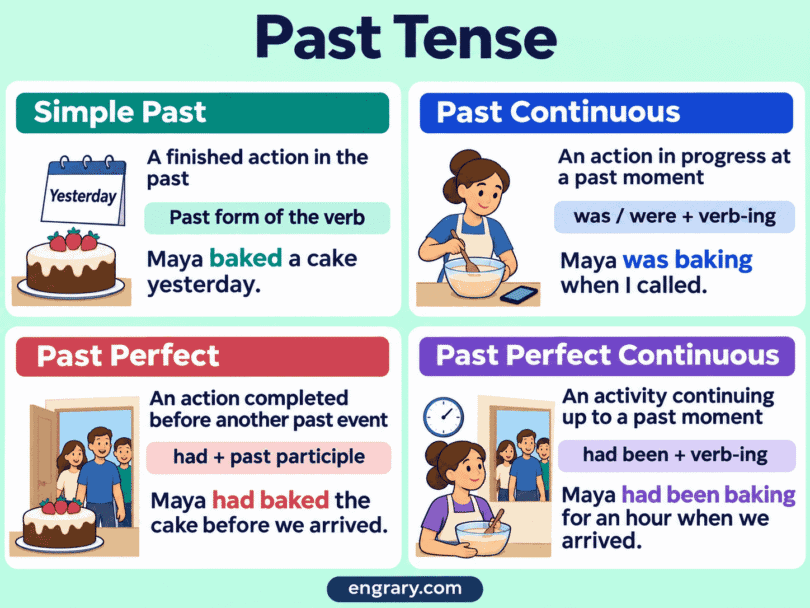
The past tense in English helps us describe events, activities, and situations before the present moment. For example, Sara cooked dinner yesterday tells us about a past event. However, Sara was cooking when I arrived places us in the middle of that activity. English has four commonly taught past forms, and each gives the listener a different view of what happened.
Understanding these forms helps you tell stories, describe experiences, and explain the order of events. This guide covers each form separately, with sentence structures, everyday examples, negatives, questions, and short answers. You’ll also learn how to choose between similar forms and avoid mistakes such as Did she went?
The Four Forms of the Past Tense
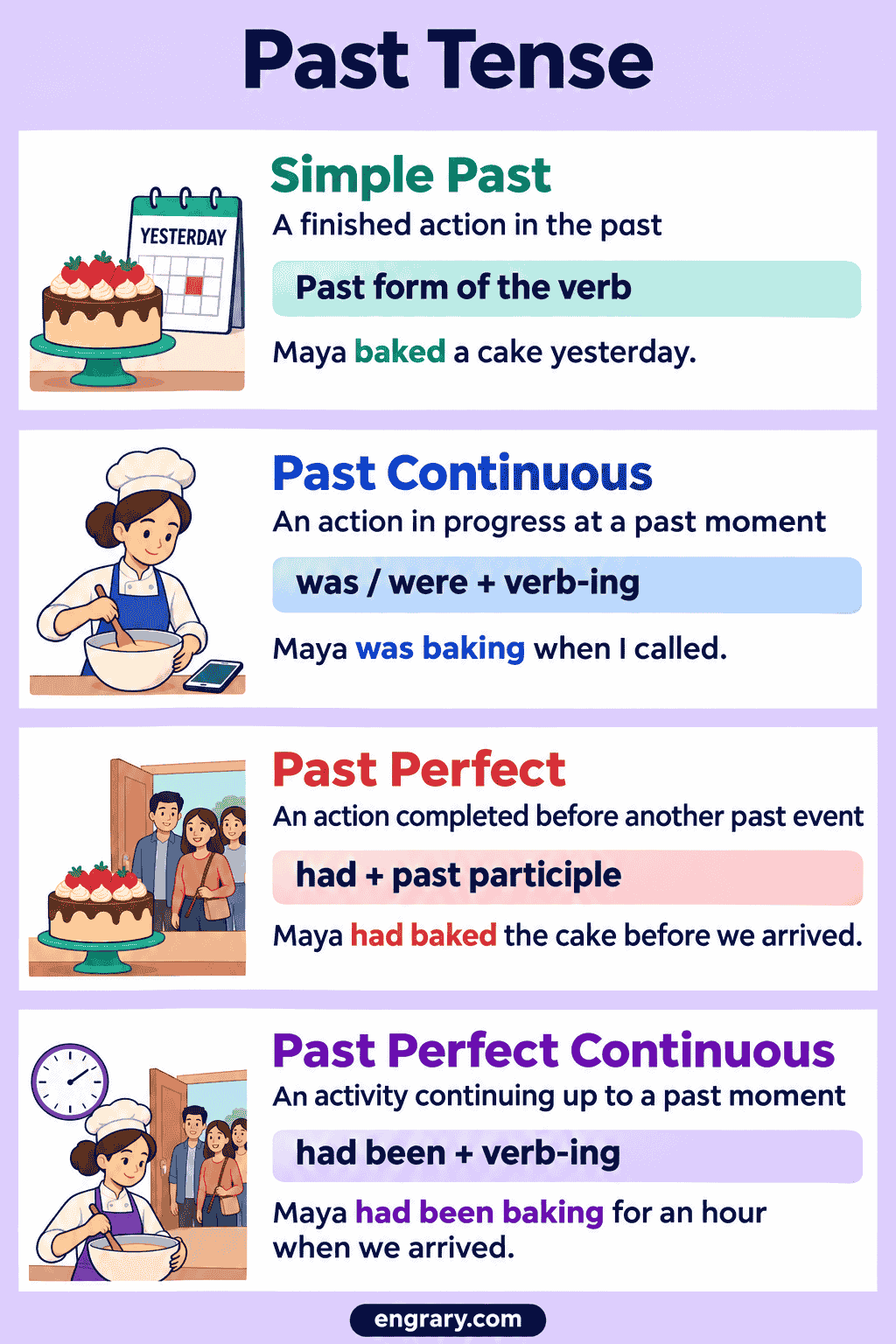
Start with the same person and activity in each sentence. Notice how the helping verbs change and how the arrival provides a reference point for the last three examples.
| Past tense form | Structure | Example | Main meaning |
|---|---|---|---|
| Simple past | Past verb form | Sara cooked dinner yesterday. | A past event |
| Past continuous | was/were + -ing | Sara was cooking when I arrived. | An activity underway at my arrival |
| Past perfect | had + past participle | Sara had cooked dinner before I arrived. | Completion before my arrival |
| Past perfect continuous | had been + -ing | Sara had been cooking for an hour when I arrived. | Duration leading up to my arrival |
Simple Past Tense
Use the simple past for completed events, past routines, past states, and sequences of actions. For example, We visited the museum last Saturday presents the visit as a past event. Meanwhile, We visited our grandparents every summer describes a repeated habit.
Simple Past Structure and Subject Agreement
Most simple past verbs stay the same with every subject. Say I worked, she worked, and they worked. However, in negatives and most questions, use did with the base form of the main verb.
| Sentence type | Example |
|---|---|
| Affirmative statement | Sara cooked dinner. |
| Negative statement | Sara didn’t cook dinner. |
| Yes-or-no question | Did Sara cook dinner? |
| Information question | What did Sara cook? |
| Positive short answer | Yes, she did. |
| Negative short answer | No, she didn’t. |
Because did already marks the past, the main verb returns to its base form. Therefore, use Did she cook? and She didn’t cook.
Was and Were in Past Sentences
The verb be has two simple past forms, was and were. In ordinary statements about the past, choose the form that matches the subject.
| Subject | Affirmative | Negative | Question |
|---|---|---|---|
| I | I was tired. | I wasn’t tired. | Was I late? |
| He, she, it | She was ready. | She wasn’t ready. | Was she ready? |
| You, we, they | They were outside. | They weren’t outside. | Were they outside? |
For a short answer, repeat was or were. For example, answer Was Sara ready? with Yes, she was or No, she wasn’t.
Regular and Irregular Past Verbs
Regular verbs usually take -ed, although some spellings change. For example, work becomes worked, study becomes studied, and stop becomes stopped.
Irregular verbs have their own forms. Also, the simple past and past participle can differ. Use the simple past form by itself, but use the past participle after had.
| Base verb | Simple past | Past participle |
|---|---|---|
| work | worked | worked |
| go | went | gone |
| write | wrote | written |
| see | saw | seen |
| take | took | taken |
| eat | ate | eaten |
For example, say She wrote the address down. To place that action before another past event, say She had written the address down before she left.
Simple Past Uses and Examples
| Use | Example | Explanation |
|---|---|---|
| Completed event | We visited the museum last Saturday. | The visit happened at a finished past time. |
| Sequence | Ali opened the door, entered the room, and sat down. | The verbs move the story forward. |
| Past habit | My grandfather walked to work every day. | Walking was his regular routine. |
| Past state | I knew the answer. | The sentence describes past knowledge. |
| Completed duration | We stayed in Lahore for three days. | The stay lasted three days and ended. |
| Question about an event | Where did you buy that bag? | The speaker asks about a past purchase. |
Past Habits and States with Used To
Use used to + base verb for a former habit or state, usually one that no longer applies. For example, We used to walk to school suggests that our routine has changed.
| Pattern | Example |
|---|---|
| Affirmative | We used to live near the station. |
| Negative | We didn’t use to own a car. |
| Question | Did you use to walk to school? |
In negatives and questions with did, write use to.
| Simple past | Used to | Difference |
|---|---|---|
| We walked to school yesterday. | We used to walk to school. | The first describes one occasion. The second describes a former routine. |
| There was a shop here in 2010. | There used to be a shop here. | The first locates a past state in time. The second suggests that the shop is gone now. |
Past Continuous Tense
Use the past continuous, also called the past progressive, for an activity in progress at a past moment. For example, At eight last night, I was reading places the reader inside the activity at eight o’clock.
Past Continuous Structure
Use was or were + the -ing form. Choose was with I, he, she, or it, and were with you, we, or they.
| Sentence type | Example |
|---|---|
| Affirmative statement | Sara was cooking dinner. |
| Negative statement | Sara wasn’t cooking dinner. |
| Yes-or-no question | Was Sara cooking dinner? |
| Information question | What was Sara cooking? |
| Positive short answer | Yes, she was. |
| Negative short answer | No, she wasn’t. |
Past Continuous Uses and Examples
| Use | Example | Explanation |
|---|---|---|
| Activity at a stated time | At nine, I was checking my homework. | The checking was underway at nine. |
| Background scene | The sun was setting, and birds were calling overhead. | The verbs establish the scene. |
| Simultaneous activities | I was washing the dishes while Ali was drying them. | Both activities were happening together. |
| Another event during an activity | We were eating when the lights went out. | The lights went out during the meal. |
| Temporary past situation | She was staying with her aunt that month. | The arrangement lasted for a limited period. |
| Question about an activity | What were you doing when I called? | The question asks about an activity underway at that moment. |
An event occurring during an activity does not always stop it. For example, I was reading when Ali arrived leaves open whether I continued reading afterward. Similarly, the past continuous alone does not establish whether an activity continues today.
Past Perfect Tense
Use the past perfect to look back from one past moment to an earlier event or state. For example, in When I reached the station, the train had left, the departure happened before my arrival.
Past Perfect Structure
Use had + past participle with every subject. For example, say I had finished, she had finished, and they had finished.
| Sentence type | Example |
|---|---|
| Affirmative statement | Sara had written the shopping list. |
| Negative statement | Sara hadn’t written the shopping list. |
| Yes-or-no question | Had Sara written the shopping list? |
| Information question | What had Sara written before she left? |
| Positive short answer | Yes, she had. |
| Negative short answer | No, she hadn’t. |
Past Perfect Uses and Examples
| Use | Example | Explanation |
|---|---|---|
| Earlier completion | Sara had cooked dinner before I arrived. | The cooking came first. |
| Completion by a past time | By eight, Sara had finished dinner. | Eight o’clock is the reference point. |
| Cause of a past situation | I couldn’t open the door because I had lost my key. | The earlier loss explains the problem. |
| Experience before a past event | I had never flown before that trip. | The trip marked the speaker’s first flight. |
| Continuing state | I had known Ali for years when we became colleagues. | The relationship began years before we worked together. |
| Question about earlier events | What had you heard before the meeting began? | The question looks back from the meeting. |
The reference point can appear in an earlier sentence. For example, We reached the station at nine. The train had already left. Here, the first sentence supplies the past moment from which the speaker looks back.
However, a clear sequence can use the simple past throughout. She opened the door, entered the room, and sat down already gives the events in order. Similarly, After she finished dinner, she washed the dishes uses after to establish the sequence.
Past Perfect Continuous Tense
Use the past perfect continuous, also called the past perfect progressive, to emphasize an activity’s duration before a past moment. It can also explain the result of a recent activity at that moment.
Past Perfect Continuous Structure
Use had been + the -ing form with every subject. For example, say I had been waiting, she had been waiting, and they had been waiting.
| Sentence type | Example |
|---|---|
| Affirmative statement | Sara had been cooking for an hour. |
| Negative statement | Sara hadn’t been cooking for long. |
| Yes-or-no question | Had Sara been cooking all afternoon? |
| Information question | How long had Sara been cooking when you arrived? |
| Positive short answer | Yes, she had. |
| Negative short answer | No, she hadn’t. |
Past Perfect Continuous Uses and Examples
| Use | Example | Explanation |
|---|---|---|
| Duration before a past event | We had been waiting for twenty minutes when the bus arrived. | The waiting led up to the arrival. |
| Repeated activity | She had been practicing every evening before the concert. | Several practice sessions preceded the concert. |
| Recent activity with a visible result | His shoes were muddy because he had been walking through the fields. | The walking explains the mud. |
| Cause of a past condition | I felt tired because I had been studying all night. | The earlier activity explains the tiredness. |
| Short duration | We hadn’t been driving long when we reached the village. | Little driving time had passed. |
| Question about duration | How long had they been living there before they moved? | The question asks about the period before the move. |
The activity may have stopped before the reference point. For example, someone could finish walking, enter the house, and then notice muddy shoes.
With verbs that describe states, the past perfect simple is usually more natural. Compare I had known Ali for years with I had been working with Ali for years. The first describes a relationship, while the second emphasizes an activity over time.
Common Contractions in Past Tense Sentences
Contractions are common in conversation and informal writing. For example, did not becomes didn’t, and had not becomes hadn’t.
| Full form | Contraction | Example |
|---|---|---|
| did not | didn’t | I didn’t hear the bell. |
| was not | wasn’t | She wasn’t waiting outside. |
| were not | weren’t | They weren’t ready. |
| had not | hadn’t | We hadn’t met before. |
The contraction ’d can mean either had or would. Look at the verb that follows to understand the meaning.
| Contracted sentence | Full form | Clue |
|---|---|---|
| She’d finished dinner. | She had finished dinner. | Finished is a past participle. |
| She’d been cooking. | She had been cooking. | Been introduces the continuous construction. |
| She’d help if she could. | She would help if she could. | Help is a base verb. |
Differences Between the Past Tense Forms
Similar sentences can describe the same situation from different viewpoints. The following comparisons show which detail each form brings into focus.
| Forms | Examples | Difference in meaning |
|---|---|---|
| Simple past and past continuous | I read the report last night. / At eight, I was reading the report. | The first presents reading as a past event. The second shows it underway at eight. |
| Simple past and past perfect | When I arrived, Sara started cooking. / When I arrived, Sara had started cooking. | In the first, cooking began at or just after my arrival. In the second, it began earlier. |
| Past perfect and past perfect continuous | She had written three pages by noon. / She had been writing for three hours by noon. | The first gives a completed quantity. The second emphasizes time spent writing. |
| Simple past and present perfect | I lost my key yesterday. / I have lost my key. | The first locates the loss at a finished past time. The second presents it as relevant now, often because the key is still missing. |
Time Expressions with the Past Tense
Time expressions help establish when something happened and how events connect. However, the sentence’s meaning determines the verb form.
| Expression | What it tells you | Example |
|---|---|---|
| Yesterday | A finished day before today | We visited the museum yesterday. |
| Last week | A finished period | She started her new job last week. |
| Ago | How far back from now | They moved here two years ago. |
| When | The time of another event | I was reading when you called. |
| While | Overlapping periods or activities | I cooked while Ali set the table. |
| Before | The order of events | She had left before the rain began. |
| By the time | A later reference point | By the time we arrived, the shop had closed. |
| Since | A starting point | By noon, we had been waiting since ten. |
| For | A length of time | We stayed for three days. |
Since introduces a starting point, such as since Monday. For introduces a duration, such as for two hours. Both can appear with perfect forms, and for can also accompany the simple past when the whole period is complete.
Also, when and while do not automatically require a particular tense. For example, When I arrived, she smiled describes two events, while When I arrived, she was smiling shows an expression already in progress.
Past Tense Forms in a Short Story
A short story often combines several past forms because each contributes a different part of the scene.
Yesterday evening, I visited Sara. She was cooking when I arrived. She had already prepared the vegetables and had been working in the kitchen for an hour. We ate together at seven.
| Verb phrase | Form | Role in the story |
|---|---|---|
| visited, arrived, ate | Simple past | Gives the main events |
| was cooking | Past continuous | Shows the activity underway at the visit |
| had already prepared | Past perfect | Looks back to earlier preparation |
| had been working | Past perfect continuous | Explains the duration leading up to the visit |
Other Uses of Past Forms
Past forms can also express imagined situations and make requests more tentative. In these uses, the context may refer to the present or future.
| Use | Example | Meaning |
|---|---|---|
| Imagined situation | If I knew the answer, I would tell you. | The speaker imagines knowing the answer now. |
| Polite request | I was wondering if you could help me. | The speaker makes a request more tentative. |
Common Past Tense Mistakes
| Common mistake | Correct sentence | Reason |
|---|---|---|
| Did she went home? | Did she go home? | Use the base verb after did. |
| I didn’t saw him. | I didn’t see him. | Use the base verb after didn’t. |
| They was waiting. | They were waiting. | Use were with they. |
| Was you tired? | Were you tired? | Use were with you. |
| She had wrote the letter. | She had written the letter. | Use the past participle after had. |
| We had been wait for an hour. | We had been waiting for an hour. | Use the -ing form after had been. |
| I was knowing the answer. | I knew the answer. | Know describes a state here. |
| Did you used to live here? | Did you use to live here? | Use use to after did. |
FAQs About the Past Tense
The simple past is one of the four commonly taught past forms. For example, She cooked dinner uses the simple past, while She was cooking dinner uses the past continuous.
Because did already carries the past marking. Therefore, She went home becomes Did she go home? in a question and She didn’t go home in a negative statement.
It can describe that situation, but it also describes background or simultaneous activities. For example, I was reading while my brother was drawing shows two activities happening together. Neither necessarily interrupted the other.
No. Context and words such as before and after can make the order clear. For example, After she finished dinner, she washed the dishes gives a clear sequence. Use the past perfect when looking back from a later past moment helps communicate the order or connection.
Yes. For example, The ground was wet because it had been raining can describe a moment after the rain stopped. The earlier activity explains the condition of the ground at that past moment.
You May Also Like



Leave a Comment