
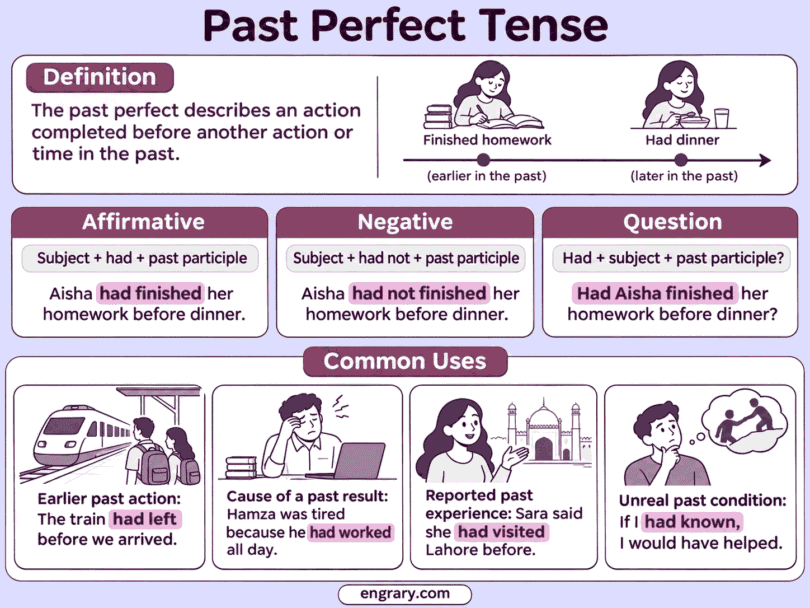
The past perfect tense describes an action, event, experience, or state that occurred before another past action or reference point. It helps readers look backward from a moment in the past and identify what had already happened. For example, The train had left before we reached the station clearly shows that the departure happened first and our arrival happened later.
English forms the past perfect with had followed by a past participle. Although its basic structure remains simple, accurate use depends on event order, context, and emphasis. This guide explains its forms, major uses, time expressions, narrative role, comparisons, reported-speech patterns, conditional structures, and common mistakes through natural examples and clear tables.
Past Perfect Tense at a Glance
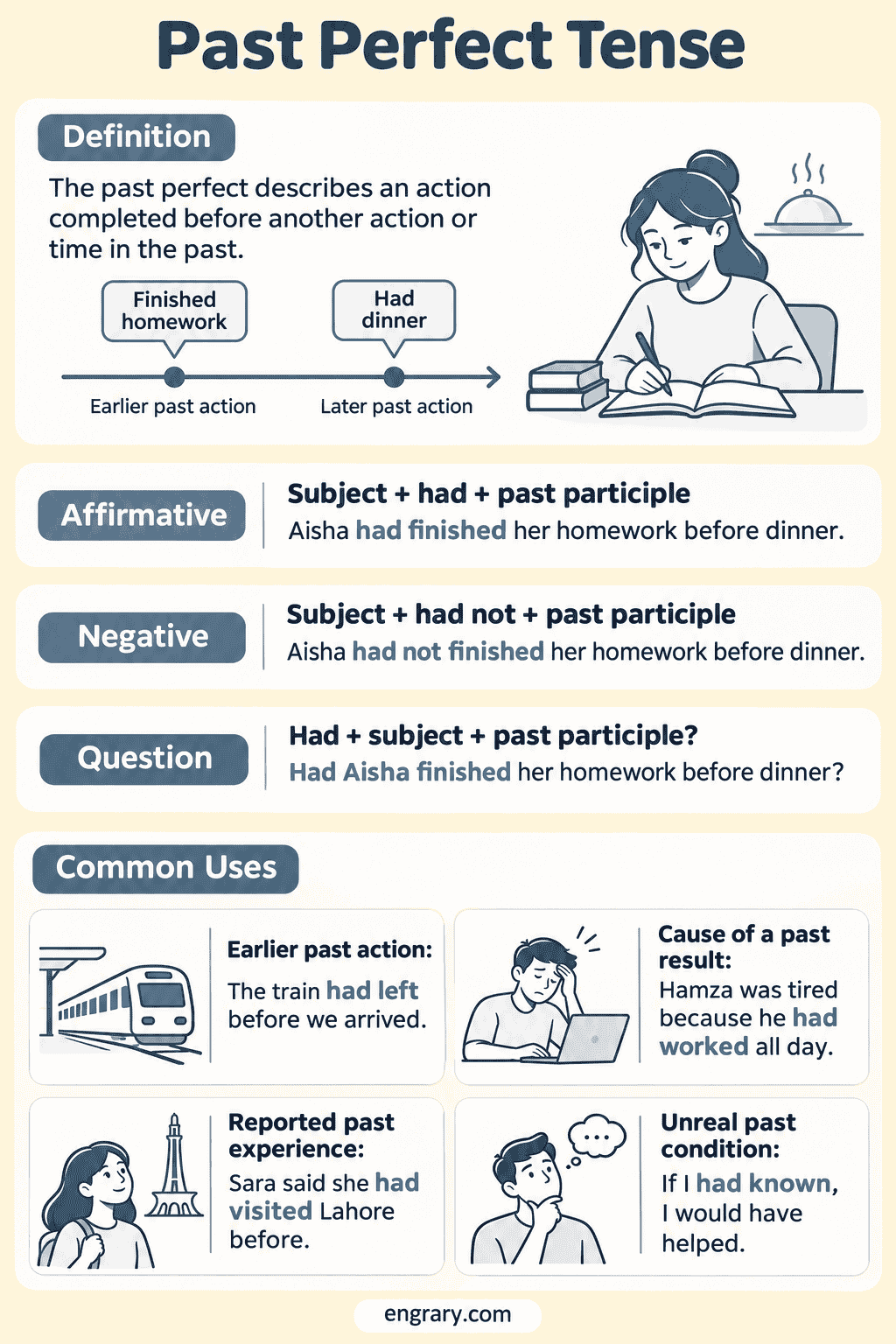
The past perfect looks backward from a past reference point. That reference point may be another action, a stated time, or a past situation established by the surrounding context.
| Point | Explanation |
|---|---|
| Meaning | Describes something that happened before a past event or time |
| Structure | Subject + had + past participle |
| Affirmative | She had completed the report. |
| Negative | She hadn’t completed the report. |
| Question | Had she completed the report? |
| Earlier event | She had completed the report. |
| Later event | Her manager arrived. |
Consider the sequence: first, Sara finished the report; later, her manager arrived. Therefore, English can combine the events as follows: Sara had finished the report before her manager arrived. The past perfect marks the earlier event, while the simple past marks the later one.
Structure of the Past Perfect Tense
The auxiliary had remains the same with every subject. As a result, learners do not need separate forms for I, you, he, she, it, we, and they.
| Sentence type | Structure | Example |
|---|---|---|
| Affirmative | Subject + had + past participle | They had arrived. |
| Negative | Subject + had not + past participle | They had not arrived. |
| Yes-or-no question | Had + subject + past participle? | Had they arrived? |
| Wh-question | Wh-word + had + subject + past participle? | Where had they gone? |
| Negative question | Hadn’t + subject + past participle? | Hadn’t they arrived? |
Affirmative Form
Place had between the subject and past participle.
- I had finished before noon.
- She had left when I called.
- The children had eaten before the guests arrived.
- We had discussed the issue earlier.
- The storm had damaged several roofs.
In informal English, had commonly contracts to ’d: I’d finished, she’d left, and they’d arrived.
Negative Form
Add not after had to form a negative. The contracted form is hadn’t.
- I had not seen the message.
- She hadn’t completed the application.
- We had never visited the area before.
- They still hadn’t replied by Friday.
Yes-or-No Questions
Move had before the subject.
- Had you met her before the conference?
- Had the bus left by the time you arrived?
- Had they completed the work before winter?
Wh-Questions
Place the question word before had.
- What had they decided?
- Where had he gone?
- Why had she refused the offer?
- How many pages had you written?
- How long had they lived there?
Past perfect questions often request an explanation for a later situation: Why had the lights gone out? or What had caused the delay?
Negative Questions
Negative questions can communicate surprise, concern, or an unmet expectation.
- Hadn’t you met her before?
- Why hadn’t they replied?
- Hadn’t the mechanic checked the brakes?
Short Answers
Short answers repeat had rather than the main verb.
| Question | Affirmative answer | Negative answer |
|---|---|---|
| Had she arrived? | Yes, she had. | No, she hadn’t. |
| Had they eaten? | Yes, they had. | No, they hadn’t. |
| Had you finished? | Yes, I had. | No, I hadn’t. |
Past Participles in the Past Perfect
Every past perfect construction uses had + past participle. Regular verbs usually add -ed, although spelling may change. Irregular verbs, however, use special participle forms.
Regular Past Participles
| Base form | Past participle | Example |
|---|---|---|
| work | worked | She had worked there before. |
| finish | finished | We had finished by noon. |
| study | studied | He had studied the topic. |
| stop | stopped | The rain had stopped. |
| move | moved | They had moved before winter. |
Irregular Past Participles
| Base form | Simple past | Past participle | Example |
|---|---|---|---|
| go | went | gone | She had gone home. |
| see | saw | seen | I had seen the film. |
| write | wrote | written | He had written the report. |
| eat | ate | eaten | They had already eaten. |
| take | took | taken | Someone had taken my seat. |
| know | knew | known | We had known her for years. |
| break | broke | broken | The branch had broken. |
| speak | spoke | spoken | I had spoken to the manager. |
Consequently, forms such as had went, had saw, and had wrote are incorrect. Use had gone, had seen, and had written instead.
Uses of the Past Perfect Tense
The past perfect does more than label the first of two actions. It can establish a past sequence, explain a cause, measure duration, supply narrative background, or describe an earlier experience from a later past viewpoint.
Earlier Actions Before Later Past Events
Use the past perfect for the earlier event and the simple past for the later event.
| Earlier event | Later event | Combined sentence |
|---|---|---|
| The train had left. | We arrived. | The train had left before we arrived. |
| She had completed the form. | She submitted it. | She submitted the form after she had completed it. |
| They had eaten dinner. | The guests arrived. | They had eaten dinner when the guests arrived. |
Clause order does not change chronological order.
- The train had left before we arrived.
- Before we arrived, the train had left.
- We arrived after the train had left.
All three sentences describe the same sequence: the train left first, and we arrived later.
Actions Completed Before a Past Time
The later reference point may be a clock time, date, age, or deadline rather than another action.
- By 2018, the company had opened ten stores.
- At midnight, everyone had left.
- Before the age of thirty, she had written two novels.
- By the end of June, we had completed the project.
Causes and Explanations
The past perfect often explains why a later past condition existed.
- He was tired because he had not slept well.
- We took a taxi because we had missed the bus.
- She felt confident because she had prepared carefully.
- The ground was wet because it had rained overnight.
In each sentence, the earlier action provides a cause or explanation for the later situation.
Duration Up to a Past Reference Point
Use the tense for a state that continued until a particular past moment.
- She had lived there for ten years before she moved.
- They had known each other since childhood.
- By June, I had worked there for a full year.
- The family had owned the shop for three generations before selling it.
Use for with a period and since with a starting point. Stative verbs such as know, own, believe, and understand usually favor the simple form.
Experiences Before a Past Event
The past perfect can describe experience accumulated before a later past moment.
- He had never flown before his trip to Dubai.
- Had you ever seen snow before that winter?
- It was the best performance we had ever watched.
- She understood the culture because she had visited the country several times.
Past Discoveries and Realizations
Verbs such as realized, discovered, noticed, remembered, and understood commonly establish the later reference point.
- I realized that I had left my phone at home.
- She discovered that someone had opened the window.
- We noticed that the water level had risen.
- He remembered that he had promised to call.
Unfulfilled Plans and Expectations
The tense can introduce an earlier plan, hope, intention, or expectation that later changed or failed.
- I had planned to visit her, but I became ill.
- She had hoped to finish early, but the meeting continued.
- We had intended to travel by train, but the service was cancelled.
- They had expected the repairs to take two days.
Changes and Achievements Before a Past Time
- By 2020, the town had grown considerably.
- She had earned two degrees before she turned thirty.
- Scientists had developed several treatments by then.
- The team had won six matches before its first defeat.
First-Time and Superlative Experiences
From a past viewpoint, use the past perfect after expressions such as the first time, the second time, and a superlative.
| Present viewpoint | Past viewpoint |
|---|---|
| This is the first time I have travelled alone. | It was the first time I had travelled alone. |
| This is the best meal I have ever eaten. | It was the best meal I had ever eaten. |
| This is the second time she has missed the flight. | That was the second time she had missed the flight. |
Background Information in Narratives
In stories, the past perfect supplies earlier background, while the simple past advances the main events.
Mariam opened the door. Someone had entered the room and had moved the furniture. She called the police.
Once readers understand the sequence, writers usually return to the simple past. Repeating had throughout every later sentence makes the narrative heavy and unnecessary.
Past Perfect in Relative Clauses
Relative clauses often provide earlier background about a person, place, or thing.
- We visited the town where my father had grown up.
- She found the book that she had lost.
- He thanked everyone who had supported him.
- They returned to the house they had rented years earlier.
Time Expressions Used with the Past Perfect
Time expressions can clarify event order. Nevertheless, the meaning comes from the complete relationship between events, not from a signal word alone.
Before and After
| Pattern | Example |
|---|---|
| Past perfect + before + simple past | She had left before I arrived. |
| After + past perfect, simple past | After she had finished, she called me. |
| After + simple past, simple past | After she finished, she called me. |
Because before and after already clarify order, the simple past may sometimes replace the past perfect. However, the past perfect can emphasize completion or prevent ambiguity.
By, By Then, and By the Time
By means “no later than” a stated moment.
- By six o’clock, everyone had left.
- By then, we had completed the project.
- By the time I arrived, the meeting had started.
- The river had frozen by the end of December.
When, Until, and As Soon As
The tense used with when can change the event order.
| Sentence | Meaning |
|---|---|
| When I arrived, she left. | Her departure occurred at or immediately after my arrival. |
| When I arrived, she had left. | She left before my arrival. |
| When she had finished, she left. | She left after completing the first action. |
Similarly, until and as soon as can emphasize completion:
- I waited until she had finished.
- As soon as he had signed the form, he submitted it.
- They did not announce the result until all judges had voted.
Already, Just, Yet, Still, Ever, and Never
| Expression | Example |
|---|---|
| already | She had already left. |
| just | We had just arrived. |
| yet | The bus hadn’t arrived yet. |
| still | They still hadn’t replied. |
| ever | It was the best meal I had ever eaten. |
| never | I had never travelled alone before. |
Already, just, ever, and never usually appear between had and the participle. In contrast, yet normally appears at the end, while still comes before hadn’t.
Until Then, Before Then, and Up to That Point
These expressions establish a past reference point.
- Up to that point, I had never questioned the decision.
- Before then, she had not travelled abroad.
- The company had previously rejected the proposal.
- Until then, we had believed the information was correct.
Optional and Necessary Uses of the Past Perfect
The past perfect is not automatically required for every action that happened first.
Necessary for Clarity
| Less clear | Clear sequence |
|---|---|
| When I arrived, the train left. | When I arrived, the train had left. |
| She said she finished the report. | She said she had finished the report. |
Optional When Order Is Clear
| Past perfect | Simple-past alternative |
|---|---|
| After she had eaten, she left. | After she ate, she left. |
| Once he had signed the form, he submitted it. | Once he signed the form, he submitted it. |
Unnecessary for Isolated Events
Use the simple past for a single completed historical fact when no later past reference point exists.
- Unnatural: The Romans had spoken Latin.
- Natural: The Romans spoke Latin.
- Unnatural: Shakespeare had written many plays.
- Natural: Shakespeare wrote many plays.
Had Had in Past Perfect Sentences
The form had had is correct. The first had acts as the auxiliary, while the second is the past participle of the main verb have.
- I had had breakfast before I left.
- She had had the car for five years before she sold it.
- They had had enough time to prepare.
- He hadn’t had any experience before taking the job.
Contractions with ’d
The contraction ’d can mean had or would. The following verb form identifies its meaning.
| Sentence | Full form | Identification |
|---|---|---|
| She’d finished before noon. | She had finished before noon. | A past participle follows. |
| She’d finish early if she started now. | She would finish early. | A base verb follows. |
| They’d gone home. | They had gone home. | Gone is a past participle. |
| They’d go home if it rained. | They would go home. | Go is a base verb. |
Past Perfect Passive
The passive form emphasizes the receiver or result of the earlier action.
Structure: subject + had + been + past participle
| Active sentence | Passive sentence |
|---|---|
| The team had completed the work. | The work had been completed. |
| Someone had stolen the files. | The files had been stolen. |
| They had cancelled the meeting. | The meeting had been cancelled. |
| The storm had damaged several houses. | Several houses had been damaged. |
Past Perfect in Reported Speech
After a past reporting verb, a present perfect or simple-past form may backshift to the past perfect.
| Direct speech | Reported speech |
|---|---|
| “I have finished.” | She said that she had finished. |
| “I saw the message.” | He said that he had seen the message. |
| “We lost the key.” | They explained that they had lost the key. |
| “Have you eaten?” | She asked whether I had eaten. |
An original past perfect normally stays unchanged: “I had finished before noon” becomes She said that she had finished before noon, not had had finished.
Backshift can remain optional when information is still true. For example, She said that she lives in Lahore suggests that the fact remains current, while She said that she lived in Lahore reports it from the earlier viewpoint.
Past Perfect in the Third Conditional
The third conditional describes an unreal past condition and its imagined result.
Structure: If + subject + had + past participle, subject + would have + past participle
- If I had known, I would have helped.
- If they had left earlier, they would have arrived on time.
- She would have passed if she had studied harder.
The condition did not happen, so the result did not happen either. Moreover, would have does not normally belong in the if-clause.
Inverted Past Conditions
Formal English can omit if and move had before the subject.
| Standard form | Inverted form |
|---|---|
| If I had known, I would have helped. | Had I known, I would have helped. |
| If they had left earlier, they would have arrived on time. | Had they left earlier, they would have arrived on time. |
Although the inverted form begins with had, it is a conditional clause rather than a question.
Past Perfect with Wish, If Only, and Would Rather
Use wish or if only with the past perfect to express regret about an unchangeable past situation.
- I wish I had listened to your advice.
- She wished she had not said that.
- If only we had booked earlier.
- He wished he had accepted the offer.
Meanwhile, would rather + past perfect expresses a past preference about someone’s action.
- I would rather you had told me earlier.
- She would rather they had not cancelled the meeting.
- We would rather he had accepted the offer.
Past Perfect with As If and As Though
After as if and as though, the past perfect can describe an unreal, doubtful, or assumed earlier situation.
- He looked as if he had seen a ghost.
- She spoke as though she had witnessed the event.
- They treated me as if I had done something wrong.
The speaker does not necessarily believe that the earlier event actually happened.
No Sooner, Hardly, and Scarcely
Formal sequencing patterns can use inversion with the past perfect.
| Expression | Structure | Example |
|---|---|---|
| no sooner | No sooner + had + subject + participle + than | No sooner had we arrived than the rain started. |
| hardly | Hardly + had + subject + participle + when | Hardly had she sat down when the phone rang. |
| scarcely | Scarcely + had + subject + participle + when | Scarcely had they finished when the lights went out. |
Past Perfect and Simple Past
| Past perfect | Simple past |
|---|---|
| Shows an earlier past action | Shows the later or main past action |
| Looks backward from a past reference point | Reports a completed past event |
| Often supplies background or explanation | Usually advances the narrative |
| She had left before I arrived. | I arrived at nine. |
| He was tired because he had worked late. | He went to bed early. |
Remember that the past perfect is not required simply because one action occurred first. Context, clarity, and emphasis determine whether the form is useful.
Past Perfect and Perfect Modals
Perfect modals resemble perfect tenses but express possibility, criticism, obligation, or an imagined result.
| Form | Structure | Meaning |
|---|---|---|
| Past perfect | had + past participle | Actual event before a past reference point |
| Perfect modal | could/might/should/would + have + past participle | Possibility, advice, criticism, or imagined result |
- She had left before I arrived. (An actual earlier event.)
- She might have left early. (A possibility.)
- You should have called me. (Past criticism or advice.)
- I would have helped if I had known. (An imagined result.)
Therefore, would have finished is not the past perfect tense.
Present, Past, and Future Perfect
All three perfect forms connect an earlier situation with a later reference point.
| Tense | Reference point | Example |
|---|---|---|
| Present perfect | Now | She has finished the report. |
| Past perfect | A past moment | She had finished before noon. |
| Future perfect | A future moment | She will have finished by noon tomorrow. |
Past Perfect Simple and Continuous
The simple form generally emphasizes completion, result, total, or state. In contrast, the continuous form emphasizes activity, process, or duration.
| Past perfect simple | Past perfect continuous |
|---|---|
| She had written five pages. | She had been writing for two hours. |
| They had repaired the road. | They had been repairing the road. |
| He had read three chapters. | He had been reading since breakfast. |
| I had known her for years. | I had been knowing her is normally incorrect. |
Sometimes both forms work with a change in emphasis:
- She had worked there for ten years. (Focus on the completed period or state.)
- She had been working there for ten years. (Focus on the continuing activity or duration.)
Common Mistakes with the Past Perfect Tense
| Incorrect | Correct | Explanation |
|---|---|---|
| She had went home. | She had gone home. | Use the past participle after had. |
| He has finished before I arrived. | He had finished before I arrived. | The reference point is in the past. |
| Did they had left? | Had they left? | Do not use did in a past perfect question. |
| She hadn’t never seen snow. | She had never seen snow. | Avoid a double negative. |
| If I would have known, I would have helped. | If I had known, I would have helped. | Use past perfect in the if-clause. |
| I wish I would have listened. | I wish I had listened. | Use past perfect for past regret. |
| The Romans had spoken Latin. | The Romans spoke Latin. | Use simple past for an isolated historical fact. |
| I had been knowing her for years. | I had known her for years. | Know is normally stative. |
| After he had arrived, he had called me. | After he had arrived, he called me. | The later main event normally uses simple past. |
| Had I knew, I would have helped. | Had I known, I would have helped. | Inversion still requires a past participle. |
| No sooner we had arrived than it rained. | No sooner had we arrived than it rained. | Formal negative expressions require inversion. |
| She said she had had finished. | She said she had finished. | Past perfect does not backshift again. |
Past Perfect Tense Examples
The following examples review the tense across common forms and uses.
Affirmative Sentences
- I had completed the application before the deadline.
- She had learned basic Arabic before moving abroad.
- We had packed everything by eight o’clock.
- The children had fallen asleep when the guests left.
Negative Sentences
- I hadn’t received the parcel when I contacted the seller.
- He had not chosen a topic before the meeting.
- We had never visited that museum before our school trip.
- The pain hadn’t disappeared by morning.
Questions
- Had you read the report before the discussion?
- Had she sent the invitation by Friday?
- Where had they parked the car?
- Why hadn’t you called me?
Causes, Experiences, and Narratives
- The road was slippery because snow had fallen overnight.
- She recognized the village because she had visited it as a child.
- He felt relieved after he had completed the interview.
- The room looked different because someone had painted the walls.
Past Perfect Tense Quick Reference
| Feature | Rule or example |
|---|---|
| Basic formula | Subject + had + past participle |
| Negative | Subject + hadn’t + past participle |
| Question | Had + subject + past participle? |
| Earlier event | The train had left before we arrived. |
| Past reference time | By noon, she had finished. |
| Cause | He was tired because he had not slept. |
| Reported speech | She said she had finished. |
| Third conditional | If I had known, I would have helped. |
| Past regret | I wish I had listened. |
FAQs
The past perfect is a verb tense that describes an action, event, experience, or state occurring before another past action or reference point. It uses had followed by a past participle, as in The train had left before we arrived.
The past perfect looks backward from a later past moment and identifies an earlier event. In contrast, the simple past normally reports the later or main event. For example, She had finished the report before the manager arrived uses past perfect for the earlier completion and simple past for the later arrival.
No. When conjunctions such as before and after already make the sequence clear, the simple past may work for both actions. However, the past perfect remains useful when it prevents ambiguity, emphasizes completion, or supplies meaningful background.
In reported speech, the past perfect can result from backshifting an earlier simple-past or present-perfect statement, as in She said that she had finished. In the third conditional, it appears in the if-clause: If she had studied, she would have passed.
The past perfect simple usually emphasizes a result, completed action, total, or state, while the continuous form emphasizes an activity, process, or duration. For example, She had written five pages focuses on the result, whereas She had been writing for two hours focuses on the activity and its duration.
You May Also Like


Leave a Comment