
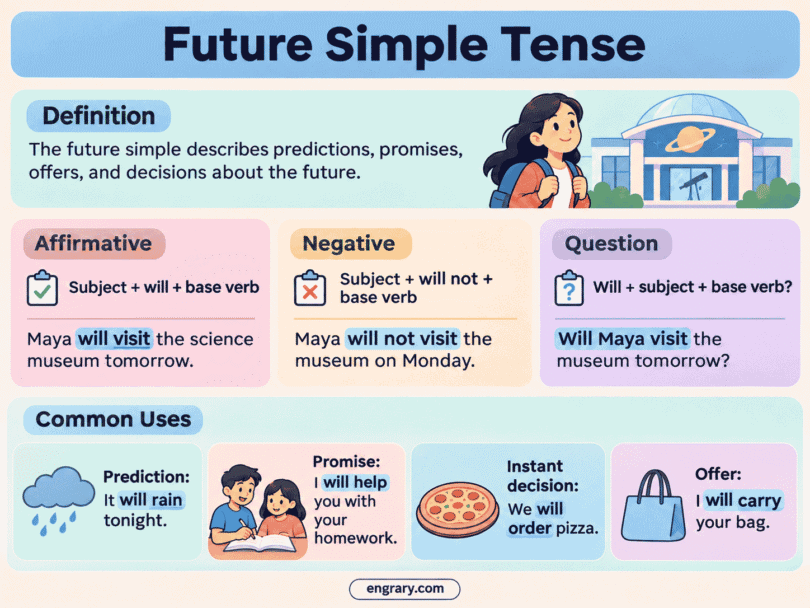
The future simple tense describes predictions, spontaneous decisions, promises, offers, and other events viewed as future. English usually forms it with will + the base form of a verb, as in I will call, She will help, and They will arrive.
This guide explains future simple structures, uses, contractions, questions, short answers, passive forms, and time expressions. In addition, it compares will with be going to, the present continuous, and the present simple through clear tables and practical examples.
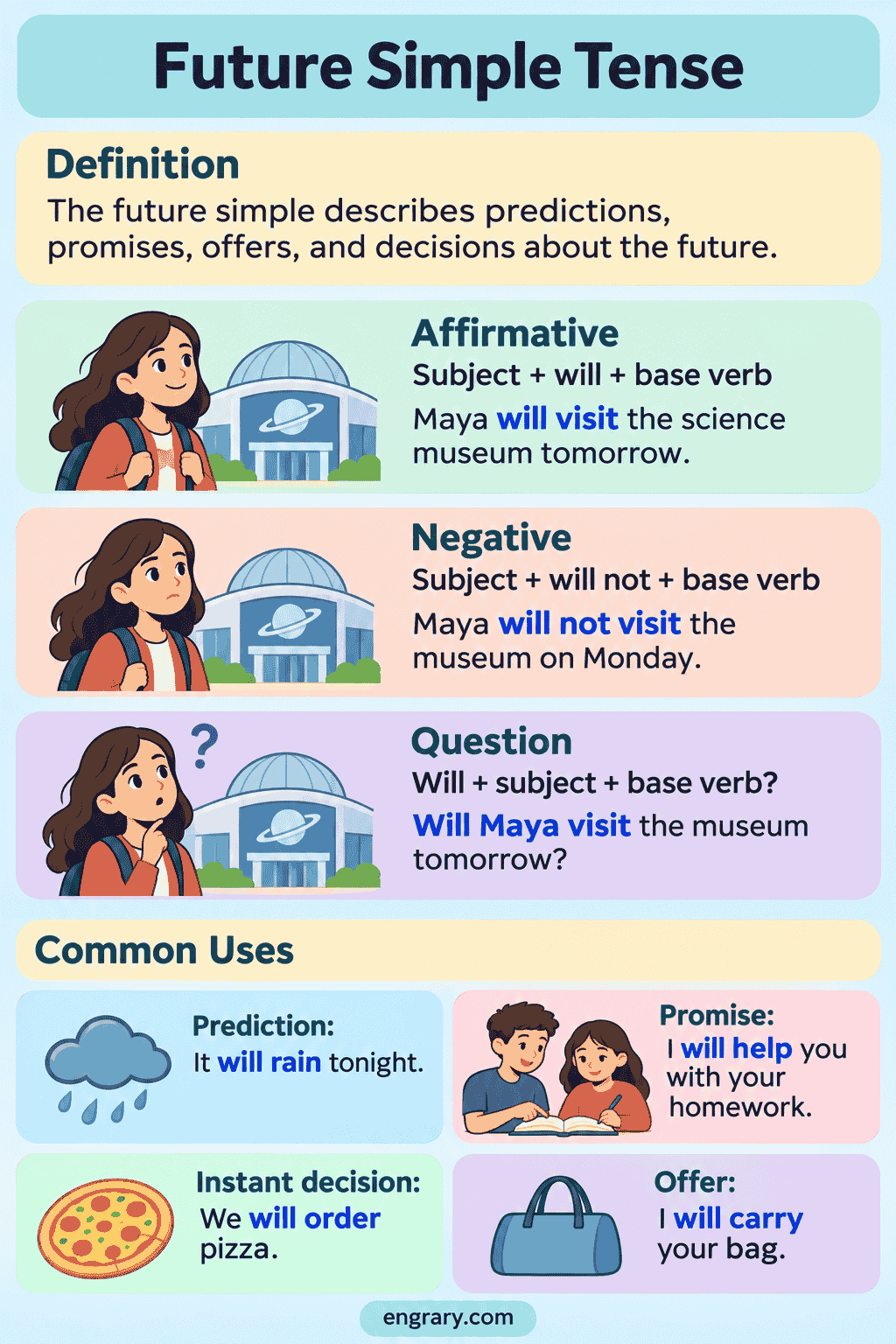
Future Simple Tense at a Glance
Begin with a concise explanation and an overview table.
| Sentence Type | Structure | Example |
|---|---|---|
| Affirmative | Subject + will + base verb | She will arrive soon. |
| Negative | Subject + will not + base verb | She will not arrive soon. |
| Question | Will + subject + base verb? | Will she arrive soon? |
| Wh-question | Wh-word + will + subject + base verb? | When will she arrive? |
| Short answer | Yes, subject + will. / No, subject + won’t. | Yes, she will. |
Add a brief terminology note explaining that traditional teaching calls this form the future simple tense, although modern grammar often analyzes will as a modal verb.
Future Simple Tense Structures
Affirmative Sentences
Explain the structure:
Subject + will + base form of the verb
Include examples with different subjects and verbs.
Negative Sentences
Explain both full and contracted forms:
- will not
- won’t
Include refusal and malfunction meanings:
- He won’t listen.
- The car won’t start.
Yes-or-No Questions and Short Answers
Explain subject–auxiliary inversion and provide a table of questions with positive and negative short answers.
Wh-Questions
Cover questions beginning with what, where, when, why, who, and how.
Negative Questions
Explain forms such as:
- Won’t you join us?
- Won’t she be available tomorrow?
Clarify that negative questions may express expectation, surprise, or an invitation.
Question Tags
Include examples such as:
- You’ll call me, won’t you?
- She won’t object, will she?
Future Simple Contractions
| Full Form | Contraction |
|---|---|
| I will | I’ll |
| You will | You’ll |
| He will | He’ll |
| She will | She’ll |
| It will | It’ll |
| We will | We’ll |
| They will | They’ll |
| Will not | Won’t |
Mention that won’t, not willn’t, is the correct negative contraction.
Future Simple with Be, Have, and Do
Explain these common patterns separately:
- She will be twenty next year.
- It will be cold tonight.
- We will have enough time.
- I will do the work tomorrow.
Future Ability and Necessity
Cover future meanings that require longer constructions:
| Meaning | Structure | Example |
|---|---|---|
| Future ability | will be able to | She will be able to drive soon. |
| Future necessity | will have to | We will have to leave early. |
| Future need | will need to | You will need to bring identification. |
Future Simple with There Will Be
Explain affirmative, negative, and question forms:
- There will be a meeting tomorrow.
- There won’t be enough chairs.
- Will there be any food?
Main Uses of the Future Simple Tense
Predictions Based on Opinions
Use examples with think, believe, expect, hope, probably, and perhaps.
Spontaneous Decisions
Show that speakers often use will for decisions made at the moment of speaking.
Promises and Assurances
Include personal and formal examples.
Offers of Help
Compare:
- I’ll carry that for you.
- Shall I carry that for you?
Requests and Invitations
Explain the tone of will and compare it briefly with the softer would.
Willingness and Refusal
Include positive willingness and negative refusal.
Warnings and Threats
Use neutral, appropriate examples that clearly demonstrate the function.
Instructions and Firm Requirements
Explain that will sometimes appears in formal instructions or authoritative statements.
Future Facts and Expected Results
Use examples involving age, weather, schedules, consequences, and anticipated conditions.
Certainty Adverbs with the Future Simple
| Adverb | Typical Position | Example |
|---|---|---|
| definitely | After will | She will definitely come. |
| certainly | After will | They will certainly notice. |
| probably | After will | He will probably agree. |
| perhaps | Beginning of sentence | Perhaps she will call. |
| maybe | Beginning of sentence | Maybe it will rain. |
Clarify the natural negative position:
- She probably won’t attend.
- Avoid the less natural form She won’t probably attend.
Future Simple in the First Conditional
Explain the standard pattern:
If + present simple, will + base verb
Examples:
- If it rains, we will stay inside.
- If you study, you will improve.
- We will begin if everyone arrives on time.
Future Time and Condition Clauses
Cover clauses introduced by:
- when
- before
- after
- until
- as soon as
- once
- unless
- if
Explain that English normally uses the present simple—not will—inside a future time or condition clause:
- I’ll call when I arrive.
- We’ll eat after she comes home.
Include the important exception between a time clause and an embedded question:
| Clause Type | Correct Example | Explanation |
|---|---|---|
| Future time clause | I’ll call when he arrives. | When introduces the time of the future action. |
| Embedded question | I don’t know when he will arrive. | When he will arrive is the information that is unknown. |
Also explain that will can follow if when it expresses willingness:
- If you will wait here, I’ll get the manager.
Future Simple Passive Voice
Explain the structure:
Subject + will be + past participle
| Form | Example |
|---|---|
| Affirmative | The results will be announced tomorrow. |
| Negative | The road will not be opened today. |
| Question | Will the package be delivered on time? |
Keep this section practical and avoid excessive passive constructions elsewhere in the article.
Future Simple in Reported Speech
Explain that will often changes to would when reporting speech from a past viewpoint:
- Direct: Maya said, “I will call.”
- Reported: Maya said that she would call.
Clarify that the change depends on context and the reporting viewpoint.
Will and Would for Future Meaning
| Form | Main Meaning | Example |
|---|---|---|
| will | Future viewed from the present | She will arrive at six. |
| would | Future viewed from a past point | She said she would arrive at six. |
| will | Direct request | Will you help me? |
| would | Softer, more tentative request | Would you help me? |
Will and Be Going To
| Feature | Will | Be Going To |
|---|---|---|
| Spontaneous decision | I’ll answer the phone. | — |
| Prior intention | — | I’m going to study tonight. |
| Opinion-based prediction | I think it will rain. | — |
| Evidence-based prediction | — | Look at those clouds. It’s going to rain. |
| Promise | I’ll help you. | — |
Mention that real usage sometimes overlaps and that the speaker’s viewpoint determines the most natural choice.
Will and the Present Continuous
| Form | Main Use | Example |
|---|---|---|
| will + base verb | Prediction or spontaneous decision | I’ll call her now. |
| Present continuous | Personal arrangement already organized | I’m meeting her at six. |
Will and the Present Simple
| Form | Main Use | Example |
|---|---|---|
| will + base verb | Prediction or future decision | The journey will take two hours. |
| Present simple | Timetable or fixed schedule | The train leaves at six. |
Will and Shall
Explain that modern English generally uses will with every subject. However, shall still appears:
- With I and we in suggestions and offers
- In formal or legal language
- More commonly in British English
Examples:
- Shall I open the window?
- Shall we begin?
- The tenant shall pay the stated fee.
Clarify that legal shall often expresses obligation rather than ordinary future time. Also mention that shan’t exists but is uncommon, especially outside British English.
Advanced Meanings of Will
Explain that will does not always refer directly to the future.
Characteristic or Habitual Behaviour
- He will sit for hours without speaking.
- She will often call after dinner.
Annoying Persistence
- He will keep interrupting.
- The printer will stop whenever I need it most.
Clearly label these as advanced uses.
Future Simple Time Expressions
Organize useful expressions into bullets:
- tomorrow
- tonight
- soon
- later
- next week
- next month
- next year
- in a few minutes
- in the future
- one day
- someday
- by then
- this evening
- at the weekend
Explain that these expressions suggest future time but do not automatically determine which future form the sentence requires.
Future Simple Example Paragraph
Add one natural paragraph containing several future simple forms. Follow it with a short table identifying each example and its purpose, such as prediction, promise, spontaneous decision, or offer.
Common Future Simple Mistakes
| Incorrect | Correct | Explanation |
|---|---|---|
| She will goes tomorrow. | She will go tomorrow. | Use the base verb after will. |
| He wills call later. | He will call later. | Will does not change with the subject. |
| They don’t will come. | They won’t come. | Form the negative with will not. |
| Will she comes? | Will she come? | Use the base verb in questions. |
| I will to help. | I will help. | Do not use to after will. |
| I’ll call when I will arrive. | I’ll call when I arrive. | Use the present simple in future time clauses. |
| I think she won’t come. | I don’t think she will come. | The second version is often more natural. |
| She won’t probably come. | She probably won’t come. | Place probably before won’t. |
| I will can help. | I will be able to help. | Two modal verbs cannot normally appear together. |
| We will must leave. | We will have to leave. | Use will have to for future necessity. |
Tips for Using the Future Simple Correctly
- Use the base form of the verb after will.
- Use will for spontaneous decisions, promises, offers, and opinion-based predictions.
- Use be going to for prior intentions and predictions based on present evidence.
- Use the present continuous for organized personal arrangements.
- Use the present simple for fixed schedules and timetables.
- Avoid will in ordinary future time and condition clauses.
- Use contractions in natural conversation and informal writing.
- Consider the speaker’s viewpoint instead of choosing a future form from the time expression alone.
FAQs
The future simple tense is a verb construction commonly used for predictions, spontaneous decisions, promises, offers, willingness, and other future meanings. Its usual structure is will + base verb, as in She will arrive tomorrow.
Use will followed by the base form of the main verb. An affirmative sentence follows the pattern subject + will + base verb. Add not after will to form a negative, or place will before the subject to form a question.
Use will for decisions made at the moment of speaking, promises, offers, requests, willingness, refusals, and predictions based on thoughts or opinions. Other constructions may be more natural for prior plans, arrangements, and fixed schedules.
Will commonly expresses spontaneous decisions and opinion-based predictions, while be going to usually describes prior intentions or predictions supported by present evidence. However, their meanings sometimes overlap, so context and the speaker’s viewpoint remain important.
Shall mainly appears with I and we in offers and suggestions, such as Shall I help? and Shall we begin? It also occurs in formal and legal language, where it frequently expresses an obligation instead of a simple future event.
You May Also Like

Leave a Comment