
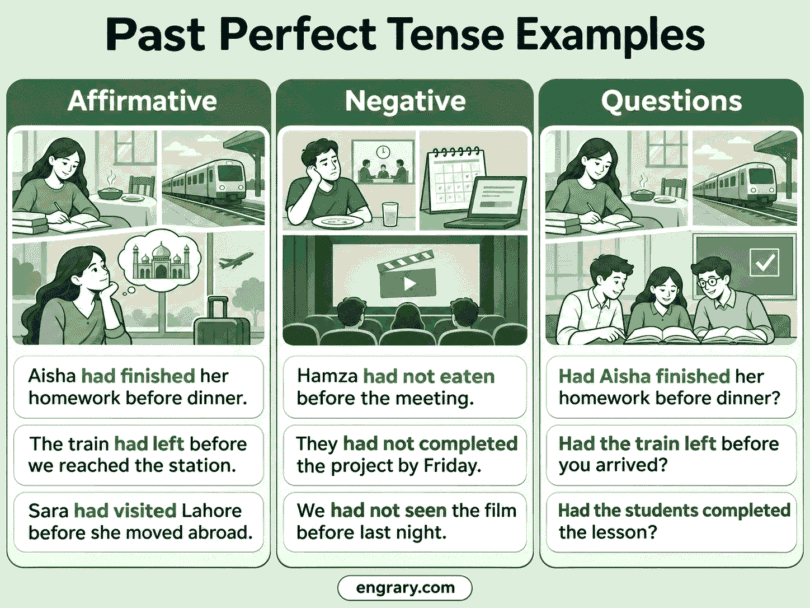
The past perfect tense shows that one action, event, or state happened before another point in the past. It uses had + past participle, as in had finished, had gone, and had seen. Because the form stays the same with every subject, learners can focus on the order of events rather than changing the auxiliary verb.
Below are 135 past perfect tense examples in sentences, organized by sentence type and purpose. In addition to affirmative statements, negatives, questions, time markers, reported speech, conditionals, and advanced patterns, the guide compares the past perfect with related tenses and explains common errors.
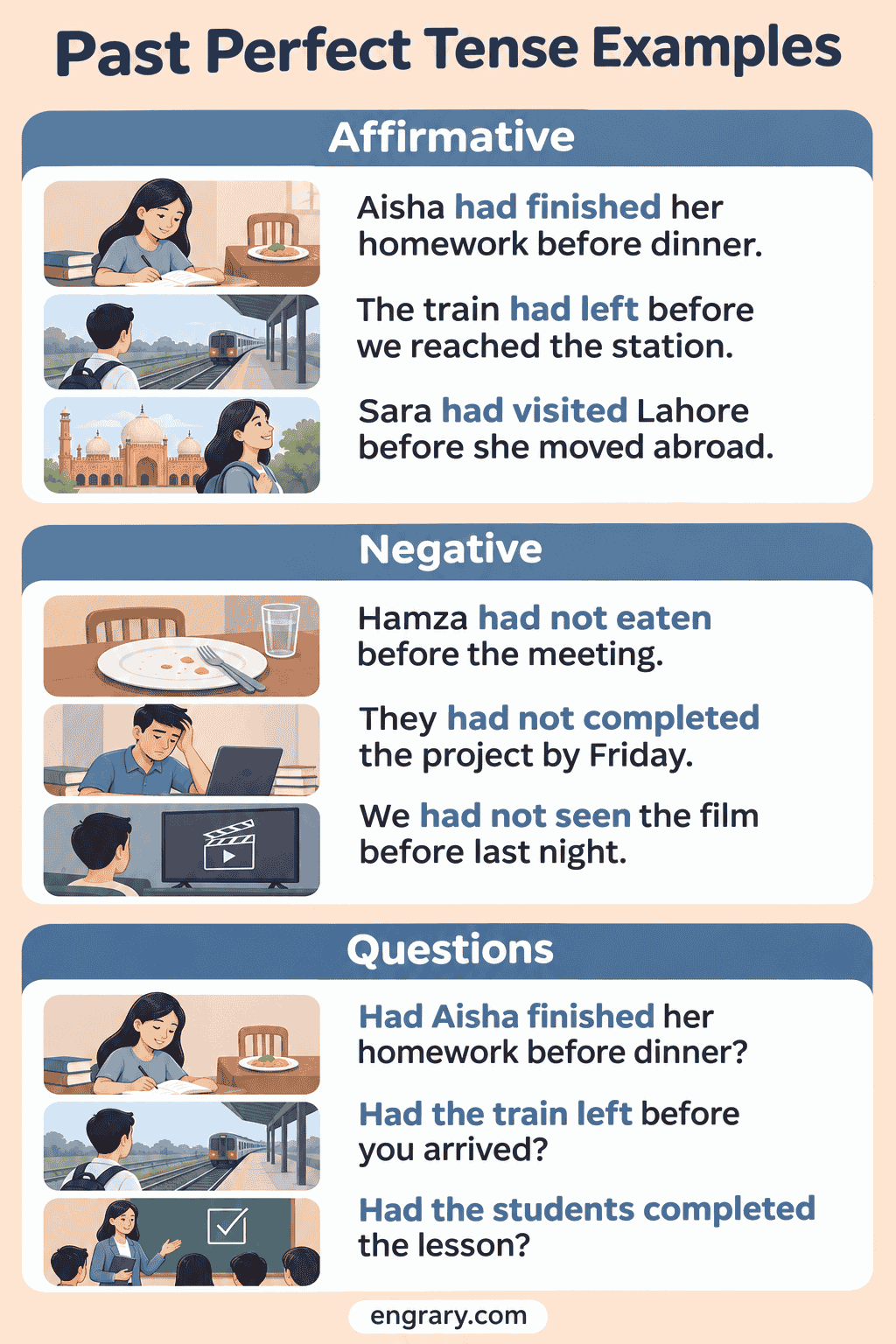
Past Perfect Tense Examples at a Glance
The past perfect looks back from a past reference point. In the sentence Maya had left before I arrived, had left happened first, while arrived happened later.
| Sentence type | Structure | Example |
|---|---|---|
| Affirmative | Subject + had + past participle | Leo had completed the report before noon. |
| Negative | Subject + had not + past participle | Leo had not completed the report before noon. |
| Yes-or-no question | Had + subject + past participle…? | Had Leo completed the report before noon? |
| Wh-question | Wh-word + had + subject + past participle…? | Why had Leo completed the report early? |
| Passive | Subject + had been + past participle | The report had been completed before noon. |
The tense often appears with before, after, by the time, when, until, already, just, never, and yet. However, a time marker alone does not choose the tense; the relationship between the events does.
Structure Used in Past Perfect Sentences
Every past perfect construction contains had followed by a past participle. Regular participles often end in -ed, while irregular participles take forms such as written, gone, eaten, and known.
| Function | Formula | Model sentence |
|---|---|---|
| Statement | Subject + had + past participle | They had started before we arrived. |
| Negative | Subject + had not + past participle | They had not started before we arrived. |
| Question | Had + subject + past participle…? | Had they started before we arrived? |
| Short answer | Yes, subject + had. / No, subject + had not. | Yes, they had. |
The contraction hadn’t means had not. In informal writing and speech, I’d, you’d, he’d, she’d, we’d, and they’d can mean had when a past participle follows.
135 Past Perfect Tense Examples
Common Past Perfect Examples
- Mia had packed her suitcase before the taxi arrived.
- The children had fallen asleep by the time their father came home.
- I had seen that film twice before we discussed it in class.
- Noah had locked the door before he walked to the station.
- We had finished dinner when the lights suddenly went out.
- Sara had learned basic Spanish before she moved to Madrid.
- The rain had stopped by the time the match began.
- They had sold their old car before they bought the new one.
- Omar had saved enough money before he booked the trip.
- The baker had prepared the dough before the shop opened.
- My phone had lost its charge, so I borrowed a charger.
- The guests had already arrived when we reached the venue.
Affirmative Past Perfect Sentences
- Ava had completed the assignment ahead of the deadline.
- The mechanic had repaired the engine before the owner returned.
- We had planted the seeds before the spring rain started.
- Ethan had read the instructions before he assembled the shelf.
- The team had practiced the routine several times before the show.
- I had kept every letter that my grandmother sent me.
- Priya had taken detailed notes before she wrote the summary.
- The dog had buried its toy beneath the old tree.
- Daniel had worked at the company for six years before he resigned.
- The museum had acquired the painting before its value increased.
- She had chosen a quiet table before her friends entered the café.
- The students had understood the concept before the final review.
- Our neighbors had built the fence before winter arrived.
Negative Past Perfect Sentences
- I had not met the new manager before the staff meeting.
- Layla hadn’t checked the weather before she left home.
- The shop had not received our order by Friday afternoon.
- We hadn’t expected such a large crowd at the festival.
- Ben had not driven in snow before that winter.
- The baby hadn’t fallen asleep when the visitors arrived.
- You had not mentioned the schedule change before the call.
- The hikers hadn’t reached the shelter before the storm began.
- Nora had not used a digital camera until she joined the course.
- They hadn’t solved the problem by the end of the lesson.
- My brother had not tasted sushi before our trip to Tokyo.
- The workers hadn’t finished the repairs when the building reopened.
- I had not realized how late it was until the clock struck midnight.
Yes-or-No Questions
- Had you visited the city before you moved there?
- Had Elena submitted the form by the closing date?
- Had the train departed when you reached the platform?
- Had they discussed the budget before the meeting began?
- Had Marcus ever cooked for such a large group before the event?
- Had we taken the correct road before the GPS stopped working?
- Had the teacher explained the rule before she assigned the exercise?
- Had your parents heard the news before you called them?
- Had the water frozen before the temperature rose again?
Wh-Questions
- Why had Sofia left the office before the presentation?
- Where had you placed the keys before you found them?
- How long had Amir lived abroad before he returned home?
- What had the scientists discovered before they published the paper?
- Who had used the computer before the error appeared?
- Which route had the driver taken before the road closed?
- How many chapters had Rosa read before the test?
- When had the company announced the change?
- What had caused the alarm to sound before the guards arrived?
Examples with Past Time Markers
- The chef had already served the soup before the final guest arrived.
- I had just closed my laptop when the power failed.
- Maya had never flown alone before she started university.
- Had you ever seen the ocean before that holiday?
- The parcel had not arrived yet when I contacted the seller.
- By the time the sun rose, the campers had packed their tents.
- After the nurse had checked his temperature, the doctor examined him.
- Before the audience entered, the crew had tested every microphone.
- When we reached the cabin, someone had lit a fire inside.
- The guard had stayed at his post until the replacement arrived.
- As soon as Ella had signed the receipt, the courier handed her the package.
- The library had closed by the time I finished work.
- He had still not replied when the office closed for the weekend.
- By the tournament, the players had practiced every morning since the coach introduced the new system.
- I had known Farah for years before we became business partners.
Past Causes and Later Results
- The pavement was slippery because the rain had frozen overnight.
- Lucas felt relieved because he had passed the entrance exam.
- The garden looked fresh because the caretaker had watered it early.
- We missed the opening scene because the bus had broken down.
- The room smelled wonderful because Nina had baked cinnamon bread.
- The computer ran slowly because someone had installed too many programs.
- The team celebrated because it had achieved its highest score of the season.
- Aria knew the answer because she had researched the topic thoroughly.
- The road was empty because the police had redirected the traffic.
- I could not enter the apartment because I had left my key at work.
Duration, Repetition, and Experiences Before a Past Point
- By 2020, my aunt had lived in Karachi for twenty years.
- We had visited the same village every summer before we moved overseas.
- Jonah had called the clinic three times before someone answered.
- Before that evening, I had never heard such a moving performance.
- The twins had attended the same school since age five when their family relocated.
- By the end of the month, the volunteers had collected hundreds of books.
- She had owned the house for a decade when she finally renovated it.
- The researcher had repeated the experiment five times before accepting the result.
- It was the first time Karim had spoken in front of a large audience.
- That was the most beautiful garden we had ever visited.
- Until the merger, the company had operated independently for forty years.
- I had taken that train many times before it changed its route.
Narrative, Discovery, Realization, and Failed-Plan Examples
- When I opened the drawer, I discovered that someone had removed the documents.
- The detective noticed that the intruder had entered through a rear window.
- Ana returned to the beach and realized that the tide had carried away her sandals.
- We reached the restaurant only to learn that it had closed early.
- Theo had hoped to study medicine, but he chose engineering instead.
- I had intended to call you, but an urgent task took all my attention.
- They had planned to hold the ceremony outdoors, but heavy rain forced them inside.
- The traveler who had lost his passport reported it to the embassy.
- The book that I had ordered finally arrived on Tuesday.
- Lina looked as if she had seen something frightening.
- He spoke as though he had known the answer all along.
- By the time the firefighters arrived, the neighbors had moved everyone to safety.
Past Perfect Examples in Reported Speech
- Maya said that she had completed the application the previous day.
- The guide explained that the storm had damaged the northern trail.
- I told Sam that I had never visited the gallery before.
- The witness reported that a blue car had stopped near the gate.
- Ben said that he had already eaten, so he declined dinner.
- The reporter asked whether the mayor had approved the proposal.
- The teacher asked why the students had left the room early.
- Sara said that she had finished before noon; her original words had also used the past perfect.
- The teacher said that scientists had known for centuries that Earth orbits the Sun.
Third Conditional and Past Regret Examples
- If I had known about the delay, I would have left later.
- If they had followed the map, they would not have become lost.
- We would have attended the concert if we had found tickets.
- If Zara had studied the data carefully, she might have noticed the error.
- The plants could have survived if someone had watered them.
- I wish I had listened to your advice.
- Noah regretted that he had not accepted the earlier offer.
- If the alarm had worked, the guard would have responded sooner.
- She would rather have stayed home than have driven, but she had promised to help.
- Had we booked earlier, we would have secured better seats.
Advanced Past Perfect Examples
- No sooner had the bell rung than the students rushed outside.
- Hardly had I sat down when the doorbell rang.
- Scarcely had the match begun when heavy rain stopped play.
- Had Nadia known the truth, she would have made a different choice.
- I would rather you had told me about the problem sooner.
- The committee acted as if it had considered every possible outcome.
- By the time I met him, he had been to Italy twice but had gone to France only once.
- Before she moved away, Aisha had been in the same department for seven years.
- I had had breakfast before the early meeting started.
- The apartment had had several owners before our family bought it.
- The proposal, which the board had rejected once before, finally received approval.
Past Perfect Questions with Short Answers
Short answers repeat had rather than the main verb. As a result, they sound concise and avoid needless repetition.
| Question | Affirmative short answer | Negative short answer |
|---|---|---|
| Had Eva called before noon? | Yes, she had. | No, she hadn’t. |
| Had the guests arrived? | Yes, they had. | No, they hadn’t. |
| Had you seen the message? | Yes, I had. | No, I hadn’t. |
| Had the shop closed? | Yes, it had. | No, it hadn’t. |
In a Wh-question, the answer usually adds information: Why had Eva called? She had needed directions.
Examples with Regular and Irregular Verbs
Regular verbs usually form the past participle with -ed. In contrast, irregular verbs require a special participle, so learners need to distinguish the simple past from the past participle.
| Base verb | Simple past | Past participle | Past perfect example |
|---|---|---|---|
| finish | finished | finished | She had finished before lunch. |
| arrive | arrived | arrived | They had arrived by eight. |
| write | wrote | written | He had written three pages. |
| go | went | gone | The bus had gone. |
| see | saw | seen | I had seen the sign. |
| eat | ate | eaten | We had eaten already. |
| take | took | taken | Maya had taken the keys. |
| speak | spoke | spoken | The manager had spoken to us. |
Do not place a simple-past form after had. For example, write had gone, not had went, and had written, not had wrote.
Clause Order and Chronological Order
The position of the clauses can change, but the timeline stays the same. The past perfect marks the earlier event, while the simple past normally marks the later one.
| Earlier event | Later event | Sentence |
|---|---|---|
| The film started. | We arrived. | The film had started before we arrived. |
| The film started. | We arrived. | Before we arrived, the film had started. |
| Ella finished dinner. | Ella called. | After Ella had finished dinner, she called. |
| Ella finished dinner. | Ella called. | Ella called after she had finished dinner. |
A comma usually follows an introductory dependent clause: After Ella had finished dinner, she called. However, writers normally omit the comma when the independent clause comes first: Ella called after she had finished dinner.
Necessary, Optional, and Unnecessary Past Perfect
The past perfect helps most when the sequence might otherwise seem unclear. Nevertheless, clear time markers sometimes make it optional.
| Use | Example | Explanation |
|---|---|---|
| Necessary for clarity | When I arrived, Leo had left. | Leo left before my arrival. |
| Optional with a clear marker | After Leo had finished, he left. / After Leo finished, he left. | After already shows the sequence. |
| Unnecessary for a simple sequence | Leo entered, sat down, and opened his bag. | The actions follow their narrative order. |
Avoid using the past perfect for every action in a story. Instead, use it to step farther back in time, and then return to the simple past for the main narrative.
Past Perfect and Simple Past Examples
The simple past places an action in a finished past period. The past perfect, on the other hand, places an action before another past reference point.
| Tense | Example | Meaning |
|---|---|---|
| Simple past | Nora left at six. | The sentence reports a finished past action. |
| Past perfect | Nora had left when I called. | Her departure happened before my call. |
| Simple past sequence | I unlocked the door and entered. | The events occurred in the stated order. |
| Past perfect contrast | I entered because Sam had unlocked the door. | Sam unlocked it before I entered. |
With before and after, either tense may work when the order is already obvious. Still, the past perfect emphasizes that the first action was complete before the second occurred.
Past Perfect and Present Perfect Examples
Both tenses connect two time points. However, the present perfect connects the past to now, whereas the past perfect connects an earlier time to a past point.
| Tense | Example | Reference point |
|---|---|---|
| Present perfect | I have completed the course. | The result matters now. |
| Past perfect | I had completed the course before I applied. | The completion came before the past application. |
| Present perfect | She has lived here for ten years. | She still lives here now. |
| Past perfect | She had lived there for ten years before she moved. | The period ended or changed at a past point. |
Therefore, do not use the present perfect with a finished past reference such as before I applied. Choose the past perfect when you look back from that past moment.
Past Perfect Simple and Continuous Examples
The past perfect simple often emphasizes completion, result, quantity, or experience. By comparison, the past perfect continuous emphasizes an activity’s duration or ongoing nature before a past point.
| Past perfect simple | Past perfect continuous | Main contrast |
|---|---|---|
| She had written five pages before lunch. | She had been writing for two hours before lunch. | Quantity versus duration |
| The ground was wet because it had rained. | The ground was wet because it had been raining. | Completed event versus ongoing activity |
| He had repaired the bicycle. | He had been repairing the bicycle. | Finished result versus activity in progress |
State verbs such as know, believe, own, and understand usually take the simple form: I had known her for years, not I had been knowing her for years.
Past Perfect and Perfect Modals
Past perfect forms and perfect modals both use a past participle, but they serve different purposes.
| Form | Structure | Example | Meaning |
|---|---|---|---|
| Past perfect | had + past participle | She had left before noon. | An earlier past event |
| Modal perfect | modal + have + past participle | She may have left before noon. | Possibility about the past |
| Third conditional result | would have + past participle | She would have stayed. | An unreal past result |
Thus, had left establishes past sequence, while might have left expresses uncertainty. Likewise, would have left usually describes an imagined result rather than an earlier factual event.
Had Had and Contractions with ’d
The phrase had had is grammatical. The first had works as the auxiliary, while the second is the past participle of the main verb have. For example, We had had enough time before the deadline changed means that we possessed enough time at an earlier past point.
The contraction ’d can mean had or would, so the word that follows reveals its meaning.
| Contraction | Full form | Clue |
|---|---|---|
| She’d finished. | She had finished. | A past participle follows. |
| She’d leave. | She would leave. | A base verb follows. |
| He’d had lunch. | He had had lunch. | Had acts as the main verb’s participle. |
| He’d help us. | He would help us. | Help remains in the base form. |
Past Perfect Passive Examples
The passive form uses had been + past participle. It shifts attention from the person who performed the action to the action or its receiver.
| Active form | Passive form |
|---|---|
| The crew had cleaned the hall. | The hall had been cleaned by the crew. |
| Someone had cancelled the flight. | The flight had been cancelled. |
| The editor had corrected the errors. | The errors had been corrected by the editor. |
Use the passive when the agent is unknown, obvious, or less important. Otherwise, the active form usually sounds more direct.
Common Mistakes in Past Perfect Sentences
| Incorrect | Correct | Reason |
|---|---|---|
| She had went home. | She had gone home. | Use the past participle after had. |
| They had not ate. | They had not eaten. | Eaten is the participle of eat. |
| Had you saw it? | Had you seen it? | Questions also require a participle. |
| I had finished yesterday. | I finished yesterday. | A single finished past action usually needs the simple past. |
| When I had arrived, I had sat down. | When I arrived, I sat down. | Do not use the past perfect for a straightforward sequence. |
| She didn’t had time. | She hadn’t had time. | Use had not, not did not had. |
| If I would have known, I would have helped. | If I had known, I would have helped. | Use the past perfect in the third conditional’s if-clause. |
Another common error involves unfinished actions. The train hadn’t left until nine means it remained at the station before nine. By contrast, The train had left by nine means its departure occurred no later than nine.
Past Perfect Sentence Quick Reference
- Use had + past participle for every subject.
- Use had not or hadn’t for negative sentences.
- Move had before the subject to form a question.
- Use the tense to mark an event before another past action or time.
- Use for with a duration and since with a starting point.
- Place already, just, ever, and never between had and the participle in most sentences.
- Use yet mainly at the end of negatives and questions.
- Use the past perfect selectively when it clarifies or emphasizes sequence.
- Use had been + past participle for the passive.
- Use had been + -ing for the past perfect continuous.
FAQs
Common examples include She had left before I arrived, They had already eaten when we called, and Had you met him before the conference? In each case, had + past participle places an action before another past event or reference point.
No. A sentence can state one action while the context supplies the past reference point. For example, a speaker discussing a 2019 trip could say, I had never flown before. The trip provides the later past point even though the sentence does not repeat it.
The simple past can often replace it when before, after, or the narrative order makes the sequence unmistakable. For instance, both After she had finished, she left and After she finished, she left are natural. However, keep the past perfect when it prevents ambiguity or emphasizes earlier completion.
In reported speech, it often backshifts an original simple-past statement: “I lost the key” becomes He said that he had lost the key. In a third conditional, it appears in the if-clause to describe an unreal past condition: If he had found the key, he would have opened the door.
The past perfect simple highlights completion, result, number, or experience, as in She had painted three rooms. In contrast, the past perfect continuous highlights duration or an ongoing activity, as in She had been painting for three hours. The context and intended emphasis determine the better form.
You May Also Like



Leave a Comment