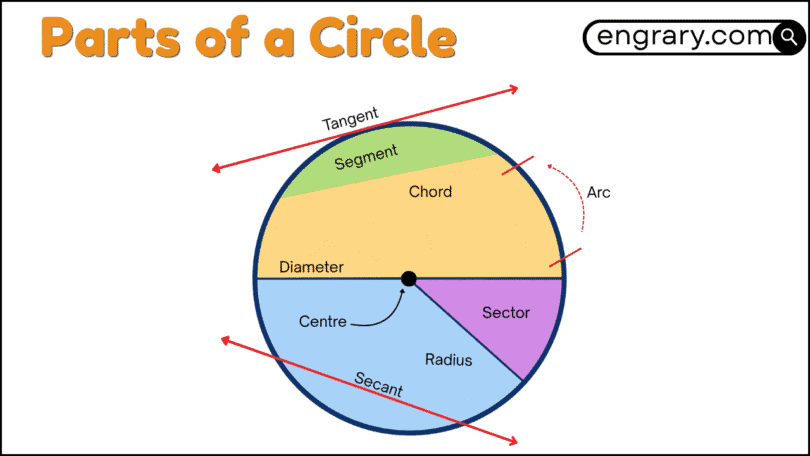
A circle is a geometric shape where every point on the boundary is the same distance from the center. Understanding its parts helps students solve geometry problems and interpret diagrams. In addition, labeled diagrams make it easier to visualize each part and its role.
Students studying geometry use these terms to calculate measurements, divide areas, and understand relationships between lines, angles, and regions. Moreover, mastering the parts of a circle is essential for exams and practical applications.
Parts of a Circle With Labeled Diagram
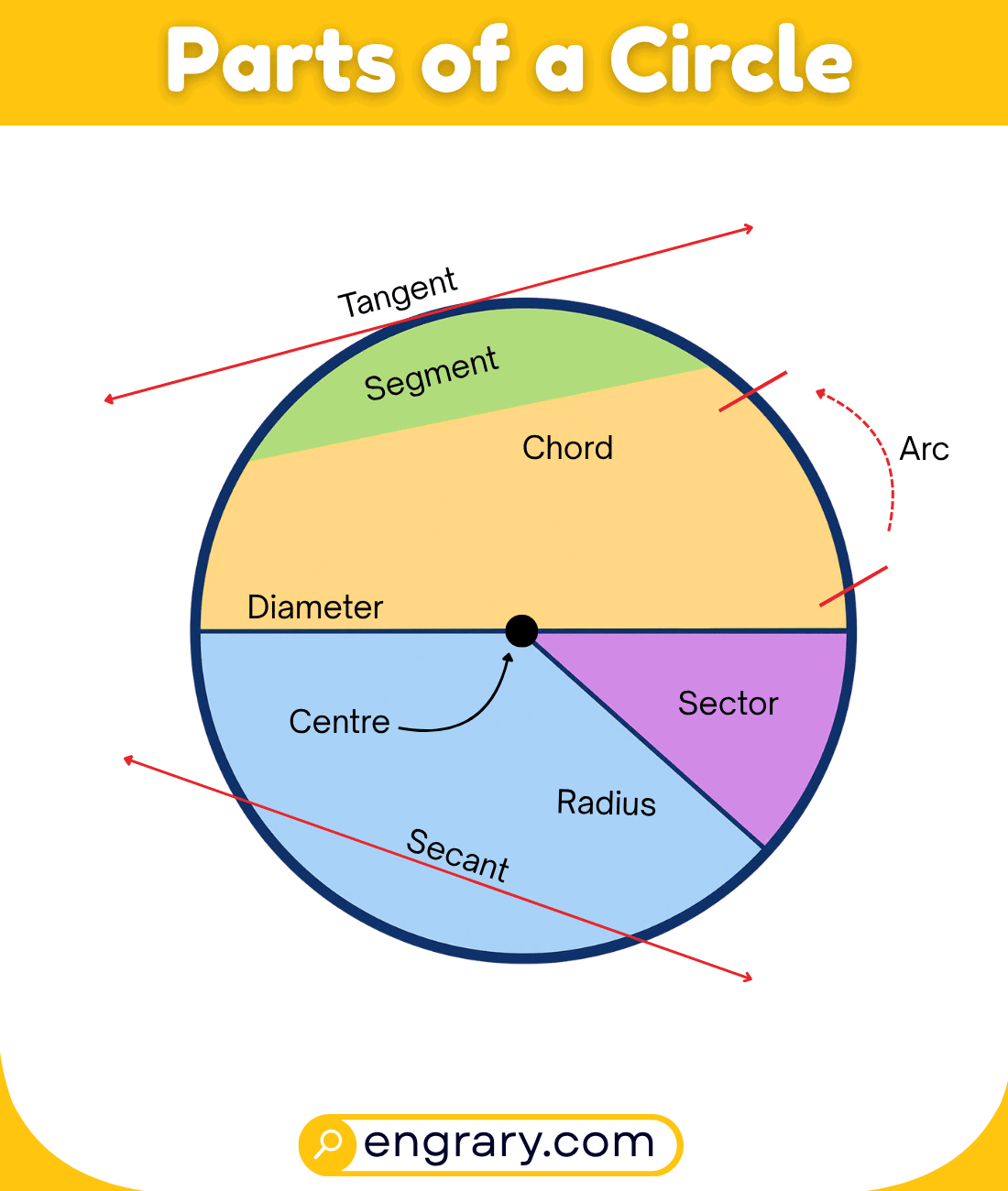
A labeled diagram shows all major components of a circle. Furthermore, it highlights how lines, angles, and regions work together, providing a complete view of circle geometry.
Main Parts of a Circle
The main parts define the circle’s structure and size. For example, the center, radius, diameter, and circumference form the foundation of circle terminology.
Center
The center is the fixed point in the middle of the circle. All points on the circumference are equally distant from it.
Radius
A radius is a line segment connecting the center to a point on the circumference. In addition, it helps measure the circle’s size.
Diameter
A diameter passes through the center and connects two points on the circumference. It is twice the length of the radius.
Circumference
The circumference is the complete boundary around the circle. It represents the perimeter.
Chord
A chord is a straight line connecting two points on the circumference. It does not pass through the center.
Arc
An arc is a curved section of the circumference. It represents part of the circle’s boundary.
Major Arc
A major arc is the longer curved path between two points on the circle.
Minor Arc
A minor arc is the shorter curved path between two points on the circle.
Sector
A sector is the area enclosed by two radii and an arc. For example, it resembles a slice of a pie.
Segment
A segment is the area enclosed by a chord and its corresponding arc.
Semicircle
A semicircle is half of a circle formed by a diameter. It contains exactly 180 degrees.
Tangent
A tangent is a line that touches the circle at exactly one point. Therefore, it does not cross the circle.
Point of Tangency
The point of tangency is where a tangent meets the circle.
Secant
A secant intersects the circle at two points. In addition, it extends beyond the circle.
Central Angle
A central angle is formed at the center by two radii. It measures the angle corresponding to an arc.
Inscribed Angle
An inscribed angle has its vertex on the circumference and sides intersect the circle.
Concentric Circles
Concentric circles share the same center but have different radii.
Circle Lines and Boundaries
Circle lines and boundaries describe straight and curved components. Moreover, they are essential for construction and measurements.
Radius
Connects the center to the circumference and helps calculate distance.
Diameter
Passes through the center and shows the circle’s full width.
Circumference
Measures the distance around the circle.
Chord
Connects two points on the circumference.
Tangent
Touches the circle at exactly one point.
Secant
Intersects the circle at two points.
Circle Arcs and Regions
Arcs and regions divide the circle into smaller portions. Also, they help calculate areas and angles.
Arc
Represents a curved part of the circumference.
Minor Arc
Forms the shorter curved path between two points.
Major Arc
Forms the longer curved path between two points.
Sector
Two radii and an arc enclose a sector.
Segment
A chord and an arc enclose a segment.
Semicircle
A diameter creates a semicircle with 180 degrees.
Circle Angles
Angles help measure arcs and regions. Similarly, they assist in geometric proofs.
Central Angle
Two radii meeting at the center form a central angle.
Inscribed Angle
Two chords or lines meeting on the circumference form an inscribed angle.
Right Angle in a Semicircle
An angle touching both ends of a diameter forms a right angle.
Special Circle Features
Special features illustrate relationships within circles. Moreover, these parts are important for advanced diagrams.
Point of Tangency
Where a tangent touches the circle.
Concentric Circles
Circles with the same center but different radii.
Common Center
The shared middle point of concentric circles.
Parts of a Circle and Their Functions
Parts of a Circle and Their Functions
Each part of a circle has a specific role in geometry. Some parts measure size, some describe the boundary, and others divide the circle into regions.
Center
The center gives the circle its fixed middle point. It helps define radius, diameter, and central angles.
Radius
The radius measures the distance from the center to the circumference. It is used to calculate area and circumference.
Diameter
The diameter measures the full width of the circle through the center. It is useful because it equals two radii.
Circumference
The circumference measures the distance around the circle. It helps calculate perimeter-based circle problems.
Chord
The chord connects two points on the circumference. It helps form segments and compare distances inside the circle.
Arc
The arc shows a curved portion of the circle. It helps measure parts of the circumference.
Sector
The sector shows a slice-shaped region. It helps calculate part of a circle’s area.
Segment
The segment shows the region between a chord and an arc. It helps describe smaller areas inside the circle.
Tangent
The tangent shows a line touching the circle at one point. It is useful in angle and construction problems.
Secant
The secant shows a line crossing the circle at two points. It helps compare intersecting lines and chords.
Comparison of Circle Parts
The table below explains the key differences between circle components.
| Comparison | Explanation |
|---|---|
| Radius vs Diameter | A radius connects the center to the circumference. A diameter passes through the center and is twice the radius. |
| Arc vs Chord | An arc curves along the circumference. A chord is a straight line connecting two points. |
| Sector vs Segment | A sector is enclosed by two radii and an arc. A segment is enclosed by a chord and an arc. |
| Tangent vs Secant | A tangent touches the circle at one point. A secant intersects the circle at two points. |
Real-Life Examples of Circle Parts
Wheel
Wheels show radius, diameter, and circumference.
Clock
Clock hands illustrate central angles.
Pizza
Pizza slices represent sectors.
Round Table
A round table demonstrates diameter and chord.
Target Board
Concentric circles illustrate multiple circles with the same center.
Circle Formulas and Measurements
Radius Formula r = d ÷ 2
Diameter Formula d = 2 × r
Circumference Formula C = 2πr or C = πd
Area Formula A = πr²
Why Understanding Circle Parts Matters
Understanding circle parts helps students solve problems, read diagrams, and apply formulas. In addition, labeled diagrams improve retention and connect theory with real-life examples.
Parts of a Circle Key Takeaways
The parts of a circle define its structure, size, boundaries, angles, and regions. Recognizing the center, radius, diameter, chord, arc, sector, segment, tangent, secant, angles, semicircle, and concentric circles enhances geometry comprehension and problem-solving. Moreover, diagrams help students visualize and memorize each component effectively.
FAQs
The main parts of a circle include the center, radius, diameter, circumference, chord, arc, sector, segment, tangent, secant, central angle, and inscribed angle.
A radius connects the center to the circumference. A diameter passes through the center and is twice the length of the radius.
A chord is a straight line segment that connects two points on the circumference. The diameter is the longest chord in a circle.
A sector is formed by two radii and an arc. A segment is formed by a chord and an arc.
A tangent line touches a circle at exactly one point. That point is called the point of tangency.
You May Also Like