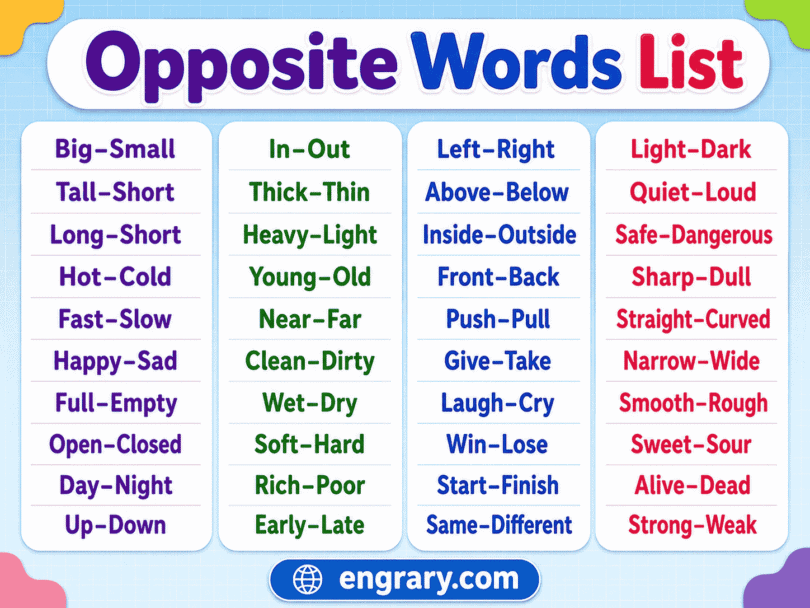
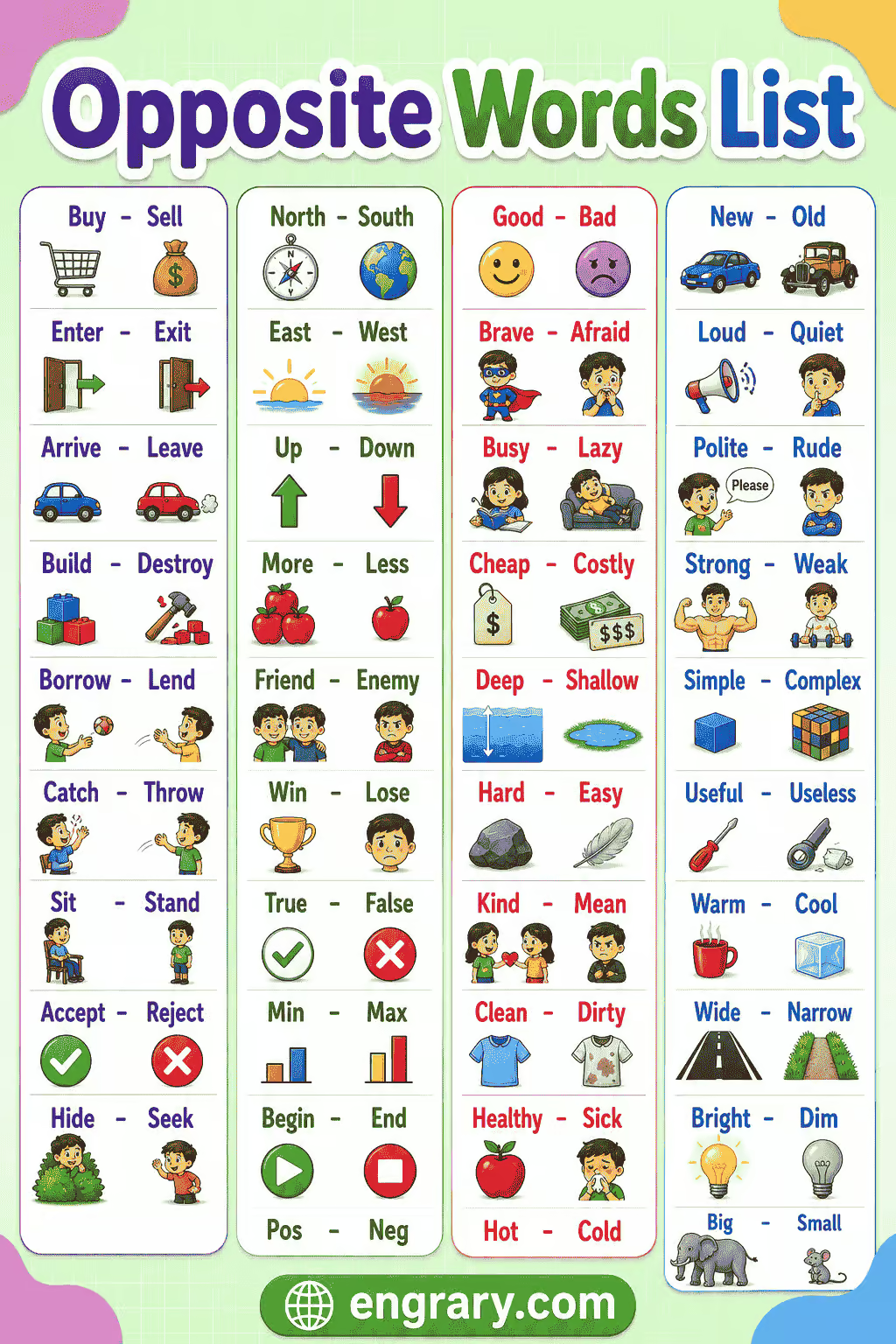
Opposite words are word pairs with opposite meanings, such as big and small, hot and cold, or happy and sad. These words help children compare people, places, actions, feelings, sizes, and everyday objects in a simple way.
Kids learn opposites faster when the words are connected with pictures, actions, and real examples. This guide includes common opposite words, simple meanings, preschool and kindergarten pairs, category-based lists, sentence examples, worksheet ideas, and teaching tips.
Common Opposite Words for Kids
Common opposite words are useful for daily speaking, early reading, picture charts, and classroom vocabulary practice.
- big – small
- tall – short
- long – short
- hot – cold
- warm – cool
- fast – slow
- happy – sad
- good – bad
- clean – dirty
- new – old
- young – old
- up – down
- in – out
- inside – outside
- open – closed
- day – night
- near – far
- front – back
- left – right
- top – bottom
- full – empty
- wet – dry
- hard – soft
- light – dark
- heavy – light
- loud – quiet
- easy – hard
- rich – poor
- right – wrong
- safe – dangerous
- beautiful – ugly
- kind – mean
- brave – scared
- early – late
- first – last
- start – stop
- come – go
- push – pull
- give – take
- laugh – cry
- shout – whisper
- sit – stand
- buy – sell
- build – break
- find – lose
- remember – forget
- same – different
- smooth – rough
- sweet – sour
- awake – asleep
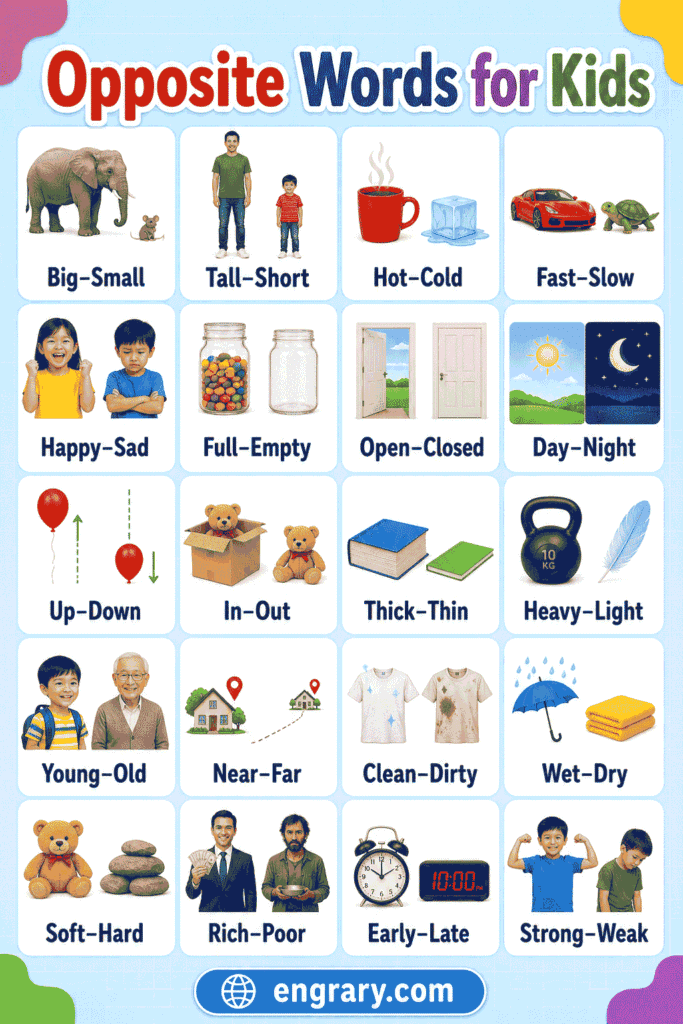
Opposite Words and Their Meanings
These opposite word pairs include simple meanings to help children understand both words clearly.
- Big – Small — big means large, and small means little.
- Hot – Cold — hot means very warm, and cold means not warm.
- Fast – Slow — fast means quick, and slow means not quick.
- Happy – Sad — happy means feeling joy, and sad means feeling unhappy.
- Open – Closed — open means not shut, and closed means shut.
- Full – Empty — full means filled, and empty means nothing inside.
- Up – Down — up means higher, and down means lower.
- In – Out — in means inside, and out means outside.
- Near – Far — near means close, and far means not close.
- Clean – Dirty — clean means not dirty, and dirty means not clean.
- Wet – Dry — wet means covered with water, and dry means without water.
- Hard – Soft — hard means not easy to press, and soft means easy to press.
- Light – Dark — light means bright, and dark means not bright.
- Loud – Quiet — loud means making a strong sound, and quiet means making little sound.
- Good – Bad — good means nice or right, and bad means not good.
- New – Old — new means recently made, and old means not new.
- Early – Late — early means before the expected time, and late means after the expected time.
- First – Last — first means at the beginning, and last means at the end.
- Safe – Dangerous — safe means not harmful, and dangerous means able to cause harm.
- Same – Different — same means alike, and different means not alike.
- Kind – Mean — kind means nice to others, and mean means unkind.
- Brave – Scared — brave means not afraid, and scared means afraid.
- Smooth – Rough — smooth means even to touch, and rough means not smooth.
- Sweet – Sour — sweet means sugary in taste, and sour means sharp in taste.
- Awake – Asleep — awake means not sleeping, and asleep means sleeping.
Easy Opposite Words for Kindergarten
Kindergarten opposite words should be simple, familiar, and easy to understand with pictures or classroom examples.
- big – small
- tall – short
- long – short
- hot – cold
- warm – cool
- fast – slow
- happy – sad
- good – bad
- clean – dirty
- wet – dry
- open – closed
- full – empty
- up – down
- in – out
- near – far
- day – night
- light – dark
- loud – quiet
- hard – soft
- new – old
- young – old
- front – back
- left – right
- top – bottom
- first – last
- early – late
- safe – dangerous
- easy – hard
- same – different
- awake – asleep
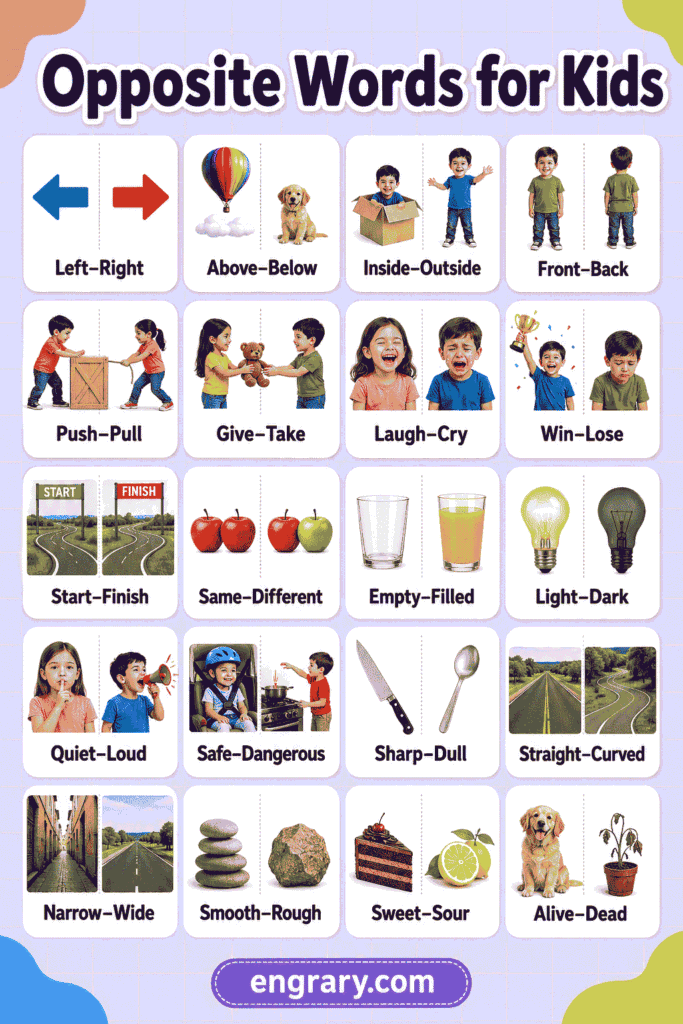
Opposite Words for Preschool
Preschool opposite words should be visual, action-based, and easy to act out with body movement or real objects.
- up – down
- in – out
- on – off
- open – shut
- big – small
- tall – short
- happy – sad
- loud – quiet
- fast – slow
- wet – dry
- hot – cold
- day – night
- full – empty
- near – far
- clean – dirty
- sit – stand
- laugh – cry
- push – pull
- come – go
- stop – start
- light – dark
- heavy – light
- soft – hard
- front – back
- inside – outside
Opposite Words by Category
Opposite words become easier to remember when children learn them in meaning groups.
Size Opposite Words
Size opposites help children compare how big, small, tall, short, wide, or narrow something is.
- big – small
- tall – short
- long – short
- wide – narrow
- thick – thin
- large – little
- huge – tiny
- high – low
- deep – shallow
- heavy – light
Direction Opposite Words
Direction opposites show movement, side, and path.
- up – down
- left – right
- forward – backward
- north – south
- east – west
- come – go
- enter – exit
- rise – fall
- ascend – descend
- move – stay
Position Opposite Words
Position opposites show where something is placed.
- in – out
- inside – outside
- near – far
- front – back
- above – below
- over – under
- top – bottom
- here – there
- before – after
- on – off
Time Opposite Words
Time opposites help children talk about order, days, and daily routines.
- day – night
- morning – evening
- early – late
- first – last
- before – after
- start – finish
- now – later
- today – tomorrow
- old – new
- past – future
Feeling Opposite Words
Feeling opposites help children describe emotions and moods.
- happy – sad
- calm – angry
- brave – scared
- excited – bored
- kind – mean
- cheerful – gloomy
- proud – ashamed
- relaxed – worried
- friendly – unfriendly
- awake – sleepy
Action Opposite Words
Action opposites show different movements or activities.
- sit – stand
- push – pull
- give – take
- open – close
- start – stop
- laugh – cry
- shout – whisper
- buy – sell
- build – break
- find – lose
Quality Opposite Words
Quality opposites describe how something looks, feels, or works.
- good – bad
- clean – dirty
- safe – dangerous
- easy – difficult
- right – wrong
- strong – weak
- smooth – rough
- soft – hard
- beautiful – ugly
- useful – useless
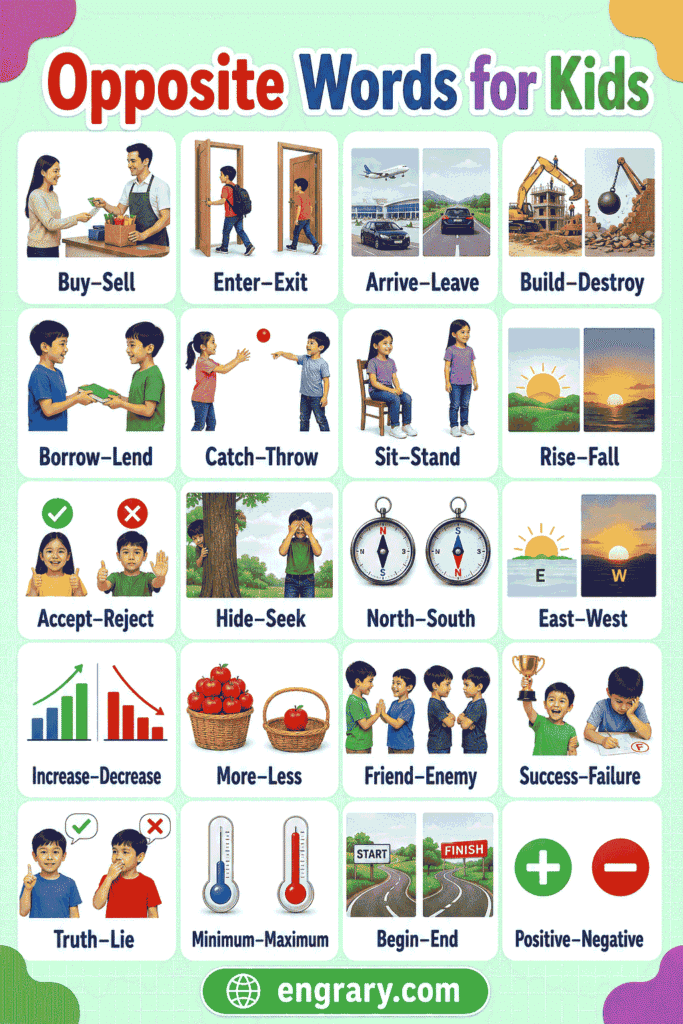
Quantity Opposite Words
Quantity opposites help children compare amounts and numbers.
- many – few
- more – less
- full – empty
- all – none
- enough – not enough
- whole – half
- most – least
- several – one
- much – little
- plenty – scarce
Weather Opposite Words
Weather opposites help children describe daily weather and seasons.
- hot – cold
- warm – cool
- sunny – cloudy
- wet – dry
- rainy – clear
- windy – calm
- stormy – peaceful
- bright – dark
- humid – dry
- snowy – snowless
Taste Opposite Words
Taste opposites help children describe food and drinks.
- sweet – sour
- salty – bland
- bitter – sweet
- spicy – mild
- fresh – stale
- tasty – tasteless
- hot – cold
- juicy – dry
- soft – crunchy
- ripe – unripe
Sound Opposite Words
Sound opposites help children understand noise, voice, and listening words.
- loud – quiet
- noisy – silent
- shout – whisper
- talk – listen
- high – low
- clear – muffled
- strong – weak
- near – distant
- music – silence
- sound – silence
Shape and Appearance Opposite Words
Shape and appearance opposites help children describe how things look.
- round – square
- straight – curved
- smooth – rough
- bright – dull
- shiny – matte
- clean – dirty
- beautiful – ugly
- plain – fancy
- thick – thin
- whole – broken
Opposite Words with Sentences
Sentence examples help children understand how opposite words work in real speech and writing.
- Big – Small — The elephant is big, and the mouse is small.
- Hot – Cold — The tea is hot, and the ice cream is cold.
- Fast – Slow — The car is fast, and the turtle is slow.
- Happy – Sad — The girl is happy, but the boy is sad.
- Tall – Short — The tree is tall, and the plant is short.
- Open – Closed — The door is open, but the box is closed.
- Full – Empty — The glass is full, and the bottle is empty.
- Clean – Dirty — The shirt is clean, but the shoes are dirty.
- Wet – Dry — The towel is wet, and the floor is dry.
- Up – Down — The balloon goes up, and the ball falls down.
- In – Out — The cat is in the box, and the dog is out.
- Near – Far — The school is near, but the airport is far.
- Day – Night — The sun shines in the day, and the moon shines at night.
- Light – Dark — The room is light, but the cave is dark.
- Loud – Quiet — The drum is loud, but the library is quiet.
- Hard – Soft — The rock is hard, and the pillow is soft.
- New – Old — This toy is new, but that chair is old.
- First – Last — She came first, and he came last.
- Early – Late — We came early, but they came late.
- Safe – Dangerous — The park is safe, but the broken road is dangerous.
- Kind – Mean — A kind child helps, but a mean child hurts.
- Brave – Scared — The brave dog stayed, but the scared cat ran away.
- Push – Pull — Push the door open and pull the drawer out.
- Give – Take — I give you a pencil, and you take it.
- Build – Break — We build a tower, but the baby can break it.
- Find – Lose — I find my book, but I lose my pen.
- Same – Different — These bags are the same, but those shoes are different.
- Sweet – Sour — Candy is sweet, but lemon is sour.
- Straight – Curved — The ruler is straight, but the road is curved.
- Whole – Broken — The cup is whole, but the plate is broken.
Opposite Words Chart with Pictures
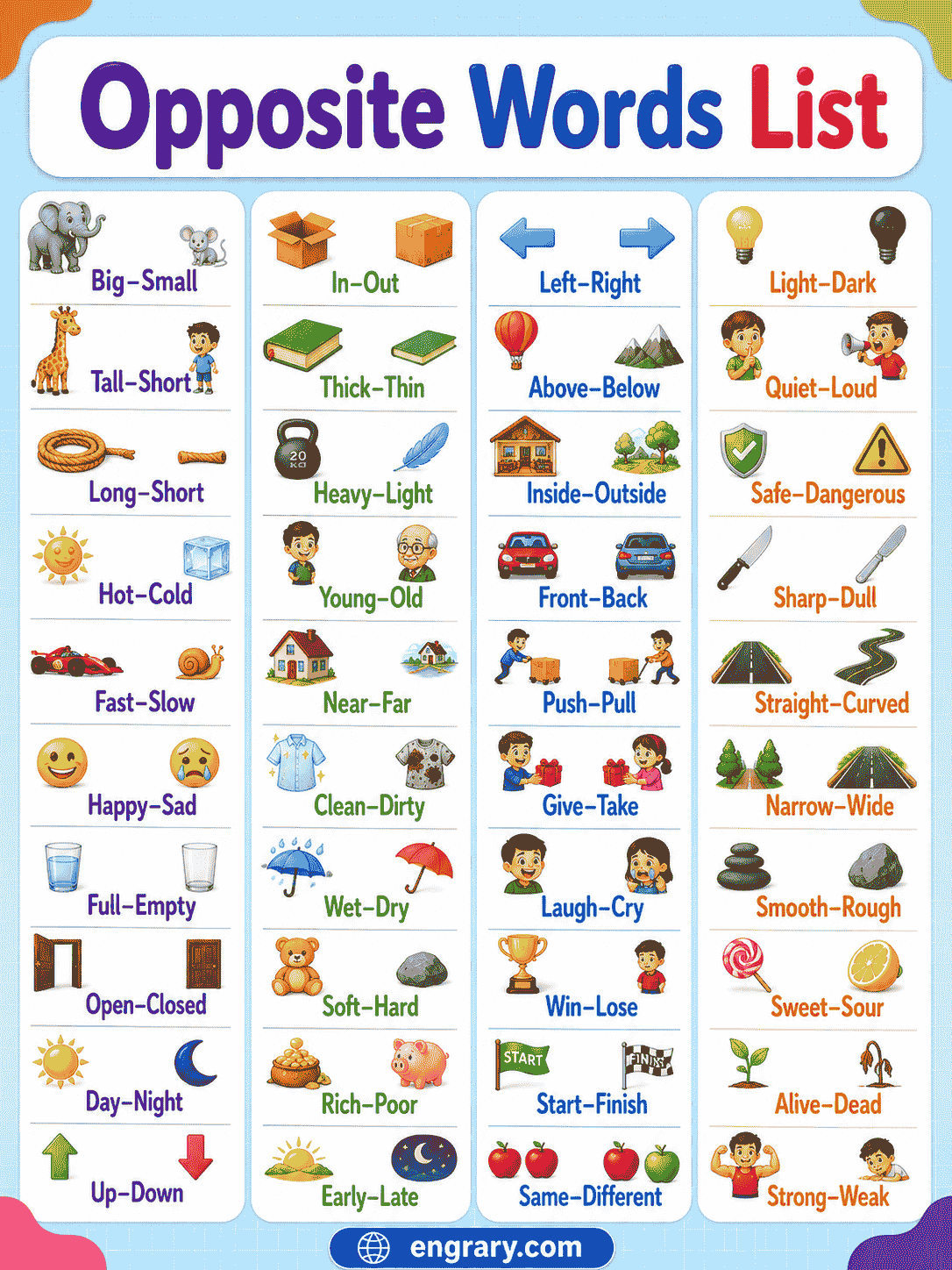
A chart helps children compare opposite word groups with examples.
| Opposite Group | Details |
|---|---|
| Size Words | Best for: visual comparison Examples: big – small, tall – short |
| Direction Words | Best for: movement practice Examples: up – down, left – right |
| Position Words | Best for: location learning Examples: in – out, near – far |
| Time Words | Best for: daily routine vocabulary Examples: day – night, early – late |
| Feeling Words | Best for: emotion vocabulary Examples: happy – sad, calm – angry |
| Action Words | Best for: sentence building Examples: push – pull, give – take |
| Quality Words | Best for: describing objects Examples: clean – dirty, safe – dangerous |
| Sound Words | Best for: listening and speaking practice Examples: loud – quiet, shout – whisper |
Opposite Words Worksheet Ideas
Worksheet activities help children practice opposite words through matching, drawing, sorting, and sentence building.
- Matching pairs — match each word with its opposite.
- Picture matching — match each picture with the opposite picture.
- Circle the opposite — choose the correct opposite word from a group.
- Fill in the blank — complete a sentence with the correct opposite.
- Cut and paste pairs — cut out opposite words and place them together.
- Draw the opposite — draw big and small, hot and cold, or happy and sad.
- Sort by category — group opposites by size, feeling, action, or time.
- Sentence practice — write one short sentence using an opposite pair.
- Flashcard game — show one card and ask for the opposite word.
- Act it out — act out opposites like sit and stand or shout and whisper.
How to Teach Opposite Words to Kids
Start with opposite words children can see, touch, or act out. Use real objects for big and small, hot and cold, full and empty, or open and closed. Pictures also help children connect each word pair with a clear visual meaning.
Actions and short sentences make opposites easier to remember. A child can stand up and sit down, push and pull a toy, or say, “The elephant is big, and the mouse is small.” Repeating a few pairs each day is better than teaching too many words at once.
FAQs
Opposite words for kids are word pairs with opposite meanings. Examples include big – small, hot – cold, happy – sad, up – down, and open – closed.
Easy opposite words for kindergarten include big – small, tall – short, hot – cold, fast – slow, clean – dirty, open – closed, full – empty, and happy – sad.
You can teach opposite words with pictures, flashcards, real objects, actions, matching games, and short sentences. Acting out pairs like sit – stand and push – pull also helps.
Common opposite word pairs for kids include big – small, hot – cold, fast – slow, day – night, up – down, in – out, near – far, full – empty, and loud – quiet.
Opposite words help kids compare meanings, describe things clearly, build vocabulary, and understand simple sentences. They also support early reading, speaking, and writing skills.
You May Also Like