
Wrenches come in many shapes because fasteners, pipes, fittings, collars, and other parts need different kinds of grip. Some wrench heads approach a fastener from the side, while others surround it completely, adjust to different sizes, use a ratcheting mechanism, or grip with a strap, chain, hook, or pin.
In this guide, you’ll learn 45 types of wrenches with pictures and uses. Each description focuses on visible features such as the head opening, jaw shape, ring, socket, adjustment mechanism, handle form, or gripping method, making the different wrench types easier to recognize.

How Different Wrench Heads Grip a Fastener
The head provides the fastest way to identify most wrenches. An open jaw approaches a fastener from the side, a box end surrounds it, and an adjustable jaw changes width. Other designs use sockets, rings, straps, chains, or specialized heads.
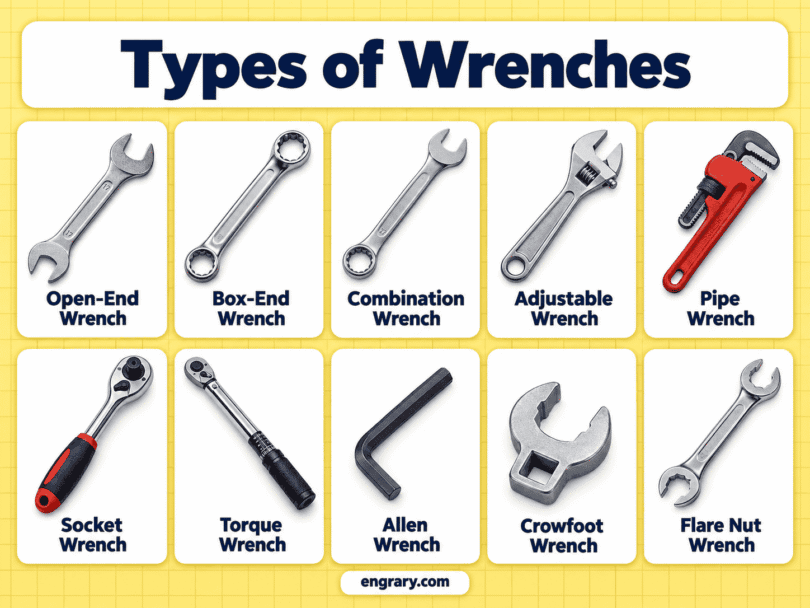
1. Open-End Wrench
An open-end wrench has a U-shaped opening at one or both ends. The open jaws approach a nut or bolt head from the side, making this one of the easiest wrench types to recognize.
2. Box-End Wrench
A box-end wrench has a closed ring-shaped head that surrounds the fastener. Its enclosed head clearly separates it from an open-end wrench.
3. Combination Wrench
A combination wrench has an open end on one side and a box end on the other. Both ends usually match the same nominal fastener size.
4. Adjustable Wrench
An adjustable wrench has one fixed jaw and one movable jaw controlled by a threaded adjuster. Because the opening changes width, one wrench can accommodate several compatible fastener sizes.
5. Ratcheting Wrench
A ratcheting wrench contains a ratchet mechanism inside its enclosed head. The ring can turn a fastener while allowing the handle to move back without fully removing the wrench.
6. Ratcheting Combination Wrench
A ratcheting combination wrench pairs an open end with a ratcheting box end. It resembles a standard combination wrench until you look closely at the enclosed ratchet head.
7. Flex-Head Wrench
A flex-head wrench has a pivoting joint between the handle and working head. This movable connection lets the head sit at different angles.
8. Stubby Wrench
A stubby wrench has a much shorter handle than a standard wrench. Its compact body is the main visual clue.
9. Flare-Nut Wrench
A flare-nut wrench has an almost closed ring with a narrow slot cut through one side. The opening allows the wrench to pass around tubing while the head contacts more sides of a fitting than a normal open-end wrench.
10. Spline Wrench
A spline wrench has an enclosed head with a multi-spline internal profile. Its ring looks more finely toothed than a conventional box-end wrench.
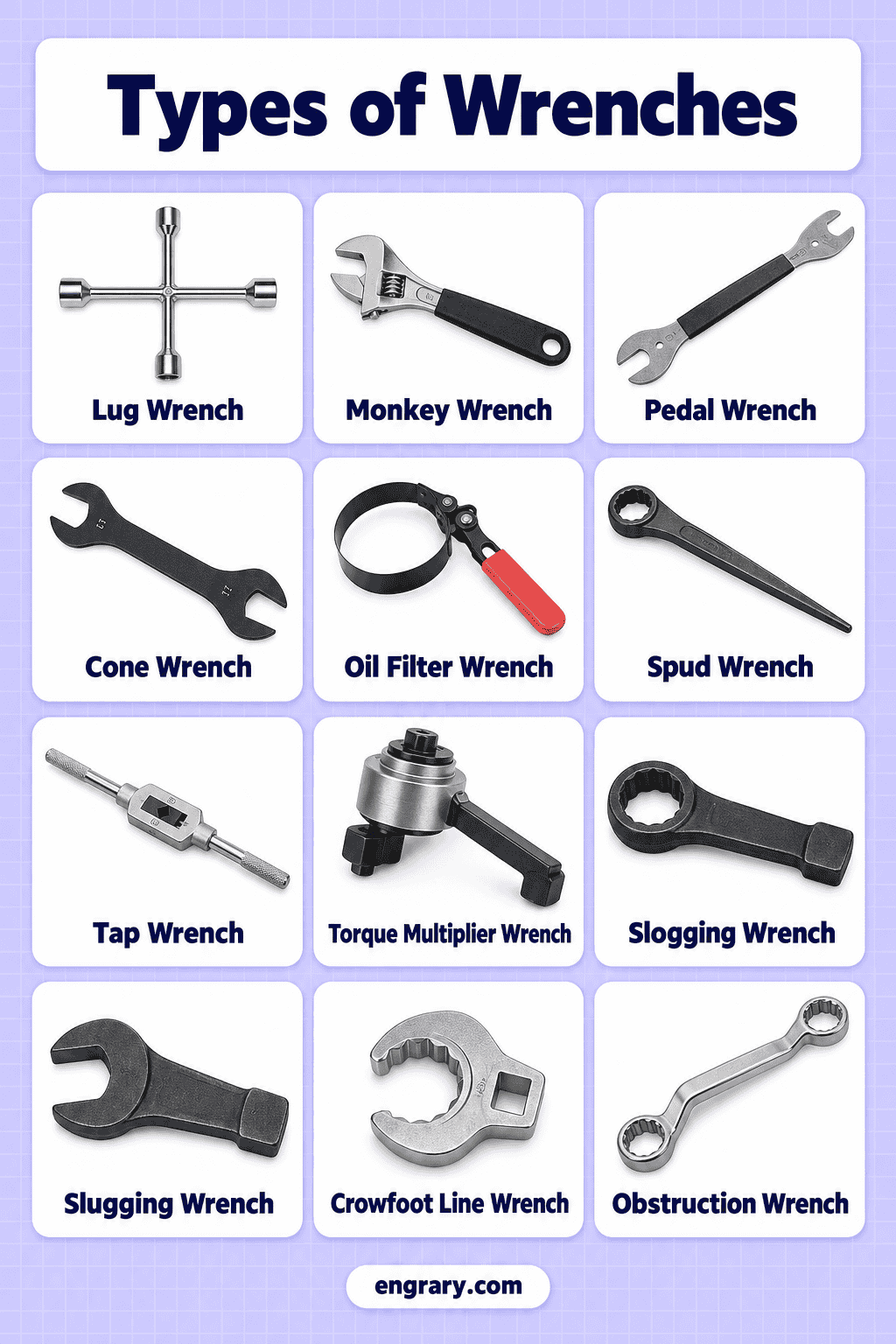
11. Crowfoot Wrench
A crowfoot wrench looks like an open-end wrench head without a normal handle. Instead, it has a square-drive opening for connection to a compatible ratchet or extension.
12. Basin Wrench
A basin wrench has a long shaft, a pivoting gripping jaw, and a crossbar-style handle. Its tall, narrow body makes it visually very different from ordinary hand wrenches.
13. Pipe Wrench
A pipe wrench has heavy serrated jaws and a movable upper jaw. The hooked jaw profile gives the head a rugged appearance designed around round pipe and fittings.
14. Strap Wrench
A strap wrench uses a flexible strap instead of rigid metal jaws. The strap wraps around a round or irregular object and provides the main gripping surface.
15. Chain Wrench
A chain wrench uses a metal chain that wraps around the object being gripped. Its chain loop makes it easy to distinguish from strap and jaw-style wrenches.
16. Socket Wrench
A socket wrench uses a ratchet handle that accepts removable sockets. The socket surrounds the nut or bolt head while the ratchet mechanism turns it.
17. Torque Wrench
A torque wrench has a mechanism that indicates or controls applied torque. Its longer handle and specialized adjustment or display features distinguish it from an ordinary ratchet.
18. Hex Key
A hex key has a solid six-sided shaft, usually bent into an L shape. It fits fasteners with internal hexagonal recesses and is also widely known as an Allen wrench.
19. Torx Key
A Torx key resembles a hex key in overall form but uses a six-lobed star-shaped working end instead of a hexagonal one.
20. Lug Wrench
A lug wrench has a dedicated shape for wheel fasteners. Many versions use an L-shaped body with a socket at one end.
21. Oil Filter Wrench
An oil filter wrench grips the round body of an oil filter rather than a conventional hex fastener. Depending on the design, it may use a band, strap, chain, or cap-style gripping element.
22. Spark Plug Wrench
A spark plug wrench uses a deep tubular or socket-like head shaped around spark plugs. Its elongated body helps distinguish it from an ordinary shallow socket wrench.
23. Spud Wrench
A spud wrench combines a wrench head with a long tapered handle. The pointed handle gives the tool an immediately recognizable industrial silhouette.
When the Jaw Opening Can Be Adjusted
Some wrenches change their opening with a screw, sliding jaw, or specialized pipe-jaw mechanism. These designs differ from fixed-size wrenches because the head can adapt to a range of compatible objects.
24. End Pipe Wrench
An end pipe wrench places its gripping jaws at an angle suited to working near pipe ends or confined fittings. It keeps the serrated adjustable-jaw character of a pipe wrench but changes the head orientation.
25. Offset Pipe Wrench
An offset pipe wrench has a jaw assembly set at a pronounced angle from the handle. The offset profile makes it easy to distinguish from a straight pipe wrench.
Wrenches That Ratchet, Pivot, or Flex
Mechanical movement inside the head can change how a wrench works. Some designs reverse ratchet direction, while others combine compact bodies with ratcheting or pivoting heads.
26. Reversible Ratcheting Wrench
A reversible ratcheting wrench has a selector that changes the direction of the ratchet mechanism. The small reversing lever near the head is a common identification feature.
27. Stubby Ratcheting Wrench
A stubby ratcheting wrench combines a shortened handle with a ratcheting box end. Its compact form differs clearly from a full-length ratcheting wrench.

Wrenches Made for Tight or Restricted Spaces
Limited access often changes the shape of the entire wrench. Thin bodies, curved handles, offsets, and unusual head positions help these tools reach fasteners that standard straight wrenches may not reach easily.
28. Ignition Wrench
An ignition wrench is a small, thin wrench designed around small fasteners in restricted spaces. Its narrow head and slim handle are the main recognition clues.
29. Offset Wrench
An offset wrench has one or both heads displaced from the main plane of the handle. Viewed from the side, the bends or offsets are easy to see.
30. Obstruction Wrench
An obstruction wrench has a deeply curved or offset body that passes around components blocking direct access to a fastener. Its unusual bent shape gives it a distinctive profile.
31. S-Shaped Wrench
An S-shaped wrench has a handle curved into an S-like form. The bends position the heads away from the centerline and help identify it immediately.
Wrenches That Grip with Straps, Chains, Hooks, or Pins
Not every wrench needs flat jaws or a box-shaped ring. Some grip round components with flexible loops, while others engage slots, holes, or notches with hooks and pins.
32. Hook Spanner
A hook spanner has a curved hook at the working end. The hook engages a notch on a compatible collar or ring.
33. Pin Spanner
A pin spanner has one or more projecting pins at its head. These pins engage matching holes rather than the flats of a conventional nut.
34. Face Spanner
A face spanner has pins positioned to engage holes on the face of a collar, nut, or ring. Its head differs from hook spanners because the contact points face forward rather than around the outer edge.
Wrenches That Use Sockets or Controlled Torque
Torque wrenches use different mechanisms to indicate or control turning force. Their displays, scales, handles, and internal mechanisms create several genuinely distinct wrench designs.
35. Beam Torque Wrench
A beam torque wrench has a long main beam and a separate pointer that moves across a scale. Its exposed pointer-and-scale arrangement makes it easy to recognize.
36. Click Torque Wrench
A click torque wrench has an adjustable handle with an internal mechanism that signals when a selected torque level is reached. Its cylindrical handle often includes a graduated adjustment scale.
37. Dial Torque Wrench
A dial torque wrench has a circular dial gauge connected to the wrench body. The large analog dial provides its clearest visual clue.
38. Digital Torque Wrench
A digital torque wrench has an electronic display on the handle or body. Buttons and a digital screen make it immediately distinguishable from beam, click, and dial versions.
Wrenches Shaped for Automotive, Plumbing, and Trade Work
Some wrench types develop around one particular trade or component. Their body shape often provides a stronger identification clue than the size of the fastener they turn.
39. Cross Lug Wrench
A cross lug wrench has four arms arranged in a cross, with socket ends at the outer points. Its X-shaped body makes it one of the easiest automotive wrenches to recognize.
40. Pedal Wrench
A pedal wrench has a long, thin handle and a narrow open-end head. Its slim profile distinguishes it from a standard combination wrench.
41. Cone Wrench
A cone wrench is unusually thin and flat. It resembles a very slender open-end wrench and is associated with narrow bicycle bearing flats.
42. Spoke Wrench
A spoke wrench is a small tool with a slotted or notched opening sized around spoke nipples. Its compact body looks very different from full-length wrenches.
43. Striking Wrench
A striking wrench has a short, thick body with a heavy striking area opposite the wrench head. It looks far more compact and robust than an ordinary box or open-end wrench.
44. Engineer’s Wrench
An engineer’s wrench is a heavy open-end wrench made in larger sizes for substantial fasteners. Its broad jaws and thick body distinguish it from lighter general-purpose wrenches.
45. Hydrant Wrench
A hydrant wrench has a specialized head designed around hydrant operating fittings. Many versions use an unusual pentagonal or adjustable opening rather than a conventional hex-shaped wrench head.
How to Tell Similar Wrenches Apart
Many wrenches look alike until you compare how their heads contact a fastener or object. The head opening, ring, movable jaw, ratchet, socket, or gripping material usually reveals the difference.
| Wrenches | Main Difference |
|---|---|
| Open-End vs Box-End Wrench | Open-end wrenches have U-shaped jaws, while box-end wrenches completely surround the fastener. |
| Open-End vs Combination Wrench | An open-end wrench uses open jaws, while a combination wrench pairs an open end with a box end. |
| Box-End vs Combination Wrench | A box-end wrench uses enclosed heads, while a combination wrench has one enclosed and one open end. |
| Adjustable vs Open-End Wrench | An adjustable wrench has a movable jaw, while an open-end wrench has a fixed opening. |
| Adjustable vs Pipe Wrench | Adjustable wrenches have smoother jaws for flat-sided fasteners, while pipe wrenches use heavy serrated jaws for round pipe and fittings. |
| Box-End vs Ratcheting Wrench | A box-end wrench has a solid enclosed ring, while a ratcheting wrench adds an internal ratchet mechanism. |
| Fixed-Head vs Flex-Head Wrench | A fixed head stays aligned with the handle, while a flex head pivots at a joint. |
| Standard vs Stubby Wrench | A stubby wrench has a much shorter handle than a standard wrench. |
| Flare-Nut vs Open-End Wrench | A flare-nut wrench partly surrounds a fitting, while an open-end wrench contacts it from only two sides. |
| Crowfoot vs Open-End Wrench | Both may use open jaws, but a crowfoot wrench has no conventional handle and connects to a square drive. |
| Pipe vs Strap Wrench | A pipe wrench uses rigid serrated jaws, while a strap wrench wraps a flexible strap around the object. |
| Strap vs Chain Wrench | A strap wrench uses a flexible band, while a chain wrench uses linked metal chain. |
| Socket Wrench vs Combination Wrench | A socket wrench uses removable sockets and a ratchet handle, while a combination wrench has fixed open and box ends. |
| Ratchet vs Torque Wrench | A ratchet primarily turns sockets, while a torque wrench also measures or controls applied torque. |
| Hex Key vs Torx Key | A hex key has six flat sides, while a Torx key has a six-lobed star profile. |
| Hook Spanner vs Pin Spanner | A hook spanner engages a notch with a curved hook, while a pin spanner engages one or more holes with projecting pins. |
Other Names Used for the Same Wrenches
Wrench terminology changes between countries, trades, and manufacturers. These alternate terms should not increase the numbered count when they describe the same basic tool.
| Main Name | Other Common Names |
|---|---|
| Adjustable Wrench | Crescent Wrench |
| Box-End Wrench | Ring Spanner |
| Combination Wrench | Combination Spanner |
| Flare-Nut Wrench | Line Wrench |
| Hex Key | Allen Wrench / Allen Key |
| Stubby Wrench | Short-Body Wrench |
| Spud Wrench | Structural Wrench in overlapping usage |
| Strap Wrench | Belt Wrench in some contexts |
| Open-End Wrench | Open-Ended Spanner |
| Pipe Wrench | Stillson Wrench for the traditional pattern |
Because regional names vary, the head shape, jaw construction, gripping method, and mechanism usually provide a more reliable identification clue than the name alone.
Questions People Ask
Common wrench families include Open-End, Box-End, Combination, Adjustable, Ratcheting, Pipe, Socket, Torque, Crowfoot, Flare-Nut, Strap, Chain, and specialty trade wrenches.
An open-end wrench has U-shaped jaws that approach a fastener from the side. A box-end wrench uses a closed ring that surrounds the fastener.
An adjustable wrench has a movable jaw designed around flat-sided fasteners. A pipe wrench has heavier serrated jaws shaped to grip round pipe and fittings.
Both can use enclosed heads, but a ratcheting wrench contains an internal mechanism that allows repeated turning without fully repositioning the tool. A standard box-end wrench has a solid fixed ring.
Look at whether the head is open, enclosed, adjustable, ratcheting, socket-based, hooked, pinned, or connected to a strap or chain. These features usually reveal the wrench family faster than handle length or size markings.
You May Also Like

Leave a Comment