
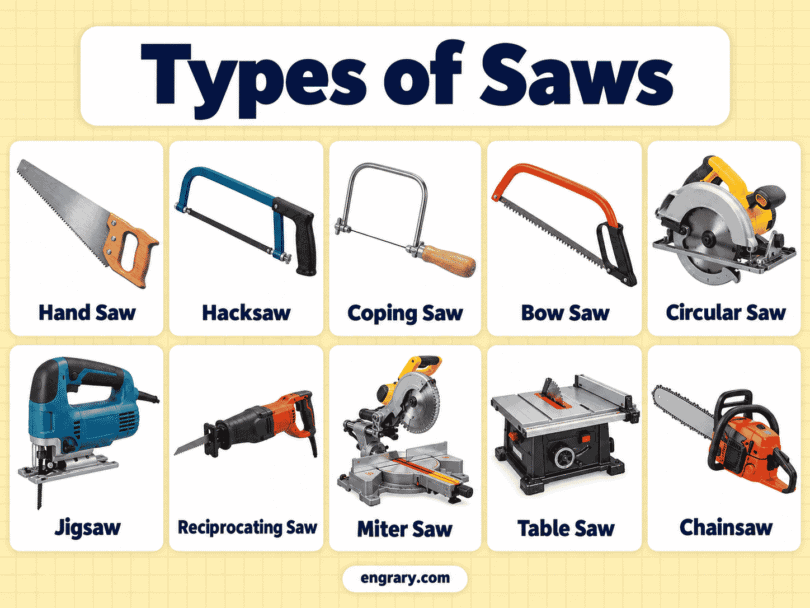
Saws come in many shapes because different blades, frames, and cutting motions suit different materials and kinds of work. Some saws use broad rigid blades, while others rely on thin framed blades, rotating discs, reciprocating blades, continuous bands, or moving chains.
This guide covers 40 types of saws with pictures and uses. Each description focuses on visible features such as blade shape, frame design, tooth arrangement, body style, or blade movement, making the different saw types easier to recognize.
Saws You Can Recognize by Their Blade and Frame
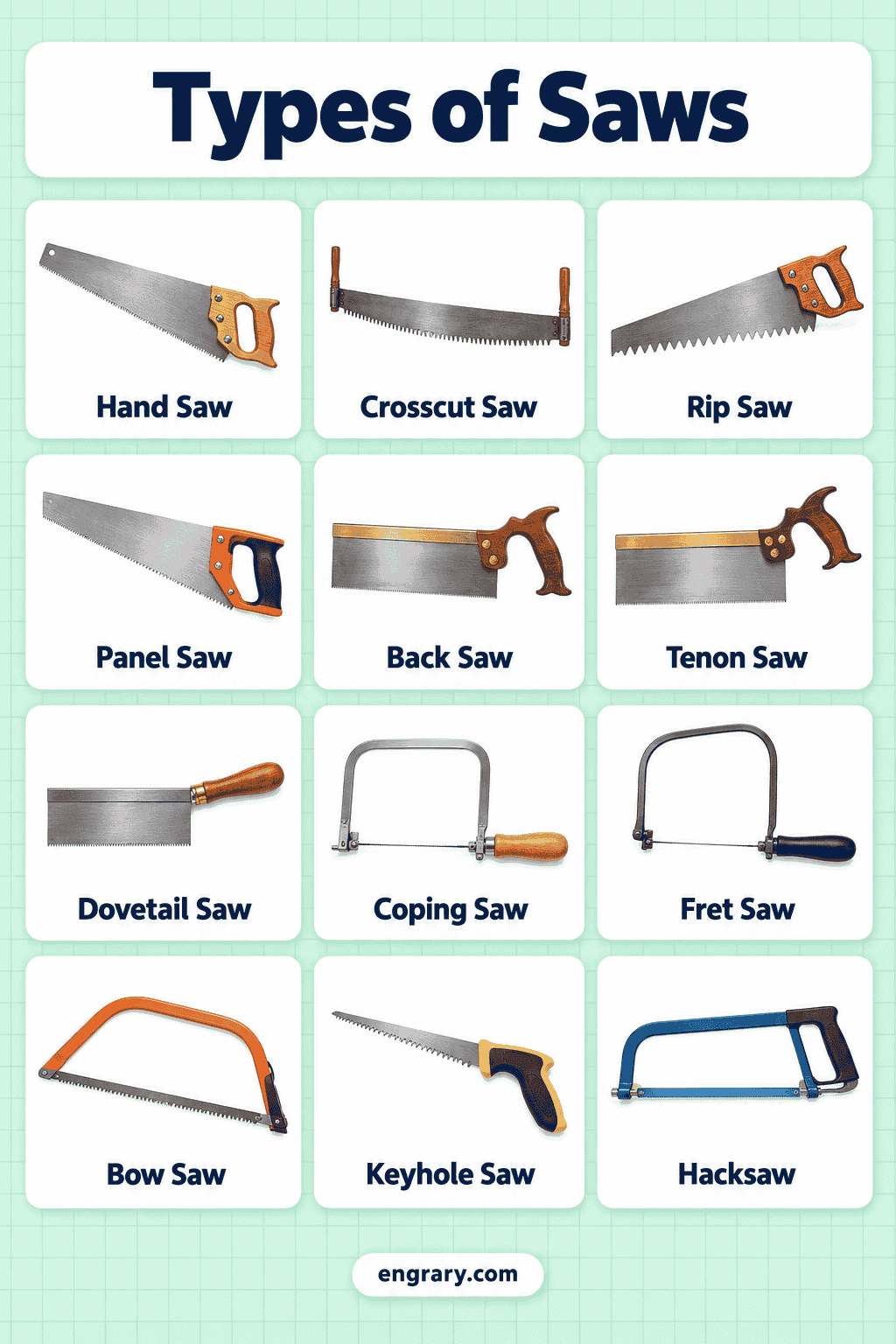
The blade and frame usually provide the quickest clues when identifying a saw. Traditional hand saws use rigid or tensioned blades, while powered saws may use circular, reciprocating, continuous-loop, or chain-based cutting systems.
1. Hand Saw
A hand saw has a broad steel blade with teeth along one edge and a handle at the rear. Its simple blade-and-handle design makes it one of the most familiar saw forms.
2. Rip Saw
A rip saw resembles a traditional hand saw but uses teeth associated with cutting along the grain of wood. Its broad tapered blade gives it the familiar carpenter’s-saw appearance.
3. Crosscut Saw
A crosscut saw has a toothed blade associated with cuts across wood grain. Handheld versions resemble rip saws, although their tooth geometry differs.
4. Panel Saw
A panel saw is a shorter hand saw with a broad rigid blade. Its compact proportions distinguish it from longer traditional hand saws.
5. Back Saw
A back saw has a rectangular blade with a rigid reinforced spine along its upper edge. The stiff back is its main visual feature.
6. Tenon Saw
A tenon saw belongs to the back-saw family and has a broad rectangular blade with a reinforced spine. It is generally larger and deeper than a dovetail saw.
7. Dovetail Saw
A dovetail saw is a small fine-toothed back saw with a reinforced upper spine. Its shorter, shallower blade distinguishes it from a larger tenon saw.
8. Coping Saw
A coping saw has a thin narrow blade stretched across a U-shaped metal frame. The blade sits far below the frame and can handle detailed curved work.
9. Fret Saw
A fret saw also uses a thin tensioned blade, but its frame is much deeper than that of a coping saw. The tall frame provides its clearest recognition feature.
10. Bow Saw
A bow saw has a large open frame with a long tensioned blade running across the bottom. Its broad bow-shaped body makes it easy to identify.
11. Hacksaw
A hacksaw has a metal frame that holds a narrow replaceable blade under tension. Its frame and thin blade are commonly associated with metal and other hard materials.
12. Junior Hacksaw
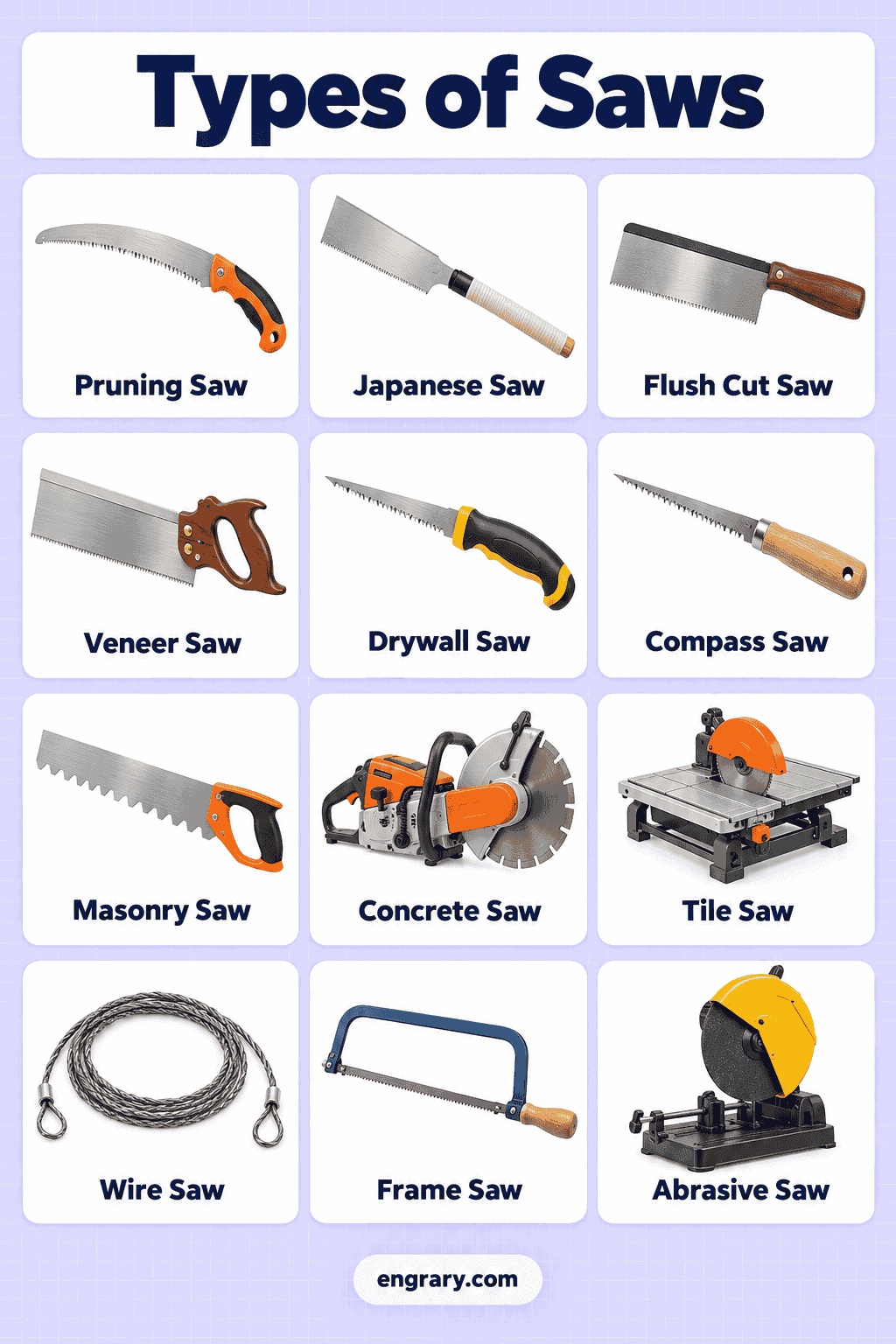
A junior hacksaw is a smaller version of a full-size hacksaw. Its compact frame and shorter blade make the difference obvious.
13. Japanese Pull Saw
A Japanese pull saw has a thin flexible blade designed around a pulling cutting action. Many versions have a straight blade with fine teeth and a simple wrapped or wooden handle.
14. Pruning Saw
A pruning saw usually has a narrow blade with large teeth and may be straight, curved, or folding. Its coarse tooth pattern and outdoor-oriented form make it easy to recognize.
15. Circular Saw
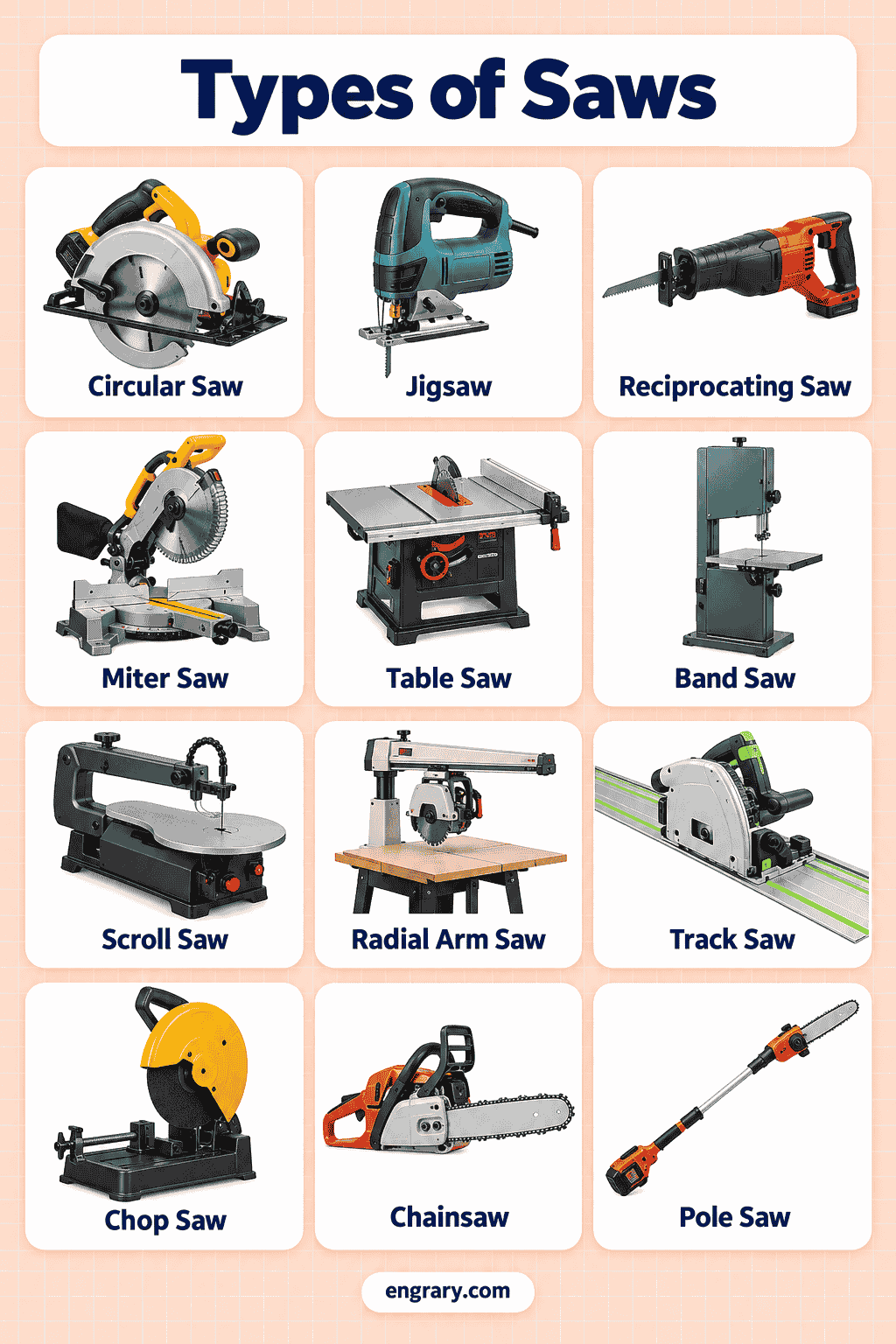
A circular saw has a round rotating blade mounted in a handheld motor body with a flat base plate. The exposed lower portion of the disc is the main visual clue.
16. Track Saw
A track saw resembles a circular saw but is designed to travel along a guide track. The rail-guided base distinguishes it from an ordinary handheld circular saw.
17. Miter Saw
A miter saw has a circular blade mounted on a pivoting arm above a base or table. The blade lowers toward the work surface from above.
18. Table Saw
A table saw has a circular blade projecting upward through a flat work table. The stationary table is the defining feature.
19. Jigsaw
A jigsaw has a narrow vertical blade beneath a handheld motor body and flat base plate. Its blade moves up and down through the material.
20. Reciprocating Saw
A reciprocating saw has a long narrow blade projecting from the front of an elongated powered body. The blade moves rapidly back and forth.
21. Band Saw
A band saw uses one continuous loop blade running around wheels inside a tall machine body. A small section of the blade remains exposed above the work table.
22. Chainsaw
A chainsaw has a cutting chain that travels around a long guide bar. Its bar-and-chain system makes it mechanically different from conventional bladed saws.
Hand Saws with Frames and Narrow Blades
Some hand saws use narrow pointed blades instead of broad panels. Their compact blade shapes make them easy to distinguish from ordinary carpenter’s hand saws.
23. Keyhole Saw
A keyhole saw has a very narrow pointed blade attached to a straight handle. The blade tapers toward the end and is associated with small openings and internal shapes.
24. Compass Saw
A compass saw has a narrow tapering blade that is generally longer and broader than a typical keyhole saw. Its pointed form suits curved and irregular cutting work.
25. Drywall Saw
A drywall saw has a short pointed blade with large aggressive-looking teeth and a straight handle. It is also commonly called a jab saw.
Saws for Curved, Detailed, and Interior Cuts
Detailed cutting calls for thin blades that can follow curves or work inside a small area. Some saws achieve this with a handheld frame, while others use a stationary table and a vertically moving blade.
26. Scroll Saw
A scroll saw is a stationary saw with a very thin vertical blade passing through a small work table. Its delicate blade and compact table arrangement make it easy to distinguish from a jigsaw.
27. Flush-Cut Saw
A flush-cut saw has a thin flexible blade designed to cut very close to a surrounding surface. Many versions have fine teeth and a compact straight handle.
28. Ryoba Saw
A Ryoba saw is a Japanese hand saw with teeth along both long edges of the blade. The double-edged blade is its most distinctive feature.
29. Dozuki Saw
A Dozuki saw is a Japanese back saw with a very thin blade and a rigid spine along the top. Its reinforced back and fine teeth give it a precise, lightweight appearance.
Circular Saws and the Designs Built Around Them
Many powered saws use a circular blade, but the arrangement of the blade, motor, table, and pivot changes from one design to another.
30. Compound Miter Saw
A compound miter saw adds a tilting blade assembly to the basic pivoting miter-saw design. Its head can angle as well as pivot across the base.
31. Sliding Miter Saw
A sliding miter saw mounts the blade and motor on rails. The rail system lets the head move forward and backward in addition to pivoting downward.
32. Sliding Compound Miter Saw
A sliding compound miter saw combines the rail movement of a sliding saw with the tilting head of a compound miter saw. The extra rails and pivot points make its head assembly more complex.
33. Radial Arm Saw
A radial arm saw mounts a circular blade and motor on a horizontal arm above a table. The overhead arm gives it a distinctive workshop-machine appearance.
34. Chop Saw
A chop saw has a circular blade mounted on a hinged arm above a base. Its overall form resembles a miter saw, but it is generally simpler and more heavy-duty in appearance.
Saws with Reciprocating Blades
Reciprocating saws use blades that travel rapidly back and forth rather than rotating continuously. Their body shape and blade orientation determine how different designs are recognized.
35. Compact Reciprocating Saw
A compact reciprocating saw has the same basic back-and-forth blade action as a full-size reciprocating saw but uses a shorter, more compact body.
Band Saws and Other Continuous-Blade Designs
A band saw uses a continuous strip of toothed metal rather than a circular disc or short reciprocating blade. Portable versions use the same loop-blade principle in a handheld body.
36. Portable Band Saw
A portable band saw has a handheld frame containing a continuous loop blade running around two wheels. Its large C-shaped cutting opening distinguishes it from stationary band saws.
Chainsaws and Pole Saws
Chain-based saws move a toothed chain around a guide bar instead of using a conventional blade. Their guide bars and chain housings make them visually distinctive.
37. Pole Saw
A pole saw places a compact saw head at the end of a long pole. Powered versions often use a small chain-and-guide-bar arrangement similar to a compact chainsaw.
Saws for Tile, Masonry, and Metal
Some saws are built around the needs of a particular material. Their blades, guards, tables, or overall bodies may differ noticeably from general woodworking saws.
38. Tile Saw
A tile saw typically has a circular blade mounted in a table-style or compact cutting unit. Its guarded blade and work-support arrangement distinguish it from an ordinary handheld circular saw.
39. Masonry Saw
A masonry saw has a heavy-duty body and circular-blade arrangement associated with brick, block, stone, or similar materials. Many versions use a sturdy table or support frame.
40. Metal-Cutting Circular Saw
A metal-cutting circular saw has the familiar handheld circular-saw layout but is configured around metal cutting. Its guarded round blade and robust body distinguish it from hand-operated hacksaws.
How to Tell Similar Saws Apart
Many saws share similar blades or body shapes. Comparing the blade support, frame, movement, mounting style, and overall size usually reveals the difference.
| Saws | Main Difference |
|---|---|
| Rip Saw vs Crosscut Saw | Both look like traditional hand saws, but they use different tooth geometry associated with cutting along or across wood grain. |
| Back Saw vs Tenon Saw | Back saw is the broader reinforced-spine family, while a tenon saw is a larger specific type within that family. |
| Tenon Saw vs Dovetail Saw | Tenon saws generally have broader, deeper blades, while dovetail saws are smaller and finer. |
| Coping Saw vs Fret Saw | Both use thin framed blades, but a fret saw has a much deeper frame. |
| Keyhole Saw vs Compass Saw | Keyhole saws tend to have very narrow pointed blades, while compass saws usually have longer, broader tapering blades. |
| Hacksaw vs Junior Hacksaw | A junior hacksaw has a smaller frame and shorter blade than a standard hacksaw. |
| Circular Saw vs Track Saw | A circular saw moves freely across a surface, while a track saw is built around a guide rail. |
| Circular Saw vs Table Saw | A circular saw is handheld, while a table saw has a stationary blade projecting through a table. |
| Miter Saw vs Chop Saw | Both use hinged circular blades, but miter saws emphasize adjustable cutting angles while chop saws generally have a simpler heavy-duty layout. |
| Miter Saw vs Sliding Miter Saw | A standard miter saw pivots downward, while a sliding model also moves along rails. |
| Jigsaw vs Reciprocating Saw | A jigsaw has a short vertical blade and base plate, while a reciprocating saw has a longer blade projecting from the front. |
| Jigsaw vs Scroll Saw | A jigsaw is handheld, while a scroll saw is stationary with a thin blade passing through a table. |
| Band Saw vs Scroll Saw | A band saw uses a continuous loop blade, while a scroll saw uses a short reciprocating blade. |
| Band Saw vs Portable Band Saw | Both use loop blades, but one is stationary and the other is handheld. |
| Chainsaw vs Pole Saw | A chainsaw has a conventional handheld body, while a pole saw places the cutting head at the end of a long pole. |
Other Names Used for the Same Saws
Saw terminology varies between trades and regions. These alternate names should not increase the numbered count when they refer to the same basic saw.
| Main Name | Other Common Names |
|---|---|
| Drywall Saw | Jab Saw |
| Reciprocating Saw | Sawzall-style Saw |
| Jigsaw | Jig Saw |
| Japanese Pull Saw | Japanese Saw in broad usage |
| Keyhole Saw | Pad Saw in some contexts |
| Bow Saw | Buck Saw where designs overlap |
| Chop Saw | Cut-Off Saw in overlapping usage |
| Pole Saw | Pole Pruner when referring to the saw form |
| Back Saw | Backsaw |
| Junior Hacksaw | Mini Hacksaw in some usage |
Because naming can overlap, blade shape, frame construction, and blade movement usually provide a more reliable identification clue than the name alone.
Questions People Ask About Saws
Major saw families include traditional hand saws, back saws, framed saws, narrow-blade saws, circular saws, reciprocating saws, band saws, chain saws, and material-specific saws.
Both look like traditional hand saws, but their tooth designs differ. A rip saw is associated with cuts along wood grain, while a crosscut saw is associated with cuts across it.
Both use rotating circular blades in portable motor bodies. A track saw, however, is designed to run along a dedicated guide track, while a conventional circular saw is not dependent on that rail system.
A jigsaw has a short vertical blade beneath a flat base plate. A reciprocating saw has a longer blade projecting horizontally from the front of the tool.
Look at whether the blade is broad or narrow, rigid or tensioned in a frame, circular, reciprocating, arranged as a continuous band, or replaced by a moving chain. These features usually reveal the saw family quickly.
You May Also Like



Leave a Comment