
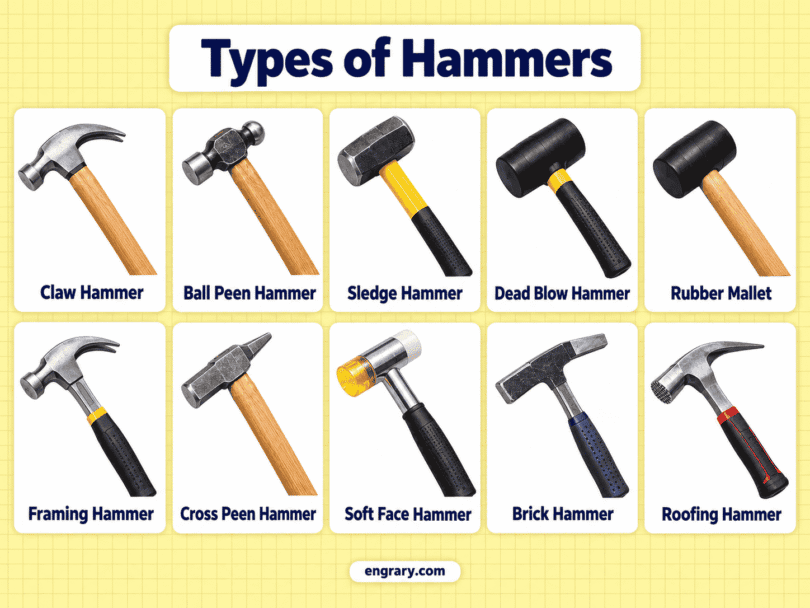
Hammers come in many shapes because different trades need different striking faces, claws, peens, head weights, and materials. Some hammers drive or remove nails, while others shape metal, work with masonry, deliver heavy blows, or protect finished surfaces from marks.
This guide covers 35 types of hammers with pictures and uses. Each description focuses on the hammer’s visible features, such as the claw, peen, striking face, head material, and overall shape, so the different types are easier to recognize.
Common Hammers You Should Know
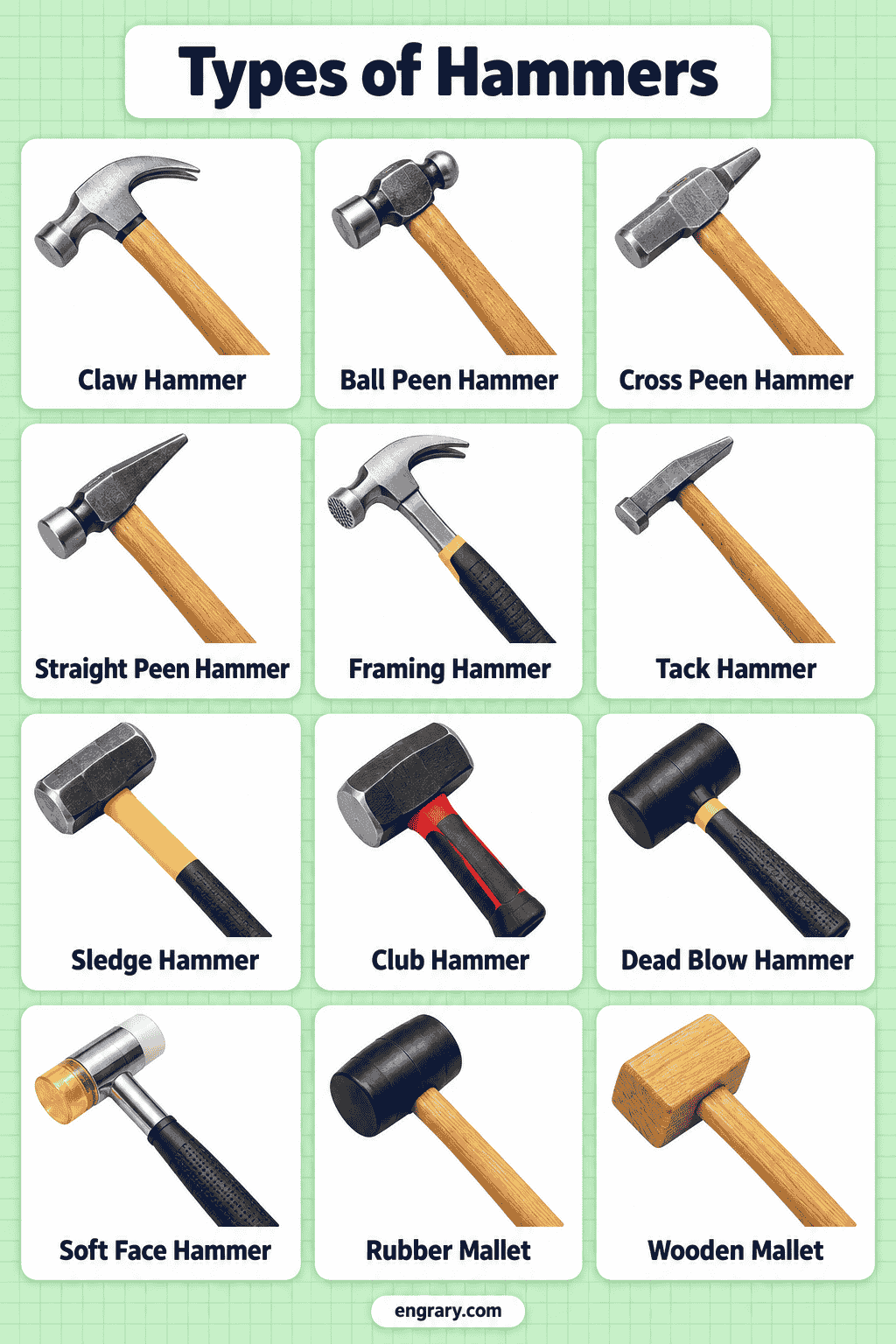
A hammer usually has a striking face on one side of the head and a second feature—such as a claw, peen, wedge, or another face—on the opposite side. Because these head shapes differ so much, they provide the easiest way to identify one hammer from another.
1. Claw Hammer
A claw hammer has a flat striking face and a forked claw on the opposite side. It is one of the most recognizable hammers used for general nail and carpentry work.
2. Curved-Claw Hammer
A curved-claw hammer has a noticeably curved forked claw behind the striking face. The curved profile distinguishes it from straighter rip-claw designs.
3. Rip-Claw Hammer
A rip-claw hammer has a straighter claw that extends backward from the head. Compared with a curved-claw hammer, its claw has a flatter, more direct profile.
4. Framing Hammer
A framing hammer has a larger head and longer overall form than many general claw hammers. It often has a straighter claw and may feature a textured striking face.
5. Finish Hammer
A finish hammer is lighter and more compact than a typical framing hammer. It generally has a smoother face and a less bulky head for controlled finish work.
6. Trim Hammer
A trim hammer is a compact, lightweight hammer associated with fine carpentry and trim work. Its smaller head makes it easy to distinguish from heavier framing hammers.
7. Tack Hammer
A tack hammer has a small lightweight head designed around small fasteners and delicate fastening work. Some versions have narrow striking faces.
8. Ball Peen Hammer
A ball peen hammer has a flat striking face on one side and a rounded ball-shaped peen on the other. Its spherical end makes it one of the easiest metalworking hammers to identify.
9. Cross Peen Hammer
A cross peen hammer has a wedge-shaped peen positioned across the direction of the handle. Therefore, the narrow edge runs sideways relative to the handle.
10. Straight Peen Hammer
A straight peen hammer also has a wedge-shaped end, but the wedge aligns with the direction of the handle. This orientation separates it from a cross peen hammer.
11. Diagonal Peen Hammer
A diagonal peen hammer has a wedge-shaped peen set at an angle rather than directly across or in line with the handle.
12. Riveting Hammer
A riveting hammer has a compact metalworking head designed around rivet and sheet-metal work. Its head may combine a flat face with a narrow peen.
13. Planishing Hammer
A planishing hammer has smooth polished faces intended for fine metal-surface refinement. Its clean, rounded striking surfaces distinguish it from rougher heavy hammers.
14. Body Hammer
A body hammer has specially shaped faces for metal-panel work. Different designs may use flat, crowned, or contoured striking surfaces.
15. Chipping Hammer
A chipping hammer has a narrow pointed or chisel-like head arrangement rather than a broad general-purpose claw. Its head shape makes it easy to identify among metalworking hammers.
16. Brick Hammer
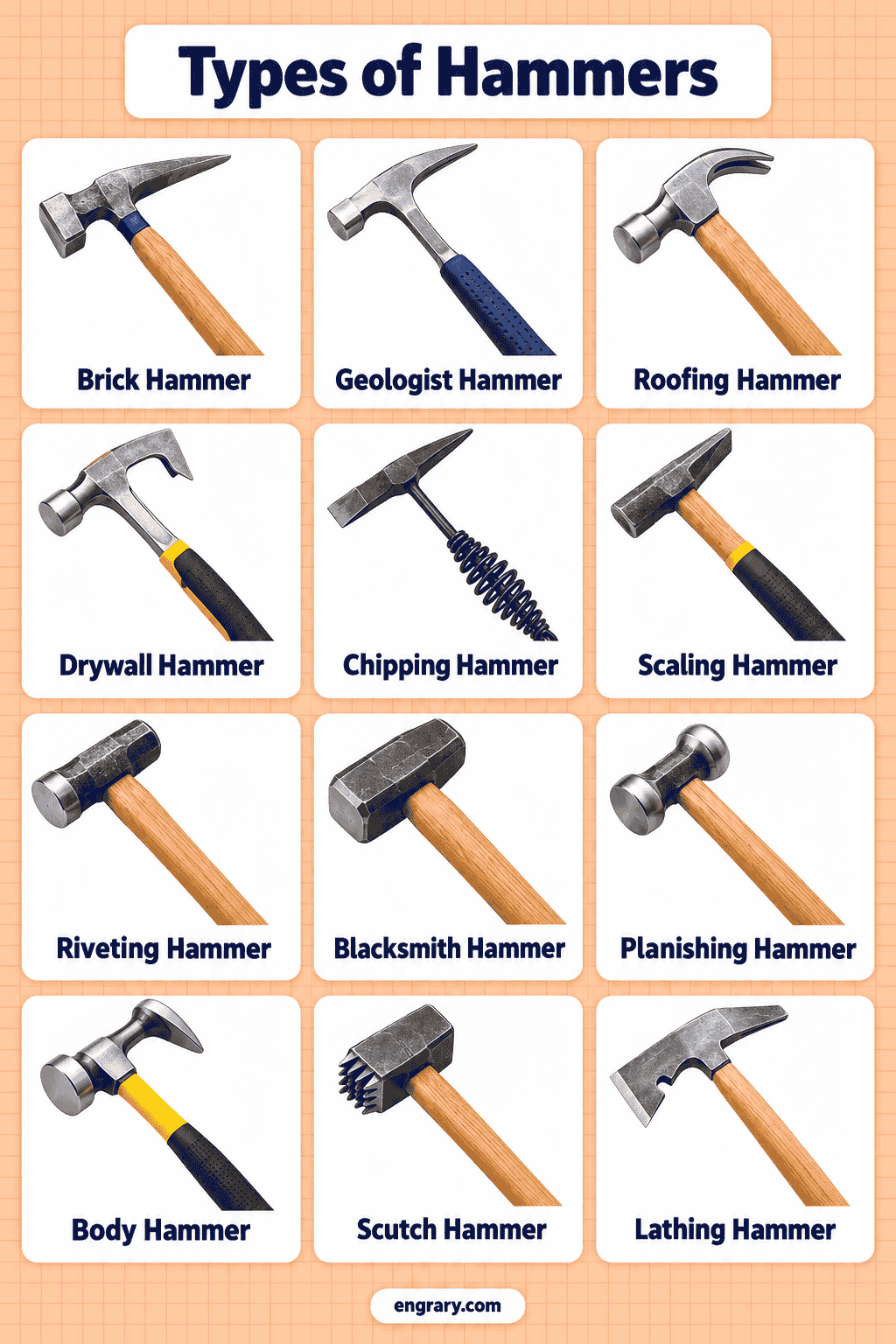
A brick hammer combines a flat striking face with a chisel-like blade on the opposite side. This distinctive head shape strongly identifies it with masonry work.
17. Mason’s Hammer
A mason’s hammer is a trade-focused striking tool used around stone and masonry work. Its head commonly combines a striking face with a narrower shaping end.
18. Stone Hammer
A stone hammer has a robust head designed around stone and masonry work. It generally looks heavier and more solid than a standard carpentry hammer.
19. Club Hammer
A club hammer has a short handle and heavy double-faced head. It resembles a compact one-handed version of a sledgehammer.
20. Sledgehammer
A sledgehammer has a large heavy head mounted on a long handle. Its size immediately separates it from ordinary hand hammers.
21. Mini Sledgehammer
A mini sledgehammer has the heavy double-faced head style of a sledgehammer but uses a shorter handle and smaller overall body.
22. Engineer’s Hammer
An engineer’s hammer has a compact heavy head and relatively short handle. It belongs to the heavier striking-hammer family but remains much smaller than a full sledgehammer.
23. Drilling Hammer
A drilling hammer has a short handle with a dense, heavy double-faced head. Its compact proportions resemble a particularly stout club hammer.
24. Rubber Mallet
A rubber mallet has a large rubber head instead of a conventional steel striking face. Therefore, it can strike suitable surfaces with less risk of visible marking than a hard metal face.
25. Wooden Mallet
A wooden mallet has a large wooden head and wooden handle. Its broad rectangular or rounded head makes it visually distinct from steel hammers.
Claw Hammers for Carpentry and Nail Work
Claw hammers combine a striking face with a forked claw. However, claw shape, head size, face texture, and overall weight vary according to the kind of carpentry work the hammer is meant to support.
The Claw Hammer, Curved-Claw Hammer, Rip-Claw Hammer, Framing Hammer, Finish Hammer, and Trim Hammer already cover the main recognizable carpentry forms in this guide.
Rather than treating different handle materials or head weights as separate hammer types, it is more accurate to regard those as design variations within the same family.
Peen Hammers for Metalworking
The peen is the shaped part of a hammer head opposite the main face. Its form can be rounded, wedge-shaped, straight, crosswise, or angled, which makes peen geometry one of the best ways to recognize metalworking hammer types.
Ball peen, cross peen, straight peen, diagonal peen, riveting, planishing, body, and chipping hammers already appear in the main list.
Their different peen and face shapes create much more meaningful distinctions than simply grouping them by size.
Hammers for Masonry and Stone Work
Masonry hammers often use a heavy striking face together with a narrower blade, pick, or shaping end. Their head geometry reflects work around brick, stone, and similar materials.
26. Geologist’s Hammer
A geologist’s hammer has a steel striking head with a pointed pick or chisel-like opposite end. Its long narrow head shape makes it visually distinct from a brick hammer.
Brick Hammer, Mason’s Hammer, Stone Hammer, and Club Hammer also belong naturally within masonry and stone-related work.
Heavy Hammers for Demolition and Striking
Heavy hammers use larger heads and stronger overall construction than ordinary carpentry hammers. Their main recognition clues are head mass, handle length, and double-faced construction.
Sledgehammer, Mini Sledgehammer, Club Hammer, Engineer’s Hammer, and Drilling Hammer already represent the main heavy striking forms in this article.
Soft-Face Hammers and Mallets
Soft-face tools use materials such as rubber, nylon, rawhide, wood, or replaceable softer inserts. As a result, they create a different striking surface from conventional steel-faced hammers.
27. Dead Blow Hammer
A dead blow hammer usually has a thick enclosed head made from a resilient outer material. Its head construction reduces rebound compared with many ordinary hammers.
28. Soft-Face Hammer
A soft-face hammer has one or more non-marring striking faces made from softer materials. Many designs use replaceable face inserts.
29. Nylon-Face Hammer
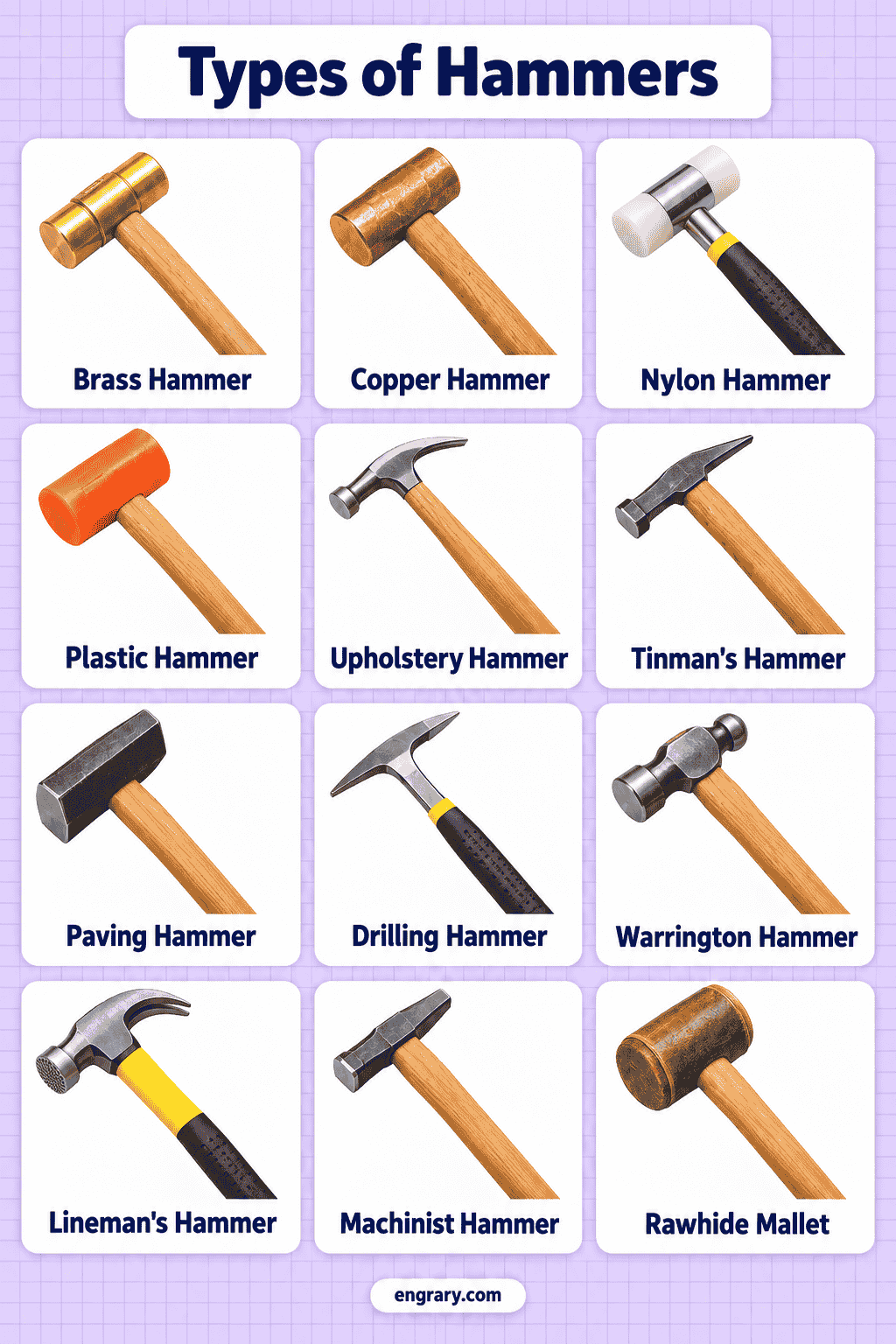
A nylon-face hammer uses a hard nylon striking surface. Its light-colored or replaceable synthetic face clearly distinguishes it from steel-faced hammers.
30. Rawhide Mallet
A rawhide mallet has a striking head made from rolled or compressed rawhide. Its tan or brown cylindrical head gives it a distinctive appearance.
Rubber and wooden mallets also belong in this family and already appear in the opening section.
Hammers Designed for Specific Trades
Some hammers develop around the needs of one trade. Their head shape often combines ordinary striking with another trade-specific feature.
31. Drywall Hammer
A drywall hammer has a specialized head associated with drywall work. Its head commonly differs from a standard claw hammer in both face and opposite-end design.
32. Roofing Hammer
A roofing hammer is designed around roofing tasks and typically has a recognizable specialized head rather than the simple form of a general claw hammer.
33. Electrician’s Hammer
An electrician’s hammer usually has a relatively compact head and longer, slimmer proportions suited to electrical trade work.
34. Upholstery Hammer
An upholstery hammer is a light hammer with a small narrow head for small tacks and similar upholstery fasteners.
35. Scaling Hammer
A scaling hammer has a narrow pointed or chisel-like striking end for surface scale and similar trade work. Its head looks noticeably different from nail-driving hammers.
Hammer Types That Are Easy to Confuse
Many hammers appear similar because they share flat faces, claws, peens, or heavy double-faced heads. However, the opposite end of the head, handle length, material, and overall proportions usually reveal the difference.
| Hammer Types | Main Difference |
|---|---|
| Claw Hammer vs Rip-Claw Hammer | Claw hammer is the broad family, while a rip-claw hammer has a noticeably straighter claw. |
| Curved-Claw vs Rip-Claw Hammer | A curved-claw hammer has a strongly curved claw, whereas a rip-claw hammer uses a straighter claw profile. |
| Framing Hammer vs Finish Hammer | A framing hammer is generally larger and heavier, while a finish hammer is lighter and usually has a smoother face. |
| Claw Hammer vs Ball Peen Hammer | A claw hammer has a forked claw, while a ball peen hammer has a rounded peen opposite the face. |
| Ball Peen vs Cross Peen Hammer | A ball peen hammer has a rounded end, whereas a cross peen hammer has a sideways wedge-shaped end. |
| Cross Peen vs Straight Peen Hammer | A cross peen runs across the handle direction, while a straight peen aligns with it. |
| Club Hammer vs Sledgehammer | A club hammer has a short handle and compact heavy head, while a sledgehammer has a much longer handle and larger head. |
| Sledgehammer vs Rubber Mallet | A sledgehammer has a heavy hard striking head, whereas a rubber mallet has a softer rubber head. |
| Rubber Mallet vs Wooden Mallet | A rubber mallet uses a flexible rubber head, while a wooden mallet uses a solid wooden head. |
| Dead Blow Hammer vs Rubber Mallet | A dead blow hammer focuses on reducing rebound through its head construction, while a rubber mallet mainly provides a softer striking surface. |
| Soft-Face Hammer vs Dead Blow Hammer | A soft-face hammer focuses on non-marring contact, whereas a dead blow hammer specifically focuses on reducing rebound. |
| Brick Hammer vs Club Hammer | A brick hammer has a chisel-like opposite end, while a club hammer normally has two broad striking faces. |
| Tack Hammer vs Finish Hammer | A tack hammer has a much smaller head for light fastening work, while a finish hammer resembles a lighter carpentry claw hammer. |
Alternate Names for Hammers
Hammer terminology varies by region and trade. Therefore, some hammer types appear under slightly different names without representing a different tool.
| Main Name | Alternate Name |
|---|---|
| Ball Peen Hammer | Ball Pein Hammer |
| Club Hammer | Lump Hammer |
| Tack Hammer | Tacking Hammer |
| Finish Hammer | Finishing Hammer |
| Dead Blow Hammer | Deadblow Hammer |
| Claw Hammer | Nail Hammer in some contexts |
| Rubber Mallet | Rubber Hammer in some usage |
| Sledgehammer | Sledge Hammer |
| Brick Hammer | Bricklayer’s Hammer in some usage |
| Engineer’s Hammer | Engineering Hammer |
These alternate names do not count as additional hammer types when they refer to the same basic design.
Frequently Asked Questions
Common hammer types include claw hammers, framing hammers, finish hammers, ball peen hammers, cross peen hammers, brick hammers, club hammers, sledgehammers, dead blow hammers, and rubber mallets.
A framing hammer is generally larger, heavier, and built around heavier carpentry work. In contrast, a finish hammer is lighter and usually has a smoother face for more controlled work.
A ball peen hammer has a rounded ball-shaped peen. A cross peen hammer, however, has a narrow wedge-shaped peen positioned across the direction of the handle.
A club hammer has a short handle and compact heavy head, so it suits one-handed heavy striking. A sledgehammer has a much longer handle and considerably larger head.
A dead blow hammer uses special head construction to reduce rebound. A rubber mallet mainly relies on a softer rubber head to provide a less marking striking surface.
You May Also Like


Leave a Comment