

Finishing tools help smooth, refine, deburr, sand, polish, buff, or prepare a surface near the final stages of a job. Because wood, metal, painted surfaces, and other materials need different kinds of refinement, workshops use a wide range of manual and powered finishing tools.
This guide covers 40 finishing tools names with pictures and uses. Each description includes a simple recognition clue, so you can identify scrapers, files, sanders, polishing tools, and finish-application equipment more easily.
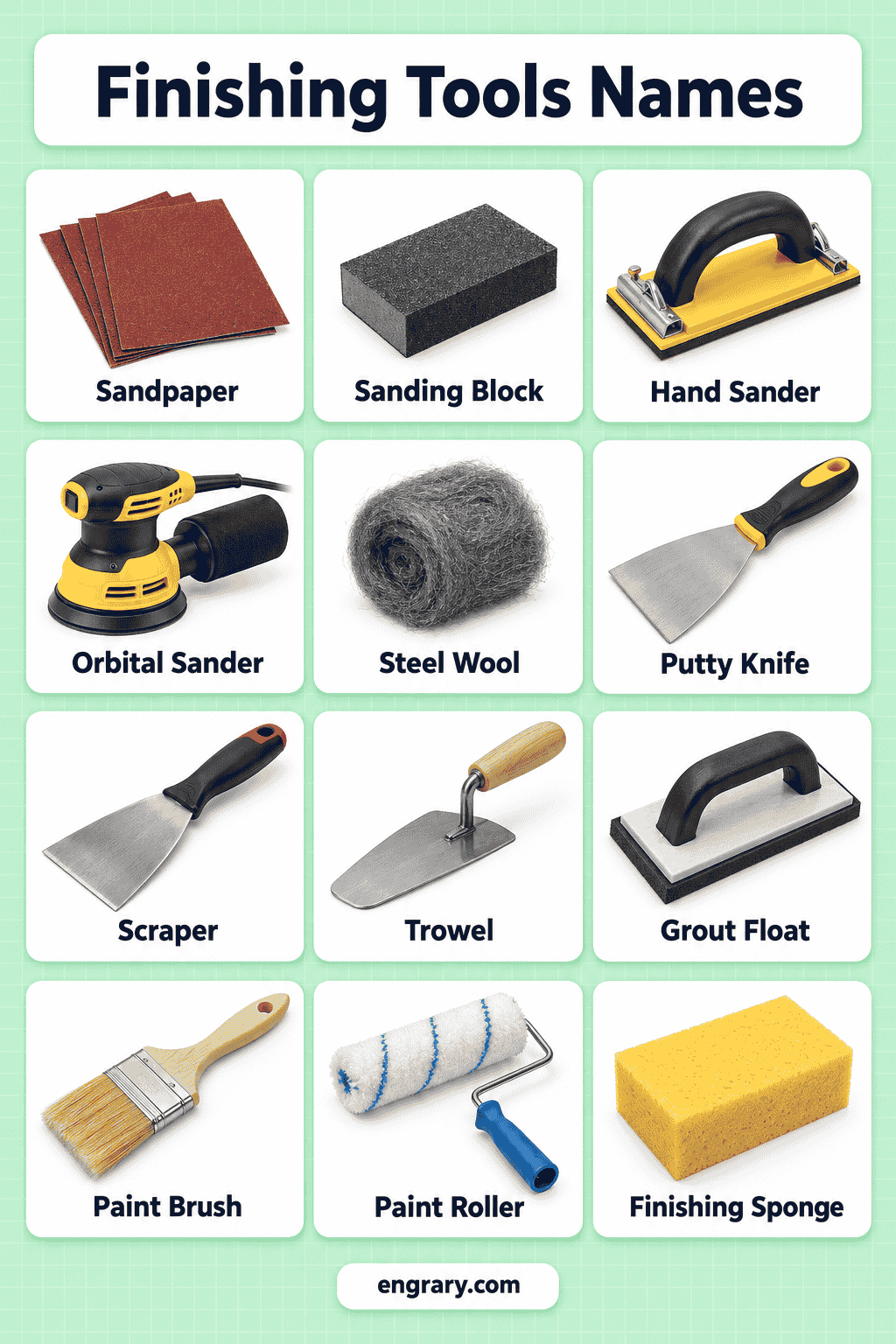
Common Tools for Surface Finishing
Surface finishing usually happens in stages. For example, scrapers and files can remove imperfections first, while sanders refine the surface further. Polishing and buffing tools then improve the final smoothness or appearance.
1. Card Scraper
A card scraper is a thin, flat piece of hardened steel with straight edges. Woodworkers use it to remove very fine shavings and surface imperfections.
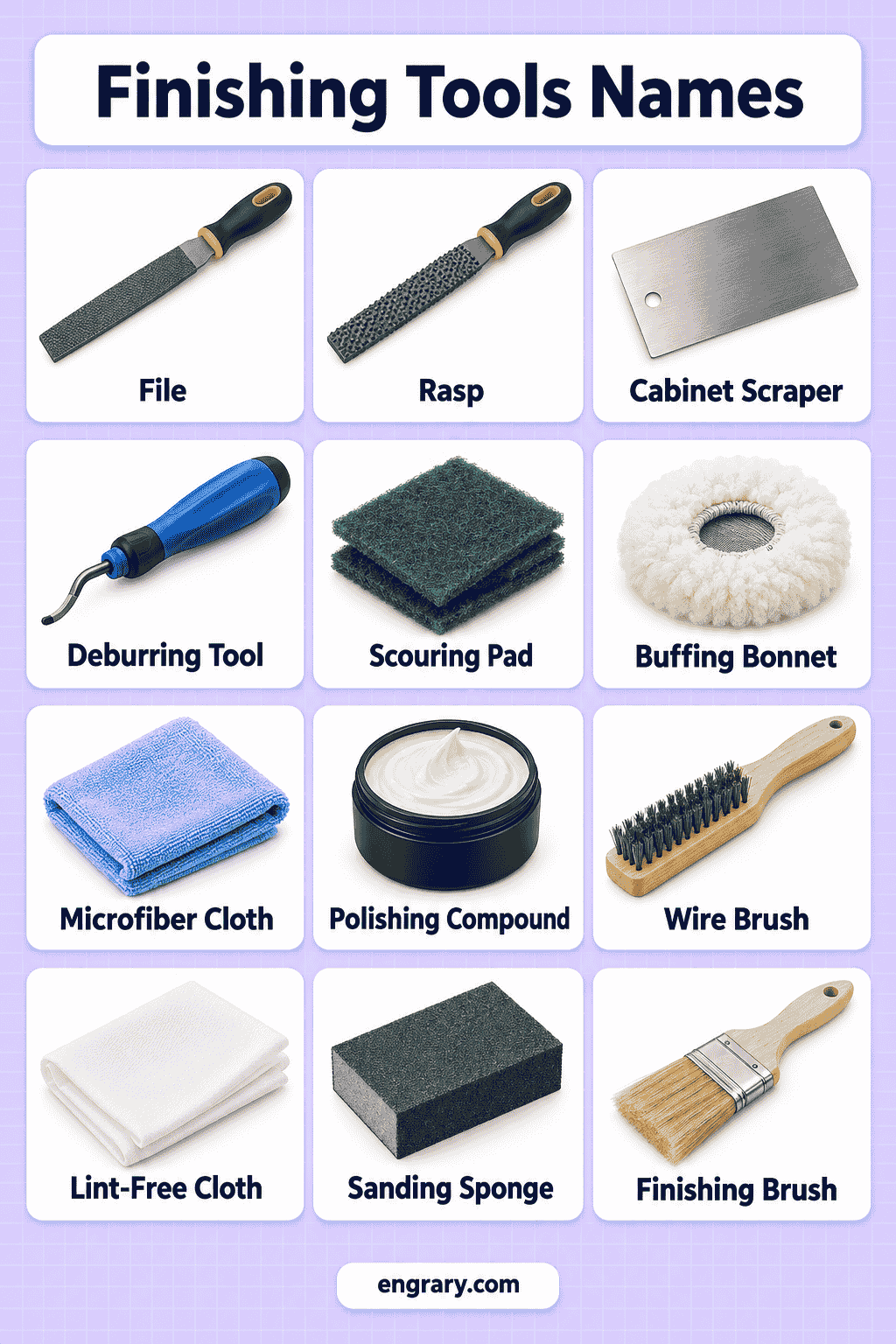
2. Cabinet Scraper
A cabinet scraper holds a scraper blade inside a handled body or frame. Therefore, it offers more support than a simple handheld card scraper.
3. Paint Scraper
A paint scraper has a flat blade attached to a handle. It removes loose coatings, residue, and other unwanted material before refinishing.
4. Triangle Scraper
A triangle scraper has a pointed body with three working edges. Its triangular cross-section makes it easy to recognize among hand scrapers.
5. Smoothing Plane
A smoothing plane has a flat sole, blade, and two-handed body designed for fine wood surface refinement. It removes thin shavings from an already prepared surface.
6. Block Plane
A block plane has a compact body with a relatively low blade angle. Because of its small size, it is easy to recognize beside larger bench planes.
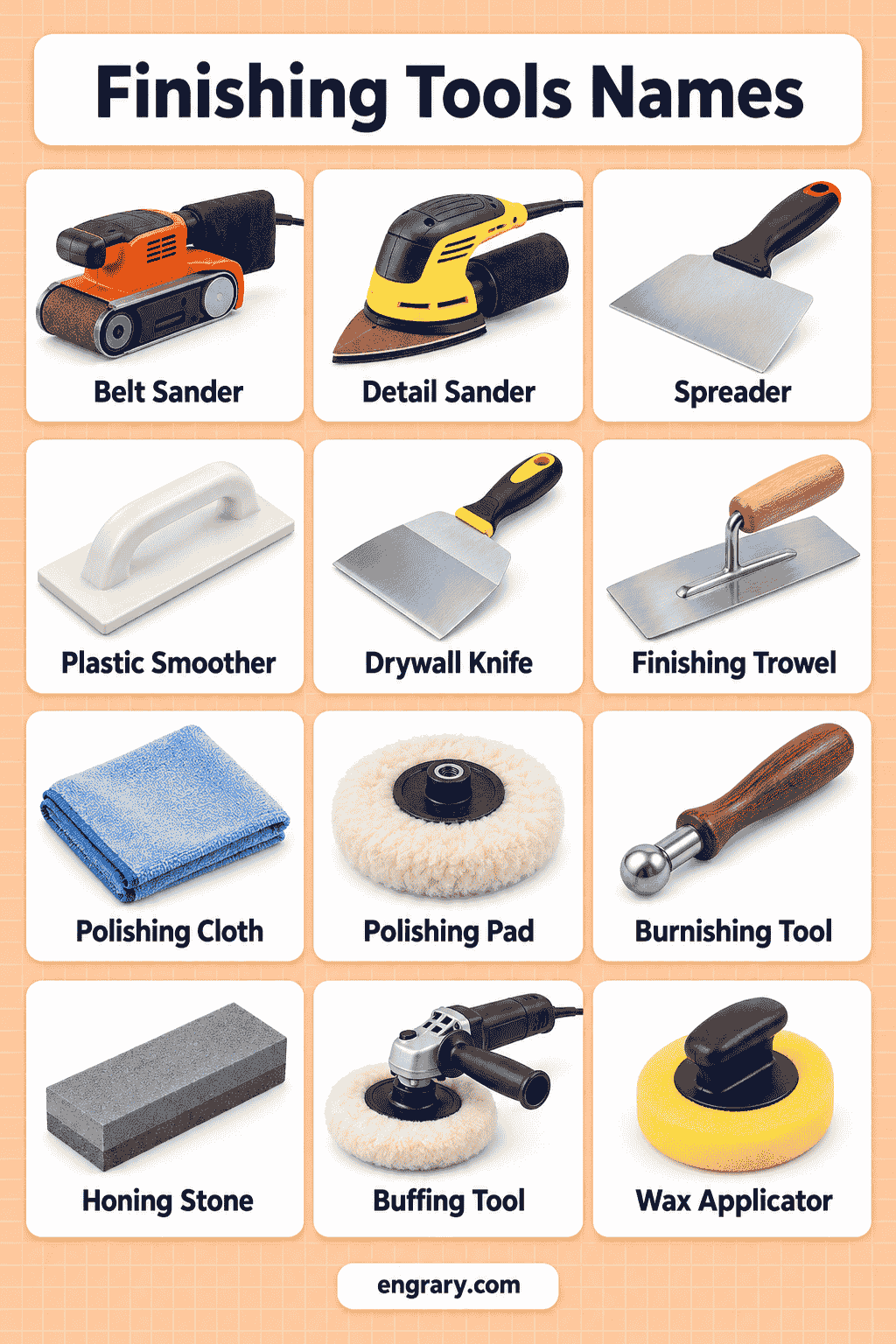
7. Smooth File
A smooth file has relatively fine teeth along its metal body. It removes small amounts of material during later stages of surface refinement.
8. Flat File
A flat file has a rectangular cross-section with broad flat faces. It can refine edges and flat surfaces after rougher cutting or shaping work.
9. Half-Round File
A half-round file has one flat face and one curved face. As a result, it can refine both flat and concave surfaces.
10. Needle File
A needle file is a small, slender precision file. Its compact size suits detailed finishing where a standard file would be too large.
11. Hand Deburring Tool
A hand deburring tool has a slim handle with a small hooked cutting blade. It removes unwanted burrs from edges and openings.
12. Swivel-Blade Deburring Tool
A swivel-blade deburring tool has a small curved blade that pivots as it follows an edge. Therefore, it adapts more easily to changing contours.
13. Countersink Deburring Tool
A countersink deburring tool has a conical cutting head. It removes burrs around the entrance of suitable drilled holes.
14. Deburring Brush
A deburring brush uses stiff abrasive or wire-like bristles to clean and refine edges or surfaces.
15. Sanding Block
A sanding block is a flat handheld block that supports abrasive paper. The rigid backing helps spread pressure more evenly than loose abrasive paper alone.
16. Hand Sander
A hand sander has a grip or handle attached to a flat sanding surface. It holds abrasive material while the user works manually across the surface.
17. Palm Sander
A palm sander has a compact body that fits easily in one hand. It usually uses a small square or rectangular sanding pad for light finishing.
18. Orbital Sander
An orbital sander moves its sanding pad in small orbital motions. Its flat pad works well on broad surfaces during intermediate or final sanding.
19. Random Orbital Sander
A random orbital sander has a round sanding pad that combines rotation with an orbital movement. Consequently, it differs visibly and mechanically from a basic sheet-style orbital sander.
20. Detail Sander
A detail sander has a pointed triangular sanding pad. Its shape helps it reach corners and narrow areas that larger sanders cannot cover easily.
21. Belt Sander
A belt sander uses a continuous abrasive belt running around rollers. Although it can remove material quickly, it also supports surface preparation before finer finishing stages.
22. Disc Sander
A disc sander uses a circular abrasive disc mounted on a rotating surface. Stationary versions often place a support table beside the disc.
23. Spindle Sander
A spindle sander uses a vertical cylindrical sanding drum. Its rounded abrasive surface suits curves and inside edges.
24. Rotary Polisher
A rotary polisher has a handheld motor body with a large circular polishing pad. The pad rotates around a single central axis.
25. Buffing Wheel
A buffing wheel is a soft circular wheel made from layered fabric or similar material. It refines and brightens suitable surfaces during the final finishing stage.
Scrapers and Planes for Surface Refining
Scraping and planing can improve a surface before sanding begins. Unlike abrasive tools, these tools use a cutting edge to remove thin layers of material.
26. Scraper Plane
A scraper plane holds a scraping blade inside a plane-style body. Therefore, it combines the controlled handling of a plane with the surface-refining action of a scraper.
Card scrapers, cabinet scrapers, paint scrapers, triangle scrapers, smoothing planes, and block planes already cover the other major manual refining tools in this article.
Files and Deburring Tools
Files refine edges and surfaces with rows of small cutting teeth, while deburring tools focus more specifically on unwanted raised material left after cutting or machining.
27. Round File
A round file has a cylindrical body covered with cutting teeth. It works on curved surfaces and round openings that a flat file cannot follow.
Smooth files, flat files, half-round files, needle files, and the main deburring tools already appear in the opening section. Keeping this group selective prevents the article from becoming a complete file-types guide.
Hand Sanding Tools
Manual sanding tools support abrasive material and help the user apply more even pressure across the workpiece.
28. Sanding Sponge
A sanding sponge combines abrasive material with a flexible foam body. Because the sponge can flex, it follows curved or irregular surfaces more easily than a rigid sanding block.
The sanding block and hand sander remain the two main rigid manual sanding tools in this list.
Powered Sanders for Surface Finishing
Powered sanders speed up surface preparation and finishing. However, their pad shape and abrasive movement determine where each machine works best.
29. Drum Sander
A drum sander uses abrasive material wrapped around a rotating cylindrical drum. Its wide sanding area distinguishes it from a smaller spindle sander.
30. Edge Sander
An edge sander has a long abrasive belt arranged to refine edges and narrow surfaces. Stationary models commonly include a support table beside the sanding belt.
Palm, orbital, random orbital, detail, belt, disc, and spindle sanders already appear in the opening section because they represent the most recognizable powered sanding forms.
Polishing and Buffing Tools
Polishing and buffing usually follow the rougher surface-preparation stages. Instead of removing obvious defects, these tools focus more on final smoothness, sheen, and appearance.
31. Polishing Wheel
A polishing wheel is a circular finishing wheel with a surface suited to polishing rather than coarse sanding. It is generally firmer or more polishing-focused than a soft buffing wheel.
32. Dual-Action Polisher
A dual-action polisher combines rotating and oscillating movement at its polishing pad. In contrast, a standard rotary polisher spins primarily around one central axis.
33. Bench Buffer
A bench buffer has a stationary motor with buffing or polishing wheels mounted on one or both sides. Its body resembles a bench grinder, but the working wheels focus on surface finishing.
34. Burnishing Tool
A burnishing tool smooths or compresses the surface rather than relying on heavy abrasive removal. Manual versions often have a hard, smooth working tip or face.
35. Burnishing Machine
A burnishing machine uses a powered rotating or moving finishing head to refine larger surfaces. It represents the powered form of the burnishing process.
Tools for Applying the Final Finish
Finishing can also include applying the final coating after the surface has been properly prepared. Therefore, a few coating tools belong naturally at the end of the finishing process.
36. Paint Brush
A paint brush has bristles fixed into a handle and ferrule. It applies paint, varnish, stain, or other suitable finishes to a surface.
37. Foam Brush
A foam brush has a soft foam head instead of conventional bristles. Its flat shape makes it easy to distinguish from an ordinary paint brush.
38. Paint Roller
A paint roller uses a cylindrical cover mounted on a frame and handle. It spreads coatings quickly across broad, flat surfaces.
39. Spray Gun
A spray gun has a trigger body, nozzle, and fluid-feed arrangement. It atomizes a suitable coating into a fine spray for surface application.
40. Airbrush
An airbrush is a small precision spray tool with a narrow nozzle and compact body. Compared with a full-size spray gun, it handles finer and more detailed coating work.
Finishing Tools That Are Easy to Confuse
Several finishing tools perform related jobs, but their movement, shape, or stage of use makes them different.
| Tools | Main Difference |
|---|---|
| Hand Sander vs Sanding Block | A hand sander normally includes a dedicated handle or clamping system, while a sanding block is a simpler rigid support for abrasive paper. |
| Orbital Sander vs Random Orbital Sander | An orbital sander moves its pad in small orbital motions, while a random orbital sander combines orbital movement with rotation. |
| Palm Sander vs Detail Sander | A palm sander usually has a small flat pad, whereas a detail sander has a pointed triangular pad for corners. |
| Belt Sander vs Orbital Sander | A belt sander uses a continuous abrasive belt, while an orbital sander uses a flat oscillating pad. |
| Card Scraper vs Cabinet Scraper | A card scraper is a simple steel plate held by hand, while a cabinet scraper supports the blade in a handled body or frame. |
| Smooth File vs Sanding Block | A smooth file cuts with fine metal teeth, whereas a sanding block supports an abrasive sheet or surface. |
| File vs Deburring Tool | A file refines a broader surface or edge, while a deburring tool focuses mainly on removing raised burrs. |
| Buffing Wheel vs Polishing Wheel | A buffing wheel is usually softer and suited to final shine, while a polishing wheel may use a firmer surface for earlier polishing stages. |
| Rotary Polisher vs Dual-Action Polisher | A rotary polisher spins around one central axis, while a dual-action polisher combines rotation with oscillation. |
| Bench Buffer vs Handheld Polisher | A bench buffer stays fixed on a bench, while a handheld polisher moves across the workpiece. |
| Sanding vs Polishing | Sanding removes imperfections with abrasives, while polishing refines the surface further for smoothness or appearance. |
| Scraping vs Sanding | Scraping removes thin material with a cutting edge, while sanding uses an abrasive surface. |
| Surface Preparation vs Final Finishing | Surface preparation removes defects and prepares the workpiece, while final finishing focuses on appearance, smoothness, or coating application. |
Alternate Names for Finishing Tools
Finishing-tool terminology varies between trades, regions, and manufacturers. Therefore, the same basic tool may appear under more than one name.
| Main Name | Alternate Name |
|---|---|
| Random Orbital Sander | ROS |
| Card Scraper | Cabinet Card Scraper in some usage |
| Hand Deburring Tool | Burr Remover |
| Rotary Polisher | Rotary Buffing Machine in some contexts |
| Bench Buffer | Buffing Machine |
| Sanding Block | Sandpaper Block |
| Detail Sander | Corner Sander in some contexts |
| Paint Roller | Roller Applicator |
| Spray Gun | Paint Spray Gun |
| Airbrush | Air Brush |
These alternate names do not count as additional tools when they refer to the same basic design.
Frequently Asked Questions
Common finishing tools include sanding blocks, card scrapers, smooth files, deburring tools, palm sanders, random orbital sanders, detail sanders, polishing wheels, buffing wheels, polishers, and spray guns.
Sanding uses abrasive material to remove imperfections and smooth a surface. Polishing follows with finer surface refinement to improve smoothness, sheen, or appearance.
An orbital sander moves its pad in small orbital patterns. A random orbital sander, however, combines orbital movement with rotation and usually uses a round pad.
A card scraper is a thin steel plate held directly by hand. In contrast, a cabinet scraper supports the scraping blade inside a handled frame or body.
A rotary polisher spins its pad around one central axis. A dual-action polisher combines rotation with an additional oscillating movement, so its pad follows a different motion pattern.
You May Also Like

Leave a Comment