
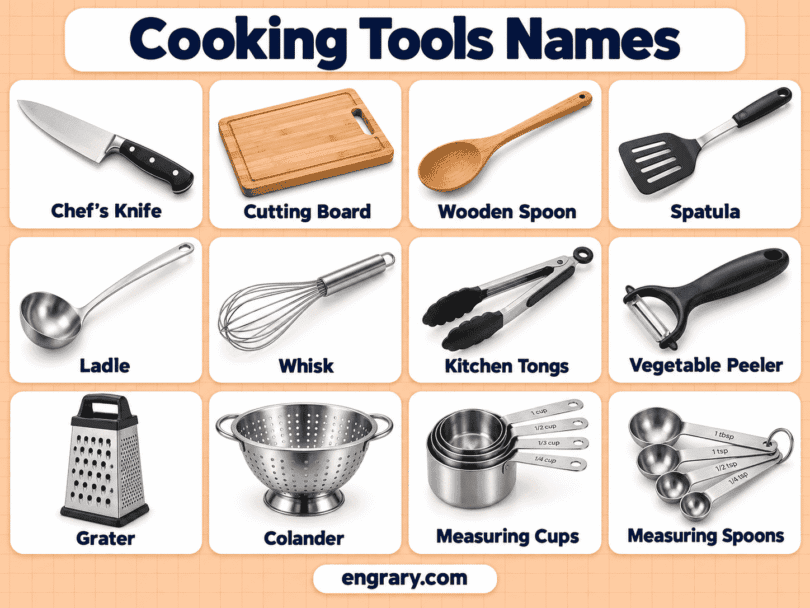
A whisk’s wire loops, a ladle’s deep bowl, and a grater’s sharp openings make familiar cooking tools easy to recognize. Others need a closer look: a flexible spatula scrapes a bowl, while a flat turner supports food from underneath. Knowing their names helps you find the right implement when following a recipe or sorting through a kitchen drawer.
Common cooking tools include knives, peelers, spoons, tongs, measuring cups, and strainers. Each shape supports a particular job, from preparing ingredients to handling cooked food. Pots, pans, and baking equipment serve related purposes, although they belong to different groups from handheld utensils.
Common Cooking Tools and Their Uses
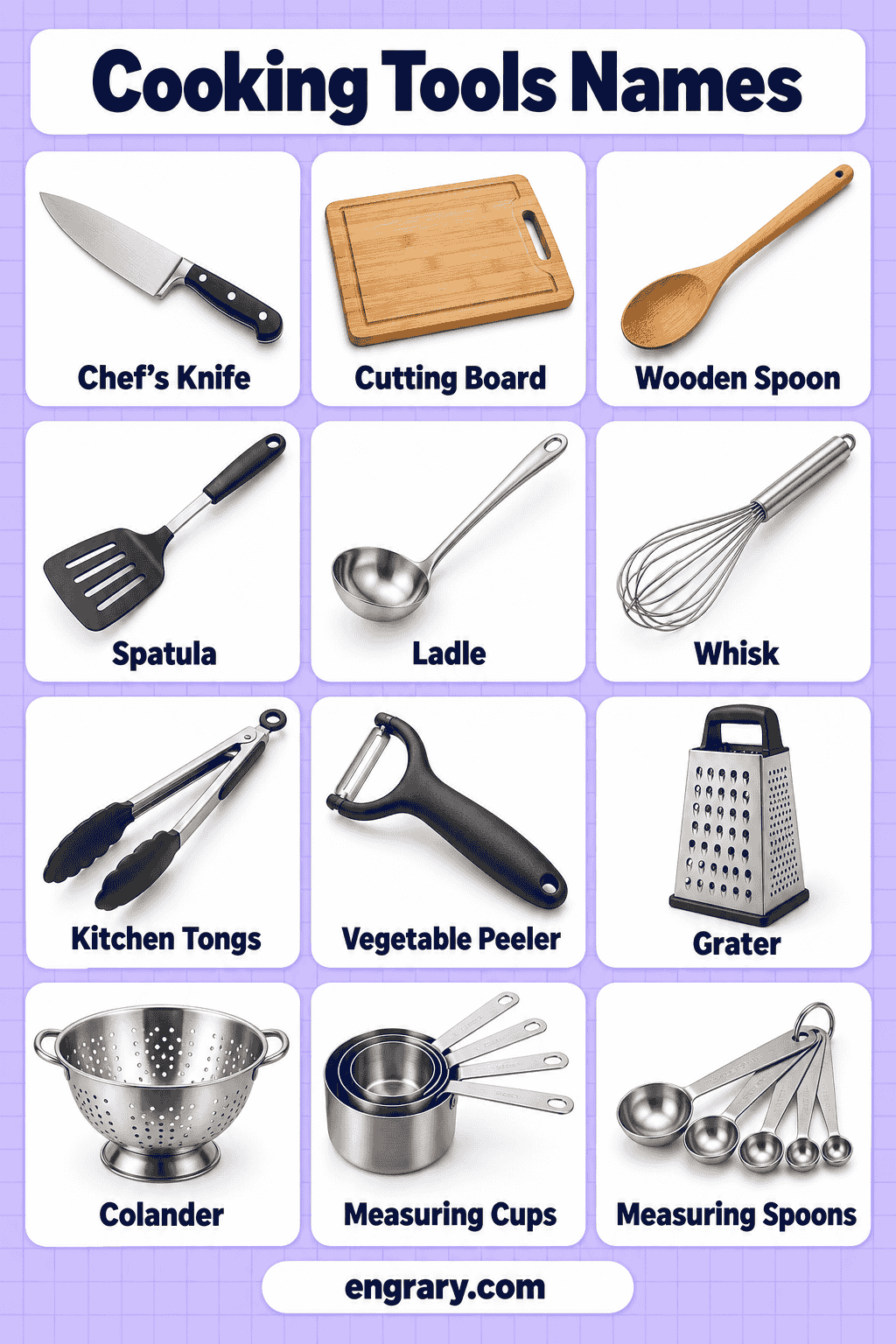
Everyday cooking involves cutting, measuring, mixing, lifting, and draining. Some implements handle several tasks, but each has a main purpose and a recognizable working shape. These 20 common names provide a starting point for identifying the tools you encounter most often.
Chef’s Knife
A chef’s knife has a broad blade for chopping, slicing, and mincing ingredients. Its curved cutting edge often supports a rocking motion, while the pointed tip helps with smaller cuts.
Cutting Board
A cutting board provides a working surface for preparing ingredients with a knife. People also call it a chopping board, so these names usually describe the same item.
Vegetable Peeler
A vegetable peeler removes thin strips of skin from produce such as potatoes and carrots. Some designs have a Y-shaped frame, while others position the blade along a straight handle.
Box Grater
A box grater has several upright faces with different cutting surfaces. For example, larger openings shred cheese or vegetables, while finer surfaces produce smaller pieces.
Wooden Spoon
A wooden spoon stirs sauces, combines ingredients, and moves food around a pan. Its shallow bowl also makes it useful for mixing thicker foods such as porridge.
Whisk
A whisk combines ingredients with a head of curved wires. It can blend sauces or beat eggs; different wire shapes also suit different mixtures.
Flexible Spatula
A flexible spatula scrapes bowls and folds ingredients together. Its bendable edge follows curved surfaces, helping gather batter or sauce from the sides.
Turner
A turner has a flat head that slides beneath food for lifting or flipping. People often call it a spatula too, although that broader name also covers scraping and spreading tools.
Kitchen Tongs
Kitchen tongs have two arms that grip food between their tips. They help turn, lift, and transfer ingredients; some also lock closed for storage.
Ladle
A ladle has a deep bowl and a long handle for scooping liquids. Compared with a shallow serving spoon, it holds more soup, stew, or sauce in each scoop.
Slotted Spoon
A slotted spoon lifts solid food while liquid drains through openings in its bowl. For example, it can remove cooked vegetables from water without carrying much liquid.
Mixing Bowl
A mixing bowl holds ingredients during stirring, tossing, or kneading. Its curved interior helps contain the mixture, while a broad opening provides room to work.
Dry Measuring Cups
Dry measuring cups usually come in fixed-capacity sets for measuring ingredient volume. Their open rims allow leveling, although the correct filling method depends on the ingredient and recipe.
Measuring Spoons
Measuring spoons measure small volumes, such as a teaspoon of spice or a tablespoon of oil. Unlike ordinary eating spoons, they carry defined measurement markings.
Colander
A colander is a bowl-shaped tool with drainage openings and usually a base or supporting feet. It holds food while water runs out, making it useful for draining pasta or rinsing produce.
Fine-Mesh Strainer
A fine-mesh strainer separates small particles from liquids through a woven mesh surface. Compared with many colanders, its smaller openings retain finer ingredients.
Rolling Pin
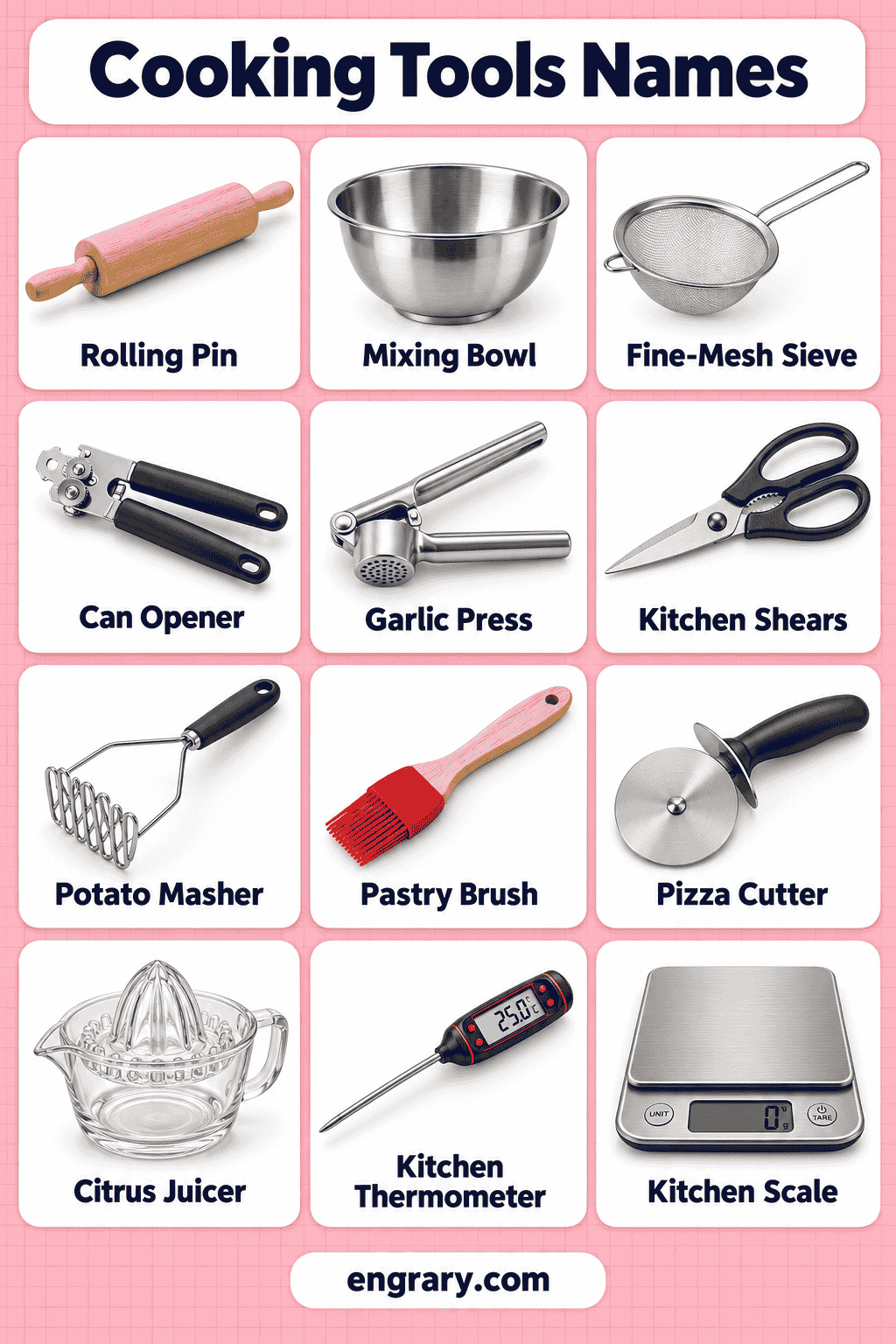
A rolling pin flattens dough into a sheet. Some versions have separate handles, while others consist of a straight or tapered cylinder.
Can Opener
A can opener opens food cans by cutting or separating part of the lid or seam. It is also commonly called a tin opener.
Garlic Press
A garlic press pushes a clove through small openings to crush it. Unlike a knife, it uses pressure rather than repeated chopping.
Potato Masher
A potato masher crushes cooked potatoes and other soft foods. Its working end may have a perforated plate or bent wires, while its handle provides downward leverage.
Cutting and Chopping Tools
Different blades suit different ingredient sizes and textures. A short blade offers control for detailed preparation, while a serrated edge works through crusts. The following tools add specific functions beyond everyday chopping.
Paring Knife
A paring knife has a short blade for trimming and small preparation tasks. Compared with a chef’s knife, its compact size makes detailed cuts easier to control.
Bread Knife
A bread knife has a long, serrated blade for slicing bread. Its teeth help start the cut through the crust, while a sawing motion carries the blade through the loaf.
Kitchen Shears
Kitchen shears are sturdy scissors intended for food preparation. They can snip herbs and cut suitable ingredients, but their capabilities depend on the blade design.
Bench Scraper
A bench scraper has a broad, usually rigid blade with a straight lower edge. Also called a bench knife, it divides dough, gathers chopped ingredients, and clears a work surface.
Food Preparation Tools
Preparation tools change an ingredient’s size, texture, or form before cooking. Some remove a thin outer layer, while others slice, crush, or extract juice. Their working surfaces help distinguish tools that have similar handles.
Citrus Zester
A traditional citrus zester has small, sharp-edged holes that remove fine strands of zest. Some models also include a channel knife for wider strips or twists; a rasp-style grater produces a different, finely grated texture.
Mandoline Slicer
A mandoline slicer has a blade set into a supporting platform for making repeated slices. Unlike a handheld knife, it keeps the cutting edge in a fixed position; use the food holder or guard according to the manufacturer’s instructions.
Mortar and Pestle
A mortar and pestle work together to crush or grind ingredients. The mortar is the bowl, while the pestle is the handheld implement that presses ingredients against it.
Citrus Press
A citrus press extracts juice by squeezing cut citrus fruit. Many handheld designs have hinged handles and drainage holes, whereas a citrus reamer uses a ridged head to release juice.
Mixing and Stirring Tools
Mixing tools differ in how they move through ingredients. A spoon stirs, a whisk blends or incorporates air, and a flexible spatula scrapes and folds. More specialized designs help with sticky dough or mixtures of flour and firm fat.
Dough Whisk
A dough whisk has a sturdy head formed from a few thick wire loops. Its open design moves through thick mixtures, with fewer narrow gaps than a conventional balloon whisk.
Bowl Scraper
A bowl scraper is a small, flexible tool with an edge that follows a bowl’s curves. Unlike a rigid bench scraper, it bends to gather sticky dough or batter from the interior.
Pastry Blender
A pastry blender has several curved blades or wires attached to a handle. It cuts firm fat into flour, rather than blending ingredients with an electric motor.
Tools for Turning and Serving Food
Food-handling utensils support, grip, or scoop ingredients. A thin head slides beneath delicate food, while a perforated bowl lets liquid escape. The working shape helps explain why these tools differ from an ordinary serving spoon.
Fish Turner
A fish turner typically has a thin, elongated head with slots. Its shape helps support delicate food during lifting, although it can handle more than fish.
Skimmer
A skimmer has a shallow perforated or mesh head on a long handle. It removes material from the surface of a liquid or lifts small food pieces while allowing liquid to drain.
Spider Strainer
A spider strainer has a broad, shallow wire basket and a long handle. Compared with a fine-mesh strainer, its open basket often drains quickly when lifting larger food pieces.
Rice Paddle
A rice paddle has a broad, shallow head for handling cooked rice. Some designs also have a textured surface intended to reduce sticking.
Measuring and Monitoring Tools
Recipes use several kinds of measurement, and each requires a suitable tool. Cups and spoons measure volume, while scales measure weight. Thermometers and timers track temperature and time rather than ingredient quantity.
Liquid Measuring Cup
A liquid measuring cup or jug has graduated markings, usually with a handle and pouring spout. Unlike a dry measuring cup, it leaves space above the measurement line to make handling liquids easier.
Kitchen Scale
A kitchen scale measures ingredient weight. It offers an alternative to measuring by volume, which can vary with how tightly an ingredient fills a cup.
Food Thermometer
A food thermometer measures temperature, commonly through a probe. Different models suit different tasks, so check whether the instrument targets food interiors, liquids, or another application.
Kitchen Timer
A kitchen timer tracks a chosen period and signals when it ends. However, elapsed time does not establish a food’s internal temperature.
| Tool | Measurement | Familiar example |
|---|---|---|
| Measuring cup | Volume | A cup of milk |
| Measuring spoon | Small volumes | A teaspoon of spice |
| Kitchen scale | Weight | Grams of flour |
| Food thermometer | Temperature | Temperature inside food |
| Kitchen timer | Time | Minutes of cooking |
Draining and Straining Tools
Drainage tools let liquid pass through while holding back food. However, the size of their openings determines what they retain. A tool that holds pasta may allow tiny seeds or fine particles to pass through.
Flour Sifter
A flour sifter passes flour and other dry ingredients through a screen. Some versions use a crank or squeeze mechanism, while a simple sieve relies on shaking or tapping.
Salad Spinner
A salad spinner has a perforated basket inside an outer bowl. Spinning moves water away from washed leaves, whereas a colander mainly relies on gravity for drainage.
The terms sieve and strainer overlap in everyday use. A fine-mesh tool may serve both purposes, so different labels do not always indicate different implements. Colanders commonly have a larger bowl-shaped body with handles and a supporting base.
Cookware and Steaming Equipment
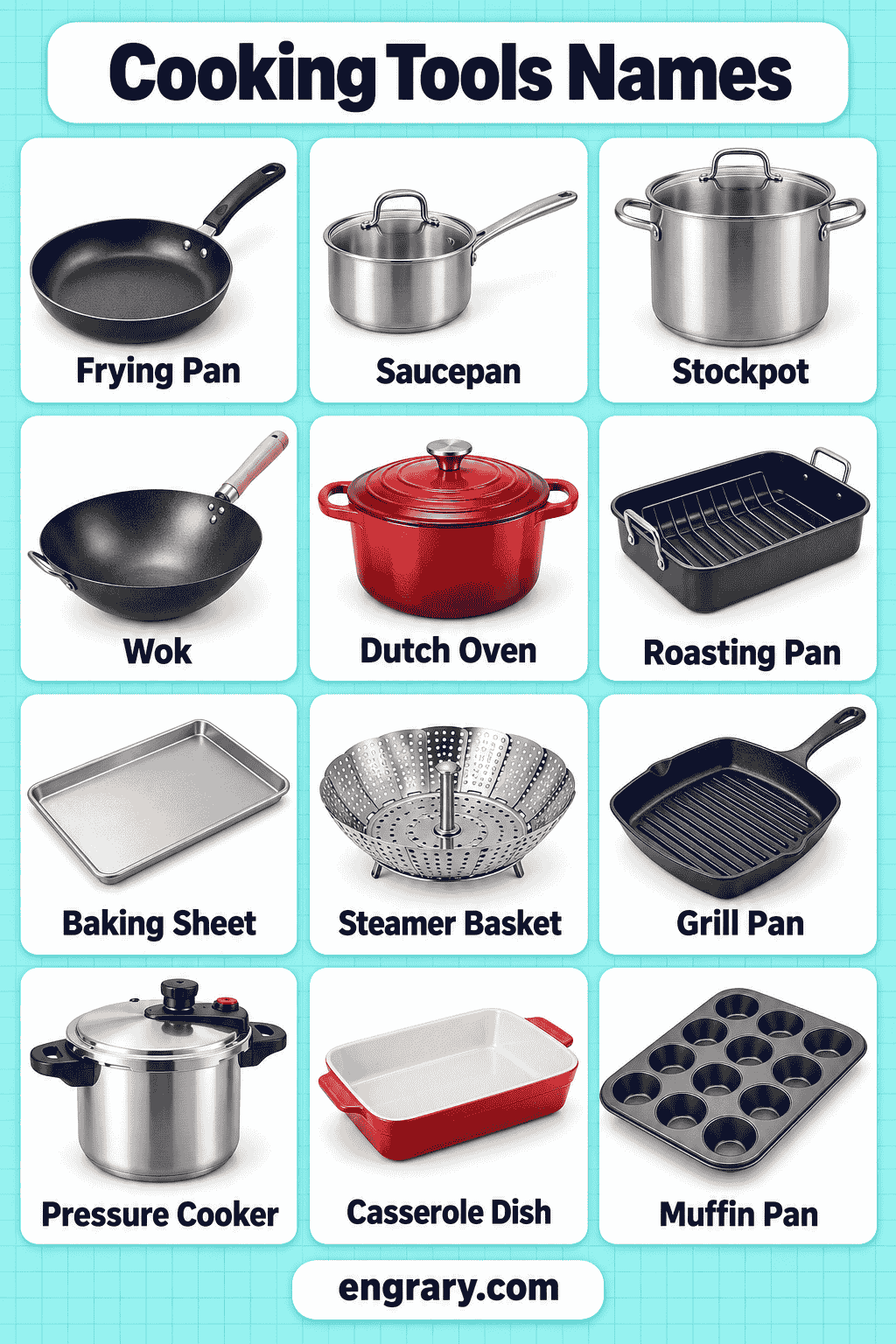
Cookware holds food during cooking, while steaming inserts support food above water inside another vessel. Depth, side shape, and handle placement help identify these items. Several can prepare similar dishes, but their designs give them different strengths.
Frying Pan
A frying pan has a broad cooking surface and typically low, sloping sides. It is also commonly called a skillet, so the names often describe the same general vessel.
Saucepan
A saucepan has relatively deep sides and usually one long handle. It suits sauces, grains, and smaller quantities of liquid, while larger pots provide more capacity.
Sauté Pan
A sauté pan typically has straight sides and a broad base. Compared with a sloping-sided frying pan, its shape helps contain food and liquid during cooking.
Stockpot
A stockpot is a deep pot, usually with two side handles. Its tall body provides capacity for stocks, soups, and larger batches of food.
Wok
A wok has deep, sloping sides around a smaller central cooking area. Traditional designs have rounded bottoms, while flat-bottomed versions suit many household stovetops.
Dutch Oven
A Dutch oven is a heavy, thick-walled pot with a close-fitting lid. It retains heat for dishes such as stews and braises, and suitable models also work for bread baking.
Steamer Basket
A steamer basket holds food above water inside a suitable pot. Its openings allow steam to circulate, while its raised position keeps the food out of the water below.
Dough Preparation and Baking Tools
Baking shares many tools with everyday cooking, including bowls, scales, and spatulas. Additional equipment supports brushing, oven cooking, and cooling. The depth and shape of a vessel often provide the clearest identification clues.
Baking Tray
A baking tray, also commonly called a baking sheet, provides a broad surface for oven cooking. Many have raised rims, although some cookie sheets have few or no raised edges.
Roasting Pan
A roasting pan has deeper sides than a typical baking sheet. It holds food and cooking juices, while some versions include a rack that raises the food above the base.
Baking Dish
A baking dish is an oven-safe vessel for foods such as casseroles and baked pasta. Unlike a shallow sheet, its deeper sides contain layered mixtures and sauces.
Pastry Brush
A pastry brush applies ingredients such as egg wash, melted butter, or glaze. Similar brushes may carry the name basting brush, depending on their intended use.
Cooling Rack
A cooling rack supports baked food on an open grid. It allows air to reach beneath the food, whereas a solid tray restricts airflow along the underside.
Check the manufacturer’s instructions before putting a cooling rack or other utensil into an oven. Appearance alone does not establish its permitted temperature or intended use.
Commonly Confused Cooking Tools
Some cooking-tool names are alternatives, while others identify meaningful differences in design. These comparisons help distinguish similar implements without counting every label as a separate tool.
| Names | Relationship or difference |
|---|---|
| Cutting board and chopping board | Common alternative names for the same item |
| Turner and flexible spatula | Supporting and flipping food versus scraping and folding |
| Ladle and slotted spoon | Holding liquid versus allowing liquid to drain |
| Colander and fine-mesh strainer | Typically larger drainage openings versus finer mesh |
| Bench scraper and bowl scraper | A rigid work-surface tool versus a flexible bowl tool |
| Dry and liquid measuring cups | Fixed-capacity cups with leveling rims versus graduated vessels with headroom |
| Frying pan and skillet | Often alternative names for the same general cookware |
| Frying pan and sauté pan | Typically sloping sides versus straighter sides |
| Kitchen timer and food thermometer | Measuring time versus measuring temperature |
For an unfamiliar implement, check three details together:
- Working surface: blades, wires, mesh, holes, or a solid head.
- Shape: deep enough to scoop, flat enough to slide underneath food, or flexible enough to follow a curve.
- Product description: the intended task and any limits on heat or use.
FAQs About Cooking Tools
Common tools include a chef’s knife, cutting board, peeler, wooden spoon, whisk, spatula, tongs, ladle, measuring cups, and colander. However, the tools you use most depend on the meals you prepare.
It is usually called a turner or pancake turner. People also call it a spatula, although that broader word includes several other designs.
The terms overlap. “Utensils” commonly describes handheld implements, while “cooking tools” can include a broader range of preparation and measuring equipment.
Useful groups include cutting, preparation, mixing, food handling, measuring, and straining tools. Cookware and baking equipment form related groups, although they serve as vessels or supports rather than handheld implements.
In broad everyday usage, people may include them among cooking tools. More specifically, they are cookware, whereas knives, whisks, and tongs are implements for preparing or handling food.
You May Also Like


Leave a Comment