

Medical tools include the instruments, devices, and equipment healthcare professionals use to examine patients, measure vital signs, support diagnosis, monitor health, provide treatment, and assist with patient care. Some are small handheld instruments, while others are larger electronic machines found in clinics and hospitals.
Learning medical tools names in English with pictures and uses makes healthcare vocabulary easier to recognize and remember. The guide below covers familiar examination tools, diagnostic devices, treatment equipment, emergency tools, mobility aids, laboratory equipment, and selected surgical instruments.
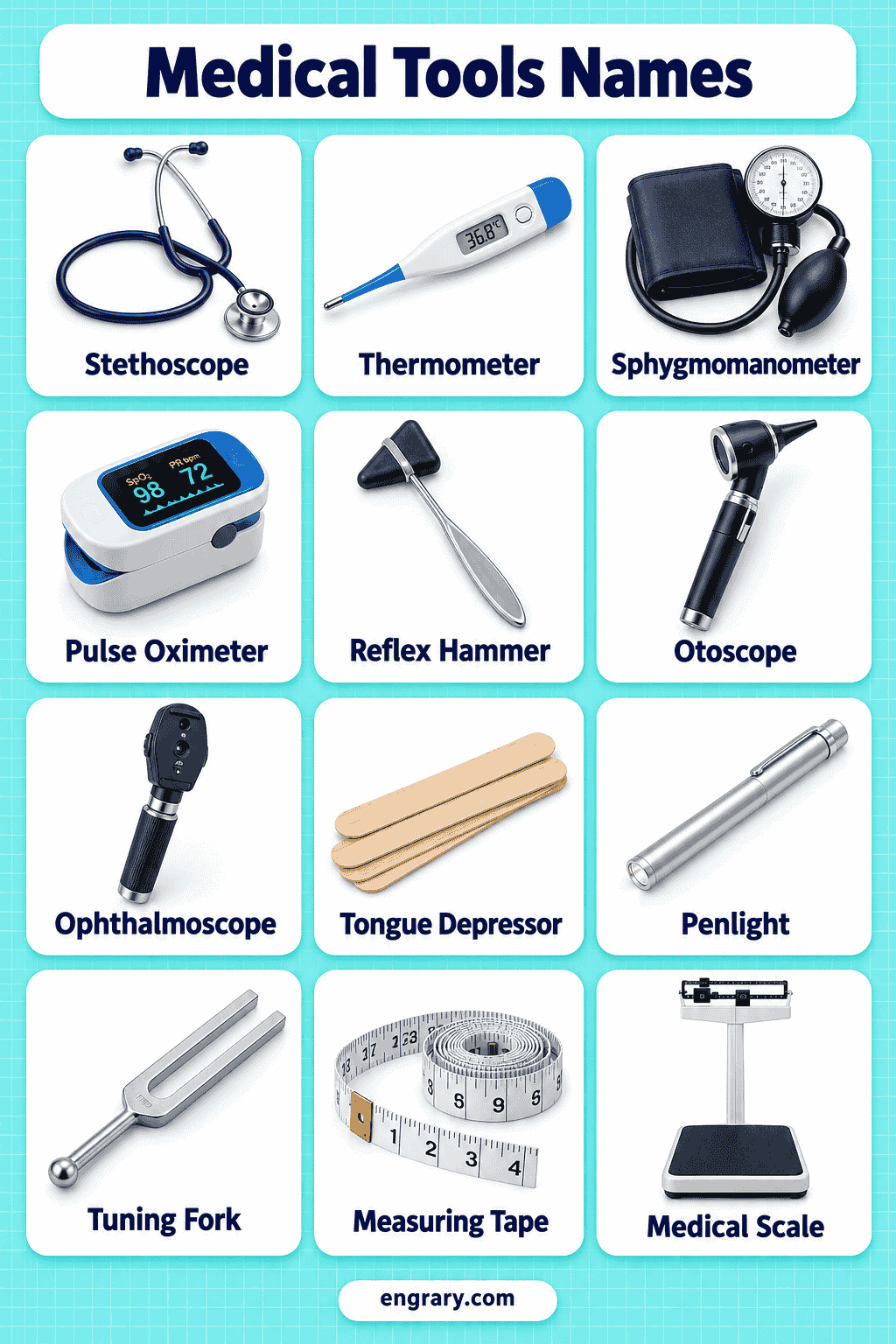
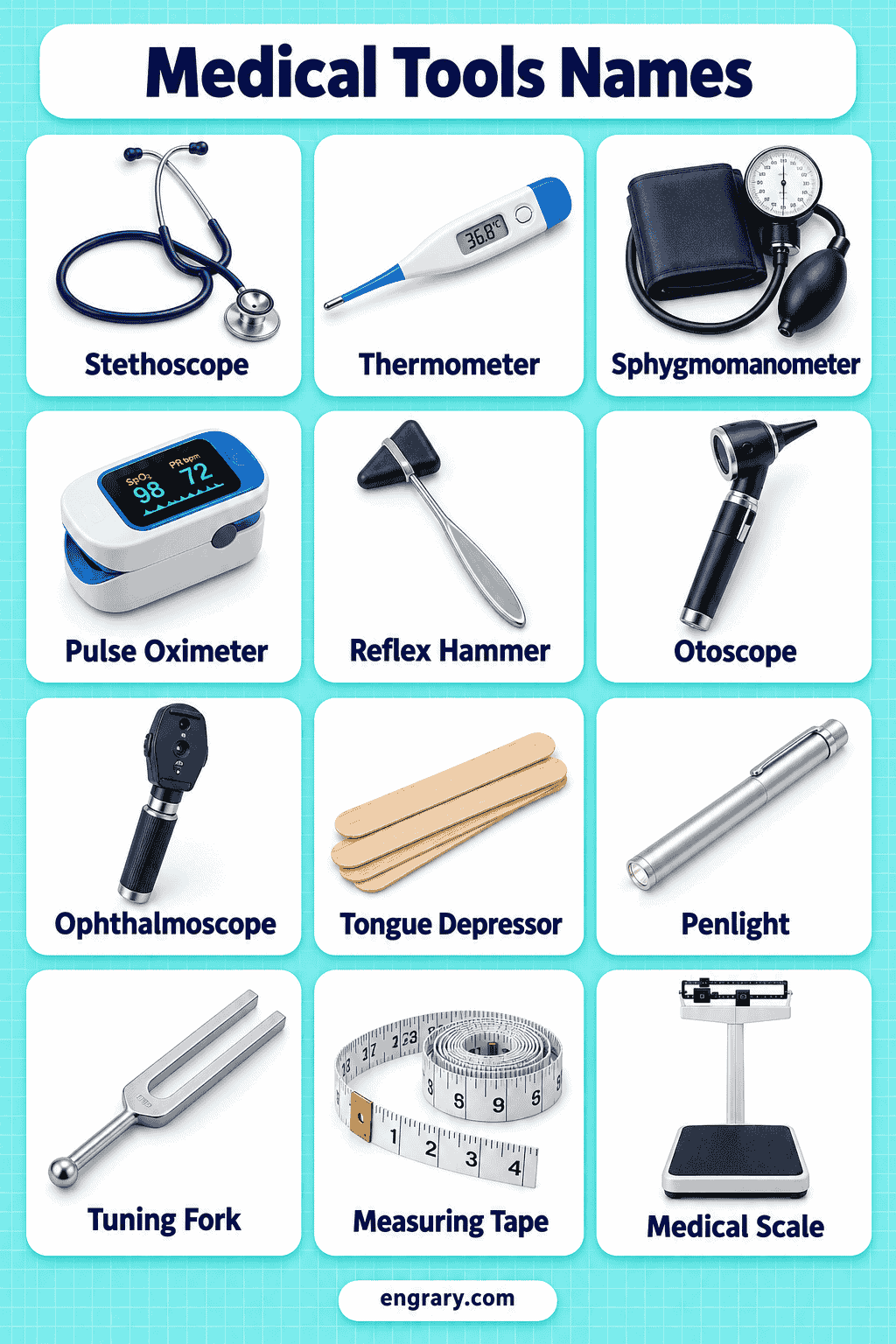
Essential Medical Tools Used Across Healthcare Settings
Hospitals, clinics, laboratories, and emergency departments use many different medical tools. The following are among the most recognizable items learners may encounter in healthcare vocabulary.
Stethoscope
A stethoscope has earpieces connected to flexible tubing and a round chest piece. Healthcare professionals use it to listen to sounds from the heart, lungs, and other parts of the body.
Thermometer
A thermometer measures body temperature. Digital thermometers are common in homes, clinics, and hospitals.
Blood Pressure Monitor
A blood pressure monitor measures the pressure of blood flowing through the arteries. Manual and digital versions are widely available.
Pulse Oximeter
A pulse oximeter is a small electronic device that clips onto a finger. It measures blood oxygen saturation and pulse rate.
Otoscope
An otoscope is a handheld instrument with a light and viewing lens. Clinicians use it to examine the ear canal and eardrum.
Ophthalmoscope
An ophthalmoscope is a lighted handheld instrument for examining structures inside the eye.
Reflex Hammer
A reflex hammer is a small examination tool with a soft striking head. Clinicians use it when checking certain reflex responses.
Tongue Depressor
A tongue depressor is a flat handheld tool that helps provide a clearer view of the mouth and throat during an examination.
Penlight
A penlight is a small medical flashlight. Healthcare workers use it for quick visual examinations.
Glucometer
A glucometer is a portable device that measures the glucose level in a blood sample.
Syringe
A syringe consists of a barrel and movable plunger. Medical professionals use syringes to handle measured amounts of certain fluids.
Nebulizer
A nebulizer converts liquid medication into a fine mist that a patient can breathe through a mask or mouthpiece.
Inhaler
An inhaler is a compact handheld device that delivers respiratory medication for breathing into the lungs.
ECG Machine
An electrocardiogram, or ECG, machine records the electrical activity of the heart and displays it as a tracing.
Ultrasound Machine
An ultrasound machine uses sound waves to produce images of structures inside the body.
X-Ray Machine
An X-ray machine produces images that help healthcare professionals examine bones and certain internal structures.
Patient Monitor
A patient monitor displays health measurements such as heart rate, oxygen saturation, blood pressure, and other vital information.
Infusion Pump
An infusion pump is an electronic device that delivers controlled amounts of fluid or medication through an infusion system.
Wheelchair
A wheelchair provides seated mobility for people who have difficulty walking or moving independently.
Stretcher
A stretcher supports a person in a lying position while healthcare workers move them within a medical setting or during emergency transport.
Tools for Checking Vital Signs
Vital signs give healthcare professionals basic information about important body functions. Different devices measure temperature, pulse, blood pressure, breathing, and oxygen levels.
Manual Sphygmomanometer
A manual sphygmomanometer uses an inflatable cuff and pressure gauge to measure blood pressure.
Digital Blood Pressure Monitor
This electronic device automatically measures blood pressure and usually displays pulse rate as well.
Clinical Thermometer
A clinical thermometer measures body temperature and may use digital, infrared, or other sensing technology.
Infrared Thermometer
An infrared thermometer estimates temperature without the same type of direct contact required by many conventional thermometers.
Vital Signs Monitor
A vital signs monitor combines several measurements, such as blood pressure, pulse, temperature, and oxygen saturation, in one device.
Instruments Used During Physical Examination
Physical examinations often involve simple handheld instruments that help clinicians observe, listen to, or assess different areas of the body.
Tuning Fork
A tuning fork produces a steady vibration and sound. Clinicians may use medical tuning forks during certain hearing or neurological assessments.
Nasal Speculum
A nasal speculum gently holds the nostril open so a healthcare professional can view the inside of the nose.
Medical Magnifying Lamp
A medical magnifying lamp combines illumination with magnification, helping clinicians inspect the skin or other visible areas more closely.
Dermatoscope
A dermatoscope is a handheld magnifying instrument with a light source. Medical professionals use it to examine skin lesions and surface structures more clearly.
Examination Light
An examination light provides focused illumination during routine clinical examinations.
Diagnostic Medical Tools and Devices
Diagnostic equipment helps healthcare professionals collect information about body structures and functions. Some devices create images, while others measure electrical activity, airflow, or other signals.
Doppler Device
A Doppler device uses sound waves to detect and assess movement such as blood flow.
Spirometer
A spirometer measures how much air a person can breathe in and out and how quickly air moves from the lungs.
Peak Flow Meter
A peak flow meter is a small handheld device that measures how quickly a person can force air out of the lungs.
Holter Monitor
A Holter monitor is a portable device that records heart electrical activity over an extended period while the wearer goes about normal daily activities.
CT Scanner
A computed tomography scanner uses X-rays and computer processing to create detailed cross-sectional images of the body.
MRI Scanner
An MRI scanner uses a strong magnetic field and radio waves to create detailed images of internal body structures.

Infusion and Treatment Equipment
Treatment areas use equipment that helps medical professionals deliver fluids, medications, or other forms of care in controlled ways.
Syringe Pump
A syringe pump holds a syringe and moves its plunger at a controlled rate to deliver small measured amounts of fluid.
IV Stand
An IV stand is a tall wheeled or stationary support used to hold infusion containers and related equipment.
Suction Machine
A medical suction machine creates controlled suction for clinical care.
Medical Suction Canister
A suction canister is a container connected to suction equipment to collect removed fluids.
Treatment Trolley
A treatment trolley is a wheeled cart that keeps medical instruments and equipment organized and accessible during patient care.
Respiratory Care Equipment
Respiratory equipment supports breathing assessment, oxygen delivery, and respiratory treatment in hospitals, clinics, and home-care settings.
Oxygen Concentrator
An oxygen concentrator draws in surrounding air and supplies air with a higher concentration of oxygen for prescribed medical use.
Oxygen Mask
An oxygen mask fits over the nose and mouth and connects to an oxygen source.
Ventilator
A ventilator is a medical machine that supports or controls breathing for patients who require respiratory assistance.
Bag-Valve Mask
A bag-valve mask is a handheld emergency breathing device used by trained healthcare professionals to provide assisted ventilation.
Nasal Cannula
A nasal cannula is lightweight oxygen-delivery tubing with two small prongs that sit at the nostrils.
Patient Monitoring Devices
Medical teams use monitoring devices to observe important physiological measurements and detect changes in a patient’s condition.
Cardiac Monitor
A cardiac monitor continuously displays information about heart rhythm and rate.
Telemetry Monitor
A telemetry system allows heart-related measurements to be monitored while a patient can move around within the supported clinical area.
Capnograph
A capnograph measures and displays carbon dioxide levels in exhaled air.
Fetal Monitor
A fetal monitor records information related to fetal heart activity and, depending on the system, other pregnancy-related measurements.
Apnea Monitor
An apnea monitor tracks breathing patterns and can alert caregivers when a monitored breathing pause meets preset conditions.
Emergency Medical Tools and Equipment
Emergency medical teams rely on recognizable equipment for rapid assessment, monitoring, patient transport, and life-support care.
Defibrillator
A defibrillator is an electronic medical device that can deliver a controlled electrical shock in certain serious heart-rhythm emergencies.
Automated External Defibrillator
An automated external defibrillator, commonly called an AED, analyzes heart rhythm and provides automated prompts for trained or permitted emergency use.
Emergency Stretcher
An emergency stretcher is designed for moving patients safely in ambulances, emergency departments, and rescue environments.
Cervical Collar
A cervical collar supports the neck when healthcare professionals need to limit movement following certain injuries.
Medical Splint
A medical splint supports and limits movement of an injured limb or joint during assessment and care.
Patient Mobility and Support Equipment
Healthcare facilities use mobility and support equipment to help patients move, rest, transfer, or maintain stability.
Walker
A walker is a lightweight support frame that helps provide stability while walking.
Crutches
Crutches transfer some body weight away from one or both legs and provide additional support during walking.
Hospital Bed
A hospital bed has adjustable sections and features that support patient positioning and clinical care.
Examination Table
An examination table gives patients a stable surface for routine medical examinations.
Patient Lift
A patient lift is a mechanical or powered device that helps trained caregivers transfer people who have limited mobility.
Basic Laboratory Tools Used in Healthcare
Medical laboratories use specialized tools to examine samples, separate materials, and perform diagnostic testing.
Microscope
A microscope magnifies objects that are too small to see clearly with the unaided eye.
Centrifuge
A centrifuge spins laboratory samples at high speed to separate components according to their physical properties.
Pipette
A pipette measures and transfers small quantities of liquid in laboratory work.
Test Tube Rack
A test tube rack holds laboratory tubes upright and keeps samples organized.
Laboratory Analyzer
A laboratory analyzer is an automated device that performs specific measurements or tests on medical samples.
Common Instruments Used in Surgery
Operating rooms contain many specialized instruments. For general medical vocabulary, it is more useful to recognize a small group of common instrument types than dozens of highly specialized variations.
Scalpel
A scalpel is a small surgical cutting instrument with a very sharp blade. Trained medical professionals use it during surgical procedures.
Surgical Forceps
Surgical forceps are tweezer-like instruments that allow clinicians to grasp or hold material during procedures.
Surgical Scissors
Surgical scissors come in different shapes and sizes for cutting specific materials during clinical procedures.
Hemostat
A hemostat is a locking clamp that surgeons use to hold or control tissue or blood vessels during procedures.
Needle Holder
A needle holder resembles locking forceps and helps surgeons securely control a surgical needle.
Retractor
A retractor helps keep tissue or the edges of an incision positioned away from the working area during surgery.
Surgical Clamp
A surgical clamp is a general category of instrument used to grasp or hold structures securely during medical procedures.
Curette
A curette is a slender medical instrument with a shaped working end. Different medical specialties use specialized curettes for different clinical purposes.
Medical Tools People Often Confuse
Many medical devices have similar shapes or related purposes. The differences below can make their names easier to recognize.
| Medical Tools | Main Difference |
|---|---|
| Otoscope vs Ophthalmoscope | An otoscope examines the ear; an ophthalmoscope examines the eye |
| Thermometer vs Pulse Oximeter | A thermometer measures temperature; a pulse oximeter measures oxygen saturation and pulse |
| Nebulizer vs Inhaler | A nebulizer creates a mist; an inhaler delivers medication from a compact handheld device |
| ECG Machine vs Patient Monitor | An ECG machine records heart electrical activity; a patient monitor displays ongoing physiological measurements |
| Spirometer vs Peak Flow Meter | A spirometer provides broader lung-function measurements; a peak flow meter mainly measures maximum expiratory airflow |
| Wheelchair vs Stretcher | A wheelchair supports seated transport; a stretcher supports lying transport |
| Syringe Pump vs Infusion Pump | A syringe pump controls fluid from a syringe; a general infusion pump can manage fluids from other infusion containers |
| Defibrillator vs AED | An AED is an automated type of defibrillator designed to guide emergency use |
| Stethoscope vs Doppler Device | A stethoscope detects body sounds acoustically; a Doppler device uses sound-wave technology to detect movement such as blood flow |
| Forceps vs Hemostat | Forceps primarily grasp or hold; a hemostat has a locking mechanism for secure clamping |
Medical Tools, Instruments, Equipment, and Supplies Explained
The words tool, instrument, equipment, and supply often appear together in healthcare vocabulary, but they do not always mean exactly the same thing.
| Term | General Meaning | Examples |
|---|---|---|
| Medical Tool | Broad everyday term for items used in healthcare | Stethoscope, thermometer |
| Medical Instrument | Usually a handheld item used for examination or treatment | Otoscope, reflex hammer, forceps |
| Medical Equipment | Larger, powered, or more complex devices | Ventilator, ultrasound machine, patient monitor |
| Medical Supply | Consumable or replaceable healthcare material | Gauze, gloves, dressings, medical tape |
The boundaries are not always strict. For example, people may casually call an electronic thermometer a medical tool, instrument, or device depending on the context.
Questions People Ask About Medical Tools
Common medical tools include a stethoscope, thermometer, blood pressure monitor, pulse oximeter, otoscope, reflex hammer, syringe, glucometer, and penlight. Hospitals also use larger equipment such as patient monitors, infusion pumps, ultrasound machines, and ventilators.
Doctors may use a stethoscope, thermometer, blood pressure monitor, otoscope, ophthalmoscope, reflex hammer, tongue depressor, and penlight during routine examinations. The exact tools depend on the type of examination.
Medical instruments are often smaller handheld items used for examination or treatment. Medical equipment generally refers to larger, powered, or more complex devices such as monitors, scanners, ventilators, and infusion pumps.
Thermometers measure temperature, blood pressure monitors measure blood pressure, and pulse oximeters measure oxygen saturation and pulse. Multi-parameter monitors can display several vital measurements together.
Surgical instruments are one category within the broader group of medical tools. Medical tools also include examination instruments, diagnostic devices, monitoring equipment, respiratory equipment, laboratory tools, and patient-support equipment.
You May Also Like



Leave a Comment