
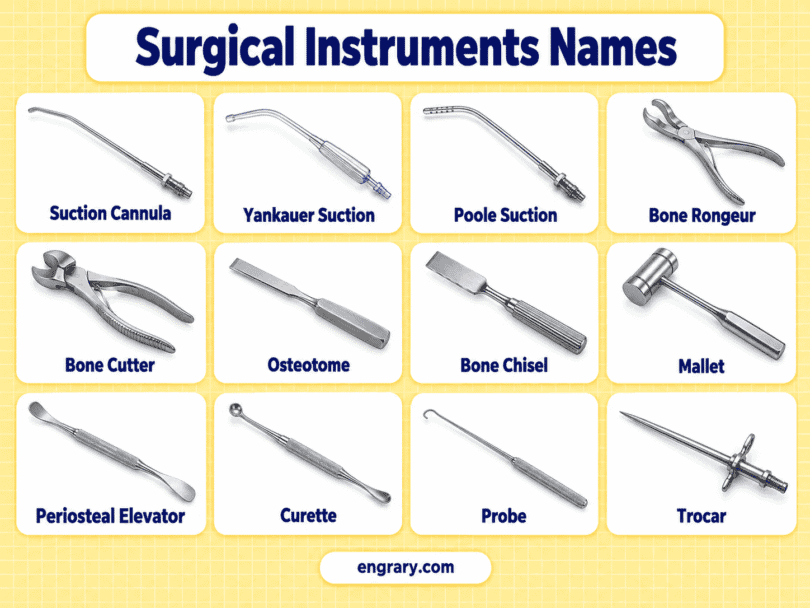
Surgical instruments are specialized tools that medical professionals use for cutting, grasping, clamping, retracting, suturing, suction, and other tasks during surgical procedures. Their shapes and working ends differ according to the broad function they perform in the operating room.
Learning surgical instruments names with pictures and uses helps students and English learners recognize common operating-room vocabulary. This guide covers widely used instruments from general surgery, orthopedic work, closure, suction, probing, and minimally invasive surgery.
Common Surgical Instruments Used in the Operating Room
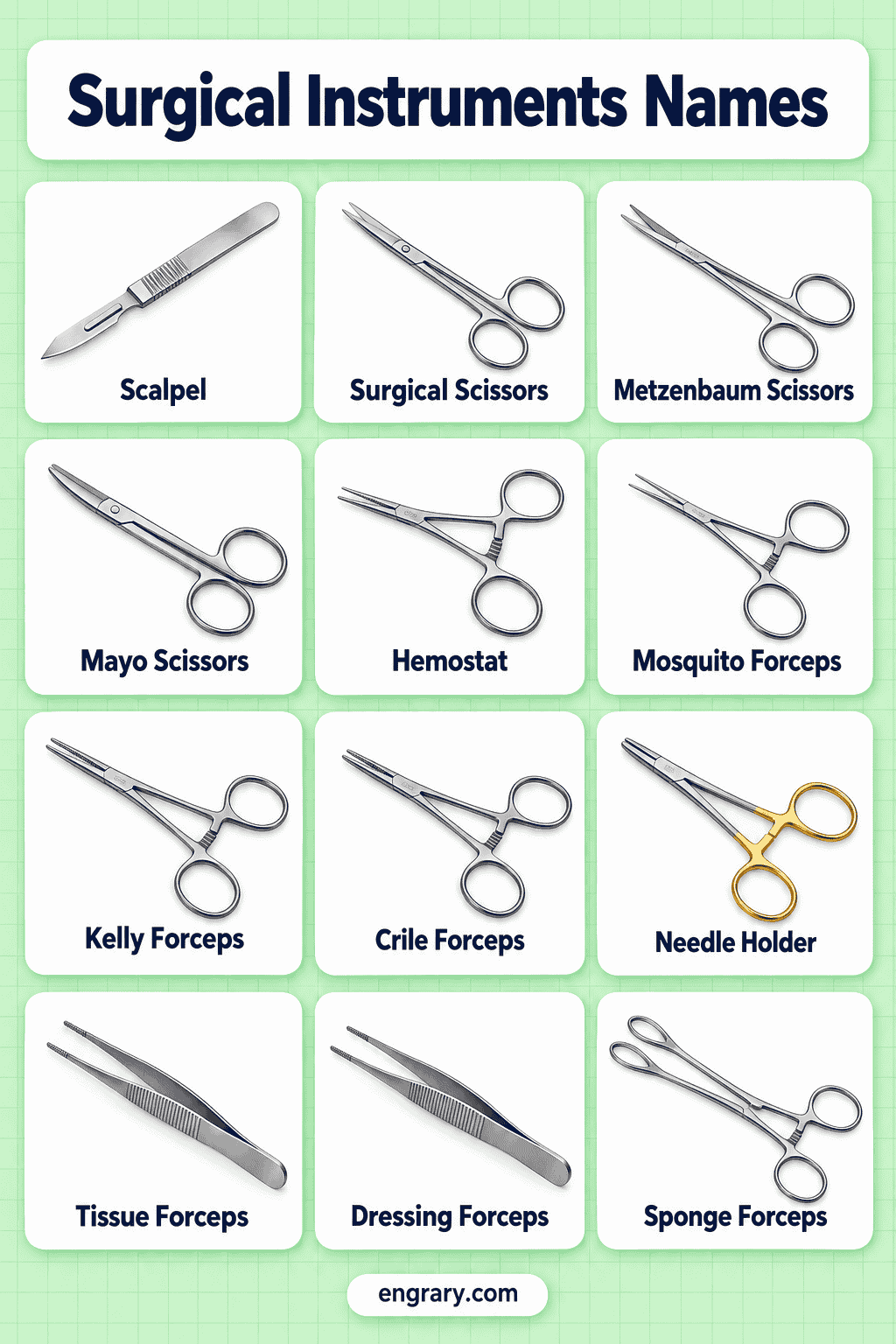
Operating rooms contain many instruments with distinctive handles, jaws, blades, tips, and locking mechanisms. These commonly recognized examples represent several of the major surgical instrument families.
Scalpel
A scalpel is a small cutting instrument with a very sharp blade attached to a handle. Surgeons use it for precise surgical cutting.
Mayo Scissors
Mayo scissors have strong blades and sturdy ring handles. They are heavier than many other surgical scissors and are designed for relatively firm material.
Metzenbaum Scissors
Metzenbaum scissors have long handles and comparatively fine blades. Their lighter construction helps distinguish them from heavier Mayo scissors.
Iris Scissors
Iris scissors are small, fine surgical scissors with short blades. Their compact shape makes them easy to recognize among larger surgical scissors.
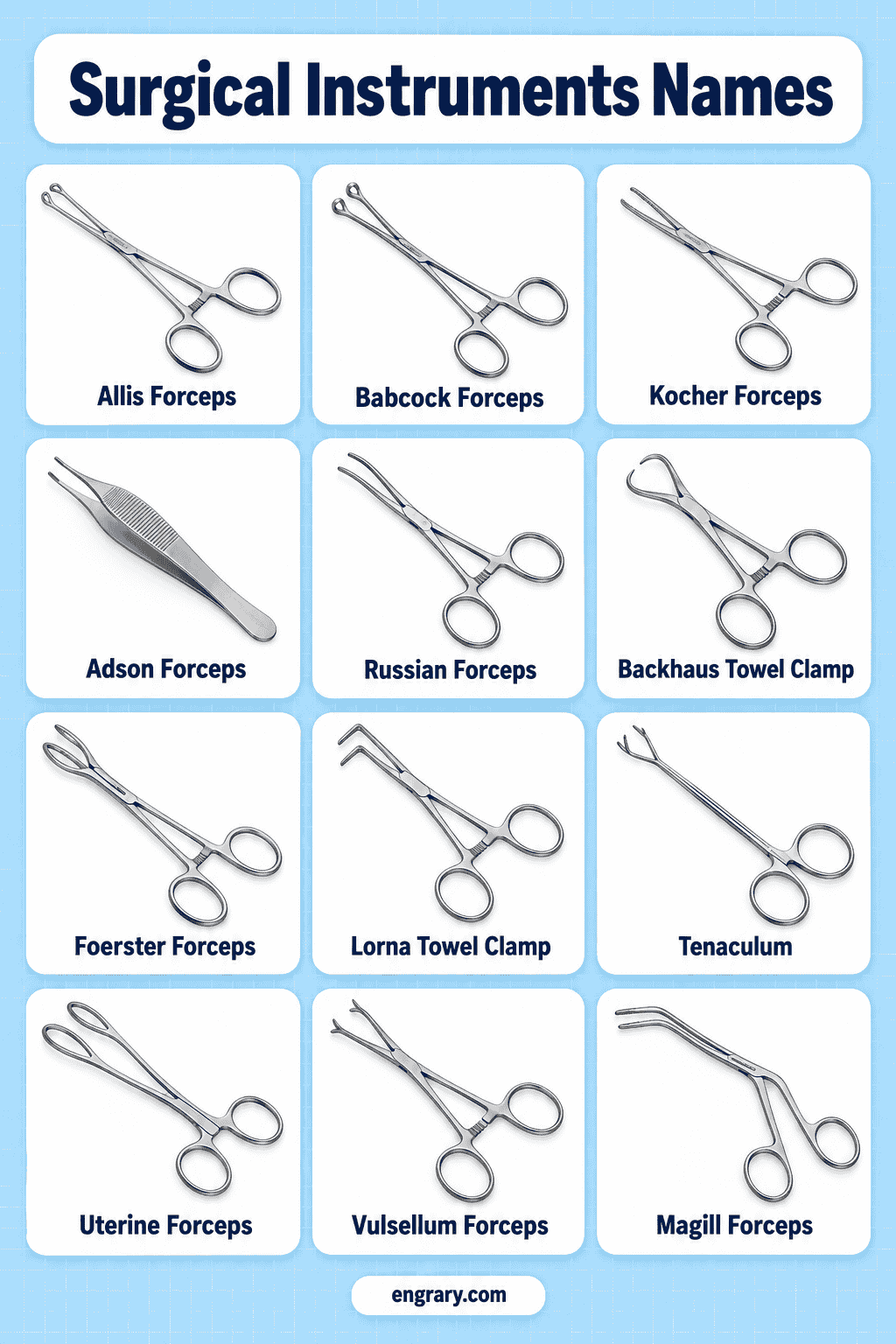
Adson Forceps
Adson forceps are short thumb forceps with a broad grip area and narrow tips. Different versions may have toothed or non-toothed ends.
DeBakey Forceps
DeBakey forceps are long, slender thumb forceps with finely patterned jaws. Their delicate tips distinguish them from heavier grasping instruments.
Allis Forceps
Allis forceps have ring handles, a locking mechanism, and toothed jaws at the working end. They provide a firm grip on suitable tissue.
Babcock Forceps
Babcock forceps have rounded, fenestrated jaws rather than sharp gripping teeth. Their smooth loop-like ends give them a distinctive appearance.
Mosquito Hemostat
A mosquito hemostat is a small locking clamp with narrow jaws and ring handles. It is one of the more compact instruments in the hemostat family.
Kelly Clamp
A Kelly clamp is a ring-handled locking instrument with longer jaws than a mosquito hemostat. It belongs to the common hemostatic clamp family.
Kocher Forceps
Kocher forceps resemble locking hemostats but have a toothed tip. The teeth are a useful visual clue for distinguishing them from smooth-ended clamps.
Backhaus Towel Clamp
A Backhaus towel clamp has ring handles and sharply pointed curved tips. It is commonly associated with securing surgical drapes.
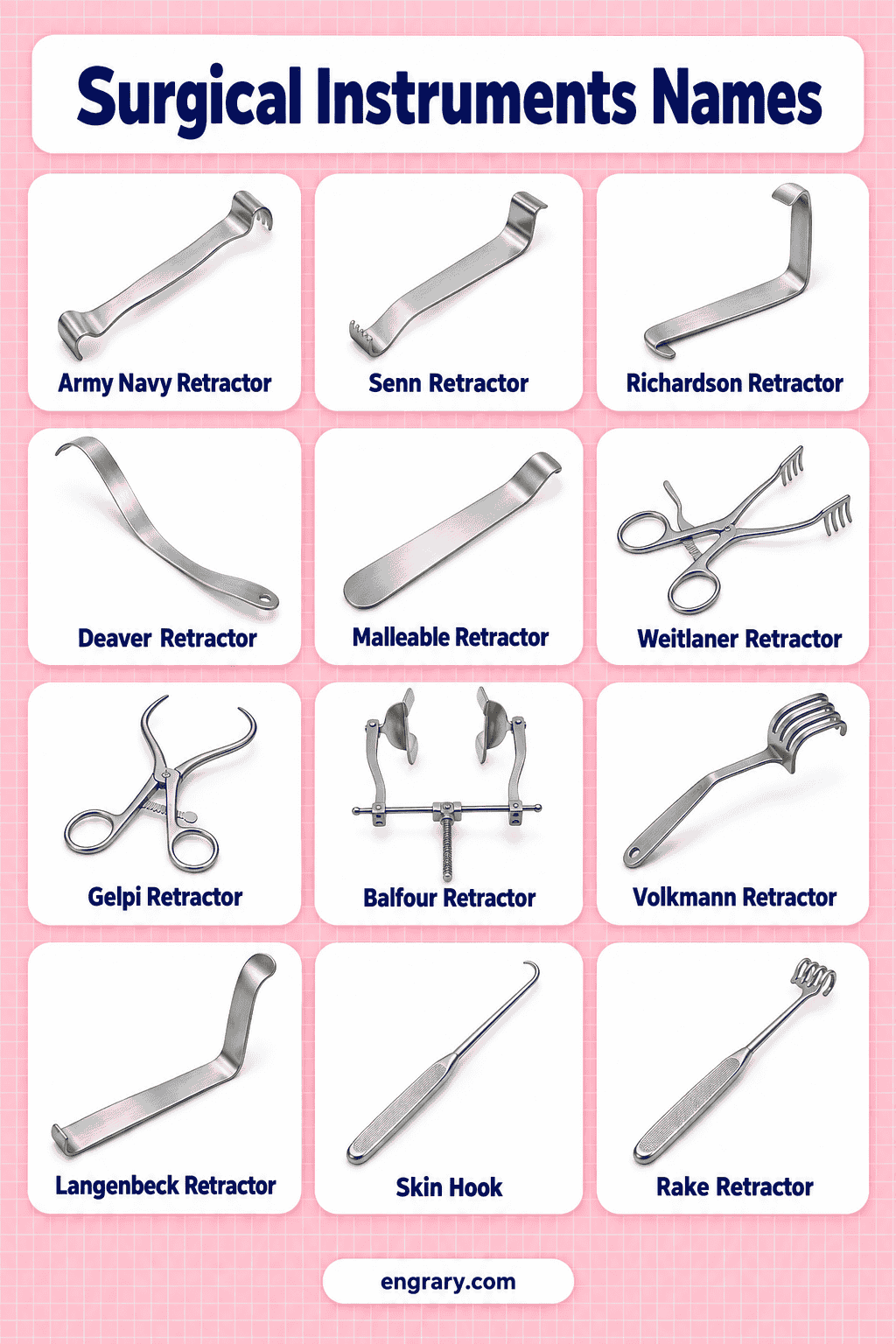
Senn Retractor
A Senn retractor is a small double-ended instrument. One end has a flat blade, while the other commonly has rake-like prongs.
Army-Navy Retractor
An Army-Navy retractor is a double-ended handheld retractor with flat blades at both ends. It has no locking mechanism.
Richardson Retractor
A Richardson retractor has a broad right-angled blade attached to a sturdy handle. It is larger than many small handheld retractors.
Deaver Retractor
A Deaver retractor has a long handle and a broad, smoothly curved blade. Its deep sweeping curve makes it visually distinctive.
Weitlaner Retractor
A Weitlaner retractor is self-retaining and has ring handles connected to multiple rake-like prongs. A locking mechanism keeps the instrument open.
Mayo-Hegar Needle Holder
A Mayo-Hegar needle holder resembles a locking clamp but has short, strong jaws designed to hold a surgical needle securely.
Yankauer Suction Tip
A Yankauer suction tip is a rigid suction instrument with a relatively broad curved tip and openings near its end.
Frazier Suction Tip
A Frazier suction tip is a narrow metal suction tube with a fine angled end. It is much slimmer than a Yankauer tip.
Cutting and Dissecting Instruments
Cutting and dissecting instruments vary greatly in size and shape. Some have fine blades for delicate work, while others have heavier edges for tougher materials such as bone.
Tenotomy Scissors
Tenotomy scissors are small scissors with fine, narrow blades and relatively long handles. Their delicate design distinguishes them from heavier general surgical scissors.
Lister Bandage Scissors
Lister bandage scissors have angled blades and a broad blunt lower tip. Their distinctive shape helps protect underlying surfaces while cutting dressings or bandaging material.
Osteotome
An osteotome is a solid chisel-like surgical instrument with a flat cutting edge. It is primarily associated with work involving bone.
Bone Chisel
A bone chisel has a strong shaft and sharpened working edge. It resembles a traditional chisel but is manufactured as a surgical instrument.
Rongeur
A rongeur is a heavy instrument with biting jaws at the tip. Its spring-loaded or hinged construction makes it easy to distinguish from ordinary forceps.
Gigli Saw
A Gigli saw is a flexible wire saw with textured cutting surfaces. Unlike rigid surgical saws, it looks like a length of metal wire with attachment loops or handles.
Curette
A curette is a slender instrument with a loop, scoop, or spoon-shaped working end. Different medical specialties use curettes in different forms.
Grasping and Holding Instruments
Grasping instruments help surgical teams hold or position materials and tissues. Some resemble tweezers, while others use ring handles and locking mechanisms.
Dressing Forceps
Dressing forceps are tweezer-like instruments with narrow, generally non-toothed tips. Their simple thumb-forceps design makes them easy to recognize.
Tissue Forceps
Tissue forceps are handheld grasping instruments that often have small teeth at the tips. They do not usually have ring handles.
Russian Forceps
Russian forceps have broad, rounded tips with a distinctive textured gripping surface. Their spoon-like ends separate them visually from fine thumb forceps.
Sponge Holding Forceps
Sponge holding forceps are long ring-handled instruments with rounded loop-like jaws. Their large circular or oval tips are a key recognition clue.
Lane Tissue Forceps
Lane tissue forceps are strong ring-handled graspers with toothed working ends. Their robust construction provides a visibly firmer gripping surface than delicate forceps.
Clamping and Occluding Instruments
Clamping instruments usually have ring handles, a ratchet lock, and opposing jaws. Differences in jaw length, serrations, curvature, and tip design help identify individual types.
Crile Hemostat
A Crile hemostat is a locking clamp with slender jaws. Its serrations typically extend along the working portion of the jaws.
Rochester-Pean Forceps
Rochester-Pean forceps are heavy locking clamps with robust jaws. They are noticeably larger and stronger-looking than small hemostats.
Rochester-Carmalt Forceps
Rochester-Carmalt forceps are long, heavy clamps with distinctive longitudinal jaw serrations. Their large size helps distinguish them from standard hemostats.
Bulldog Clamp
A bulldog clamp is a small spring-operated clamp with short jaws. Unlike ring-handled hemostats, it has a compact spring design.
Satinsky Clamp
A Satinsky clamp has long handles and curved jaws with an angled profile. Its shape is especially distinctive compared with straight hemostatic clamps.
Right-Angle Clamp
A right-angle clamp has jaws that turn sharply near the tip, creating an approximately right-angled working end.
Common Surgical Retractors
Retractors help keep tissue positioned away from the working area so the surgical field remains visible. Some require a person to hold them, while self-retaining retractors can remain open through their locking mechanisms.
Langenbeck Retractor
A Langenbeck retractor has a simple handle and a flat blade that bends at roughly a right angle.
Malleable Retractor
A malleable retractor is a long, flat metal strip that can be shaped into different curves. Its simple flexible blade has no ring handle.
Gelpi Retractor
A Gelpi retractor is self-retaining and has two narrow arms ending in pointed, outward-curving tips.
Balfour Retractor
A Balfour retractor is a large self-retaining instrument with adjustable side blades mounted on a frame.
Finochietto Retractor
A Finochietto retractor is a large self-retaining instrument with broad opposing blades connected by a rack-like frame.
Needle Holders and Closure Instruments
Closure instruments include tools that hold surgical needles or help bring wound edges together. Their designs range from locking ring-handled instruments to compact mechanical devices.
Olsen-Hegar Needle Holder
An Olsen-Hegar needle holder combines needle-holding jaws with an integrated scissor section, giving it a distinctive multipurpose design.
Crile-Wood Needle Holder
A Crile-Wood needle holder has ring handles and relatively fine jaws designed for controlled needle holding.
Castroviejo Needle Holder
A Castroviejo needle holder is a compact spring-handled instrument without conventional finger rings. Its fine jaws suit delicate surgical work.
Skin Stapler
A surgical skin stapler is a handheld closure device shaped somewhat like a compact applicator. It places specialized surgical staples under professional use.
Surgical Clip Applier
A surgical clip applier is designed to hold and place specialized surgical clips. Different models may resemble long forceps or minimally invasive instruments.
Surgical Suction Instruments
Suction instruments connect to a suction system and help remove fluid from the surgical field. Their tip shapes vary according to the type of surgical setting.
Poole Suction Tip
A Poole suction tip has a large outer section with multiple openings surrounding an inner suction tube. Its perforated appearance makes it easy to distinguish from Yankauer and Frazier tips.
Bone and Orthopedic Instruments
Orthopedic surgery uses strong instruments designed around bone handling, shaping, exposure, or alignment. These tools generally have heavier construction than delicate soft-tissue instruments.
Periosteal Elevator
A periosteal elevator has a sturdy handle and a broad, flat or curved working end. Different versions vary in blade shape.
Bone Curette
A bone curette has a strong handle and a small scoop- or cup-shaped working end. It resembles other curettes but generally has a more robust construction.
Bone Holding Forceps
Bone holding forceps are heavy gripping instruments with strong jaws designed to hold bone securely under professional surgical use.
Reduction Forceps
Reduction forceps are orthopedic grasping instruments with strong opposing tips or jaws. Their shape helps stabilize bone fragments during surgical alignment.
Orthopedic Mallet
An orthopedic mallet resembles a compact hammer with a solid head and sturdy handle. Surgeons use it with compatible orthopedic instruments.
Probing, Dilating, and Measuring Instruments
Some surgical instruments help professionals examine pathways, guide other instruments, widen an opening, or assess dimensions rather than cut or grasp tissue.
Surgical Probe
A surgical probe is a thin, slender instrument with a smooth or shaped tip. It is designed for professional examination or guidance during procedures.
Grooved Director
A grooved director is a narrow instrument with a longitudinal channel running along part of its surface. The groove is its most recognizable feature.
Dilator
A surgical dilator is a smooth instrument designed in graduated or specialized forms. Sets often contain several sizes, although the entire family represents one instrument type here.
Instruments Used in Minimally Invasive Surgery
Minimally invasive surgery uses long, narrow instruments that pass through small access points. Many have elongated shafts with small working tips controlled from handles outside the body.
Trocar
A trocar is a pointed or blunt access instrument used as part of a minimally invasive surgical access system. It is typically paired with a sleeve or port.
Laparoscope
A laparoscope is a long, narrow viewing instrument containing optical components and a light system. It allows surgical teams to view internal structures on a monitor.
Laparoscopic Grasper
A laparoscopic grasper has a long narrow shaft with small grasping jaws at the tip and a control handle at the opposite end.
Surgical Instruments People Often Confuse
Many surgical instruments look similar at first glance. Shape, jaw design, locking mechanisms, and blade proportions provide useful clues for telling them apart.
| Surgical Instruments | Main Recognition Difference |
|---|---|
| Mayo vs Metzenbaum Scissors | Mayo scissors are heavier; Metzenbaum scissors have finer blades and longer handles |
| Kelly vs Crile Hemostat | Their jaw serration patterns differ |
| Allis vs Babcock Forceps | Allis has toothed gripping jaws; Babcock has rounded fenestrated jaws |
| Adson vs DeBakey Forceps | Adson is shorter and broader; DeBakey is longer with finely patterned jaws |
| Gelpi vs Weitlaner Retractor | Gelpi has pointed tips; Weitlaner has multiple rake-like prongs |
| Senn vs Army-Navy Retractor | Senn commonly has a rake end; Army-Navy has flat blades at both ends |
| Yankauer vs Frazier Suction | Yankauer has a broader rigid tip; Frazier has a narrow fine tube |
| Needle Holder vs Hemostat | A needle holder has specialized jaws for controlling needles; a hemostat is primarily a clamp |
| Kocher vs Kelly Clamp | Kocher has a toothed tip; Kelly generally lacks that terminal tooth |
| Deaver vs Richardson Retractor | Deaver has a long sweeping curve; Richardson has a shorter angled blade |
Alternate Names for Common Surgical Instruments
Surgical instrument terminology can vary among hospitals, manufacturers, regions, and surgical teams. Learning alternate names can therefore make identification easier.
| Common Name | Alternate or Related Name |
|---|---|
| Needle Holder | Needle Driver |
| Hemostat | Hemostatic Forceps |
| Mosquito Hemostat | Mosquito Clamp |
| Tissue Forceps | Thumb Forceps or Pickups |
| Backhaus Towel Clamp | Towel Clip |
| Sponge Holding Forceps | Sponge Forceps |
| Malleable Retractor | Ribbon Retractor |
| Clip Applier | Surgical Clip Applicator |
Alternate terminology does not necessarily indicate a completely different instrument, so these names should not be counted as separate tools.
Surgical Instruments, Equipment, and Supplies Explained
Surgical instruments form only one part of an operating room. Equipment and supplies also support surgery, but they belong to different categories.
| Term | General Meaning | Examples |
|---|---|---|
| Surgical Instrument | Tool directly handled or operated during surgery | Scalpel, forceps, scissors, retractor |
| Surgical Equipment | Larger or powered operating-room device | Operating table, suction machine, electrosurgical unit |
| Surgical Supply | Consumable or replaceable material | Sutures, gauze, surgical drapes, gloves |
Keeping these categories separate prevents supplies and equipment from artificially increasing a surgical-instrument list.
FAQs
Common surgical instruments include scalpels, surgical scissors, forceps, hemostats, clamps, retractors, needle holders, suction tips, and orthopedic instruments. The exact selection depends on the type of surgery.
Major categories include cutting and dissecting instruments, grasping instruments, clamping instruments, retractors, closure instruments, suction instruments, orthopedic instruments, and minimally invasive instruments.
Forceps generally grasp or hold material, while many surgical clamps include a locking mechanism that maintains pressure. However, terminology can overlap, and some named instruments use the word forceps even though they function as locking clamps.
Both often have ring handles and ratchet locks, but needle holders have specialized jaws designed to control surgical needles. Hemostats primarily function as clamping instruments.
No. Surgical instruments are individual tools such as scalpels, scissors, forceps, and retractors. Surgical equipment usually refers to larger or powered systems used in the operating room.
You May Also Like


Leave a Comment