
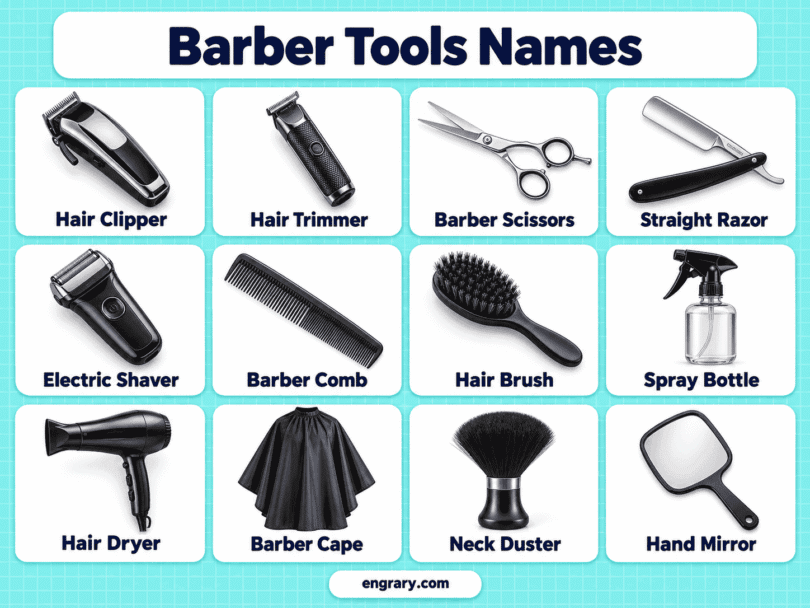
Barber tools include cutting instruments, clippers, trimmers, combs, brushes, shaving equipment, styling devices, and barbershop accessories. Barbers use these tools to cut, shape, trim, style, and finish different types of hair while keeping their work organized and efficient.
Learning barber tools names with pictures and uses makes it easier to recognize common equipment found in barbershops. This guide covers familiar handheld tools, electrical devices, workstation equipment, cleaning accessories, and other items used in professional barbering.

Basic Barber Tools and Their Names
These are some of the most recognizable tools and equipment found in modern barbershops. Each item has a distinct design and general purpose.
Hair Clippers
Hair clippers are powered cutting tools with moving blades. Barbers commonly use them for shortening hair and creating even cuts.
Detail Trimmer
A detail trimmer is a compact powered tool designed for precise edging, outlining, and detailed grooming work.
T-Blade Trimmer
A T-blade trimmer has a wide blade shaped like the letter T. Its design makes it useful for detailed finishing and close trimming.
Foil Shaver
A foil shaver has thin perforated metal foils over moving cutters. Barbers use it for very close finishing on short hair.
Barber Scissors
Barber scissors have two sharp blades and finger rings. They help barbers cut and shape hair with controlled movements.
Thinning Shears
Thinning shears have one or two toothed blades. They reduce bulk while leaving some hair in place.
Texturizing Shears
Texturizing shears have specially spaced teeth that help create texture and soften heavy sections of hair.
Barber Comb
A barber comb is a slim handheld tool with evenly spaced teeth for arranging and controlling hair.
Fade Comb
A fade comb is designed for short hairstyles and helps barbers work with gradual changes in hair length.
Cutting Comb
A cutting comb helps lift, separate, and control hair while a barber works with scissors or clippers.
Clipper Comb
A clipper comb has a sturdy shape that helps guide hair while working with electric clippers.
Hair Brush
A hair brush uses rows of bristles or pins to smooth, arrange, and control hair.
Fade Brush
A fade brush is a compact brush used to remove loose cut hairs and make short sections easier to inspect.
Neck Duster
A neck duster has soft bristles that help remove loose hair from the neck and surrounding skin after a haircut.
Spray Bottle
A spray bottle releases a fine mist of water to lightly dampen hair during cutting or styling.
Hair Dryer
A hair dryer blows warm or cool air to dry and help style hair.
Barber Cape
A barber cape covers a client’s clothing and helps keep loose hair away from the body.
Hand Mirror
A hand mirror allows clients to view the back and sides of a finished haircut.
Barber Chair
A barber chair provides adjustable seating for clients and usually includes a backrest, armrests, and foot support.
Clipper Guards
Clipper guards attach to compatible clippers and help maintain a consistent cutting length.
Barber Cutting and Trimming Tools
Barbers use several additional tools for shortening, shaping, detailing, and managing different hair lengths.
- Cordless Clipper – A battery-powered clipper that allows easier movement around the barber chair.
- Clipper Blade – The cutting component fitted to a hair clipper or trimmer.
- Razor Comb – A comb-style grooming tool designed to combine hair control with controlled texturing.
- Sectioning Clips – Clips that hold sections of hair apart while a barber works.
- Hair Clips – Small gripping tools that temporarily secure hair in place.
- Straight Razor – A folding razor-style barber instrument used by trained professionals for selected finishing work.
- Barber Razor – A barber-focused razor tool used for controlled grooming and finishing.
- Razor Holder – A handle designed to securely hold a compatible replaceable razor blade.
Barber Combs and Brushes
Different combs and brushes help barbers control hair texture, direction, shape, and loose clippings.
- Wide-Tooth Comb – A comb with widely spaced teeth that moves easily through thicker or curlier hair.
- Styling Comb – A general-purpose comb used for arranging and shaping hair.
- Afro Pick – A comb-like tool with long teeth used to lift and shape tightly curled or textured hair.
- Vent Brush – A brush with open spaces that allow air to pass through while drying or styling.
- Round Brush – A cylindrical brush used with styling and drying techniques.
- Paddle Brush – A broad, flat brush that helps smooth larger sections of hair.
- Clipper Brush – A small stiff-bristled brush used to remove loose hair from clipper surfaces and blades.

Shaving and Finishing Tools
Barbers use finishing tools to complete grooming work and prepare polished final results.
- Shaving Brush – A dense-bristled brush used to spread shaving lather evenly.
- Shaving Bowl – A small bowl used to hold or mix shaving lather.
- Shaving Mug – A handled container traditionally used with shaving soap or lather.
- Hot Towel Steamer – A device that warms towels for professional grooming services.
- Towel Warmer – An enclosed appliance that keeps clean towels warm and ready for use.
- Facial Steamer – A device that produces warm steam for selected grooming and facial-care services.
Barber Hair Drying and Styling Equipment
Some barbershops also use styling equipment to dry, shape, smooth, or control different hairstyles.
- Diffuser Attachment – An attachment fitted to a hair dryer to spread airflow over a wider area.
- Concentrator Nozzle – A narrow dryer attachment that directs airflow toward a specific section of hair.
- Hair Straightener – A heated styling appliance used to smooth and straighten suitable hair.
- Curling Iron – A heated styling tool used to create curls or waves.
- Hair Steamer – A device that produces steam for selected hair-care and styling services.
Barber Station and Barbershop Equipment
A well-organized barber station helps keep tools visible, accessible, and properly arranged during daily work.
- Barber Station – A dedicated work area that may include a mirror, counter, drawers, and storage.
- Barber Trolley – A movable cart with shelves or drawers for carrying barber tools and accessories.
- Tool Organizer – A divided holder or storage unit that keeps small tools separated and easy to reach.
- Tool Mat – A protective surface placed on a workstation to organize tools and protect the counter.
- Wall Mirror – A large fixed mirror that allows both barber and client to view the haircut.
- Barber Footrest – A support attached to or placed near a barber chair for the client’s feet.
- Disinfectant Jar – A container designed to hold compatible tools during professional sanitation routines.
- UV Sterilizer Cabinet – A cabinet-style device used in some shops as part of tool-hygiene management.
Cleaning and Tool Maintenance Equipment
Regular tool care helps barbers keep their equipment organized and working properly. These items support cleaning, storage, and basic maintenance.
- Blade Cleaning Brush – A small brush used to remove loose hair and debris from clipper and trimmer blades.
- Tool Cleaning Tray – A shallow tray used to organize tools during cleaning or maintenance.
- Air Blower – A device that directs air to remove loose hair and dust from equipment or work areas.
- Clipper Blade Case – A protective case used to store spare or removable clipper blades.
- Scissor Case – A fitted case that protects barber scissors and shears during storage.
- Barber Tool Case – A larger case or bag used to store and transport multiple barber tools.

Barber Tools People Often Confuse
Several barber tools look similar or perform related functions. Their main differences usually involve cutting length, precision, shape, or purpose.
| Barber Tools | Main Difference |
|---|---|
| Hair Clippers vs Trimmer | Clippers handle broader hair cutting, while trimmers focus more on detailing and edging |
| Trimmer vs Foil Shaver | A trimmer shapes short hair, while a foil shaver provides a closer finishing result |
| Barber Scissors vs Thinning Shears | Scissors cut full sections, while thinning shears remove only part of the hair |
| Thinning Shears vs Texturizing Shears | Thinning shears reduce bulk, while texturizing shears create more noticeable texture |
| Barber Comb vs Fade Comb | A barber comb handles general hair control, while a fade comb suits short blending work |
| Fade Comb vs Clipper Comb | Both guide short hair, but clipper combs usually have a sturdier form for clipper work |
| Hair Brush vs Fade Brush | A hair brush arranges hair, while a fade brush clears loose clippings from short areas |
| Hair Brush vs Neck Duster | A hair brush works on the hair, while a neck duster removes loose clippings from skin |
| Hair Clippers vs Cordless Clippers | Both cut hair, but cordless models operate from a rechargeable battery |
| Straight Razor vs Razor Holder | A straight razor is the complete folding instrument, while a razor holder supports a replaceable blade |
Barber Tools, Equipment, and Supplies Explained
People often use these terms together, but they refer to different kinds of barbershop items.
| Term | Meaning | Examples |
|---|---|---|
| Barber Tool | A handheld item used directly during barbering | Comb, scissors, neck duster |
| Barber Instrument | A more precise handheld tool | Thinning shears, trimmer, razor |
| Barber Equipment | Larger, powered, or stationary items | Barber chair, hair dryer, towel warmer |
| Barber Supply | A product or disposable item replaced regularly | Neck strips, shampoo, shaving cream |
Products such as pomade, gel, shampoo, conditioner, shaving cream, tissues, and disposable gloves belong under supplies rather than the main barber-tool count.
Barber Tools vs Hairdresser Tools
Barbers and hairdressers share several tools, including scissors, combs, brushes, hair dryers, and sectioning clips. However, their typical equipment mix differs.
Barbers usually rely more heavily on clippers, detail trimmers, foil shavers, fade combs, clipper guards, neck dusters, barber razors, and barber chairs. These tools strongly connect with short haircuts, fades, edging, and traditional barber services.
Hairdressers may use a wider range of styling equipment, including curling tools, straighteners, rollers, specialty brushes, and color-related accessories. Modern salons and barbershops can overlap, so the exact tool selection varies by service.
Questions People Ask About Barber Tools
Common barber tools include hair clippers, detail trimmers, barber scissors, thinning shears, combs, brushes, foil shavers, spray bottles, neck dusters, and hair dryers.
A clipper usually handles larger sections of hair and general shortening, while a trimmer provides finer control for detailing and edging.
Common fade-related tools include clippers, clipper guards, trimmers, fade combs, clipper combs, fade brushes, and barber scissors.
They overlap, but they are not identical. Barbers tend to use more short-hair cutting, trimming, shaving, and fading equipment, while hairdressers often use a broader range of styling tools.
A typical barbershop may contain barber chairs, mirrors, workstations, trolleys, hair dryers, towel warmers, disinfectant containers, storage cases, and other professional equipment.
You May Also Like



Leave a Comment