
Artists use different tools to draw, paint, blend, measure, print, sculpt, and create digital artwork. Each tool has its own shape and purpose, from fine drawing pencils and specialized brushes to printmaking rollers, sculpting loops, and electronic drawing tablets.
Learning art tools names with pictures and uses makes these items easier to recognize and compare. This guide covers 58 art tools and pieces of equipment while keeping paints, paper, canvas, clay, ink, and other art materials outside the main tool count.
Common Tools Artists Keep Close While Creating
Artists often keep a small group of versatile tools within easy reach while they work. These 20 familiar items cover drawing, painting, measuring, blending, sculpting, printmaking, and digital art.
1. Graphite Pencil
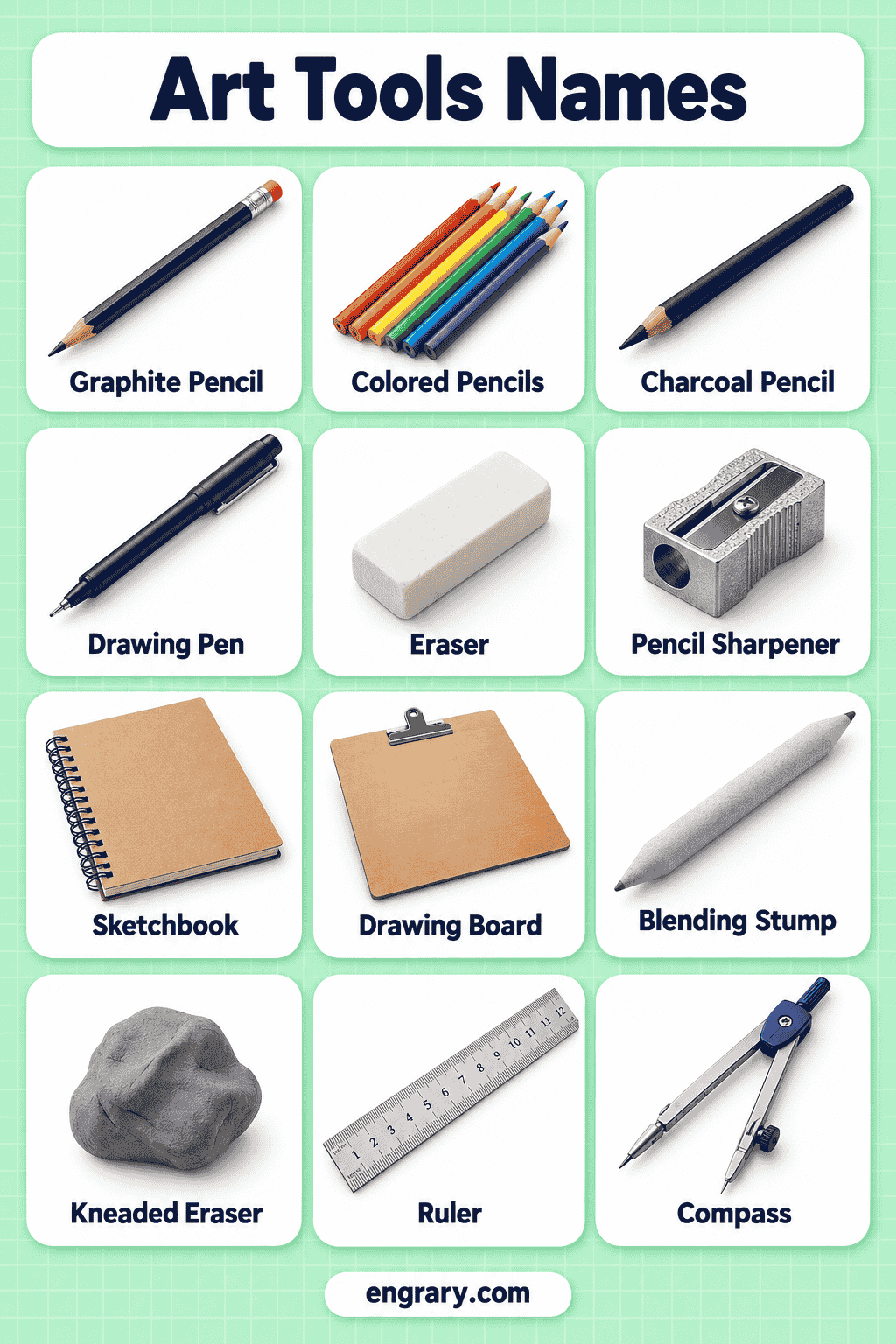
A graphite pencil has a wooden or mechanical body with a graphite core. Artists use different grades to create light construction lines, detailed drawings, and darker shaded areas.
2. Mechanical Pencil
A mechanical pencil advances thin replaceable lead through a reusable barrel. Its consistent point makes it useful for fine lines and detailed sketching.
3. Colored Pencil
A colored pencil has a pigmented core inside a wooden or mechanical body. Artists use it for drawing, layering color, shading, and detailed illustration.
4. Kneaded Eraser
A kneaded eraser has a soft, moldable texture that artists can stretch or shape with their fingers. It lifts graphite and charcoal gently and works well for creating highlights.
5. Vinyl Eraser
A vinyl eraser has a firm, smooth body and removes graphite with stronger rubbing action than a kneaded eraser. Its clean edges can also erase small controlled areas.
6. Pencil Sharpener
A pencil sharpener trims the wooden casing around a pencil core and restores a usable point. Artists may choose a fine point or a broader tip depending on the drawing style.
7. Blending Stump
A blending stump consists of tightly compressed paper shaped into a solid pointed stick. Artists rub it over graphite or charcoal to soften marks and create smoother shading.
8. Ruler
A ruler provides a straight measuring edge. Artists use it for geometric drawings, layouts, perspective guides, and other work that needs controlled straight lines.
9. Compass
A compass has two hinged legs, usually with a point on one side and a drawing point on the other. It helps artists construct circles and arcs.
10. Round Brush
A round brush has a rounded body that narrows toward the tip. Its shape handles fine lines, curves, washes, and varied brushstrokes.
11. Flat Brush
A flat brush has broad bristles with a straight edge. Artists use that shape for wide strokes, blocks of color, sharp edges, and broad coverage.
12. Filbert Brush
A filbert brush combines a flat body with a rounded tip. It creates softer edges than a square-ended flat brush while still covering a relatively broad area.
13. Artist’s Palette
An artist’s palette provides a flat surface for holding and mixing colors. Traditional versions may include a thumb hole, while modern palettes come in many reusable shapes.
14. Palette Knife
A palette knife has a slim, blunt metal or plastic blade attached to a handle. Artists mainly use it to mix, move, and organize paint on a palette.
15. Easel
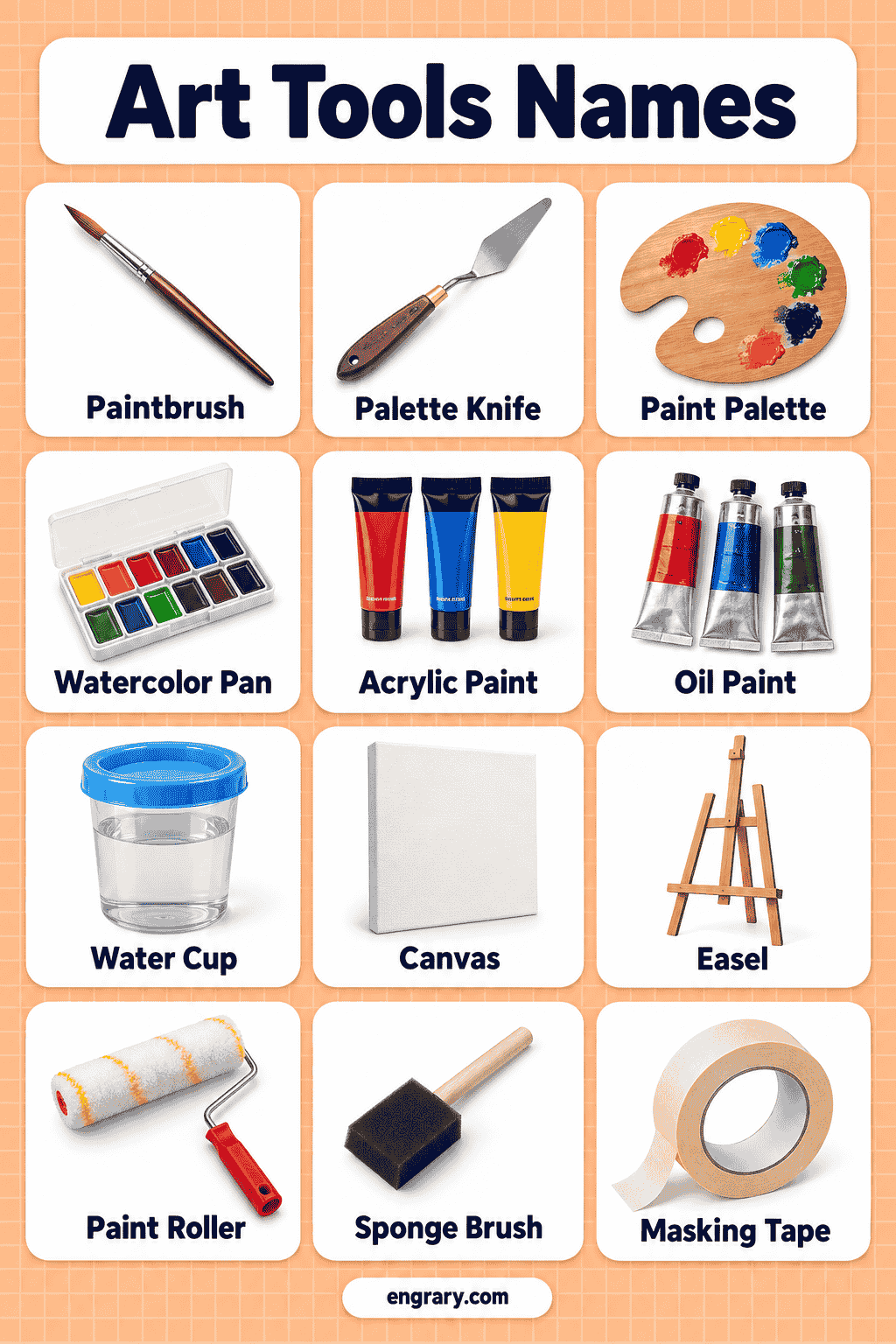
An easel supports artwork at an upright or adjustable angle. Painters and drawing artists use it to position their working surface at a comfortable height.
16. Drawing Board
A drawing board provides a rigid, flat surface beneath paper or other lightweight art surfaces. Artists can work with it on a table, stand, or easel.
17. Brayer
A brayer has a cylindrical roller mounted in a handheld frame. Printmakers roll it across ink and printing surfaces to create an even layer.
18. Modeling Tool
A modeling tool has shaped ends for pressing, smoothing, carving, or forming soft sculpting material. Different end profiles handle different details.
19. Graphics Tablet
A graphics tablet provides an electronic drawing surface that detects movement and pressure from a compatible pen. The artwork usually appears on a connected computer display.
20. Stylus
A stylus, or digital pen, is a handheld input tool for tablets and digital drawing surfaces. Pressure-sensitive models can respond to changes in hand pressure.
Drawing and Sketching Tools
Drawing tools help artists control line weight, detail, texture, and shading. Some create marks directly, while others refine or prepare drawing instruments.
21. Charcoal Pencil
A charcoal pencil encloses compressed charcoal inside a wooden casing. It produces dark, soft marks while offering more control than loose charcoal sticks.
22. Lead Holder
A lead holder uses thick replaceable drawing leads inside a reusable barrel. Its wider lead makes it different from the fine lead found in most mechanical pencils.
23. Precision Eraser
A precision eraser has a narrow tip that targets small areas. Artists use it to clean tight spaces, refine edges, and lift tiny highlights.
24. Tortillon
A tortillon is a tightly rolled paper blending tool with a pointed end. Its lighter construction distinguishes it from the denser blending stump.
25. Sandpaper Block
A sandpaper block provides a rough surface for shaping drawing points or producing fine graphite or charcoal powder. Artists can also use it to maintain some blending tools.
Erasing and Blending Tools
Artists use erasing and blending tools to soften transitions, adjust values, clean edges, and recover highlights. The tool’s texture determines how strongly it affects the drawing surface.
A kneaded eraser lifts material gently, while a vinyl eraser removes marks more firmly. For blending, a blending stump offers a dense paper surface, whereas a tortillon provides a lighter rolled-paper point.
These differences make each tool useful for a different level of control rather than making one a direct replacement for another.
Tools for Measuring and Drawing Proportions
Measurement tools help artists compare sizes, construct geometry, transfer proportions, and organize perspective. They become especially useful in technical drawing, architecture, illustration, and carefully planned compositions.
26. Protractor
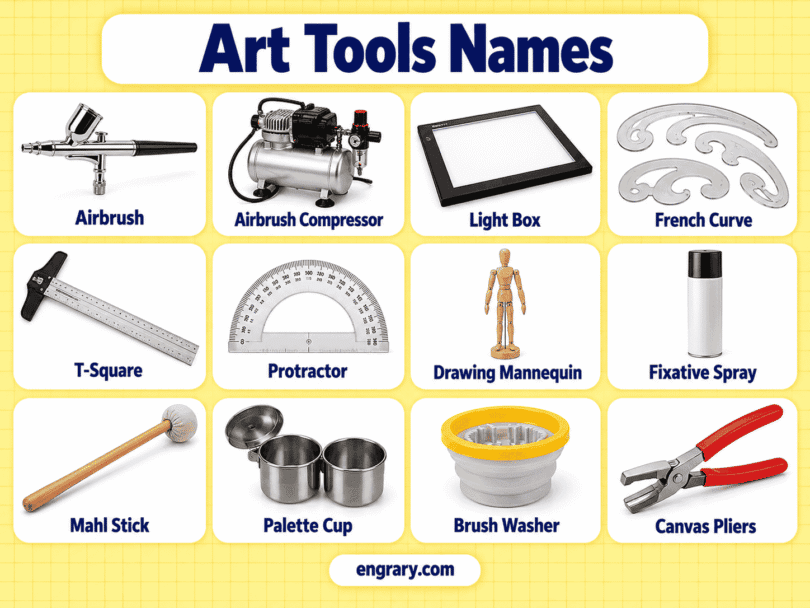
A protractor measures and constructs angles. Its curved scale helps artists create accurate geometric layouts and perspective guides.
27. T-Square
A T-square has a long straight blade attached to a shorter crosspiece. Artists use it to draw horizontal guides and maintain right-angle relationships.
28. Proportional Divider
A proportional divider has two hinged sets of points. Artists adjust it to compare or transfer proportions between a subject, reference, and drawing.
29. Grid Ruler
A grid ruler combines straight measuring edges with visible grid markings. The markings help align shapes, spacing, margins, and repeated elements.
30. French Curve
A French curve provides several smooth curved edges in one rigid template. Artists use it to draw controlled curves that would be difficult to create with an ordinary ruler.
31. Circle Template
A circle template contains multiple circular openings of different sizes. Artists trace the openings when they need consistent circles without constructing each one with a compass.
Paintbrush Types and Their Shapes
Brush shape changes the kinds of marks an artist can create. Rather than counting different sizes of the same brush, it makes more sense to recognize major shapes with genuinely different profiles.
32. Fan Brush
A fan brush spreads its bristles outward into a wide fan shape. Artists use it for soft textures, blending, repeated marks, and delicate surface effects.
33. Rigger Brush
A rigger brush has very long, narrow bristles that hold paint while maintaining a fine tip. Its shape supports extended thin lines and flowing details.
34. Mop Brush
A mop brush has a large, soft, rounded head that holds plenty of liquid. Watercolor and wash techniques often benefit from its high capacity.
35. Angle Brush
An angle brush has bristles cut on a diagonal. The slanted edge helps create controlled corners, curves, and broad-to-fine strokes.
36. Detail Brush
A detail brush has a small head and fine point. Artists use it when working on tiny shapes, precise edges, and closely controlled marks.
Round, flat, and filbert brushes from the opening list complete the main brush family in this article.
Paint Mixing and Application Tools
Painters use more than brushes to mix, place, texture, and control color. Several tools produce marks that brushes cannot easily copy.
37. Painting Knife
A painting knife usually has a flexible blade with an offset handle. Artists apply paint directly with the blade to build texture, broad shapes, and sharp-edged marks.
38. Paint Shaper
A paint shaper has a flexible silicone or rubber tip rather than bristles. It pushes, spreads, removes, or shapes thick paint and other soft art media.
39. Airbrush
An airbrush is a compact spray tool that applies a fine mist of color. Artists use it for smooth gradients, controlled shading, and detailed sprayed effects.
40. Mahl Stick
A mahl stick has a long shaft with a padded end. Painters rest it against or near the work area to steady the painting hand without touching wet paint.
41. Artist Sponge
An artist sponge has a porous surface that creates irregular textures and soft transitions. Painters can dab, lift, or spread color with it.
Easels, Drawing Boards, and Support Tools
Support tools hold, illuminate, stretch, or stabilize artwork while the artist works. They improve control without becoming part of the finished image itself.
42. Canvas Pliers
Canvas pliers have broad gripping jaws that pull canvas evenly during stretching. Their wide face spreads pressure across the material.
43. Light Box
A light box, also called a light pad, shines light through translucent artwork or paper. Artists use it to view underlying lines and transfer visual information between sheets.
The easel and drawing board from the first section also belong to this support-equipment group.
Printmaking Tools
Printmaking uses pressure, rollers, guides, and support equipment to transfer an image from one surface to another. These tools introduce vocabulary that many basic art-supply lists miss.
44. Baren
A baren is a flat handheld pressing tool used in hand printing. Printmakers rub it over the back of paper to help transfer an image from the inked surface below.
45. Burnisher
A burnisher has a smooth working surface that applies concentrated rubbing pressure. Artists and printmakers use it to press, polish, or transfer areas depending on the process.
46. Bench Hook
A bench hook rests against the edge of a workbench and provides a stable working surface. Printmakers commonly use it to keep blocks or plates from shifting during controlled handwork.
47. Registration Guide
A registration guide helps align paper and printing surfaces in consistent positions. It becomes especially useful when an artwork requires more than one printing stage.
48. Printing Press
A printing press applies controlled pressure between a prepared printing surface and paper or another receiving surface. Different printmaking methods use different press designs.
The brayer from the opening section completes the most recognizable printmaking-tool group.
Sculpting and Modeling Tools
Three-dimensional art requires tools that cut, scrape, smooth, roll, support, and shape soft materials. Each tool’s edge or profile creates a different effect.
49. Loop Tool
A loop tool has a thin wire loop fixed to a handle. Sculptors use the loop to remove, scrape, or shape soft material.
50. Ribbon Tool
A ribbon tool uses a flat metal ribbon loop rather than thin round wire. Its wider edge removes and shapes material differently from a standard loop tool.
51. Wire Clay Cutter
A wire clay cutter has a thin wire stretched between two handles. Sculptors use the wire to separate or divide sections of soft clay or similar material.
52. Clay Roller
A clay roller is a smooth cylindrical tool that flattens and evens soft modeling material. Its shape works much like a small rolling pin.
53. Potter’s Rib
A potter’s rib is a flat handheld tool with straight or curved edges. Artists use its edge to smooth, compress, and refine clay surfaces.
54. Sculpting Stand
A sculpting stand supports three-dimensional work at a convenient height. Many versions allow the artist to rotate the artwork while shaping it.
Digital Art Tools and Equipment
Digital art replaces many physical media with electronic input tools, but the physical equipment still has distinct names and functions.
55. Pen Display
A pen display combines an electronic drawing surface with a built-in screen. Artists draw directly where the digital image appears instead of looking at a separate monitor.
The graphics tablet and stylus from the first section complete the core digital-art tool group.
General Art Workspace Tools
Some tools do not belong to one artistic discipline but still support layout, cutting, preparation, or cleanup across many art projects.
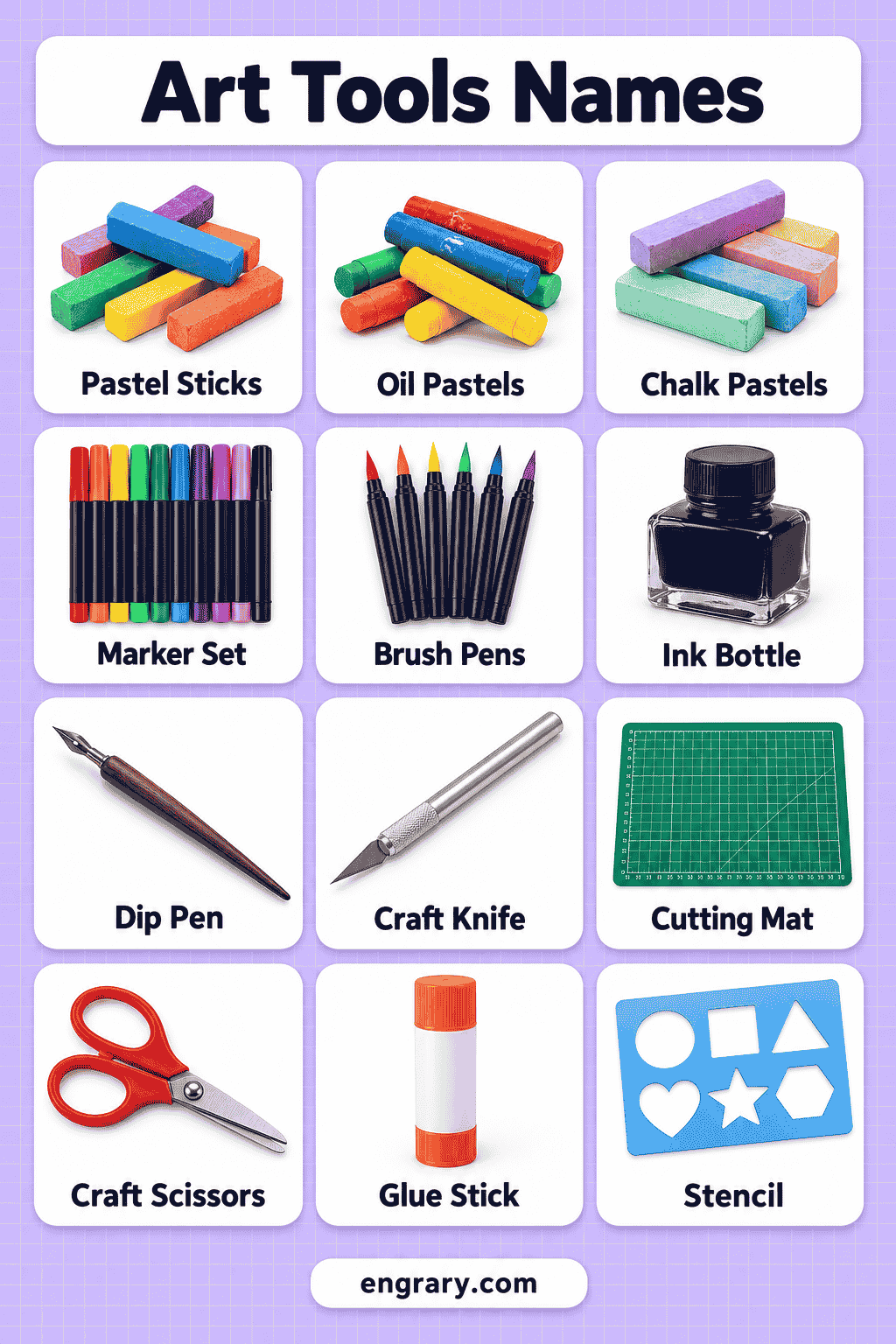
56. Cutting Mat
A cutting mat provides a durable protective surface beneath paper and craft materials. Printed grids on many mats also help with alignment and measurement.
57. Paper Trimmer
A paper trimmer guides paper along a measured cutting path to create straight, consistent edges. Artists use it for preparation, collage, presentation, and paper-based projects.
58. Brush Washer
A brush washer is a reusable container designed for rinsing and holding paintbrushes during painting sessions. Many versions include internal supports or textured areas that help release paint from bristles.
The primary list contains exactly 58 art tools and pieces of equipment. Paint, ink, loose charcoal, pastels, canvas, paper, clay, glue, fixative, and similar materials do not increase the tool count.
How to Tell Similar Art Tools Apart
Several art tools look similar at first, but their shape, material, or working method usually provides a clear clue.
| Often Confused | Main Difference |
|---|---|
| Mechanical Pencil vs Lead Holder | Mechanical pencils usually take thin lead; lead holders use thicker artist leads |
| Kneaded Eraser vs Vinyl Eraser | Kneaded erasers mold and lift gently; vinyl erasers rub marks away more firmly |
| Blending Stump vs Tortillon | Stumps use denser compressed paper; tortillons use lighter rolled paper |
| Round Brush vs Flat Brush | Round brushes taper toward a point; flat brushes have a broad straight edge |
| Flat Brush vs Filbert Brush | Flat brushes end square; filberts have rounded corners |
| Palette Knife vs Painting Knife | Palette knives mainly mix paint; painting knives commonly apply paint to the artwork |
| Easel vs Drawing Board | Easels support artwork upright; drawing boards provide rigid flat support |
| Brayer vs Baren | A brayer rolls ink; a baren presses paper during hand printing |
| Loop Tool vs Ribbon Tool | Loop tools use thin wire; ribbon tools use wider flat metal loops |
| Graphics Tablet vs Pen Display | A graphics tablet relies on a separate screen; a pen display includes its own display |
| Stylus vs Graphics Tablet | A stylus is the handheld pen; the tablet is the electronic drawing surface |
Other Names Used for Art Tools
Art vocabulary often changes between regions, brands, and artistic disciplines. Alternate names can help readers recognize the same tool without falsely treating each term as another item.
A graphics tablet may also appear as a drawing tablet or pen tablet. A stylus can appear under the name digital pen.
Artists sometimes call a blending stump a paper stump, while an artist’s palette may simply appear as a mixing palette.
Printmakers may call a brayer an ink roller in general conversation. Likewise, people often use light box and light pad for closely related illuminated drawing surfaces.
The broad terms modeling tool and sculpting tool can also overlap. Their exact meaning depends on the tool shape and the material an artist works with.
Art Tools vs Materials and Supplies
Art tools help artists perform actions, while media and materials create or receive the artwork. Separating these groups keeps an art-tool list accurate.
| Category | What It Means | Examples |
|---|---|---|
| Art Tools | Reusable objects that help create or manipulate artwork | Brush, palette knife, ruler, brayer |
| Equipment | Larger or electronic working devices | Easel, printing press, graphics tablet |
| Art Media | Materials that create marks, color, or form | Paint, ink, pastels, charcoal |
| Art Surfaces | Materials that receive the artwork | Canvas, drawing paper, watercolor paper |
| Sculpting Materials | Soft or moldable substances shaped into artwork | Clay, modeling compounds |
| Supporting Supplies | Replaceable or consumable items used during work | Tape, fixative, glue |
For example, a paintbrush counts as a tool, while the paint on its bristles counts as art media. A sculpting tool performs the work, while clay provides the material that the artist shapes.
Questions People Ask About Art Tools
Common art tools include graphite pencils, erasers, sharpeners, paintbrushes, rulers, palettes, palette knives, easels, blending tools, and drawing boards. Digital artists also commonly use graphics tablets and styluses.
Art tools are reusable objects that help artists draw, paint, shape, measure, blend, or print. Art materials include paint, ink, paper, canvas, clay, charcoal, and other substances that create or receive the artwork.
Beginners often start with pencils, erasers, sharpeners, a ruler, basic round and flat brushes, a palette, a drawing board, and simple blending tools. The best selection depends on whether the learner wants to draw, paint, sculpt, or create digital art.
Painters commonly use round, flat, filbert, and detail brushes along with palettes, palette knives, painting knives, easels, sponges, and support tools. Different painting techniques may require additional specialist equipment.
Yes. A graphics tablet is a physical digital-art tool that records input from a compatible stylus. Unlike drawing software, which functions as a digital application, the tablet itself is physical art equipment.
You May Also Like

Leave a Comment