
Sewing requires more than a needle and thread. Different tools help sewists measure fabric, mark patterns, cut accurately, hold layers together, stitch by hand or machine, press seams, shape garments, and finish small details.
Learning sewing tools names with pictures and uses makes these items easier to recognize and use correctly. This guide covers 65 sewing tools and pieces of equipment, from basic kit essentials to specialized measuring, cutting, pressing, and garment-making tools.
Sewing Tools You’ll Find in a Basic Sewing Kit
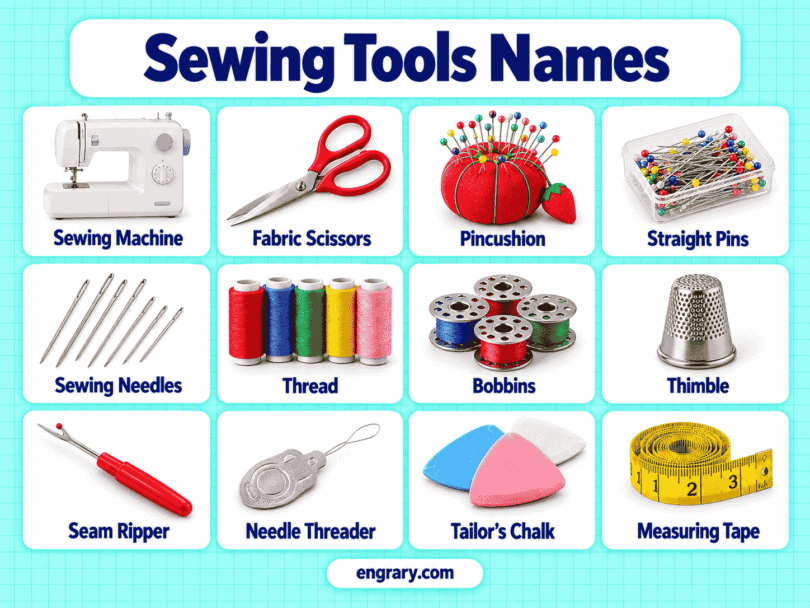
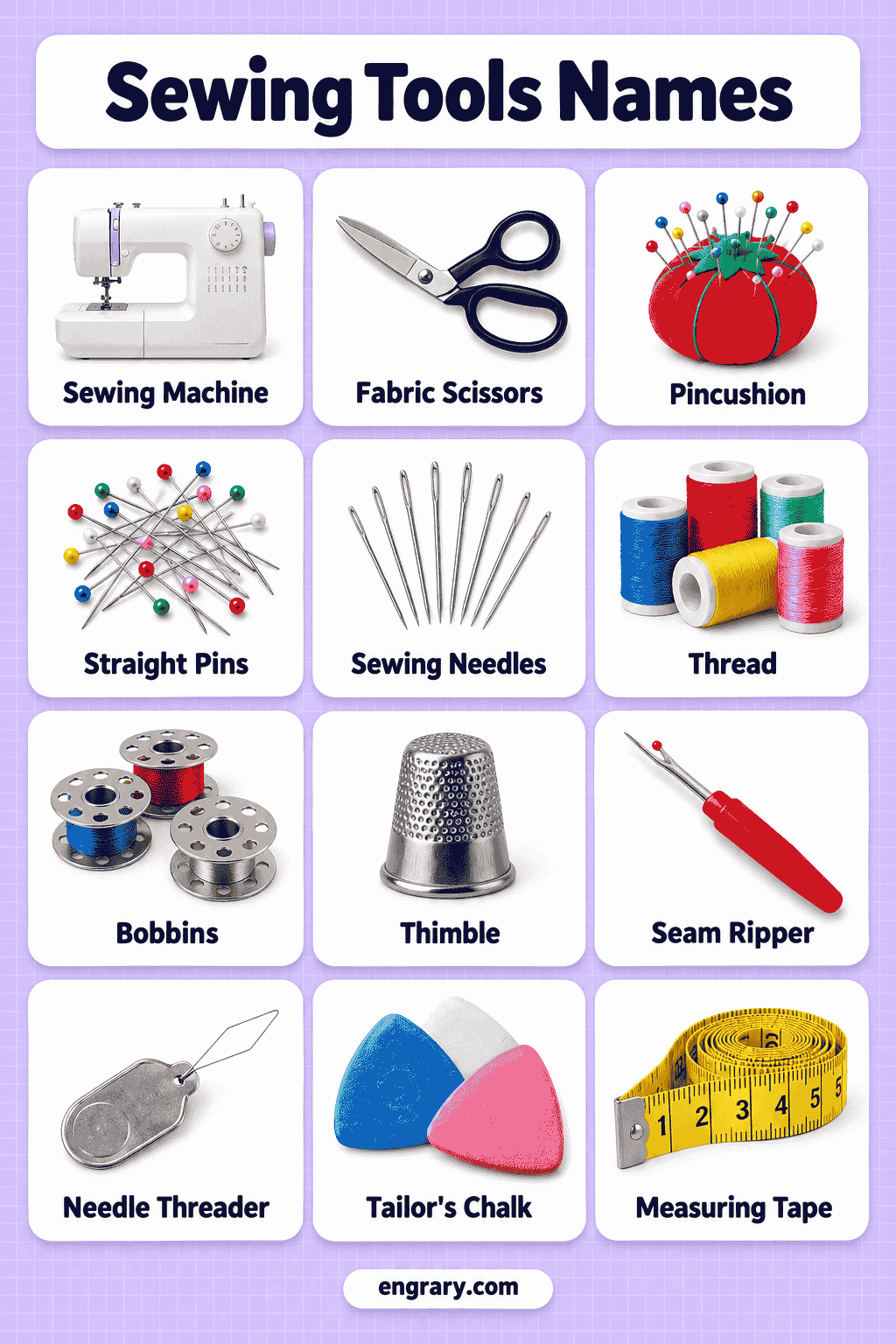
A basic sewing kit combines measuring, cutting, marking, holding, stitching, and pressing tools. These 20 items cover many of the tools beginners encounter first.
1. Tape Measure
A tape measure has a long, flexible strip marked with measurement units. Sewists use it to measure fabric, garments, and curved areas of the body.
2. Seam Gauge
A seam gauge is a short ruler with a movable marker. It helps measure seam allowances, hems, button placement, and other short repeated distances.
3. Transparent Ruler
A transparent ruler lets you see fabric or pattern markings beneath it. Its straight edge helps with measuring, marking, and pattern work.
4. French Curve
A French curve has several smooth curved edges rather than one straight side. Pattern makers use it to draw armholes, necklines, and other garment curves.
5. Tailor’s Chalk
Tailor’s chalk creates temporary marks on fabric for seams, darts, cutting lines, and placement points. Its flat or triangular shape makes it easy to recognize.
6. Tracing Wheel
A tracing wheel has a small toothed or smooth wheel attached to a handle. It transfers pattern markings onto fabric when used with suitable tracing material.
7. Dressmaker’s Shears
Dressmaker’s shears have long blades and bent or offset handles. The handle design keeps the lower blade close to the cutting surface while the fabric stays relatively flat.
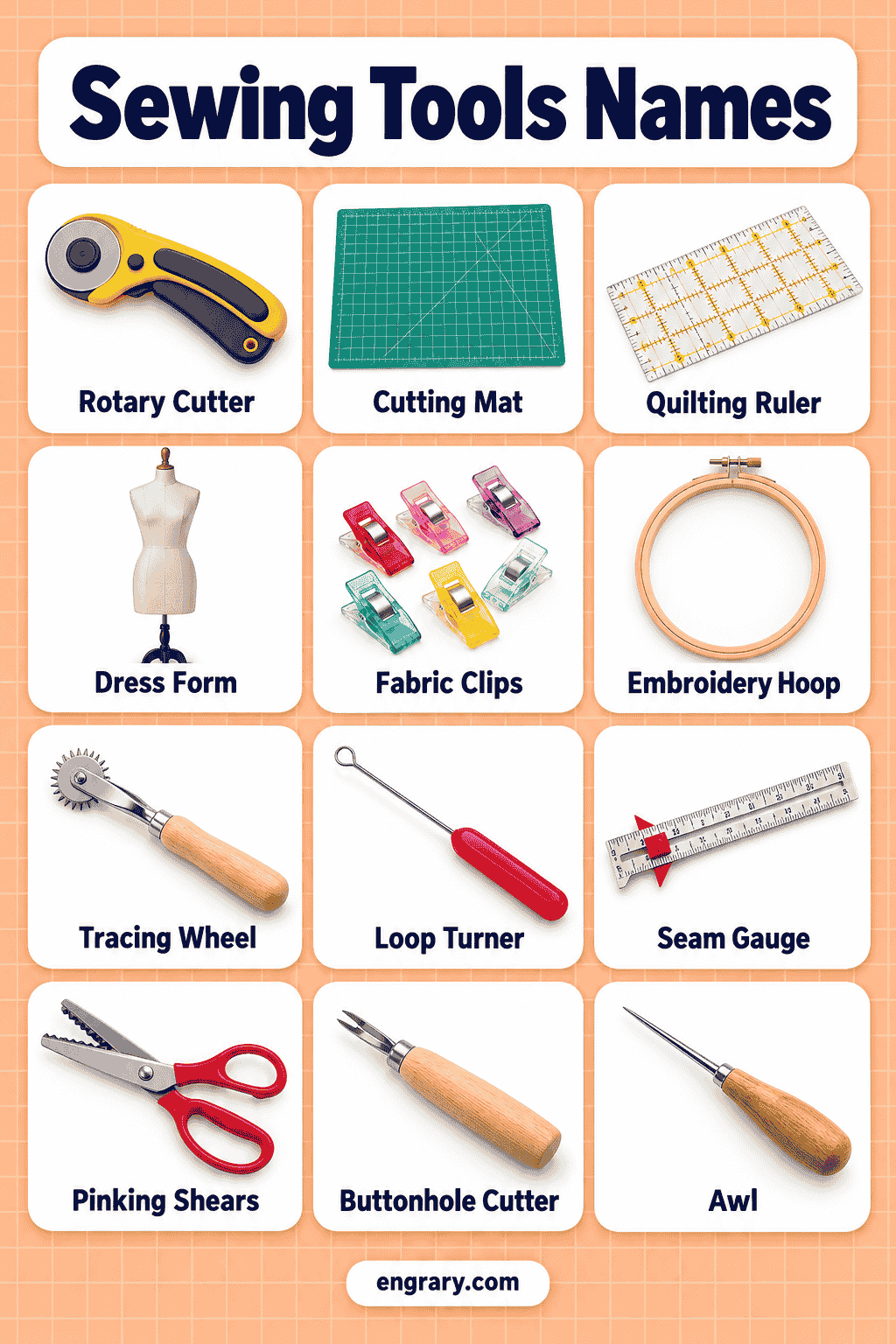
8. Pinking Shears
Pinking shears have zigzag-shaped blades. They create a saw-toothed fabric edge rather than the straight edge produced by ordinary shears.
9. Rotary Cutter
A rotary cutter has a circular rolling blade attached to a handheld grip. Sewists commonly use it with a cutting mat for straight or curved fabric cuts.
10. Seam Ripper
A seam ripper has a small pointed hook with a cutting blade between its tips. It removes unwanted stitches without requiring large scissors.
11. Straight Pins
Straight pins temporarily hold fabric layers, patterns, or seams in place before sewing.
12. Pincushion
A pincushion provides a soft surface for storing pins and needles. Its padded shape keeps sharp points organized and easy to reach.
13. Sewing Clips
Sewing clips grip fabric layers without piercing them. They work especially well with thick materials or fabrics that show pin holes easily.
14. Hand-Sewing Needle
A hand-sewing needle has a sharp or rounded point and an eye near one end. Sewists use it for hand stitching, repairs, finishing, and decorative work.
15. Thimble
A thimble is a small protective cap worn on a finger. It helps push a hand needle through fabric while protecting the fingertip.
16. Needle Threader
A needle threader has a fine wire or hook that pulls thread through a small needle eye. It makes threading easier when the opening is difficult to see.
17. Sewing Machine
A sewing machine joins fabric with controlled mechanical stitching. Modern machines may handle straight stitches, zigzag stitches, buttonholes, decorative stitches, and other sewing tasks.
18. Serger / Overlocker
A serger, also called an overlocker, trims fabric edges and wraps them with thread while stitching. It creates the finished edge commonly seen inside manufactured clothing.
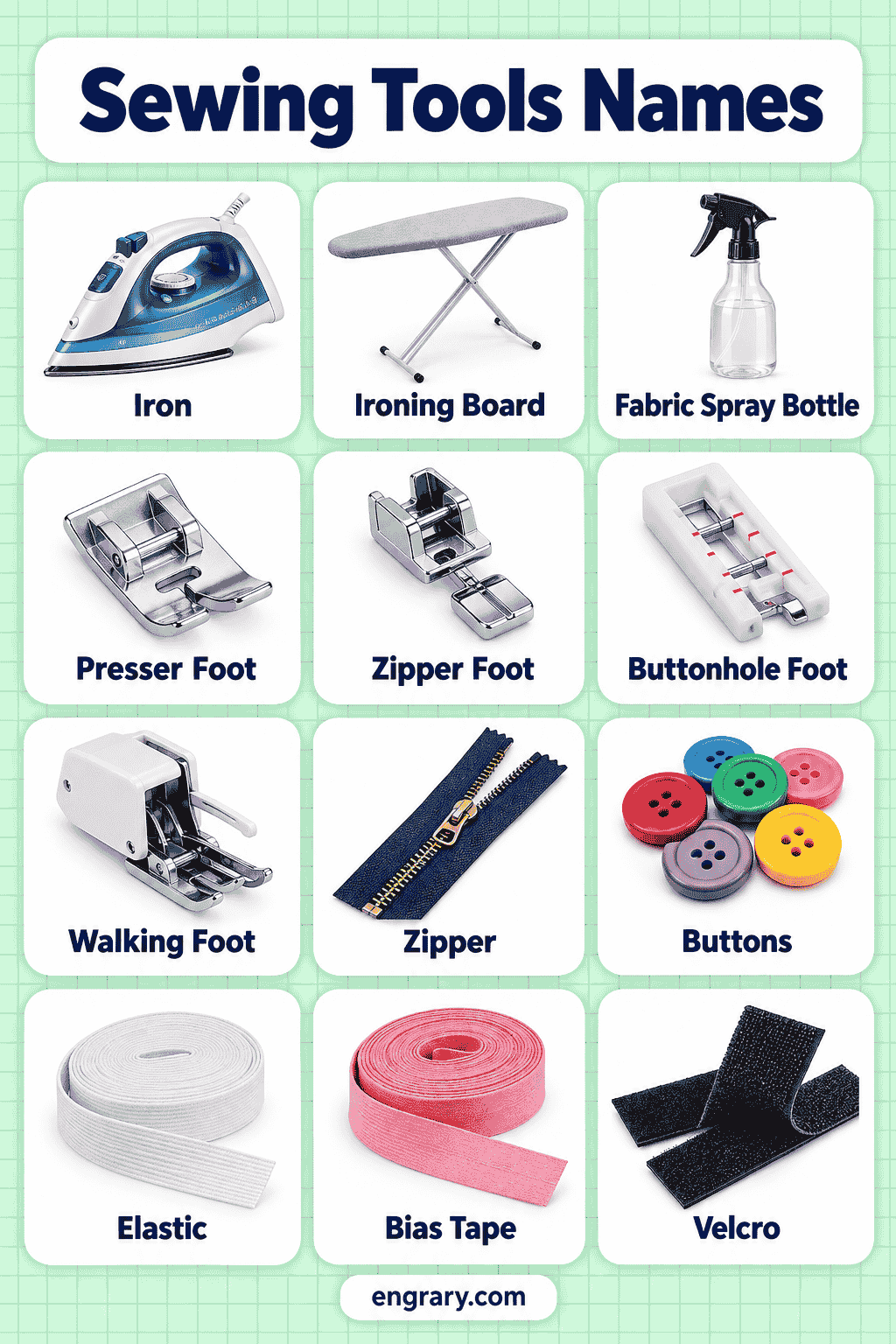
19. Iron
An iron smooths fabric and presses seams, folds, hems, and garment details during construction. Good pressing often improves the accuracy of later sewing steps.
20. Tailor’s Ham
A tailor’s ham is a firm, rounded pressing cushion. Its curved surfaces support darts, shoulders, bust areas, sleeve caps, and other shaped garment sections.
Measuring Tools for Sewing
Accurate sewing begins with accurate measurements. These tools help sewists check long distances, small seam allowances, curves, angles, and garment proportions.
21. Yardstick
A yardstick is a long rigid ruler that works well for measuring larger pieces of fabric and drawing extended straight lines.
22. Quilting Ruler
A quilting ruler is a wide transparent ruler marked with grids and angles. Its broad surface works especially well with rotary cutters and patchwork pieces.
23. Hip Curve
A hip curve has a long, gradual curved edge. Pattern makers use its shape to draw hip lines, side seams, and other gentle garment curves.
24. L-Square
An L-square forms a fixed right angle. It helps pattern makers draw perpendicular lines, check corners, and establish straight drafting guides.
25. Pattern Master
A pattern master combines straight edges, curves, angles, and measurement markings in one drafting tool. It supports several pattern-making tasks without requiring multiple rulers.
26. Hem Gauge
A hem gauge helps check the depth of hems and folds. Its markings make repeated measurements easier to keep consistent.
27. Skirt Marker
A skirt marker helps establish an even hemline while someone wears a skirt or dress. Some versions use chalk or an adjustable marking mechanism.
Pattern Drafting and Fitting Tools
Pattern and fitting tools help shape garments before final stitching. They allow sewists to create pattern details, mark construction points, and evaluate how clothing sits on the body.
28. Dress Form
A dress form is a padded torso shaped like the human body. Dressmakers use it to check fit, arrange fabric, position garment details, and develop draped designs.
29. Pattern Notcher
A pattern notcher cuts small controlled notches into paper pattern edges. These marks help identify matching points during garment construction.
30. Sewing Awl
A sewing awl has a pointed metal shaft and a handle. It helps create or enlarge small holes and can assist with detailed fabric, leather, or pattern work.
Fabric Marking Tools
Marking tools transfer construction information from a pattern to fabric. Good temporary marks show where to stitch, fold, cut, match, or position garment details.
31. Chalk Pencil
A chalk pencil places narrow chalk lines more precisely than a large piece of tailor’s chalk. Its pencil shape provides better control around small markings.
32. Fabric Marking Pen
A fabric marking pen creates temporary lines with a pen-style tip. Different versions may use water-removable, air-removable, or other washable marking systems.
33. Fabric Marking Pencil
A fabric marking pencil produces thin construction marks on fabric. It resembles an ordinary pencil but uses marking material intended for sewing work.
34. Hera Marker
A Hera marker has a smooth, firm edge that creates a visible crease without applying ink or chalk. Quilters often use it for temporary guiding lines.
Cutting Tools for Sewing
Different cutting tools handle fabric, thread, appliqué, buttonholes, and detailed trimming. Choosing the right tool improves control and protects larger fabric shears from unnecessary wear.
35. Sewing Scissors
Sewing scissors provide a general-purpose option for smaller fabric cuts and sewing tasks. They usually have shorter blades than full dressmaker’s shears.
36. Embroidery Scissors
Embroidery scissors have short, narrow blades with fine tips. Their compact size helps trim thread and make precise cuts around detailed needlework.
37. Thread Snips
Thread snips have small spring-style blades that open automatically after each cut. Sewists use them for quickly clipping loose threads.
38. Duckbill Scissors
Duckbill scissors have one broad, flat blade shaped like a duck’s bill. This blade helps protect the lower fabric layer while trimming appliqué or seam allowances.
39. Buttonhole Scissors
Buttonhole scissors make controlled cuts in buttonholes and other small openings. Some designs allow the user to adjust where the blades begin cutting.
40. Cutting Mat
A cutting mat provides a protective surface beneath a rotary cutter. Grid markings can also help align fabric and measure straight cuts.
Pinning and Fabric-Holding Tools
Holding tools keep patterns and fabric layers aligned before or during sewing. Some pierce the material, while others rely on pressure or weight.
41. Ball-Head Pins
Ball-head pins have colorful rounded heads that make them easy to see and pick up. They work well for many everyday sewing tasks.
42. T-Pins
T-pins have a wide T-shaped head that provides a strong grip. Sewists often use them when working with heavier fabrics, upholstery, or blocking tasks.
43. Magnetic Pin Holder
A magnetic pin holder attracts loose steel pins and keeps them collected in one place. Its open surface allows faster access than a traditional pincushion.
44. Pattern Weights
Pattern weights hold paper patterns against fabric without pins. They work especially well when cutting with a rotary cutter.
Hand-Sewing Tools
Hand sewing still plays an important role in garment construction, repairs, embroidery, closures, and finishing. These tools improve control when working without a machine.
45. Embroidery Needle
An embroidery needle usually has a larger eye than many ordinary hand needles. The extra space accommodates embroidery floss or thicker decorative thread.
46. Bodkin
A bodkin is a long, slim tool with an eye or gripping end. It guides elastic, ribbon, cord, or drawstrings through fabric casings.
47. Loop Turner
A loop turner is a long narrow rod with a small hook near one end. It helps pull narrow sewn fabric tubes right-side out.
48. Point Turner
A point turner has a narrow but relatively blunt tip. It pushes out corners in collars, cuffs, straps, and other sewn shapes without using a sharp object.
Sewing Machine Tools and Equipment
A sewing machine relies on several removable accessories that directly affect stitching. These items belong in sewing-tool vocabulary, although many permanent machine mechanisms belong in a separate sewing-machine-parts guide.
49. Machine Needle
A machine needle has an eye close to its pointed end and a shank designed to fit a sewing machine. Different needle types suit different fabrics and threads.
50. Bobbin
A bobbin is a small spool that holds the lower thread used by a sewing machine. It sits beneath or near the needle area depending on the machine design.
51. Bobbin Case
A bobbin case holds the bobbin in machines that use a removable case. It guides the lower thread as the machine forms stitches.
52. Presser Foot
A presser foot holds fabric against the feed mechanism while the machine stitches. Different foot designs support different sewing tasks.
53. Walking Foot
A walking foot helps move the upper fabric layer along with the layers beneath it. Quilters and sewists often use it for thick, slippery, or layered materials.
54. Zipper Foot
A zipper foot has a narrow shape that allows the needle to stitch close to zipper teeth, piping, and raised edges.
55. Magnetic Seam Guide
A magnetic seam guide attaches to a suitable metal needle plate and creates a straight reference edge. It helps maintain a consistent seam allowance.
Pressing and Shaping Tools
Pressing does more than remove wrinkles. Sewists use heat, moisture, pressure, and shaped supports to flatten seams and form garment details accurately.
56. Ironing Board
An ironing board provides a padded, heat-resistant surface for pressing fabric and garments. Its long shape supports both large pieces and everyday sewing work.
57. Press Cloth
A press cloth sits between the iron and the fabric. It protects delicate surfaces from shine, scorching, or direct contact with the soleplate.
58. Seam Roll
A seam roll is a long, narrow padded cylinder. It supports seams inside sleeves, pant legs, and other tubular or narrow garment areas.
59. Sleeve Board
A sleeve board looks like a small narrow ironing board. It fits inside sleeves and other compact garment sections that are difficult to press on a full-size board.
60. Tailor’s Clapper
A tailor’s clapper is a smooth wooden block. Sewists place it on freshly pressed fabric to help set sharp seams, folds, and creases as the area cools.
61. Point Presser
A point presser provides a narrow raised surface for pressing collars, lapels, corners, and other hard-to-reach garment details.
62. Pressing Mitt
A pressing mitt fits over the hand and creates a portable curved pressing surface. It helps shape areas that do not lie flat on an ironing board.
63. Needle Board
A needle board contains many short metal pins that support pile fabrics during pressing. The raised surface helps protect velvet and similar materials from flattening.
Turning and Finishing Tools
Finishing tools handle small construction details that become difficult to manage with ordinary scissors or needles.
64. Buttonhole Cutter
A buttonhole cutter has a short, sharp cutting edge that opens stitched buttonholes cleanly. Its compact blade provides more control than large scissors.
65. Bias Tape Maker
A bias tape maker folds fabric strips inward as they pass through the tool. It helps create evenly folded bias tape for binding edges and finishing seams.
The primary list contains exactly 65 sewing tools and pieces of equipment. Fabric, thread, buttons, zippers, elastic, interfacing, and similar items do not count toward the total because they function mainly as supplies, notions, or materials.
How to Tell Similar Sewing Tools Apart
Several sewing tools perform related jobs, but their shapes and working methods make them easier to distinguish once you know what to look for.
| Often Confused | Main Difference |
|---|---|
| Dressmaker’s Shears vs Sewing Scissors | Shears have longer blades and often use offset handles; sewing scissors handle smaller general cuts |
| Fabric Shears vs Rotary Cutter | Shears close two blades; a rotary cutter rolls a circular blade across fabric |
| Pinking Shears vs Regular Shears | Pinking shears create a zigzag edge; regular shears make a straight cut |
| Thread Snips vs Embroidery Scissors | Snips quickly clip thread; embroidery scissors offer finer pointed control |
| Tape Measure vs Seam Gauge | Tape measures handle longer and curved measurements; seam gauges handle short repeated measurements |
| Tailor’s Chalk vs Fabric Pen | Chalk leaves a dry surface mark; fabric pens apply a temporary ink-style line |
| Straight Pins vs Sewing Clips | Pins pierce fabric; clips grip layers without making holes |
| Tailor’s Ham vs Seam Roll | A ham supports broad curves; a seam roll supports narrow seams and tubes |
| Hand Needle vs Machine Needle | Hand needles have the eye near one end; machine needles place the eye close to the point |
| Sewing Machine vs Serger | Sewing machines handle general construction; sergers specialize in trimming and overlocking fabric edges |
Other Names Used for Sewing Tools
Sewing vocabulary often varies between regions, sewing traditions, and manufacturers. Knowing these alternate names helps learners recognize the same tool under different labels.
Dressmaker’s shears may also appear as fabric shears, while thread snips can appear as thread clippers or thread nippers.
People commonly use dressmaker’s chalk as another name for tailor’s chalk. Likewise, a seam gauge may appear as a sewing gauge.
A tailor’s ham can also be called a pressing ham, while manufacturers sometimes describe a seam roll as a pressing roll or sleeve roll, depending on its shape and intended use.
The name serger is common in North America, while overlocker is widely used in other regions. Both refer to the same general type of edge-finishing sewing machine.
Sewing Tools vs Supplies and Machine Parts
A clear distinction prevents sewing vocabulary lists from counting unrelated items simply to increase the total.
| Category | What It Means | Examples |
|---|---|---|
| Sewing Tools | Reusable items that help perform sewing tasks | Shears, seam gauge, thimble, seam ripper |
| Equipment | Larger devices used during sewing or pressing | Sewing machine, serger, iron |
| Supplies and Notions | Materials consumed or added to a project | Thread, zipper, buttons, elastic |
| Machine Accessories | Removable items that work with a sewing machine | Bobbin, presser foot, walking foot |
| Machine Parts | Components built into the machine mechanism | Feed dogs, handwheel, needle plate |
Fabric, thread, interfacing, buttons, zippers, elastic, beads, and hook-and-loop tape are important sewing materials, but they should not inflate a strict list of sewing tools.
Likewise, feed dogs, tension controls, spool pins, handwheels, and take-up levers belong more naturally in an article about parts of a sewing machine.
Questions People Ask About Sewing Tools
A beginner usually needs fabric shears, a tape measure, seam gauge, tailor’s chalk or another fabric marker, straight pins or clips, hand needles, a seam ripper, and basic pressing equipment. A sewing machine becomes important for larger machine-sewn projects.
Fabric shears usually have long, sharp blades and handles designed for cutting fabric smoothly across a flat surface. Ordinary household scissors may struggle with fabric and can dull quickly when used for several different materials.
A seam ripper removes unwanted stitches with greater control than large scissors. Its small hooked blade can cut individual stitches while reducing the risk of damaging surrounding fabric.
Tape measures and seam gauges handle many everyday sewing measurements. Pattern makers may also use transparent rulers, quilting rulers, French curves, hip curves, and L-squares.
Sewing tools are reusable objects that help perform tasks, such as scissors, rulers, needles, or irons. Supplies such as fabric, thread, buttons, elastic, and zippers usually become part of a project or get consumed during sewing.
You May Also Like

Leave a Comment