
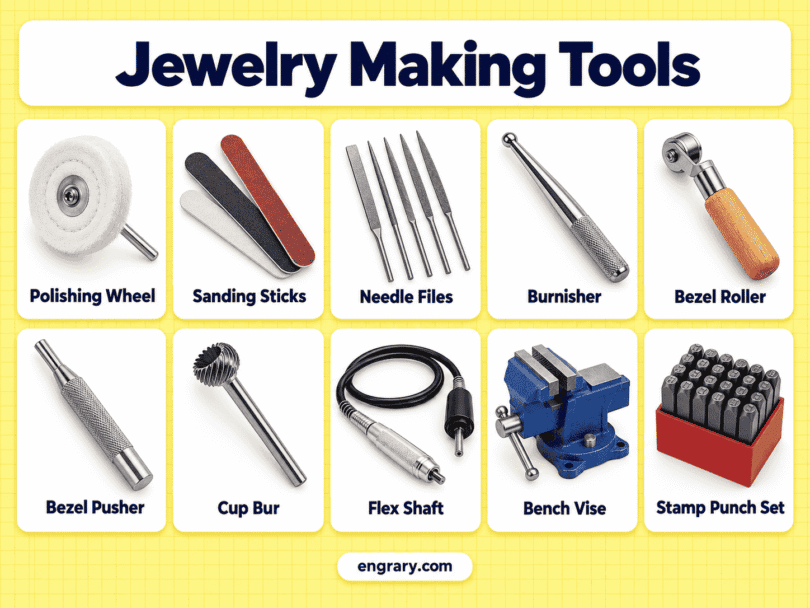
Jewelry makers use specialized tools to cut wire, shape metal, form rings, measure small parts, set stones, and polish finished pieces. Because many jewelry tools look similar, learning their names along with their visible features makes them much easier to identify.
This guide covers 65 jewelry making tools names with pictures and uses, from common pliers and files to soldering, stone-setting, beading, forming, and polishing equipment. Each description explains what the tool looks like and what jewelry makers commonly use it for.
Common Jewelry Making Tools and Their Uses
Some jewelry tools appear on almost every workbench because they handle basic gripping, cutting, shaping, filing, and measuring tasks. The following tools are among the most useful and easiest to recognize.
1. Chain-Nose Pliers
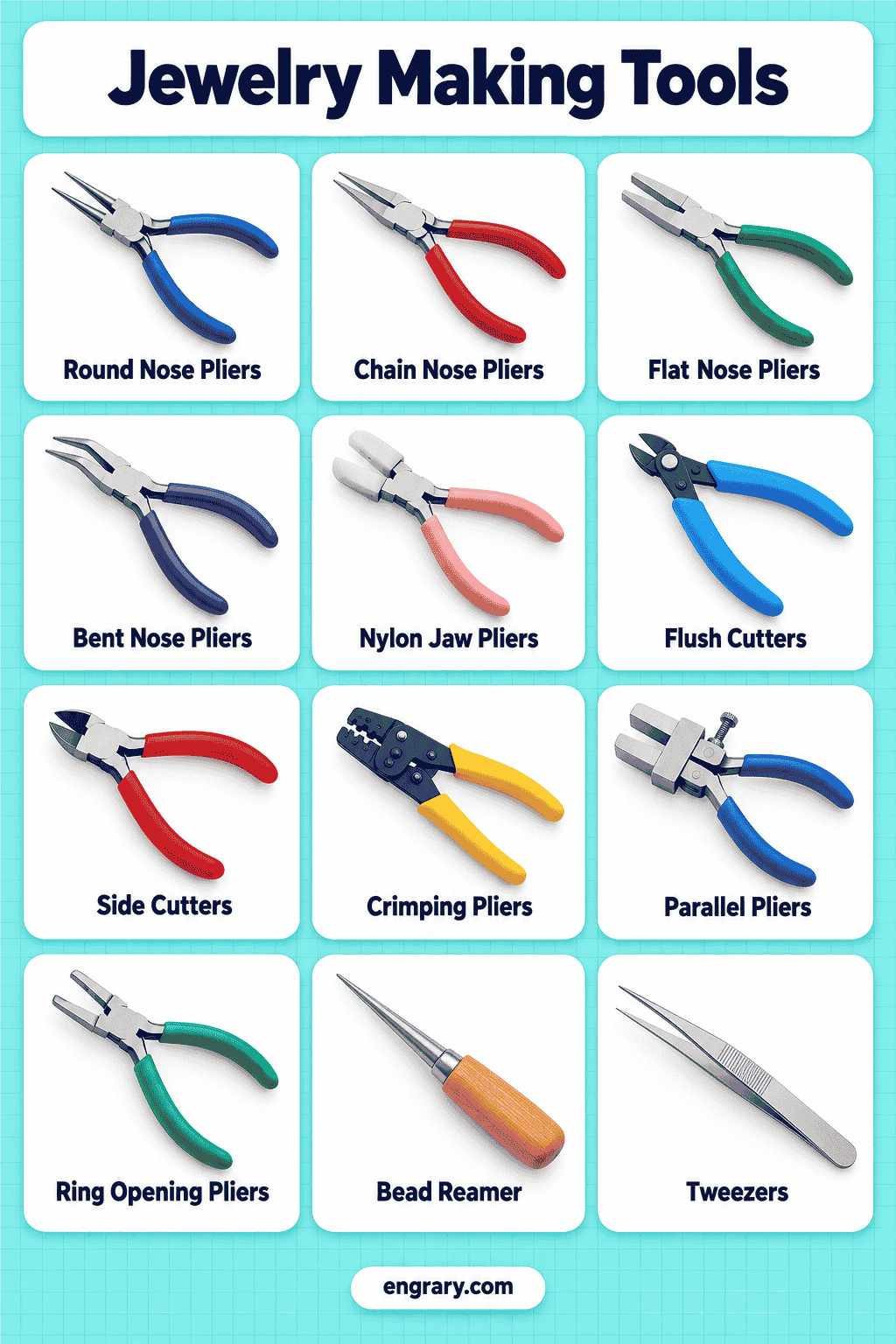
Chain-nose pliers have narrow jaws that taper toward the tips while keeping flat inner surfaces. Jewelers use them to grip wire, bend small components, open jump rings, and work in tight spaces.
2. Round-Nose Pliers
Round-nose pliers have two smooth, cone-shaped jaws. Because the jaws gradually change diameter, they help form loops, curves, and rounded wire shapes.
3. Flat-Nose Pliers
Flat-nose pliers feature broad rectangular jaws with flat gripping surfaces. Their wider shape provides firm control when holding sheet metal, flattening wire, or making straight bends.
4. Bent-Nose Pliers
These pliers have narrow jaws that bend near the tips. The angled shape improves access around beads, wire components, and other places where straight jaws may block the view.
5. Nylon-Jaw Pliers
Nylon-jaw pliers use softer nylon gripping surfaces instead of exposed metal faces. As a result, jewelry makers can straighten or shape wire while reducing scratches and jaw marks.
6. Crimping Pliers
Crimping pliers have specially shaped sections inside their jaws. Beaders use them to shape and secure crimp beads or tubes when attaching flexible jewelry wire to clasps.
7. Bail-Making Pliers
Bail-making pliers usually have two smooth cylindrical jaws of different diameters. They help create consistent loops, bails, coils, and curved wire forms.
8. One-Step Looper Pliers
One-step looper pliers combine wire forming and trimming in a specialized mechanism. They help jewelry makers produce repeated loops of a similar size for eye pins and linked components.
9. Parallel-Action Pliers
The jaws of parallel-action pliers stay nearly parallel as they open and close. Therefore, they spread pressure more evenly than ordinary hinged pliers.
10. Flush Cutter
A flush cutter has fine cutting jaws designed to leave one side of a wire cut relatively flat. Jewelry makers often use it for head pins, eye pins, and fine jewelry wire.
11. Side Cutter
Side cutters have diagonal cutting edges near the side of the head. They handle general wire trimming and usually have a heavier cutting profile than delicate flush cutters.
12. Jeweler’s Saw
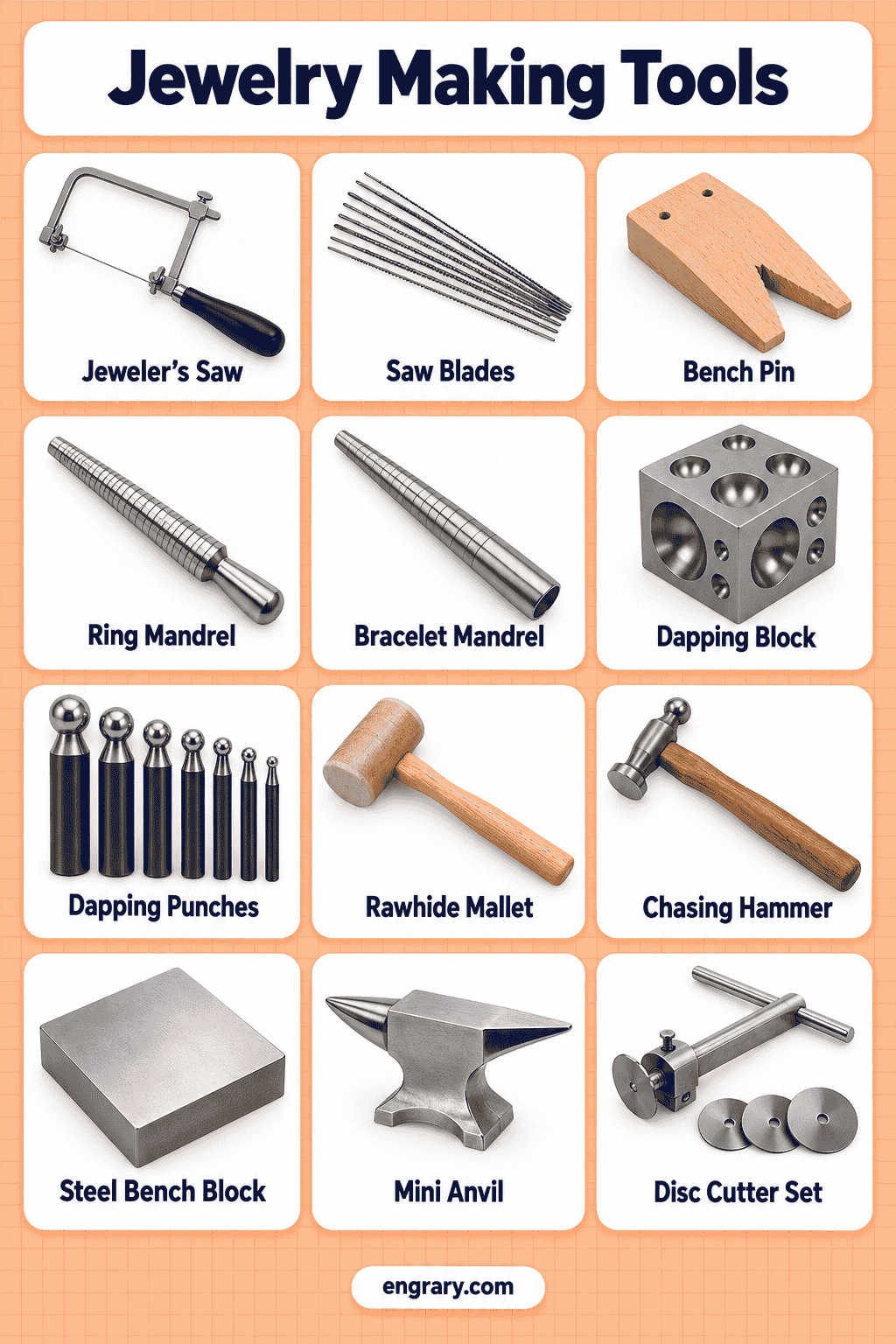
A jeweler’s saw has a narrow metal frame that holds a very fine blade. Jewelers use it for detailed cuts, pierced patterns, and precise shaping in sheet metal.
13. Jeweler’s Shears
Jeweler’s shears look like compact, heavy-duty scissors. Their sturdy blades cut thin sheet metal, mesh, foil, and other lightweight jewelry materials.
14. Flat File
A flat file has broad, flat working faces covered with cutting teeth. It removes rough edges, levels surfaces, and refines metal after cutting.
15. Half-Round File
One side of a half-round file is flat, while the other curves outward. Because of this combination, it can refine both straight surfaces and inside curves.
16. Needle File Set
Needle files are small precision files with narrow profiles. A set usually includes several shapes for refining tiny openings, grooves, corners, and detailed jewelry components.
17. Ball-Peen Hammer
A ball-peen hammer combines a flat striking face with a rounded ball-shaped peen. Jewelers use the two faces for general forming, texturing, and controlled movement of metal.
18. Planishing Hammer
A planishing hammer has smooth, polished working faces. After initial forming, jewelers use it to refine curves and smooth minor surface irregularities.
19. Rawhide Mallet
A rawhide mallet has a firm but softer head than a steel hammer. Consequently, it can shape rings, bracelets, and sheet metal while leaving fewer visible marks.
20. Ring Mandrel
A ring mandrel is a long tapered form, often marked with ring sizes. Jewelers use it to support rings while checking size, shaping bands, or correcting roundness.
Jewelry Pliers and What Each Type Does
Jewelry pliers differ mainly in jaw shape and movement. Some grip small components, while others create curves, repeat loops, protect soft wire, or apply even pressure.
The chain-nose, round-nose, flat-nose, bent-nose, nylon-jaw, crimping, bail-making, one-step looper, and parallel-action pliers listed above cover the main gripping and wire-forming jobs used in jewelry making.
Rather than counting every small jaw variation as a separate tool, this guide focuses on pliers with clearly different designs or purposes.
Jewelry Cutting and Piercing Tools
Jewelry makers use different cutting tools depending on the material and shape they need. Some tools cut wire, while others pierce sheet metal or create repeatable circles and holes.
21. Tube Cutter
A small tube cutter surrounds metal tubing with an adjustable frame and cutting wheel. It helps produce controlled cuts across tubing without relying on ordinary shears.
22. Disc Cutter
A disc cutter has a hardened block with circular openings and matching punches. Jewelry makers use it to produce clean, repeatable metal discs in different diameters.
23. Hole-Punch Pliers
Hole-punch pliers have a punch on one jaw and a matching opening on the other. They create small holes in suitable thin jewelry materials and are easy to recognize by their specialized jaws.
The jeweler’s saw, shears, flush cutter, and side cutter from the first section also belong to this group.
Tools for Filing, Smoothing, and Refining Metal
Cut metal often develops rough edges, burrs, or uneven surfaces. Files remove material, while scrapers and burnishers refine smaller areas or smooth the surface without heavy cutting.
24. Riffler File
A riffler file has a small curved or bent working end that reaches recesses and irregular surfaces. Its distinctive shape makes it useful where straight files cannot reach easily.
25. Scraper
A jewelry scraper has a hardened edge or pointed profile that removes small burrs and unwanted surface material. Jewelers often use it during detailed metal finishing.
26. Burnisher
A burnisher has a smooth, highly polished metal working surface. Instead of cutting away metal, it presses and smooths the surface and can also help finish metal around stone settings.
Together with flat, half-round, and needle files, these tools cover the main hand-refining jobs at a jewelry bench.
Hammers and Mallets Used in Jewelry Making
Jewelry hammers differ mainly in face shape, finish, and weight. Mallets use softer heads when the maker wants to shape metal while reducing visible marks.
27. Chasing Hammer
A chasing hammer usually combines a broad polished face with a rounded peen. Jewelry makers use it for light forming, decorative work, and controlled hammering.
28. Riveting Hammer
A riveting hammer has a small flat face and a narrow peen. Its compact head gives better control when forming small rivets and working on detailed metal components.
29. Nylon Mallet
A nylon mallet has a hard synthetic head that remains softer than steel. For this reason, it works well for straightening or forming metal when a polished steel hammer could leave stronger marks.
Ball-peen and planishing hammers, along with the rawhide mallet, complete the main hammering group.
Tools for Shaping Rings, Bracelets, and Sheet Metal
Jewelry makers need solid surfaces and forms when shaping metal. Mandrels, blocks, punches, stakes, and rolling equipment help create curves, domes, controlled thicknesses, and other forms.
30. Bracelet Mandrel
A bracelet mandrel is much larger than a ring mandrel and may have a round or oval cross-section. Jewelers form bangles and cuffs around its solid surface.
31. Steel Bench Block
A steel bench block provides a hard, flat surface for hammering, flattening, riveting, and texturing small metal pieces. Its polished rectangular form is common on jewelry benches.
32. Jeweler’s Anvil
A jeweler’s anvil is a compact version of a traditional metalworking anvil. Its small flat and shaped surfaces support light forging and forming tasks.
33. Dapping Block
A dapping block contains rows of smooth hemispherical depressions. Jewelry makers pair these cavities with matching punches to form curved or domed metal pieces.
34. Dapping Punches
Dapping punches have rounded ends in graduated sizes. When paired with a dapping block, they press sheet metal into smooth dome-like shapes.
35. Forming Stake
A forming stake provides a shaped metal surface over which jewelry makers hammer sheet metal. Different stake profiles support curves, channels, and other three-dimensional forms.
36. Drawplate
A drawplate contains rows of progressively sized holes in a hardened plate. It helps refine and reduce suitable wire to controlled dimensions.
37. Rolling Mill
A rolling mill passes metal between strong rollers. Jewelers use it to reduce sheet or wire thickness and, with suitable rollers, create certain surface textures.
Measuring and Sizing Tools for Jewelry Making
Accurate measurements affect fit, symmetry, and alignment. Jewelry makers use rulers, calipers, gauges, and marking tools to check dimensions before cutting, forming, or assembling pieces.
38. Steel Ruler
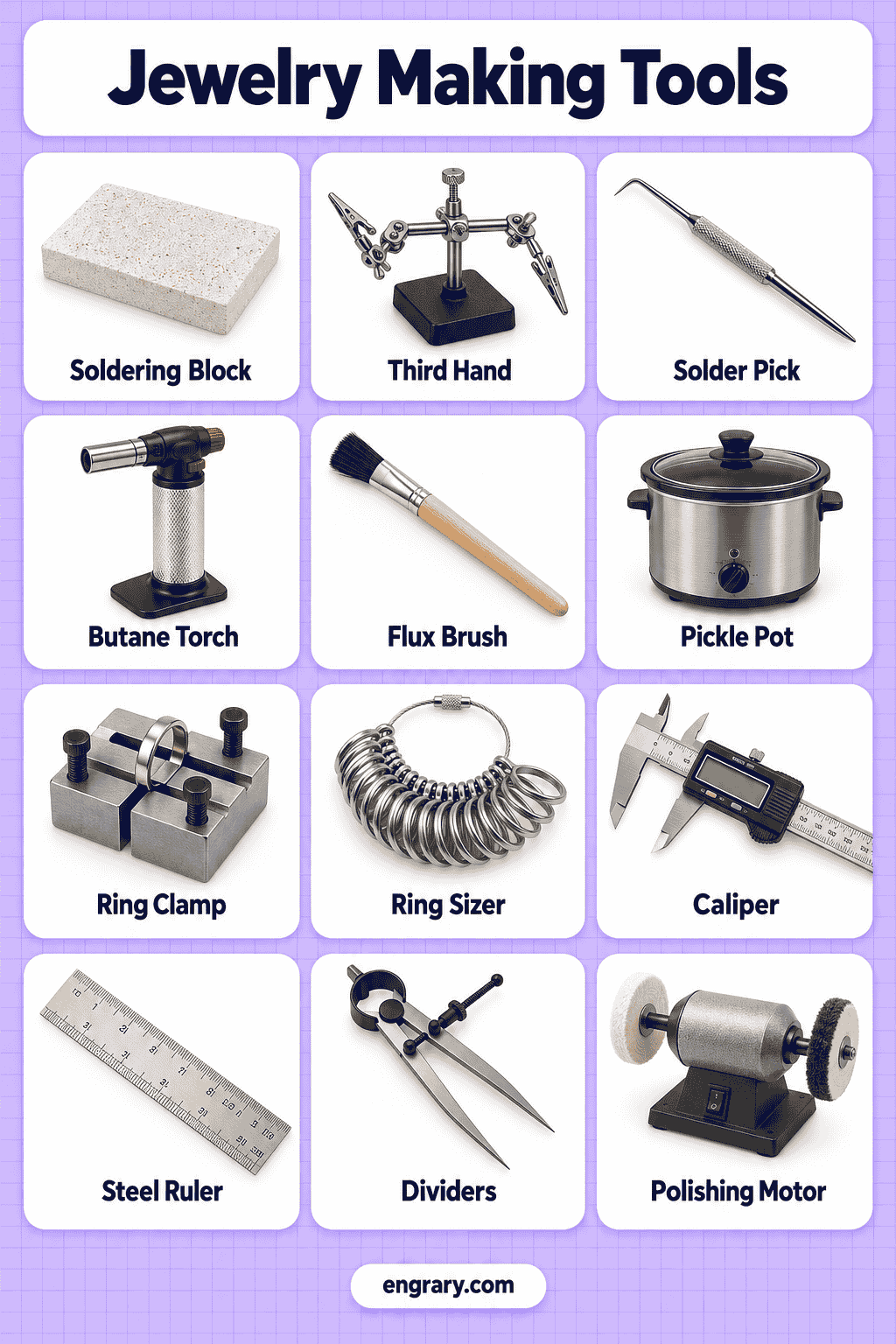
A steel ruler provides a rigid straight edge and clear measurement scale. Jewelry makers use it for checking lengths and laying out straight reference lines.
39. Digital Caliper
A digital caliper measures outside dimensions, inside dimensions, and depth. Its display makes it useful for checking metal thickness, stone dimensions, tubing, and small finished components.
40. Dividers
Dividers have two pointed legs connected by an adjustable joint. They transfer measurements and help mark circles, arcs, or repeated spacing.
41. Scriber
A scriber has a sharp hardened point that creates fine visible lines on metal. These marks can guide later cutting, drilling, or forming work.
42. Finger Gauge Set
A finger gauge consists of graduated rings in different sizes. Trying the rings on the finger helps identify an appropriate ring size before fabrication or fitting.
The ring mandrel from the first section complements the finger gauge because it supports and checks the ring itself rather than measuring the finger.
Tools for Holding Small Jewelry Pieces
Small jewelry components can be difficult to control during filing, sawing, polishing, soldering, or setting. Holding tools keep the work steady while leaving important surfaces accessible.
43. Bench Pin
A bench pin is a small wooden support mounted at the front of a jewelry bench. It supports metal during sawing, filing, piercing, and many other hand operations.
44. Bench Vise
A bench vise has adjustable jaws mounted to a work surface. It provides a firm grip when a jewelry component requires more support than handheld tools can provide.
45. Ring Clamp
A ring clamp is a small handheld holder made specifically for rings and similarly sized pieces. Its jaws hold the work while leaving much of the surface accessible.
46. Pin Vise
A pin vise has a narrow handle with a small adjustable collet at one end. It can hold tiny drills, wires, reamers, and other miniature tools.
47. Third Hand
A third hand uses adjustable arms and small clamps to hold jewelry components above the bench. As the name suggests, it supports pieces when both of the maker’s hands need to remain free.
48. Reverse-Action Tweezers
Reverse-action tweezers close automatically when the user releases pressure. Their self-holding design makes them useful for positioning and holding small components.
Rotary Tools for Drilling and Detail Work
Rotary tools expand what a jewelry bench can do. Depending on the attachment, they can support drilling, grinding, smoothing, polishing, and fine detail work.
49. Hand Drill
A hand drill rotates through manual movement rather than a powered motor. Its simple design gives controlled rotation for small, light drilling tasks.
50. Flex Shaft
A flex shaft has a separate motor connected to a handheld tool through a flexible drive shaft. Jewelry makers use the system for many rotary jobs, including drilling, grinding, and polishing.
51. Micromotor
A micromotor places a compact motor system close to or within the handpiece. Compared with a traditional flex shaft, it offers a lightweight setup suited to detailed bench work.
Drill bits and burs attach to these tools, but they are cutting accessories rather than separate primary machines, so they are not counted as extra tools.
Jewelry Soldering Tools
Metal jewelry often requires controlled joining. Soldering tools support heating, positioning, and post-heating cleanup, while solder and flux remain materials rather than tools.
52. Jeweler’s Torch
A jeweler’s torch produces a small controllable flame for heating metal during soldering and other jewelry bench processes that require focused heat.
53. Soldering Block
A soldering block provides a heat-resistant work surface beneath metal components. It protects the bench while giving the jeweler a stable surface for heated work.
54. Soldering Pick
A soldering pick has a thin, heat-resistant shaft with a pointed end. Jewelry makers use it to position tiny components or guide small amounts of solder during bench work.
55. Pickle Pot
A pickle pot is a dedicated container used with jewelry pickle solution after heating metal. It keeps this cleaning stage separate from ordinary workshop containers.
56. Copper Tongs
Copper tongs handle pieces around a jewelry pickle bath. Their distinctive copper construction makes them easy to distinguish from ordinary steel tweezers or tongs.
Stone-Setting Tools for Jewelry
Stone-setting tools work on the small areas of metal that hold gemstones in place. Because these tools often touch nearly finished settings, their working surfaces usually need to be smooth and precise.
57. Bezel Pusher
A bezel pusher has a small flat working end. Jewelers use it to press bezel metal toward the stone in a controlled manner.
58. Prong Pusher
A prong pusher has a narrow working tip that directs pressure onto individual prongs. Its focused shape helps jewelers adjust the metal surrounding a gemstone.
59. Stone-Setting Pliers
Stone-setting pliers have specially shaped opposing jaws. They help move or close setting components while applying controlled pressure from both sides.
60. Graver
A graver is a small hardened steel cutting tool with a carefully shaped tip. Jewelers use different graver profiles for engraving and precision work around stone settings.
61. Jeweler’s Loupe
A jeweler’s loupe is a small magnifying lens used for close inspection. It helps reveal fine scratches, stone-setting details, solder joints, and other features that are difficult to see unaided.
The burnisher listed earlier also plays an important role in stone setting because its smooth surface can refine and press metal around a finished setting.
Common Tools for Beading and Wire Jewelry
Bead stringing and wire jewelry use several tools that differ from traditional metalsmithing equipment. Crimping pliers, chain-nose pliers, round-nose pliers, and nylon-jaw pliers from earlier sections already serve important roles here.
62. Bead Reamer
A bead reamer is a slender precision tool designed for working inside bead holes. Its narrow tip distinguishes it from ordinary files and larger drilling tools.
63. Bead Board
A bead board has recessed channels, layout spaces, and measurement markings. Beaders use the surface to arrange components and preview necklace or bracelet layouts before assembly.
These tools add dedicated beading coverage without mixing beads, findings, or stringing materials into the tool count.
Tools for Polishing, Finishing, and Cleaning Jewelry
Finishing removes minor surface imperfections and gives completed jewelry its final appearance. Hand burnishers and rotary tools handle smaller jobs, while dedicated machines make repeated polishing and cleaning more efficient.
64. Polishing Motor
A polishing motor is a bench-mounted machine that spins polishing wheels or mops. Jewelry workshops use it for controlled surface finishing and final polishing.
65. Ultrasonic Cleaner
An ultrasonic cleaner uses high-frequency vibration in a liquid bath to loosen residue from small surfaces and recesses. Jewelers commonly use it to clean suitable finished jewelry and detailed components.
The main list stops here at exactly 65 jewelry making tools. Polishing compounds, buffs, saw blades, burs, solder, flux, wire, beads, and findings remain accessories, materials, or consumables rather than additional numbered tools.
How to Tell Similar Jewelry Tools Apart
Several jewelry tools can look almost identical at first. Checking the jaw shape, working surface, or basic mechanism usually makes the difference easier to see.
| Tools | Main Difference |
|---|---|
| Chain-Nose vs Flat-Nose Pliers | Chain-nose jaws taper toward the tips, while flat-nose jaws remain broader. |
| Round-Nose vs Bail-Making Pliers | Round-nose jaws taper like cones, whereas bail-making jaws provide cylindrical forming surfaces. |
| Flush Cutter vs Side Cutter | Flush cutters create a flatter cut on one side, while side cutters use broader diagonal cutting edges. |
| Hammer vs Mallet | Hammers generally use metal faces, while mallets use softer heads to reduce marking. |
| Ring Mandrel vs Finger Gauge | The mandrel supports and checks rings, while the gauge measures the wearer’s finger. |
| Bench Vise vs Ring Clamp | A bench vise provides firm general holding, whereas a ring clamp holds small jewelry pieces by hand. |
| File vs Burnisher | A file removes material, while a burnisher presses and smooths the existing surface. |
| Flex Shaft vs Micromotor | A flex shaft transfers power through a flexible drive, while a micromotor uses a compact motorized handpiece system. |
| Dapping Block vs Disc Cutter | A dapping block forms domes, while a disc cutter punches flat circular blanks. |
| Jeweler’s Saw vs Shears | A saw handles detailed or internal cuts, while shears make simpler cuts through thin sheet. |
Other Names Used for Jewelry Making Tools
Jewelry tool names can vary between countries, suppliers, and workshop traditions. Learning the common alternatives makes catalogs, tutorials, and tool descriptions easier to understand.
A jeweler’s saw may also appear as a piercing saw, particularly in traditional metal jewelry work. Likewise, ball-peen hammer and ball-pein hammer refer to the same general hammer style.
A side cutter may be called a diagonal cutter, while bent-nose pliers may appear as curved chain-nose pliers. Some suppliers also use mandrel pliers for certain bail-making and wire-forming pliers.
Terminology also changes with regional spelling. American English usually uses jeweler and jewelry, whereas British English commonly uses jeweller and jewellery. The tools themselves remain the same even when the spelling changes.
FAQs
Beginners often start with chain-nose pliers, round-nose pliers, flat-nose pliers, wire cutters, files, a hammer, and measuring tools. However, someone working mainly with beads will need a different starter set from a maker who focuses on metal fabrication.
Chain-nose, round-nose, flat-nose, bent-nose, nylon-jaw, crimping, bail-making, and looping pliers all appear frequently in jewelry work. Because each jaw has a different shape, each tool handles gripping or forming in a slightly different way.
Jewelers commonly use a jeweler’s saw for detailed sheet-metal cutting. In addition, shears handle simpler sheet cuts, cutters trim wire, tube cutters work across tubing, and disc cutters produce circular blanks.
A mandrel provides a solid form that supports jewelry during shaping. For example, ring mandrels support rings, while larger bracelet mandrels provide the curved surface needed for bangles and cuffs.
Jewelry tools perform work repeatedly and include items such as pliers, hammers, saws, files, mandrels, and polishing machines. In contrast, jewelry supplies include wire, beads, solder, flux, findings, polishing compounds, and other materials or consumables used during the making process.
You May Also Like

Leave a Comment