
A bobber and a sinker can sit just inches apart on a fishing line, yet they do opposite jobs. The bobber stays at the surface so you can see a bite, while the sinker carries the bait down. Once you recognize both pieces, it’s easier to understand the rig they belong to.
This guide covers 40 fishing tools and tackle items. The pictures show 36 common names, and the text adds a fishing snap and three reel types. Start with the rod, reel, and line, then take a closer look at the smaller pieces you might find in a tackle box.
Common Fishing Gear and Its Uses
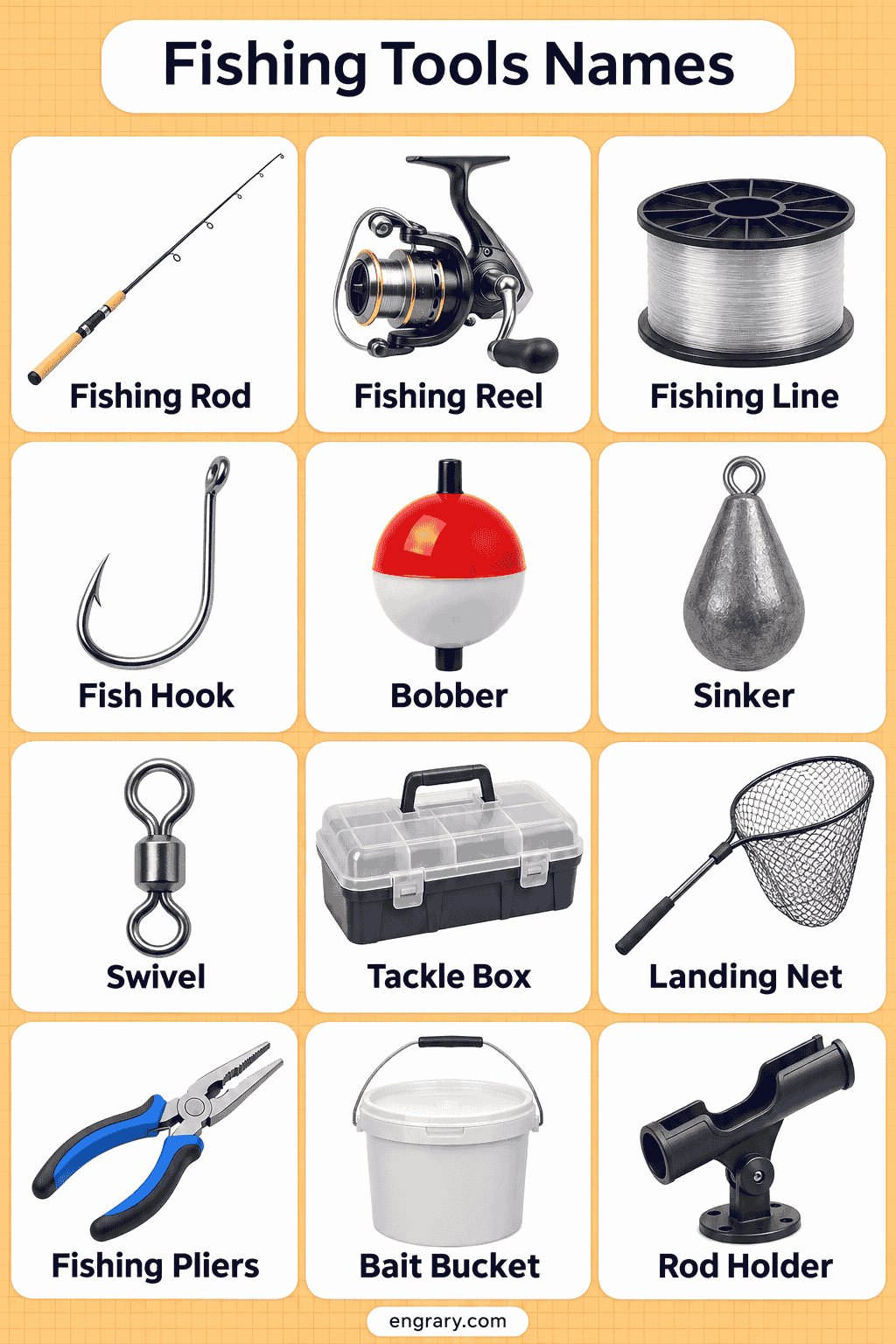
Follow a simple fishing setup from the handle to the hook. The rod guides the line, the reel stores it, and the hook holds the bait. Along the way, a float or weight helps keep the bait where you want it.
common.png
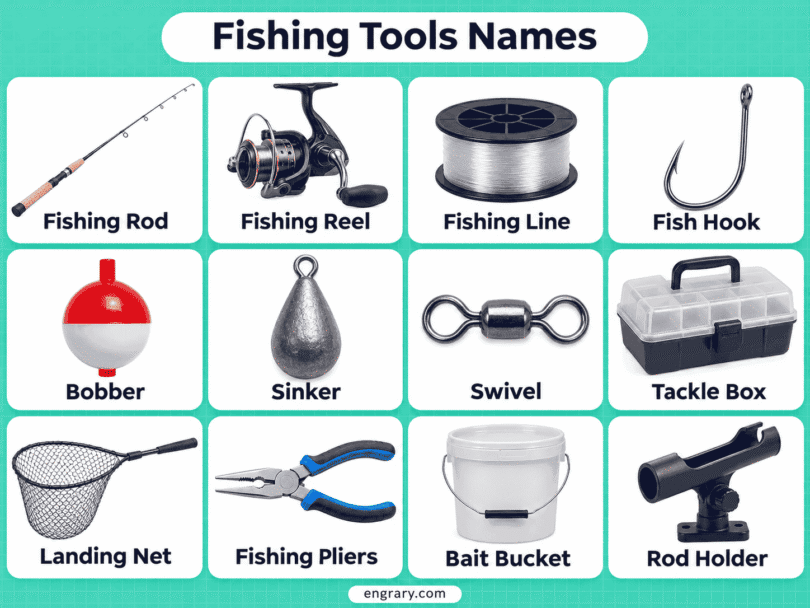
1. Fishing rod
A fishing rod is the long, flexible pole you use to cast and guide a hooked fish. Look for the row of small rings along its length. These line guides carry the line from the reel to the rod tip.
2. Fishing reel
A fishing reel holds line on a spool. When you turn the handle, the reel winds the line back in. A common example is the spinning reel, which hangs beneath the rod and has a curved wire arm around an exposed spool.
3. Fishing line
Fishing line connects the reel to the hook or lure. It also carries movement back to the rod, so you can sometimes feel a bite before you see the float move.
4. Fishing hook
A fishing hook has a curved bend and a sharp point. On most hooks, the small loop at the top is the eye. You tie the line there and place the bait farther down the hook.
5. Bobber (float)
A bobber suspends bait below the surface and gives you a visible sign of a bite. Watch its brightly colored top. It may dip, rise, or move sideways when a fish takes the bait.
6. Sinker (fishing weight)
A sinker adds weight to a rig and helps the bait reach the desired depth. For example, a small split shot has a groove that pinches onto the line, while an egg sinker has a hole through its center.
7. Swivel
A swivel is a small connector with an eye at each end and a rotating joint in the middle. The joint lets two sections of line turn independently, which helps reduce line twist.
8. Tackle box
A tackle box keeps hooks, weights, lures, and tools in separate compartments. Shallow trays make tiny swivels easier to spot, while longer compartments give bulky lures room to lie flat.
9. Landing net
A landing net has a mesh bag hanging from a hoop. Once a hooked fish comes within reach, you can guide it over the rim and support it in the mesh.
10. Fishing pliers
Fishing pliers grip hooks and small metal parts. A pair with long, narrow jaws can reach an accessible hook, while a pair with built-in cutters can also trim line.
11. Bait bucket
A bait bucket keeps bait close at hand. For live minnows, some buckets include an aerator that adds air to the water. Others have a perforated inner basket so you can lift out the bait without emptying the bucket.
12. Rod holder
A rod holder supports the rod handle while you wait for a bite. On shore, it may have a spike that fits into the ground. On a boat, it often mounts to a rail or deck.
Fishing Line Attachments and Rigging Tools
The small pieces at the working end of a fishing line are often called terminal tackle. To identify one, look at how it attaches. A clip opens, a split ring has overlapping coils, and a leader forms a separate length between the main line and the lure.
tackle.png
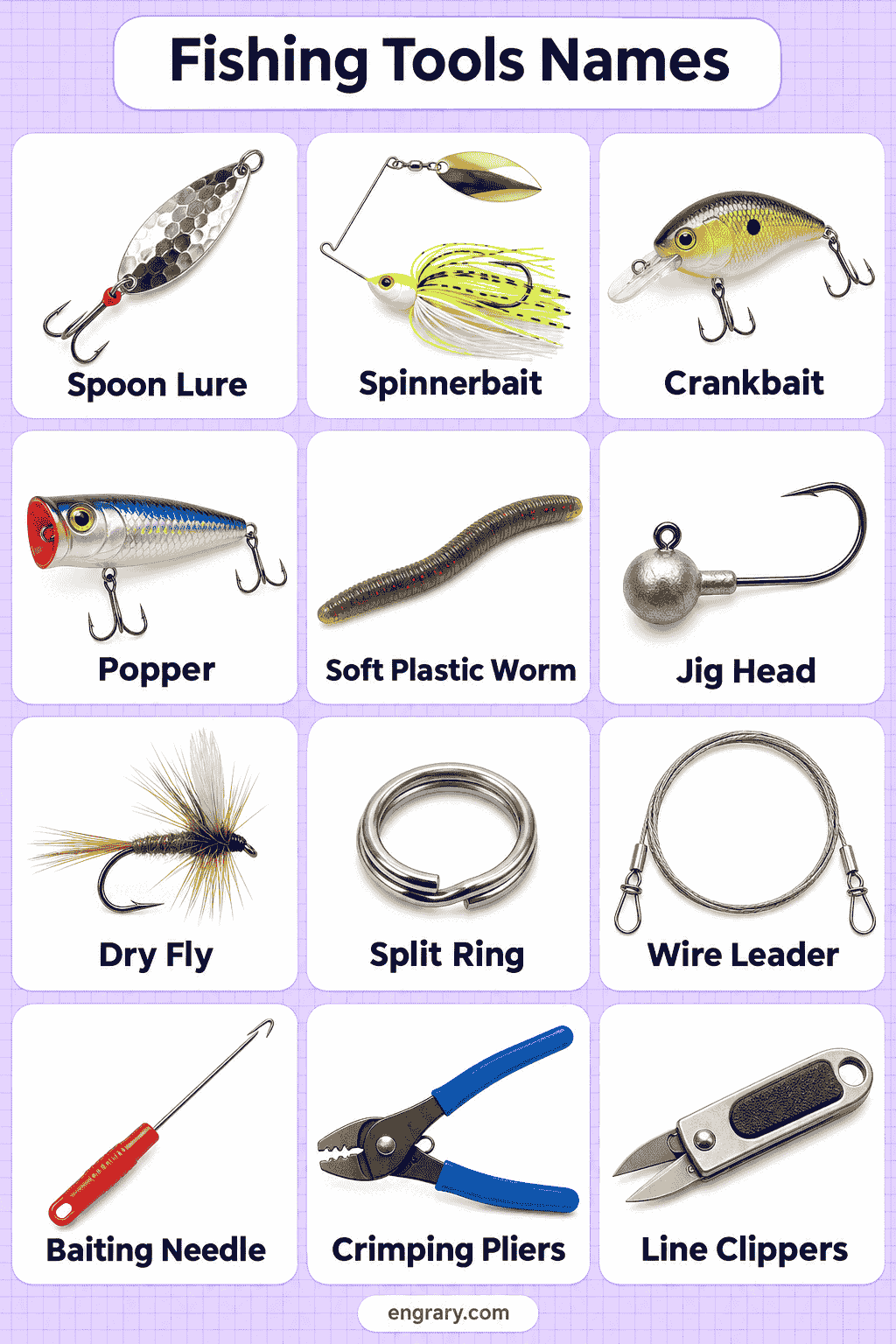
13. Wire leader
A wire leader sits between the main line and the hook or lure. Anglers often choose wire for fish with sharp teeth because it resists biting and abrasion.
14. Fishing snap
A fishing snap is a small wire clip with a gate that opens. After you tie it to the line, you can change lures by opening the clip instead of tying another knot.
15. Split ring
A split ring resembles a miniature key ring. Its overlapping coils often connect a hook to a hard lure, allowing the hook to swing beneath the lure body.
16. Baiting needle
A baiting needle is a slender tool that helps you thread bait onto a rig. For example, you can pass the needle through a firm, round bait called a boilie, catch the loop of the rig, and draw it back through the bait.
17. Crimping pliers
Crimping pliers have shaped grooves in their jaws. When you squeeze the handles, the jaws compress a small metal sleeve around leader material to secure a loop or connection.
18. Line clippers
Line clippers have short cutting edges for trimming fishing line. After tying a knot, use them to cut off the spare tip, commonly called the tag end.
| Small connector | Identifying feature | Main use |
|---|---|---|
| Swivel | Two eyes with a rotating joint between them | Joins sections of line and allows rotation |
| Fishing snap | Wire gate that clips open and shut | Lets you change lures quickly |
| Split ring | Two overlapping coils, like a key ring | Attaches a hook to a lure |
Fishing Lures and Their Distinctive Shapes
A lure’s shape often tells you how it moves. Start with the face, blade, or tail. A cupped face pushes water forward, for instance, while a curved metal body wobbles as you reel it in.
19. Spoon lure
A spoon lure is a curved piece of metal with a hook at one end. Its shallow bowl gives the lure its name. As it travels through the water, the body rocks from side to side and flashes in the light.
20. Spinnerbait
A spinnerbait has a bent wire frame with blades on one arm and a weighted hook on the other. As you retrieve it, the blades spin above the hook. Many spinnerbaits also have a skirt of flexible strands around the hook.
21. Crankbait
A crankbait is a hard-bodied lure that wobbles during a steady retrieve. On many models, a lip projects from the front. Water presses against the lip and makes the lure dive.
22. Popper
A popper is a surface lure with a hollowed or cupped face. Give it a short pull and the face pushes water forward, creating the splash and popping sound behind its name.
23. Soft-plastic worm
A soft-plastic worm has a flexible body that you thread onto a hook. Some have a straight tail, while others have a curled tail that ripples as the lure moves.
24. Jig head
A jig head combines a hook with a weight near the hook eye. You can thread a soft-plastic body onto the hook, then raise and lower the rod tip to make the lure lift and drop.
25. Dry fly
A dry fly is a lightweight artificial fly that floats on the surface. Its fibers help support it on the water, where its outline can resemble a resting or newly emerged insect.
Fishing Reel Types and Their Identifying Features
Once you recognize a spinning reel, three details help you identify other reels: where the reel sits, whether you can see the spool, and how the line leaves it during a cast.
26. Spincast reel
A spincast reel has a rounded cover over its spool. The line comes out through a small opening at the front, and a thumb button on a typical model controls its release during a cast.
27. Baitcasting reel
A baitcasting reel sits above the rod with its spool running crosswise. The spool turns during the cast, so you can touch it with your thumb to slow the lure as it approaches the water.
28. Fly reel
A fly reel has a round, wheel-like spool beneath the rod. It stores the fly line and a reserve of thinner line called backing. During a typical fly cast, the weight of the fly line carries the lightweight fly forward.
| Reel type | Quickest way to recognize it |
|---|---|
| Spinning reel | Exposed spool beneath the rod with a curved wire bail |
| Spincast reel | Rounded cover with a small opening at the front |
| Baitcasting reel | Crosswise spool above the rod, within reach of your thumb |
| Fly reel | Wheel-like spool beneath the rod, usually with a small winding knob on its face |
Tools for Handling, Measuring, and Keeping a Catch
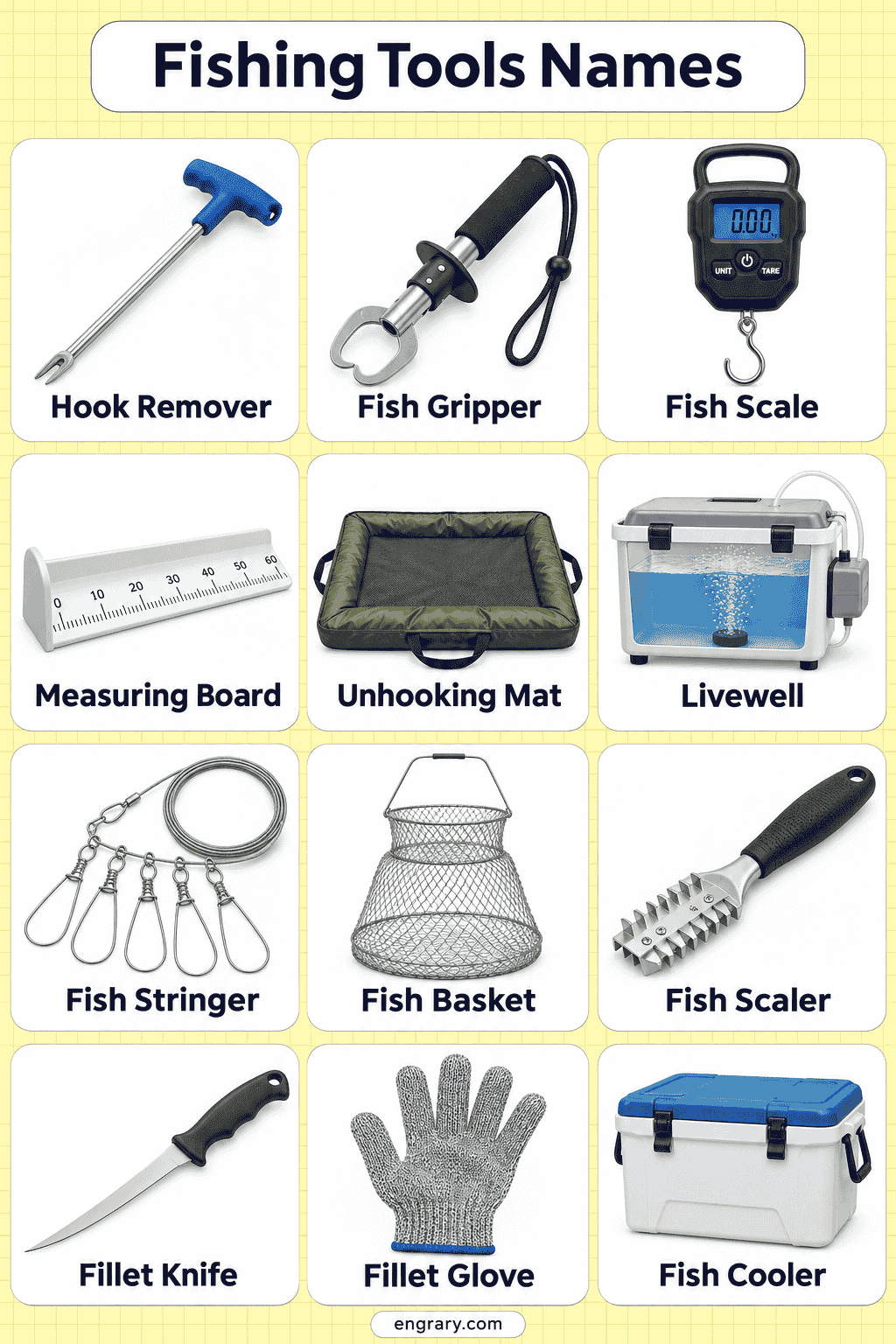
After landing a fish, choose the tool that fits the job. A measuring board gives you length, a scale gives you weight, and a hook remover helps you reach the hook. The equipment for storing or preparing a catch has a different set of identifying features.
handling.png
Hook Removal and Fish Handling
29. Hook remover (dehooker)
A hook remover has a handle and a narrow working end that engages the hook. Depending on the design, the tip may have a slot, a loop, or small jaws that help you turn the hook free.
30. Fish gripper
A fish gripper has jaws that close around a fish’s lower lip. It gives you a point of control while you remove a hook. When handling a larger fish, support its body as well.
31. Unhooking mat
An unhooking mat provides a padded surface for a fish during hook removal or measurement. Look for a flat or slightly raised base with soft sides. Wet the surface before placing a fish on it.
Measuring Length and Weight
32. Fish scale
A fish scale displays the weight of a catch on a dial or digital screen. If you use a weighing sling, zero the scale with the empty sling attached first. The reading will then show the fish’s weight alone.
33. Measuring board
A measuring board has length markings and usually a raised end. The raised edge gives you a fixed starting point for the fish’s snout, making its length easier to read.
Containers for Holding a Catch
34. Livewell
A livewell is a tank for holding live fish in water. Unlike an ordinary storage compartment, it has a system that circulates or aerates the water.
35. Fish stringer
A fish stringer is a cord or cable for securing fish you intend to keep. Some models have several clips along the cable, giving each fish a separate attachment point.
36. Fish basket
A fish basket is a mesh container that hangs in the water. Its opening lets you place a retained catch inside, while the mesh allows water to pass through.
37. Fish cooler
A fish cooler is an insulated container that holds a harvested catch on ice. A firm lid and insulated walls help keep the contents cold during the trip home.
Fish Cleaning and Preparation
38. Fish scaler
A fish scaler has a short handle and a toothed scraping surface. The teeth catch the edges of scales as you work along the skin, usually from the tail toward the head.
39. Fillet knife
A fillet knife has a long, narrow blade that can follow the shape of the backbone and ribs. Its pointed tip helps you start a precise cut, while the length of the blade supports a smooth slicing stroke.
40. Fillet glove
A fillet glove gives the hand holding the fish a better grip and added cut resistance. You can recognize the mesh version by its interlocking metal rings. Other versions use cut-resistant fibers.
Common Fishing Terms Explained
| Terms | Difference in everyday use |
|---|---|
| Fishing gear and terminal tackle | Fishing gear includes the whole setup. Terminal tackle refers to pieces near the end of the line, such as hooks, sinkers, and swivels. |
| Bobber and float | Both names refer to a floating bite indicator. A fixed float grips the line in one place, while a slip float slides along the line until it reaches a stop. |
| Natural bait and artificial lure | A live worm or minnow is natural bait. A metal spoon or soft-plastic worm is an artificial lure. |
| Landing net and fish basket | A landing net helps bring a hooked fish within reach. A fish basket holds a retained catch in the water. |
| Fish scaler and fish scale | A scaler scrapes scales from the skin. A scale measures how much the fish weighs. |
FAQs About Fishing Tools and Tackle
Start with the rod, reel, line, and hook. For a simple float rig, learn two more names: the bobber, which helps you see a bite, and the sinker, which helps the bait reach the depth you want.
Terminal tackle includes the small pieces you attach near the end of a fishing line. For example, a hook holds bait, a sinker adds weight, and a swivel connects two sections of line while allowing them to rotate.
A fishing snap is a clip that opens so you can change lures. A snap swivel adds a rotating joint to that clip. To tell them apart in a tackle box, look for a small rotating body at one end of the clip.
Look at the spool. A spinning reel has an exposed spool with a curved wire arm around it. A spincast reel has a rounded cover, so you see the line coming through a small hole at the front.
Use a measuring board for length. Rest the fish’s snout against the raised end and read the markings along the board. For weight, use a fish scale.
You May Also Like


Leave a Comment