
A springform pan has a latch on its side. A Bundt pan has a tube through its center. Both make cakes, but those features tell you which pan a recipe calls for before you pour the batter. The same trick works with smaller baking tools. Look at the edge, handle, or tip, and its job often becomes clear.
The pictures below identify 36 distinct baking tools, from everyday whisks and measuring cups to bread lames and cake levelers. The descriptions also cover alternative names you may see in recipes, including cake tin for cake pan and bench knife for bench scraper.
Common Baking Tools and Their Uses
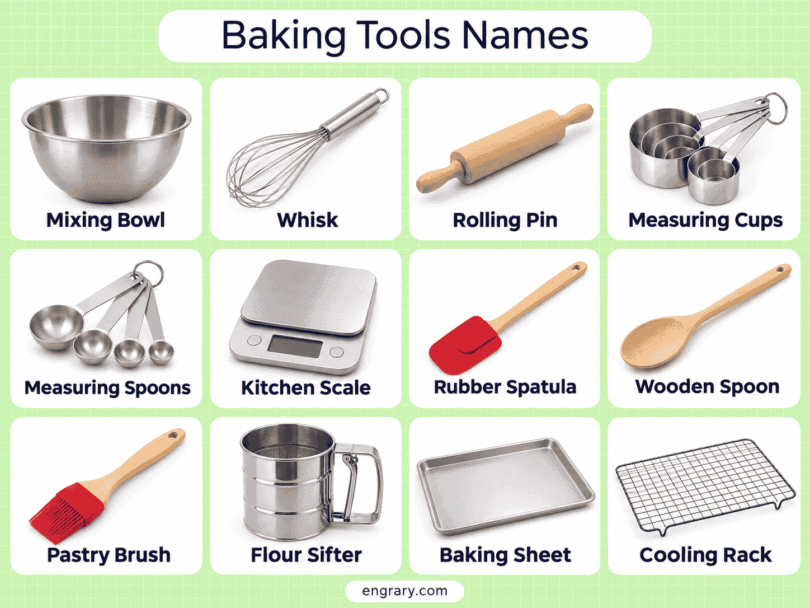
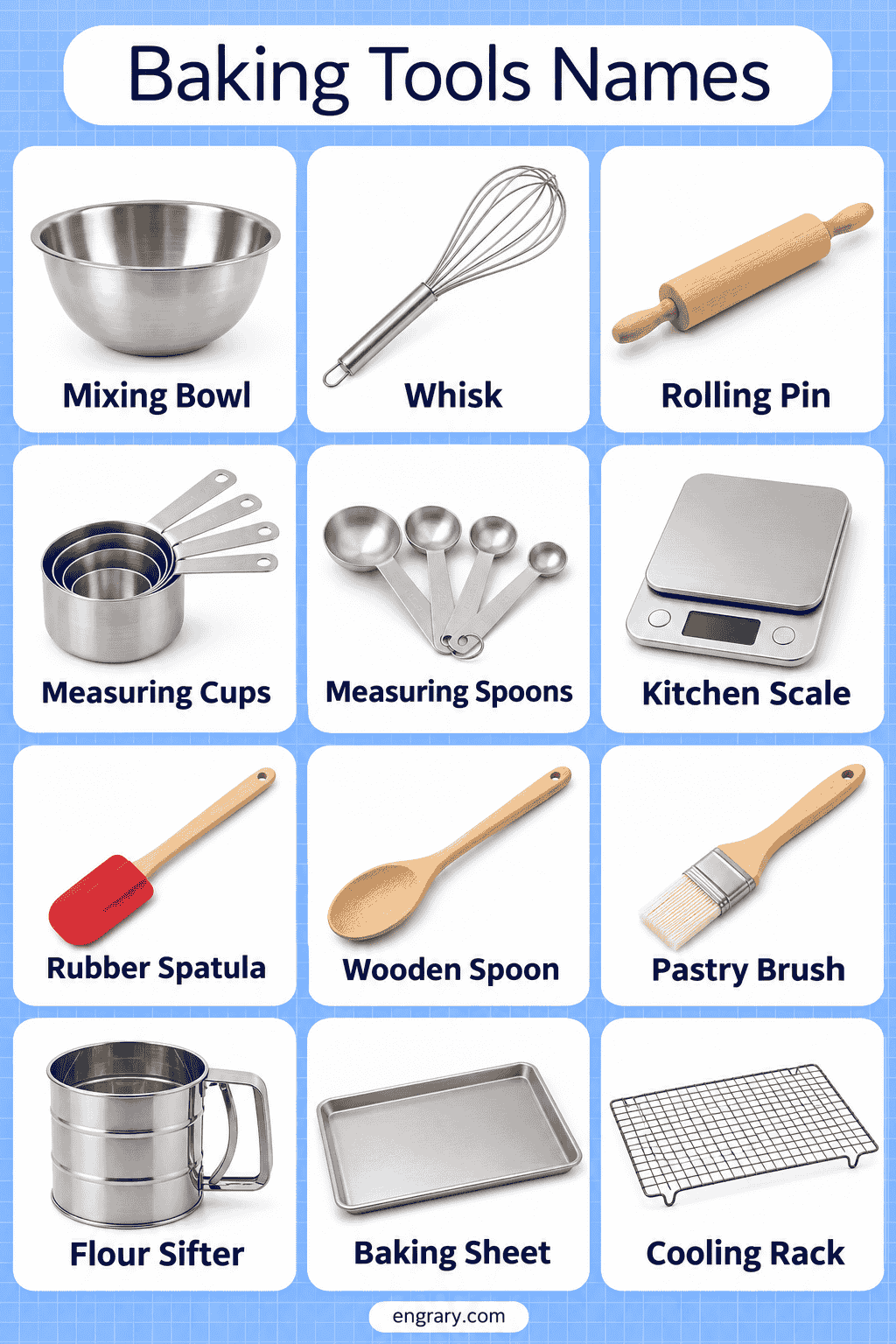
If you make a batch of biscuits, you might measure flour, whisk the dry ingredients, roll out the dough, and lift the baked biscuits onto a rack. These twelve tools cover much of that journey. Notice the working surfaces in the picture, especially the solid baking sheet, the mesh inside the flour sifter, and the open grid of the cooling rack.
Mixing Bowl
A mixing bowl gives you room to whisk, stir, or fold ingredients together. For example, the curved sides let you sweep a spatula underneath cake batter and lift it back over itself without leaving flour in the corners.
Whisk
A whisk has wire loops that break up lumps and blend ingredients. The rounded balloon whisk in the picture also draws air into cream or egg whites as you beat them.
Rolling Pin
A rolling pin flattens dough to an even thickness. The pictured version has a handle at each end, while a French-style pin often tapers toward the ends and rolls directly under your palms.
Measuring Cups
The nested cups in the picture are dry measuring cups. Each holds a fixed volume when you fill it to the rim. Follow the recipe’s filling directions because spooning flour into a cup and packing it down can give you different amounts.
Measuring Spoons
Measuring spoons hold small, marked volumes such as a teaspoon or half a teaspoon. Use the marked spoon when a recipe calls for baking powder, salt, or vanilla. An ordinary teaspoon from a cutlery drawer can vary in size.
Kitchen Scale
A kitchen scale lets you weigh ingredients directly in the bowl. Set the empty bowl on the platform and press tare to return the display to zero. You can then add flour until the display reaches the weight in the recipe.
Rubber Spatula
A rubber spatula has a flexible head that bends against the sides of a bowl. Many modern versions use silicone, although recipes still use the familiar name rubber spatula. Its curved edge helps gather the last of a thick batter.
Wooden Spoon
A wooden spoon has a firm head for stirring mixtures that resist a whisk. For instance, it can work chocolate chips through cookie dough without trapping pieces between wires.
Pastry Brush
A pastry brush spreads a thin coating over food. Dip the bristles in beaten egg to glaze pastry or in melted butter to brush bread rolls. Both the silicone brush and the bristle brush in the pictures serve this purpose.
Flour Sifter
A flour sifter passes dry ingredients through a fine screen. In a handled model, a squeeze mechanism or crank moves flour across the mesh. It also helps break up cocoa lumps before they reach the batter.
Baking Sheet
A baking sheet is a flat metal tray that holds cookies, biscuits, or pastries in the oven. The pictured sheet has a raised rim on all four sides. Recipes may also call it a baking tray.
Cooling Rack
A cooling rack raises baked goods above the counter on an open wire grid. Air can reach the underside, so steam can escape from the bottom of a cookie. For delicate cakes, follow the recipe’s instructions about how long to cool them in the pan before turning them out.
Measuring Ingredients and Checking Oven Temperature
The unit beside an ingredient tells you which tool to reach for. Grams call for a scale, while teaspoons and millilitres describe volume. Bakers also use thermometers to answer two different questions: how hot the oven is and how warm something is inside.
Liquid Measuring Jug
A liquid measuring jug has markings up its side and a spout for pouring. Unlike a dry cup that measures at the rim, a jug leaves space above the fill line. Set it on a level surface to measure milk or water.
Oven Thermometer
An oven thermometer sits or hangs inside the oven so you can read the temperature near the baking area. It helps when a familiar recipe repeatedly browns too quickly or takes longer than expected.
Probe Thermometer
A probe thermometer takes a reading at its metal tip. For example, a bread recipe may specify the temperature of the dough after mixing or the center of a loaf near the end of baking.
| What the recipe asks for | Tool to reach for | Where to read the measurement |
|---|---|---|
| 250 g of flour | Kitchen scale | Digital display or dial |
| 1 level teaspoon of baking powder | Measuring spoon | Level with the spoon’s rim |
| 100 ml of milk | Liquid measuring jug | Mark on the side of the jug |
| Temperature inside the oven | Oven thermometer | Dial or display |
| Temperature at the center of a loaf | Probe thermometer | Reading from the probe tip |
Mixing Batter and Working Butter into Flour
Cake batter, bread dough, and pie crust place different demands on a mixing tool. A whisk moves easily through milk and eggs. Once flour makes a mixture thick or sticky, the shape and spacing of the wires matter more. For pastry, the aim changes again because the recipe may call for small pieces of butter to remain in the flour.
Dough Whisk
A dough whisk, often called a Danish dough whisk, has a few sturdy loops arranged in an open coil. The loops pull flour into liquid as you mix a rough bread dough, while the wide spaces let the thick mixture pass through.
Pastry Blender
A pastry blender has several curved blades or thick wires beneath a handle. Pressing it through cold butter and flour cuts the butter into smaller pieces. The word blender here refers to a handheld tool, which you can recognize by its arched cutting head.
Bowl Scraper
A bowl scraper is a small, flexible piece with a curved edge. It bends against the inside of a bowl to release sticky dough in one piece. That flexibility is especially helpful when transferring dough to a work surface.
Rolling, Cutting, and Portioning Dough
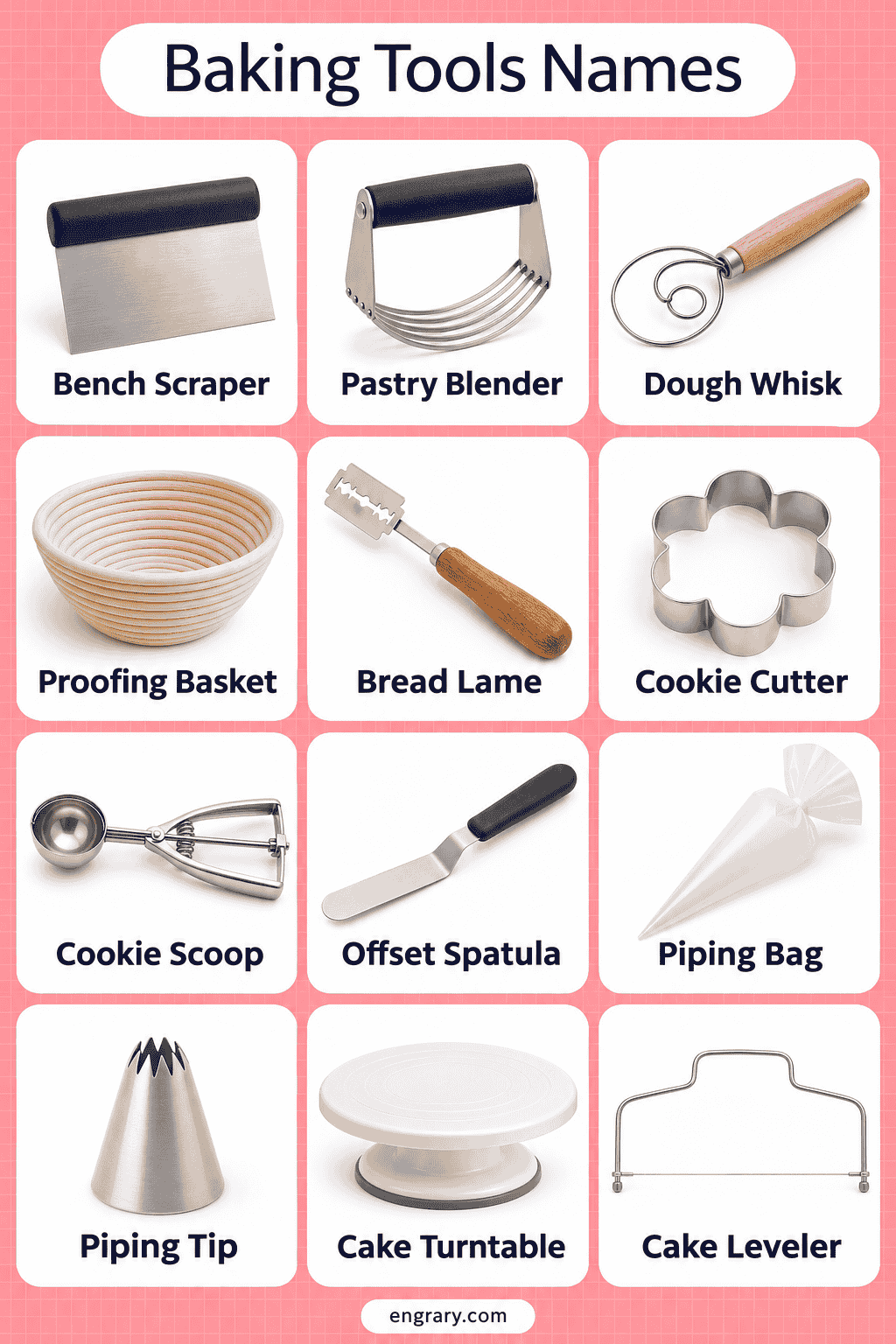
The recipe’s action verb often gives away the tool. To divide bread dough, use a straight edge. To stamp out biscuits, press a cutter through a rolled sheet. To portion soft cookie dough, use a scoop. The picture includes these tools alongside bread-making and decorating equipment.
Bench Scraper
A bench scraper has a broad, rigid blade with a handle along one edge. Its straight lower edge divides dough into portions and lifts them from the worktop. Bench knife is another name for the same tool.
Cookie Cutter
A cookie cutter stamps a shape from rolled dough. The outline determines the finished shape, so a flower cutter produces a flower even before you add icing. In British recipes, you may see the name biscuit cutter.
Cookie Scoop
A cookie scoop portions soft dough into mounds. Many models have a lever that sweeps the inside of the scoop and releases the dough. Similar-sized portions bake more evenly when they share a tray.
Proofing Basket
A proofing basket, also called a banneton, supports a shaped bread dough during its final rise. A coiled basket can leave a spiral pattern on a floured loaf. After proofing, turn the dough out onto the surface you will bake it on.
Bread Lame
A bread lame, pronounced lahm, is a small blade on a handle. Bakers use it to score the surface of a shaped loaf just before baking. The cut gives the expanding dough a place to open in the oven.
A recipe may use dough scraper for either of two tools. Check where the dough is and what the instruction asks you to do.
| If the recipe says… | Likely tool | Identifying feature |
|---|---|---|
| “Scrape the dough out of the bowl” | Bowl scraper | Flexible edge that follows the bowl’s curve |
| “Divide the dough into eight pieces” | Bench scraper or bench knife | Rigid, straight blade that reaches the worktop |
How to Recognize Baking Pans and Tins
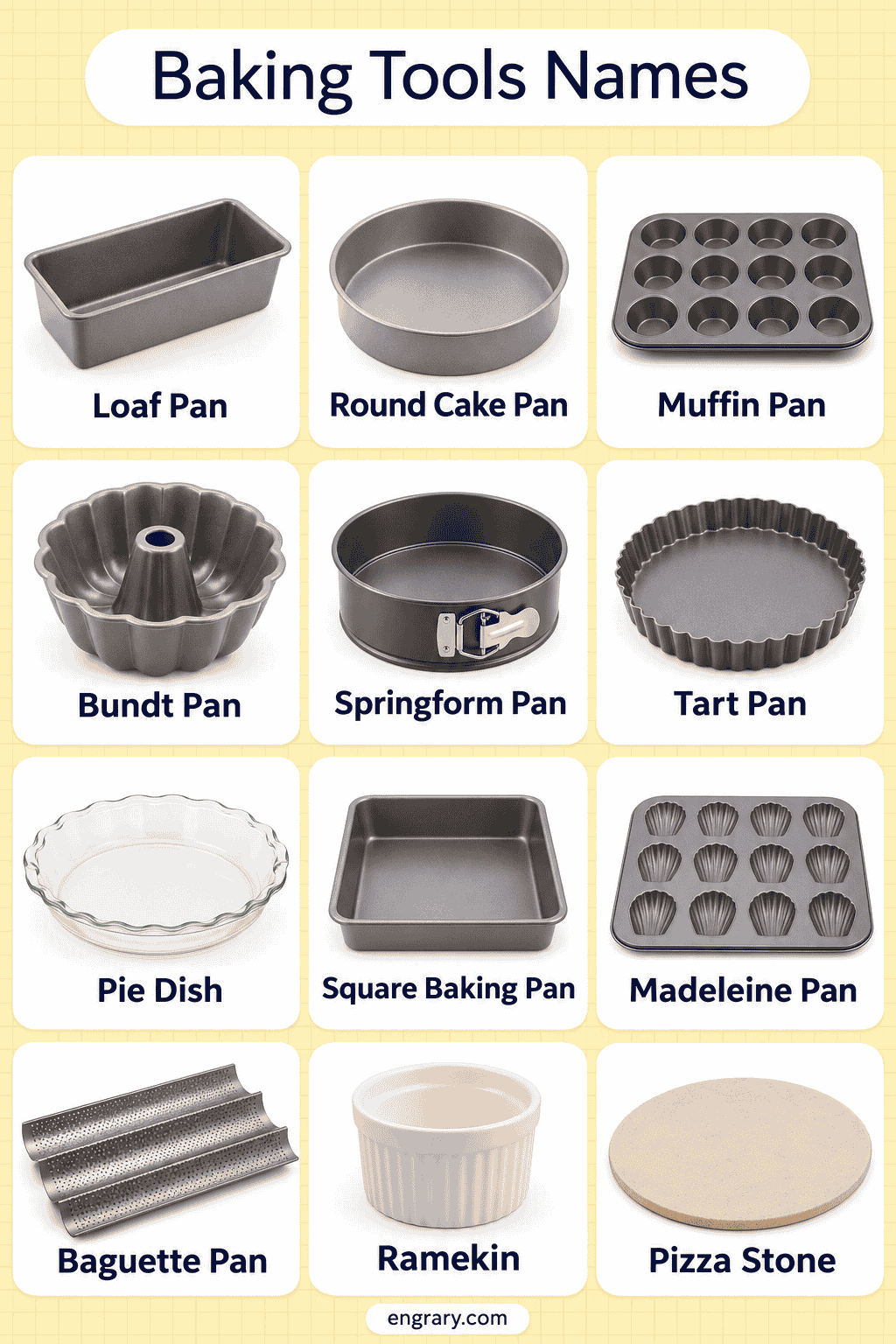
Pan and tin often name the same piece of bakeware. Shape is the more useful clue. Look at the depth of the sides, the shape of each cavity, and whether the pan has a latch, removable base, or central tube. These details affect both the shape of the bake and how you release it.
Loaf Pan
A loaf pan is a deep rectangular pan for sandwich bread, banana bread, and loaf cakes. Its tall sides support the mixture as it rises and give the finished loaf a shape that slices neatly.
Round Cake Pan
A round cake pan has a flat base and usually straight sides. Bakers often divide batter between two or more matching pans to make layers. Check the diameter as well as the depth when matching a pan to a recipe.
Muffin Pan
A muffin pan has a grid of individual cups for muffins or cupcakes. Also called a muffin tin, it supports each portion separately. A paper liner sits inside a cup and helps release the finished bake.
Bundt Pan
A Bundt pan forms a ring-shaped cake with a hole in the center and a decorative outer surface. The central tube brings heat into the middle of the batter, while the molded sides leave a pattern when you turn the cake out.
Springform Pan
A springform pan has a removable outer ring secured by a latch. Opening the latch releases the sides, so you can uncover a delicate cheesecake without turning it upside down.
Tart Pan
A tart pan typically has shallow, fluted sides that leave a ridged edge on the pastry shell. Many versions also have a removable base. Once the tart is cool enough to handle, the base helps lift it free of the outer ring.
Pie Dish
A pie dish has sloping sides that widen toward the rim. Its rim supports the edge of the crust and gives you room to crimp it. The terms pie plate and pie dish often refer to the same shape.
Square Baking Pan
A square baking pan has straight sides and four corners. It suits brownies, bars, and snack cakes because the finished bake divides easily into rows. A recipe’s stated dimensions matter because a wider pan spreads the same batter into a thinner layer.
Madeleine Pan
A madeleine pan has shallow, shell-shaped cavities with ridges along each base. Each cavity gives an individual madeleine its distinctive shell pattern.
Baguette Pan
A baguette pan has long, curved channels that support slender loaves. Some models also have perforations that allow air to circulate around the dough as it bakes.
Ramekin
A ramekin is a small oven-safe dish for an individual portion. Its sides are often straight, and the exterior may have vertical ribs. Recipes use ramekins for baked custards, soufflés, and small crumbles.
Pizza Stone
A pizza stone is a flat baking surface, usually made from stone or ceramic. It stores heat and transfers it to the dough resting on it. Follow the maker’s instructions for heating and cooling your particular stone.
| Bakeware that looks similar | Detail to check | What it means for the bake |
|---|---|---|
| Round cake pan and springform pan | Latch on the side | The springform ring opens around a delicate cake. |
| Pie dish and tart pan | Sloping sides or a shallow fluted edge | A pie dish supports a crimped rim. A tart pan shapes the pastry’s edge. |
| Muffin pan and madeleine pan | Deep cups or shallow shell molds | The cavity determines the shape of each individual bake. |
Cooling, Glazing, and Decorating Baked Goods
Let a cake cool as its recipe directs before adding frosting. Once it is ready, the tools below help with different parts of the finish. A leveler cuts an even layer, a turntable rotates the cake, and a spatula spreads the frosting.
Cake Leveler
A cake leveler has a wire or thin blade stretched across a frame. It makes a horizontal cut through a cake, often to remove a domed top so the next layer can sit flat.
Cake Turntable
A cake turntable has a flat platform that rotates on a base. Turning the cake lets you keep the spatula at a steady angle while smoothing frosting around the sides.
Offset Spatula
An offset spatula has a narrow blade that sits lower than its handle. The bend gives your knuckles clearance as you spread frosting over a cake or smooth batter into the corners of a pan.
Piping Bag
A piping bag is a cone-shaped bag that guides frosting, cream, or soft dough through its narrow end. Pressure at the wider end controls the flow, while the opening or attached tip shapes what comes out.
Piping Tip
A piping tip, also called a piping nozzle, fits at the narrow end of the bag. A round opening makes dots and smooth lines, while the teeth around a star opening leave ridges in the frosting.
FAQs About Baking Tools
For a basic batter you can mix by hand, start with a mixing bowl, whisk or wooden spoon, flexible spatula, measuring tools, and the pan specified in the recipe. A cooling rack gives the cake somewhere to cool. Recipes that rely on whipped eggs or creamed butter may also call for a mixer.
For many recipes, pan and tin are alternative names for the same vessel. Match the stated shape, internal dimensions, and depth. An 8-inch round cake tin calls for an 8-inch round cake pan.
Yes. A fine-mesh sieve can sift flour or cocoa. Hold it over a bowl and tap the side gently. A mechanical sifter does a similar job with a screen and a moving mechanism.
It is a springform pan. The clip is a latch that releases the outer ring. A round pan with a tube through the center and molded, decorative sides is usually a Bundt pan.
Use an offset spatula to spread frosting across the cake. A long blade covers a broad top, while a small offset spatula gives you more control around the edge or on a cupcake. Keep the flexible rubber spatula handy for scraping frosting out of the bowl.
You May Also Like


Leave a Comment