

Farming uses many different tools and machines for preparing land, planting crops, controlling weeds, watering fields, harvesting produce, and handling crops after harvest. Learning farming tools names with pictures and uses makes it easier to recognize agricultural equipment and understand where each item fits in farm work.
This guide covers 70 farming tools names with short descriptions and simple recognition clues. The list includes traditional hand tools, agricultural implements, irrigation equipment, harvesting machines, and larger farm machinery used at different stages of crop production.

Farming Tools Seen Across Different Stages of Crop Production
Farm work changes from one stage to another, so farmers rely on different tools for soil preparation, sowing, crop care, irrigation, harvesting, and handling produce. The following names include many of the most recognizable tools and machines used across these stages.
1. Hoe
A hoe has a long handle with a flat or angled blade. Farmers use it for loosening surface soil, shaping rows, and controlling weeds.
2. Spade
A spade has a relatively flat blade with a straight cutting edge. It is useful for digging, cutting into soil, and making small field channels.
3. Shovel
A shovel usually has a broad curved blade that holds loose material. It is commonly used for moving soil, manure, grain, and other farm materials.
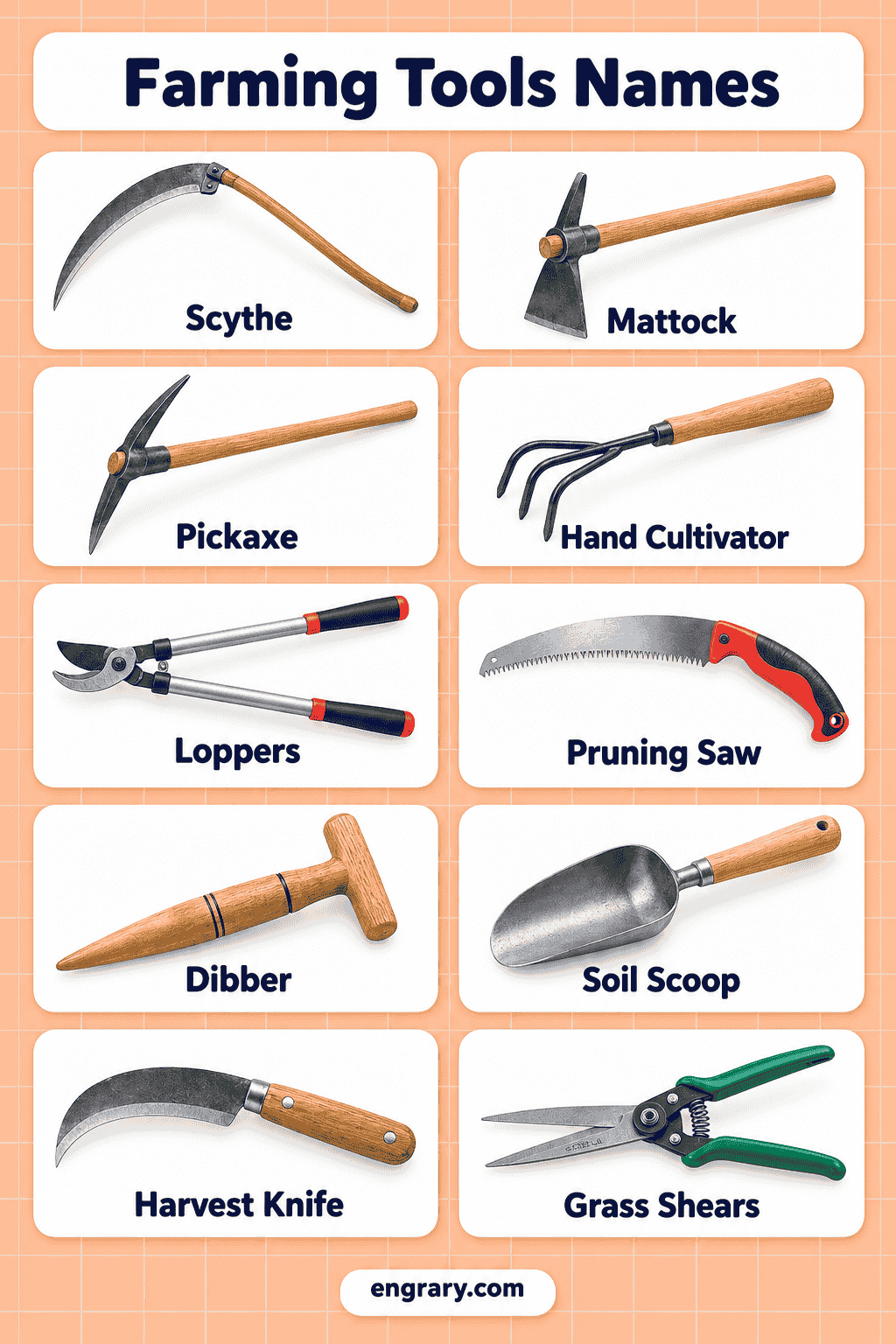
4. Pickaxe
A pickaxe has a heavy metal head with a pointed end. It helps break hard or compacted ground.
5. Mattock
A mattock combines a broad cutting or digging blade with another working edge. Farmers use it for difficult ground and root-filled soil.
6. Rake
A rake has a long handle and a toothed head. It helps level soil, break small clods, and gather loose plant material.
7. Sickle
A sickle has a short handle and a strongly curved blade. Farmers traditionally use it for cutting crops, grasses, and similar plant material.
8. Scythe
A scythe has a long shaft and a long curved blade. Its shape allows a wider sweeping cut than a sickle.
9. Pitchfork
A pitchfork has a long handle with several long pointed tines. It is useful for lifting hay, straw, and other loose plant material.
10. Plough
A plough is a soil-turning implement pulled across a field. It opens and turns soil before planting.
11. Disc Plough
A disc plough uses large concave metal discs instead of a traditional plough body. The discs cut and turn soil as the implement moves forward.
12. Harrow
A harrow is a broad field implement fitted with teeth, tines, or other working parts. It breaks soil clods and smooths the field after ploughing.
13. Disc Harrow
A disc harrow has rows of concave metal discs mounted on a frame. It breaks and mixes the upper soil layer.
14. Cultivator
A cultivator uses tines or shanks to loosen soil and disturb weeds between or before crop rows.
15. Rotavator
A rotavator uses rotating blades or tines to break and mix soil. It is also commonly called a rotary tiller.
16. Power Tiller
A power tiller is a compact powered machine used for soil preparation and other small-field operations.
17. Field Roller
A field roller has a heavy cylindrical section that presses and levels the soil surface after field preparation or seeding.
18. Seed Drill
A seed drill places seeds into rows at a controlled depth and spacing.
19. Seeder
A seeder is equipment designed to distribute seed across or into prepared soil.
20. Planter
A planter places seeds or planting units into rows at planned spacing.
21. Transplanter
A transplanter places young seedlings into prepared soil instead of sowing loose seed.
22. Fertilizer Spreader
A fertilizer spreader distributes granular fertilizer across a field or crop area.
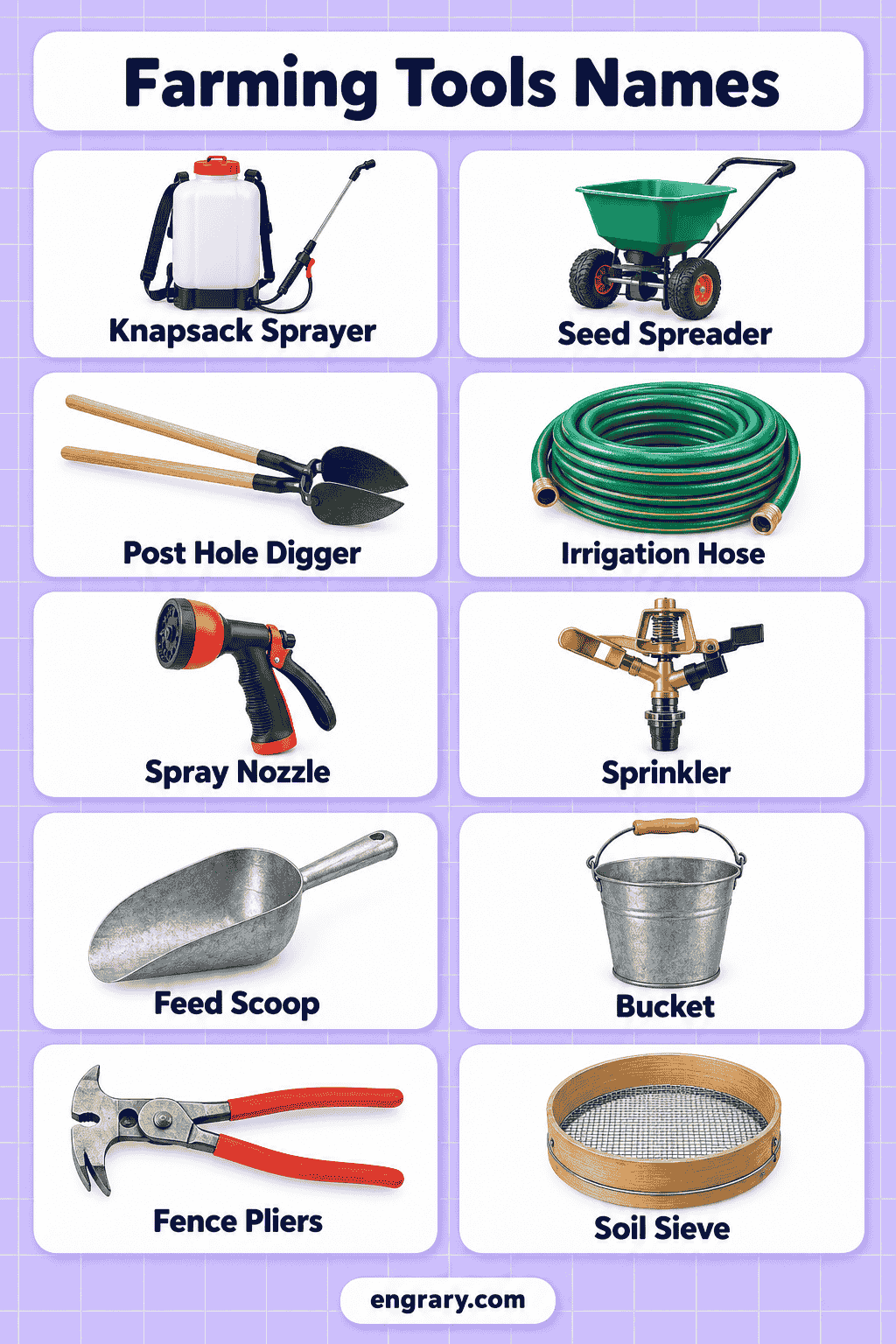
23. Knapsack Sprayer
A knapsack sprayer is a portable tank carried on the back with a hand-held spray lance for applying liquids over crops.
24. Water Pump
A water pump moves water from a source into irrigation channels, pipes, tanks, or field systems.
25. Sprinkler
A sprinkler distributes water over crops through small streams or droplets across a wider area.
Hand Tools for Field Work
Manual tools remain useful for smaller plots, maintenance work, harvesting, and jobs that require direct control. Their simple shapes also make them important agricultural vocabulary.
26. Hand Weeder
A hand weeder is a small manually operated tool used to loosen or remove individual weeds.
27. Dibber
A dibber is a pointed planting tool used to make small holes for seeds or young plants.
28. Hand Trowel
A hand trowel has a short handle and a scoop-shaped blade. It works well for small planting and transplanting jobs.
29. Pruning Shears
Pruning shears are compact cutters used for trimming small stems and shoots. They are also called secateurs or hand pruners.
30. Pruning Saw
A pruning saw has a toothed blade suited to cutting woody branches that are too large for pruning shears.
31. Farm Knife
A farm knife is a general-purpose cutting tool used for suitable field, harvest, and crop-handling tasks.
32. Billhook
A billhook has a heavy curved blade that suits cutting woody stems, hedging material, and similar vegetation.
Tools and Implements for Land Preparation
Land preparation creates the soil conditions needed for sowing and planting. These tools and implements cut, loosen, turn, break, mix, or level field soil.
33. Chisel Plough
A chisel plough has strong narrow shanks designed to loosen deeper compacted soil with less complete soil inversion.
34. Subsoiler
A subsoiler uses one or more heavy shanks to loosen hard soil layers below normal tillage depth.
35. Spring-Tooth Harrow
A spring-tooth harrow uses flexible metal teeth to loosen and break the upper soil layer.
36. Spike-Tooth Harrow
A spike-tooth harrow has straight metal teeth arranged across a frame for lighter soil finishing and leveling.
37. Land Leveler
A land leveler is an implement with a broad leveling surface used to smooth uneven field ground.
38. Ridger
A ridger shapes soil into raised ridges or furrows for certain crops and planting systems.
39. Bed Former
A bed former shapes prepared soil into raised planting beds.
40. Rotary Hoe
A rotary hoe has rotating or wheel-like working elements that disturb the soil surface and help manage young weeds.
Sowing and Planting Equipment
Planting equipment improves seed placement, spacing, and row consistency. Different designs are used depending on crop type, seed size, and production scale.
41. Broadcast Seeder
A broadcast seeder scatters seed over a wider surface rather than placing it into individual rows.
42. Precision Seeder
A precision seeder is designed to place individual seeds or small groups at more controlled spacing.
43. Row Marker
A row marker creates visible guidelines or marks that help maintain consistent planting rows.
44. Seed Dibbler
A seed dibbler makes repeated small holes or depressions where seeds can be placed.
45. Fertilizer Drill
A fertilizer drill places fertilizer in bands or rows at controlled positions in the field.
Weeding and Crop-Maintenance Tools
Once crops are established, farmers need equipment for weed control, nutrient application, and crop protection. These tools help maintain healthier growing conditions.
46. Wheel Hoe
A wheel hoe is a manually pushed cultivating tool with a wheel and interchangeable or fixed working blade.
47. Inter-Row Cultivator
An inter-row cultivator works between crop rows to loosen soil and control weeds without disturbing the main plants.
48. Boom Sprayer
A boom sprayer uses a long horizontal boom fitted with multiple spray nozzles to cover larger field areas.
49. Crop Sprayer
A crop sprayer applies liquids over crops through one or more nozzles and may be handheld, tractor-mounted, or self-propelled.
50. Manure Spreader
A manure spreader carries and distributes manure across agricultural land.
Irrigation Tools and Equipment
Irrigation equipment delivers water where rainfall is not sufficient or where crops need more controlled watering. Different systems suit different field sizes and crop arrangements.
51. Irrigation Pump
An irrigation pump supplies water specifically to field irrigation systems.
52. Irrigation Pipe
Irrigation pipes carry water from its source to different parts of the field.
53. Drip Line
A drip line releases water slowly near crop roots through small emitters or openings.
54. Irrigation Reel
An irrigation reel stores and manages long irrigation hose or pipe, often as part of a traveling irrigation system.
55. Water Tank
A farm water tank stores water for irrigation, spraying, or other agricultural use.
Harvesting Tools and Machines
Harvesting equipment removes mature crops from the field. The correct tool depends on crop type, field size, and whether harvesting is manual or mechanized.
56. Reaper
A reaper is a machine designed mainly to cut standing crops during harvest.
57. Combine Harvester
A combine harvester performs several grain-harvesting operations in one machine, including cutting, threshing, and separating grain.
58. Forage Harvester
A forage harvester cuts and chops crops intended mainly for animal feed or silage.
59. Corn Picker
A corn picker is specialized harvesting equipment used to collect ears of corn from standing plants.
60. Potato Digger
A potato digger lifts soil and potatoes from the ground so the crop can be separated and collected.
Post-Harvest and Crop-Handling Equipment
Farm work continues after the crop leaves the field. Post-harvest equipment helps separate, move, dry, bale, or process harvested material.
61. Thresher
A thresher separates grain or seed from harvested stalks and other plant material.
62. Winnower
A winnower helps separate lighter chaff from heavier grain using moving air.
63. Chaff Cutter
A chaff cutter chops straw, fodder, or similar plant material into smaller pieces.
64. Baler
A baler compresses loose hay, straw, or similar crop material into compact bales.
65. Grain Auger
A grain auger uses a rotating screw inside a tube or trough to move grain from one point to another.
66. Grain Elevator
A grain elevator moves grain vertically or between different storage and handling points.
67. Grain Dryer
A grain dryer removes excess moisture from harvested grain before longer-term storage.
68. Grain Cart
A grain cart is a large field trailer used to receive and transport harvested grain.
69. Hay Rake
A hay rake gathers cut hay or forage into rows so it can dry or be collected more efficiently.
70. Hay Tedder
A hay tedder lifts and spreads cut hay to expose more of it to air and improve drying.
Farm Machines Used for Large-Scale Field Work
Large farms depend on powered machines to provide traction, operate implements, transport loads, and perform field work efficiently. Some of these machines also appear in earlier sections because they support several stages of production.
Tractor
A tractor is the main power unit on many farms. It pulls implements such as ploughs, harrows, cultivators, planters, and trailers.
Two-Wheel Tractor
A two-wheel tractor is a smaller walk-behind power unit that can operate different implements on smaller fields.
Farm Trailer
A farm trailer attaches to a tractor or other vehicle for transporting crops, tools, fertilizer, and other agricultural materials.
Self-Propelled Sprayer
A self-propelled sprayer carries its own engine and wide spray booms for covering large crop areas.
Combine Harvester
A combine harvester is one of the largest crop-harvesting machines and combines cutting, threshing, and grain separation in a single operation.
Farming Tools That Are Easy to Confuse
Several farming tools and machines have related functions, but their designs and stages of use are different. The following comparisons make these names easier to recognize.
| Tools | Main Difference |
|---|---|
| Spade vs Shovel | A spade usually has a flatter blade for cutting and digging soil, while a shovel generally has a broader scooped blade for moving loose material. |
| Hoe vs Cultivator | A hoe normally uses a blade for surface soil and weed control, while a cultivator commonly uses tines or shanks to loosen soil. |
| Sickle vs Scythe | A sickle is short and handheld, while a scythe has a long shaft and cuts a wider area with each sweep. |
| Plough vs Harrow | A plough turns or opens soil more deeply, while a harrow works the upper soil layer and breaks clods after primary tillage. |
| Disc Plough vs Disc Harrow | A disc plough uses fewer, larger soil-turning discs, while a disc harrow uses groups of discs mainly to break and mix surface soil. |
| Cultivator vs Rotavator | A cultivator loosens soil with tines or shanks, while a rotavator uses powered rotating blades or tines. |
| Seeder vs Seed Drill | Seeder is a broader term for equipment that distributes seed, while a seed drill specifically places seed into rows at controlled depth. |
| Seed Drill vs Planter | A seed drill commonly handles continuous row seeding, while a planter generally places seeds or planting units at more defined spacing. |
| Reaper vs Combine Harvester | A reaper mainly cuts standing crops, while a combine also threshes and separates grain. |
| Thresher vs Combine Harvester | A thresher works on already harvested material, while a combine performs harvesting and threshing in the field. |
| Hay Rake vs Hay Tedder | A hay rake gathers forage into rows, while a tedder spreads and turns it to improve drying. |
Alternate Names for Farming Tools
Agricultural vocabulary varies between countries and regions. Knowing alternate terms makes farm-equipment names easier to understand in manuals, classrooms, and international discussions.
| Main Name | Alternate Name |
|---|---|
| Plough | Plow |
| Rotavator | Rotary Tiller |
| Combine Harvester | Combine |
| Thresher | Threshing Machine |
| Pruning Shears | Secateurs, Hand Pruners |
| Crop Sprayer | Agricultural Sprayer |
| Power Tiller | Walking Tractor in some contexts |
| Farm Trailer | Agricultural Trailer |
Alternate names should not be counted as separate tools when they refer to the same or closely equivalent equipment.
Frequently Asked Questions
Common farming tools include hoes, spades, shovels, sickles, ploughs, harrows, cultivators, seed drills, sprayers, tractors, reapers, and threshers.
A plough works the soil more deeply and turns or opens it during primary land preparation. A harrow usually follows later to break clods and create a finer, more level surface.
A seed drill generally places seed continuously or regularly along rows at controlled depth. A planter usually places individual seeds or planting units at more defined spacing.
Common harvesting machines include reapers, combine harvesters, forage harvesters, corn pickers, and potato diggers. The correct machine depends on the crop.
A thresher separates grain from harvested plant material after cutting. A combine harvester cuts the crop and also performs threshing and grain separation during the same field operation.
You May Also Like



Leave a Comment