

Walk into a welding or fabrication shop and you may notice thick cables, gun-shaped handpieces, small torch components, clamps, gauges, grinders, and protective equipment. At first, many of these items look similar. However, learning welder tools names becomes much easier when you connect each name with its shape, purpose, and welding process.
This guide explains 60 common welding tools, equipment parts, accessories, and safety items in clear language. In addition, it highlights visual recognition clues, common alternative names, and process-specific terms. Therefore, readers can identify welding equipment more confidently without getting lost in unnecessary technical detail.

Common Welder Tools Names at a Glance
Welders use different tools for joining metal, preparing surfaces, holding workpieces, removing slag, and staying protected during the job. Learning these common welder tool names helps beginners recognize essential workshop equipment more easily.
Welding Machine
A welding machine supplies the electrical power needed to create a welding arc and join metal pieces.
Welding Helmet
A welding helmet protects the face and eyes from bright arc light, sparks, and flying debris.
Welding Gloves
Welding gloves protect the hands from heat, sparks, sharp edges, and hot metal.
Welding Electrode
A welding electrode carries current to the weld area and may also provide filler metal, depending on the welding process.
Welding Wire
Welding wire serves as filler metal in processes such as MIG and flux-cored welding.
Electrode Holder
An electrode holder grips a stick electrode securely and carries welding current to it.
Ground Clamp
A ground clamp connects the welding circuit to the workpiece or welding table.
Welding Clamp
A welding clamp holds metal pieces firmly in position before and during welding.
Welding Table
A welding table provides a strong, heat-resistant surface for positioning and joining metal parts.
Angle Grinder
An angle grinder cuts metal, removes rust, smooths welds, and prepares surfaces before welding.
Chipping Hammer
A chipping hammer breaks and removes slag from completed welds.
Wire Brush
A wire brush cleans rust, slag, scale, and loose debris from metal surfaces.
Welding Pliers
Welding pliers grip hot parts, trim wire, remove spatter, and handle small welding tasks.
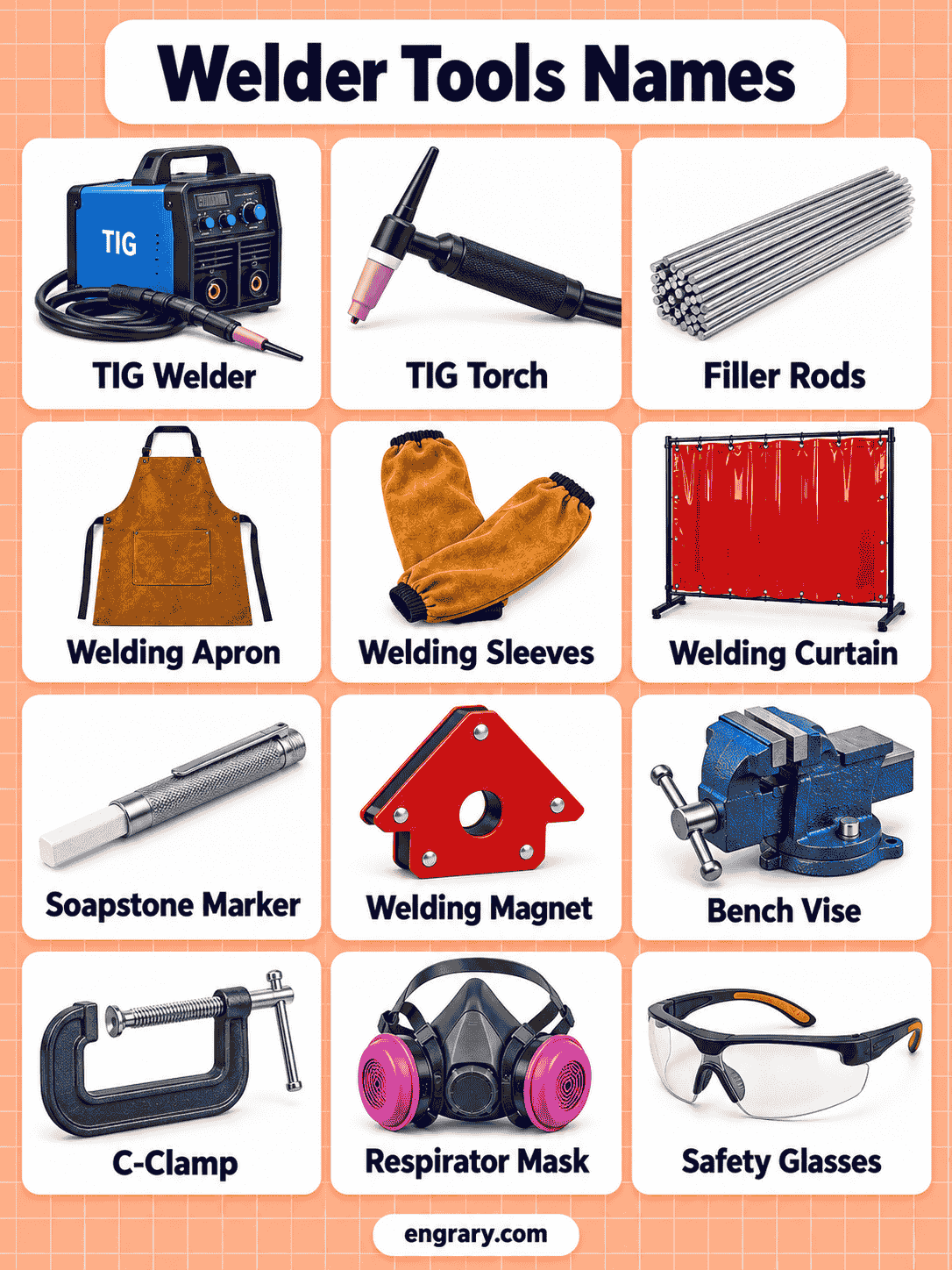
C-Clamp
A C-clamp holds metal workpieces firmly against a table or each other.
Locking Pliers
Locking pliers grip metal parts tightly and keep them fixed during fitting or welding.
Soapstone Marker
A soapstone marker creates visible layout and cutting lines on metal.
Welding Jacket
A welding jacket protects the upper body from heat, sparks, and hot spatter.
Leather Apron
A leather apron adds protection for the chest, waist, and legs during welding work.
Welding Curtain
A welding curtain helps shield nearby people from arc light, sparks, and welding debris.
Safety Glasses
Safety glasses protect the eyes during grinding, chipping, cutting, and other workshop tasks outside active arc welding.
Main Welding Tools and Equipment
The main welding system includes the power source, electrical connections, process-specific handpieces, and gas-control components. Although MIG, TIG, and stick welding share some supporting equipment, each process uses a different main handpiece and electrode system. Miller identifies MIG, TIG, and stick as distinct arc-welding processes with different equipment and electrode types.
1. Welding Machine
A welding machine, or welding power source, supplies electrical energy for many arc-welding processes. Usually, it looks like a box-shaped unit with control knobs, displays, vents, and cable connections. However, the exact layout changes according to the welding process and machine design.
Also called: Welder, welding power source.
2. MIG Gun
A MIG gun is the handheld component associated with MIG welding. Because it usually has a pistol-shaped body and trigger, beginners can often recognize it quickly. In addition, the welding wire travels through the gun toward its front end.
Used with: MIG/GMAW.
3. TIG Torch
A TIG torch is a slim handheld component that holds a tungsten electrode. Unlike a MIG gun, it normally has a torch-style body with a cup surrounding the electrode area. Meanwhile, shielding gas travels through the torch toward the welding zone.
Used with: TIG/GTAW.
4. Electrode Holder
An electrode holder grips a coated stick electrode during stick welding. Visually, it resembles an insulated clamp attached to a heavy welding cable. In workshop language, people also commonly call it a stinger.
Also called: Stinger.
Used with: Stick/SMAW.
5. Work Clamp
A work clamp connects the work side of the welding circuit. It usually looks like a strong spring-loaded or screw-type clamp attached to a thick cable. Although many people call it a ground clamp, work clamp describes its welding-circuit role more precisely.
Also called: Ground clamp.
6. Welding Cable
A welding cable carries electrical current between parts of a welding system. Because manufacturers build it from flexible stranded conductors with heavy insulation, it looks much thicker than an ordinary household electrical cord.
Also called: Welding lead, electrode cable.
7. Wire Feeder
A wire feeder moves welding wire toward the gun in wire-fed welding systems. Some machines contain the feeder inside the main housing, whereas other systems use a separate feeder unit. Therefore, its appearance varies considerably.
8. Gas Regulator
A gas regulator controls gas pressure in a compatible shielding-gas system. Typically, it attaches near the gas supply and includes gauges or adjustment controls. Because gas systems differ, regulator designs can also vary.
9. Flowmeter
A flowmeter indicates the rate of shielding-gas flow. Many welding flowmeters use a transparent vertical tube with measurement markings. As a result, readers can often recognize them more easily than internal gas-system components.
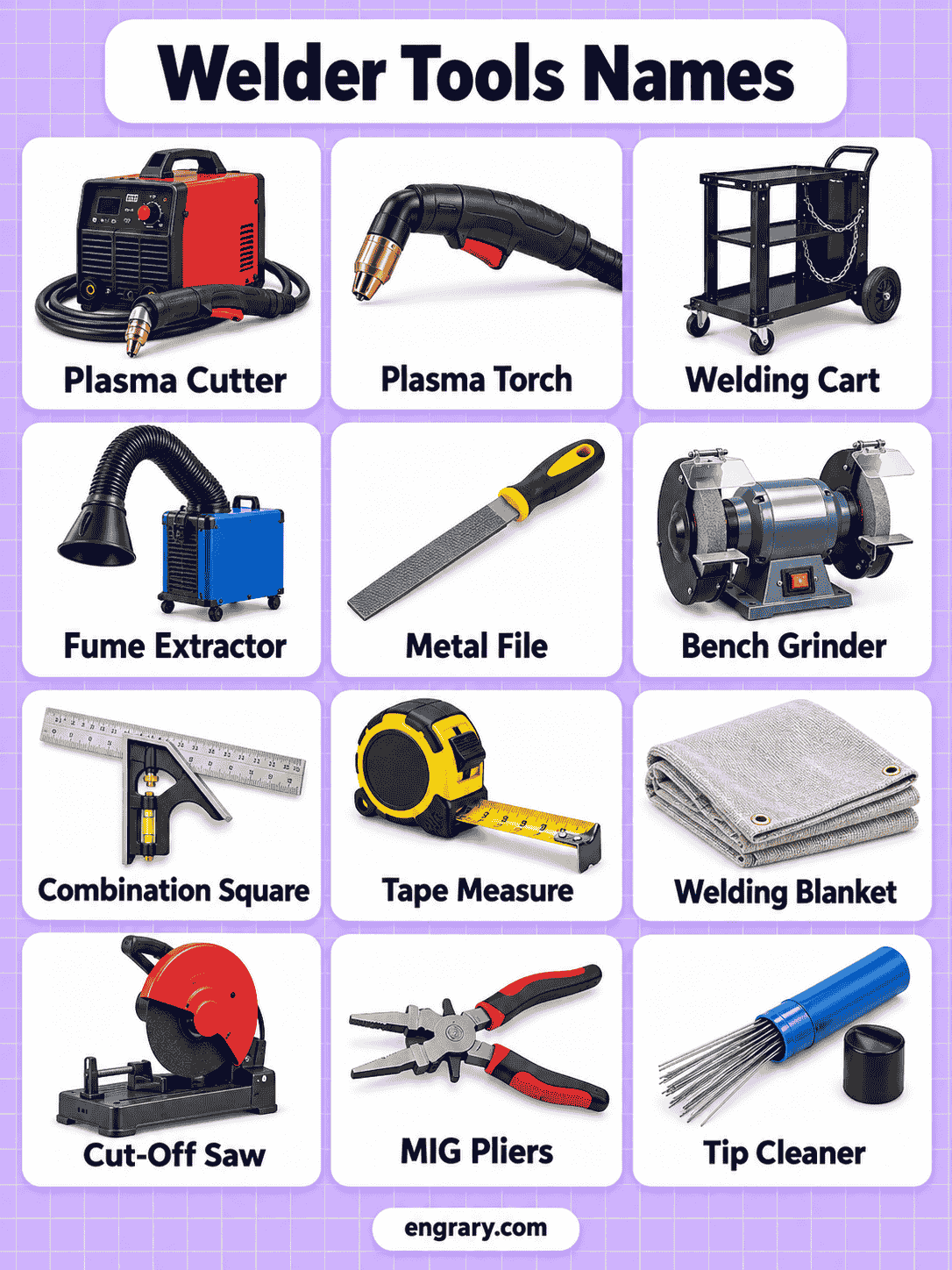
10. Welding Cart
A welding cart provides a wheeled platform for compatible welding equipment and accessories. For example, many carts include shelves, a handle, cable-storage areas, or space for related equipment. However, cart layouts vary between manufacturers.
MIG Welding Tool and Component Names
MIG welding uses a continuously fed consumable wire electrode. Therefore, a MIG system includes several smaller parts that guide the wire, transfer electrical current, and direct shielding gas. Miller describes MIG as a process that uses continuously fed filler-metal wire.
11. Contact Tip
A contact tip is a small metal component near the front of a MIG gun. Welding wire passes through the hole in its center. Because the tip remains small compared with the surrounding nozzle, beginners may overlook it when viewing a complete gun.
12. Gas Nozzle
A gas nozzle surrounds the front area of many MIG guns and directs shielding gas toward the welding zone. Usually, it looks like a short hollow metal cup. By contrast, the contact tip sits farther inside the nozzle area.
13. MIG Gun Liner
A MIG gun liner guides welding wire through the gun cable assembly. Since the liner sits mainly inside the cable, people rarely see it during normal operation. However, when removed, it resembles a long flexible tube or coiled guide.
14. Drive Roll
A drive roll forms part of the wire-feeding mechanism. It looks like a small wheel with a groove that contacts the welding wire. Consequently, its round shape makes it quite different from the long wire liner.
15. Welding Wire Spool
A welding wire spool holds a continuous length of wire around a circular reel. MIG welding commonly uses solid wire supplied on a spool. Therefore, the spool provides one of the clearest visual clues that a system uses continuously fed wire.
16. Gas Diffuser
A gas diffuser helps distribute shielding gas within the front assembly of many MIG guns. Its exact shape depends on the gun design. Therefore, its position behind or near the nozzle often helps readers identify it more reliably than its shape alone.
TIG Welding Tool and Component Names
TIG welding uses a non-consumable tungsten electrode rather than continuously fed MIG wire. Consequently, TIG torches contain a different group of small components that hold the tungsten and guide shielding gas. Miller’s TIG guidance describes the torch, tungsten, work lead, gas system, and related components.
17. Tungsten Electrode
A tungsten electrode is a thin rod positioned inside a TIG torch. Unlike MIG wire, the tungsten primarily carries the arc rather than feeding continuously into the joint as filler metal. Therefore, its straight rod shape provides an important recognition clue.
18. Collet
A collet is a small internal component that grips the tungsten inside the TIG torch. Usually, it looks like a narrow metal cylinder with slots along part of its body. Because it sits inside the torch, readers often see it only when looking at TIG-parts diagrams.
19. Collet Body
The collet body supports the collet and forms part of the torch assembly. In addition, gas passes through openings in this area toward the cup. Its shape differs by torch design, so context remains an important identification clue.
20. Ceramic Cup
A ceramic cup surrounds the front of many TIG torches and directs shielding gas around the tungsten. It normally has a smooth cup-shaped appearance. Consequently, it is one of the easiest small TIG components to recognize.
Also called: TIG cup, ceramic nozzle.
21. TIG Back Cap
A TIG back cap attaches to the rear of many TIG torches. It helps secure the tungsten assembly and may extend noticeably behind the torch body. However, manufacturers offer short and long versions, so length alone does not identify every back cap.
22. TIG Remote Control
A TIG remote control adjusts output on compatible TIG systems. For example, manufacturers may provide a foot-pedal control or a smaller fingertip control. Therefore, this item can look very different depending on the equipment setup.
Stick Welding Tools and Related Equipment
Stick welding, formally called shielded metal arc welding or SMAW, uses a coated consumable electrode. As a result, its equipment looks different from both wire-fed MIG systems and tungsten-based TIG systems. Miller also notes that stick electrodes contain a flux coating that provides shielding during the process.
23. Stick Electrode
A stick electrode is a straight coated electrode used in stick welding. Unlike MIG wire, manufacturers supply it as an individual rod rather than a continuous spool. Therefore, beginners can distinguish the two consumable forms quite easily.
Also called: Welding electrode, welding rod.
24. Electrode Oven
An electrode oven provides controlled storage for certain welding consumables in professional settings. Instead of resembling a hand tool, it usually looks like a small heated cabinet or portable storage unit. Therefore, it belongs under welding equipment rather than handheld tools.
25. Electrode Quiver
An electrode quiver is a portable container that holds compatible stick electrodes. Typically, it has a long enclosed body that protects the rods while workers carry them. By contrast, an electrode holder grips one electrode during welding.
26. Welding Cable Connector
A welding cable connector joins compatible welding leads to equipment or other cable sections. Many connectors appear as compact cylindrical fittings attached to thick cables. However, manufacturers use different connector designs, so shapes vary.
Tools for Holding and Positioning Metal
Welders and fabricators often need to keep pieces aligned before and during fabrication work. Therefore, clamps, magnets, vises, and worktables play an important supporting role. Although these tools do not create the weld, they help organize and position the metal.
27. Welding Clamp
A welding clamp is a general term for clamps used around welding and fabrication work. Because different joints require different holding methods, welding clamps come in many shapes. Therefore, the jaws and adjustment mechanism usually provide the strongest recognition clues.
28. C-Clamp
A C-clamp has a rigid C-shaped frame and an adjustable screw. Consequently, its outline makes it one of the easiest holding tools to recognize. Fabricators use it as a general-purpose workholding tool.
29. F-Clamp
An F-clamp uses a long straight bar with one fixed jaw and one movable jaw. Although it performs a similar holding role to a C-clamp, its extended bar gives it a noticeably different profile.
30. Locking Pliers
Locking pliers have jaws that lock around a suitable workpiece. In addition, an adjustment screw usually appears at the end of one handle. Because these pliers serve many workshop tasks, they are general fabrication tools rather than welding-specific equipment.
31. Welding Magnet
A welding magnet uses magnetic force to help position ferromagnetic workpieces. Many versions use arrow-like or polygonal bodies with angled sides. Therefore, their geometric shape often provides the easiest visual clue.
32. Corner Clamp
A corner clamp holds workpieces at a corner, commonly around a right-angle arrangement. Unlike a straight clamp, its jaws face the pieces from different directions. As a result, its angled design clearly reflects its purpose.
33. Pipe Clamp
A pipe clamp supports or holds cylindrical work such as pipe or tube. Since round workpieces require different contact surfaces from flat plates, many pipe clamps use curved or adjustable holding points.
34. Bench Vise
A bench vise mounts to a bench or heavy work surface and uses two jaws to grip a workpiece. Although it is not exclusive to welding, it commonly appears in fabrication shops. Moreover, its fixed base makes it easy to distinguish from portable clamps.
35. Welding Table
A welding table provides a sturdy work surface for metal fabrication. Some models include holes, slots, or fixture systems for clamps and positioning accessories. Therefore, the table often serves as both a work surface and an organizing platform.
Tools for Cleaning and Preparing Metal
Preparation and cleanup tools remove rough edges, loose material, slag, scale, or excess metal. However, these tools belong to the wider fabrication workflow rather than the welding circuit itself. For that reason, this section focuses on names and recognition instead of operating instructions.
36. Chipping Hammer
A chipping hammer is a compact hand tool commonly associated with removing slag from welding processes that produce a slag covering. Typically, it has pointed, narrow, or chisel-like ends. Therefore, its unusual hammer head makes it easy to recognize.
37. Wire Brush
A wire brush uses stiff metal bristles for surface cleaning. Hand versions usually have a narrow handle and rectangular bristle area. Similarly, powered wire-brush accessories also appear in metalworking environments.
38. Angle Grinder
An angle grinder is a handheld power tool with a rotating disc mounted roughly at a right angle to the motor body. Because the disc sits on the side rather than directly in line with the motor, its shape is distinctive. Fabricators commonly encounter it during metal preparation and finishing.
39. Bench Grinder
A bench grinder stays fixed to a bench or stand while abrasive wheels rotate on either side of its motor housing. By contrast, an angle grinder moves with the operator’s hands. Therefore, the stationary base provides the easiest recognition clue.
40. Die Grinder
A die grinder is a smaller rotary power tool with a narrow body and compact accessory. Compared with an angle grinder, it usually looks slimmer and uses much smaller attachments. Consequently, it suits tighter fabrication areas.
41. Flap Disc
A flap disc consists of overlapping abrasive flaps arranged around a circular backing. Because the layers remain visible, readers can easily distinguish it from a solid grinding disc.
42. Grinding Disc
A grinding disc is a solid abrasive wheel designed for compatible grinding equipment. Unlike a flap disc, it does not show overlapping abrasive strips. Therefore, surface appearance provides a quick visual distinction.
43. Deburring Tool
A deburring tool removes small burrs from suitable cut or machined edges. Handheld versions often have slim handles and small hooked or rotating blades. As a result, they look very different from larger powered grinders.
44. Metal File
A metal file is a hardened hand tool covered with cutting teeth. Different profiles include flat, round, square, and half-round forms. Consequently, the tool’s cross-sectional shape often reveals the type of file.
45. Beveling Tool
A beveling tool creates an angled edge on suitable metal workpieces during fabrication or joint preparation. However, beveling equipment ranges from compact handheld designs to larger machines. Therefore, the term describes a function rather than one universal shape.
Measuring, Marking, and Inspection Tools
Accurate fabrication depends on dimensions, angles, layout marks, alignment, and inspection. Therefore, measuring and marking tools belong naturally in a welder-tools vocabulary guide even though they do not produce an arc. In addition, these items often appear beside welding equipment in workshops and training environments.
46. Tape Measure
A tape measure uses a flexible graduated blade to measure length and distance. Because the blade retracts into a compact case, most readers recognize this tool immediately.
47. Steel Rule
A steel rule is a rigid straight measuring tool with engraved or printed graduations. Unlike a flexible tape, it also provides a firm straight edge. Therefore, it works well as a visual reference tool in fabrication layouts.
48. Combination Square
A combination square combines a graduated rule with an adjustable head. Because the head slides along the rule, readers can distinguish it from a fixed try square. In addition, different heads may support different layout functions.
49. Scribe
A scribe is a pointed metal marking tool that creates fine reference lines on suitable surfaces. Usually, it looks like a slender metal pen or narrow pointed rod. Therefore, it can appear deceptively simple.
50. Center Punch
A center punch is a short pointed metal tool that creates a small reference indentation. Its hardened point forms the main recognition feature. Meanwhile, its thicker body gives the user a firm area to hold.
51. Caliper
A caliper measures outside, inside, or depth dimensions depending on its design. Digital models have an electronic display, whereas dial and vernier versions use mechanical scales. Therefore, the sliding jaws remain the most consistent recognition clue.
52. Welding Gauge
A welding gauge checks selected weld or joint dimensions. Because different gauges measure different features, manufacturers produce several distinctive shapes. However, measurement scales and small sliding or shaped sections usually reveal their inspection role.
53. Spirit Level
A spirit level contains liquid-filled vials that indicate level or vertical alignment. Magnetic versions attach conveniently to ferromagnetic surfaces. Therefore, they commonly appear in fabrication environments.
54. Soapstone Marker
A soapstone marker makes visible marks on suitable metal surfaces. It usually appears as a pale rectangular stick, although some versions sit inside a metal holder. Consequently, its light-colored marking material separates it visually from a steel scribe.
Welding Safety Equipment Names
Safety equipment deserves a separate category because it protects people rather than performing the welding task itself. OSHA identifies welding hazards that can include metal fumes, ultraviolet radiation, burns, eye injury, electrical shock, cuts, and other risks. Therefore, workplaces use appropriate engineering controls, work practices, and PPE to reduce exposure to those hazards.
55. Welding Helmet
A welding helmet covers much of the face and includes a filtered viewing area intended for welding applications. Because of its large shell and dark viewing window, it remains one of the most recognizable pieces of welding PPE. OSHA also addresses suitable helmets, hand shields, and eye protection in welding environments.
56. Safety Glasses
Safety glasses protect the eyes against hazards appropriate to their design and rating. However, they are not another name for a welding helmet. Instead, the two pieces of protection serve different roles depending on the task and hazard.
57. Welding Gloves
Welding gloves provide protective coverage for the hands and wrists in welding-related environments. Compared with light general-purpose gloves, they usually use heavier construction and offer more coverage.
58. Welding Jacket
A welding jacket covers the torso and arms. Because it provides broader upper-body coverage, it looks quite different from separate sleeves or an apron. However, protective clothing should always suit the actual workplace hazards.
59. Welding Curtain
A welding curtain creates a screening barrier around part of a welding area. Unlike PPE, workers do not wear it. Instead, the curtain helps separate welding activity from nearby areas and can contribute to protecting others from direct arc radiation when workplaces select and position it appropriately.
60. Fume Extractor
A fume extractor captures airborne contaminants close to their source through a ventilation system. For example, some systems use a flexible extraction arm and hood near the work area. OSHA identifies ventilation as an important control consideration for welding fumes.
MIG, TIG, and Stick Welding Tools Compared
MIG, TIG, and stick welding can look similar to a beginner because all three create an electric arc. However, their electrode systems and handheld components differ significantly. Therefore, comparing the main equipment side by side makes their terminology easier to remember.
| Feature | MIG | TIG | Stick |
|---|---|---|---|
| Main handheld component | MIG gun | TIG torch | Electrode holder |
| Electrode form | Continuous consumable wire | Non-consumable tungsten | Coated consumable electrode |
| Common feeding component | Wire feeder | No continuous tungsten feeder | No wire feeder |
| Easy visual clue | Pistol-like gun | Slim torch with ceramic cup | Clamp-like holder |
| Common abbreviation | GMAW | GTAW | SMAW |
MIG uses continuously fed wire, whereas TIG uses a tungsten electrode. Stick welding, by contrast, uses individual coated electrodes. Consequently, the main handheld tool also changes from a MIG gun to a TIG torch or electrode holder.
Welding Tool Names That Commonly Cause Confusion
Welding vocabulary mixes formal terminology with common workshop language. As a result, two names may sometimes refer to the same general component, while other similar-sounding terms describe completely different items. This compact comparison resolves five of the most useful naming questions.
| Names | Main Difference |
|---|---|
| Welder vs Welding Machine | Welder commonly means the person who welds, although people also use it informally for the machine. Welding machine or welding power source identifies the equipment more clearly. |
| Work Clamp vs Ground Clamp | People commonly use both names for the work-side clamp. However, work clamp describes its welding-circuit role more precisely. Miller explicitly notes the alternative term ground clamp. |
| Electrode Holder vs Stinger | Both names generally refer to the same stick-welding handpiece. Electrode holder is descriptive, whereas stinger is common workshop terminology. |
| MIG Gun vs TIG Torch | A MIG gun belongs to a continuously fed wire system, while a TIG torch holds a tungsten electrode. Therefore, the two names describe different process-specific components. |
| Welding Rod vs Welding Wire | Stick welding uses coated electrodes, TIG may use separate filler rods, and MIG commonly uses continuous wire on a spool. Therefore, rod and wire should not automatically be treated as interchangeable terms. |
How to Recognize Welding Tools in Pictures
Pictures are easier to understand when you focus on shape and position. A MIG gun usually has a pistol-style grip and trigger, while a TIG torch is slimmer with a ceramic cup near the tungsten. An electrode holder looks like an insulated clamp, whereas a work clamp grips the workpiece. Smaller MIG parts are also easy to place: the contact tip sits near the front, the gas nozzle surrounds it, the liner guides wire through the cable, and the drive roll belongs to the wire feeder.
TIG parts follow a similar pattern. The tungsten electrode runs through the center of the torch, the collet grips it, the ceramic cup surrounds the front, and the back cap sits at the rear. Holding tools also have clear shapes: a C-clamp has a curved frame, an F-clamp uses a long bar, and a welding magnet often has angled sides. Meanwhile, safety equipment is easy to separate because a helmet, gloves, and jacket are worn, while a welding curtain stands around the work area.
Understanding Different Types of Welding Gear
People often use welding tools as a broad phrase, although the objects in a welding shop actually belong to several different categories. Therefore, separating the terms helps readers understand why a helmet, contact tip, welding machine, and clamp can all appear in the same guide without serving the same purpose.
- Tools support tasks such as holding, cleaning, measuring, marking, and inspection.
- Equipment includes substantial devices or systems such as welding machines, wire feeders, and fume extractors.
- Components form part of a larger assembly; for example, contact tips, nozzles, collets, and TIG back caps belong inside or around other equipment.
- Accessories support another tool or system. For instance, welding carts, cable connectors, flap discs, and grinding discs fit this category in many contexts.
- Consumables require replacement as work continues. Welding wire and many stick electrodes provide clear examples.
- PPE means personal protective equipment. Welding helmets, suitable safety glasses, gloves, and protective clothing belong to this group.
However, everyday workshop language does not always follow strict category boundaries. Therefore, a names-and-identification guide should focus primarily on what an item is, where it belongs, and how readers can recognize it.
FAQs
Common names include a welding machine, MIG gun, TIG torch, electrode holder, work clamp, welding cables, clamps, wire brush, chipping hammer, angle grinder, measuring tools, welding helmet, and suitable protective equipment. However, the exact collection varies according to the welding process and workplace.
The main electrical equipment is generally called a welding machine or welding power source. However, the handheld component changes with the process. MIG uses a MIG gun, TIG uses a TIG torch, and stick welding uses an electrode holder.
A welding helmet, MIG gun, TIG torch, electrode holder, work clamp, welding magnet, chipping hammer, angle grinder, and welding machine all have distinctive shapes. In addition, smaller MIG and TIG components become easier to recognize when a picture shows their position within the full gun or torch assembly.
Not exactly. Generally, a tool performs a specific supporting task, whereas equipment refers to a larger machine or system. Nevertheless, people often use welding tools as an umbrella phrase that includes machines, components, accessories, consumables, and PPE.
Formal terminology and everyday workshop language often overlap. For example, people call an electrode holder a stinger, while many also call a work clamp a ground clamp. Consequently, learning both the formal and common names makes equipment identification easier.
You May Also Like



Leave a Comment