
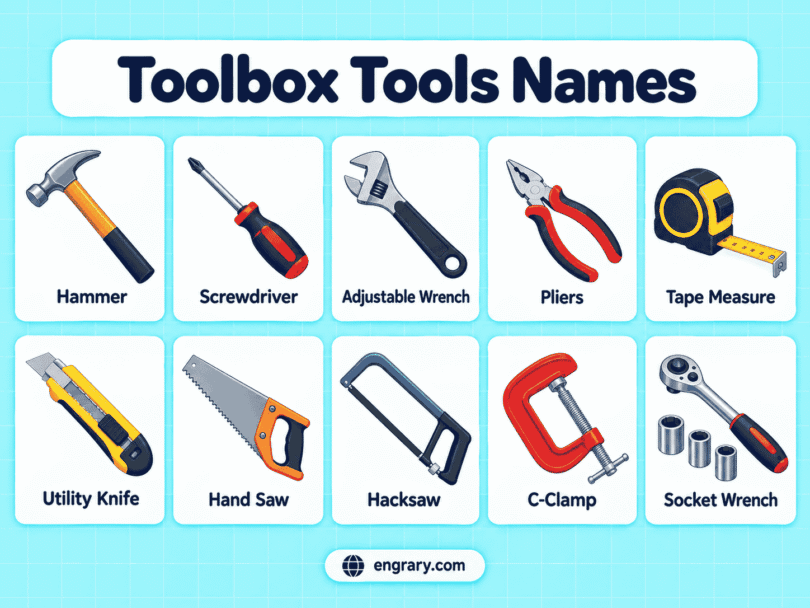
A well-stocked toolbox keeps everyday repair, assembly, measuring, cutting, and maintenance tools together in one convenient place. Learning common toolbox tools names in English helps you recognize practical tools used around the home, garage, workshop, and DIY projects.
This article introduces 40 common tools that realistically fit in a toolbox, along with their main uses. You will also learn which tools suit everyday repairs, what belongs in a starter toolbox, how common storage options differ, and which toolbox items are accessories or supplies rather than tools.
What Is a Toolbox?
A toolbox is a container that stores and organizes tools for repair, maintenance, assembly, and DIY work.
Toolboxes may be portable or form part of a larger storage system. Small portable boxes commonly hold screwdrivers, pliers, wrenches, hammers, measuring tools, cutting tools, and other compact repair items.
The toolbox itself is a storage item rather than a tool.
Common Tools Found in a Toolbox
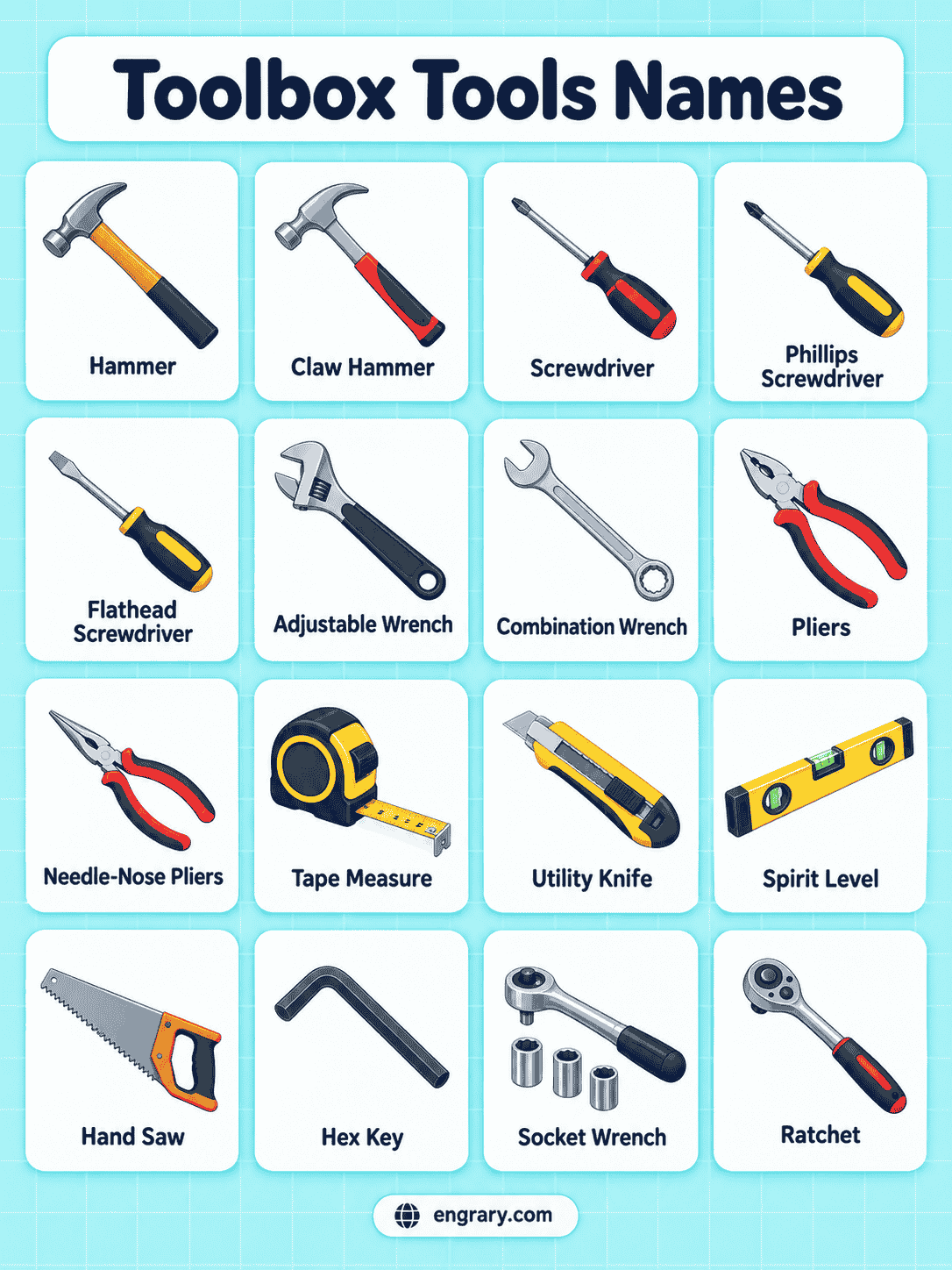
A toolbox usually holds basic tools for measuring, tightening, cutting, fastening, and small repair jobs. Learning these tool names helps beginners and English learners recognize common equipment used at home, in workshops, and during maintenance tasks.
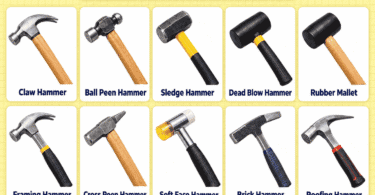
Hammer
A hammer drives nails, removes them, and handles light striking tasks.
Screwdriver
A screwdriver tightens or loosens screws during repair and assembly work.
Phillips Screwdriver
A Phillips screwdriver has a cross-shaped tip that fits matching screw heads.
Flathead Screwdriver
A flathead screwdriver uses a straight, flat tip for screws with a single slot.
Pliers
Pliers grip, bend, twist, and hold wires or small objects.
Needle-Nose Pliers
Needle-nose pliers have long, narrow jaws for reaching small parts and tight spaces.
Adjustable Wrench
An adjustable wrench uses a movable jaw to fit nuts and bolts of different sizes.
Combination Wrench
A combination wrench has an open end and a ring-shaped end for turning fasteners.
Socket Wrench
A socket wrench works with removable sockets to tighten or loosen nuts and bolts.
Allen Key
An Allen key turns screws and bolts with hexagonal sockets.
Tape Measure
A tape measure checks length, width, height, and distance.
Utility Knife
A utility knife cuts cardboard, plastic, rope, packaging, and other thin materials.
Wire Cutter
A wire cutter cuts electrical wire, cable, and thin metal.
Level
A level helps check whether a surface sits straight, horizontal, or vertical.
Claw Hammer
A claw hammer drives nails with one end and pulls them out with the curved claw.
Adjustable Pliers
Adjustable pliers widen or narrow their jaws to grip objects of different sizes.
Ratchet
A ratchet turns sockets while allowing repeated movement without removing the tool from the fastener.
Small Saw
A small hand saw cuts wood, plastic, or other light materials during basic repair work.
File
A file smooths rough edges and shapes wood, metal, or plastic surfaces.
Flashlight
A flashlight provides portable light when working in dark corners, cabinets, or poorly lit spaces.
Tools You’re Most Likely to Keep in a Toolbox
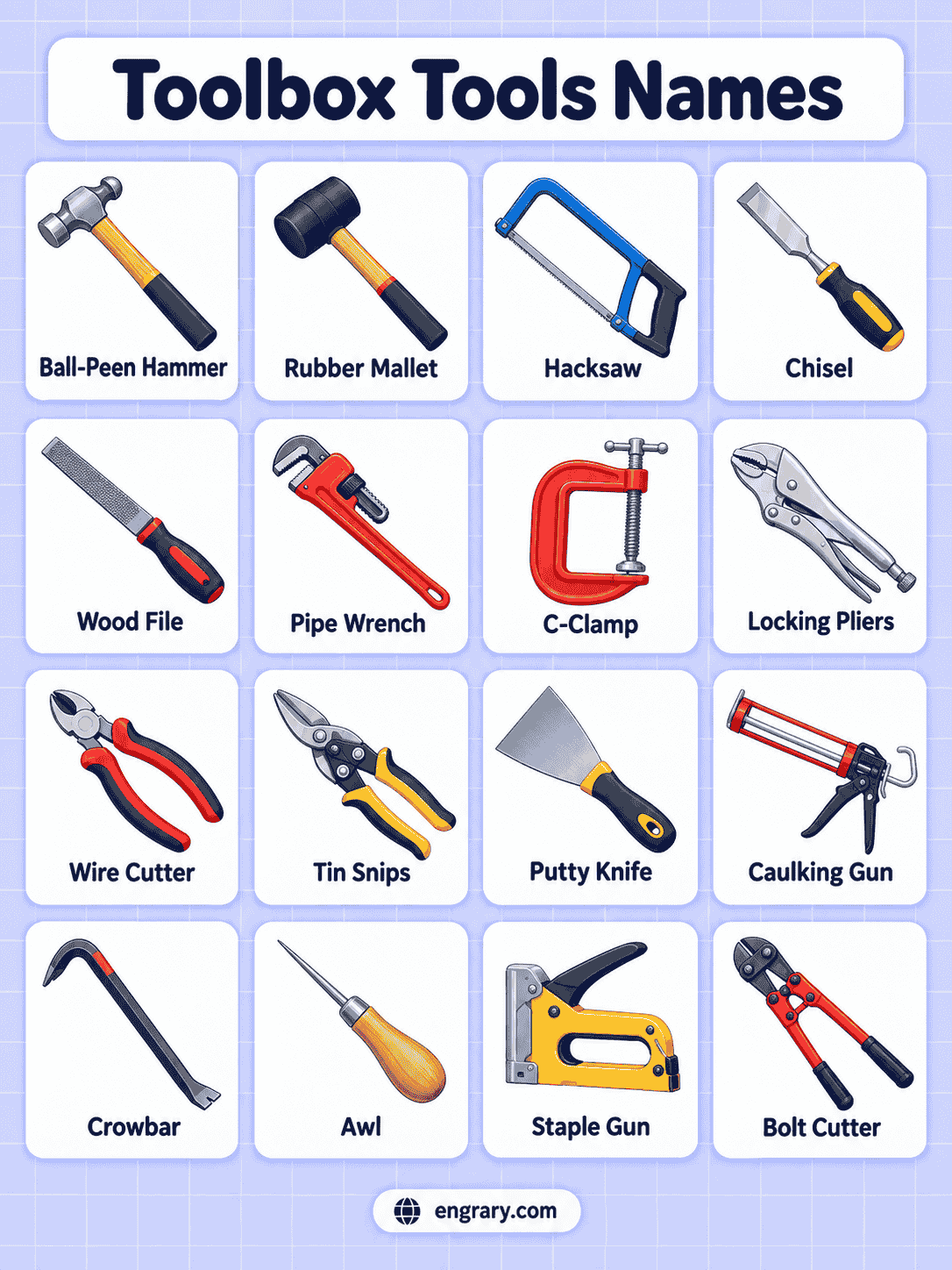
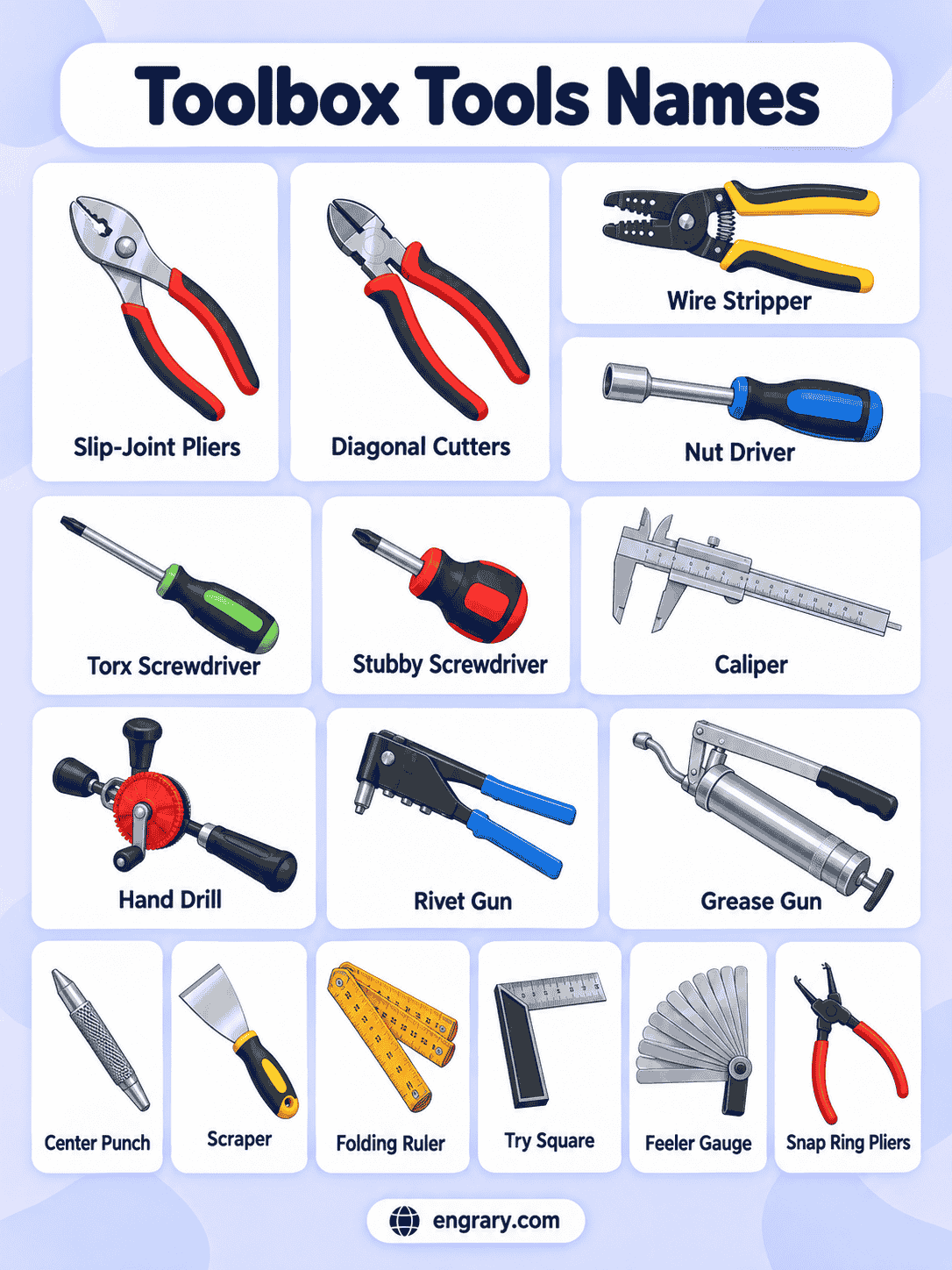
The following list contains exactly 40 distinct tools that suit common household, repair, maintenance, and DIY work.
Screwdrivers and Hex Tools
Flathead Screwdriver
Turns screws with a single straight slot across the head.
Phillips Screwdriver
Fits cross-shaped Phillips screws commonly found in furniture, fixtures, and household items.
Torx Screwdriver
Turns star-shaped Torx screws used in appliances, vehicles, electronics, and equipment.
Ratcheting Screwdriver
Speeds up repeated screwdriving through a mechanism that resets the handle without removing the tip.
Allen Key
Tightens and loosens hex-socket screws commonly found in flat-pack furniture and machinery.
Nut Driver
Turns small nuts and hex-head fasteners with a socket-style shaft and screwdriver-like handle.
Pliers and Gripping Tools
Combination Pliers
Grip, bend, twist, and cut wire or other small materials.
Needle-Nose Pliers
Reach narrow spaces and hold small components with long tapered jaws.
Slip-Joint Pliers
Adjust their jaw opening to grip objects of different sizes.
Locking Pliers
Clamp tightly onto a workpiece and maintain pressure without continuous hand force.
Diagonal Cutters
Cut electrical wire, cable ties, and other small wire-like materials.
Tongue-and-Groove Pliers
Grip pipes, fittings, and larger irregular objects with widely adjustable jaws.
Wrenches and Socket Tools
Adjustable Wrench
Changes jaw width to fit several sizes of nuts, bolts, and fittings.
Combination Wrench
Provides an open end and a closed box end for different turning jobs.
Socket Wrench
Uses interchangeable sockets to tighten or loosen fasteners of different sizes.
Ratchet
Drives sockets repeatedly while allowing the handle to reset without removing the tool.
Torque Wrench
Tightens nuts and bolts to a specified amount of torque.
Spark Plug Socket
Fits around spark plugs for removal and installation during basic engine maintenance.
Hammers and Striking Tools
Claw Hammer
Drives nails and pulls them out with its curved claw.
Ball-Peen Hammer
Shapes metal and handles light mechanical or metalworking jobs.
Rubber Mallet
Positions materials with softer blows that reduce surface marks and damage.
Nail Set
Drives nail heads slightly below a wooden surface for a cleaner finish.
Cutting and Scraping Tools
Utility Knife
Cuts cardboard, plastic, carpet, tape, drywall, and other lightweight materials.
Hacksaw
Cuts metal, plastic, bolts, and small pipes with a fine-toothed blade.
Small Hand Saw
Handles basic wood-cutting jobs where a compact manual saw is sufficient.
Wire Cutter
Cuts electrical wire and thin metal strands cleanly.
Putty Knife
Spreads filler or putty and scrapes small amounts of loose material from surfaces.
Scraper
Removes old paint, adhesive, labels, residue, and dried material.
Measuring and Layout Tools
Tape Measure
Checks length, width, height, spacing, and distance during repair and installation work.
Spirit Level
Checks whether shelves, frames, fixtures, and other objects sit level or plumb.
Combination Square
Checks right angles, marks straight lines, and measures short depths.
Steel Rule
Measures short distances and provides a firm straight edge for marking.
Chalk Line
Creates long straight reference lines across walls, floors, timber, and other surfaces.
Holding and Small Repair Tools
C-Clamp
Holds materials firmly during gluing, drilling, cutting, or small repair jobs.
Spring Clamp
Provides quick light-pressure holding through spring-loaded jaws.
Awl
Pierces small holes and marks precise starting points in wood, leather, and similar materials.
Hand File
Smooths rough edges and removes small amounts of material.
Wood Chisel
Cuts, trims, and shapes wood with a sharpened beveled edge.
Small Pry Bar
Lifts, separates, and removes trim, boards, nails, or fitted materials with leverage.
Caulking Gun
Dispenses sealant neatly into joints, gaps, cracks, and edges.
Toolbox Tools for Everyday Repairs
Different household jobs call for different combinations of basic tools.
Furniture Assembly
A Phillips Screwdriver, Allen Key, Adjustable Wrench, and Combination Pliers cover many furniture fasteners and fittings.
Hanging Pictures and Shelves
A Tape Measure helps position the item, a Spirit Level checks alignment, and a Claw Hammer handles nails.
Loose Screws and Hinges
Flathead, Phillips, Torx, and Ratcheting Screwdrivers handle common screw types around doors, cabinets, furniture, and appliances.
Minor Plumbing Jobs
An Adjustable Wrench and Tongue-and-Groove Pliers help grip and turn common fittings.
Cutting and Opening Materials
A Utility Knife handles packaging and lightweight sheet materials, while a Hacksaw cuts metal or plastic.
Holding Parts During Repair
C-Clamps, Spring Clamps, and Locking Pliers keep materials steady while you work.
Small Surface Repairs
A Putty Knife spreads filler, a Scraper removes loose material, and a Caulking Gun seals gaps or joints.
Starter Toolbox vs Expanded Toolbox
A starter toolbox covers common household jobs, while an expanded toolbox handles a wider range of repairs.
| Starter Toolbox | Expanded Toolbox |
|---|---|
| Claw Hammer | Ball-Peen Hammer |
| Phillips Screwdriver | Torx Screwdriver |
| Flathead Screwdriver | Ratcheting Screwdriver |
| Combination Pliers | Locking Pliers |
| Adjustable Wrench | Socket Wrench |
| Tape Measure | Combination Square |
| Utility Knife | Hacksaw |
| Spirit Level | C-Clamp |
| Allen Key | Torque Wrench |
A beginner does not need every specialized tool immediately. Adding tools as new repair needs appear keeps the toolbox practical rather than overcrowded.
Small Tools That Fit Easily in a Toolbox
Compact tools are especially useful because they take little space while handling many routine jobs.
Examples include:
- Allen Key
- Nut Driver
- Screwdrivers
- Needle-Nose Pliers
- Diagonal Cutters
- Utility Knife
- Steel Rule
- Awl
- Nail Set
- Hand File
Small size does not necessarily mean limited usefulness. An Allen Key, for example, can assemble furniture, while a small awl can mark drilling points and start holes accurately.
Tools That Usually Stay Outside the Toolbox
Some tools are too large, heavy, or fixed to fit inside an ordinary portable toolbox.
Examples include:
Drill Press
Usually stays fixed to a bench or stand for controlled drilling.
Table Saw
Requires a dedicated work area rather than portable toolbox storage.
Bench Grinder
Normally remains mounted to a workbench.
Large Sledgehammer
Fits better in larger workshop or site storage because of its size.
Air Compressor
Supplies compressed air to pneumatic tools but functions as workshop equipment.
Workbench
Provides a working surface rather than portable tool storage.
Concrete Mixer
Belongs to construction equipment rather than a household toolbox.
A tool can still be useful without being a realistic toolbox item.
Toolbox Tools Beginners Often Confuse
Some toolbox tools look similar or perform related jobs, but their designs and main uses differ.
| Tools | Main Difference |
|---|---|
| Flathead Screwdriver vs Phillips Screwdriver | A flathead screwdriver fits a single straight slot, while a Phillips screwdriver fits a cross-shaped recess. |
| Adjustable Wrench vs Combination Wrench | An adjustable wrench changes jaw width to fit several sizes, while a combination wrench has fixed-size ends. |
| Combination Pliers vs Needle-Nose Pliers | Combination pliers handle general gripping, bending, and cutting, while needle-nose pliers reach small parts and narrow spaces more easily. |
| Hand Saw vs Hacksaw | A hand saw mainly cuts wood, while a hacksaw commonly cuts metal, plastic, bolts, and tubing. |
| C-Clamp vs Locking Pliers | A C-clamp applies steady pressure across a workpiece, while locking pliers grip an object directly and lock their jaws in place. |
| Utility Knife vs Putty Knife | A utility knife cuts material with a sharp blade, while a putty knife spreads filler and scrapes surfaces. |
| Socket Wrench vs Ratchet | A socket wrench is the socket-based turning system, while the ratchet is the handle mechanism that drives interchangeable sockets. |
The main difference usually comes down to shape, grip, material, or the specific job each tool performs.
Toolbox vs Tool Bag vs Tool Chest
Different storage options suit different amounts of tools and types of work.
| Storage Type | Best Use |
|---|---|
| Toolbox | Portable storage for everyday repair tools |
| Tool Bag | Flexible transport of mixed or irregularly shaped tools |
| Tool Chest | Larger organized storage for an extensive tool collection |
| Tool Belt | Keeps a small working set within reach during a job |
A toolbox works well for home repairs and general maintenance. A tool bag offers more flexibility, while a tool chest suits a larger workshop collection.
A tool belt carries only the tools needed during active work rather than storing an entire collection.
What Belongs in a Toolbox but Is Not a Tool?
Toolboxes often contain useful supplies and accessories alongside actual tools.
Screws
Fasten materials together.
Nails
Join wood and other suitable materials.
Wall Plugs
Provide anchors for screws in masonry or drywall.
Washers
Distribute pressure beneath nuts or bolt heads.
Drill Bits
Attach to drills to create different types and sizes of holes.
Utility Blades
Replace worn blades in utility knives.
Electrical Tape
Insulates and bundles electrical wires.
Sandpaper
Smooths surfaces through abrasive particles.
These items belong to categories such as fasteners, accessories, consumables, or repair supplies rather than tools themselves.
FAQs
A basic toolbox should include a claw hammer, flathead and Phillips screwdrivers, combination pliers, adjustable wrench, Allen keys, utility knife, tape measure, and spirit level.
Common toolbox tools include screwdrivers, pliers, wrenches, hammers, utility knives, tape measures, levels, files, clamps, saws, and socket tools.
A toolbox usually provides portable storage for a smaller tool collection, while a tool chest offers larger organized storage and often stays in a workshop or garage.
Screwdrivers, a claw hammer, combination pliers, adjustable wrench, utility knife, tape measure, spirit level, Allen keys, and a small clamp handle many routine household repairs.
Toolboxes often contain screws, nails, wall plugs, washers, drill bits, replacement blades, electrical tape, and sandpaper. These are fasteners, accessories, or repair supplies rather than tools.
You May Also Like



Leave a Comment