
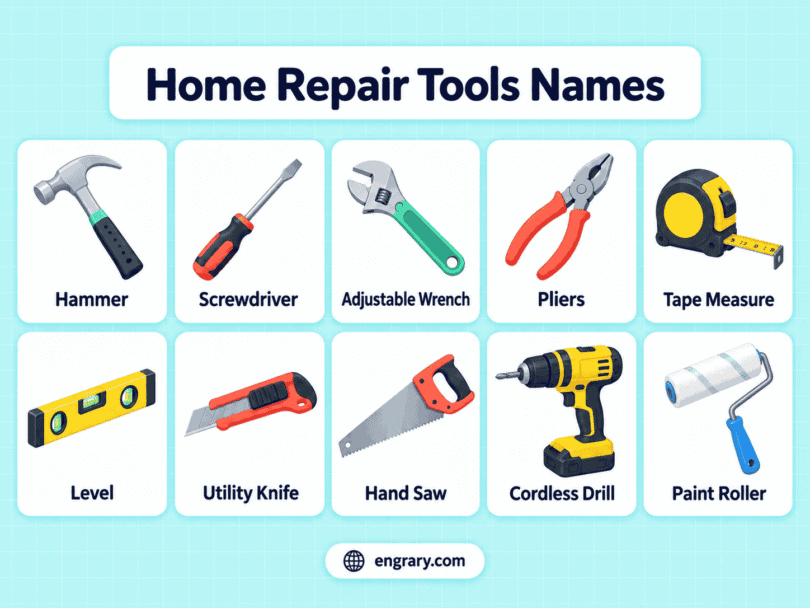
Home repair tools help with everyday jobs such as hanging shelves, tightening furniture, clearing drains, sealing gaps, patching walls, fixing loose hardware, and installing household fixtures. Learning common home repair tools names in English makes it easier to recognize useful tools and understand vocabulary for maintenance and DIY work around the house.
This article introduces 50 practical home repair tools and explains where they are most useful. You will also see which tools suit different rooms, how a basic repair kit differs from a larger DIY kit, which similar tools are easy to confuse, and which supplies support repairs without actually being tools.
Tools Used for Everyday Home Repairs
Home repair tools help fix, adjust, install, maintain, or improve furniture, walls, plumbing, fixtures, fittings, trim, and other parts of a home.
Some rely entirely on hand force, while others use electricity or rechargeable batteries.
For example:
Claw Hammer
Drives nails and removes them during hanging, furniture, and light repair jobs.
Adjustable Wrench
Turns nuts, bolts, and fittings during plumbing, furniture, and general maintenance.
Cordless Drill
Drills holes and drives screws when installing shelves, fixtures, furniture, and hardware.
A useful home repair collection usually combines measuring, fastening, gripping, cutting, plumbing, electrical, sealing, and drilling tools.
Everyday Tools for Fixes Around the House
Everyday Tools for Fixes Around the House
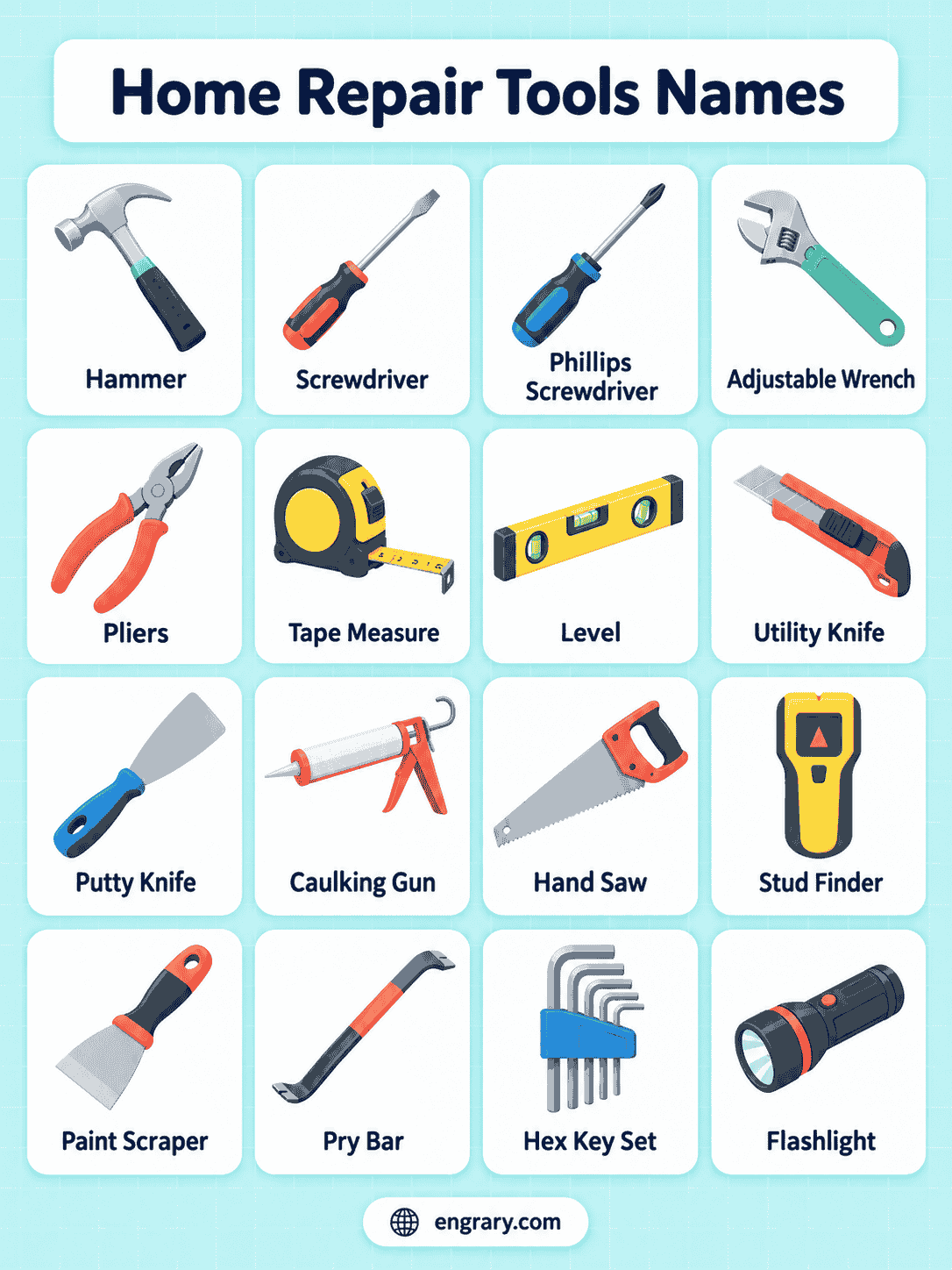
Small household repairs often require simple tools for tightening, measuring, cutting, fastening, or adjusting everyday items. Learning these tool names helps beginners and English learners recognize useful equipment for common home maintenance tasks.
Hammer
A hammer drives nails, removes them, and helps with simple repair and hanging jobs.
Screwdriver
A screwdriver tightens or loosens screws in furniture, appliances, handles, and fixtures.
Phillips Screwdriver
A Phillips screwdriver uses a cross-shaped tip for matching screws commonly found around the home.
Flathead Screwdriver
A flathead screwdriver has a straight tip that fits screws with a single slot.
Pliers
Pliers grip, bend, twist, and hold small parts, wires, or fittings during repairs.
Adjustable Wrench
An adjustable wrench fits nuts and bolts of different sizes with its movable jaw.
Tape Measure
A tape measure checks length, width, height, and distance before installing or moving household items.
Utility Knife
A utility knife cuts cardboard, plastic, rope, packaging, and other thin materials.
Allen Key
An Allen key turns screws with hexagonal sockets commonly found in flat-pack furniture.
Level
A level checks whether shelves, frames, cabinets, and other surfaces sit straight.
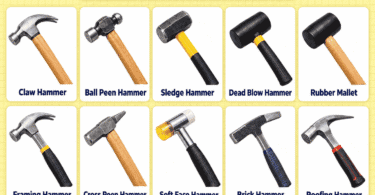
Claw Hammer
A claw hammer drives nails with one side and pulls them out with the curved claw.
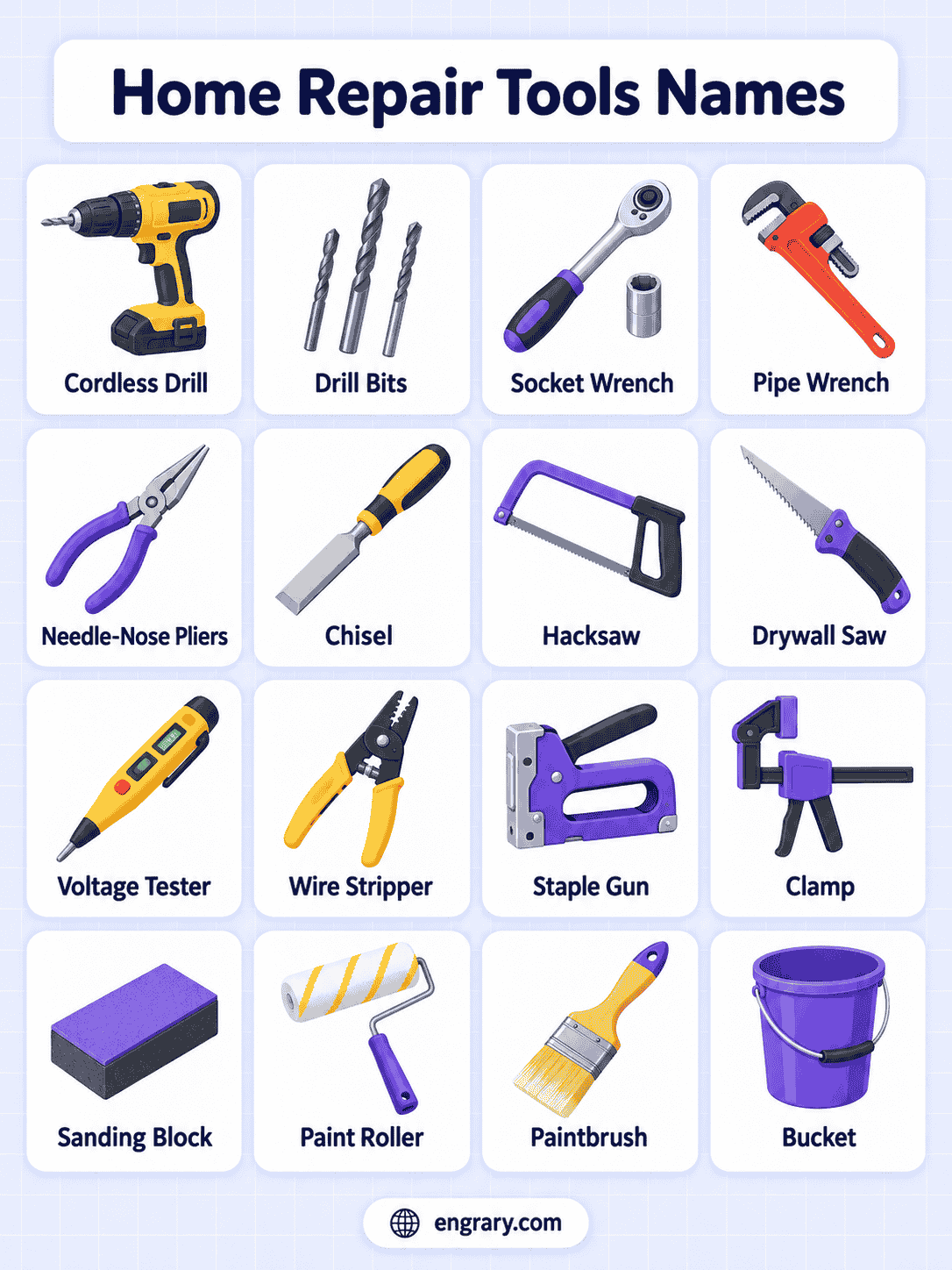
Needle-Nose Pliers
Needle-nose pliers reach narrow spaces and grip small wires, screws, or parts.
Wire Cutter
A wire cutter cuts thin electrical wire, cable, and similar materials.
Adjustable Pliers
Adjustable pliers widen or narrow to grip pipes, fittings, and objects of different sizes.
Socket Wrench
A socket wrench tightens and loosens nuts and bolts with interchangeable sockets.
Hand Saw
A hand saw cuts wood and other light materials during small repair projects.
Cordless Drill
A cordless drill makes holes and drives screws quickly without a power cord.
Flashlight
A flashlight provides light when working under sinks, behind furniture, or in dark spaces.
Putty Knife
A putty knife spreads filler, removes loose material, and helps with small wall repairs.
Caulking Gun
A caulking gun applies sealant around sinks, windows, tubs, and other joints to help close gaps.
The complete list below contains exactly 50 distinct tools, organized around the repairs people commonly handle at home.
Tools for Common Problems at Home
Hanging Pictures, Shelves, and Wall Items
These tools help measure spaces, locate support behind walls, check alignment, and position wall-mounted items accurately.
Tape Measure
Checks width, height, spacing, and distance before hanging pictures, shelves, mirrors, or fixtures.
Spirit Level
Checks whether shelves, frames, cabinets, and other items sit level or plumb.
Stud Finder
Locates wall framing behind drywall so heavier fixtures can attach to solid support.
Torpedo Level
Checks alignment in confined spaces with a short, compact body.
Chalk Line
Creates long, straight reference lines across walls, floors, and other surfaces.
Claw Hammer
Drives nails into wood or wall supports and removes them with its curved claw.
Combination Square
Checks right angles and marks short straight lines during layout and installation work.
Fixing Furniture and Cabinets
Furniture, drawers, cabinet handles, hinges, and flat-pack items often need simple turning and tightening tools.
Flathead Screwdriver
Turns screws with a single straight slot.
Phillips Screwdriver
Fits common cross-shaped screws found in furniture, cabinets, fixtures, and appliances.
Ratcheting Screwdriver
Speeds up repeated screwdriving without requiring constant handle repositioning.
Allen Key
Tightens hex-socket screws commonly found in flat-pack furniture, beds, tables, and shelving.
Nut Driver
Turns small nuts and hex-head fasteners with a socket-style shaft and screwdriver-like handle.
Adjustable Wrench
Changes jaw width to fit several sizes of nuts, bolts, and household fittings.
Sink, Faucet, and Drain Repairs
Minor plumbing jobs require tools that can grip fittings, reach awkward nuts, cut tubing, or clear blockages.
Basin Wrench
Reaches mounting nuts beneath sinks and faucets where ordinary wrenches struggle to fit.
Pipe Wrench
Grips and turns threaded metal pipes and sturdy plumbing fittings.
Tongue-and-Groove Pliers
Adjust their wide jaws to grip pipes, fittings, and irregular plumbing parts.
Plunger
Uses pressure and suction to clear simple blockages in sinks, drains, and toilets.
Drain Snake
Reaches deeper into drain lines to loosen or retrieve stubborn clogs.
Tube Cutter
Makes clean, controlled cuts through suitable plumbing tubing.
Doors, Hinges, and Loose Hardware
Doors, handles, brackets, clips, and small household parts often require gripping, bending, or cutting tools.
Combination Pliers
Grip, bend, twist, and cut wire or small household components.
Needle-Nose Pliers
Reach narrow spaces and hold small clips, wires, screws, or fittings with long tapered jaws.
Locking Pliers
Clamp firmly onto damaged fasteners, metal parts, and awkward objects.
Slip-Joint Pliers
Adjust their jaw opening to grip household objects of different sizes.
Diagonal Cutters
Cut wire, cable ties, and other thin materials cleanly.
Electrical Fixtures and Small Repairs
These tools help identify electrical conditions and work with wires or fixture hardware. Electrical repairs should stay within the user’s knowledge and local safety requirements.
Non-Contact Voltage Tester
Detects the presence of electrical voltage without requiring direct contact with bare conductors.
Receptacle Tester
Checks common wiring conditions in household electrical outlets.
Wire Stripper
Removes insulation from electrical wire while leaving the conductor intact.
Linesman Pliers
Grip, twist, bend, and cut electrical wire with strong broad jaws.
Insulated Screwdriver
Turns electrical fixture screws while providing additional insulation around the shaft and handle.
Patching Walls and Repairing Surfaces
Small wall holes, peeling paint, damaged filler, and rough surfaces require tools that cut, spread, scrape, and smooth.
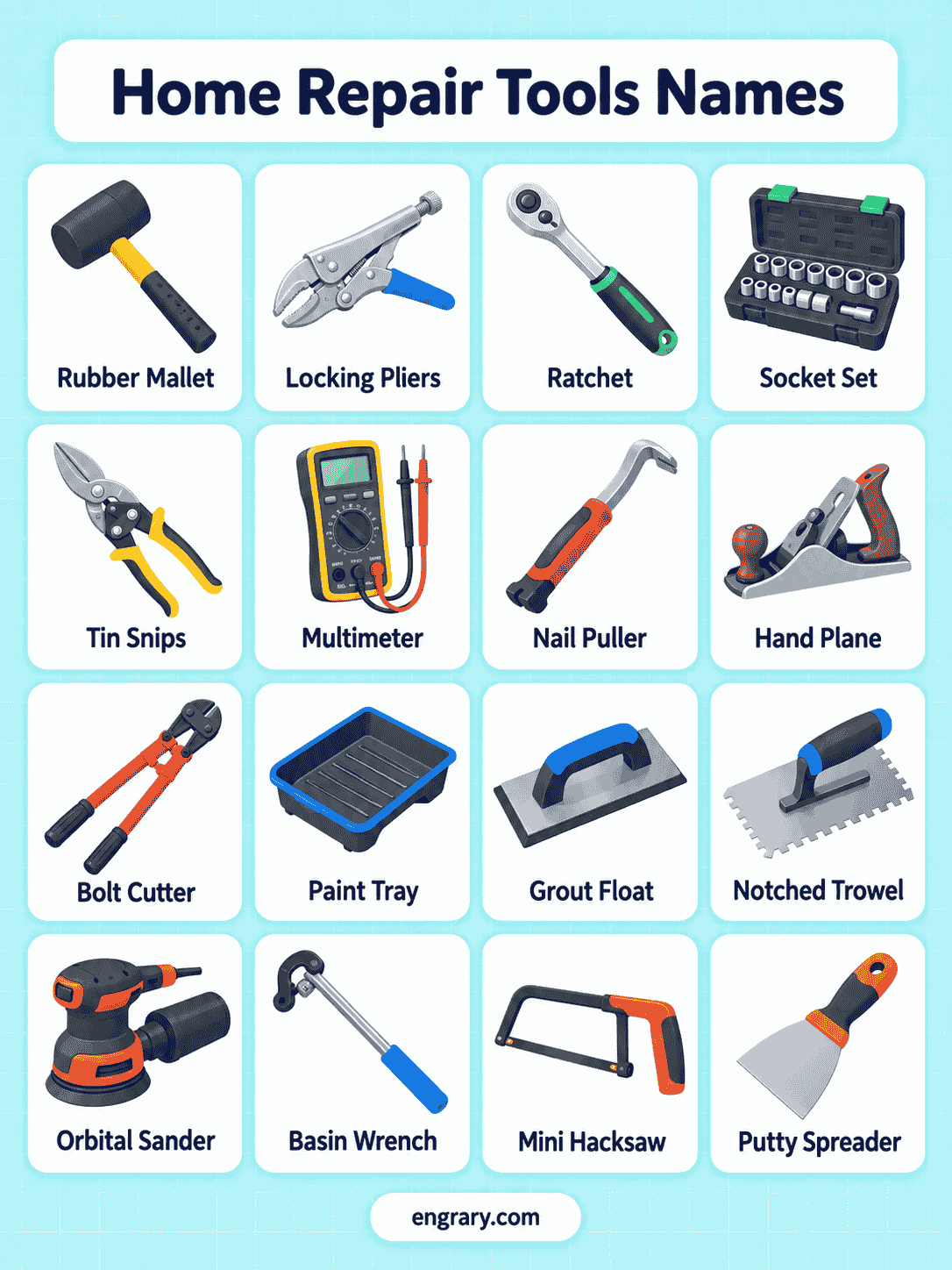
Utility Knife
Cuts drywall facing, plastic, tape, packaging, and other lightweight repair materials.
Putty Knife
Spreads filler and putty across holes, cracks, dents, and minor surface damage.
Paint Scraper
Removes loose paint, old coatings, adhesive, and flaky surface material.
Hand File
Smooths rough edges and gradually removes small amounts of wood, metal, or plastic.
Sanding Block
Supports abrasive paper and provides even hand pressure while smoothing repaired areas.
Drywall Taping Knife
Spreads joint compound across drywall seams, patches, and larger wall repairs.
Sealing Gaps and Joints
Finishing small gaps and refreshed surfaces often requires application tools rather than heavy repair equipment.
Caulking Gun
Dispenses sealant into gaps around windows, sinks, bathtubs, trim, and joints.
Grout Float
Pushes grout into tile joints and helps remove excess grout from the surface.
Paint Brush
Applies paint precisely to trim, edges, corners, and smaller repaired areas.
Paint Roller
Covers larger wall or ceiling areas efficiently after patching or surface preparation.
Fixing Wood and Trim
Small carpentry jobs around the home may involve cutting molding, adjusting timber, holding pieces together, or fitting joints.
Hand Saw
Cuts timber, boards, and other suitable materials manually.
Coping Saw
Creates curved and detailed cuts in trim, molding, and thin wood.
Wood Chisel
Trims, carves, and shapes wood during small fitting and repair jobs.
Rubber Mallet
Positions wood, flooring, furniture parts, and other materials without leaving hard metal impact marks.
C-Clamp
Holds pieces firmly during gluing, drilling, cutting, or small wood repairs.
Drilling and Installing Fixtures
Powered tools make installation work faster when a job involves repeated drilling, fastening, cutting, or nailing.
Cordless Drill
Drills holes and drives screws for shelves, brackets, furniture, and household fixtures.
Impact Driver
Drives long screws and stubborn fasteners with high rotational force.
Electric Screwdriver
Handles repeated light screwdriving during furniture assembly and fixture installation.
Oscillating Multi-Tool
Cuts, scrapes, trims, and sands in confined areas through interchangeable attachments.
Brad Nailer
Drives thin brad nails into trim, molding, and lightweight wooden pieces.
Small Pry Bar
Lifts trim, separates fitted pieces, and removes small boards or fastened components.
Useful Tools for Different Rooms
Different rooms create different repair needs, so the most useful tools change throughout the house.
| Area | Useful Tools |
|---|---|
| Kitchen | Adjustable Wrench, Screwdriver, Caulking Gun, Combination Pliers |
| Bathroom | Plunger, Basin Wrench, Tongue-and-Groove Pliers, Caulking Gun |
| Living Room | Tape Measure, Spirit Level, Stud Finder, Claw Hammer |
| Bedroom | Allen Key, Phillips Screwdriver, Cordless Drill |
| Garage | Adjustable Wrench, Pliers, Utility Knife, Impact Driver |
| Utility Area | Voltage Tester, Wire Stripper, Adjustable Wrench |
| Hallway | Tape Measure, Stud Finder, Spirit Level, Cordless Drill |
The same versatile tool may appear in several rooms because many household repairs share common measuring, fastening, and gripping tasks.
Basic Home Repair Kit vs Expanded DIY Kit
A basic repair kit handles routine maintenance, while an expanded DIY kit supports more involved installation and improvement projects.
| Basic Home Repair Kit | Expanded DIY Kit |
|---|---|
| Claw Hammer | Small Pry Bar |
| Phillips Screwdriver | Ratcheting Screwdriver |
| Adjustable Wrench | Additional Socket and Wrench Tools |
| Combination Pliers | Locking Pliers |
| Tape Measure | Combination Square |
| Spirit Level | Stud Finder |
| Utility Knife | Oscillating Multi-Tool |
| Cordless Drill | Impact Driver |
A beginner can start with versatile essentials and add more specialized tools when new repair needs arise.
Similar Tools and How They Differ
Several home repair tools perform related jobs, but their designs suit different situations.
| Tools | Main Difference |
|---|---|
| Stud Finder vs Spirit Level | A stud finder locates framing behind a wall, while a spirit level checks whether an object sits straight. |
| Putty Knife vs Paint Scraper | A putty knife spreads filler and handles light scraping, while a paint scraper focuses on removing old coatings and loose material. |
| Adjustable Wrench vs Tongue-and-Groove Pliers | An adjustable wrench turns flat-sided fasteners, while tongue-and-groove pliers grip round or irregular fittings. |
| Cordless Drill vs Impact Driver | A cordless drill creates holes and drives screws, while an impact driver specializes in higher-torque fastening. |
| Caulking Gun vs Putty Knife | A caulking gun dispenses sealant, while a putty knife spreads filler and smooths small surface repairs. |
| Plunger vs Drain Snake | A plunger clears simple blockages through pressure and suction, while a drain snake reaches farther into the drain line. |
| Hand Saw vs Coping Saw | A hand saw handles general straight cuts, while a coping saw creates tighter curves and detailed cuts. |
The main difference usually comes down to the material, location, grip, or type of repair each tool handles best.
Tools That Handle the Most Everyday Repairs
A small group of versatile tools can cover a large share of routine household maintenance.
Cordless Drill
Handles drilling and screwdriving for shelves, fixtures, furniture, and installations.
Phillips Screwdriver
Fits one of the most common screw types found throughout the home.
Adjustable Wrench
Handles different nut, bolt, and fitting sizes without requiring several fixed wrenches.
Combination Pliers
Grip, bend, pull, twist, and cut small materials.
Claw Hammer
Covers basic nailing and nail-removal jobs.
Tape Measure
Supports nearly every job that requires spacing, positioning, sizing, or fitting.
Spirit Level
Keeps shelves, frames, fixtures, and furniture aligned.
Utility Knife
Cuts packaging and many lightweight repair materials.
Caulking Gun
Handles sealing around sinks, tubs, windows, trim, and joints.
Plunger
Solves many simple household drain and toilet blockages.
These multi-purpose tools form a practical foundation for everyday home maintenance.
Other Useful Supplies for Home Repairs
Repair work also depends on supplies and accessories that are not tools themselves.
Wall Plugs
Anchor screws in suitable wall materials.
Screws and Nails
Join or secure household components.
Sandpaper
Smooths patched, painted, or wooden surfaces through abrasive action.
Electrical Tape
Insulates or bundles electrical wires where appropriate.
Drill Bits
Attach to a drill and create holes of different sizes in suitable materials.
Replacement Utility Blades
Restore a sharp cutting edge to a utility knife.
Caulk
Fills and seals gaps around fixtures, trim, windows, and joints.
Wall Filler
Fills small holes, dents, and cracks before sanding or painting.
These items support repair work as fasteners, accessories, consumables, or materials rather than functioning as tools themselves.
FAQs
Useful home repair tools include a cordless drill, screwdrivers, claw hammer, adjustable wrench, pliers, tape measure, spirit level, utility knife, caulking gun, and plunger.
A practical basic set includes a claw hammer, Phillips and flathead screwdrivers, combination pliers, adjustable wrench, tape measure, spirit level, utility knife, Allen keys, and a cordless drill.
Useful plumbing tools include an adjustable wrench, basin wrench, tongue-and-groove pliers, plunger, drain snake, and tube cutter.
A tape measure, stud finder, spirit level, claw hammer, combination square, and cordless drill help position and install shelves, frames, and wall fixtures accurately.
A basic kit covers routine household maintenance with versatile hand tools and a drill. An expanded DIY kit adds more specialized tools for installation, cutting, fastening, and larger improvement projects.
You May Also Like



Leave a Comment