
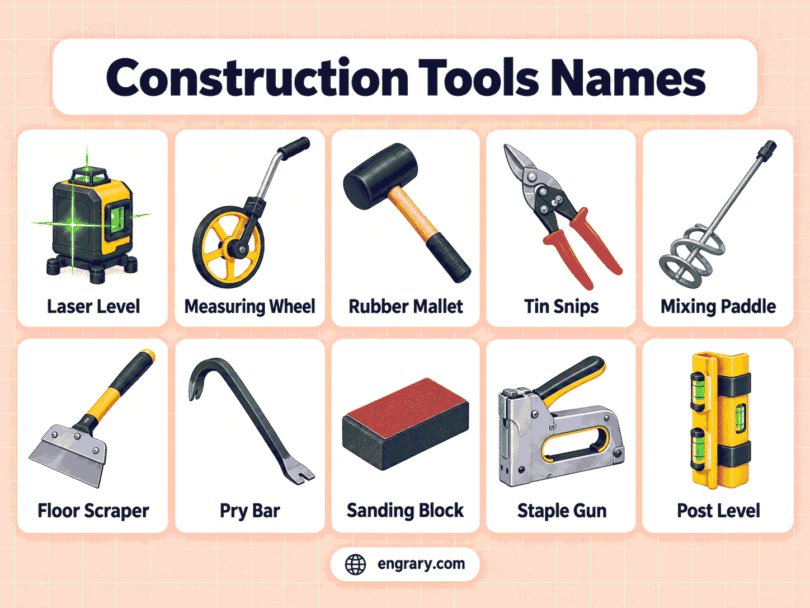
Construction tools help workers measure, mark, dig, cut, drill, fasten, level, shape, finish, and remove materials throughout a building project. Learning common construction tools names in English makes it easier to understand site vocabulary, recognize tools in pictures, and follow terms used in masonry, concrete work, framing, plastering, roofing, tiling, and demolition.
This article covers 60 common construction tools and their practical uses, grouped by the jobs they perform on a building site. You will also learn which tools suit different construction stages and trades, how manual and powered tools differ, which similar tools learners often confuse, and how tools differ from equipment and materials.
What Are Construction Tools?
Construction tools are tools that perform direct tasks during building, repair, installation, finishing, or demolition work.
They may measure dimensions, establish layout lines, move soil, cut materials, drill holes, spread mortar, finish concrete, drive fasteners, smooth surfaces, or remove existing structures.
For example:
Brick Trowel
Spreads and shapes mortar while laying bricks and blocks.
Spirit Level
Checks whether a surface sits level or plumb.
Rotary Hammer
Drills into concrete and masonry with strong powered hammering action.
Some construction tools operate manually, while others rely on electricity, batteries, compressed air, or another external power source.
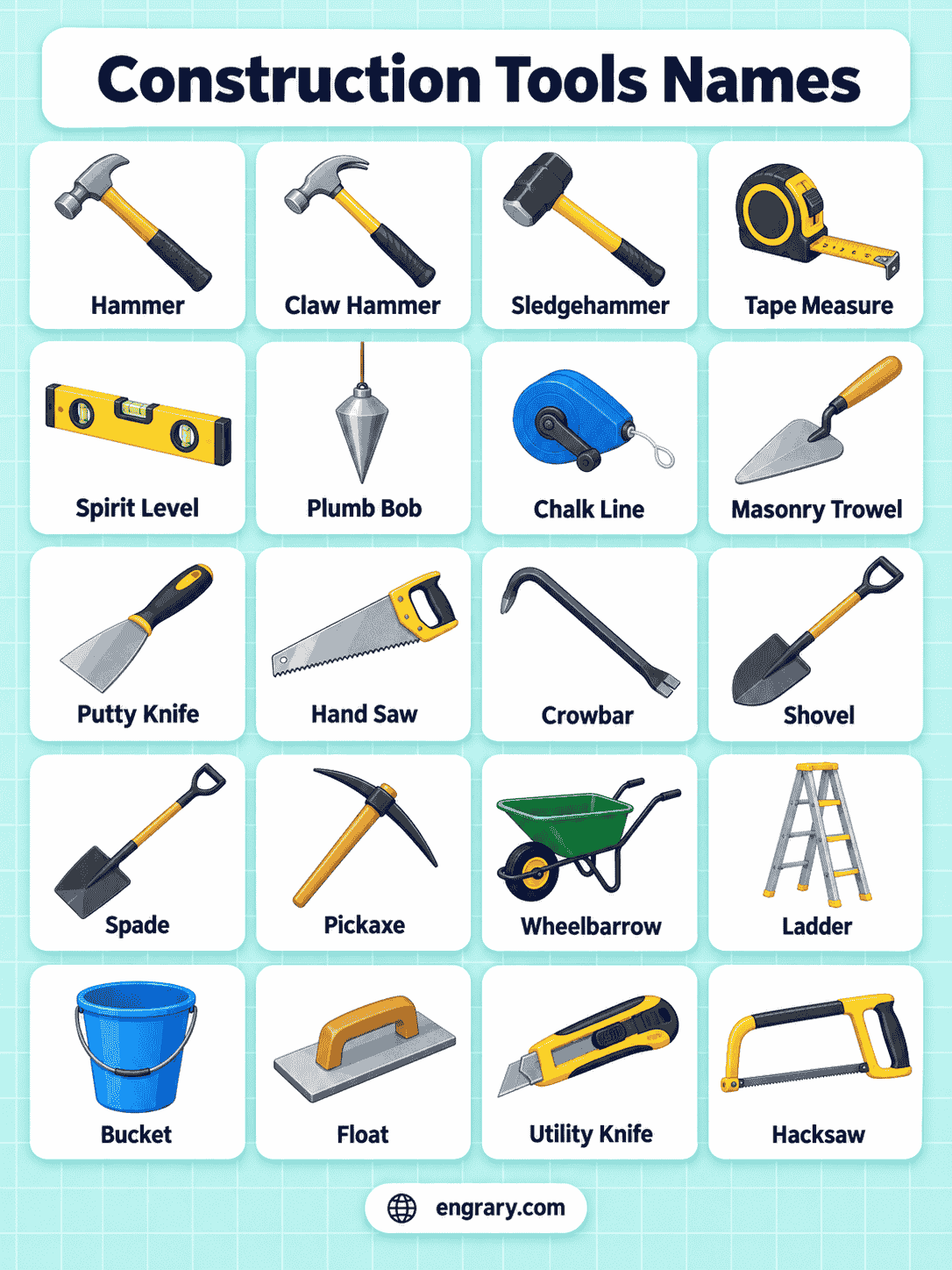
Common Construction with Pictures
Construction work uses many tools, machines, materials, and safety items to build and repair houses, roads, bridges, and other structures. Learning common construction names with pictures helps children and English learners recognize everyday building vocabulary more easily.
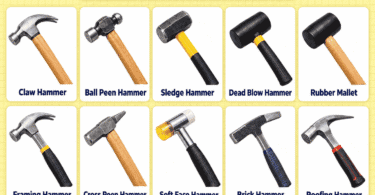
Hammer
A hammer drives nails into wood and helps with basic fastening and repair tasks.
Hard Hat
A hard hat protects the head from falling objects and other hazards on construction sites.
Cement Mixer
A cement mixer combines cement, sand, gravel, and water to prepare concrete.
Wheelbarrow
A wheelbarrow carries sand, bricks, concrete, tools, and other materials around a work site.
Shovel
A shovel helps workers dig soil and move sand, gravel, cement, or other loose materials.
Ladder
A ladder helps workers reach higher areas during building, painting, and installation work.
Drill
A drill makes holes in wood, metal, concrete, and other construction materials.
Saw
A saw cuts wood, plastic, metal, or other materials depending on the blade type.
Tape Measure
A tape measure checks length, width, height, and distance during construction work.
Spirit Level
A spirit level helps workers check whether a surface sits straight, horizontal, or vertical.
Brick
A brick is a solid building material commonly used for walls, foundations, and other structures.
Cement
Cement is a powdered binding material used to make concrete and mortar.
Concrete
Concrete combines cement, water, sand, and aggregate to create a strong construction material.
Scaffolding
Scaffolding provides temporary raised platforms where workers can stand and work safely at height.
Crane
A crane lifts and moves heavy materials such as steel beams, concrete sections, and equipment.
Excavator
An excavator uses a large digging arm and bucket to remove soil, dig foundations, and move materials.
Bulldozer
A bulldozer pushes soil, rocks, debris, and other heavy materials with a large front blade.
Dump Truck
A dump truck carries and unloads sand, gravel, soil, debris, and other construction materials.
Safety Vest
A safety vest uses highly visible material to help workers remain easy to see around vehicles and machinery.
Toolbox
A toolbox stores and organizes hand tools, fasteners, measuring equipment, and repair accessories.
Construction Tools for Different Building Jobs
Measuring, Layout, and Leveling Tools
Accurate construction begins with measurements, reference lines, angles, and alignment.
Tape Measure
Checks length, width, height, spacing, and other site dimensions with a flexible marked tape.
Spirit Level
Checks horizontal and vertical alignment through liquid-filled bubble vials.
Laser Level
Projects visible reference lines or points across walls, floors, and wider work areas.
Plumb Bob
Checks true vertical alignment with a pointed weight suspended from a string.
Chalk Line
Snaps long straight reference lines onto floors, walls, timber, and other surfaces.
Mason’s Square
Checks and marks right angles during masonry, framing, and layout work.
Measuring Wheel
Measures longer ground distances by recording wheel rotations as the user walks.
Masonry and Bricklaying Tools
Masonry tools help workers spread mortar, align courses, shape bricks, and finish joints.
Brick Trowel
Scoops, spreads, and shapes mortar while laying bricks, blocks, and stone.
Pointing Trowel
Handles small mortar joints, repairs, and detailed masonry work with a narrow blade.
Margin Trowel
Reaches tight areas and handles small amounts of mortar, adhesive, or patching material.
Brick Hammer
Cuts, chips, and shapes bricks while its hammer face handles light striking work.
Bolster Chisel
Cuts bricks, blocks, and masonry with a broad hardened cutting edge.
Joint Raker
Removes or shapes mortar from joints before repointing or finishing.
Mason’s Line
Provides a straight visual guide for keeping brick or block courses aligned.
Concrete Tools
Concrete tools help workers place, level, compact, shape, and finish fresh concrete.
Screed
Levels fresh concrete to the required height by removing excess material across the surface.
Bull Float
Smooths and levels broad concrete surfaces soon after screeding.
Hand Float
Refines smaller concrete areas and helps close minor surface imperfections.
Concrete Edger
Rounds and finishes exposed concrete edges to reduce sharp corners and chipping.
Concrete Groover
Forms control joints in fresh concrete to help manage cracking.
Concrete Vibrator
Removes trapped air and helps fresh concrete settle around reinforcement and formwork.
Concrete Tamper
Compacts and levels fresh concrete through repeated manual tamping.
Digging and Groundwork Tools
Groundwork tools prepare soil, trenches, post holes, and foundation areas before construction begins above ground.
Shovel
Lifts and moves soil, gravel, sand, and other loose construction materials.
Spade
Cuts into soil with a flat blade for edging, trenching, and controlled digging.
Pickaxe
Breaks hard soil, compacted ground, and rocky surfaces with a pointed and chisel-like head.
Mattock
Cuts roots, loosens compacted soil, and breaks ground with an adze and pick combination.
Digging Bar
Breaks compacted ground, loosens rocks, and helps lever heavy buried objects.
Trenching Shovel
Creates narrow trenches for pipes, cables, drainage, and other buried services.
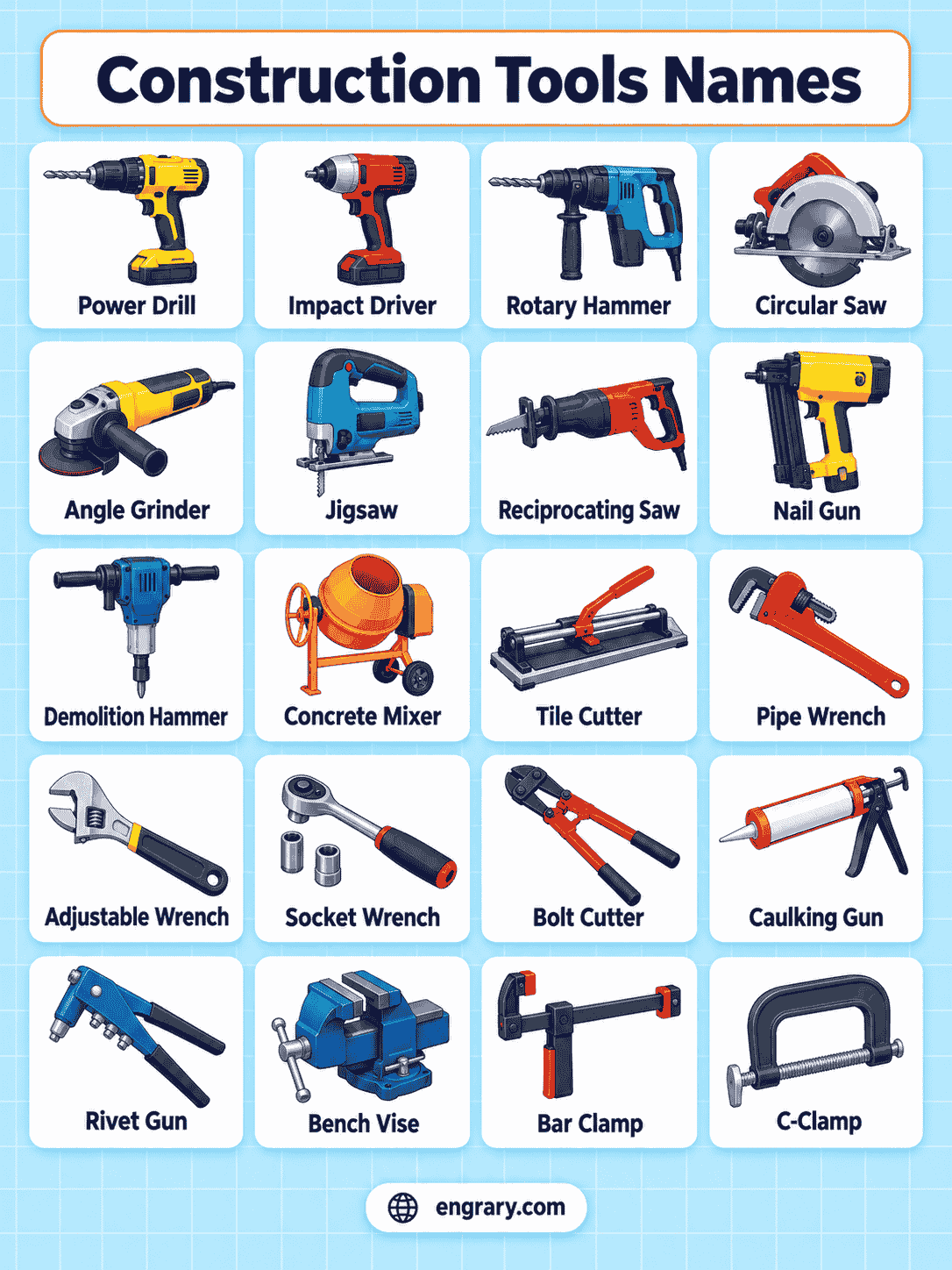
Cutting and Material-Shaping Tools
Construction requires different tools for cutting timber, metal, tiles, boards, and masonry.
Hand Saw
Cuts timber and other suitable materials manually with a toothed blade.
Hacksaw
Cuts metal, plastic, small pipes, and similar materials with a fine-toothed blade.
Circular Saw
Makes fast straight cuts through timber, boards, and suitable sheet materials.
Angle Grinder
Cuts, grinds, cleans, and shapes metal, masonry, tile, and other hard materials.
Utility Knife
Slices drywall, insulation, plastic sheeting, carpet, and other lightweight construction materials.
Tile Cutter
Scores and snaps ceramic or porcelain tiles along straight cutting lines.
Cold Chisel
Cuts and chips metal, masonry, and other hard materials when struck with a hammer.
Fastening and Drilling Tools
These tools create holes, drive screws, install nails, and secure construction materials.
Claw Hammer
Drives nails and removes them with a curved claw.
Screwdriver
Tightens and loosens screws during installation, assembly, and finishing work.
Cordless Drill
Drills holes and drives screws with rechargeable battery power.
Hammer Drill
Adds rapid hammering action to rotation for drilling into brick and lighter masonry.
Rotary Hammer
Handles heavier drilling and chiseling in concrete and masonry.
Impact Driver
Drives long screws and other fasteners with high rotational force and repeated impacts.
Nail Gun
Drives nails rapidly into timber, framing, sheathing, trim, and other suitable materials.
Plastering and Finishing Tools
Finishing tools help workers spread compounds, smooth surfaces, fill gaps, and prepare walls or ceilings.
Plastering Trowel
Spreads, levels, and smooths plaster across walls and ceilings.
Hawk
Holds plaster or mortar close to the work surface while the user applies it with a trowel.
Putty Knife
Applies filler and putty while scraping small areas and removing loose material.
Drywall Taping Knife
Spreads joint compound over drywall seams, fasteners, and tape.
Scraper
Removes old paint, adhesive, dried compound, and loose surface material.
Sanding Float
Smooths plaster, render, and repaired surfaces with an abrasive face.
Caulking Gun
Dispenses sealant accurately into joints, cracks, and gaps.
Roofing and Tiling Tools
Roofing and tiling require several specialized tools for fastening, removing, placing, cutting, and finishing materials.
Roofing Hammer
Drives roofing nails and assists with shingle installation and removal.
Roofing Shovel
Lifts and strips old shingles, nails, and roofing layers from roof surfaces.
Tile Nipper
Bites away small sections of tile to form curves and irregular shapes.
Notched Trowel
Spreads tile adhesive in evenly spaced ridges that help tiles bond properly.
Grout Float
Presses grout into tile joints and removes excess material from the surface.
Tile Spacer Tool
Positions tiles at consistent distances to maintain even grout joints.
Demolition and Prying Tools
Demolition tools break, separate, loosen, and remove existing construction materials.
Sledgehammer
Breaks masonry, drywall, concrete sections, and other materials with heavy manual blows.
Jackhammer
Breaks concrete, pavement, and other dense surfaces through rapid powered impacts.
Demolition Hammer
Chips and removes tile, masonry, concrete, and similar materials with controlled powered impacts.
Crowbar
Provides strong leverage for lifting, prying, separating, and dismantling materials.
Pry Bar
Removes trim, boards, flooring, and fastened components with controlled leverage.
Wrecking Bar
Handles heavier dismantling and demolition through a long reinforced metal body.
Construction Tools by Stage of Work
Construction tools change as a project moves through different stages.
| Building Stage | Common Tools |
|---|---|
| Site Layout | Tape Measure, Chalk Line, Laser Level, Plumb Bob |
| Groundwork | Shovel, Pickaxe, Mattock, Digging Bar |
| Masonry | Brick Trowel, Mason’s Line, Brick Hammer, Pointing Trowel |
| Concrete Work | Screed, Bull Float, Concrete Edger, Concrete Vibrator |
| Framing | Claw Hammer, Circular Saw, Cordless Drill, Impact Driver |
| Plastering | Hawk, Plastering Trowel, Taping Knife, Scraper |
| Roofing and Tiling | Roofing Hammer, Tile Cutter, Notched Trowel, Grout Float |
| Finishing | Putty Knife, Sanding Float, Caulking Gun |
| Demolition | Sledgehammer, Pry Bar, Jackhammer, Demolition Hammer |
Looking at tools by construction stage makes it easier to understand why the same building site may require very different tool groups over time.
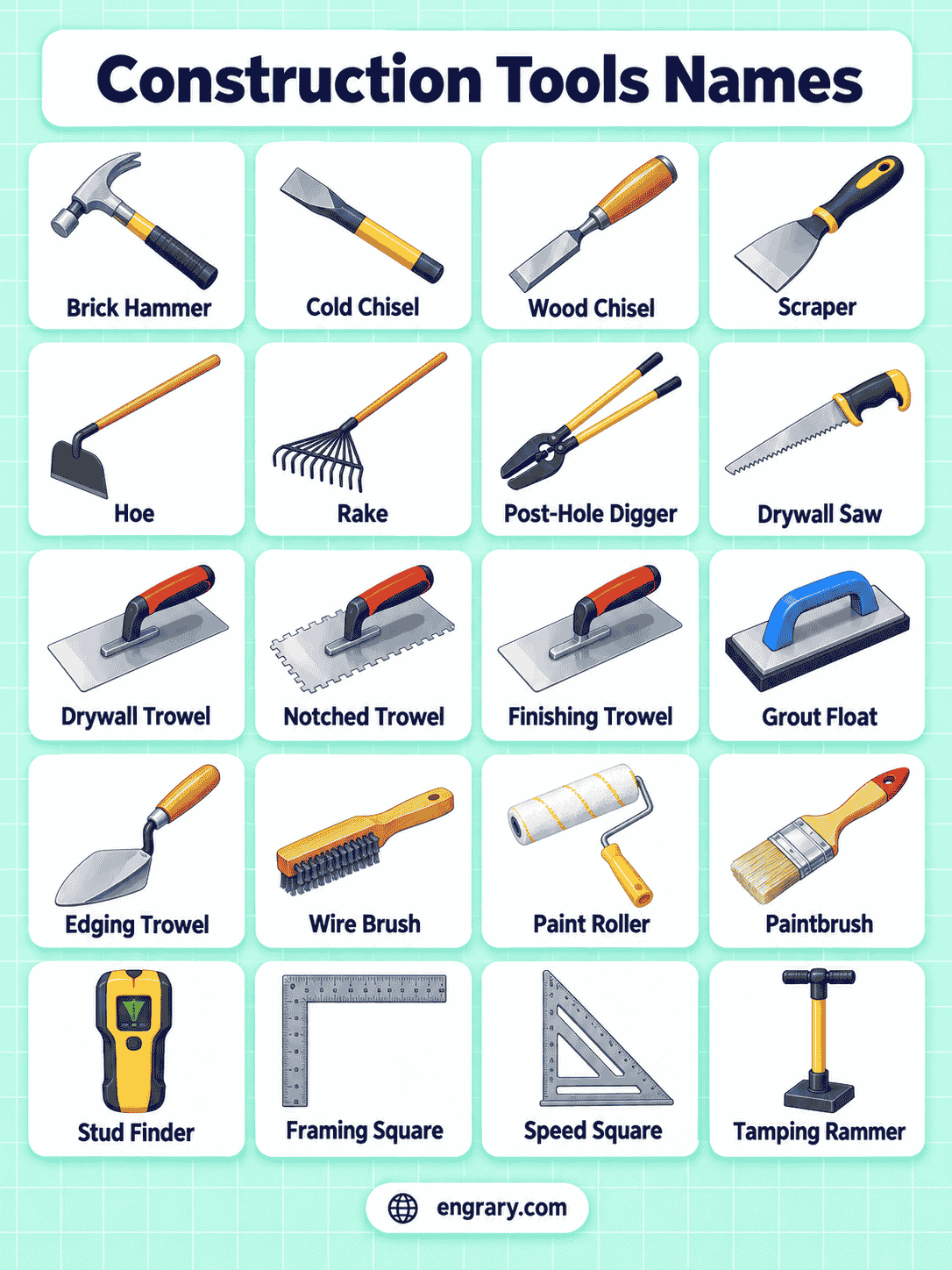
Manual vs Powered Construction Tools
Construction workers use both manually operated and externally powered tools.
| Manual Construction Tools | Powered Construction Tools |
|---|---|
| Brick Trowel | Rotary Hammer |
| Shovel | Jackhammer |
| Crowbar | Demolition Hammer |
| Hand Saw | Circular Saw |
| Claw Hammer | Nail Gun |
| Tile Cutter | Angle Grinder |
Manual tools rely mainly on human force and control. Powered tools draw energy from electricity, batteries, compressed air, or another source to complete demanding or repetitive work faster.
Construction Tools Used by Different Trades
Each construction trade depends on a different combination of tools.
| Trade | Common Construction Tools |
|---|---|
| Mason | Brick Trowel, Pointing Trowel, Mason’s Line, Brick Hammer |
| Carpenter | Claw Hammer, Circular Saw, Mason’s Square, Cordless Drill |
| Concrete Worker | Screed, Bull Float, Concrete Edger, Concrete Vibrator |
| Plasterer | Hawk, Plastering Trowel, Taping Knife, Scraper |
| Tiler | Tile Cutter, Tile Nipper, Notched Trowel, Grout Float |
| Roofer | Roofing Hammer, Roofing Shovel, Nail Gun, Pry Bar |
| Electrician | Rotary Hammer, Cordless Drill, Spirit Level, Screwdriver |
| Plumber | Cordless Drill, Spirit Level, Hacksaw, Adjustable Hand Tools |
These groups cover only a few common tools from each trade. Specialist articles can explore complete carpenter, electrician, plumber, masonry, roofing, and tiling tool sets.
Construction Tools Beginners Often Confuse
Some construction tools look similar or perform related jobs, but their primary functions differ.
Brick Trowel vs Pointing Trowel
A brick trowel carries and spreads larger amounts of mortar during bricklaying. A pointing trowel handles narrow joints, repairs, and detailed mortar work.
Spirit Level vs Laser Level
A spirit level checks alignment directly against a surface. A laser level projects reference lines or points across a larger working area.
Hammer Drill vs Rotary Hammer
A hammer drill handles lighter masonry drilling, while a rotary hammer delivers stronger hammering action for demanding concrete work.
Screed vs Float
A screed establishes the height and general level of fresh concrete. A float then smooths and refines the surface.
Crowbar vs Pry Bar
A crowbar usually handles heavier levering and dismantling, while a pry bar provides more controlled removal of boards, trim, and fitted materials.
Jackhammer vs Demolition Hammer
A jackhammer generally tackles heavier floor, pavement, or slab demolition. A demolition hammer often suits smaller or more controlled breaking jobs.
Brick Hammer vs Claw Hammer
A brick hammer chips and shapes masonry, while a claw hammer mainly drives and removes nails.
Construction Tool vs Equipment vs Material
Construction sites contain tools, equipment, materials, fasteners, accessories, and protective items. These terms describe different things.
| Term | Meaning | Example |
|---|---|---|
| Hand Tool | Performs a construction task through manual force | Brick Trowel |
| Power Tool | Performs work through an external power source | Rotary Hammer |
| Equipment | Supports larger construction operations | Concrete Mixer |
| Material | Becomes part of the building or project | Cement |
| Fastener | Joins or secures components | Screw |
| Accessory | Works with or extends a tool | Drill Bit |
| Protective Equipment | Protects the worker | Hard Hat |
For example, a Rotary Hammer is a power tool, while its drill bit is an accessory.
Likewise, a Brick Trowel is a hand tool, while the mortar it handles is a construction material.
Items such as ladders, scaffolds, generators, wheelbarrows, concrete mixers, hard hats, nails, screws, and bricks are useful construction vocabulary, but they should not all be classified as construction tools.
FAQs
Common construction tools include tape measures, spirit levels, brick trowels, hammers, shovels, saws, drills, screeds, floats, pry bars, angle grinders, and demolition tools.
Bricklayers commonly use brick trowels, pointing trowels, brick hammers, bolster chisels, joint rakers, mason’s lines, and leveling tools.
Concrete workers commonly use screeds, bull floats, hand floats, edgers, groovers, concrete vibrators, and tampers to place and finish fresh concrete.
Construction tools perform specific direct tasks such as cutting, measuring, drilling, or spreading mortar. Construction equipment usually supports larger site operations, such as mixing, lifting, transport, or access.
Powered construction tools include cordless drills, hammer drills, rotary hammers, circular saws, angle grinders, nail guns, jackhammers, and demolition hammers.
You May Also Like



Leave a Comment