
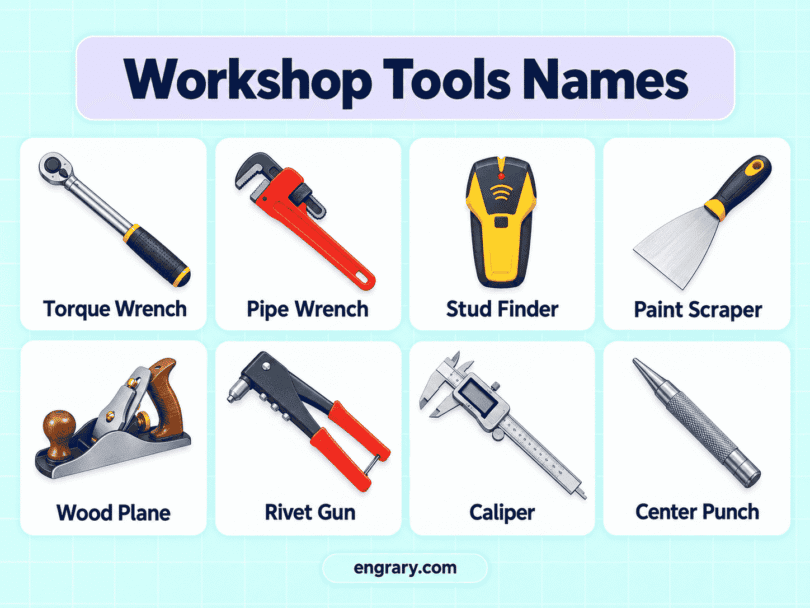
A workshop brings together tools for measuring, holding, cutting, drilling, shaping, fastening, repairing, and finishing different materials. Learning common workshop tools names in English makes it easier to recognize equipment around a workbench and understand vocabulary used in woodworking, metalworking, maintenance, fabrication, and general repairs.
This article introduces 70 useful workshop tools with their practical uses. You will also see which tools usually stay near a workbench, how workshop setups change for different jobs, how portable tools differ from bench-mounted ones, and how to distinguish tools that look or work similarly.
Inside a Typical Workshop
A workshop is a dedicated work area where people build, repair, adjust, assemble, or shape objects and materials. It may contain simple hand tools, precision measuring tools, portable power tools, and fixed bench-mounted tools.
For example:
Bench Vise
Holds a workpiece firmly while you cut, drill, file, or assemble it.
Vernier Caliper
Measures outside, inside, and depth dimensions with greater precision than an ordinary ruler.
Bench Grinder
Sharpens, cleans, and shapes metal against rotating abrasive wheels.
The exact tool set changes according to the type of workshop, but holding, measuring, cutting, fastening, and finishing tools appear in many work areas.
Common Workshop Tools You’ll See Most Often
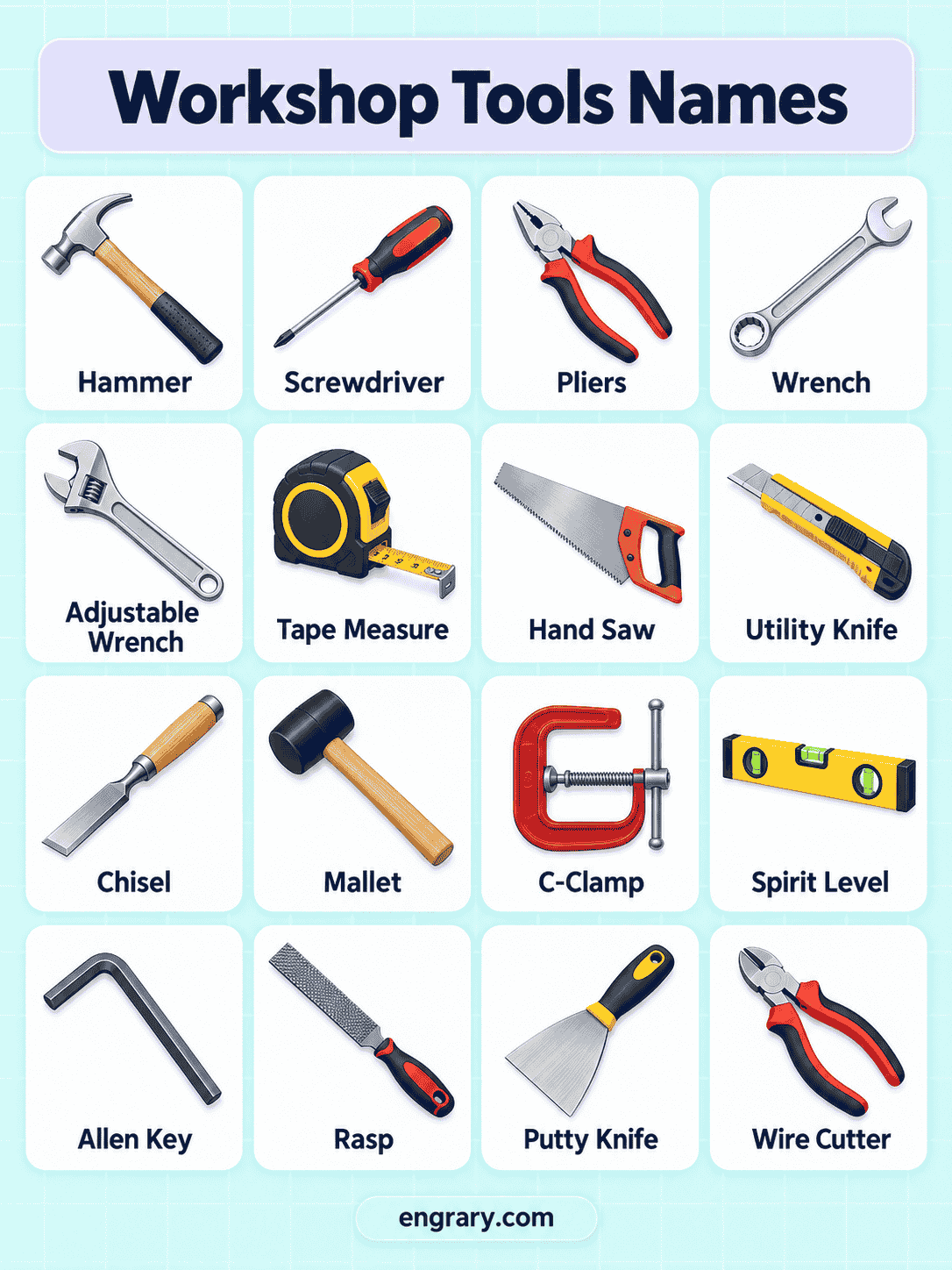
Workshops use many hand tools, power tools, measuring tools, and storage items for repair, building, cutting, drilling, and maintenance work. Learning common workshop tool names helps beginners and English learners recognize useful equipment more easily.
Hammer
A hammer drives nails, removes them, and handles light striking tasks during repair and building work.
Screwdriver
A screwdriver tightens or loosens screws. Different tip shapes fit different screw heads.
Pliers
Pliers grip, bend, twist, and hold wires or small parts during repair work.
Adjustable Wrench
An adjustable wrench uses a movable jaw to fit nuts and bolts of different sizes.
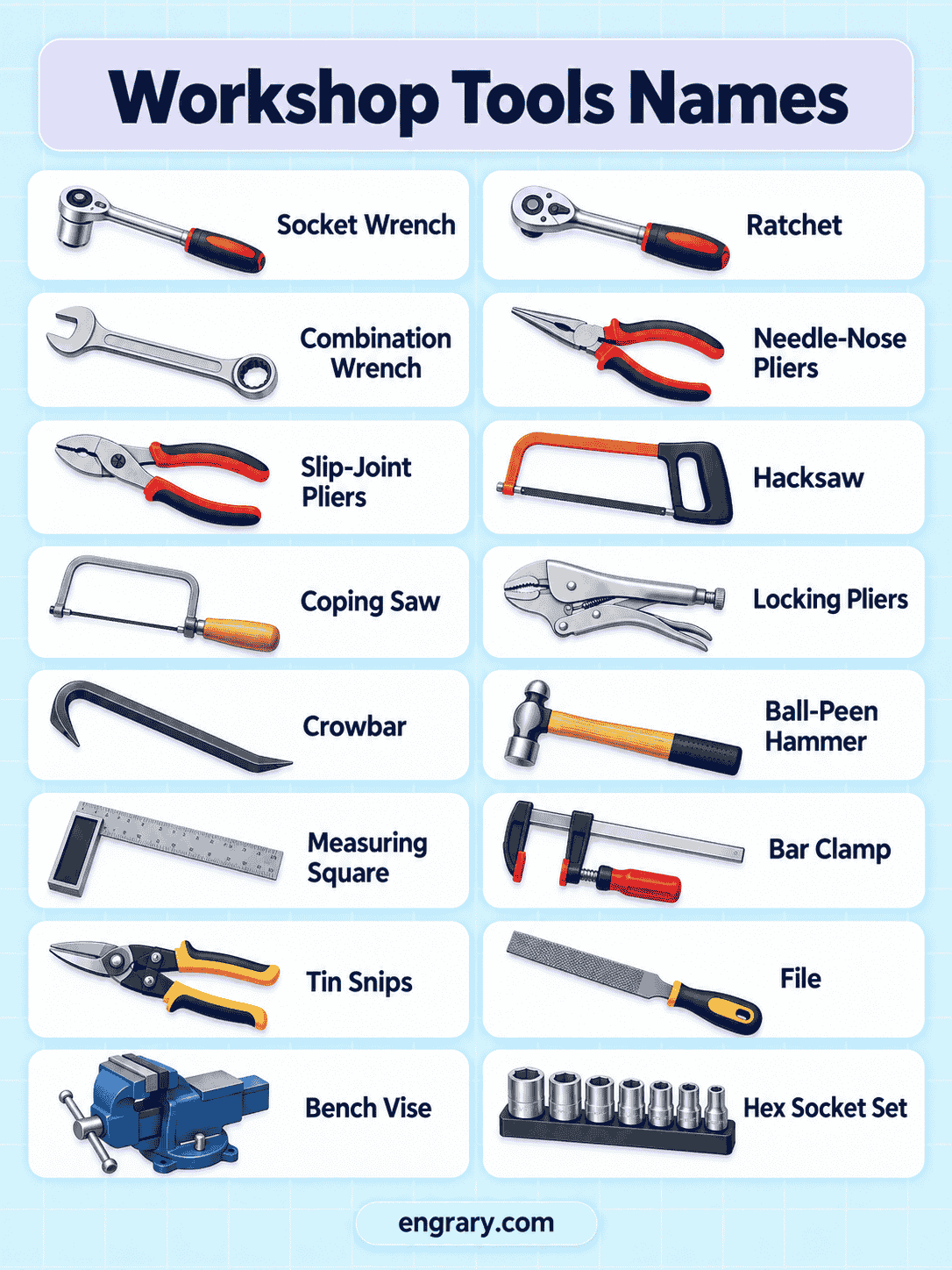
Combination Wrench
A combination wrench has an open end and a ring-shaped end for turning nuts and bolts.
Socket Wrench
A socket wrench works with removable sockets to tighten or loosen fasteners quickly.
Hand Saw
A hand saw cuts wood and similar materials with a toothed blade.
Hacksaw
A hacksaw uses a fine-toothed blade to cut metal, plastic, and other hard materials.
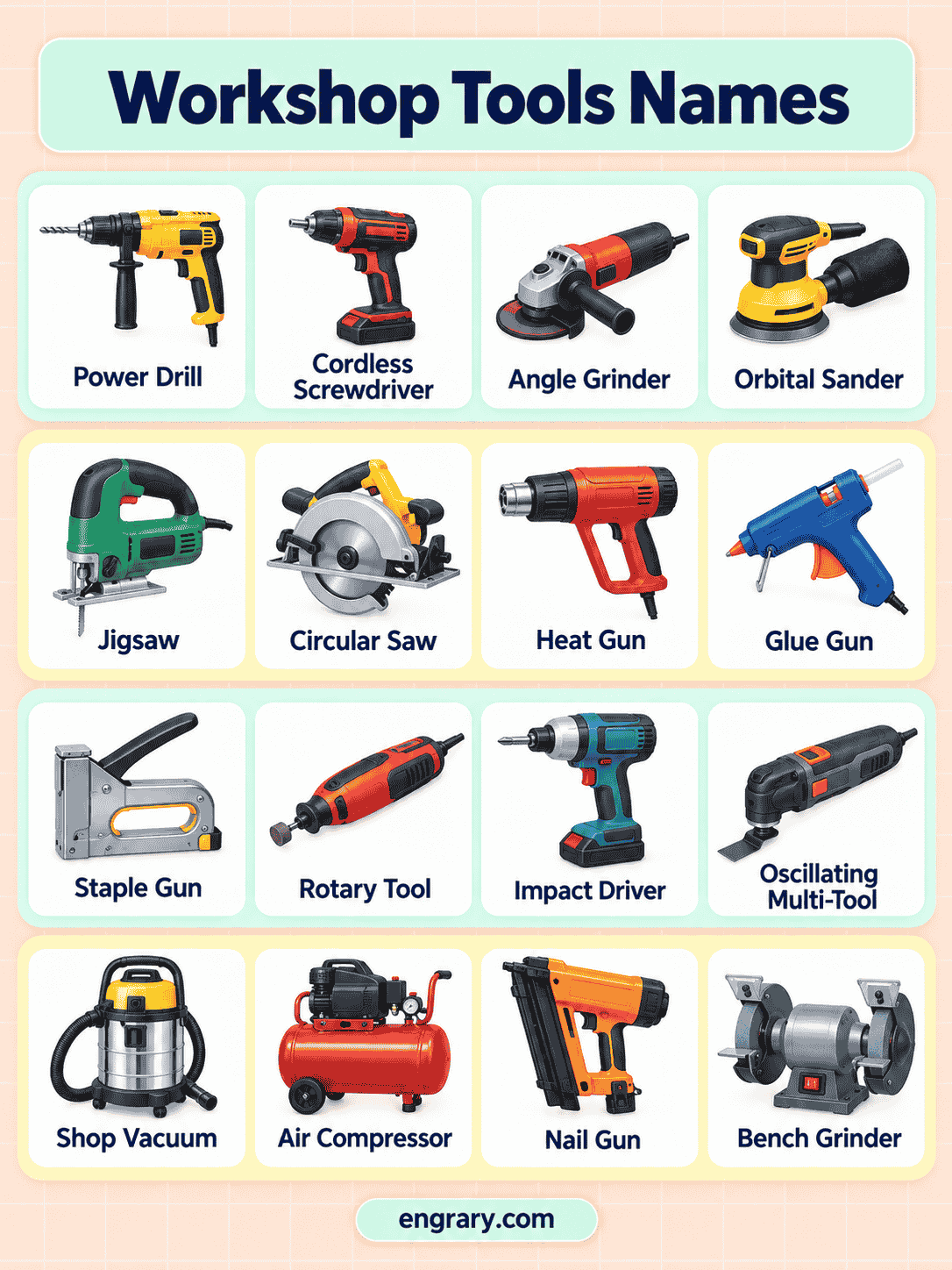
Power Drill
A power drill makes holes in wood, metal, plastic, and other materials. Many models can also drive screws.
Drill Bit
A drill bit fits into a drill and creates holes of different sizes and shapes.
Tape Measure
A tape measure checks length, width, height, and distance accurately.
Spirit Level
A spirit level helps check whether a surface sits horizontally or vertically.
Utility Knife
A utility knife cuts cardboard, plastic, rope, packaging, and other thin materials.
Chisel
A chisel cuts, shapes, or removes material from wood, stone, or metal.
File
A file smooths rough edges and shapes hard surfaces.
Clamp
A clamp holds materials firmly in place while someone cuts, drills, glues, or repairs them.
Bench Vise
A bench vise grips an object securely so a worker can cut, file, drill, or shape it safely.
Angle Grinder
An angle grinder cuts, grinds, and smooths metal or other hard materials with a fast-spinning disc.
Workbench
A workbench provides a sturdy flat surface for assembling, repairing, measuring, and working with tools.
Toolbox
A toolbox stores and organizes hand tools, fasteners, drill bits, and other workshop accessories.
Tools for Bench Work and Repairs
Holding and Clamping Tools
Secure workpieces make cutting, drilling, filing, gluing, and assembly more controlled.
Bench Vise
Grips workpieces between adjustable jaws fixed to a workbench.
Woodworking Vise
Holds wooden parts firmly while reducing the risk of surface damage.
C-Clamp
Applies strong pressure across small or medium workpieces during assembly or repair.
F-Clamp
Holds wider materials through a sliding jaw mounted on a long bar.
Bar Clamp
Secures large panels, boards, or assemblies across a long clamping span.
Spring Clamp
Provides quick light-pressure holding with spring-loaded jaws.
Hand Screw Clamp
Adjusts two wooden jaws independently for controlled woodworking pressure.
Locking Pliers
Clamp onto an object and maintain their grip without continuous hand pressure.
Measuring and Precision Tools
Accurate measurements and layout marks help workshop jobs fit together correctly.
Tape Measure
Checks length, width, height, and distance with a flexible graduated tape.
Steel Rule
Measures short distances and provides a rigid straight edge for marking.
Combination Square
Checks square corners, measures depth, and marks straight or angled lines.
Try Square
Checks and marks precise 90-degree angles.
Vernier Caliper
Measures outside, inside, and depth dimensions with fine accuracy.
Micrometer
Measures very small thicknesses or diameters with high precision.
Protractor
Measures and marks angles.
Scriber
Scratches fine layout lines into metal and other hard surfaces.
Marking Gauge
Scores a consistent line parallel to the edge of a wooden board.
Center Punch
Creates a small indentation that helps a drill start at the correct point.
Cutting and Shaping Tools
These tools separate material or gradually change its shape.
Hacksaw
Cuts metal, plastic, tubing, and small components with a fine-toothed blade.
Hand Saw
Cuts timber manually with a long toothed blade.
Coping Saw
Creates curved and detailed cuts with a narrow tensioned blade.
Utility Knife
Slices cardboard, plastic, gasket material, tape, and other lightweight workshop materials.
Tin Snips
Cut thin sheet metal with short, powerful blades.
Bolt Cutter
Cuts bolts, chain, rods, and heavy wire through long handles and compound leverage.
Wood Chisel
Cuts, pares, and shapes wood with a sharpened beveled edge.
Cold Chisel
Chips and cuts metal or other hard materials when struck with a hammer.
Hand File
Smooths edges and gradually removes material through rows of cutting teeth.
Rasp
Shapes wood and other softer materials quickly with coarse raised teeth.
Hand Plane
Shaves thin layers from wood to flatten, straighten, or smooth a surface.
Scraper
Removes paint, glue, residue, and other material from a surface.
Drilling Tools
Workshop drilling ranges from simple handheld hole-making to precise fixed drilling.
Cordless Drill
Drills holes and drives screws with rechargeable battery power.
Corded Drill
Provides continuous drilling power through an electrical connection.
Drill Press
Keeps the drill fixed while the workpiece sits on an adjustable table for controlled drilling.
Hand Drill
Rotates a drill bit manually through a geared crank mechanism.
Brace
Turns larger bits by hand to bore holes, especially in wood.
Awl
Pierces small holes and marks exact starting points.
Hand Reamer
Enlarges and finishes an existing hole to a more accurate size.
Countersink Tool
Creates a tapered recess so a screw head can sit flush with the surface.
Fastening and Assembly Tools
These tools tighten, loosen, join, or secure workshop components.
Flathead Screwdriver
Turns screws with a single straight slot.
Phillips Screwdriver
Fits cross-shaped Phillips screws for common fastening jobs.
Torx Screwdriver
Turns star-shaped Torx fasteners found in machinery, vehicles, and equipment.
Allen Key
Fits hex-socket screws and bolts with its L-shaped hexagonal shaft.
Adjustable Wrench
Changes jaw width to fit several sizes of nuts and bolts.
Combination Wrench
Provides an open end and a closed box end for different turning situations.
Socket Wrench
Uses interchangeable sockets to fit different fastener sizes.
Ratchet
Turns sockets repeatedly without requiring the handle to be removed after each movement.
Torque Wrench
Tightens fasteners to a specified torque value.
Nut Driver
Turns nuts and small hex-head fasteners with a socket-style shaft and screwdriver-like handle.
Grinding and Finishing Tools
Grinding, sanding, brushing, and polishing refine surfaces after cutting or shaping.
Angle Grinder
Cuts, grinds, cleans, and smooths metal or other hard materials with interchangeable discs.
Bench Grinder
Sharpens and shapes metal against fixed rotating grinding wheels.
Orbital Sander
Smooths flat surfaces through small orbital movements.
Belt Sander
Removes material quickly with a continuously moving abrasive belt.
Detail Sander
Reaches corners and confined areas with a compact pointed sanding pad.
Sanding Block
Supports abrasive paper for controlled manual sanding.
Wire Brush
Removes rust, scale, loose paint, and surface contamination.
Polisher
Refines and shines finished surfaces with rotating polishing pads.
Threading and Metalworking Tools
These tools help create threads, check clearances, and perform more precise metalworking jobs.
Tap Wrench
Holds and turns a tap while cutting internal threads.
Die Stock
Holds a threading die while cutting external threads on rods or pipes.
Thread File
Repairs damaged external threads with specially shaped file teeth.
Feeler Gauge
Measures narrow gaps and clearances with thin blades of known thickness.
Depth Gauge
Checks the depth of holes, slots, recesses, and stepped surfaces.
Ball-Peen Hammer
Shapes metal and strikes punches during fitting and fabrication work.
Woodworking Bench Tools
Woodworking workshops often add tools designed specifically for fitting, smoothing, and joining timber.
Block Plane
Trims edges and end grain while making small adjustments to wood.
Spokeshave
Shapes curved wooden surfaces through a short blade held between two handles.
Wooden Mallet
Strikes chisels and wooden joints without the concentrated impact of a steel hammer.
Dovetail Saw
Makes fine, controlled cuts for joints and detailed woodworking.
Sliding Bevel
Copies and transfers angles between workpieces.
Mortise Gauge
Marks paired parallel lines for mortise-and-tenon joints.
Cabinet Scraper
Produces a fine wood surface by shaving away very thin material.
Bradawl
Starts small holes in wood before screws or nails enter the surface.
Tools Commonly Kept Around a Workbench
A workbench usually holds the tools needed for frequent measuring, fitting, gripping, cutting, and repair work.
A Bench Vise often stays attached to the bench so a worker can secure material quickly. Nearby C-Clamps or F-Clamps handle jobs that the fixed vise cannot reach.
Measuring and marking tools such as a Steel Rule, Combination Square, Scriber, Vernier Caliper, and Center Punch often stay within easy reach because many workshop tasks begin with accurate layout.
A typical bench may also hold Screwdrivers, Pliers, Wrenches, a Hand File, Utility Knife, Chisel, Hammer, and Tape Measure for everyday adjustments and repairs.
Powered tools such as a Cordless Drill may sit close to the bench, while larger fixed tools such as a Drill Press or Bench Grinder usually occupy their own dedicated workspace.
Different Tools for Different Workshop Jobs
A workshop changes according to the material and task. The same bench may support woodworking one day and mechanical repair the next.
| Type of Work | Useful Workshop Tools |
|---|---|
| Woodworking | Hand Plane, Wood Chisel, Dovetail Saw, Marking Gauge, Woodworking Vise |
| Metalworking | Ball-Peen Hammer, Cold Chisel, Hand File, Bench Grinder, Scriber |
| General Repair | Screwdrivers, Combination Pliers, Adjustable Wrench, Cordless Drill |
| Precision Measuring | Vernier Caliper, Micrometer, Combination Square, Depth Gauge |
| Assembly | C-Clamp, Ratchet, Socket Wrench, Torque Wrench |
| Surface Finishing | Orbital Sander, Sanding Block, Wire Brush, Polisher |
This variety explains why a workshop tool set is broader than a simple hand-tool or power-tool list.
Portable and Bench-Mounted Tools
Some workshop tools move with the user, while others remain attached to a bench, stand, or fixed working position.
| Portable Tools | Bench-Mounted Tools |
|---|---|
| Cordless Drill | Drill Press |
| Angle Grinder | Bench Grinder |
| Hand File | Bench Vise |
| Orbital Sander | Fixed workshop sanding machine |
| Hand Saw | Band Saw |
Portable tools work well when the tool needs to move around the material. Bench-mounted tools provide a stable setup for repeated, controlled, or more precise work.
The distinction is not simply about power. A Bench Vise is manual but fixed, while a Cordless Drill is powered and portable.
Similar Workshop Tools and Their Differences
Several workshop tools perform related jobs, but their designs suit different situations.
Bench Vise vs C-Clamp
A bench vise stays fixed to a workbench and grips material between permanent jaws. A C-clamp moves between workpieces and can hold material in many different locations.
Hand File vs Rasp
A file removes material more gradually and works on several materials. A rasp has much coarser teeth and removes wood or other soft material faster.
Cordless Drill vs Drill Press
A cordless drill moves with the user and works in many locations. A drill press keeps the drilling setup fixed and provides more controlled vertical movement.
Angle Grinder vs Bench Grinder
An angle grinder moves across the workpiece. A bench grinder stays fixed while the worker moves the material against its wheels.
Try Square vs Combination Square
A try square mainly checks or marks 90-degree angles. A combination square also measures depth and performs additional layout tasks.
Center Punch vs Scriber
A center punch creates an indentation that guides a drill bit. A scriber scratches a fine line for layout work.
Bench Vise vs Woodworking Vise
A general bench vise commonly grips metal and mixed materials. A woodworking vise uses broader jaws designed to secure wood more gently.
Hand Plane vs Block Plane
A hand plane handles broader surface flattening and smoothing. A block plane suits smaller trimming jobs and end grain.
Other Useful Items Found in a Workshop
A workshop contains many useful items that support tool use without being tools themselves.
Workbench
Provides a stable working surface for assembly, repair, cutting, and fitting.
Tool Chest
Stores and organizes hand tools.
Air Compressor
Supplies compressed air for pneumatic tools and other workshop tasks.
Drill Bits
Attach to drills to create holes in different materials.
Saw Blades
Fit specific saws and provide the cutting edge.
Sandpaper
Supplies an abrasive surface for manual or powered sanding.
Grinding Discs
Fit grinders for cutting, grinding, or surface preparation.
Nails, Screws, and Bolts
Act as fasteners rather than tools.
Safety Goggles
Protect the eyes from chips, dust, and debris.
Work Gloves
Protect the hands during appropriate workshop tasks.
Keeping these categories separate makes workshop vocabulary more accurate. A Cordless Drill is a tool, for example, while its drill bit is an accessory. A Workbench supports the task but functions as workshop equipment.
FAQs
Common workshop tools include hammers, screwdrivers, pliers, wrenches, vises, clamps, files, saws, chisels, drills, grinders, sanders, squares, calipers, and measuring tools.
A workbench commonly has a bench vise, clamps, screwdrivers, pliers, files, chisels, measuring tools, a hammer, utility knife, and layout tools nearby.
Tape measures, steel rules, combination squares, try squares, calipers, micrometers, scribers, marking gauges, and center punches support measurement and layout work.
Portable tools move with the user or workpiece, while bench-mounted tools stay fixed to a bench, stand, or workstation for controlled operation.
A workshop tool performs a direct task such as cutting, drilling, measuring, or fastening. Workshop equipment supports the work environment or tool operation, such as a workbench, tool chest, or air compressor.
You May Also Like



Leave a Comment