
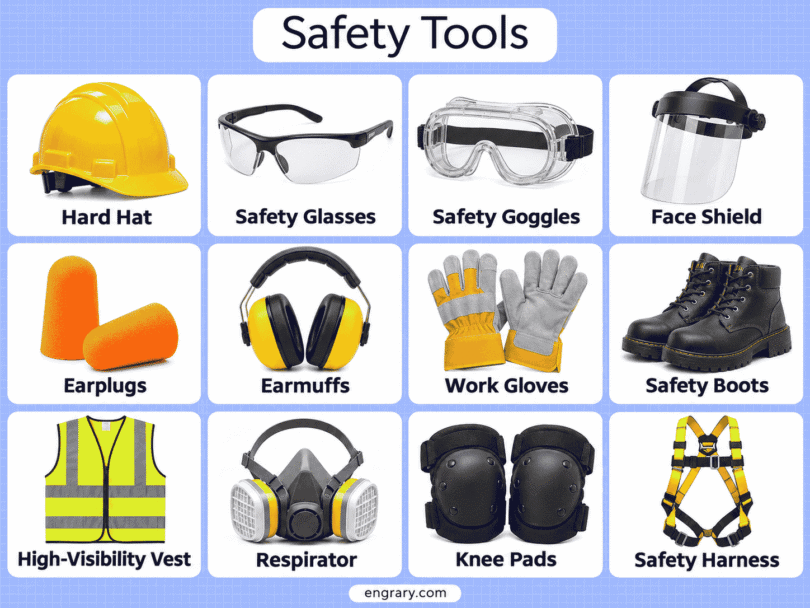
A hard hat protects the person who wears it. A smoke alarm warns everyone within earshot. A wheel chock does its job on the ground, where its wedge shape helps keep a parked vehicle from rolling. All three are safety equipment, but each has a different purpose.
This picture guide covers 36 safety equipment names in English. Start with the protective gear people wear, then explore emergency supplies and the equipment you might see around vehicles, walkways, and machines. Each entry explains how to recognize the item and what people use it for.
Common Types of Personal Protective Equipment
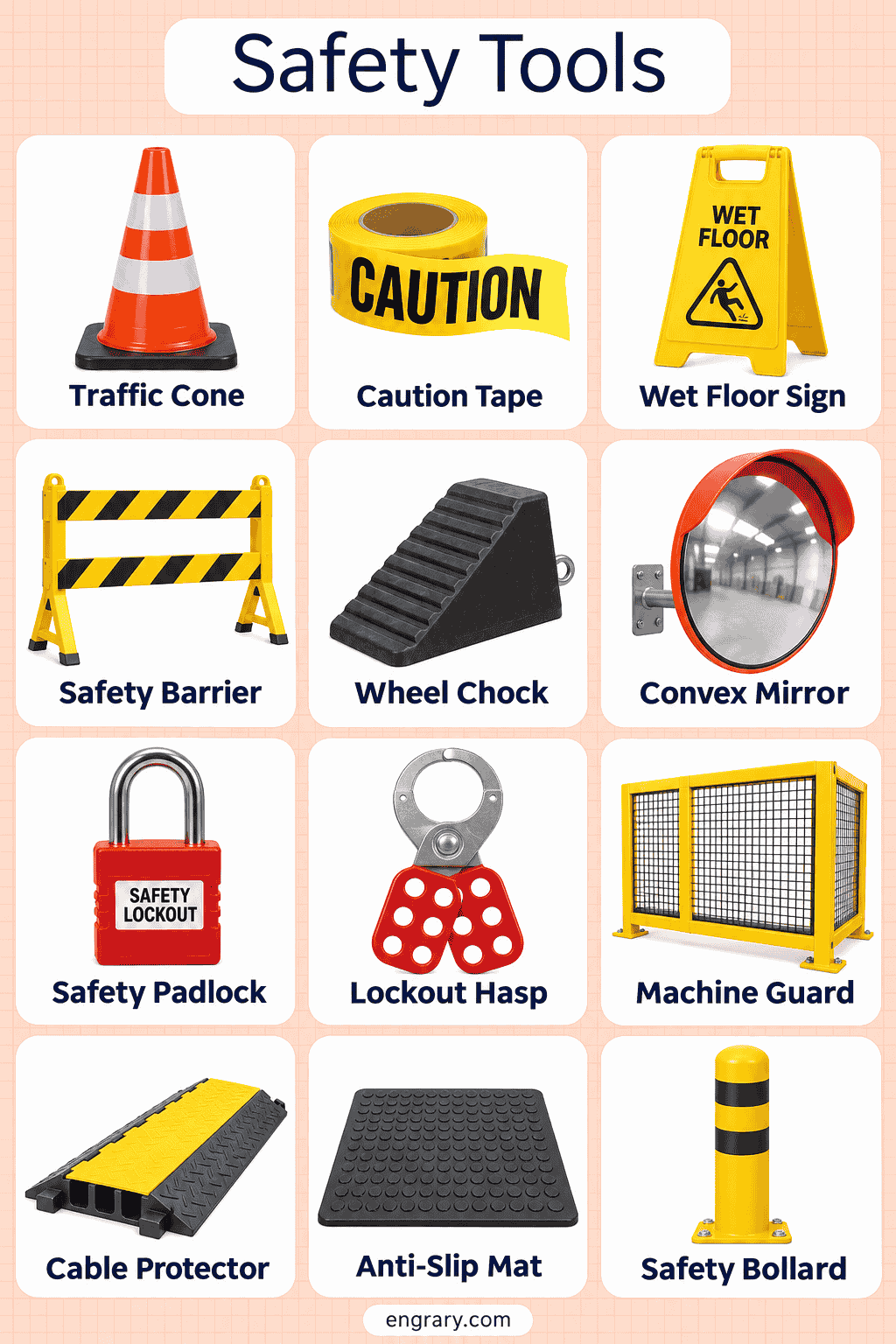
Personal protective equipment (PPE) is gear people wear to reduce exposure to a particular hazard. A useful place to start is the first row of the picture. The hard hat has a rigid shell, the safety glasses have side arms, and the goggles have a close-fitting rim and strap.
ppe.png
1. Hard hat
A hard hat has a rigid outer shell and a suspension system inside. Together, they help protect the wearer’s head from impacts such as a falling tool. The suspension leaves space between the shell and the head to help absorb the force of a blow.
2. Safety glasses
Safety glasses have protective lenses and arms that rest over the ears. They help shield the eyes from flying particles, such as small wood chips. On a wraparound pair, the lenses curve toward the temples for additional side coverage.
3. Safety goggles
Safety goggles fit closely around the eyes, and a strap holds them in place. Different designs protect against different hazards. For example, chemical-splash goggles help keep splashed liquid out of the eye area.
4. Face shield
A face shield has a wide visor that extends from the forehead toward the chin. It helps protect more of the face than glasses or goggles alone. For impact hazards, workers wear a face shield over suitable safety glasses or goggles.
| Equipment | Feature to look for | Area it covers |
|---|---|---|
| Safety glasses | Lenses with side arms | Eyes, with side coverage depending on the design |
| Safety goggles | Close-fitting rim and head strap | Eyes and the area immediately around them |
| Face shield | Broad visor attached to headgear | A larger part of the face, including the cheeks and chin |
5. Earplugs
Earplugs fit into the ear canals to reduce the sound that reaches the ears. Some look like small foam cylinders, while others have flexible ridges. A cord, like the one in the picture, keeps the pair together.
6. Earmuffs (ear defenders)
Protective earmuffs have two padded cups joined by a headband. While earplugs fit inside the ears, earmuffs cover the outer ears. The cushions form a seal that helps reduce noise exposure.
7. Work gloves
Work gloves protect the hands during specific tasks. For example, sturdy handling gloves can help prevent scrapes from rough materials, while chemical-resistant gloves use materials suited to particular substances. The task determines which type of glove is appropriate.
8. Safety boots
Safety boots protect the feet from workplace hazards. Many have toe caps that help protect against falling objects. Some also have slip-resistant soles or puncture-resistant layers, so the boot’s markings tell you more about its protection than its appearance alone.
9. High-visibility vest
A high-visibility vest, often called a hi-vis vest, makes the wearer easier to see. The bright fabric stands out in daylight, while reflective strips return light from sources such as vehicle headlights.
10. Respirator
A respirator helps protect the wearer from specific airborne hazards. The half-face model in the picture covers the nose and mouth and carries a cartridge on each side. Its protection depends on the respirator, the correct filters or cartridges, and its fit.
11. Knee pads
Knee pads cushion the knees during work close to the ground, such as laying floor tiles. Some fasten around the legs with straps, while others slide into pockets in work trousers.
12. Safety harness
A full-body safety harness has straps around the shoulders, torso, and thighs. In a fall-arrest system, it connects through other equipment to a suitable anchorage. If the system arrests a fall, the harness distributes force across the wearer’s body.
Fire Safety, First Aid, and Rescue Equipment
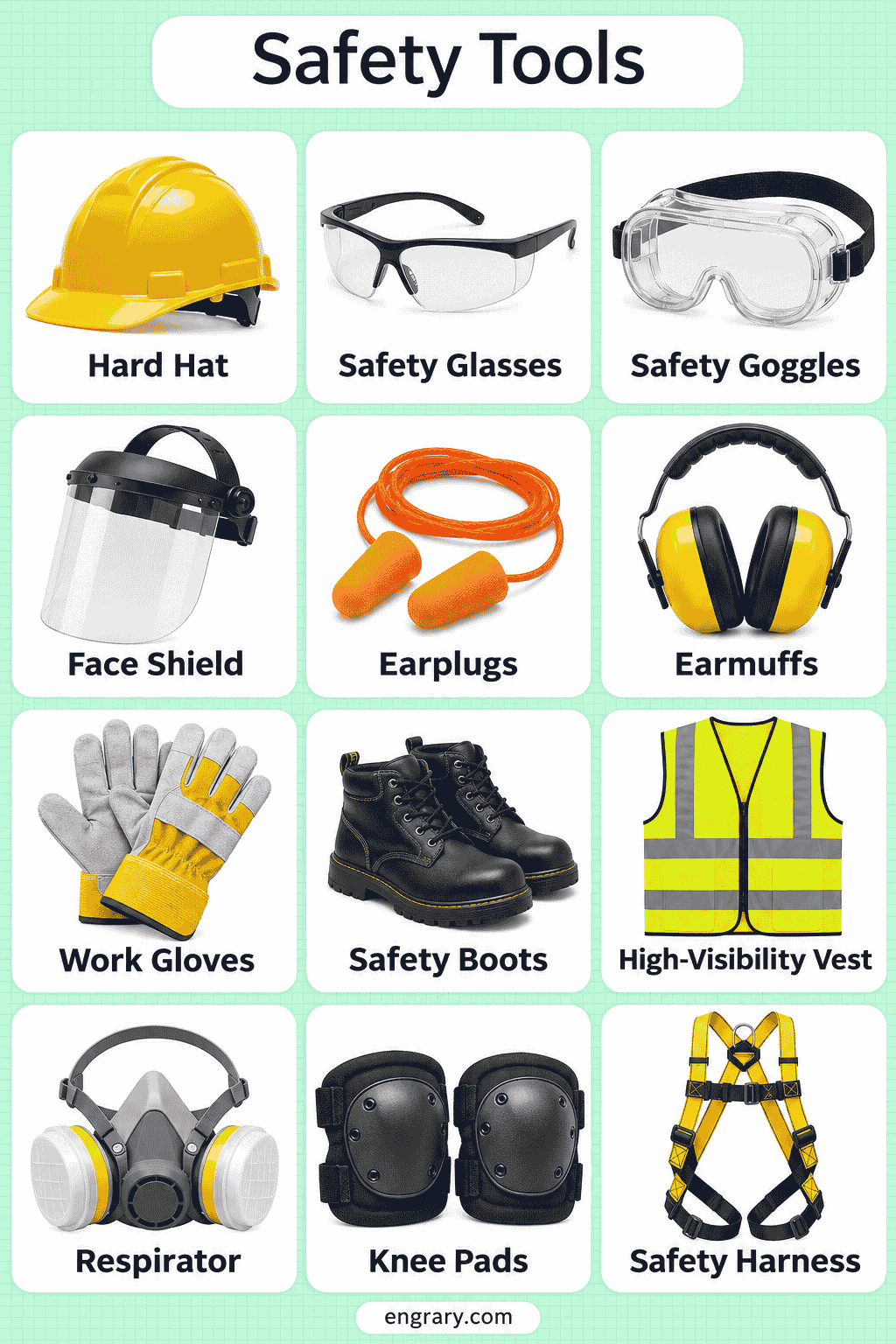
In the emergency equipment picture, the red cylinder, pouch, and reel all relate to fire safety. Their shapes reveal three different items: the cylinder holds extinguishing agent, the pouch contains a folded blanket, and the reel stores a length of hose.
13. Fire extinguisher
A portable fire extinguisher holds an agent for putting out certain types of small fires. Look for a cylinder, an operating handle, and a nozzle or hose. The label identifies which kinds of fire the extinguisher can tackle.
14. Fire blanket
A fire blanket is a fire-resistant sheet that can smother a small, contained fire by limiting its oxygen supply. In the picture, the red pouch holds the folded blanket, and the two tabs hang below it.
15. Smoke alarm
A smoke alarm senses smoke and sounds a warning. Small openings in its housing let air reach the sensor. Its job is to alert people nearby so they can respond to the danger.
16. Fire hose reel
A fire hose reel stores a hose on a rotating drum connected to a water supply. The drum keeps the hose compact against the wall, while its rotating center lets the hose unwind.
17. First aid kit
A first aid kit keeps supplies for immediate care in one marked case. Typical contents include dressings, bandages, and disposable gloves. The exact supplies vary with the setting.
18. Eyewash station
An eyewash station supplies rinsing fluid for the eyes after exposure to a harmful substance. On the pictured unit, two small outlets point upward over a basin. Their position is the easiest way to recognize the station.
19. Emergency shower
An emergency shower releases water from overhead to rinse contaminants from the body and clothing. The pictured model has a wide showerhead and a pull handle hanging within reach.
| Equipment | Identifying feature | Main use |
|---|---|---|
| Eyewash station | Paired outlets above a basin | Rinsing the eyes |
| Emergency shower | Large showerhead above the user | Rinsing the body and clothing |
20. Automated external defibrillator (AED)
An AED is a portable device for use during suspected sudden cardiac arrest. Through adhesive chest pads, it checks the person’s heart rhythm and determines whether a shock is appropriate. Prompts guide the user through the process.
21. Rescue stretcher
A rescue stretcher supports a person while rescuers move them. The basket-style stretcher in the picture has raised sides, carrying points, and straps that help keep the person in position during transport.
22. Life ring (lifebuoy)
A life ring is a buoyant ring that someone can throw to a person in the water. Its open center and outer rope give the person places to hold on while awaiting rescue.
23. Emergency flashlight
An emergency flashlight provides portable light during a power outage or in a dark area. Its battery allows it to work even when the building’s usual lighting fails.
24. Rescue whistle
A rescue whistle produces a sharp sound that draws attention to the person carrying it. For example, someone who is difficult to see can use the whistle to help others locate them.
Safety Equipment Around Vehicles, Walkways, and Machines
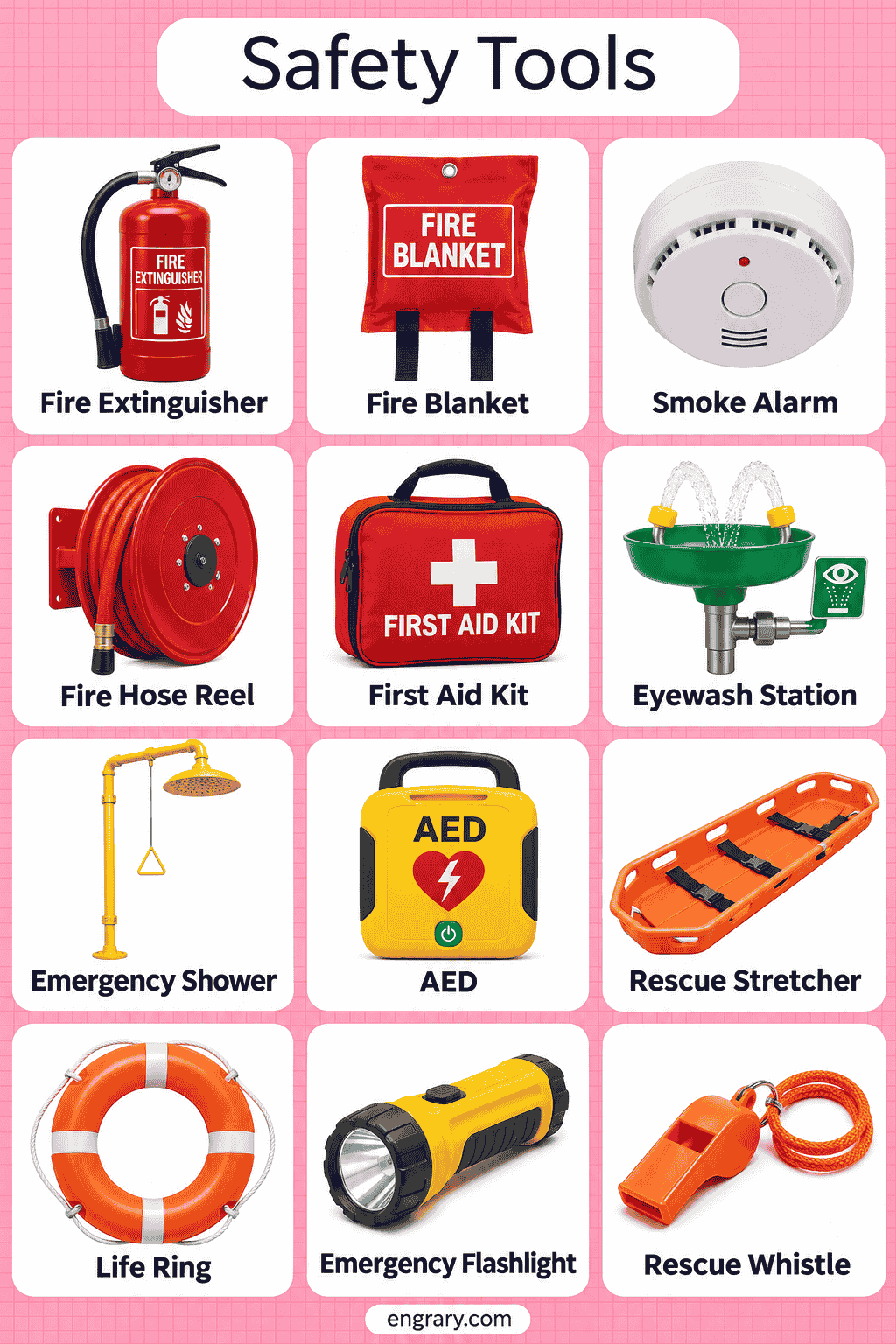
A warning sign, a barrier, and a machine guard serve different purposes. The sign tells people about a hazard, the barrier marks or separates an area, and the guard restricts access to a dangerous machine part. The remaining items are easiest to recognize by where they sit: against a tire, above a blind corner, or across a walking route.
25. Traffic cone
A traffic cone has a tapered body and a broad base. Workers place cones in a line to guide pedestrians or drivers around a temporary work area. Bright colors and reflective bands help make the route visible.
26. Caution tape
Caution tape is a long strip that marks a boundary or draws attention to a hazard. Its color and printed message give people a visual warning, although the lightweight tape offers little physical resistance.
27. Wet floor sign
A wet floor sign warns pedestrians about a potentially slippery surface. The familiar folding model stands on its own, with a message or slipping-person symbol visible to people approaching from either direction.
28. Safety barrier
A safety barrier separates a work area from a route used by pedestrians or vehicles. The pictured barrier has a rigid frame and a striped horizontal rail, making the boundary easier to see than a strip of tape.
29. Wheel chock
A wheel chock is a wedge that fits snugly against a tire to help keep a stationary vehicle or trailer from rolling. Its sloping side faces the tire, while its broad base rests on the ground.
30. Convex mirror
A convex mirror curves outward to give a wider view of the surrounding area. At a blind warehouse corner, for example, it can help a pedestrian spot an approaching forklift. Objects in the mirror appear smaller than they are.
31. Safety padlock
A safety padlock is a dedicated lock used during equipment lockout. Its curved shackle closes around a compatible lockout device to help secure an energy-isolating device in its safe position during maintenance.
32. Lockout hasp
A lockout hasp has a clasp and several padlock holes. It allows multiple workers to attach their individual locks at the same isolation point. The row of holes distinguishes the hasp from the padlocks it holds.
| Equipment | Feature to look for | Role during lockout |
|---|---|---|
| Safety padlock | A lock body and curved shackle | Provides an individual lock |
| Lockout hasp | A clasp with several padlock holes | Accommodates multiple locks at one isolation point |
33. Machine guard
A machine guard forms a physical barrier around a hazardous machine part. For example, a mesh guard can let a worker see moving machinery while restricting access to the dangerous area.
34. Cable protector
A floor cable protector has one or more channels beneath a raised cover. Cables fit inside those channels where they cross a walkway. The cover shields the cables and gives people a defined place to cross.
35. Anti-slip mat
An anti-slip mat provides a textured surface for standing or walking. Unlike a cable protector, it generally lies flat and covers a broader area, such as the floor in front of a workstation.
36. Safety bollard
A safety bollard is a short, upright post that marks a boundary or helps separate vehicles from pedestrians and equipment. Some bollards act as visual guides, while impact-rated models also provide protection against specified vehicle impacts.
FAQs About Safety Tools and Equipment
PPE stands for personal protective equipment. Hard hats, goggles, earplugs, and safety boots all belong to this group because a person wears them for protection. A traffic cone is safety equipment too, but it marks an area rather than protecting something the wearer has on.
Yes. In workplace safety vocabulary, both names refer to hearing protection with padded cups that cover the outer ears. Earplugs are a separate type of hearing protection that fits into the ear canals.
AED stands for automated external defibrillator. The sign marks where to find a device that checks heart rhythm during suspected sudden cardiac arrest and can deliver a shock when appropriate.
It is a wheel chock. Its wedge shape lets it fit between the tire and the ground to help prevent the wheel from rolling.
It is a convex mirror. Its outward curve gives people a wider view of approaching traffic in places such as warehouse aisles, driveways, and parking areas.
You May Also Like

Leave a Comment