
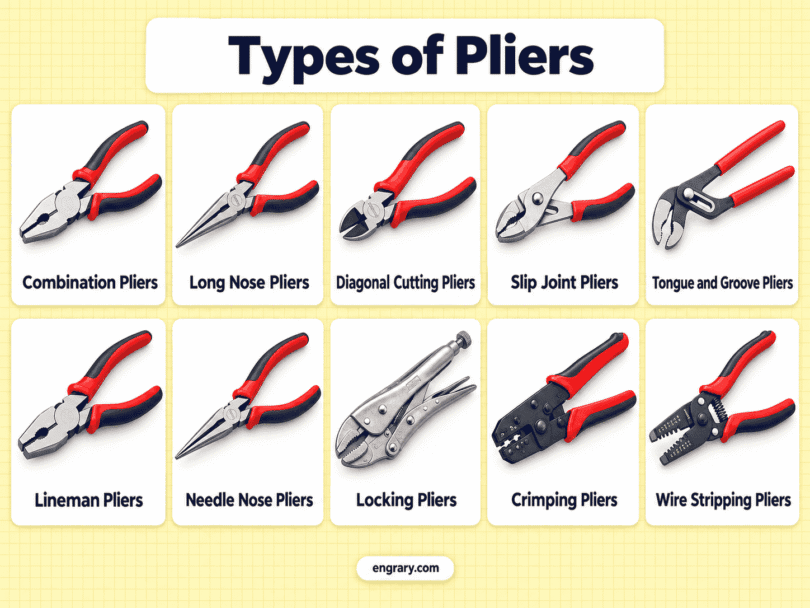
Pliers come in many shapes because their jaws are designed for different kinds of gripping, cutting, bending, holding, clamping, and precision work. Some types have long narrow noses, while others use curved jaws, built-in cutters, locking mechanisms, or specialized tips.
This guide covers 45 types of pliers with pictures and uses. Each description focuses on the jaw shape, nose form, joint, cutting-edge position, or other visible feature that helps you recognize one type from another.
Pliers You’ll Recognize by Their Jaws
The jaws provide the quickest way to identify most pliers. Broad jaws suit general gripping, narrow jaws reach small spaces, curved jaws wrap around round objects, and cutting edges give some pliers an additional function.
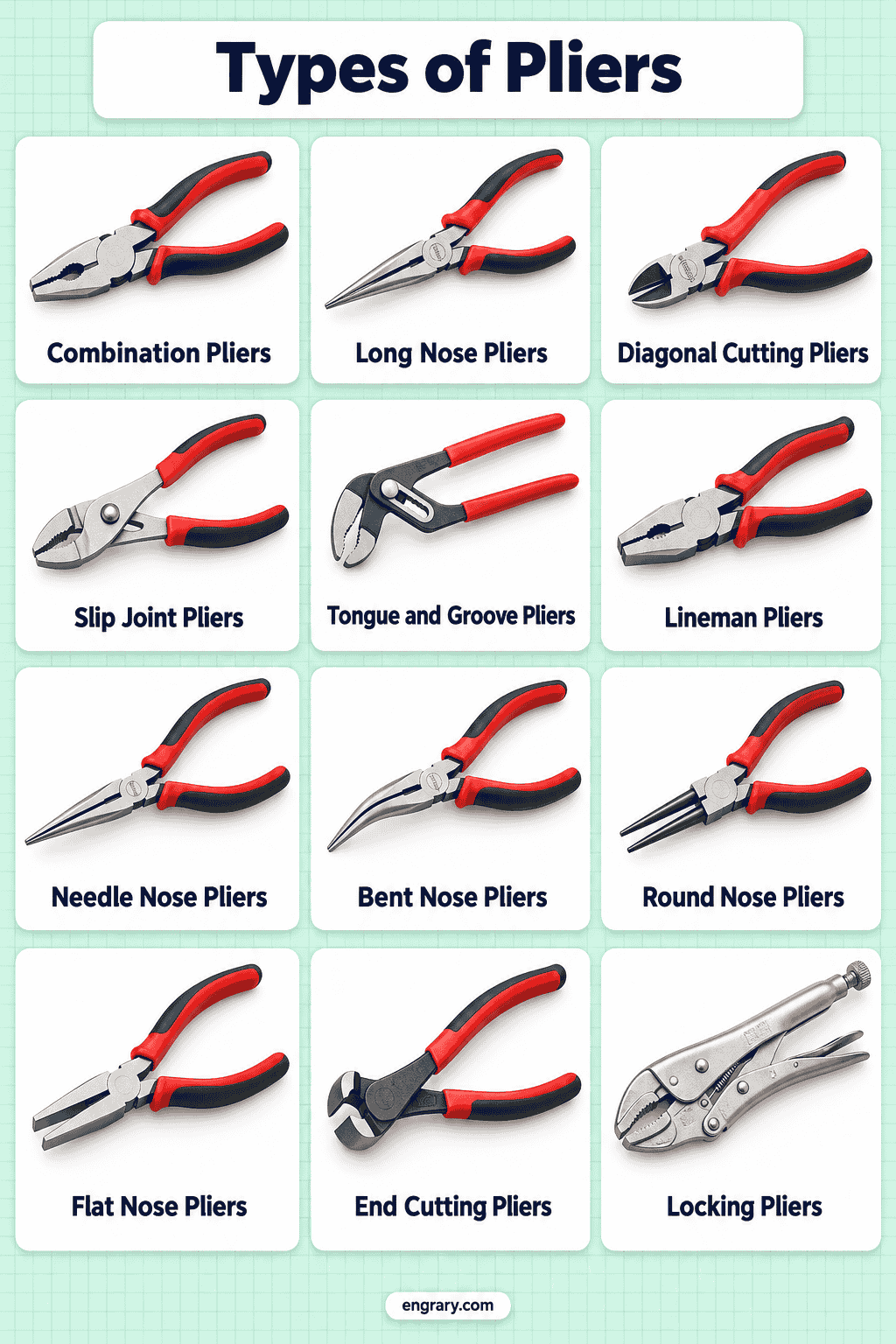
1. Combination Pliers
Combination pliers have serrated gripping jaws, a rounded gripping section, and cutting edges near the pivot. Their mixed head design makes them one of the most recognizable multipurpose pliers.
2. Slip-Joint Pliers
Slip-joint pliers have an adjustable pivot that moves between different positions. Changing the joint position allows the jaws to open wider without changing the basic shape of the tool.
3. Tongue-and-Groove Pliers
Tongue-and-groove pliers have adjustable jaws that move through several groove positions. Their long handles and wide opening range make them easy to distinguish from ordinary slip-joint pliers.
4. Linesman’s Pliers
Linesman’s pliers have short, broad jaws with strong gripping surfaces and built-in cutters near the pivot. Their heavy head looks more robust than that of most combination pliers.
5. Needle-Nose Pliers
Needle-nose pliers have long, narrow jaws that taper toward fine tips. Their slender nose makes them easy to recognize among broader gripping pliers.
6. Bent-Nose Pliers
Bent-nose pliers have narrow jaws that angle or curve near the tips. That bend immediately separates them from straight needle-nose pliers.
7. Flat-Nose Pliers
Flat-nose pliers have broad, straight jaws with flat inner surfaces. Their rectangular nose shape contrasts clearly with round or tapered pliers.
8. Round-Nose Pliers
Round-nose pliers have smooth, tapered cylindrical jaws. Their cone-shaped nose is one of the clearest visual features in the plier family.
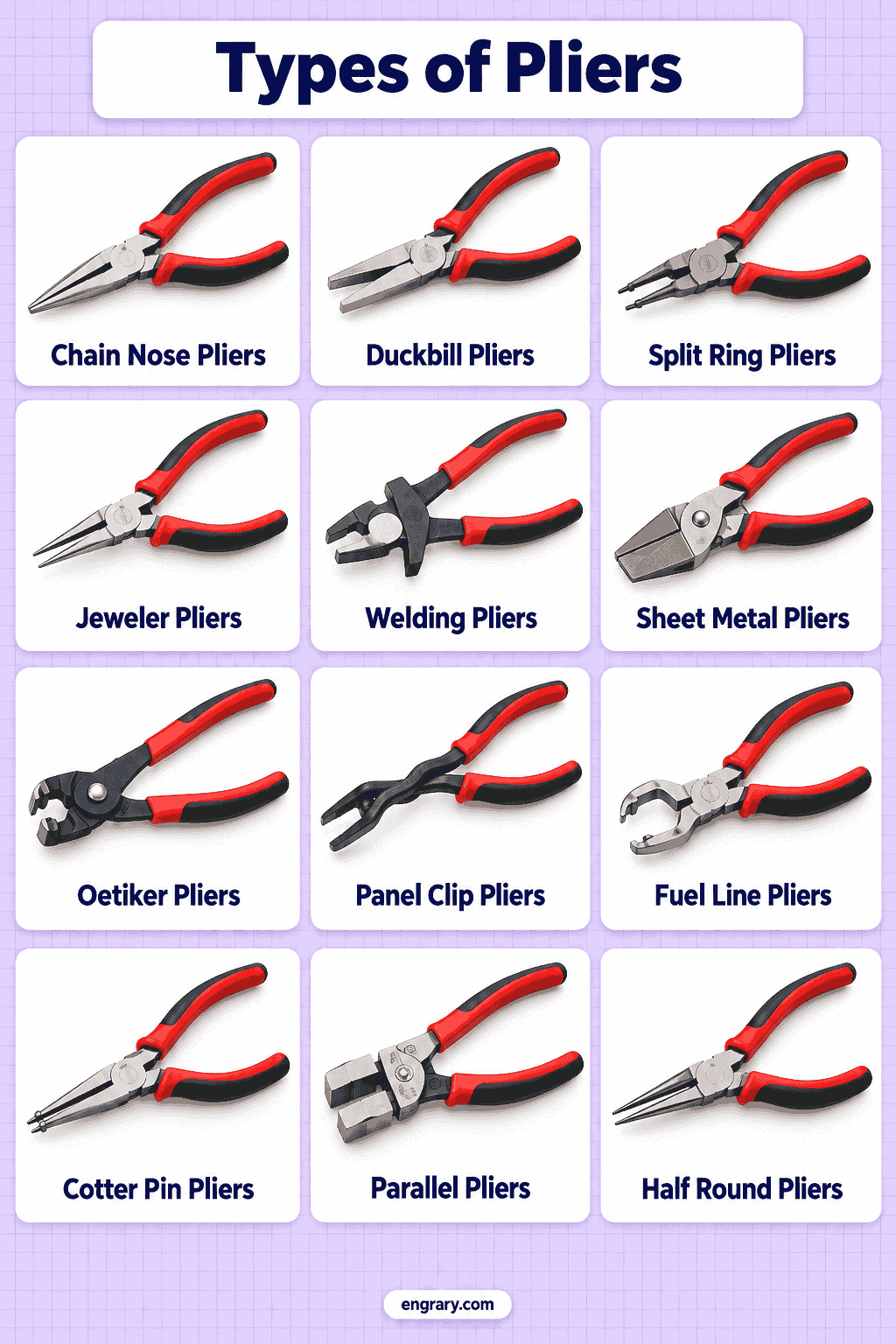
9. Duckbill Pliers
Duckbill pliers have broad, flat jaws that taper toward the end. Their flattened nose resembles a duck’s bill, which gives the tool its name.
10. Chain-Nose Pliers
Chain-nose pliers have tapered jaws with narrow tips and flat inner gripping surfaces. They look similar to needle-nose pliers but usually have a shorter precision profile.
11. Long-Reach Pliers
Long-reach pliers have extended jaws or shafts that place the tips much farther from the pivot. Their unusually long body makes them easy to recognize.
12. Locking Pliers
Locking pliers have an adjustment screw and locking mechanism built into the handles. Once closed, the jaws can remain fixed in position until the release is activated.
13. Straight-Jaw Locking Pliers
Straight-jaw locking pliers use flatter gripping surfaces than curved-jaw versions. Their straight contact faces suit workpieces with flatter sides.
14. Curved-Jaw Locking Pliers
Curved-jaw locking pliers have rounded jaws that form a deeper opening. The curved profile is especially noticeable when viewed from the side.
15. Long-Nose Locking Pliers
Long-nose locking pliers combine narrow extended jaws with a locking handle mechanism. They look like a cross between needle-nose pliers and conventional locking pliers.
16. Diagonal Cutting Pliers
Diagonal cutting pliers have cutting edges positioned diagonally across the side of the head. They are also widely known as diagonal cutters or side cutters.
17. End-Cutting Pliers
End-cutting pliers place their cutting edges across the very front of the head. Their rounded front-cutting profile differs clearly from side-cutting pliers.
18. Flush-Cut Pliers
Flush-cut pliers have fine cutting edges designed to leave a flatter cut on suitable material. They usually have a smaller and more delicate head than heavy diagonal cutters.
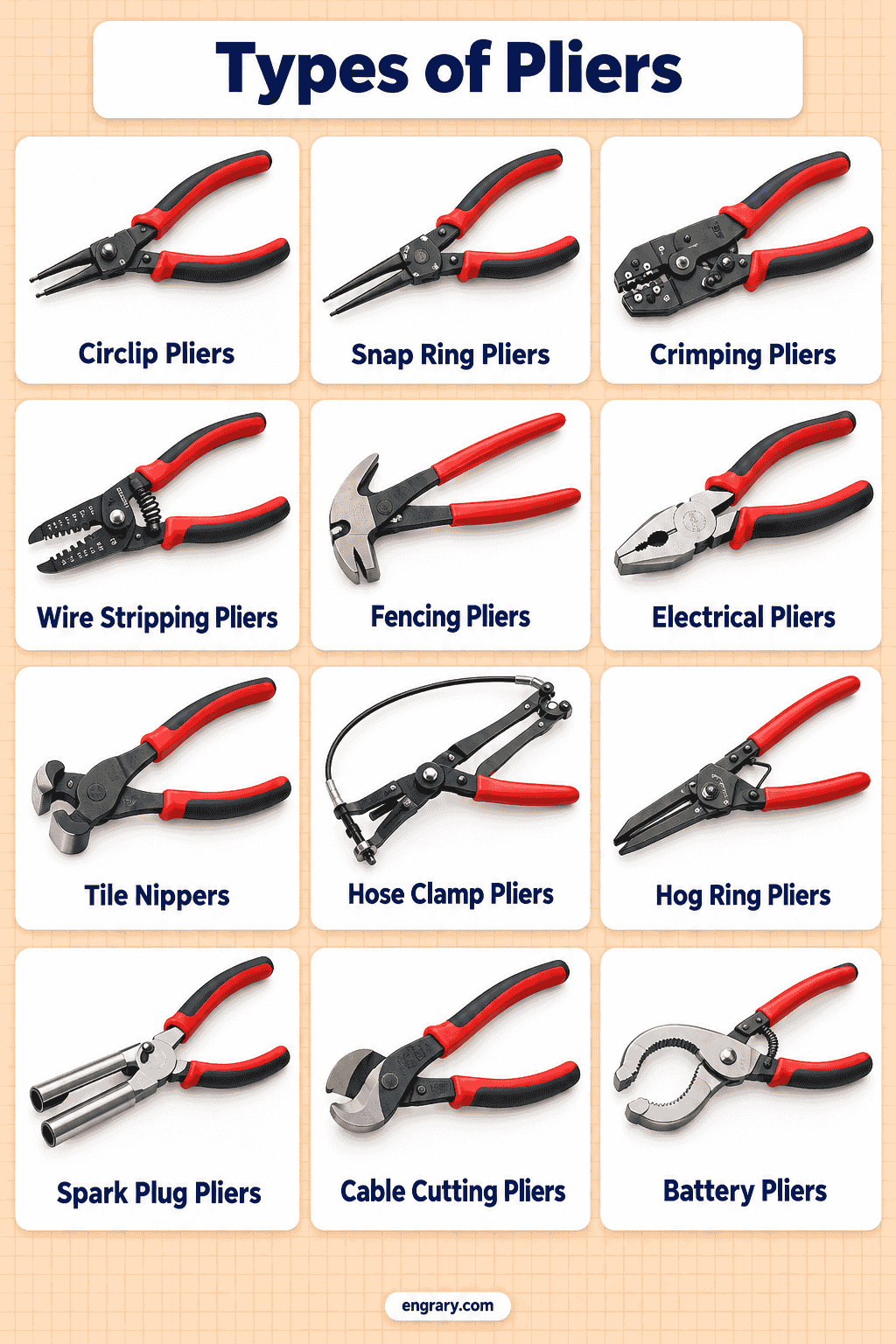
19. Cable-Cutting Pliers
Cable-cutting pliers have curved cutting jaws that wrap around cable. Their rounded cutting profile is easy to distinguish from straight diagonal edges.
20. Internal Retaining-Ring Pliers
Internal retaining-ring pliers have narrow pin-like tips designed around retaining rings fitted inside bores. Their slender tips are the main recognition clue.
21. External Retaining-Ring Pliers
External retaining-ring pliers also use narrow tips, but their jaw action is intended for rings fitted around shafts. They belong to the same circlip family as internal versions.
22. Crimping Pliers
Crimping pliers have shaped jaw recesses rather than simple gripping faces. Their stepped or molded sections give the head a very different appearance from ordinary pliers.
23. Hose Clamp Pliers
Hose clamp pliers have specially shaped jaw ends designed around compatible hose clamps. Their distinctive tips make them easy to recognize.
Pliers with Different Nose Shapes
Changing the nose shape changes how pliers contact small, curved, delicate, or narrow objects. Some types focus on forming and precision work rather than general gripping.
24. Bail-Making Pliers
Bail-making pliers have two smooth cylindrical jaws, often with different diameters. Their parallel round jaws distinguish them from tapered round-nose pliers.
25. Parallel-Action Pliers
Parallel-action pliers use a linked joint that keeps the jaws more parallel as they open and close. Their mechanism looks more complex than a standard single-pivot design.
26. Soft-Jaw Pliers
Soft-jaw pliers use padded, plastic, nylon, or other non-marring jaw surfaces. The softer gripping inserts make them visually different from exposed serrated steel jaws.
Adjustable Pliers and How Their Jaws Move
Some pliers change their opening through buttons, sliding pivots, or parallel-jaw mechanisms. The adjustment system becomes the main feature that separates these tools from fixed-joint designs.
27. Push-Button Pliers
Push-button pliers have an adjustable pivot controlled by a button near the joint. The button provides a clear visual difference from traditional tongue-and-groove pliers.
28. Pliers Wrench
A pliers wrench combines adjustable plier-style handles with smooth, parallel jaws. Unlike serrated water-pump pliers, its gripping faces look flat and wrench-like.
Locking Pliers and Their Jaw Variations
Locking pliers come in several jaw forms. Manufacturers can replace the usual straight or curved jaws with clamps, chains, or extended gripping shapes while keeping the same basic locking mechanism.
29. C-Clamp Locking Pliers
C-clamp locking pliers have large C-shaped jaws attached to a locking handle mechanism. Their wide opening gives them a clamp-like appearance.
30. Locking Chain Pliers
Locking chain pliers use a flexible chain instead of one conventional jaw. The chain forms a loop around the object while the handle mechanism provides the locking action.
Pliers with Different Cutting-Edge Designs
Cutting pliers differ mainly by where their edges sit and how the head is shaped. Some cut from the side, others from the front, while precision models use finer edges for small work.
31. Precision Cutting Pliers
Precision cutting pliers have a compact head with finely ground cutting edges. Their small size makes them more delicate-looking than standard diagonal cutters.
32. Electronics Cutting Pliers
Electronics cutting pliers use a lightweight head and fine cutting edges for small wire and component work. Their slender profile distinguishes them from heavier workshop cutters.
33. Wire-Stripping Pliers
Wire-stripping pliers combine plier-style handles with shaped stripping openings and cutting sections. The series of holes or notches in the jaws provides the main visual clue.
Pliers Built Around Rings, Clips, and Clamps
Retaining rings, clamps, and formed rings need specially shaped tips or jaws. These pliers often look unusual because their working ends are designed around one particular fastener or ring form.
34. Convertible Retaining-Ring Pliers
Convertible retaining-ring pliers can switch between internal and external ring operation. Their changeable action separates them from fixed internal or external designs.
35. Hog-Ring Pliers
Hog-ring pliers have grooved or shaped jaws that hold compatible metal rings. The recessed tips give them a distinctive head profile.
36. Hose-Grip Pliers
Hose-grip pliers have curved jaws shaped to contact hoses or similar cylindrical parts. Unlike hose clamp pliers, they grip the hose rather than the clamp.
Pliers Designed for Specific Jobs
Some pliers are easy to identify because their heads include hooks, punches, grooves, springs, or other trade-specific features. These tools keep the basic two-handle plier form but adapt the jaws for one particular type of work.
37. Fencing Pliers
Fencing pliers have a large multipurpose head with gripping, cutting, staple-related, and hammer-like features. Their unusual head shape makes them one of the most recognizable specialty pliers.
38. Wire-Twisting Pliers
Wire-twisting pliers combine narrow jaws with a locking and spiral-style mechanism in the handles. The extra mechanical section gives them a distinctive elongated appearance.
39. Welding Pliers
Welding pliers have a multifunction head with several gripping and cutting areas. Their specialized nose and jaw sections distinguish them from standard combination pliers.
40. Battery Terminal Pliers
Battery terminal pliers have compact curved jaws shaped around battery-terminal work. Their gripping area is generally shorter and broader than a needle-nose profile.
41. Piston Ring Pliers
Piston ring pliers have specially shaped tips or jaws designed around piston rings. Their head looks more delicate and specialized than general automotive pliers.
42. Brake Spring Pliers
Brake spring pliers use hooked and shaped ends associated with brake spring work. Their asymmetric head gives them a very distinctive appearance.
43. Hole-Punch Pliers
Hole-punch pliers use a punch-and-die arrangement at the jaws instead of ordinary serrated gripping surfaces. Closing the handles brings the punch toward the matching die.
44. Revolving Punch Pliers
Revolving punch pliers have a rotating wheel fitted with several punch sizes. The circular turret near the head is the clearest feature for identification.
45. Hemostat Pliers
Hemostat pliers have long narrow jaws, finger-ring handles, and a locking ratchet near the grips. Their scissor-like body looks very different from conventional workshop pliers.
How to Tell Similar Pliers Apart
Many pliers share similar handles and pivots, so the jaw profile usually gives the fastest clue. The table below highlights the main feature that separates commonly confused types.
| Pliers | Main Difference |
|---|---|
| Combination vs Linesman’s Pliers | Combination pliers have a general multipurpose head, while linesman’s pliers have broader, heavier jaws and a stronger cutting section. |
| Slip-Joint vs Tongue-and-Groove Pliers | Slip-joint pliers have limited pivot positions, while tongue-and-groove pliers offer several adjustment grooves and a wider opening range. |
| Needle-Nose vs Bent-Nose Pliers | Needle-nose pliers have straight tapered jaws, while bent-nose pliers angle near the tips. |
| Needle-Nose vs Long-Reach Pliers | Needle-nose pliers mainly taper toward the tip, while long-reach pliers extend much farther from the pivot. |
| Flat-Nose vs Round-Nose Pliers | Flat-nose pliers have broad flat jaws, while round-nose pliers have smooth cylindrical jaws. |
| Diagonal Cutting vs End-Cutting Pliers | Diagonal cutters place their edges along the side of the head, while end cutters place them across the front. |
| Diagonal Cutting vs Flush-Cut Pliers | Diagonal cutters handle general cutting, while flush cutters have finer edges designed for a flatter finish. |
| Locking vs Slip-Joint Pliers | Locking pliers can hold their jaws in position, while slip-joint pliers rely on hand pressure and an adjustable pivot. |
| Straight-Jaw vs Curved-Jaw Locking Pliers | Straight-jaw versions use flatter gripping surfaces, while curved-jaw versions form a rounded opening. |
| Internal vs External Retaining-Ring Pliers | Internal versions work with rings inside bores, while external versions work with rings around shafts. |
| Hose Clamp vs Hose-Grip Pliers | Hose clamp pliers engage the clamp, while hose-grip pliers contact the hose itself. |
| Crimping vs Combination Pliers | Crimping pliers have shaped crimping recesses, while combination pliers use general gripping surfaces and cutters. |
| Fencing vs Linesman’s Pliers | Fencing pliers have a multipurpose specialty head, while linesman’s pliers have a more conventional gripping-and-cutting head. |
| Hole-Punch vs Revolving Punch Pliers | Hole-punch pliers use a fixed punch arrangement, while revolving punch pliers use a rotating wheel with several punch sizes. |
Other Names Used for the Same Pliers
Pliers often have different names across trades and regions. These alternate terms should not increase the numbered count when they describe the same basic tool.
| Main Name | Other Common Names |
|---|---|
| Needle-Nose Pliers | Long-Nose Pliers |
| Tongue-and-Groove Pliers | Groove-Joint Pliers / Water-Pump Pliers |
| Locking Pliers | Mole Grips / Vise-Grip-Style Pliers |
| Diagonal Cutting Pliers | Diagonal Cutters / Side Cutters |
| Retaining-Ring Pliers | Snap-Ring Pliers / Circlip Pliers |
| End-Cutting Pliers | End Nippers in overlapping usage |
| Fencing Pliers | Fence Pliers |
| Hose Clamp Pliers | Clamp Pliers in some contexts |
Because terminology varies, the jaw shape, pivot, tips, and mechanism often provide a more reliable identification clue than the name alone.
Questions People Ask About Pliers
Major plier families include combination, slip-joint, tongue-and-groove, needle-nose, locking, cutting, retaining-ring, crimping, clamp, and specialty pliers.
Look at the nose length, jaw width, curvature, serrations, cutting edges, tip shape, and adjustment mechanism. For example, needle-nose pliers have long tapered jaws, while round-nose pliers have smooth cylindrical jaws.
Slip-joint pliers use a pivot with a limited number of positions. Tongue-and-groove pliers use several grooves, so their jaws can adjust across a wider opening range.
Needle-nose pliers have long narrow jaws for small or restricted areas. Linesman’s pliers have shorter, broader jaws with a heavier gripping and cutting section.
Gripping pliers usually have serrated or shaped surfaces designed to hold an object. Cutting pliers have sharpened edges positioned along the side, front, or inner part of the head.
You May Also Like



Leave a Comment