

Chisels come in many shapes because different blades suit different kinds of cutting, trimming, joinery, carving, timber work, metalwork, and masonry. The easiest way to identify a chisel is to look at its blade thickness, cutting edge, side profile, neck shape, and overall construction.
In this guide, you’ll learn 35 types of chisels with pictures and uses, including woodworking, joinery, timber, Japanese, metalworking, and masonry chisels. Each description focuses on simple recognition clues so you can tell similar chisel types apart more easily.
Chisel Types by Blade Shape and Build
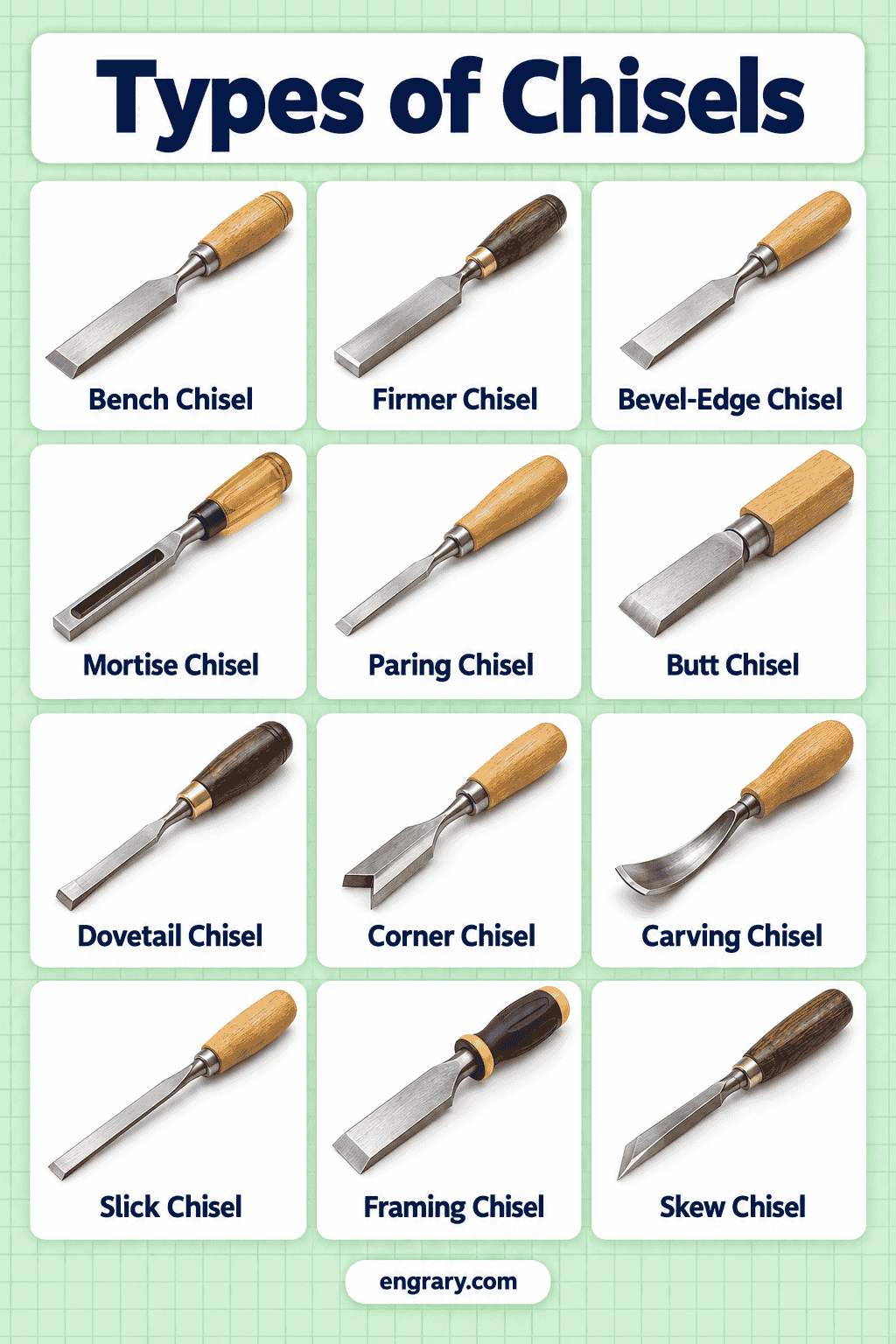
Many chisels can be identified immediately by the length, thickness, width, or side profile of the blade. Some have straight sides, while others use beveled edges, thick rectangular sections, flared ends, or offset necks.
1. Bench Chisel
A Bench Chisel has a medium-length blade, straight cutting edge, and conventional handle. It is the familiar general-purpose woodworking form that many other wood chisels resemble.
2. Bevel-Edge Chisel
A Bevel-Edge Chisel has its blade sides relieved or beveled toward the cutting face. The narrowed side profile makes it visibly different from thicker straight-sided chisels.
3. Firmer Chisel
A Firmer Chisel has a thicker, more substantial blade with relatively straight sides. Its heavier construction distinguishes it from a lighter Bevel-Edge Chisel.
4. Mortise Chisel
A Mortise Chisel has a narrow cutting edge and a very thick rectangular blade. Its deep blade section is one of the clearest visual clues in the chisel family.
5. Sash Mortise Chisel
A Sash Mortise Chisel has a slimmer profile than a heavy traditional Mortise Chisel. It still uses a relatively thick blade, but the body is usually lighter and less bulky.
6. Pigsticker Chisel
A Pigsticker Chisel is a traditional heavy Mortise Chisel with a deep, stout blade. Its unusually thick blade section gives it a very robust appearance.
7. Paring Chisel
A Paring Chisel has a long, thin blade designed for controlled trimming work. Its extended blade length makes it easy to distinguish from ordinary Bench Chisels.
8. Cranked Paring Chisel
A Cranked Paring Chisel has an offset or bent neck that raises the handle above the blade line. This stepped profile is its most obvious identifying feature.
9. Butt Chisel
A Butt Chisel has a short blade and compact overall body. It looks like a shortened, stout version of a general woodworking chisel.
10. Framing Chisel
A Framing Chisel has a broad, thick blade and a robust handle. Its larger proportions separate it from ordinary Bench and Firmer Chisels.
11. Slick
A Slick is a very large timber chisel with a broad blade and long handle. Its size and wide cutting edge make it one of the easiest heavy chisels to recognize.
12. Skew Chisel
A Skew Chisel has a cutting edge set diagonally across the end of the blade. The slanted edge creates a noticeably asymmetrical tip.
13. Corner Chisel
A Corner Chisel has a cutting profile shaped around a right angle. Its 90-degree working end gives it a very different appearance from flat-edged chisels.
14. Fishtail Chisel
A Fishtail Chisel has a narrow neck that widens toward the cutting edge. The flared blade resembles a fish tail when viewed from above.
15. Swan-Neck Chisel
A Swan-Neck Chisel has a curved or bent blade section that gives the tool a distinctive sweeping profile. The curved neck is the main recognition clue.
16. Cranked Chisel
A Cranked Chisel has an offset blade or neck that moves the handle away from the cutting plane. It is a broader offset-chisel form than the more specific Cranked Paring Chisel.
17. Oire Chisel
An Oire Chisel is a compact Japanese woodworking chisel with a relatively short blade. Its proportions make it suitable as a general Japanese bench-style form.
18. Mukomachi Chisel
A Mukomachi Chisel is a Japanese mortising chisel with a thick, narrow blade. Its heavy rectangular section visually links it with Western Mortise Chisels.
19. Kote Chisel
A Kote Chisel has a cranked or offset neck that raises the handle above the cutting line. Its stepped Japanese profile is easy to recognize.
20. Tsuki Chisel
A Tsuki Chisel has a long blade and extended handle arrangement associated with controlled paring-style woodworking. Its elongated form distinguishes it from shorter Japanese chisels.
Chisels for Joinery and Mortising
Joinery chisels usually have thicker blades or narrow cutting edges because their shape is built around joints rather than general surface trimming. Several of the main Mortise and Bench forms already appeared above, while the types below add more specific joinery profiles.
21. Dovetail Chisel
A Dovetail Chisel has narrow side bevels that allow the blade to fit into tight angled corners. Its slim side profile is the main visual distinction.
22. Registered Chisel
A Registered Chisel has a heavy blade with straight, square sides. Its robust rectangular construction places it between general Firmer and heavier timber-working forms.
Long-Blade and Offset Chisels
Some chisels change the relationship between the blade and handle rather than changing the cutting edge itself. Long or offset designs are easy to recognize because their silhouette differs from an ordinary straight Bench Chisel.
23. Bent Chisel
A Bent Chisel has a blade or shank that curves away from the handle line. The bent profile allows the handle to sit above or away from the working surface.
24. Offset Chisel
An Offset Chisel has a blade that runs on a different plane from the handle. Unlike a gently bent form, the offset may appear as a more distinct step in the shank.
Chisels with Distinctive Cutting Edges
Several chisel types are defined mainly by the shape of the cutting end. Looking at the point or edge is often enough to identify them.
25. V-Chisel
A V-Chisel has a V-shaped cutting profile rather than a single flat edge. Its sharply angled working end makes it easy to separate from ordinary straight chisels.
26. Dog-Leg Chisel
A Dog-Leg Chisel has an offset blade profile with a sharp change in angle along the shank. Its stepped shape is more pronounced than that of a simple straight or gently bent chisel.
Chisels for Heavy Timber Work
Heavy timber chisels use larger blades, stronger bodies, and longer handles than ordinary bench tools. Framing Chisels and Slicks are the best-known examples, while other traditional forms use similar heavy construction.
27. Timber Framing Mortise Chisel
A Timber Framing Mortise Chisel has a thick, heavy blade sized around large timber joints. Its substantial body is visibly heavier than a normal cabinetmaking Mortise Chisel.
Japanese Wood Chisels
Japanese chisels often share the same broad roles as Western chisels, but their proportions and regional names create recognizable families. Oire, Mukomachi, Kote, and Tsuki forms already appear above, so this section avoids repeating them.
28. Atsu Chisel
An Atsu Chisel has a thicker and heavier blade than a compact general-purpose Japanese chisel. Its robust build places it closer to heavy woodworking and timber work.
Chisels for Metalworking
Metalworking chisels usually have solid steel bodies without the conventional wooden handle seen on woodworking chisels. Their working ends vary from broad flat edges to narrow, rounded, or pointed profiles.
29. Cold Chisel
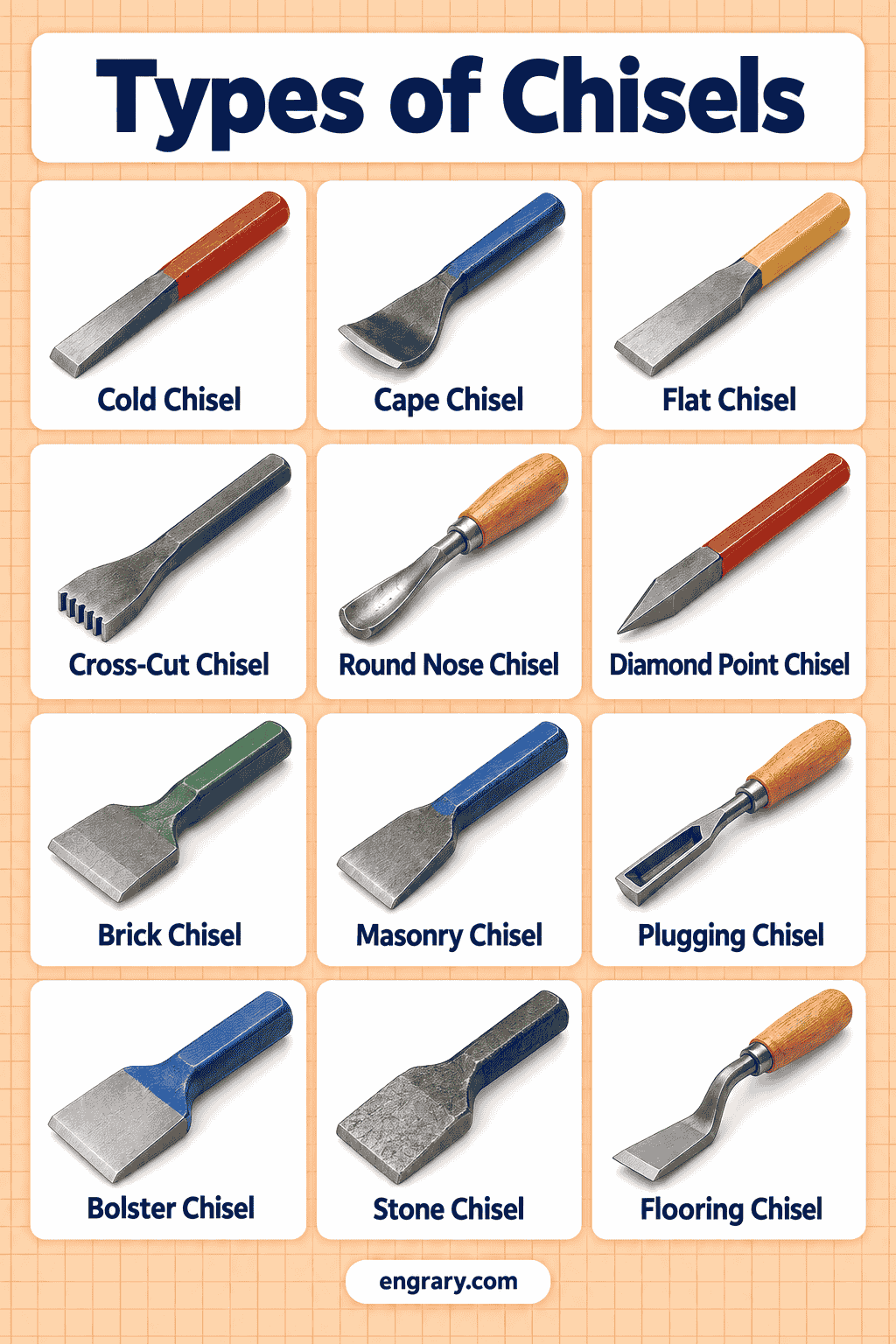
A Cold Chisel has an all-metal body and a broad straight cutting edge. Its solid steel shank makes it immediately different from most woodworking chisels.
30. Cape Chisel
A Cape Chisel has a much narrower cutting edge than a standard Cold Chisel. It is also commonly called a Crosscut Chisel in metalworking terminology.
31. Diamond-Point Chisel
A Diamond-Point Chisel tapers to a four-sided pointed end. The diamond-shaped point gives it one of the most distinctive profiles among metal chisels.
32. Round-Nose Chisel
A Round-Nose Chisel has a rounded working end rather than a flat or sharply pointed tip. The curved cutting profile provides its main recognition clue.
33. Grooving Chisel
A Grooving Chisel has a narrow shaped working edge intended around groove-forming work. The term Groove Chisel is also used for the same basic form.
Chisels for Brick, Masonry, and Stone
Masonry chisels usually use solid metal bodies and broader or more heavily reinforced working ends. Their shapes vary depending on whether the tip is flat, wide, narrow, or pointed.
34. Masonry Chisel
A Masonry Chisel has a solid metal body and a strong flat cutting end. It serves as a broad reference form for chisels designed around brick, block, stone, and similar materials.
35. Bolster Chisel
A Bolster Chisel has a notably broad cutting edge that is wider than the main shank. Its wide blade profile makes it easy to distinguish from narrower masonry chisels.
How to Tell Similar Chisels Apart
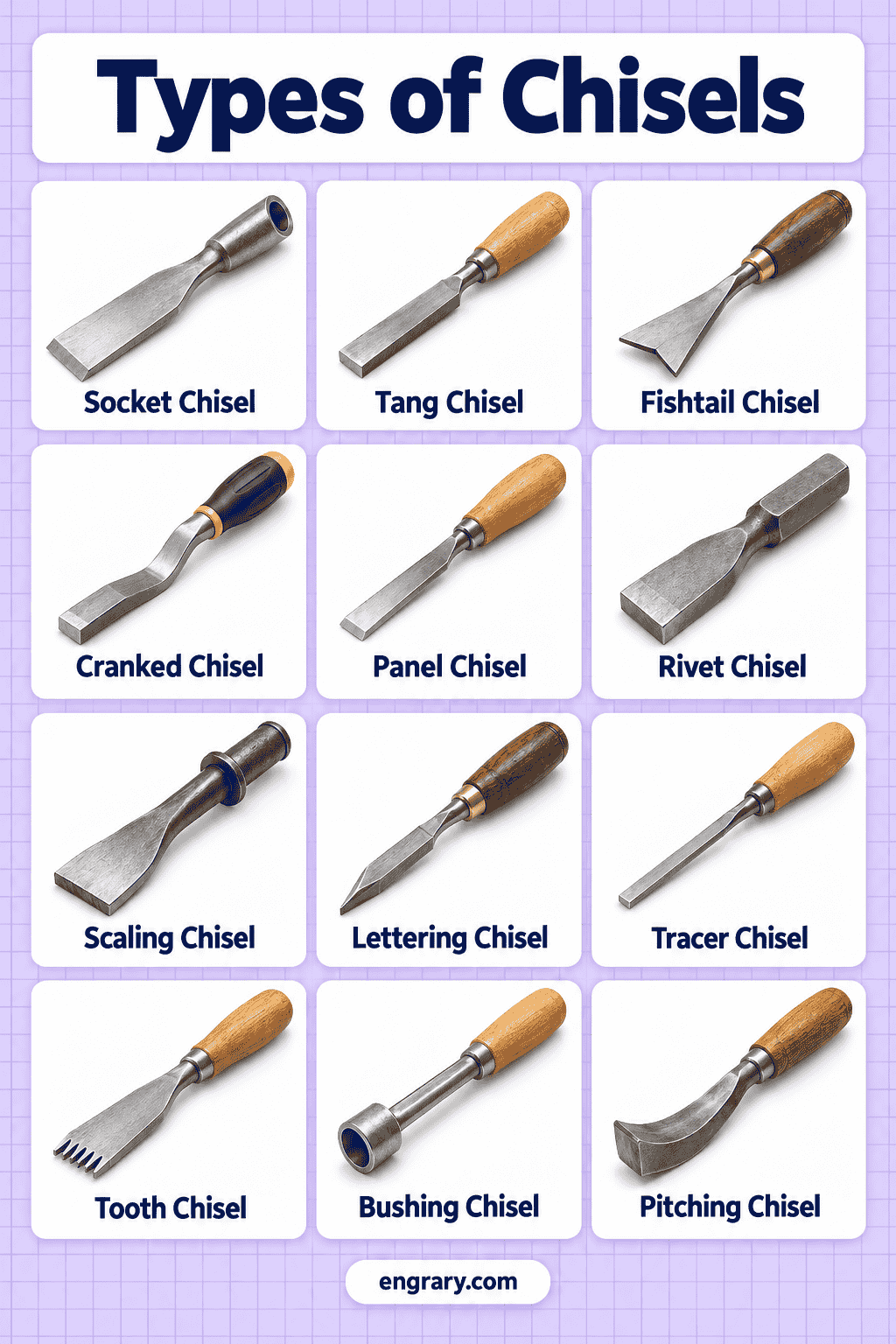
Many chisel names overlap because one term may describe blade geometry while another describes the job or regional tradition. Comparing blade thickness, length, edge shape, and neck arrangement usually makes the distinction clearer.
| Chisel Types | Main Difference |
|---|---|
| Bench Chisel vs Bevel-Edge Chisel | Bench Chisel describes a general woodworking form, while Bevel-Edge Chisel specifically refers to relieved blade sides. |
| Bench Chisel vs Firmer Chisel | A Bench Chisel is generally lighter, while a Firmer Chisel has a thicker and more substantial blade. |
| Bench Chisel vs Butt Chisel | A Butt Chisel is much shorter and more compact than a standard Bench Chisel. |
| Bench Chisel vs Paring Chisel | A Paring Chisel has a noticeably longer and thinner blade. |
| Mortise Chisel vs Bench Chisel | A Mortise Chisel has a much thicker, narrower blade section. |
| Mortise Chisel vs Sash Mortise Chisel | A Sash Mortise Chisel is generally slimmer and lighter than a heavy Mortise Chisel. |
| Mortise Chisel vs Pigsticker Chisel | A Pigsticker is a particularly deep and heavy traditional mortise form. |
| Paring Chisel vs Cranked Paring Chisel | A Cranked Paring Chisel offsets the handle above the blade line. |
| Firmer Chisel vs Framing Chisel | A Framing Chisel is usually larger and heavier overall. |
| Framing Chisel vs Slick | A Slick is broader and typically has a much longer handle. |
| Straight Chisel vs Skew Chisel | A straight chisel has a square cutting edge, while a Skew Chisel has a diagonal edge. |
| Corner Chisel vs Fishtail Chisel | A Corner Chisel has a 90-degree profile, while a Fishtail Chisel flares outward toward the edge. |
| Cold Chisel vs Wood Chisel | A Cold Chisel normally has a solid all-metal body, while a wood chisel typically has a separate handle. |
| Cold Chisel vs Cape Chisel | A Cold Chisel has a broad flat edge, while a Cape Chisel has a narrow cutting edge. |
| Cape Chisel vs Diamond-Point Chisel | A Cape Chisel ends in a narrow blade, while a Diamond-Point Chisel ends in a pointed four-sided tip. |
| Chisel vs Gouge | A typical chisel has a flat or shaped blade, while a gouge has a curved cutting profile. |
Other Names Used for the Same Chisels
Chisel terminology varies by region, woodworking tradition, and manufacturer. Some terms are alternate names, while others describe overlapping blade geometry.
| Main Name | Other Name or Overlapping Term |
|---|---|
| Mortise Chisel | Mortice Chisel |
| Cape Chisel | Crosscut Chisel |
| Grooving Chisel | Groove Chisel |
| Slick | Framing Slick |
| Corner Chisel | 90-Degree Chisel in some catalogs |
| Cranked Chisel | Crank-Neck Chisel where the same profile is intended |
| Bolster Chisel | Brick Bolster in overlapping masonry terminology |
| Bench Chisel | Bevel-Edge Bench Chisel when the bench form has relieved sides |
Names alone do not always identify a chisel precisely. The blade thickness, side profile, cutting-edge shape, neck arrangement, and overall construction usually provide better clues.
Questions People Ask About Chisels
Major chisel families include Bench, Bevel-Edge, Firmer, Mortise, Paring, Framing, Slick, Skew, Corner, Japanese, Cold, and Masonry Chisels.
A Bench Chisel has a medium-weight general woodworking blade. A Mortise Chisel has a much thicker, narrower blade built around mortise-style joinery.
A Paring Chisel has a longer and thinner blade, while a Bench Chisel has a shorter and more general-purpose body.
A Cold Chisel normally has a solid steel body and no separate woodworking-style handle. A Wood Chisel usually has a handled blade designed around cutting and shaping wood.
Start with the blade. Check its thickness, length, side bevels, cutting-edge shape, neck angle, and whether the body is handled or made from solid metal. These features usually reveal the chisel family quickly.
You May Also Like



Leave a Comment