
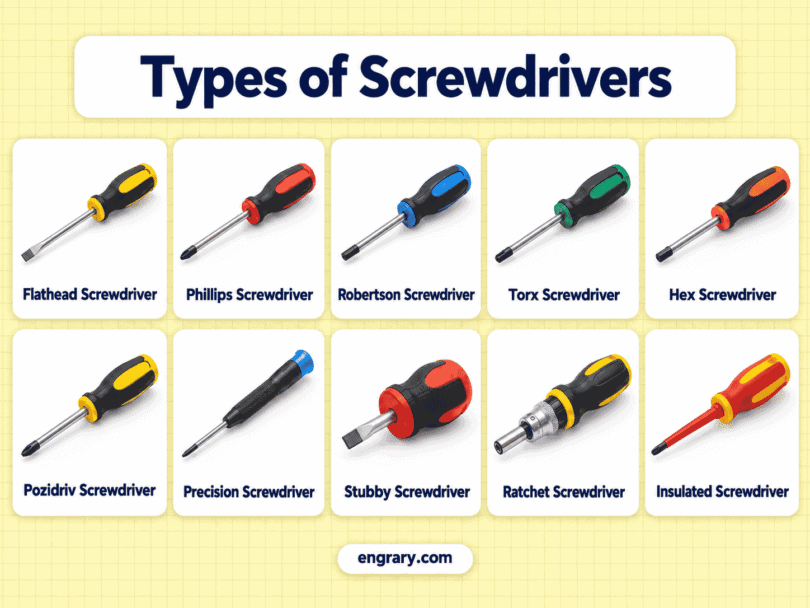
Screwdrivers come in many forms because screw heads use different slots, crosses, stars, squares, splines, and security patterns. Other screwdriver types differ because of their size, shaft shape, handle design, interchangeable tips, or turning mechanism.
In this guide, you’ll learn 50 types of screwdrivers with pictures and uses. Each description focuses on an easy recognition clue, helping you identify the tip shape or physical feature that makes one screwdriver different from another.
Common Screwdrivers You Should Know
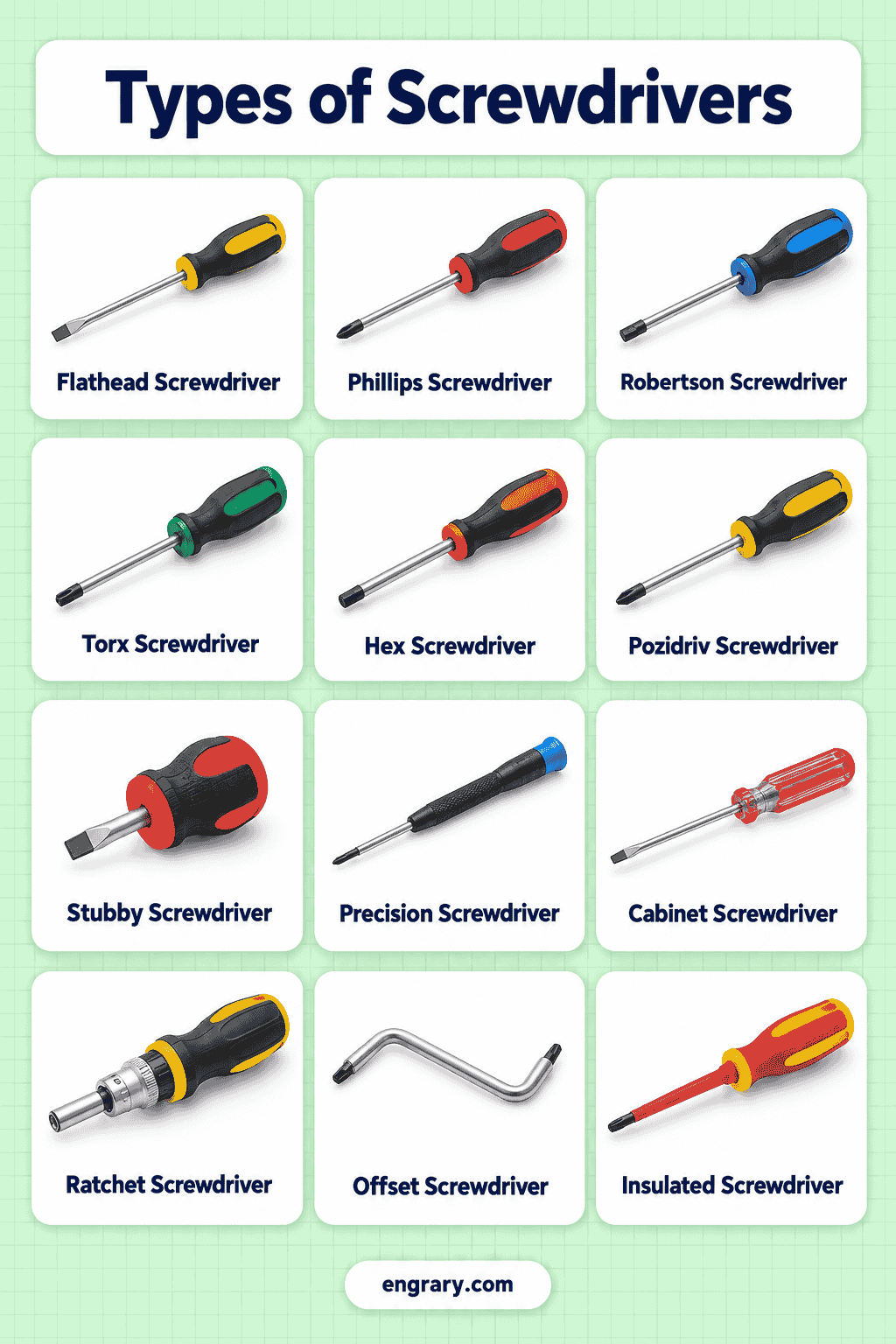
The easiest way to identify most screwdrivers is to look closely at the working tip. Some have simple flat or cross-shaped ends, while others use square, hexagonal, star-shaped, winged, or security patterns.
1. Slotted Screwdriver
A slotted screwdriver has one straight, flat blade at the end of its shaft. It matches screw heads with a single straight slot and is also widely called a flat-head or flat-blade screwdriver.
2. Phillips Screwdriver
A Phillips screwdriver has a four-arm cross-shaped tip. Its familiar cross profile makes it one of the most recognizable screwdriver types.
3. Pozidriv Screwdriver
A Pozidriv screwdriver resembles Phillips but has additional smaller ribs between the main cross arms. These extra lines are an important visual clue when distinguishing the two.
4. JIS Screwdriver
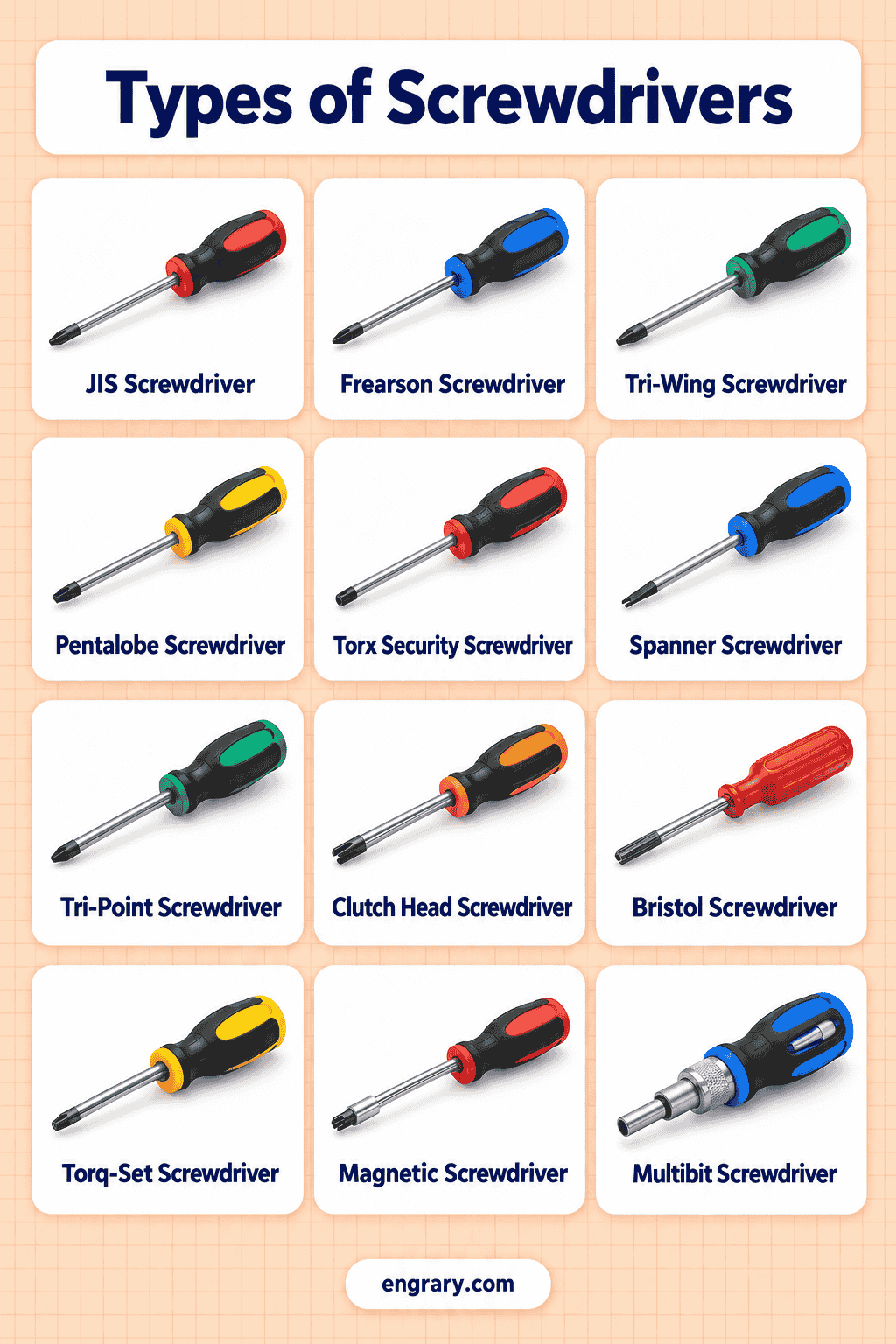
A JIS screwdriver has a cross-shaped tip associated with Japanese Industrial Standard fasteners. It looks similar to Phillips, although the working geometry differs.
5. Frearson Screwdriver
A Frearson screwdriver uses a sharp cross-shaped tip with more pointed arms than a typical Phillips driver. It is also known as a Reed and Prince screwdriver.
6. Robertson Screwdriver
A Robertson screwdriver has a simple square-shaped tip. Because of this shape, it is also commonly called a square screwdriver or square-drive screwdriver.
7. Hex Screwdriver
A hex screwdriver has a six-sided tip that matches a hexagonal recess. The same basic drive shape is also commonly associated with the name Allen.
8. Torx Screwdriver
A Torx screwdriver has a six-lobed star-shaped tip with rounded lobes. Its star profile makes it easy to distinguish from square and hex drivers.
9. Torx Plus Screwdriver
A Torx Plus screwdriver uses a modified six-lobed design with broader lobes than standard Torx. Although related, the two tip profiles are not identical.
10. Security Torx Screwdriver
A Security Torx screwdriver has a six-lobed Torx tip with a small hole in the center. The center opening distinguishes it from a standard Torx driver.
11. Tri-Wing Screwdriver
A Tri-Wing screwdriver has three wing-like blades arranged around its center. The tip resembles a small three-bladed propeller.
12. Tri-Point Screwdriver
A Tri-Point screwdriver has three arms arranged in a Y-shaped pattern. Although it resembles Tri-Wing, the shape of its three arms is different.
13. Pentalobe Screwdriver
A Pentalobe screwdriver has a five-lobed flower- or star-like tip. Counting five lobes helps distinguish it from six-lobed Torx.
14. Triangle Screwdriver
A Triangle screwdriver has a solid triangular working tip. Its three straight sides make it visually different from Tri-Wing and Tri-Point patterns.
15. Clutch Screwdriver
A Clutch screwdriver has a bow-tie or butterfly-shaped tip. This unusual profile makes it one of the more recognizable specialty screwdriver types.
16. Spanner Screwdriver
A Spanner screwdriver has two narrow prongs at the tip. It is also known as a snake-eye or two-pin screwdriver.
17. Torq-Set Screwdriver
A Torq-Set screwdriver has four offset wing-like arms. Unlike a simple Phillips cross, its arms appear slightly displaced from one another.
18. Triple-Groove Screwdriver
A Triple-Groove screwdriver works with a fastener that has three grooves positioned around its outer edge. Its tip design differs greatly from central slot or star patterns.
19. ECX Screwdriver
An ECX screwdriver uses a combination-style tip designed for compatible combination recesses. Its working shape combines characteristics associated with more familiar drive patterns.
20. Bristol Spline Screwdriver
A Bristol spline screwdriver has several straight-sided splines arranged around its tip. These sharply defined splines distinguish it from the rounded lobes of Torx.
21. Security Hex Screwdriver
A Security Hex screwdriver has a six-sided hex tip with a hole through the center. The hole accommodates tamper-resistant hex fasteners with a center pin.
22. Security Phillips Screwdriver
A Security Phillips screwdriver uses a modified cross-head design intended for compatible tamper-resistant fasteners. Its security feature separates it from an ordinary Phillips driver.
23. Precision Screwdriver
A precision screwdriver has a very small handle and shaft for tiny fasteners. Precision versions can carry Phillips, Slotted, Torx, Pentalobe, and many other miniature tip styles.
24. Stubby Screwdriver
A stubby screwdriver has a short shaft and compact handle. Its noticeably reduced overall length is the easiest feature to recognize.
25. Offset Screwdriver
An offset screwdriver has an angled or bent body instead of a conventional straight shaft. Its unusual form helps distinguish it from standard straight screwdrivers.
Cross-Head and Combination Screwdrivers
Some less common screwdriver tips build on familiar cross-head or combination-drive patterns. Their differences may be subtle, so the shape of the extra ribs, recesses, or wings becomes especially important.
26. Supadriv Screwdriver
A Supadriv screwdriver uses a cross-head pattern closely related to Pozidriv. Its additional driving features distinguish it from a basic Phillips screwdriver.
27. Quadrex Screwdriver
A Quadrex screwdriver has a combination profile that blends square and cross-head characteristics. Its mixed geometry allows it to match compatible combination fasteners.
28. Pozisquare Screwdriver
A Pozisquare screwdriver combines features of Pozidriv and square-drive patterns. Its tip therefore looks more complex than either a standard Pozidriv or Robertson driver.
29. Mortorq Screwdriver
A Mortorq screwdriver uses a distinctive shallow cruciform pattern with curved wing-like sections. Its unusual cross shape makes it easy to separate from ordinary Phillips and Pozidriv tips.
Security and Specialty Screwdrivers for Unusual Fasteners
Some fasteners use less familiar splines, lobes, grooves, or one-way patterns. These screwdriver types add useful depth to a complete screwdriver guide without relying on different tip sizes as separate entries.
30. Triple-Square Screwdriver
A Triple-Square screwdriver has a multi-point spline profile made from three overlapping square forms. It may also be described as an XZN-style driver.
31. Ribe Screwdriver
A Ribe screwdriver has a multi-spline tip with straight-sided teeth arranged around the center. Its profile is common in some automotive and mechanical applications.
32. Torx Plus Security Screwdriver
A Torx Plus Security screwdriver uses a tamper-resistant variation of the Torx Plus pattern. Its lobe arrangement and security feature distinguish it from both standard Torx and ordinary Torx Plus.
33. One-Way Screwdriver
A one-way screwdriver is associated with specialized one-way fastener designs. Its working end differs from standard Slotted or Phillips tips because the compatible fastener is designed around restricted turning or removal.
Screwdrivers for Small and Precision Fasteners
Some screwdriver designs focus on small components rather than introducing a completely new drive pattern. Their compact handles, controlled construction, or protection against static electricity provide their main identifying features.
34. ESD-Safe Screwdriver
An ESD-safe screwdriver is designed with materials that help control electrostatic discharge around sensitive electronic components. It often resembles a precision screwdriver but carries distinctive ESD markings or handle materials.
35. Insulated Screwdriver
An insulated screwdriver has protective insulation covering much of its shaft and handle. The insulated shaft is often brightly colored and provides an obvious visual difference from a standard screwdriver.
Screwdrivers for Tight and Hard-to-Reach Spaces
Restricted spaces can require screwdriver bodies that bend, turn at an angle, or change the position of the user’s grip. These types are identified mainly by their body shape rather than by one particular tip.
36. Flexible-Shaft Screwdriver
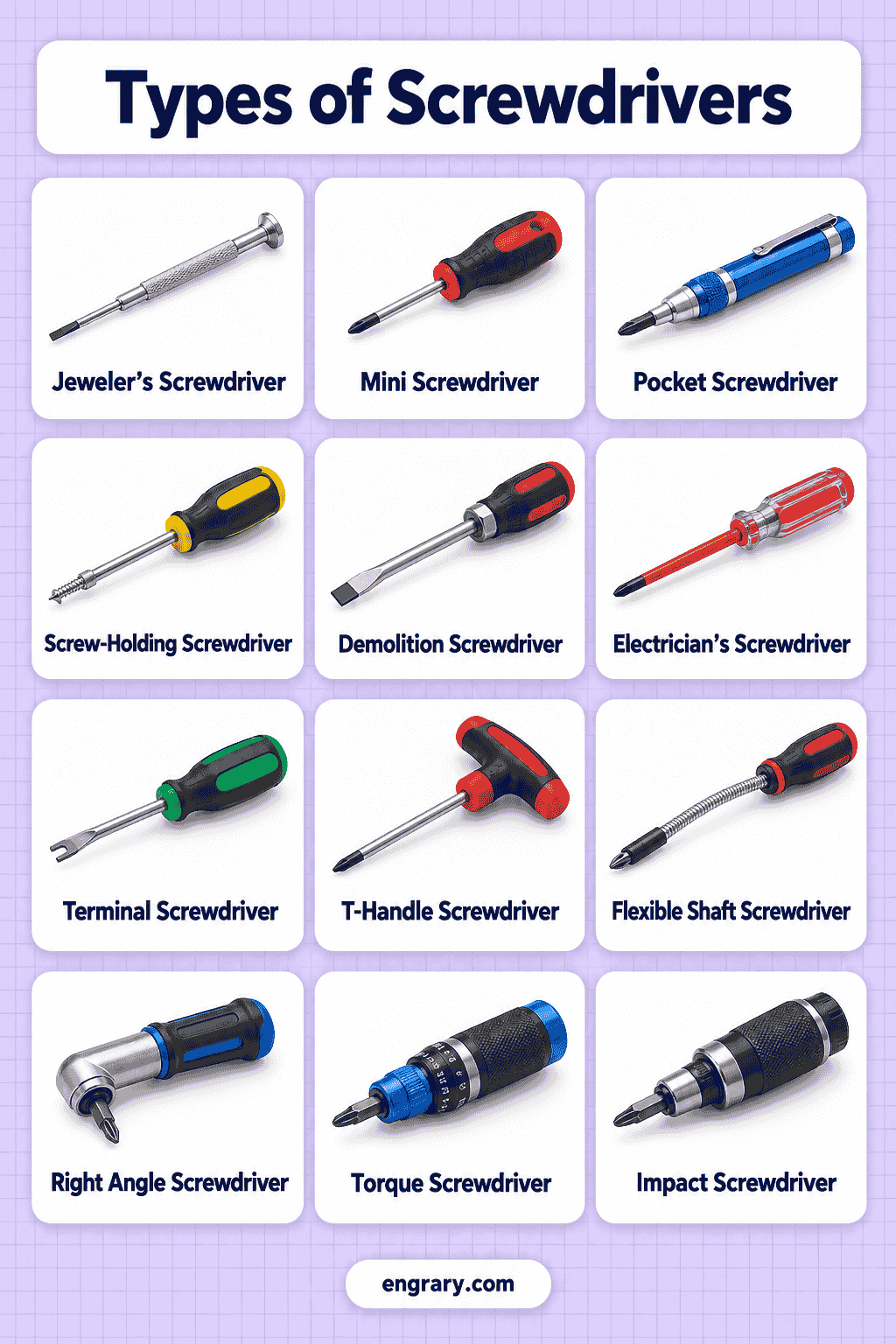
A flexible-shaft screwdriver has a bendable section between its handle and working end. The flexible shaft can curve instead of remaining rigid and straight.
37. Right-Angle Screwdriver
A right-angle screwdriver positions the working end roughly perpendicular to the main handle or body. Its L-shaped arrangement distinguishes it from a standard straight screwdriver.
38. T-Handle Screwdriver
A T-handle screwdriver has a crossbar-style handle that forms a T shape with the shaft. The wide handle gives it a very different appearance from a conventional straight screwdriver handle.
39. Pistol-Grip Screwdriver
A pistol-grip screwdriver has a handle angled downward like the grip of a pistol. Some manual and powered screwdrivers use this form.
Screwdrivers with Interchangeable or Adjustable Tips
Instead of having one permanent working end, these screwdriver designs accept removable blades or bits. Their main advantage as a category is the ability to change tip styles while keeping the same main handle.
40. Bit-Holder Screwdriver
A bit-holder screwdriver has a socket or holder at the end of its shaft for removable driver bits. The handle and shaft remain in place while the working bit can be changed.
41. Interchangeable-Blade Screwdriver
An interchangeable-blade screwdriver accepts removable full-length blades or shafts. Different blades may provide different tip patterns while using the same handle.
42. Screw-Holding Screwdriver
A screw-holding screwdriver includes a feature that helps retain a compatible screw at the working tip. Some designs use split blades, clips, or other holding arrangements.
Ratcheting and Mechanical Screwdrivers
Mechanical screwdrivers change how rotational movement reaches the fastener. Their defining feature is the mechanism inside the handle or shaft rather than the particular tip shape.
43. Ratcheting Screwdriver
A ratcheting screwdriver contains an internal ratchet mechanism. The handle can move back and forth while the shaft turns primarily in the selected direction.
44. Multi-Bit Screwdriver
A multi-bit screwdriver combines one handle with several removable driver bits. Many models store additional bits inside the handle or in an attached holder.
45. Torque Screwdriver
A torque screwdriver contains a mechanism designed to control or indicate a selected level of turning force. Its handle is usually larger or more specialized than that of a basic screwdriver.
46. Yankee Screwdriver
A Yankee screwdriver uses a spiral push-action mechanism inside its shaft. The mechanical spiral gives this traditional screwdriver a distinctive long body.
47. Impact Screwdriver
An impact screwdriver has a short, robust body built around an impact-assisted turning mechanism. Its heavier construction makes it easy to distinguish from an ordinary hand screwdriver.
Powered Screwdrivers
Powered screwdrivers use a motor instead of relying entirely on hand rotation. They remain distinct from larger drills because their main identity centers on driving fasteners.
48. Electric Screwdriver
An electric screwdriver contains a small motor that rotates a driver bit. Cordless versions commonly use a compact rechargeable battery inside the handle or body.
49. Inline Electric Screwdriver
An inline electric screwdriver places the motor, handle, and bit along one straight axis. Its slim body resembles an enlarged manual screwdriver.
50. Cordless Pistol-Grip Screwdriver
A cordless pistol-grip screwdriver has a battery-powered body with an angled handle. Its compact pistol-shaped form makes it visually different from an inline electric screwdriver.
Screwdriver Types That Are Easy to Confuse
Several screwdriver types look very similar until you examine the working tip closely. Looking at the number of arms, lobes, sides, ribs, or security holes usually reveals the difference.
| Screwdriver Types | Main Difference |
|---|---|
| Slotted vs Phillips | Slotted has one straight blade, while Phillips has a four-arm cross. |
| Phillips vs Pozidriv | Phillips has a simple cross, while Pozidriv includes additional smaller ribs between the main arms. |
| Phillips vs JIS | Both are cross-head designs, but their working geometry differs. |
| Phillips vs Frearson | Phillips has a more familiar rounded cross form, while Frearson uses sharper, more pointed arms. |
| Robertson vs Hex | Robertson has four square sides, while Hex has six sides. |
| Torx vs Torx Plus | Both use six lobes, but Torx Plus has a modified, broader lobe profile. |
| Torx vs Security Torx | Security Torx adds a center hole to the six-lobed tip. |
| Torx vs Pentalobe | Torx has six lobes, while Pentalobe has five. |
| Tri-Wing vs Tri-Point | Tri-Wing uses three wing-like blades, while Tri-Point forms a more even Y-shaped pattern. |
| Spanner vs Triangle | Spanner has two prongs, while Triangle uses one solid three-sided tip. |
| Security Hex vs Standard Hex | Security Hex adds a center hole to the normal six-sided tip. |
| Precision vs Standard Screwdriver | Precision screwdrivers are smaller and intended for tiny fasteners. |
| Stubby vs Standard Screwdriver | Stubby screwdrivers have a much shorter shaft and handle. |
| Offset vs Right-Angle Screwdriver | Both change the working angle, but their body layouts and handle arrangements differ. |
| Ratcheting vs Standard Screwdriver | Ratcheting models contain an internal ratchet; standard screwdrivers turn directly with the handle. |
| Multi-Bit vs Fixed-Tip Screwdriver | Multi-bit models accept removable tips, while fixed-tip models have one permanent tip. |
| Insulated vs Standard Screwdriver | Insulated models have protective insulation over much of the shaft and handle. |
| Screwdriver vs Driver Bit | A screwdriver is the complete tool; a driver bit is only the removable working tip. |
Alternate Names for Screwdrivers
Screwdriver terminology varies between industries and regions. Alternate names should not increase the numbered count when they describe the same basic screwdriver type.
| Main Name | Alternate Name |
|---|---|
| Slotted Screwdriver | Flat-Head Screwdriver / Flat-Blade Screwdriver |
| Frearson Screwdriver | Reed and Prince Screwdriver |
| Robertson Screwdriver | Square Screwdriver |
| Hex Screwdriver | Allen Screwdriver |
| Security Torx Screwdriver | Tamper-Resistant Torx Screwdriver |
| Spanner Screwdriver | Snake-Eye Driver / Two-Pin Driver |
| Triple-Square Screwdriver | XZN Driver |
| Ratcheting Screwdriver | Ratchet Screwdriver |
| Precision Screwdriver | Jeweler’s Screwdriver in overlapping usage |
| Multi-Bit Screwdriver | Interchangeable-Bit Screwdriver |
| Torx Screwdriver | Star Driver in some general usage |
| Electric Screwdriver | Powered Screwdriver |
Frequently Asked Questions
The most common types include Slotted, Phillips, Pozidriv, Robertson, Hex, Torx, Precision, Stubby, Ratcheting, Multi-Bit, and Electric Screwdrivers.
Most screwdriver types are identified by the shape of the working tip. Common patterns include flat blades, crosses, squares, hexagons, stars, splines, wings, and security tips with center holes or pins.
A Phillips screwdriver has a simple four-arm cross. Pozidriv also has a cross-shaped tip but includes additional smaller ribs between the main arms, giving it a more detailed appearance.
Both have a six-lobed star-shaped tip. However, a Security Torx screwdriver has a hole in the center to match compatible tamper-resistant fasteners with a center pin.
A screwdriver is the complete tool, including its handle and shaft or bit holder. A driver bit is only the removable working tip that fits into a compatible holder or powered tool.
You May Also Like



Leave a Comment