
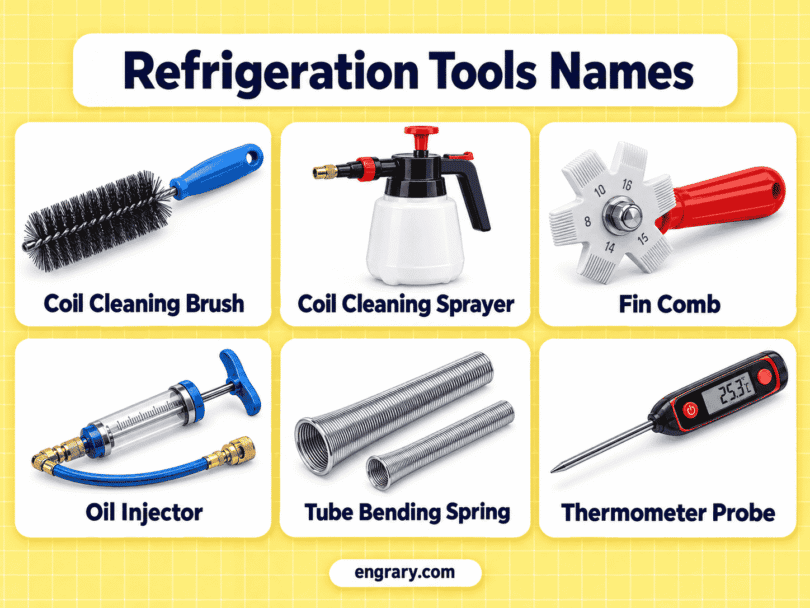
Refrigeration technicians use specialized tools to check refrigerant pressure, find leaks, evacuate systems, recover refrigerant, prepare copper tubing, test electrical components, and service compressors. Learning common refrigeration tools names in English makes it easier to recognize the equipment used with refrigerators, freezers, cold rooms, display cases, ice machines, and other cooling systems.
This article covers 80 refrigeration tools with clear explanations of their main uses. You will also learn which tools support charging and recovery, how technicians prepare copper tubing, what equipment helps diagnose sealed-system faults, and how similar refrigeration tools differ.
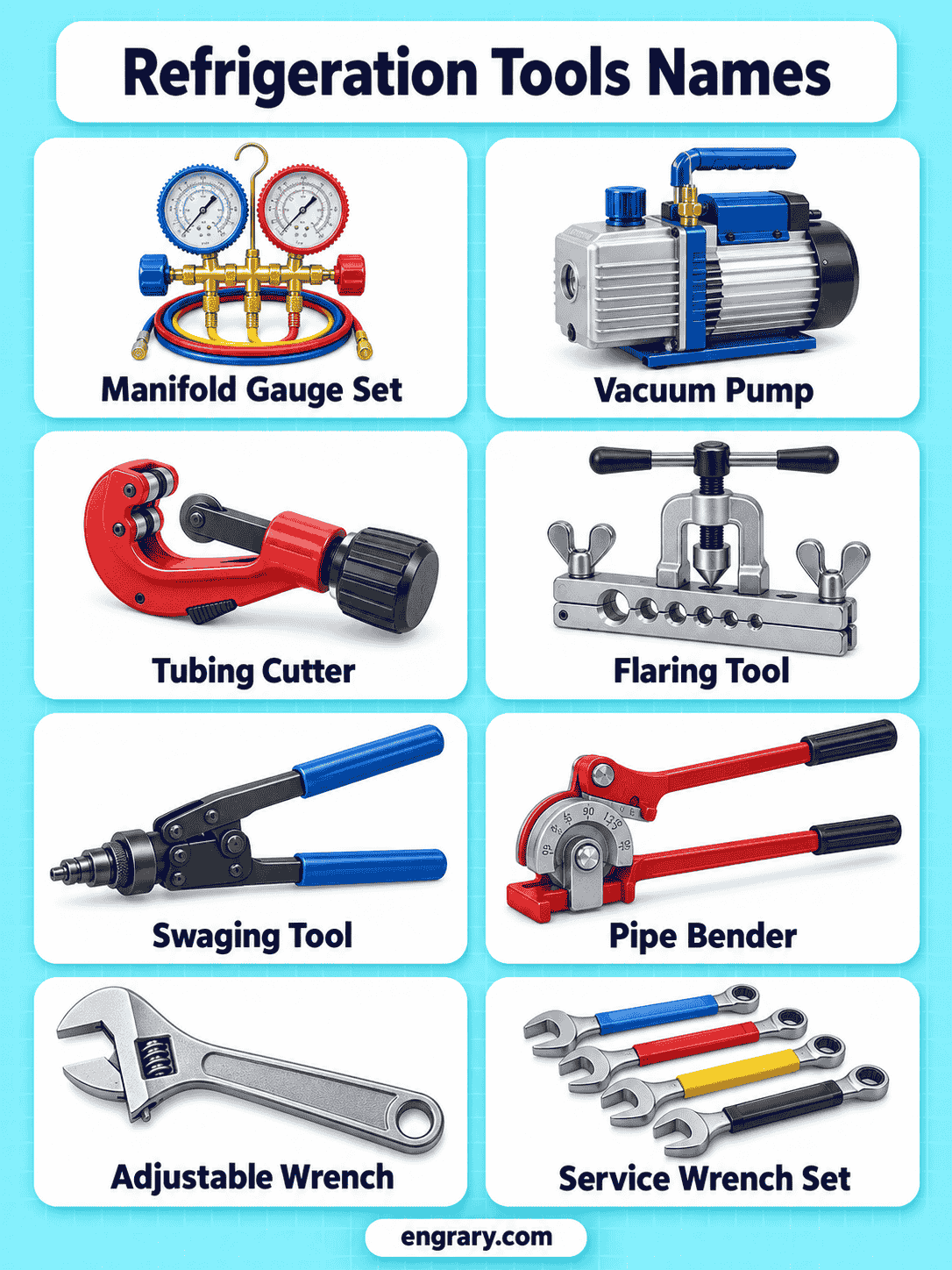
Familiar Tools Used in Refrigeration Service Work
Some tools appear regularly during refrigeration installation, maintenance, and fault diagnosis. These familiar names provide a useful overview before the complete list.
Manifold Gauge Set
Pressure gauges and service connections help technicians check the high and low sides of a refrigeration system.
Vacuum Pump
Deep vacuum removes air, moisture, and other non-condensable gases before refrigerant charging.
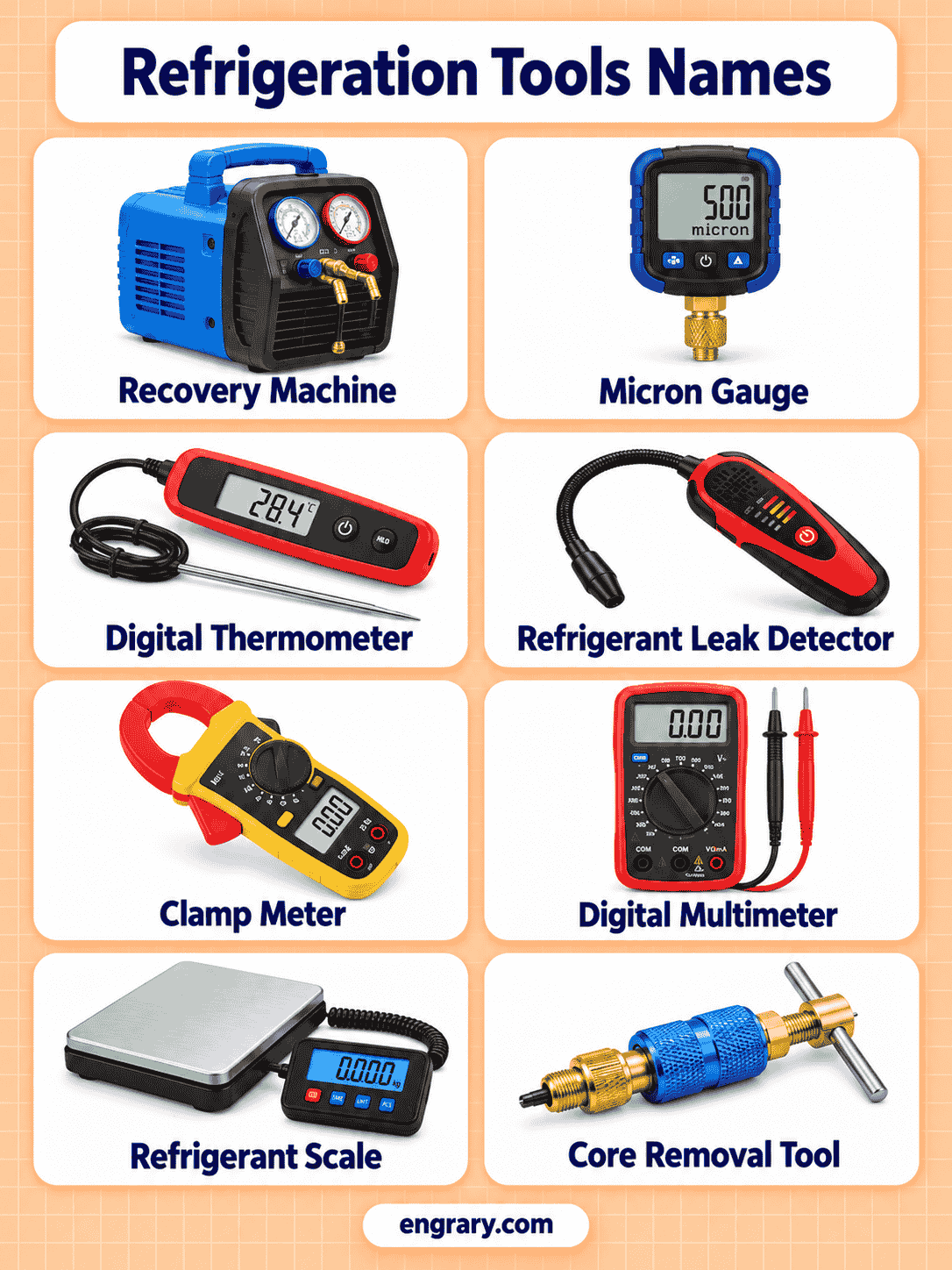
Micron Gauge
Fine vacuum measurements show how deeply a sealed refrigeration system has been evacuated.
Refrigerant Recovery Machine
The machine removes refrigerant from a system and transfers it into a recovery cylinder.
Refrigerant Charging Scale
Accurate weight readings help technicians add or recover the required amount of refrigerant.
Electronic Leak Detector
Sensitive electronics help locate refrigerant escaping from joints, tubing, coils, and components.
Tubing Cutter
A rotating cutting wheel produces a clean cut through copper refrigeration tubing.
Flaring Tool
A forming cone shapes the tube end for compatible flare connections.
Swaging Tool
The expanding head enlarges tubing so another section can fit inside it.
Tube Bender
Controlled leverage forms smooth bends without unnecessarily flattening the copper tube.
Digital Multimeter
Voltage, resistance, continuity, and other electrical values can be checked during troubleshooting.
Clamp Meter
Current can be measured around a conductor without disconnecting the wire.
Pipe Clamp Thermometer
A clamping sensor measures the surface temperature of refrigerant lines.
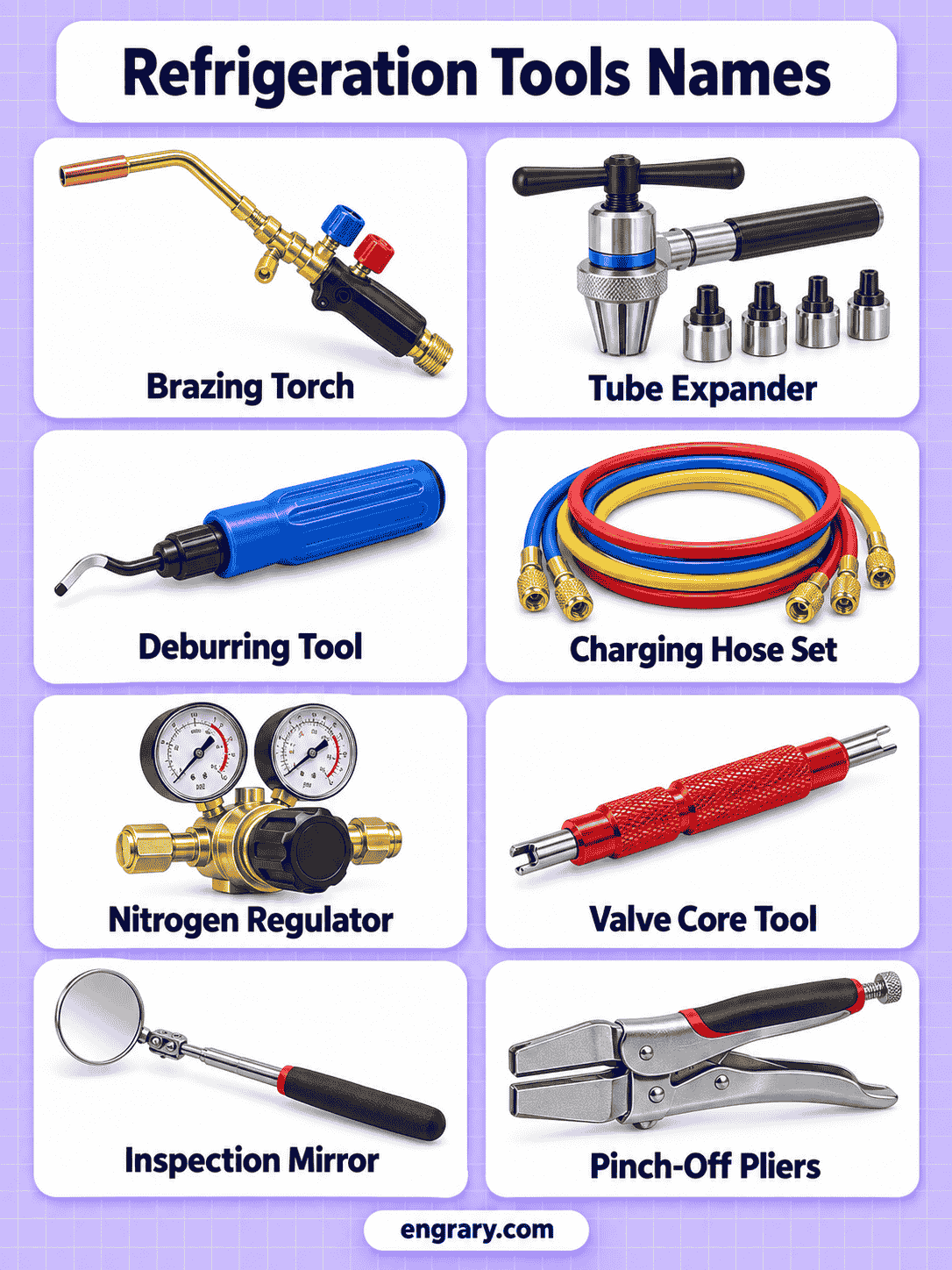
Brazing Torch
Concentrated heat joins compatible copper tubing and fittings during sealed-system work.
Nitrogen Regulator
Controlled pressure lets technicians introduce nitrogen for testing or other suitable service procedures.
Service Valve Wrench
The small wrench turns compatible refrigeration service-valve stems.
Capillary Tube Cutter
A precise cutter shortens capillary tubing while reducing deformation at the opening.
Fin Comb
Matched teeth straighten bent condenser or evaporator fins.
Coil Cleaning Brush
Soft or stiff bristles remove loose dirt from refrigeration coils.
Inspection Mirror
A small angled mirror reveals joints and components hidden behind tubing or equipment.
Tools Used to Check Refrigerant Pressure and Charge
Pressure and charging tools help technicians connect to refrigeration systems, observe operating conditions, and control refrigerant movement during service.
Analog Manifold Gauge Set
Mechanical gauges display high- and low-side refrigerant pressures during system checks.
Digital Manifold Gauge
Electronic sensors display pressure and calculated refrigeration values on a digital screen.
Charging Hose Set
Flexible pressure-rated hoses connect gauges, refrigerant containers, recovery equipment, and service ports.
Refrigerant Charging Scale
Precise weight measurements help control how much refrigerant enters or leaves a system.
Wireless Pressure Probe
A compact electronic probe sends pressure readings to a compatible display or mobile device.
Charging Valve
Controlled valve movement regulates refrigerant flow during suitable charging procedures.
Low-Loss Adapter
A shutoff mechanism reduces refrigerant release when connecting or disconnecting service hoses.
Schrader Valve Core Tool
Its small tip removes or installs compatible service-port valve cores.
Service Valve Wrench
Square and hex openings turn refrigeration service-valve stems during system access.
Refrigerant Charging Cylinder
A graduated vessel helps measure and introduce suitable refrigerant during selected charging work.
Equipment for Evacuation and Refrigerant Recovery
Sealed refrigeration systems must often be evacuated or have their refrigerant removed before internal repairs can begin.
Vacuum Pump
A motor-driven pump removes air and moisture from a sealed system before charging.
Micron Gauge
Very low absolute-pressure readings help technicians evaluate evacuation depth and system tightness.
Vacuum-Rated Hose
A large, low-permeability hose improves flow between the refrigeration system and vacuum equipment.
Vacuum Manifold
Wide internal passages connect evacuation hoses while helping reduce restrictions during deep vacuum work.
Refrigerant Recovery Machine
A compressor-driven unit transfers refrigerant from equipment into an approved recovery container.
Recovery Cylinder
A pressure-rated container stores recovered refrigerant during service and transport.
Refrigerant Recovery Hose
Durable pressure-rated tubing carries refrigerant between the system, recovery machine, and cylinder.
Refrigerant Transfer Pump
Mechanical pumping moves compatible refrigerant between suitable containers or service equipment.
Tools for Finding Leaks and Pressure Problems
Leak detection requires more than visual inspection because many refrigerant leaks are too small to see directly.
Electronic Refrigerant Leak Detector
A sensitive probe responds when refrigerant concentrations rise around a suspected leak point.
Infrared Refrigerant Leak Detector
Infrared sensing technology identifies compatible refrigerant gases around coils, joints, and fittings.
Ultrasonic Leak Detector
High-frequency sound produced by escaping gas helps reveal certain pressure leaks.
UV Leak Detection Lamp
Ultraviolet light makes compatible fluorescent leak-detection dye easier to see.
Nitrogen Regulator
Adjustable output controls nitrogen pressure during suitable system testing and service work.
Pressure Test Gauge
A dedicated gauge shows test pressure while technicians monitor the system for pressure loss.
Nitrogen Flow Meter
Measured gas flow helps technicians regulate nitrogen during suitable refrigeration procedures.
Trace Gas Leak Detector
Sensitive detection equipment identifies compatible trace gases introduced for difficult leak searches.
Tools for Cutting and Shaping Refrigeration Tubing
Copper tubing must remain clean, round, and accurately formed because poor tube preparation can affect joints and system reliability.
Tubing Cutter
A hardened wheel gradually cuts copper tubing as the tool rotates around it.
Mini Tubing Cutter
Its compact frame reaches pipes where a standard cutter cannot rotate freely.
Capillary Tube Cutter
A fine cutting mechanism separates narrow capillary tubing without heavily crushing the opening.
Tube Reamer
A tapered cutting surface removes internal ridges left after tubing has been cut.
Deburring Tool
Sharp burrs can be removed from the inner and outer edges before joining.
Flaring Tool
A clamping block and forming cone create accurate flares for compatible fittings.
Swaging Tool
Controlled expansion enlarges one tube end so matching tubing can enter it.
Tube Expander
Mechanical force increases the diameter of compatible copper tubing for selected connections.
Tube Bender
A shaped former supports the tube while it bends around a controlled radius.
Spring Tube Bender
A fitted spring supports thin tubing walls during hand bending.
Tube Straightener
Guides and rollers help remove unwanted curves from compatible soft tubing.
Pinch-Off Tool
Strong jaws temporarily close suitable soft tubing during selected sealed-system service work.
Electrical Tools for Compressors, Motors, and Controls
Refrigeration faults often involve electrical components as well as the refrigerant circuit. Electrical test tools help technicians check power, motors, capacitors, and controls.
Digital Multimeter
Direct readings reveal voltage, resistance, continuity, and other electrical conditions.
Clamp Meter
A hinged current clamp measures amperage around an individual conductor.
Non-Contact Voltage Tester
An electronic sensor indicates the possible presence of AC voltage without touching bare conductors.
Insulation Resistance Tester
High-resistance measurements help evaluate insulation condition in motors, compressors, and wiring.
Capacitance Meter
Measured capacitance helps check compatible start and run capacitors.
Phase Rotation Meter
Phase sequence can be checked on suitable three-phase refrigeration equipment.
Continuity Tester
A simple circuit check confirms whether an electrical path remains complete.
Component Tester
Electronic testing helps evaluate selected resistors, diodes, capacitors, and other components.
Test Light
A small lamp or LED provides a quick indication of power at suitable circuit points.
Compressor Analyzer
Dedicated testing functions help technicians assess compressor electrical operation and starting behavior.
Temperature and Performance Measuring Tools
Temperature measurements help technicians compare refrigeration conditions across coils, refrigerant lines, cabinets, and surrounding air.
Pipe Clamp Thermometer
Spring-loaded jaws hold a sensor directly against refrigerant tubing.
Digital Thermometer
An electronic display provides temperature readings from a compatible sensor.
Thermocouple Thermometer
Interchangeable thermocouple probes measure temperatures at selected points around the system.
Infrared Thermometer
Non-contact sensing provides quick surface-temperature readings.
Surface Temperature Probe
A contact sensor measures temperatures directly on pipes, panels, or components.
Wireless Temperature Probe
Remote electronic readings allow technicians to monitor temperatures away from the measurement point.
Psychrometer
Temperature and humidity measurements help evaluate air conditions around suitable refrigeration equipment.
Temperature Data Logger
Stored readings track temperature changes over time inside cabinets, cold rooms, or other controlled spaces.
Tools for Brazing and Sealed-System Repairs
Opening a sealed refrigeration circuit may require cutting, fitting, and joining copper lines before the system can return to service.
Brazing Torch
A concentrated flame heats copper joints to the temperature required for suitable brazing work.
Oxy-Acetylene Torch Kit
Separate oxygen and fuel controls produce a hotter adjustable flame for demanding tube work.
Torch Striker
A spark-producing mechanism ignites suitable fuel torches without an open match or lighter.
Flame Shield
A heat-resistant barrier protects nearby surfaces while technicians heat a joint.
Tube Holding Clamp
Steady mechanical grip keeps tubing aligned during fitting and joining work.
Brazing Tip Cleaner
Fine cleaning wires clear deposits from compatible torch-tip openings.
Heat-Resistant Brazing Mat
A protective mat shields walls, cabinets, and surrounding surfaces from radiant heat.
Inspection Mirror
An angled reflective face helps check the rear side of brazed joints and concealed tubing.
Hand Tools Used During Refrigeration Repairs
Not every refrigeration task needs specialized electronic equipment. General hand tools still handle covers, brackets, terminals, fittings, and installation hardware.
Screwdriver Set
Different blade and tip styles turn screws used in panels, controls, and equipment housings.
Nut Driver Set
Socket-shaped ends fit smaller hex-head screws and nuts found throughout refrigeration equipment.
Adjustable Wrench
A movable jaw handles several sizes of flat-sided nuts and fittings.
Combination Pliers
Broad jaws grip, twist, bend, and cut smaller materials during general repairs.
Needle-Nose Pliers
Long narrow jaws reach connectors, clips, and wires inside crowded equipment compartments.
Locking Pliers
Adjustable jaws clamp securely onto stubborn fittings or damaged hardware.
Ratcheting Wrench
A ratcheting box end speeds fastener work where movement is limited.
Cordless Drill
Portable power drills holes and drives fasteners during equipment installation and service.
Tools for Cleaning Coils and Drainage Areas
Dirty coils and blocked drainage areas can interfere with refrigeration performance, so cleaning equipment remains an important part of regular service.
Fin Comb
Matched teeth straighten crushed or bent aluminum coil fins.
Coil Cleaning Brush
Bristles loosen lint, dust, and surface debris from evaporator and condenser coils.
Condenser Brush
A narrow brush reaches between condenser surfaces and tight equipment spaces.
Wet/Dry Vacuum
Strong suction removes loose debris and suitable liquid from service areas.
Air Blow Gun
A concentrated compressed-air stream clears loose dust from appropriate components.
Condensate Drain Gun
Controlled pressure helps clear suitable condensate drain restrictions.
Coil Cleaning Pump Sprayer
A hand-pumped sprayer applies compatible cleaning solution evenly across coil surfaces.
Drain Line Vacuum Adapter
The fitted adapter connects a vacuum source to suitable drain lines for blockage removal.
Refrigeration Tools Used During a Typical Service Visit
Different service stages call for different equipment. Technicians may move from diagnosis to recovery, repair, evacuation, charging, and final testing during the same job.
| Service Stage | Common Tools |
|---|---|
| Pressure Check | Manifold Gauge Set, Pressure Probe |
| Leak Search | Electronic Leak Detector, Nitrogen Regulator |
| Refrigerant Recovery | Recovery Machine, Recovery Cylinder |
| Tube Repair | Tubing Cutter, Flaring Tool, Brazing Torch |
| Electrical Testing | Multimeter, Clamp Meter |
| Evacuation | Vacuum Pump, Micron Gauge |
| Charging | Manifold, Charging Scale, Hoses |
| Temperature Check | Pipe Clamp Thermometer, Digital Thermometer |
| Coil Maintenance | Fin Comb, Coil Brush |
| Final Inspection | Leak Detector, Pressure Gauge, Temperature Probe |
The exact sequence depends on the fault and refrigeration system, but pressure, temperature, electrical, evacuation, and leak checks often work together during diagnosis.
Tools for Domestic and Commercial Refrigeration Work
Small household systems and larger commercial equipment share many service tools, but the scale and complexity of the equipment can differ.
| Domestic Refrigeration | Commercial Refrigeration |
|---|---|
| Compact Manifold Gauge | Digital Manifold System |
| Small Vacuum Pump | Higher-Capacity Vacuum Pump |
| Electronic Leak Detector | Advanced Leak Detection Equipment |
| Capillary Tube Cutter | Full Tubing Tool Set |
| Digital Multimeter | Clamp Meter and Electrical Test Kit |
| Small Tubing Cutter | Multiple Tube Cutters and Benders |
| Charging Scale | High-Capacity Refrigerant Scale |
| Basic Thermometer | Multiple Temperature Probes |
Domestic refrigerators often use compact sealed systems and capillary tubing, while commercial refrigeration may involve longer pipe runs, larger refrigerant charges, multiple evaporators, and more complex controls.
Tools That Are Easy to Confuse in Refrigeration Work
Several refrigeration tools work together or measure related conditions, but they do not perform the same job.
| Tools | Main Difference |
|---|---|
| Manifold Gauge vs Micron Gauge | A manifold measures operating refrigerant pressures, while a micron gauge measures deep vacuum during evacuation. |
| Vacuum Pump vs Recovery Machine | A vacuum pump removes air and moisture after refrigerant has been removed, while a recovery machine transfers refrigerant out of the system. |
| Tubing Cutter vs Capillary Tube Cutter | A tubing cutter handles larger copper tubing, while a capillary cutter is designed for very narrow capillary tube. |
| Flaring Tool vs Swaging Tool | A flaring tool forms a flared tube end for a fitting, while a swaging tool enlarges one tube end to accept another tube. |
| Tube Bender vs Spring Bender | A tube bender uses a shaped mechanical former, while a spring bender supports tubing during simpler hand bends. |
| Electronic Leak Detector vs UV Lamp | An electronic detector senses escaping refrigerant, while a UV lamp reveals compatible fluorescent dye. |
| Charging Scale vs Manifold Gauge | A charging scale measures refrigerant by weight, while a manifold shows system pressure. |
| Multimeter vs Clamp Meter | A multimeter measures several electrical values through leads, while a clamp meter measures current around a conductor without disconnecting it. |
Choosing the correct tool depends on whether the technician needs to measure pressure, vacuum, weight, temperature, electrical behavior, or a physical tube condition.
Tools Used for Sealed-System Refrigeration Work
Sealed-system repair brings several specialized tools together because the refrigerant circuit must remain clean, tight, and accurately charged.
| Sealed-System Task | Useful Tools |
|---|---|
| Opening Copper Lines | Tubing Cutter, Capillary Tube Cutter |
| Preparing Tubing | Reamer, Flaring Tool, Swaging Tool |
| Joining Copper | Brazing Torch, Flame Shield |
| Leak Testing | Nitrogen Regulator, Leak Detector |
| Refrigerant Removal | Recovery Machine, Recovery Cylinder |
| Deep Evacuation | Vacuum Pump, Micron Gauge |
| Charging | Manifold, Charging Scale |
| Electrical Check | Multimeter, Compressor Analyzer |
| Temperature Check | Pipe Clamp Thermometer |
This combination of tube, refrigerant, electrical, and measuring tools is what makes refrigeration service different from many general repair trades.
Items Used Alongside Refrigeration Tools
Technicians also rely on materials and replacement items that support the tools but should not be counted as tools themselves.
Refrigerant
The working fluid circulates through the refrigeration cycle and absorbs or rejects heat.
Vacuum Pump Oil
Special oil helps compatible vacuum pumps create and maintain deep vacuum.
Brazing Alloy
Filler metal forms suitable permanent joints between compatible tubing and fittings.
Flux
Selected brazing or soldering applications use flux to prepare metal surfaces and support filler flow.
Nitrogen Gas
Dry nitrogen supports suitable pressure testing and service procedures.
Refrigerant Oil
Compatible lubricant supports compressors and other internal refrigeration components.
Filter-Drier
This replaceable system component helps remove moisture, acids, and contaminants from the refrigerant circuit.
Service Valve Cores
Replaceable valve components seal compatible refrigeration service ports.
These materials, gases, lubricants, and components support refrigeration work, but the 80-item list above contains the actual tools and working equipment.
FAQs
Common refrigeration tools include manifold gauges, vacuum pumps, micron gauges, recovery machines, refrigerant scales, leak detectors, tubing cutters, flaring tools, multimeters, clamp meters, and thermometers.
Technicians commonly use a manifold gauge set, charging hoses, refrigerant charging scale, service-valve tools, and suitable charging controls when servicing a refrigeration system.
Electronic leak detectors, infrared leak detectors, ultrasonic detectors, UV leak lamps, nitrogen regulators, and pressure gauges can support different leak-detection methods.
Tubing cutters, reamers, deburring tools, flaring tools, swaging tools, expanders, benders, capillary cutters, and brazing equipment help prepare and join refrigeration tubing.
Refrigeration tools focus strongly on refrigerant circuits, compressors, copper tubing, evacuation, recovery, charging, leak detection, and low-temperature systems. HVAC tools cover many of the same tasks but also extend further into airflow, ductwork, heating systems, ventilation, and indoor-air measurements.
You May Also Like

Leave a Comment