

Plumbers rely on specialized tools to grip pipes, cut tubing, prepare fittings, bend and thread pipe, clear drains, install fixtures, and test plumbing systems. Learning common plumber tools names in English makes it easier to recognize the equipment used for water lines, drainage systems, faucets, toilets, pipe connections, and professional plumbing work.
This article covers 80 plumber tools with clear descriptions of their main uses. You will also see which tools suit copper, PEX, PVC, and threaded steel pipe, how manual and powered plumbing tools differ, and which equipment plumbers commonly carry for everyday jobs.

Common Plumber Tools Names
Some plumbing tools appear on almost every job because they handle everyday gripping, cutting, pipe preparation, fixture installation, and drain work.
Pipe Wrench
Serrated jaws grip and turn threaded metal pipes and fittings.
Basin Wrench
Its long shaft reaches faucet mounting nuts beneath sinks where ordinary wrenches cannot work easily.
Adjustable Wrench
A movable jaw fits several sizes of flat-sided nuts, bolts, and plumbing fittings.
Tongue-and-Groove Pliers
Multiple jaw positions provide a strong grip on pipes, fittings, and irregular plumbing parts.
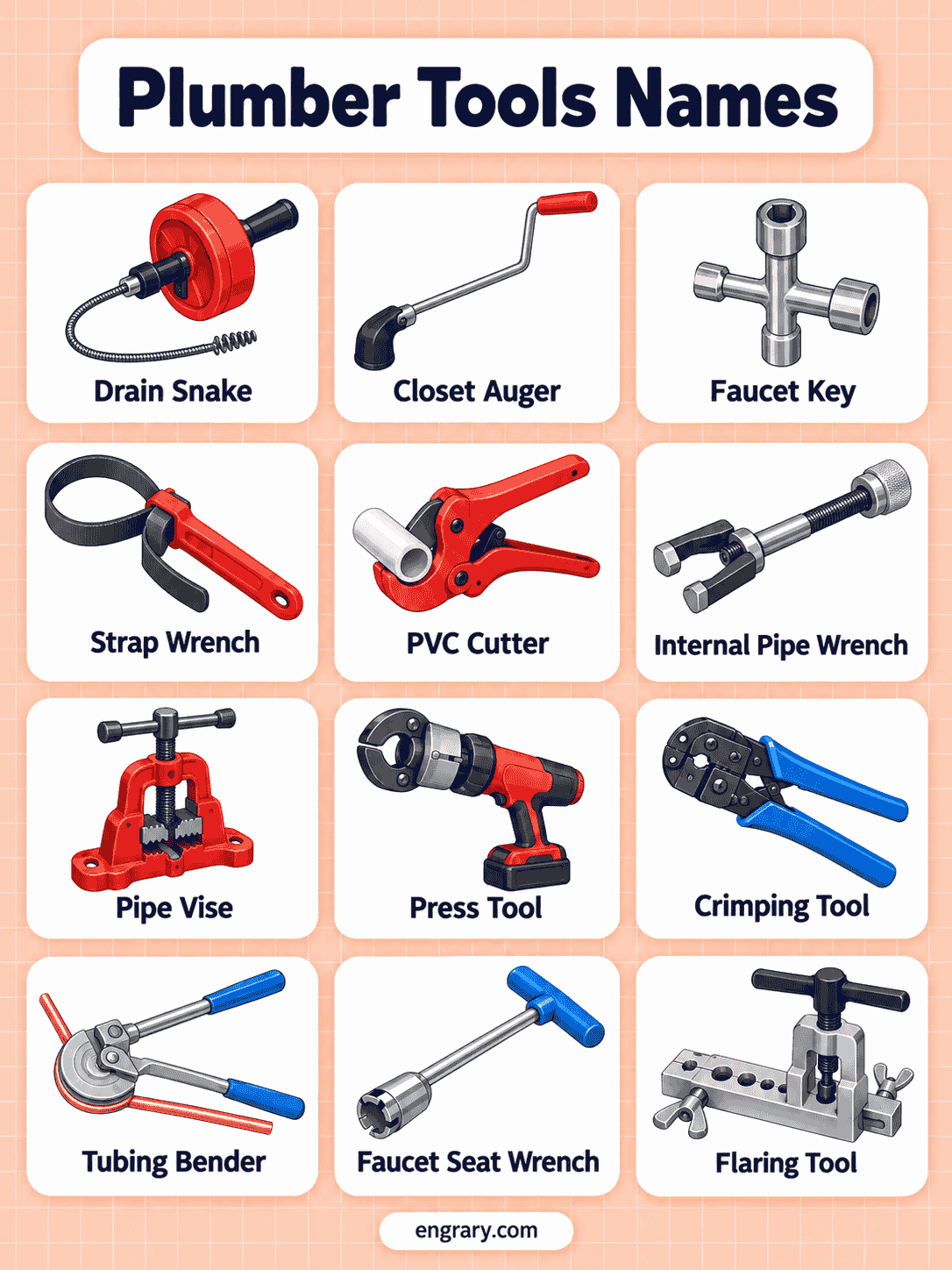
Strap Wrench
A flexible strap turns smooth or finished surfaces without sharp metal jaws biting into them.
Tubing Cutter
A rotating wheel creates a clean cut around suitable tubing.
PVC Pipe Cutter
Sharp shearing jaws slice through plastic pipe quickly.
PEX Cutter
This compact tool produces square cuts through flexible PEX tubing.
Tube Bender
Controlled leverage forms smooth bends while reducing the risk of flattening the tube.
Deburring Tool
Sharp edges left after cutting can be removed from pipe and tubing ends.
Flaring Tool
The forming mechanism reshapes a tube end for a compatible flare connection.
Press Tool
Powered jaws compress suitable press fittings around prepared pipe.
PEX Crimp Tool
A crimping mechanism secures compatible rings around PEX fittings.
Plunger
Pressure and suction help loosen simple sink, drain, and toilet blockages.
Drain Snake
A flexible cable reaches farther into a drain line to break up or retrieve clogs.
Toilet Auger
Its curved guide helps the cable pass through a toilet trap without scraping the bowl.
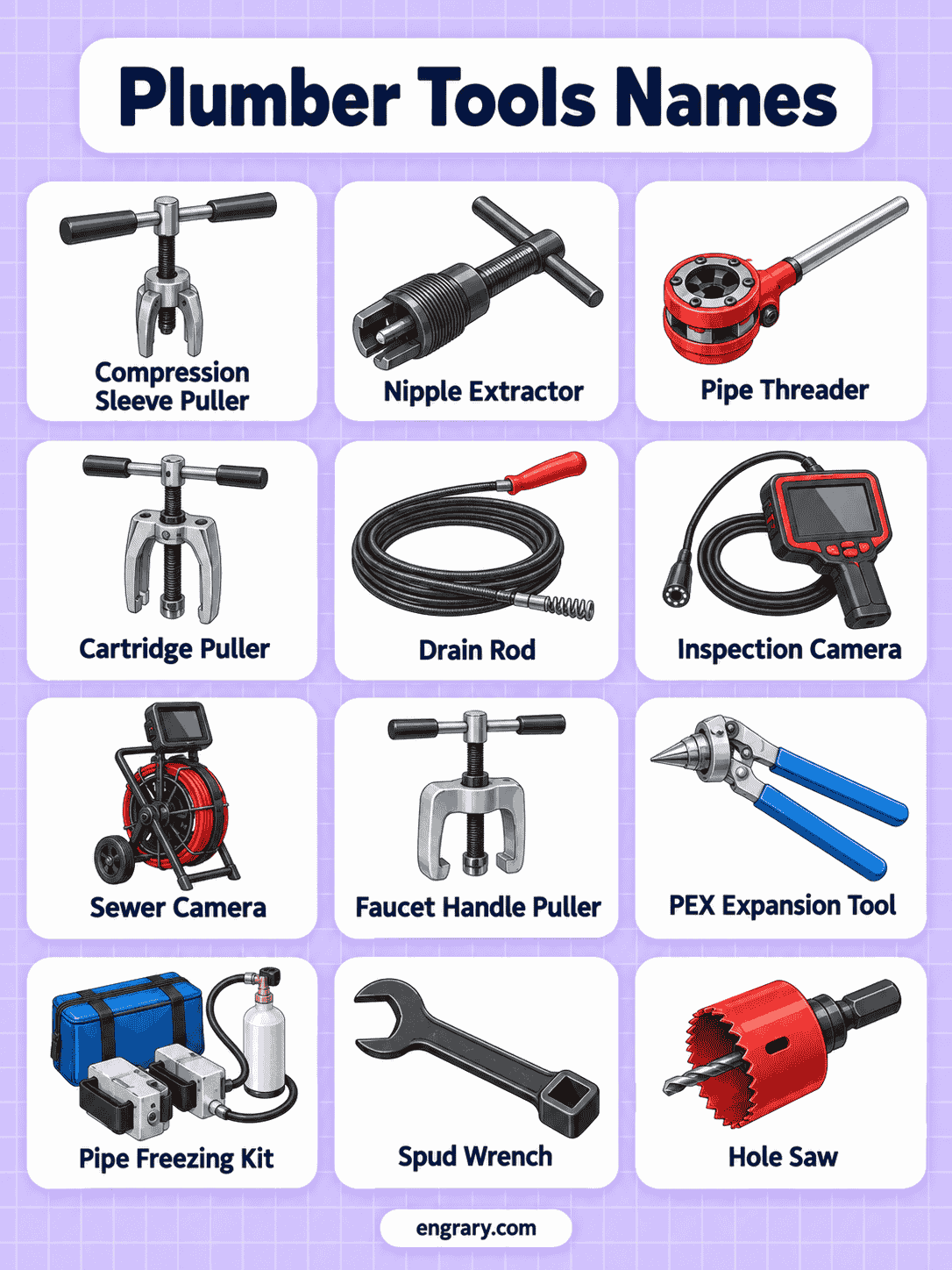
Pipe Threader
Cutting dies form external threads on compatible pipe ends.
Cartridge Puller
Controlled pulling force removes stubborn faucet or shower cartridges.
Inspection Camera
A compact camera reveals conditions inside drains, walls, and other concealed areas.
Pressure Test Pump
Controlled pressure helps check a plumbing system for leaks or pressure loss.
Essential Plumber Tools for Pipe and Fixture Work
The following 80 tools cover the major areas of plumbing work, including gripping, cutting, pipe preparation, bending, threading, joining, drainage, fixture service, testing, and inspection.
Plumbing Wrenches
Plumbing wrenches come in different shapes because round pipe, flat fasteners, faucet hardware, and drain fittings require different types of grip.
Pipe Wrench
Serrated jaws bite into round pipe and fittings to provide strong turning force.
Adjustable Wrench
A movable jaw lets one tool fit several sizes of nuts and bolts.
Basin Wrench
Its long body reaches faucet nuts behind sinks and basins.
Strap Wrench
A flexible strap grips polished or delicate surfaces with less risk of scratching them.
Chain Wrench
Heavy chain wraps around large round pipe to provide powerful leverage.
Faucet Seat Wrench
Specially shaped ends engage removable faucet seats inside compatible valve bodies.
Shower Valve Socket Wrench
Deep tubular sockets reach recessed shower and faucet valve parts.
Strainer Locknut Wrench
Wide jaws engage large locknuts beneath sink strainers.
Drain Wrench
Specialized tabs or jaws fit drain components during installation or removal.
Garbage Disposal Wrench
A short angled tool turns the motor shaft of compatible disposal units when clearing jams.
Pliers for Plumbing Work
Pliers help plumbers hold fittings, reach small components, protect finished surfaces, and grip irregular shapes.
Tongue-and-Groove Pliers
Adjustable jaw positions accommodate pipes, fittings, and larger plumbing hardware.
Slip-Joint Pliers
A movable pivot changes the jaw opening for common light-duty tasks.
Locking Pliers
Once adjusted, the jaws stay clamped onto stubborn fittings or damaged fasteners.
Needle-Nose Pliers
Long tapered jaws reach clips, washers, and small components in tight areas.
Soft-Jaw Pliers
Protective jaw surfaces grip finished fittings while reducing scratches.
Hose Clamp Pliers
Specialized jaws compress spring-style hose clamps during removal or fitting.
Pipe and Tubing Cutters
Different pipe materials call for different cutting methods, from rotary wheels to shearing blades and chain mechanisms.
Tubing Cutter
A cutting wheel gradually slices through copper and other compatible tubing as the tool rotates.
Mini Tubing Cutter
Its compact frame works in narrow areas where a standard cutter cannot turn freely.
PVC Pipe Cutter
Shearing jaws make quick cuts through suitable plastic pipe.
PEX Cutter
A sharp blade produces clean square cuts in flexible PEX tubing.
Ratcheting Pipe Cutter
Repeated handle movements advance the blade through plastic pipe with less effort.
Soil Pipe Cutter
A chain-style mechanism breaks cast-iron soil pipe along a controlled line.
Plastic Pipe Saw
Fine teeth cut PVC, ABS, and similar plastic pipe where a shearing cutter is unsuitable.
Internal Pipe Cutter
A rotating blade cuts from inside the pipe when the outer wall is difficult to reach.
Pipe Preparation Tools
A clean pipe end helps fittings seat correctly and supports a more reliable connection.
Pipe Reamer
A tapered cutting surface removes internal roughness from freshly cut pipe.
Deburring Tool
Sharp burrs are scraped away from both inner and outer edges.
Pipe Chamfer Tool
A beveled edge forms around the pipe end to improve entry into compatible fittings.
Pipe Cleaning Brush
Stiff bristles remove oxidation and surface debris before joining.
Pipe Scraper
Surface material is removed from compatible plastic pipe before selected connection methods.
Pipe Calibrator
Roundness and size can be restored to certain multilayer or plastic pipe ends.
Insertion Depth Gauge
Depth marks show how far a pipe should enter a compatible fitting.
Pipe End Prep Tool
One compact device may clean, ream, chamfer, or size the end before connection.
Bending and Forming Tools
These tools reshape tubing without simply cutting and reconnecting it.
Tube Bender
A shaped former guides tubing into a controlled bend.
Lever Tube Bender
Long handles provide greater leverage for accurate bends.
Spring Tube Bender
A flexible spring supports the tube wall while the bend forms by hand.
Pipe Bending Machine
Mechanical force produces repeatable bends in larger or stiffer pipe.
Flaring Tool
A forming cone expands the tubing end into a flare.
Swaging Tool
The tool enlarges or reforms a tube end so another section can fit into it.
Threading Tools
Threaded pipe systems require tools that hold the pipe securely and form accurate external threads.
Manual Pipe Threader
Hand force rotates a die around the pipe to cut external threads.
Ratchet Threader
A ratcheting mechanism speeds manual threading by reducing handle repositioning.
Power Threader
An electric motor turns the die head during repeated pipe-threading work.
Pipe Die
Cutting teeth form external threads on compatible pipe.
Die Head
A removable head holds the dies and guides them around the pipe.
Pipe Vise
Strong jaws secure pipe during threading, cutting, reaming, and assembly.
Joining and Connection Tools
Modern plumbing systems use several connection methods, so plumbers may need pressing, crimping, expanding, soldering, or clamping tools.
Press Tool
Powered jaws compress compatible press fittings around pipe.
PEX Crimp Tool
The jaws compress crimp rings around suitable PEX connections.
PEX Clamp Tool
A clamping mechanism tightens compatible stainless cinch clamps.
PEX Expansion Tool
An expanding head temporarily enlarges suitable PEX tubing before fitting insertion.
Compression Sleeve Puller
This puller removes sleeves and nuts without cutting the supply tube.
Pipe Freezing Tool
Controlled cooling forms a temporary ice plug inside a water line for suitable repair work.
Soldering Torch
A focused flame heats copper pipe and fittings during soldered joint work.
Pipe Joining Clamp
Steady pressure keeps pipe and fittings aligned during selected joining operations.
Drain Cleaning Tools
Drain problems range from simple surface blockages to obstructions deep inside longer waste lines.
Cup Plunger
A flat rubber cup creates pressure and suction over sink or floor-drain openings.
Flange Plunger
An extended rubber flange helps form a stronger seal inside toilet openings.
Hand Drain Auger
Manual rotation advances a flexible cable through smaller drain lines.
Drum Auger
A rotating drum stores and feeds the cleaning cable in a controlled way.
Toilet Auger
Its protective curved tube guides a cable through the toilet trap.
Drain Snake
A flexible cable reaches deeper blockages and can break up or retrieve obstructions.
Power Drain Cleaner
Motor-driven cable rotation handles tougher clogs with less manual effort.
Drain Cleaning Machine
A larger powered system feeds and retrieves cable through longer drain runs.
Sewer Rod
Connectable rods reach farther into larger drains and sewer lines.
Drain Bladder
Water pressure expands the bladder and directs a strong stream toward suitable blockages.
Faucet and Fixture Tools
Fixture work often involves deeply recessed or seized parts that ordinary wrenches cannot reach effectively.
Cartridge Puller
Controlled pulling force removes stuck faucet and shower cartridges.
Faucet Handle Puller
A compact puller lifts seized handles without heavy prying.
Faucet Stem Socket Set
Deep sockets reach recessed stems and valve components.
Sink Installer Tool
A long multi-purpose body accesses mounting nuts and fittings beneath sinks.
Internal Pipe Wrench
Expandable jaws grip the inside of short nipples and recessed pipe sections.
Nipple Extractor
Internal gripping surfaces remove damaged or broken threaded nipples.
Closet Spud Wrench
Wide jaws fit large connections around toilets and flush-valve assemblies.
Plumber’s Socket Set
Deep tubular sockets reach recessed plumbing nuts and fixture hardware.
Testing and Inspection Tools
Inspection and testing tools help plumbers locate hidden problems, confirm pressure, and evaluate system performance.
Pressure Test Pump
Manual or powered pressure checks closed systems for leakage or pressure loss.
Water Pressure Gauge
A dial displays the pressure available at a plumbing connection.
Vacuum Gauge
Negative-pressure readings help evaluate selected pumps and plumbing-related systems.
Electronic Leak Detector
Sensors assist with locating leaks that may be difficult to find visually.
Inspection Camera
A flexible camera probe provides a view inside drains, walls, and cavities.
Pipe Locator
Electronic signals help trace compatible hidden or buried pipe.
Moisture Meter
Readings reveal elevated moisture in walls, floors, timber, and other materials.
Manometer
Pressure differences can be measured accurately in suitable gas, air, or plumbing applications.
Thermal Imaging Camera
Temperature patterns may reveal hot-water routes, unusual moisture, or hidden flow.
Water Flow Meter
Measured flow shows how much water passes through a suitable line over a given period.
Tools for Copper, PEX, PVC, and Steel Pipe
Plumbing tools change significantly with pipe material and connection method. Copper may need cutting, cleaning, bending, and soldering tools, while PEX commonly relies on crimping, clamping, or expansion equipment.
| Pipe System | Common Tools |
|---|---|
| Copper Pipe | Tubing Cutter, Reamer, Cleaning Brush, Tube Bender, Soldering Torch |
| PEX Pipe | PEX Cutter, Crimp Tool, Clamp Tool, Expansion Tool |
| PVC Pipe | PVC Cutter, Plastic Pipe Saw, Chamfer Tool, Deburring Tool |
| Threaded Steel Pipe | Pipe Wrench, Pipe Vise, Threader, Die Head |
| Cast-Iron Drain Pipe | Soil Pipe Cutter, Chain Wrench |
| Multilayer Pipe | Tubing Cutter, Pipe Calibrator, Press Tool |
The pipe material determines not only how plumbers cut it but also how they prepare and connect the finished ends.
Manual vs Powered Drain and Pipe Tools
Many plumbing jobs can be completed manually, while demanding or repetitive work benefits from powered equipment.
| Manual Plumbing Tools | Powered Plumbing Tools |
|---|---|
| Hand Drain Auger | Drain Cleaning Machine |
| Manual Pipe Threader | Power Threader |
| PEX Crimp Tool | Powered Press Tool |
| Tubing Cutter | Powered Pipe Cutter |
| Hand Tube Bender | Pipe Bending Machine |
Manual tools offer direct control and portability. Powered equipment adds speed, force, and repeatability when pipe size or job scale increases.
Similar Plumber Tools and How They Differ
Several plumbing tools perform related jobs, but their designs suit different pipe materials, fittings, and working conditions.
| Tools | Main Difference |
|---|---|
| Pipe Wrench vs Adjustable Wrench | A pipe wrench grips round pipe and fittings, while an adjustable wrench turns flat-sided nuts and bolts. |
| Basin Wrench vs Pipe Wrench | A basin wrench reaches faucet nuts in confined spaces, while a pipe wrench grips threaded pipe. |
| Tubing Cutter vs PVC Pipe Cutter | A tubing cutter rotates around tubing for a controlled cut, while a PVC cutter shears plastic pipe directly. |
| Tube Bender vs Flaring Tool | A tube bender changes tubing direction, while a flaring tool reshapes the end for a flare connection. |
| Plunger vs Drain Snake | A plunger tackles simpler blockages with pressure and suction, while a drain snake reaches deeper into the line. |
| Drain Snake vs Toilet Auger | A drain snake suits many drain lines, while a toilet auger is shaped specifically for toilet traps. |
| Press Tool vs PEX Crimp Tool | A press tool compresses compatible press fittings, while a PEX crimp tool secures rings around PEX tubing. |
| Pipe Reamer vs Deburring Tool | A reamer smooths and may slightly enlarge a pipe opening, while a deburring tool mainly removes sharp cut edges. |
The main distinction usually comes down to pipe material, access, connection method, or the type of repair involved.
Tools for Home Plumbing vs Professional Pipe Work
Small household repairs need fewer specialized tools than full pipe installation, drain service, or commercial plumbing work.
| Home Plumbing Jobs | Professional Pipe Work |
|---|---|
| Adjustable Wrench | Chain Wrench |
| Basin Wrench | Pipe Vise |
| Tongue-and-Groove Pliers | Power Threader |
| Tubing Cutter | Soil Pipe Cutter |
| Cup Plunger | Drain Cleaning Machine |
| PVC Pipe Cutter | Press Tool |
| Water Pressure Gauge | Pressure Test Pump |
| Hand Drain Auger | Power Drain Cleaner |
A simple home repair may need only a wrench, pliers, or plunger. Professional work often adds larger cutters, threaders, press tools, test equipment, and powered drain machines.
Tools Often Kept in a Plumber’s Bag
A plumber usually carries a compact set of versatile tools and brings larger equipment only when the job requires it.
Common bag or pouch tools include:
- Adjustable Wrench
- Tongue-and-Groove Pliers
- Basin Wrench
- Mini Tubing Cutter
- PVC Pipe Cutter
- Utility Knife
- Tape Measure
- Screwdriver
- Mini Level
- Flashlight
Threading machines, drain cleaners, test pumps, and specialty pullers typically travel separately because of their size or limited everyday use.
Plumbing Items Used Alongside the Tools
Plumbing work also depends on fittings, sealing materials, fasteners, and other supplies that should not be counted as tools.
PTFE Tape
Thread-sealing tape helps seal suitable threaded plumbing connections.
Pipe Joint Compound
This sealing material helps prepare compatible threaded joints.
Solder
Molten filler metal forms suitable soldered pipe connections.
Flux
The compound prepares metal surfaces and assists solder flow during suitable soldering work.
Pipe Fittings
Elbows, tees, couplings, and adapters connect or redirect pipe systems.
Washers and O-Rings
Flexible seals help prevent leakage at compatible plumbing connections.
PEX Rings and Clamps
These connection components secure compatible PEX fittings when used with the correct tool.
Abrasive Cloth
The abrasive surface helps clean metal pipe before selected connection methods.
These items support the installation or become part of the finished plumbing system, while plumber tools perform the actual cutting, gripping, shaping, joining, clearing, or testing work.
FAQs
Common plumber tools include pipe wrenches, adjustable wrenches, basin wrenches, tongue-and-groove pliers, tubing cutters, PVC cutters, pipe reamers, plungers, drain snakes, and pressure gauges.
Plumbers use tubing cutters, mini tubing cutters, PVC pipe cutters, PEX cutters, ratcheting cutters, soil pipe cutters, pipe saws, and internal pipe cutters according to pipe material and access.
Common drain-cleaning equipment includes cup plungers, flange plungers, hand augers, drum augers, toilet augers, drain snakes, sewer rods, and powered drain-cleaning machines.
Depending on the pipe system, plumbers may use press tools, PEX crimp tools, clamp tools, expansion tools, soldering torches, flaring tools, or pipe-threading equipment.
Plumber tools perform jobs such as cutting, gripping, bending, threading, joining, clearing, and testing. Plumbing supplies include pipe, fittings, seals, solder, tape, rings, and other materials that support the work or become part of the finished system.
You May Also Like



Leave a Comment