
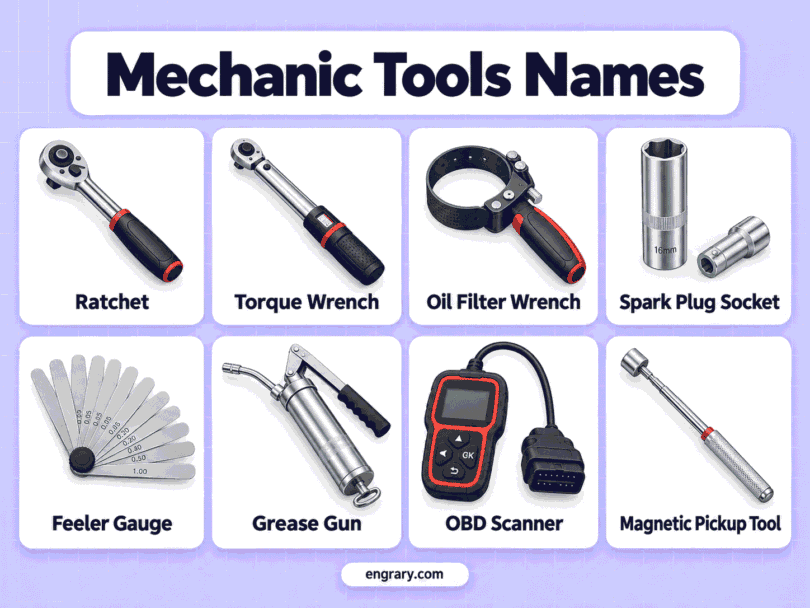
Mechanics use specialized tools to loosen fasteners, lift vehicles, diagnose faults, service engines, repair brakes, work on suspension, change tires, and handle automotive fluids. Learning common mechanic tools names in English helps students, beginners, and automotive learners recognize the equipment used in garages and vehicle repair workshops.
This article covers 100 mechanic tools with their main uses, from sockets and wrenches to diagnostic instruments, lifting equipment, engine tools, and brake-service equipment. You will also learn which tools suit different vehicle systems, how similar mechanic tools differ, and which tools mechanics keep close at hand during everyday repairs.
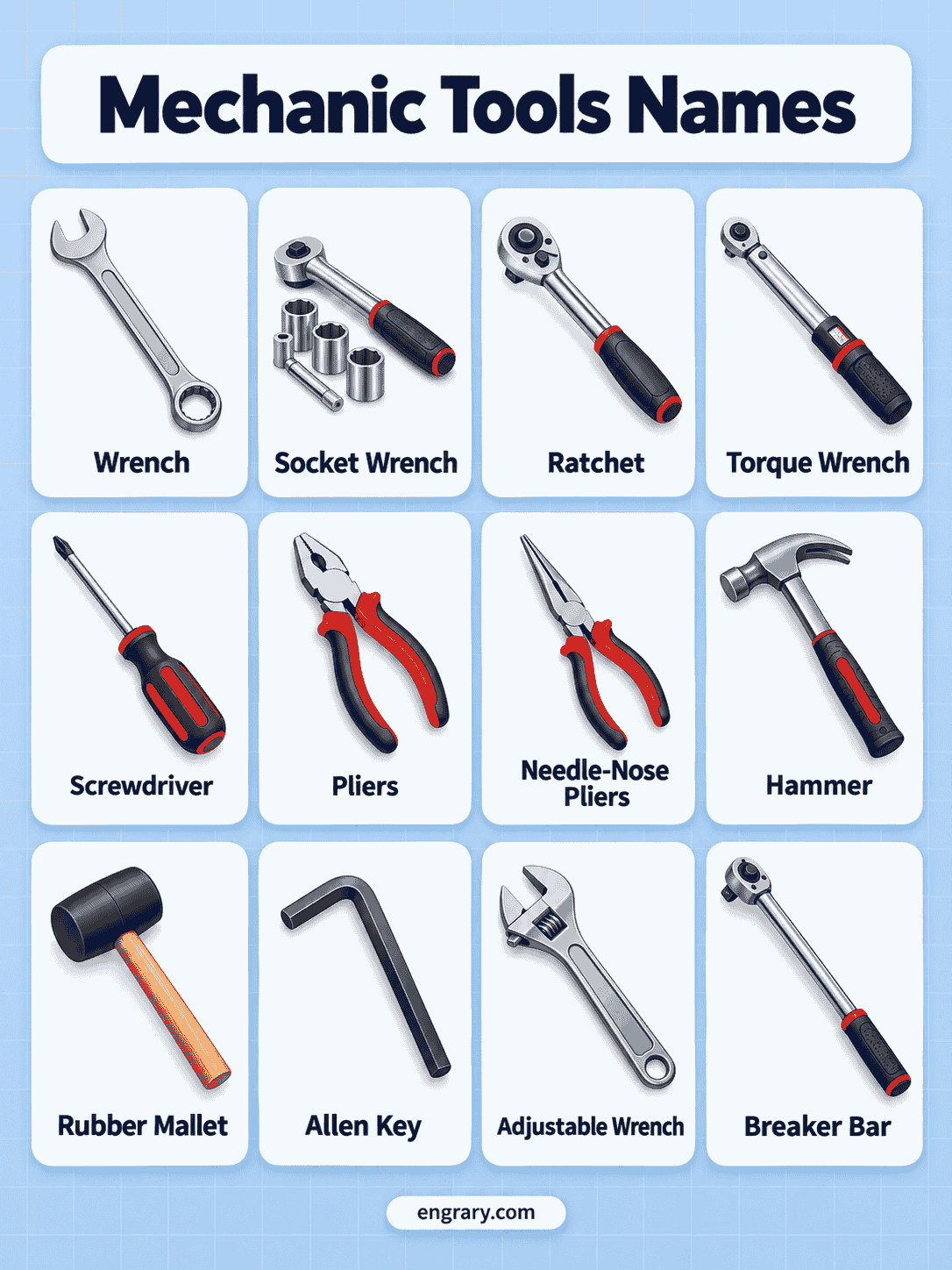
Common Mechanic Tools Names
Some tools appear in almost every mechanic’s workshop because they handle everyday fastening, lifting, testing, maintenance, and repair jobs.
Ratchet
A ratchet turns sockets repeatedly without requiring the handle to come off the fastener.
Socket
Different socket sizes fit nuts and bolts throughout a vehicle.
Combination Wrench
One open end and one box end provide two ways to turn the same fastener size.
Torque Wrench
Controlled torque helps tighten critical bolts to the required specification.
Breaker Bar
Its long handle provides extra leverage for stubborn nuts and bolts.
Impact Wrench
Rapid rotational impacts loosen or tighten heavy automotive fasteners quickly.
Phillips Screwdriver
A cross-shaped tip fits Phillips screws used in vehicle panels, brackets, and components.
Locking Pliers
Adjustable jaws clamp firmly onto damaged fasteners and awkward parts.
Spark Plug Socket
A deep socket reaches spark plugs while helping protect their ceramic bodies.
Floor Jack
Hydraulic force raises a vehicle from a suitable lifting point.
Jack Stand
A rigid stand supports the vehicle after it has been lifted.
Mechanic Creeper
The low wheeled platform lets a mechanic move comfortably beneath a raised vehicle.
Oil Filter Wrench
Specialized gripping surfaces loosen tightly fitted engine oil filters.
Drain Pan
A wide container catches used oil, coolant, and other automotive fluids during service.
OBD2 Scanner
Diagnostic data and trouble codes can be read through a vehicle’s OBD2 port.
Digital Multimeter
Voltage, resistance, continuity, and other electrical values can be checked during diagnosis.
Compression Tester
Cylinder pressure readings help assess engine sealing and mechanical condition.
Brake Caliper Piston Tool
Controlled pressure retracts or rotates caliper pistons during brake-pad replacement.
Tire Pressure Gauge
A pressure reading shows whether a tire needs more or less air.
Grease Gun
Pressurized grease reaches compatible chassis and suspension lubrication points.
Essential Mechanic Tools for Vehicle Repair
The following list contains exactly 100 distinct mechanic tools, grouped by their main role in fastening, gripping, lifting, diagnostics, engine service, brake repair, suspension work, tire service, and fluid maintenance.
Sockets, Ratchets, and Drive Tools
Sockets and drive tools handle many of the nuts and bolts found throughout a vehicle.
Ratchet
A ratcheting mechanism turns sockets repeatedly while the handle resets without removing the tool.
Flex-Head Ratchet
Its pivoting head reaches fasteners where a straight ratchet cannot align comfortably.
Air Ratchet
Compressed air spins sockets quickly during repetitive removal and installation work.
Breaker Bar
A long non-ratcheting handle delivers extra leverage to stubborn fasteners.
Standard Socket
The shorter body fits ordinary nuts and bolts when stud length is not an issue.
Deep Socket
Extra depth reaches nuts positioned farther down long studs or threaded shafts.
Impact Socket
Thicker construction withstands the repeated force produced by compatible impact tools.
Spark Plug Socket
A deep protective design reaches spark plugs inside cylinder-head recesses.
Universal Joint
The flexible joint transfers turning force to sockets positioned at an angle.
Socket Extension
Extra shaft length helps the ratchet reach recessed fasteners.
Socket Adapter
This fitting lets one drive size work with sockets or accessories of another compatible size.
Swivel Socket
An integrated pivot gives the socket more freedom around obstructed or angled fasteners.
Wrenches for Mechanic Work
Mechanic wrenches differ according to fastener shape, access, required torque, and vehicle system.
Combination Wrench
One open end and one box end handle the same fastener size in different situations.
Adjustable Wrench
A movable jaw fits several sizes of flat-sided nuts and bolts.
Ratcheting Wrench
Its box end turns a fastener repeatedly without lifting the wrench after every movement.
Torque Wrench
Specified torque settings help mechanics tighten critical fasteners accurately.
Flare Nut Wrench
A nearly closed head grips brake, fuel, and hydraulic line fittings more securely than an open wrench.
Crowfoot Wrench
The open wrench head attaches to an extension or torque tool for difficult access.
Strap Wrench
A flexible strap grips smooth cylindrical parts without serrated metal jaws.
Oil Filter Wrench
Specialized gripping surfaces loosen or install compatible spin-on oil filters.
Lug Wrench
Long arms provide leverage for removing and installing wheel lug nuts.
Offset Box Wrench
Angled box ends clear nearby surfaces while reaching recessed fasteners.
Screwdrivers, Keys, and Drivers
Small fasteners, trim, sensors, clamps, and vehicle components require several types of drivers.
Flathead Screwdriver
A straight blade turns slotted screws and can assist with light prying or adjustment.
Phillips Screwdriver
The cross-shaped tip fits common screws used in panels, brackets, and automotive hardware.
Torx Driver
A star-shaped tip engages Torx fasteners found on many modern vehicle components.
Hex Key
The L-shaped tool turns internal hex fasteners used in brakes, trim, and engine components.
Nut Driver
A socket-shaped tip turns smaller hex nuts with screwdriver-like control.
Ratcheting Screwdriver
Repeated turning becomes quicker because the handle can reset without leaving the screw.
Bit Driver
Interchangeable bits let one compact handle fit several screw and fastener styles.
Impact Driver
Rotational impacts help drive or loosen screws and smaller stubborn fasteners.
Pliers, Cutters, and Gripping Tools
Pliers handle clips, hoses, wiring, snap rings, clamps, and small parts that ordinary wrenches cannot manage easily.
Combination Pliers
Broad jaws grip, twist, bend, and cut small materials during general repair work.
Needle-Nose Pliers
Long tapered jaws reach electrical connectors, clips, and small parts in tight areas.
Locking Pliers
Once adjusted, the jaws lock firmly onto damaged fasteners and awkward components.
Slip-Joint Pliers
An adjustable pivot changes the jaw opening for different gripping tasks.
Hose Clamp Pliers
Specialized jaws compress spring-style hose clamps during cooling and fuel-system work.
Snap Ring Pliers
Fine tips expand or compress retaining rings during bearing, axle, and transmission service.
Diagonal Cutters
Angled cutting edges trim wires, cable ties, and small metal leads cleanly.
Wire Stripper
Sized cutting slots remove insulation from automotive wiring without intentionally cutting the conductor.
Safety Wire Pliers
The rotating mechanism twists locking wire evenly around bolts and fittings.
Long-Reach Pliers
Extended handles and jaws reach components deep inside crowded engine bays.
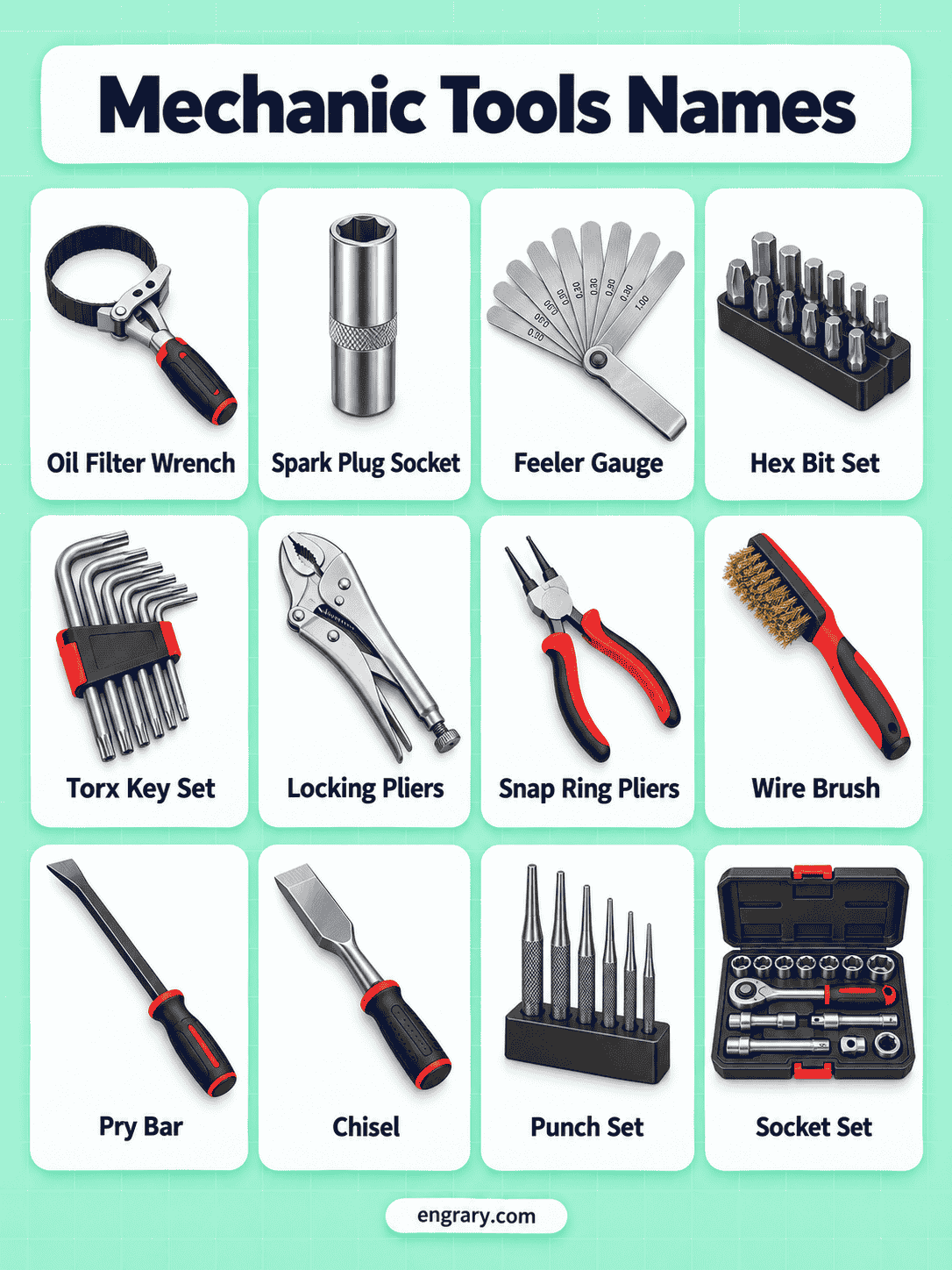
Hammers, Pry Tools, and Extractors
Stubborn parts sometimes require controlled impact, leverage, or dedicated removal tools.
Ball-Peen Hammer
A rounded peen and flat striking face suit metalwork, punches, and general mechanical repair.
Dead Blow Hammer
Internal shot reduces rebound while delivering strong controlled impact.
Rubber Mallet
A softer head moves components without leaving the marks of a steel hammer.
Pry Bar
The long steel shaft provides leverage for separating, aligning, or moving heavy parts.
Rolling Head Pry Bar
Its curved head helps align holes, position components, and work around obstacles.
Punch Set
Hardened punches drive out pins, mark centers, and assist with component removal.
Screw Extractor
Reverse-cutting or tapered profiles remove screws with damaged heads.
Bearing Puller
Hooked jaws apply controlled pulling force to remove bearings, gears, and similar press-fit parts.
Lifting and Under-Car Tools
Vehicle repair often requires safe access beneath the car or support for heavy components.
Floor Jack
Hydraulic force raises a vehicle quickly from an approved lifting point.
Bottle Jack
A compact vertical hydraulic cylinder lifts heavy loads where sufficient ground clearance exists.
Jack Stand
Rigid adjustable supports hold a raised vehicle after lifting.
Vehicle Lift
Powered arms or platforms raise the entire vehicle to a comfortable working height.
Wheel Dolly
A low rolling platform supports and moves a wheel or vehicle around the workshop.
Mechanic Creeper
Casters underneath a padded platform let mechanics slide beneath raised vehicles.
Transmission Jack
A wide adjustable saddle supports transmissions during removal and installation.
Engine Hoist
Hydraulic lifting arms raise engines and other heavy powertrain components from the vehicle.
Diagnostic and Electrical Tools
Modern automotive repair depends heavily on diagnostic data and direct electrical testing.
OBD2 Scanner
Trouble codes and basic vehicle data can be read through the standard diagnostic connector.
Professional Scan Tool
Advanced software accesses live data, manufacturer-specific systems, tests, and service functions.
Digital Multimeter
Electrical voltage, resistance, continuity, and current can be measured directly.
Test Light
A simple illuminated probe checks whether electrical power reaches a circuit point.
Battery Tester
Battery condition and starting capability can be evaluated without relying on visual inspection alone.
Battery Charger
Controlled electrical power restores charge to compatible vehicle batteries.
Circuit Tester
Electrical circuits can be checked for power, ground, continuity, or related conditions.
Vacuum Gauge
Intake-manifold vacuum patterns provide clues about engine condition and tuning.
Infrared Thermometer
Surface temperature readings help locate overheating brakes, cooling problems, and abnormal component temperatures.
Inspection Borescope
A small camera probe reveals areas inside cylinders, housings, ducts, and other spaces that are difficult to see directly.
Engine and Ignition Tools
Engine tools help measure mechanical condition, service internal parts, and work with ignition or accessory systems.
Compression Tester
Cylinder pressure readings help identify worn rings, valve leakage, or other sealing problems.
Timing Light
A flashing light synchronized with ignition pulses helps check ignition timing on compatible engines.
Feeler Gauge
Thin precision blades measure small gaps such as valve clearances and spark-plug gaps.
Valve Spring Compressor
Controlled compression releases pressure from valve springs during cylinder-head service.
Piston Ring Compressor
A band compresses piston rings so the piston can enter the cylinder bore without damage.
Harmonic Balancer Puller
Even pulling force removes a balancer or crankshaft pulley from compatible engines.
Flywheel Holding Tool
Rigid engagement prevents a flywheel or flexplate from rotating during fastener service.
Serpentine Belt Tool
A long low-profile handle reaches belt tensioners in crowded engine compartments.
Oil Pressure Tester
A mechanical gauge checks actual engine oil pressure through a suitable test port.
Brake Service Tools
Brake systems require precise tools for calipers, drums, hydraulic lines, and wear measurement.
Brake Caliper Piston Tool
Mechanical pressure retracts or rotates pistons before new brake pads are installed.
Brake Bleeder
Vacuum or pressure assists with removing air and old fluid from hydraulic brake lines.
Brake Spring Pliers
Special jaws install and remove springs used in drum brake assemblies.
Brake Spoon
A thin curved blade adjusts the star wheel inside compatible drum brake systems.
Brake Disc Micrometer
Precision measurement checks rotor thickness and wear.
Brake Hose Clamp
Controlled clamping temporarily restricts flow through a flexible brake hose during suitable service work.
Brake Pipe Flaring Tool
The forming dies shape brake-line ends for compatible flare fittings.
Steering and Suspension Tools
Suspension and steering components often use tapered, pressed, or spring-loaded connections that require dedicated tools.
Ball Joint Separator
A wedge or screw mechanism disconnects tapered ball-joint connections.
Ball Joint Press
A heavy frame applies controlled force to remove and install press-fit ball joints.
Tie Rod Puller
Steady pulling force separates a tie-rod end from the steering knuckle.
Pitman Arm Puller
Strong jaws remove a pitman arm from the steering gearbox shaft.
Coil Spring Compressor
Threaded compressors reduce coil-spring length for suitable suspension service.
Strut Spring Compressor
Opposing clamps compress a strut spring during strut disassembly and reassembly.
Hub Puller
Bolted or jaw-style pulling force separates wheel hubs from compatible assemblies.
Tire and Wheel Tools
Wheel and tire service requires accurate pressure, strong leverage, and dedicated bead or valve tools.
Tire Pressure Gauge
The gauge displays air pressure inside a tire.
Tire Inflator
Compressed air enters the tire through a controlled valve and pressure gauge.
Valve Core Tool
A small slotted end removes and installs tire valve cores.
Tire Bead Breaker
Mechanical leverage separates the tire bead from the wheel rim.
Wheel Weight Pliers
Special jaws remove, install, cut, and adjust clip-on wheel-balancing weights.
Oil and Fluid Service Tools
Fluid-service tools keep automotive maintenance cleaner and make draining, filling, extracting, and testing easier.
Drain Pan
A broad container catches used engine oil, coolant, or other fluids during service.
Fluid Extractor
Vacuum draws oil or other suitable fluids through a tube when conventional draining is inconvenient.
Fluid Transfer Pump
Manual or powered pumping moves fluid between containers and vehicle components.
Grease Gun
Pressurized lubricant flows into compatible grease fittings through a nozzle or hose.
Funnel
Its wide opening and narrow spout guide liquids into filler necks with less spilling.
Cooling System Pressure Tester
Controlled pressure reveals leaks in radiators, hoses, caps, and other cooling-system components.
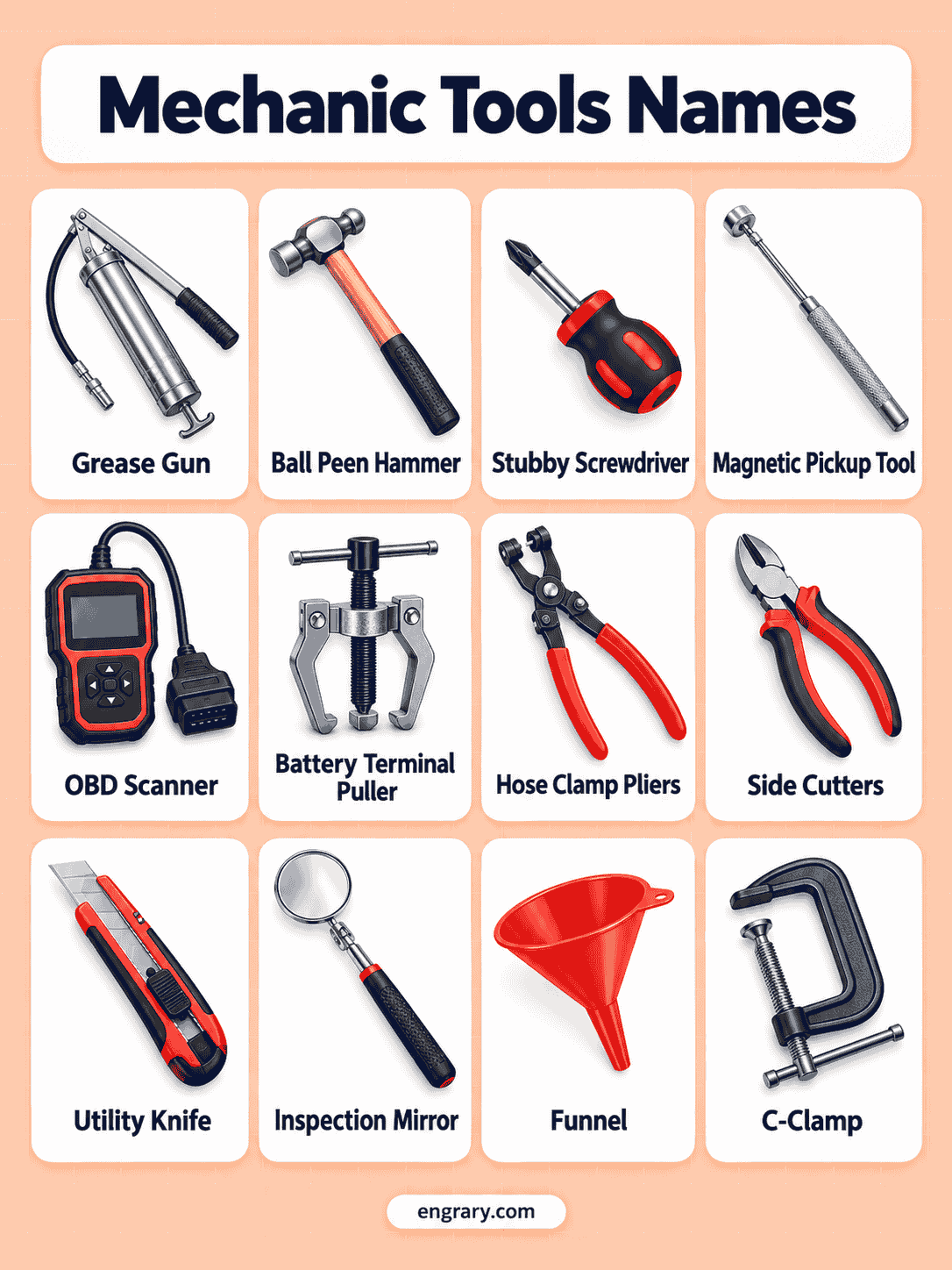
Tools for Different Vehicle Systems
Mechanics choose tools according to the vehicle system they need to inspect, service, or repair.
| Vehicle System | Common Tools |
|---|---|
| Engine | Compression Tester, Timing Light, Feeler Gauge |
| Brakes | Caliper Piston Tool, Brake Bleeder, Flare Nut Wrench |
| Suspension | Ball Joint Press, Spring Compressor, Tie Rod Puller |
| Electrical | Digital Multimeter, Test Light, OBD2 Scanner |
| Wheels | Lug Wrench, Torque Wrench, Tire Pressure Gauge |
| Cooling | Cooling System Pressure Tester, Hose Clamp Pliers, Infrared Thermometer |
| Fluids | Drain Pan, Oil Filter Wrench, Fluid Extractor |
| Transmission | Transmission Jack, Ratchet, Deep Sockets |
A mechanic may use the same everyday ratchets and wrenches across several systems, while specialty tools appear only when a particular repair requires them.
Tools for Routine Maintenance vs Major Repairs
Routine servicing needs a smaller, more portable tool set than engine, transmission, or suspension work.
| Routine Maintenance | Major Repair Work |
|---|---|
| Ratchet | Engine Hoist |
| Oil Filter Wrench | Transmission Jack |
| Torque Wrench | Ball Joint Press |
| Tire Pressure Gauge | Harmonic Balancer Puller |
| OBD2 Scanner | Coil Spring Compressor |
| Drain Pan | Hub Puller |
Routine tools handle jobs such as oil changes, inspections, wheel service, and basic diagnosis. Major repairs often require heavier lifting, pulling, compressing, or support equipment.
Manual vs Powered Mechanic Tools
Some automotive jobs can be completed with either manual or powered equipment.
| Manual Mechanic Tools | Powered Mechanic Tools |
|---|---|
| Ratchet | Air Ratchet |
| Lug Wrench | Impact Wrench |
| Breaker Bar | Impact Driver |
| Manual Fluid Pump | Powered Fluid Pump |
Manual tools often provide better control for final tightening or delicate work. Powered tools improve speed when many fasteners or stubborn components need attention.
Similar Mechanic Tools and How They Differ
Several mechanic tools handle related jobs, but their designs serve different purposes.
| Tools | Main Difference |
|---|---|
| Ratchet vs Breaker Bar | A ratchet turns fasteners repeatedly through a ratcheting mechanism, while a breaker bar provides greater leverage for stubborn fasteners. |
| Torque Wrench vs Ratchet | A torque wrench tightens a fastener to a specified torque, while a ratchet mainly provides convenient turning. |
| Standard Socket vs Deep Socket | A standard socket suits ordinary fasteners, while a deep socket reaches nuts positioned farther down long studs. |
| Impact Wrench vs Impact Driver | An impact wrench mainly handles larger nuts and bolts, while an impact driver commonly works with smaller screws and fasteners. |
| Floor Jack vs Jack Stand | A floor jack raises the vehicle, while a jack stand supports it after lifting. |
| OBD2 Scanner vs Digital Multimeter | An OBD2 scanner reads vehicle diagnostic information, while a multimeter directly measures electrical values. |
| Compression Tester vs Vacuum Gauge | A compression tester checks cylinder pressure, while a vacuum gauge measures intake-manifold vacuum. |
| Ball Joint Separator vs Ball Joint Press | A separator disconnects a tapered joint, while a press removes or installs press-fit ball joints. |
The main difference usually comes down to leverage, access, measurement, or the specific vehicle component being serviced.
Tools Mechanics Keep Close at Hand
A mechanic usually keeps versatile everyday tools within easy reach and brings out specialty equipment only when a repair requires it.
Common choices include:
- Ratchet
- Standard and Deep Sockets
- Combination Wrenches
- Torque Wrench
- Phillips Screwdriver
- Needle-Nose Pliers
- Locking Pliers
- Digital Multimeter
- OBD2 Scanner
- Flashlight
Heavy equipment such as engine hoists, transmission jacks, spring compressors, and pullers normally stays in the workshop until needed.
Mechanic Tools vs Automotive Supplies
Mechanic tools perform repair and maintenance tasks, while automotive supplies are consumed, replaced, or installed during the work.
| Mechanic Tools | Automotive Supplies |
|---|---|
| Oil Filter Wrench | Engine Oil |
| Grease Gun | Grease |
| Brake Bleeder | Brake Fluid |
| Funnel | Coolant |
| Battery Tester | Battery |
| Torque Wrench | Nuts and Bolts |
Items such as engine oil, brake fluid, coolant, grease, shop towels, fuses, gaskets, replacement parts, zip ties, fasteners, PPE, and tool boxes should not be counted as mechanic tools.
FAQs
Common mechanic tools include ratchets, sockets, combination wrenches, torque wrenches, screwdrivers, pliers, floor jacks, jack stands, multimeters, OBD2 scanners, and oil-filter wrenches.
Mechanics use OBD2 scanners, professional scan tools, digital multimeters, test lights, battery testers, vacuum gauges, compression testers, infrared thermometers, and other diagnostic instruments.
Brake-service tools include caliper piston tools, brake bleeders, brake spring pliers, brake spoons, disc micrometers, hose clamps, flare nut wrenches, and brake-pipe flaring tools.
Floor jacks, bottle jacks, vehicle lifts, and car ramps raise vehicles, while jack stands provide rigid support after lifting.
Mechanic tools perform jobs such as fastening, lifting, testing, pulling, measuring, and servicing. Automotive supplies include fluids, fasteners, filters, gaskets, replacement parts, and other materials that are consumed or installed during repair work.
You May Also Like



Leave a Comment