
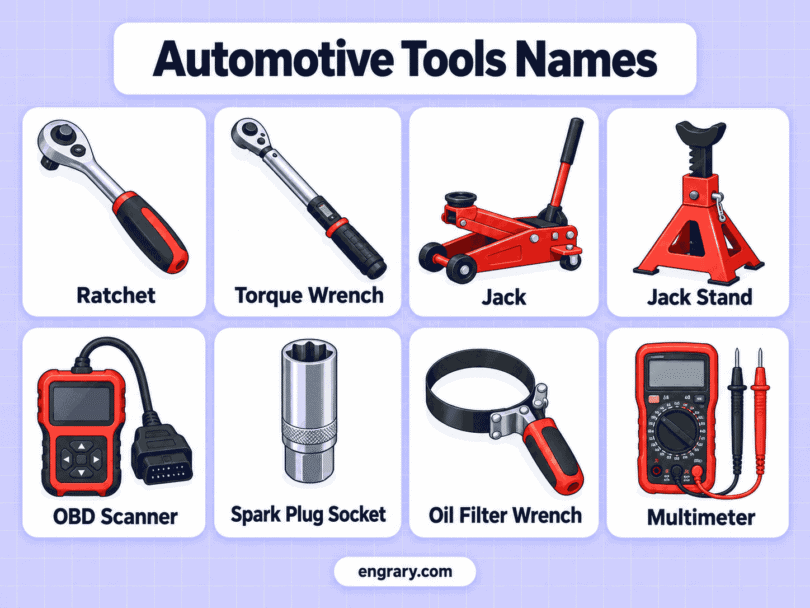
Automotive tools help people inspect, maintain, diagnose, repair, clean, and restore vehicles. Learning common automotive tools names in English makes it easier to recognize the equipment used in service garages, tire shops, body-repair areas, detailing bays, electrical work, and routine vehicle maintenance.
This article covers 120 automotive tools with clear explanations of their main uses. The list goes beyond mechanic tools to include battery equipment, tire tools, body-repair tools, automotive glass tools, detailing equipment, trim tools, inspection devices, and other tools used throughout an automotive workshop.
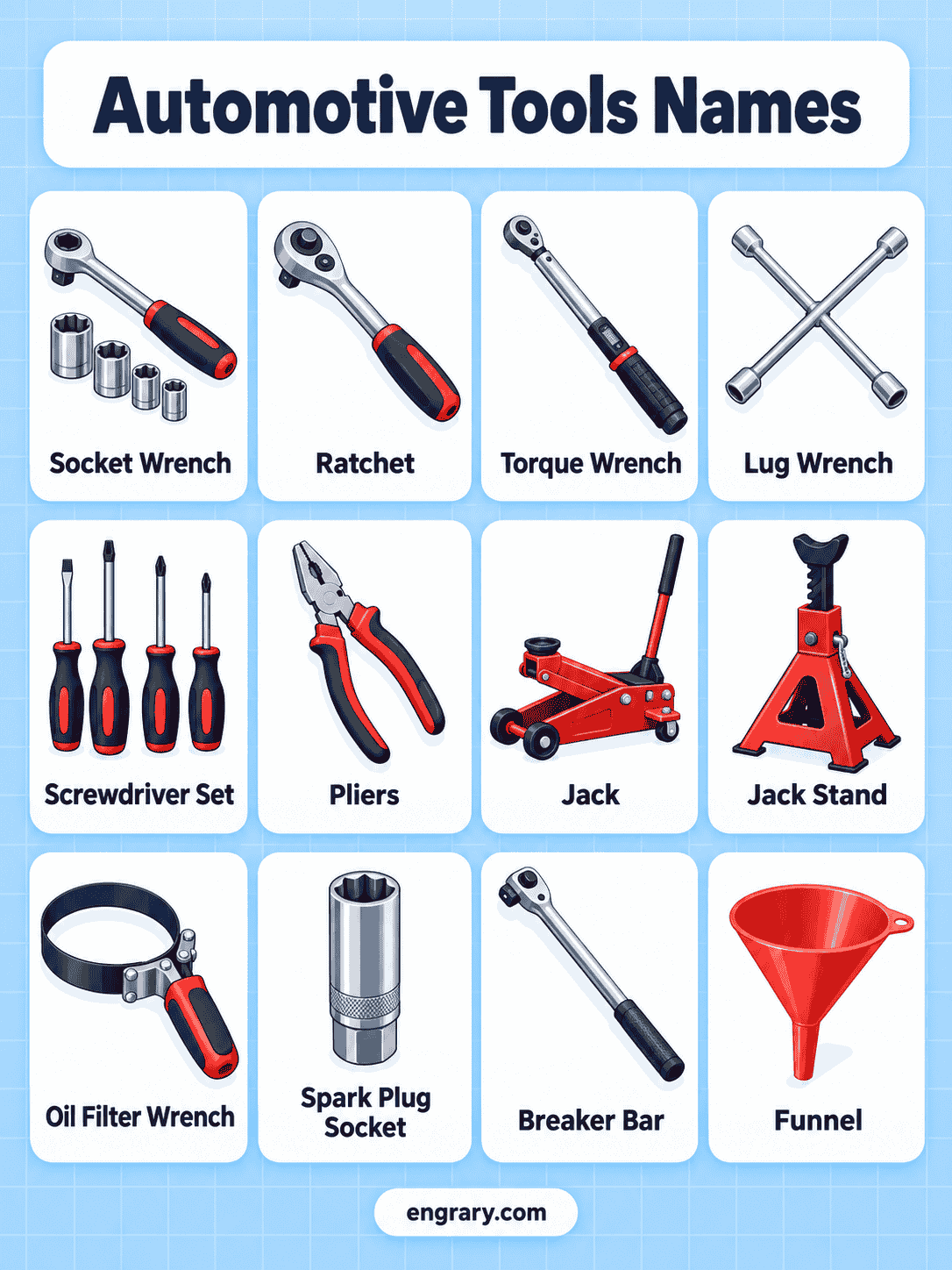
Popular Automotive Tools You’ll See Around a Garage
A modern automotive garage contains everything from simple hand tools to electronic diagnostic equipment and large lifting machines. The following names are among the most recognizable.
Ratchet
A ratcheting mechanism turns socket fasteners repeatedly without removing the tool after each movement.
Torque Wrench
Controlled torque helps tighten important vehicle fasteners to the required specification.
Impact Wrench
Rapid rotational impacts loosen wheel nuts and other heavy fasteners quickly.
Floor Jack
Hydraulic force raises part of a vehicle from a suitable lifting point.
Jack Stand
Rigid supports hold a vehicle after it has been raised.
OBD2 Scanner
Diagnostic trouble codes and vehicle data can be read through the OBD2 connector.
Digital Multimeter
Voltage, resistance, continuity, and other electrical values can be checked during fault finding.
Battery Tester
Battery condition and starting capability can be evaluated before replacement or charging.
Tire Pressure Gauge
A pressure reading shows whether a tire needs more or less air.
Tire Inflator
Compressed air raises tire pressure to the required level.
Oil Filter Wrench
Specialized gripping surfaces loosen tightly installed oil filters.
Brake Bleeder
Pressure or vacuum helps remove trapped air and old fluid from hydraulic brake lines.
Trim Removal Tool
A shaped plastic or composite edge releases interior trim with less risk of visible damage.
Dent Puller
Controlled pulling force helps reshape dented vehicle body panels.
Dual Action Polisher
Combined rotation and orbital movement polish painted surfaces with more controlled action.
Wet/Dry Vacuum
Strong suction removes dust, debris, and suitable liquids from vehicle interiors and work areas.
Inspection Light
Focused illumination reveals parts hidden inside engine bays, wheel wells, and underbody areas.
Mechanic Creeper
A low rolling platform allows easier movement beneath a raised vehicle.
Engine Hoist
Hydraulic lifting power raises engines and other heavy assemblies from a vehicle.
Glass Suction Cup
Vacuum grip helps lift and position automotive glass safely.
Tools for Everyday Vehicle Service
Routine automotive work depends on reliable fastening tools, diagnostic instruments, battery equipment, tire tools, lifting devices, and system-specific service tools.
Fastening and General Repair Tools
These everyday tools handle nuts, bolts, screws, brackets, covers, and many other vehicle fasteners.
Ratchet
Its geared mechanism turns sockets repeatedly while the handle resets between strokes.
Standard Socket
A short socket fits common nuts and bolts where extra depth is unnecessary.
Deep Socket
The longer body reaches nuts positioned farther down studs or threaded shafts.
Torque Wrench
Specified torque settings help prevent critical fasteners from being left too loose or overtightened.
Combination Wrench
One open end and one box end provide two ways to turn the same fastener size.
Adjustable Wrench
A movable jaw accommodates several sizes of flat-sided nuts and bolts.
Breaker Bar
For stubborn fasteners, the long rigid handle provides greater leverage than a standard ratchet.
Phillips Screwdriver
Its cross-shaped tip fits Phillips screws used in covers, brackets, lamps, and interior parts.
Torx Driver
A star-shaped profile engages Torx fasteners found throughout many modern vehicles.
Locking Pliers
Adjustable jaws clamp firmly onto damaged fasteners, brackets, and awkward components.
Diagnostic and Testing Equipment
Modern vehicles rely on electronic controls as well as mechanical systems, so accurate diagnosis often requires specialized instruments.
OBD2 Scanner
Stored diagnostic trouble codes and basic live vehicle information can be read through the standard port.
Professional Scan Tool
Advanced functions provide deeper access to live data, modules, service procedures, and manufacturer-specific systems.
Digital Multimeter
Direct measurements help check voltage, resistance, continuity, and electrical circuits.
Test Light
A simple illuminated probe quickly indicates whether power reaches a suitable circuit point.
Circuit Tester
Power, ground, and other basic electrical conditions can be checked during wiring diagnosis.
Compression Tester
Cylinder-pressure readings help evaluate engine sealing and mechanical condition.
Vacuum Gauge
Intake-manifold vacuum patterns can reveal useful information about engine operation.
Infrared Thermometer
Non-contact temperature readings help locate overheating brakes, cooling issues, and abnormal component temperatures.
Inspection Borescope
A small camera probe reveals areas inside cylinders, ducts, housings, and other confined spaces.
Automotive Smoke Machine
Visible smoke helps locate leaks in intake, vacuum, EVAP, and other compatible sealed systems.
Battery and Charging Tools
Battery service requires tools for testing, charging, handling terminals, and maintaining electrical power during repair work.
Battery Tester
A dedicated test evaluates battery voltage, condition, and starting performance.
Battery Charger
Controlled charging restores energy to a compatible vehicle battery.
Battery Load Tester
An applied electrical load shows how well the battery performs under demand.
Battery Terminal Puller
Even pulling force removes stubborn terminals without heavy prying.
Battery Terminal Spreader
The small expanding tool opens suitable clamp-style terminals during removal or installation.
Battery Terminal Brush
Stiff internal and external bristles clean corrosion from posts and cable terminals.
Memory Saver
Temporary backup power helps preserve selected electronic settings while the main battery is disconnected.
Jump Starter
Portable stored power assists with starting a vehicle when its battery cannot supply enough current.
Tire and Wheel Service Tools
Tire and wheel work involves pressure checks, inflation, lug-fastener service, bead work, balancing, and electronic TPMS functions.
Tire Pressure Gauge
A direct reading displays the amount of air pressure inside a tire.
Tire Inflator
Air flows through a controlled valve to increase tire pressure.
Impact Wrench
Powered impacts remove and install wheel lug nuts quickly.
Lug Wrench
Long manual leverage turns wheel nuts when powered equipment is unavailable.
Torque Stick
A calibrated extension limits applied impact torque within its designed range.
Valve Core Tool
The slotted end removes and installs valve cores in compatible tire valves.
Tire Bead Breaker
Mechanical force separates a tire bead from the wheel rim.
Tire Spoon
A curved lever assists with moving a tire bead over the edge of a wheel.
Wheel Weight Pliers
Special jaws install, remove, cut, and adjust clip-on balancing weights.
TPMS Tool
Electronic functions help activate, test, or program compatible tire-pressure monitoring sensors.
Vehicle Lifting Equipment
Safe access beneath a vehicle requires equipment designed to lift, support, or move heavy loads.
Floor Jack
A low hydraulic body raises the vehicle from an approved lifting point.
Bottle Jack
Compact vertical hydraulic action lifts heavy loads where adequate clearance exists.
Jack Stand
Mechanical support holds a raised vehicle after the lifting device has done its job.
Vehicle Lift
Powered arms or platforms raise the whole vehicle to a practical workshop height.
Car Ramp
A sloped platform lifts the wheels as the vehicle drives onto it.
Wheel Dolly
A small rolling platform supports a wheel or vehicle corner for workshop movement.
Mechanic Creeper
Casters underneath a low padded platform make under-car movement easier.
Transmission Jack
An adjustable cradle supports a transmission during removal and installation.
Brake and Suspension Service Tools
Brake, steering, and suspension work often involves hydraulic pressure, compressed springs, and tightly fitted components, so specialized tools are essential.
Brake Caliper Piston Tool
Controlled pressure pushes or rotates the caliper piston back into position before new pads are fitted.
Brake Bleeder
By using vacuum or pressure, this tool helps remove trapped air from hydraulic brake lines.
Brake Spring Pliers
Specially shaped jaws make drum-brake springs easier to install and remove.
Brake Disc Micrometer
Rotor thickness and wear can be checked accurately with this precision measuring tool.
Ball Joint Press
A heavy frame applies controlled force to remove or install press-fit ball joints.
Tie Rod Puller
Steady pressure separates a tie-rod end from a steering knuckle.
Pitman Arm Puller
Strong pulling jaws release a pitman arm from a steering gearbox shaft.
Coil Spring Compressor
Threaded clamps reduce spring length during suitable suspension work.
Hub Puller
Bolted or jaw-style force separates compatible wheel hubs from their assemblies.
Bushing Driver Set
Sized drivers install or remove bushings and similar press-fit components.
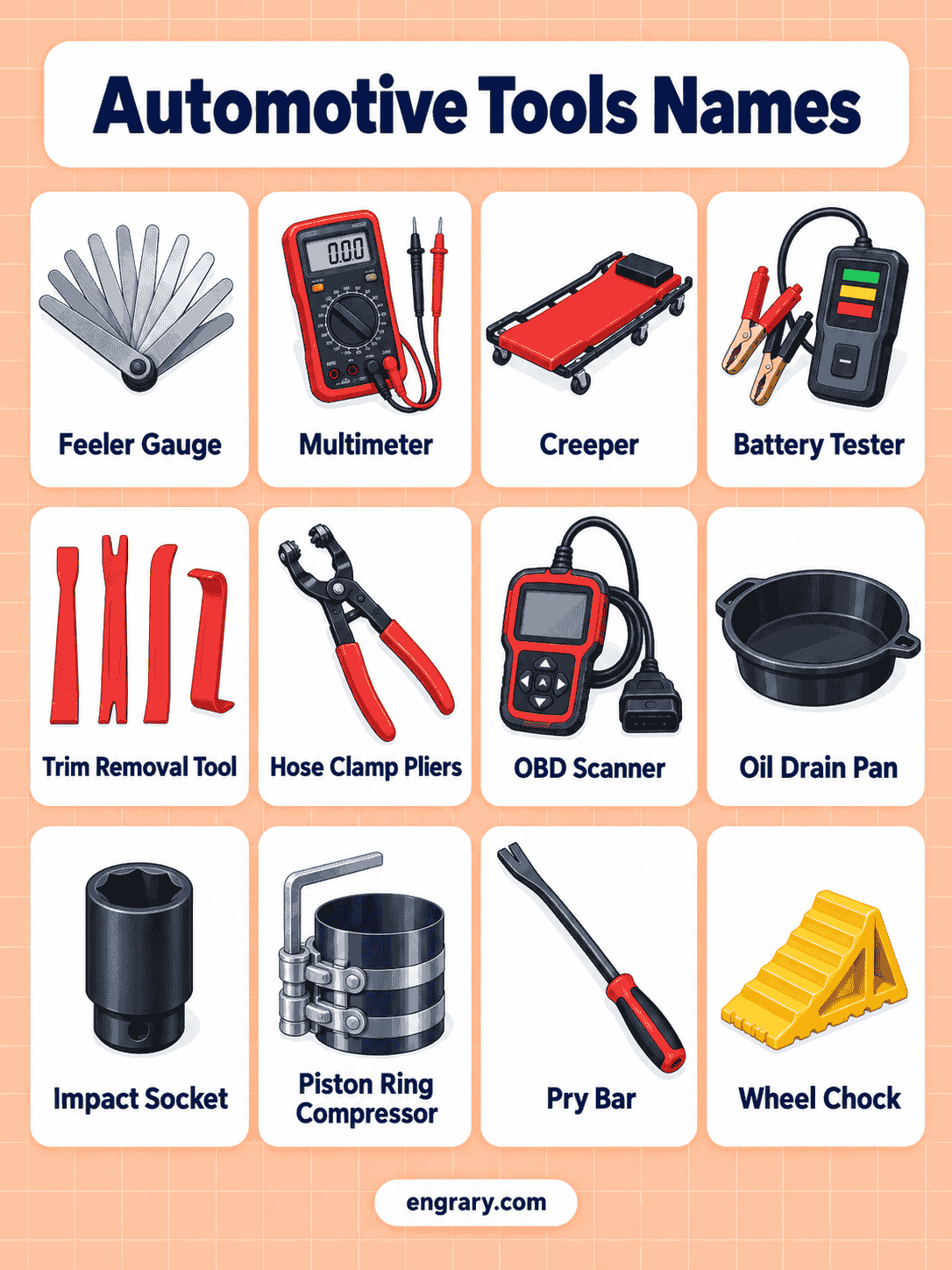
Engine and Cooling Tools
Engine and cooling work requires tools for ignition checks, belt service, internal measurements, and cooling-system diagnosis.
Spark Plug Socket
A deep protective socket reaches spark plugs inside cylinder-head recesses.
Timing Light
A flashing beam synchronized with ignition pulses helps check timing on compatible engines.
Feeler Gauge
Thin precision blades measure narrow gaps and clearances.
Serpentine Belt Tool
A long low-profile handle reaches belt tensioners in crowded engine compartments.
Harmonic Balancer Puller
Even pulling force removes compatible crankshaft pulleys or balancers.
Cooling System Pressure Tester
Controlled pressure reveals leaks in radiators, hoses, caps, and other cooling components.
Radiator Hose Pliers
Special jaws grip and release hoses or clamps in confined cooling-system areas.
Coolant Refractometer
Optical readings help evaluate coolant concentration and freeze protection.
Oil Pressure Tester
A mechanical gauge checks actual engine oil pressure through a suitable test point.
Engine Hoist
Hydraulic lifting arms raise engines and other heavy powertrain assemblies.
Automotive Electrical and Wiring Tools
Vehicle electrical work needs compact tools for stripping wire, forming connections, releasing terminals, and repairing harnesses.
Wire Stripper
Sized openings remove insulation from automotive wiring without intentionally cutting the conductor.
Crimping Tool
Mechanical compression secures compatible terminals and connectors onto prepared wires.
Soldering Iron
A heated tip joins suitable electrical wires and terminals with solder.
Heat Gun
Controlled hot air shrinks tubing, softens adhesives, and supports selected electrical repairs.
Terminal Release Tool
Thin shaped ends unlock compatible pins and terminals from connector housings.
Fuse Puller
Small gripping jaws remove blade or cartridge fuses without using ordinary pliers.
Automotive Circuit Probe
A pointed probe helps inspect power, ground, or other circuit conditions at accessible points.
Battery Cable Crimper
Heavy crimping force secures large terminals onto suitable battery cables.
Oil and Fluid Service Tools
Fluid-service equipment helps collect, transfer, extract, fill, and lubricate vehicle systems cleanly.
Oil Filter Wrench
A dedicated gripping design loosens compatible oil filters.
Drain Pan
The wide container catches used oil, coolant, and other service fluids.
Fluid Extractor
Vacuum draws suitable fluids through a narrow tube when conventional draining is inconvenient.
Fluid Transfer Pump
Manual or powered pumping moves fluid between containers and vehicle components.
Grease Gun
Pressurized lubricant reaches compatible chassis and suspension fittings.
Funnel
A wide top and narrow outlet guide fluids into filler openings with less spilling.
Fluid Syringe
A hand-operated plunger draws in or dispenses smaller quantities of automotive fluid.
Coolant Funnel
A wide elevated reservoir helps fill and bleed compatible cooling systems.
Tools for Auto Body and Exterior Work
Automotive work also includes repairing panels, replacing glass, and preparing surfaces for refinishing.
Dent and Panel Repair Tools
Body-repair tools reshape sheet metal, pull dents, smooth panels, and support parts during restoration.
Dent Puller
Controlled pulling force draws dented sheet metal toward its original shape.
Slide Hammer
A sliding weight generates outward pulling force for dents and other removal jobs.
Body Hammer
Different face shapes help straighten, stretch, and refine metal body panels.
Dolly Block
A shaped steel block supports the reverse side of a panel while hammering.
Panel Beater
Its shaped face assists with correcting dents and uneven sheet metal.
Body File
A long abrasive cutting surface reveals and reduces high spots on repaired panels.
Stud Welder
Small studs attach temporarily to damaged sheet metal so dents can be pulled outward.
Dent Lifter
Leverage applied to welded studs or tabs raises localized dents in a controlled way.
Body Spoon
A smooth metal surface backs or reshapes panels where a conventional dolly cannot fit.
Auto Body Work Stand
Adjustable supports hold bumpers, panels, and other body parts during repair or refinishing.
Automotive Glass Tools
Glass service calls for tools that cut adhesive, lift panels, scrape bonding surfaces, and position replacement glass.
Windshield Removal Tool
A specialized cutting edge separates cured adhesive around automotive glass.
Glass Suction Cup
Vacuum grip provides a secure lifting point on smooth glass surfaces.
Windshield Wire Tool
Strong cutting wire slices through adhesive between the windshield and vehicle body.
Glass Scraper
A sharp replaceable blade removes old adhesive and residue from suitable surfaces.
Sealant Knife
A narrow cutting blade trims or separates automotive sealing material.
Windshield Setting Tool
Guides help position replacement glass accurately during installation.
Paint and Surface Preparation Tools
Refinishing work depends on accurate coating application and careful preparation of damaged or repaired surfaces.
Paint Spray Gun
Atomized coating spreads automotive primer, paint, or clear coat across prepared surfaces.
Paint Thickness Gauge
Electronic readings estimate coating thickness on compatible vehicle panels.
Orbital Sander
A powered orbital motion smooths filler, primer, and painted surfaces.
Sanding Block
Rigid backing keeps abrasive work flatter and more controlled during manual sanding.
Masking Cutter
A compact blade trims masking film and related materials during paint preparation.
Surface Preparation Tool
Rotating abrasive attachments strip corrosion, coatings, or surface contamination before refinishing.
Tools for Interior and Trim Work
Interior repairs require lighter tools that can release clips, panels, and upholstery without causing unnecessary visible damage.
Trim Removal Tool
A broad plastic edge lifts trim pieces and mouldings with reduced scratching.
Panel Clip Pliers
Special jaws pull plastic retainers and clips from body or interior panels.
Upholstery Clip Remover
A forked tip reaches beneath upholstery fasteners for controlled removal.
Door Panel Tool
The shaped end releases door-panel retainers and clips around the panel edge.
Hook and Pick Set
Fine pointed tools retrieve seals, clips, wires, and small parts from tight spaces.
Plastic Pry Tool
Non-metallic leverage separates interior components while reducing marks on finished surfaces.
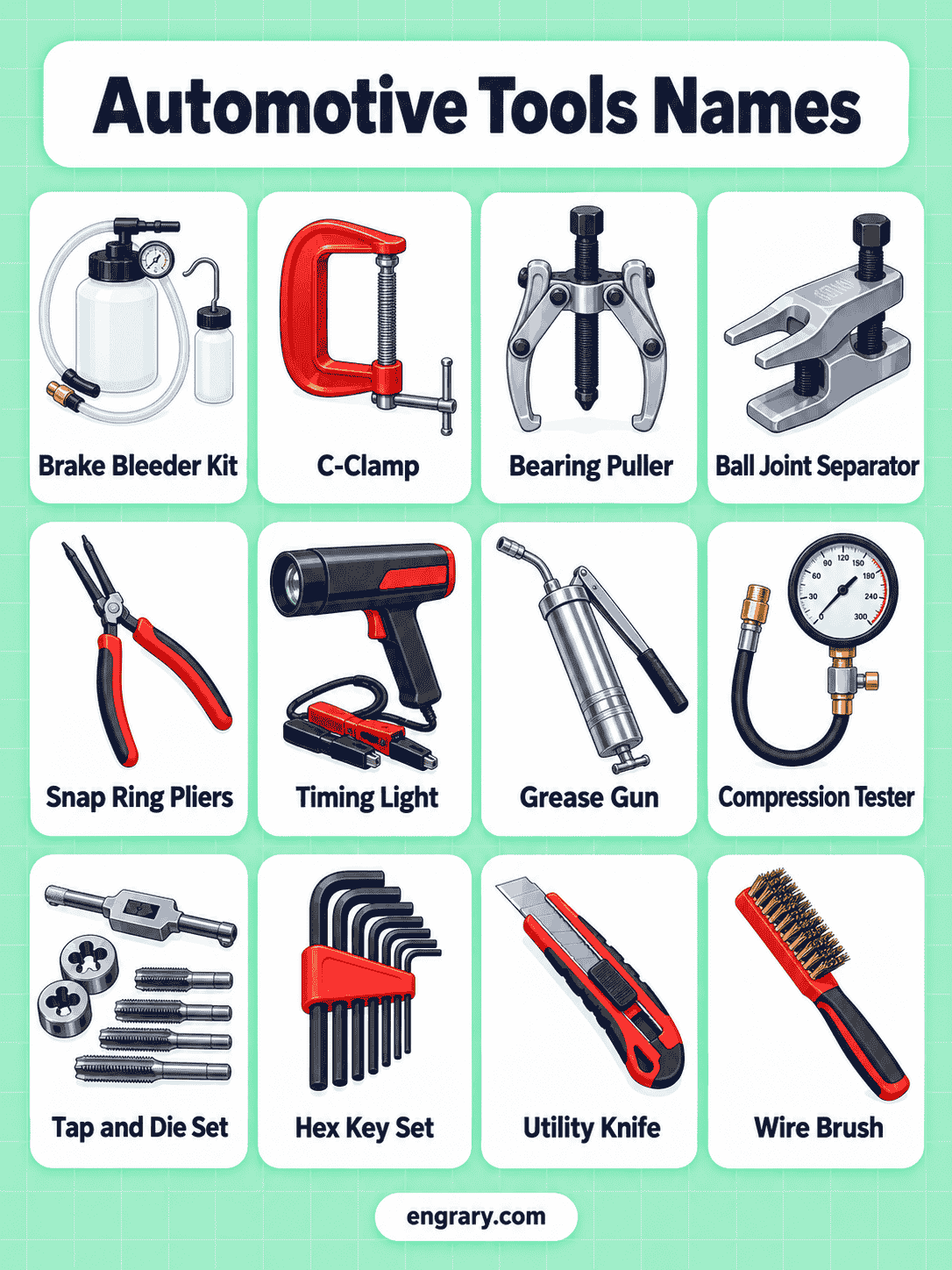
Equipment for Detailing and Vehicle Cleaning
Vehicle-care tools focus on exterior finish, interior cleanliness, and hard-to-reach areas rather than mechanical repair.
Dual Action Polisher
Combined rotation and orbital movement spreads polishing action across the paint surface.
Rotary Polisher
A direct spinning pad provides strong correction for suitable paint-restoration work.
Foam Cannon
Pressurized water mixes with detergent to cover the vehicle in cleaning foam.
Pressure Washer
A concentrated water stream removes mud and loose contamination from suitable exterior areas.
Wet/Dry Vacuum
Powerful suction removes dirt, debris, and appropriate liquids from vehicle interiors.
Detailing Brush
Soft or medium bristles reach vents, badges, seams, switches, and other small areas.
Equipment for Inspection and Fault Finding
Good inspection tools reveal problems that may remain hidden during an ordinary visual check.
Inspection Light
A bright narrow beam illuminates engine bays, wheel wells, and underbody components.
Under-Hood Light
A wide lamp spans or attaches around the engine bay to provide broad working illumination.
Inspection Mirror
An angled reflective surface reveals the backs of components and other hidden areas.
UV Leak Detection Lamp
Ultraviolet light reveals compatible fluorescent dye used to trace selected fluid or refrigerant leaks.
Inside an Automotive Workshop
Different parts of an automotive workshop rely on different tool groups.
| Workshop Area | Typical Tools |
|---|---|
| Service Bay | Ratchet, Torque Wrench, Floor Jack |
| Diagnostic Area | OBD2 Scanner, Multimeter, Borescope |
| Tire Bay | Impact Wrench, Tire Inflator, TPMS Tool |
| Battery Station | Battery Tester, Charger, Terminal Brush |
| Body Area | Dent Puller, Body Hammer, Dolly Block |
| Glass Area | Suction Cup, Removal Wire, Glass Scraper |
| Detailing Bay | Polisher, Pressure Washer, Wet/Dry Vacuum |
| Inspection Area | Work Light, Inspection Mirror, UV Lamp |
This workshop view shows why automotive tools cover much more than engine and mechanical repair.
Tools for Tire, Battery, and Quick Service Jobs
Quick-service work usually relies on tools that diagnose or complete routine jobs without major vehicle disassembly.
| Service Job | Useful Tools |
|---|---|
| Tire Pressure Check | Tire Pressure Gauge, Tire Inflator |
| Wheel Removal | Impact Wrench, Lug Wrench, Torque Stick |
| TPMS Service | TPMS Tool, Valve Core Tool |
| Battery Check | Battery Tester, Load Tester |
| Battery Charging | Battery Charger, Jump Starter |
| Oil Service | Oil Filter Wrench, Drain Pan, Funnel |
| Cooling Check | Refractometer, Cooling System Pressure Tester |
These tools support many of the jobs performed during routine inspection and service visits.
Automotive Tools Beyond Mechanical Repair
Automotive tools extend into vehicle appearance, body structure, glass, interior fittings, electrical systems, and cleaning.
A mechanic may rely mainly on sockets, wrenches, scanners, and lifting equipment. However, an automotive body technician may need dent pullers and panel tools, while a detailer works with polishers, vacuums, and cleaning equipment. Glass technicians, tire specialists, and battery-service workers also rely on their own specialized tool sets.
This broader scope is what makes automotive tools a wider category than mechanic tools alone.
Tools That Look Similar but Do Different Jobs
Several automotive tools seem interchangeable at first, but their designs suit different tasks.
| Tools | Main Difference |
|---|---|
| Ratchet vs Impact Wrench | A ratchet provides manual turning control, while an impact wrench uses powered rotational impacts. |
| Floor Jack vs Vehicle Lift | A floor jack raises one area of a vehicle, while a vehicle lift raises the whole vehicle much higher. |
| Battery Tester vs Digital Multimeter | A battery tester focuses on battery condition, while a multimeter measures broader electrical values. |
| Rotary Polisher vs Dual Action Polisher | A rotary polisher spins on one axis, while a dual action polisher combines rotation with orbital movement. |
| Dent Puller vs Slide Hammer | A dent puller focuses on body-panel reshaping, while a slide hammer supplies pulling force for several automotive jobs. |
| Tire Inflator vs Tire Pressure Gauge | An inflator adds air to the tire, while a pressure gauge only measures the existing pressure. |
| Inspection Light vs Borescope | An inspection light illuminates visible spaces, while a borescope shows areas inside confined cavities. |
| Trim Removal Tool vs Metal Pry Tool | A trim tool protects delicate panels, while a metal pry tool provides stronger leverage for heavier work. |
Choosing the correct tool usually depends on the surface, component, access, and amount of force required.
Items Commonly Used Alongside Automotive Tools
Automotive work also depends on fluids, coatings, replacement parts, and consumables that should not be counted as tools.
Engine Oil
Lubricating oil protects moving engine components during operation.
Brake Fluid
Hydraulic fluid transfers force through compatible braking systems.
Coolant
The fluid carries heat away from the engine and helps protect the cooling system.
Automotive Polish
Fine polishing material helps improve or correct suitable painted surfaces.
Wax or Sealant
A protective layer helps shield paint and improve surface appearance.
Automotive Paint
Color and protective coatings restore refinished body panels.
Sandpaper
Abrasive sheets smooth filler, primer, paint, and other surfaces during preparation.
Fasteners and Clips
Nuts, bolts, screws, retainers, and clips secure automotive parts in place.
These products support automotive work or become part of the vehicle, while tools perform the actual measuring, cutting, repairing, lifting, testing, or cleaning tasks.
FAQs
Common automotive tools include ratchets, sockets, torque wrenches, impact wrenches, jacks, diagnostic scanners, multimeters, battery testers, tire tools, oil-service tools, and trim-removal tools.
OBD2 scanners, professional scan tools, digital multimeters, test lights, circuit testers, compression testers, vacuum gauges, borescopes, infrared thermometers, and smoke machines help diagnose vehicle problems.
Tire pressure gauges, inflators, impact wrenches, lug wrenches, torque sticks, valve-core tools, bead breakers, tire spoons, wheel-weight pliers, and TPMS tools support tire and wheel work.
Common auto body tools include dent pullers, slide hammers, body hammers, dollies, panel beaters, body files, stud welders, dent lifters, body spoons, and panel stands.
Mechanic tools mainly focus on vehicle diagnosis, maintenance, and mechanical repair. Automotive tools form a broader category that also includes bodywork, glass service, detailing, tire work, battery service, interior trim, paint preparation, and other vehicle-care equipment.
You May Also Like



Leave a Comment