
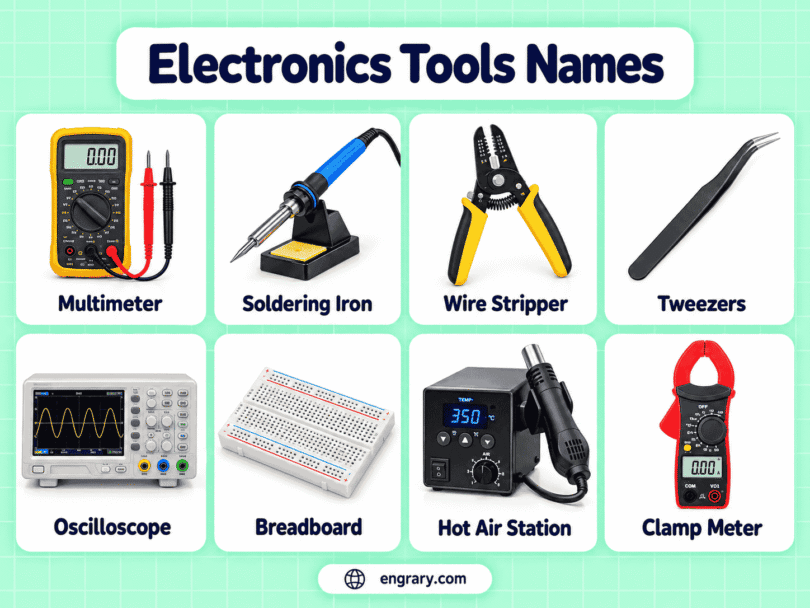
Electronics tools help technicians, hobbyists, and repair professionals test circuits, solder components, open devices, inspect circuit boards, handle tiny parts, and troubleshoot electronic systems. Learning common electronics tools names in English makes it easier to recognize the equipment used for PCB repair, device maintenance, circuit testing, prototyping, and microsoldering.
This article covers 80 electronics tools with their main uses, from basic hand tools to soldering equipment, testing instruments, bench power devices, magnification tools, and ESD-safe equipment. You will also learn which tools suit different electronics jobs, how similar tools differ, and how electronics tools compare with electrician tools.
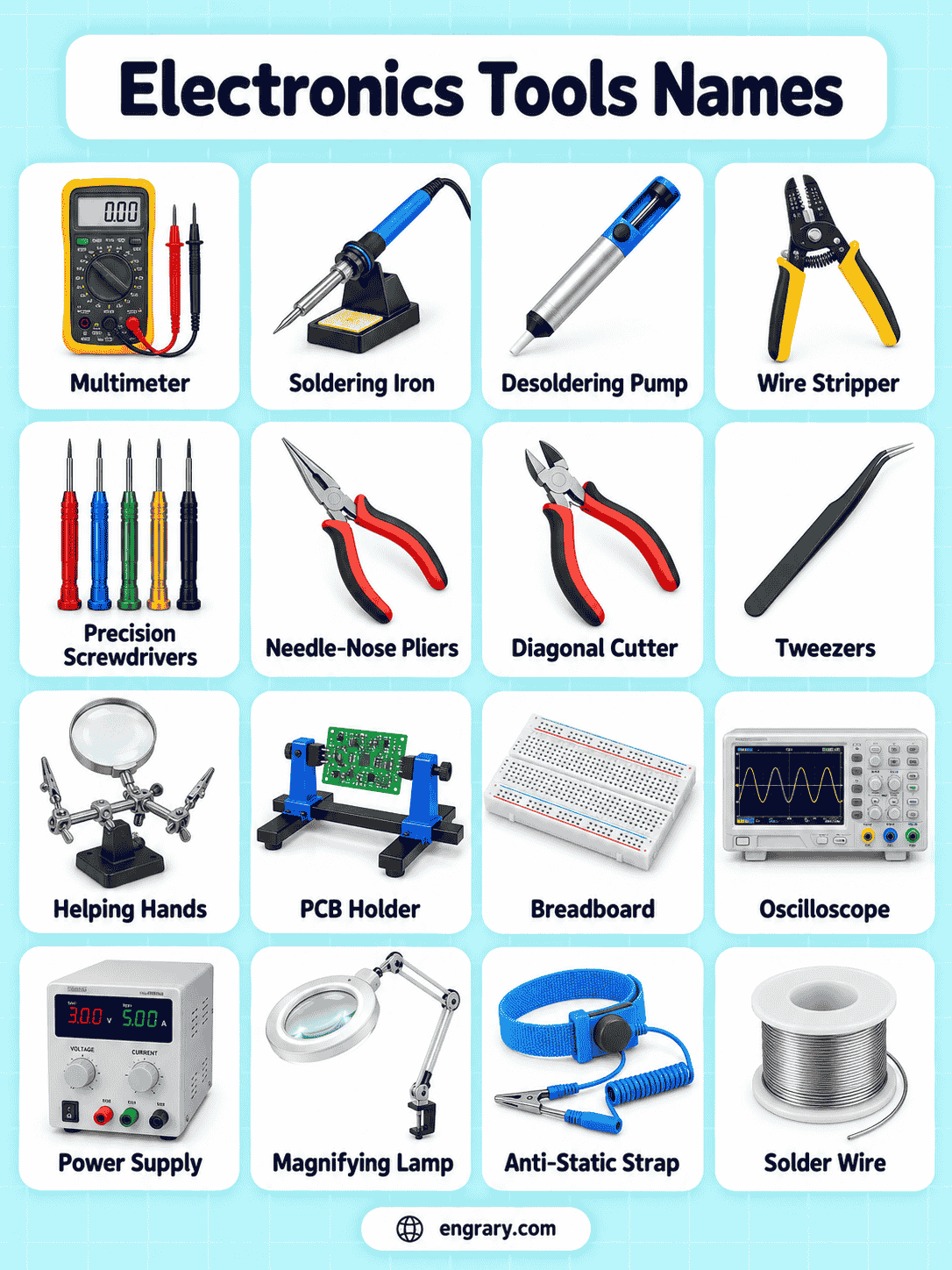
Common Electronics Tools Names with Pictures
Some electronics tools appear on almost every repair bench because they handle everyday testing, soldering, opening, cutting, holding, and inspection work. These familiar names provide a quick overview before the complete list.
Digital Multimeter
A digital multimeter measures electrical values such as voltage, resistance, continuity, and current.
Oscilloscope
An oscilloscope displays electrical signals as waveforms so changes over time can be examined.
Soldering Iron
A soldering iron heats electronic joints so solder can connect components and wires.
Soldering Station
A soldering station provides controlled heat for accurate and repeatable soldering work.
Hot Air Rework Station
A hot air rework station directs heated air onto components for SMD installation and removal.
Desoldering Pump
A desoldering pump removes molten solder through suction.
Precision Tweezers
Precision tweezers hold and position tiny electronic components.
Precision Screwdriver
A precision screwdriver turns small screws found in phones, laptops, circuit enclosures, and other devices.
Wire Stripper
A wire stripper removes insulation from small electrical conductors.
Flush Cutter
A flush cutter trims component leads and small wires close to a surface.
Needle-Nose Pliers
Needle-nose pliers grip, bend, and position small wires or components in tight spaces.
Spudger
A spudger disconnects connectors and pries delicate electronic parts without using a metal blade.
Opening Pick
An opening pick slides through seams to separate device housings and adhesive-backed panels.
PCB Holder
A PCB holder keeps a circuit board steady during soldering, testing, or repair.
Helping Hands
Helping hands hold wires, boards, or components in position while both hands remain free.
Bench Power Supply
A bench power supply delivers adjustable voltage and current to circuits during testing and development.
Logic Analyzer
A logic analyzer records and examines digital signals across several channels.
Magnifying Lamp
A magnifying lamp enlarges small components while illuminating the work area.
Inspection Microscope
An inspection microscope provides detailed views of solder joints, PCB traces, and tiny components.
ESD Wrist Strap
An ESD wrist strap helps reduce electrostatic charge on the person working with sensitive electronics.
Essential Electronics Tools for Testing and Repair
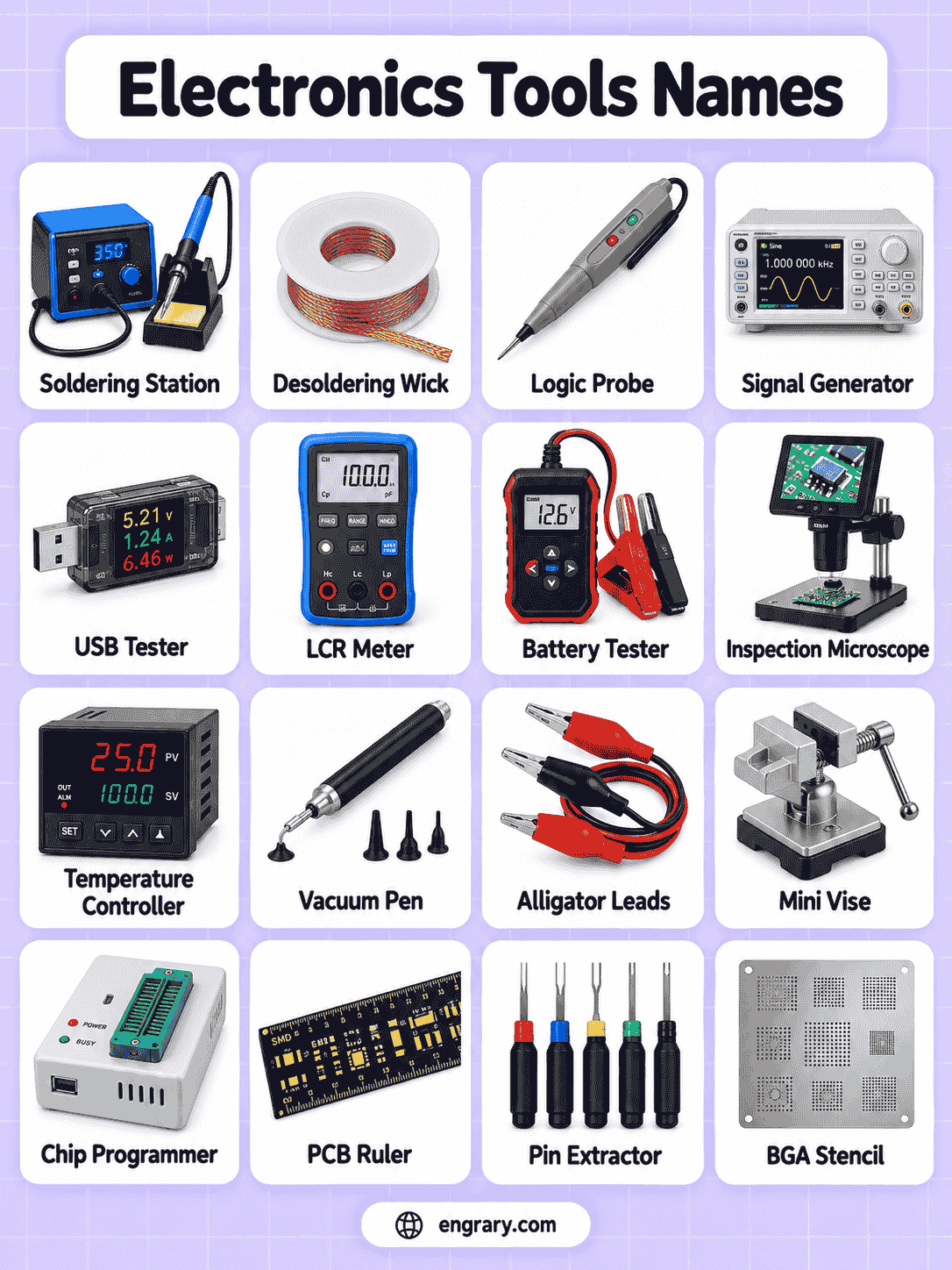
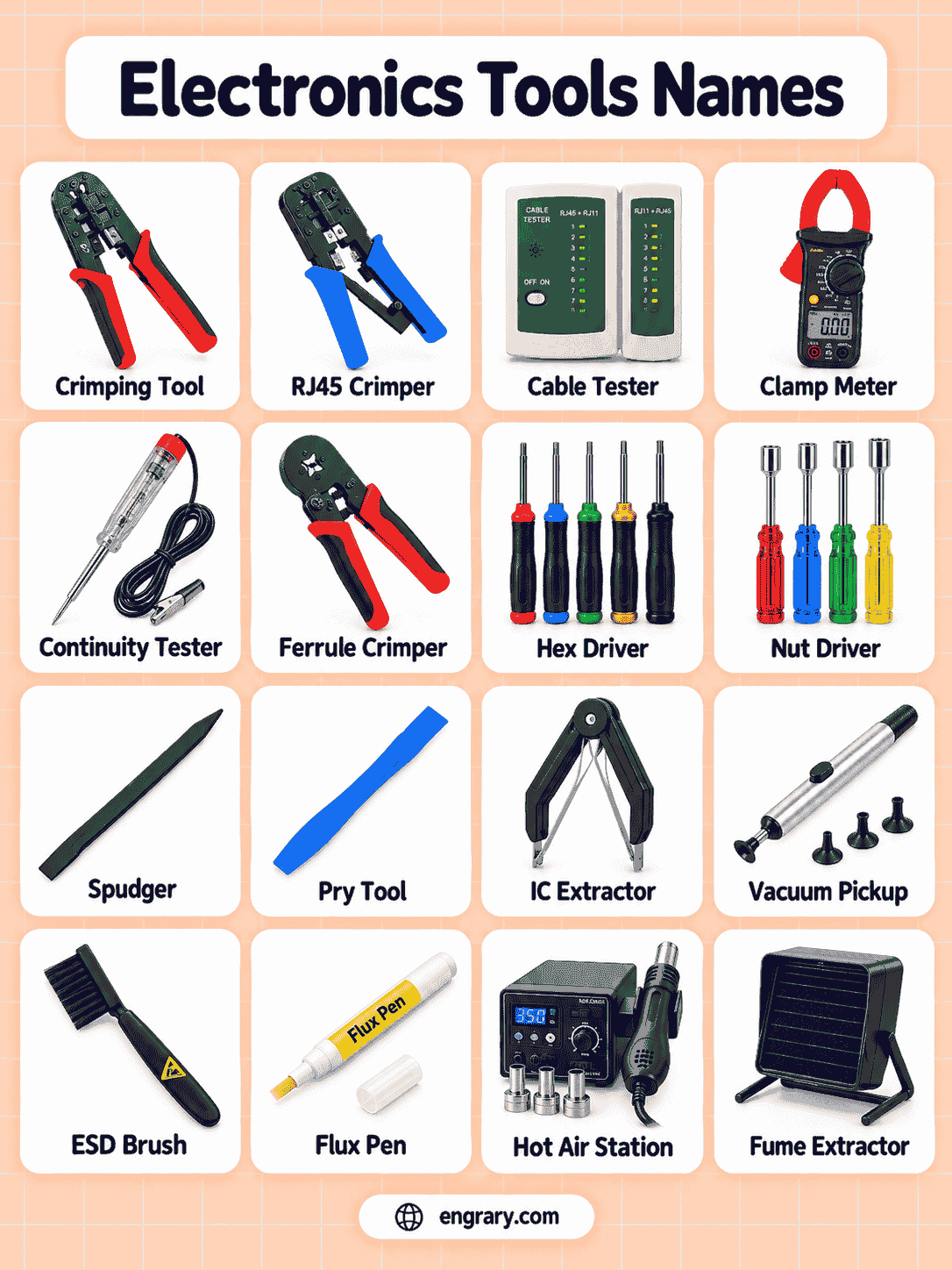
The following list contains exactly 80 distinct electronics tools, grouped according to their main role in soldering, testing, component handling, PCB repair, device opening, inspection, ESD protection, and bench work.
Soldering Tools
These tools deliver controlled heat for joining wires, terminals, and electronic components during assembly and repair.
Soldering Iron
A heated metal tip melts solder directly at the joint for component installation and wire connections.
Soldering Station
For more precise bench work, this setup pairs a soldering handpiece with adjustable temperature control and a powered base.
Temperature-Controlled Soldering Iron
Maintains an adjustable working temperature for more consistent soldering.
Soldering Gun
Provides rapid heating for larger wires, terminals, and heavier soldering jobs.
Hot Air Rework Station
Uses controlled hot air to install or remove surface-mount components.
Hot Tweezers
Heat both sides of small two-terminal components for quick removal or replacement.
Soldering Tweezers
Combine precise gripping with heated tips for working on small electronic parts.
PCB Preheater
Warms a circuit board from below to reduce the amount of direct heat needed during rework.
Desoldering Tools
These tools help remove solder and release electronic components from circuit boards during repair or replacement.
Desoldering Pump
Manual suction pulls molten solder away from a joint after heating.
Desoldering Gun
With built-in heating and suction, this tool clears solder from through-hole connections.
Desoldering Station
For repeated repair work, a powered vacuum system removes solder efficiently while maintaining controlled heat.
Electronic Testing and Measurement Tools
Testing instruments help diagnose circuits, measure components, and observe electrical behavior.
Digital Multimeter
Measures voltage, resistance, continuity, current, and other electrical values depending on the model.
Analog Multimeter
Displays electrical measurements through a moving needle and graduated scale.
Oscilloscope
Shows signal voltage over time as a waveform.
Logic Analyzer
Captures digital states across multiple channels for timing and communication analysis.
LCR Meter
Measures inductance, capacitance, and resistance in electronic components.
ESR Meter
Checks the equivalent series resistance of capacitors.
Capacitance Meter
Measures the capacitance value of capacitors.
Frequency Counter
Measures the frequency of repetitive electronic signals.
Component Tester
Identifies or measures common electronic components such as resistors, capacitors, diodes, and transistors.
USB Power Meter
Measures voltage, current, power, and related values in compatible USB connections.
Bench Power and Signal Tools
These bench instruments power circuits, generate test signals, and create controlled conditions for electronics testing and troubleshooting.
Bench Power Supply
Adjustable voltage and current let technicians power circuits safely under controlled test conditions.
Function Generator
Waveforms such as sine, square, and triangle signals help test how electronic circuits respond.
Signal Generator
For signal-path testing, this instrument produces controlled frequencies and signal levels.
DC Electronic Load
Controlled current draw helps evaluate batteries, power supplies, chargers, and power circuits.
Isolation Transformer
Electrical isolation separates suitable test equipment from the direct mains connection during bench work.
Variac
By varying AC voltage gradually, a Variac supports controlled testing of compatible equipment.
USB Power Supply Tester
USB voltage, current, power, and related charging values appear directly on this compact testing device.
Precision Screwdrivers and Drivers
Electronic devices often use small and specialized fasteners that require precision drivers.
Precision Phillips Screwdriver
Turns small cross-head screws found in electronic devices and enclosures.
Precision Flathead Screwdriver
Fits small slotted screws used in terminals, controls, and device housings.
Torx Screwdriver
Turns star-shaped Torx screws commonly found in laptops, drives, appliances, and electronics.
Pentalobe Screwdriver
Fits five-point pentalobe screws used in certain consumer electronics.
Tri-Point Screwdriver
Turns three-point fasteners found in some phones, consoles, and compact devices.
Hex Driver
Turns small internal or external hex fasteners used in electronic assemblies.
Nut Driver
Fits small nuts and hex-head fasteners with a screwdriver-style handle.
Precision Bit Driver
Accepts interchangeable precision bits for different electronic fastener types.
Tweezers and Component-Handling Tools
Small electronic parts require tools that can grip, position, and manipulate them accurately.
Precision Tweezers
Hold tiny screws, wires, and electronic components during assembly or repair.
Curved Tweezers
Use angled tips to reach components from the side or around obstacles.
Reverse Tweezers
Remain closed without constant finger pressure, making them useful for holding small parts.
Ceramic Tweezers
Use non-metallic tips for delicate component handling and suitable high-temperature work.
Vacuum Pickup Pen
Lifts small flat components through gentle suction.
Hemostat
Locks onto wires or small parts to provide a steady grip.
Probe and Pick Set
Manipulates wires, connectors, seals, and small components in confined spaces.
Component Lead Forming Tool
Bends component leads to consistent shapes before installation on a circuit board.
Opening and Prying Tools
Opening tools help separate device housings, screens, clips, and adhesive joints with less risk of damage.
Spudger
Disconnects connectors, moves wires, and pries delicate components with a non-metallic tip.
Plastic Opening Tool
Separates clips and plastic housings without the sharp edge of a metal pry tool.
Opening Pick
Slides through narrow seams to separate screens, covers, and adhesive-backed panels.
Suction Cup
Provides a grip on smooth glass or panels during device opening.
Suction Handle
Creates a larger pulling grip for lifting screens or smooth covers.
Pry Tool
Provides controlled leverage for separating fitted device parts.
Jimmy Tool
Uses a thin metal blade to enter tight seams where stronger prying force is needed.
Plastic Card Tool
Slides beneath adhesive-backed panels and batteries to help separate them from surfaces.
Cutting and Wire-Preparation Tools
These tools cut small wires, trim component leads, and prepare conductors for electronics work.
Wire Stripper
Removes insulation from small electrical wires without intentionally cutting the conductor.
Flush Cutter
Cuts component leads and small wires close to a PCB or terminal.
Diagonal Cutter
Cuts small wires, leads, and cable ties with angled cutting jaws.
Precision Side Cutter
Provides controlled cutting of fine wire and small component leads.
Needle-Nose Pliers
Grip, bend, and position small wires and parts with long narrow jaws.
Cable Stripper
Removes outer insulation or jacket material from suitable small cables.
Small Crimping Tool
Compresses small terminals and connectors onto prepared wires.
Precision Utility Knife
Trims insulation, adhesive films, labels, and other light materials during repair work.
PCB Holding and Assembly Tools
Holding tools keep circuit boards, wires, screws, and parts stable during assembly or repair.
PCB Holder
Supports a circuit board at a convenient angle for soldering and testing.
Board Vise
Clamps a PCB securely while allowing access to its working area.
Helping Hands
Uses adjustable arms and clips to hold wires, components, or small boards.
Third Hand Tool
Provides adjustable grips that hold parts in position during soldering or assembly.
Mini Bench Vise
Secures small devices, connectors, or boards on a workbench.
Magnetic Project Mat
Keeps small screws and metal parts organized during disassembly.
Anti-Static Project Tray
Organizes small electronics parts while helping reduce static-related handling risks.
Magnification and Inspection Tools
Magnification tools reveal tiny solder joints, traces, connectors, and surface-mount components.
Magnifying Lamp
Combines magnification with built-in lighting for general bench inspection.
Head Magnifier
Provides wearable magnification while leaving both hands free.
Inspection Microscope
Enlarges small PCB areas for soldering, inspection, and microsoldering.
Digital Microscope
Displays magnified images of components and circuit boards on a screen.
Jeweler’s Loupe
Provides compact close-up magnification for quick inspection of small components.
ESD-Safe Electronics Tools
Electrostatic discharge can damage sensitive electronic components, so ESD-control tools are common on repair benches.
ESD Wrist Strap
Helps keep the user at a controlled electrical potential when properly connected to an ESD-safe grounding system.
ESD Mat
Provides a dissipative work surface for handling static-sensitive components.
Ionizing Air Blower
Reduces static charge on objects and work areas by supplying ionized air.
Cleaning Tools for Electronics
Cleaning tools remove loose dust and contamination from circuit boards, connectors, and device interiors.
ESD-Safe Brush
Loosens dust and debris while reducing static-related risk around sensitive electronics.
Precision Air Blower
Directs controlled airflow into small spaces to move loose dust and particles.
Electronics Work from Opening to Final Test
Electronics repair often moves through several stages, from opening the device to checking its operation after reassembly.
| Stage | Common Tools |
|---|---|
| Opening | Spudger, Opening Pick, Suction Cup |
| Inspection | Inspection Microscope, Magnifying Lamp |
| Testing | Digital Multimeter, Oscilloscope, Logic Analyzer |
| Holding | PCB Holder, Helping Hands |
| Soldering | Soldering Station, Precision Tweezers |
| Desoldering | Desoldering Pump, Hot Air Rework Station |
| Component Handling | Ceramic Tweezers, Vacuum Pickup Pen |
| Power Testing | Bench Power Supply, USB Power Meter |
| Cleaning | ESD-Safe Brush, Precision Air Blower |
| Final Check | Digital Multimeter, Oscilloscope |
The exact sequence changes with the device, but careful inspection and testing usually help determine what work is actually required.
Tools Used for Different Electronics Jobs
Different electronics tasks rely on different combinations of hand tools and bench instruments.
| Electronics Work | Useful Tools |
|---|---|
| PCB Repair | Soldering Station, Microscope, Tweezers, Digital Multimeter |
| Phone Repair | Precision Bit Driver, Opening Pick, Suction Cup, Spudger |
| Laptop Repair | Precision Screwdriver, Multimeter, ESD Tools |
| SMD Rework | Hot Air Rework Station, Hot Tweezers, Inspection Microscope |
| Circuit Testing | Multimeter, Oscilloscope, Logic Analyzer |
| Prototype Building | Bench Power Supply, Wire Stripper, Soldering Iron |
| Cable Repair | Wire Stripper, Small Crimping Tool, Multimeter |
| Component Testing | LCR Meter, ESR Meter, Component Tester |
This variety explains why a complete electronics bench combines precision hand tools with measurement and power equipment.
Hand Tools vs Bench Instruments in Electronics
Electronics hand tools physically manipulate devices and components, while bench instruments measure, power, stimulate, or analyze circuits.
| Electronics Hand Tools | Bench Instruments |
|---|---|
| Precision Screwdriver | Oscilloscope |
| Precision Tweezers | Digital Multimeter |
| Spudger | Bench Power Supply |
| Wire Stripper | Function Generator |
| Flush Cutter | Logic Analyzer |
Both groups support electronics work, but their functions are fundamentally different.
Similar Electronics Tools and How They Differ
Several electronics tools appear similar or perform related tasks, but their designs suit different types of work.
| Tools | Main Difference |
|---|---|
| Digital Multimeter vs Oscilloscope | A multimeter shows numerical electrical measurements, while an oscilloscope displays how a signal changes over time. |
| Soldering Iron vs Soldering Station | A soldering iron is the heated hand tool, while a soldering station adds controlled power, temperature regulation, and a base unit. |
| Soldering Iron vs Hot Air Rework Station | A soldering iron transfers heat directly through a tip, while a hot air station heats components and solder joints with moving hot air. |
| Desoldering Pump vs Desoldering Gun | A manual pump removes molten solder through suction, while a desoldering gun combines heating and suction in one tool. |
| Precision Tweezers vs Hot Tweezers | Precision tweezers mechanically hold small parts, while hot tweezers heat component terminals for removal or installation. |
| Spudger vs Opening Pick | A spudger handles internal prying and connector work, while an opening pick slides through device seams and adhesive joints. |
| Logic Analyzer vs Oscilloscope | A logic analyzer monitors digital states across several channels, while an oscilloscope displays signal voltage and waveform shape over time. |
| Bench Power Supply vs USB Power Meter | A bench supply provides controlled power to a circuit, while a USB power meter measures electrical behavior through a USB connection. |
The main difference usually comes down to whether the tool manipulates, heats, measures, powers, inspects, or opens an electronic device.
Beginner Electronics Tools vs Advanced Bench Setup
A beginner can handle basic electronics work with a small set of versatile tools, while an advanced bench adds better control, measurement, magnification, and rework capability.
| Beginner Electronics Tools | Advanced Bench Setup |
|---|---|
| Digital Multimeter | Oscilloscope |
| Soldering Iron | Soldering Station |
| Wire Stripper | Precision Side Cutter |
| Precision Tweezers | Ceramic Tweezers |
| Desoldering Pump | Desoldering Station |
| Magnifying Lamp | Inspection Microscope |
| Adjustable DC Adapter | Bench Power Supply |
| Spudger | Full Device-Opening Tool Set |
A larger bench expands testing and repair capability, but careful handling, accurate measurements, and clean soldering remain important at every level.
Electronics Tools vs Electrician Tools
Electronics work and electrical installation share some tools, but the typical scale and tasks differ considerably.
| Electronics Tools | Electrician Tools |
|---|---|
| Usually focus on circuit boards, components, devices, signals, and bench repair | Usually focus on building wiring, panels, conduit, cable runs, and installation |
| Soldering Station | Conduit Bender |
| Oscilloscope | Clamp Meter |
| Precision Tweezers | Linesman Pliers |
| Spudger | Fish Tape |
| PCB Holder | Cable Puller |
| Bench Power Supply | Rotary Hammer |
Both fields may use multimeters, screwdrivers, cutters, strippers, and pliers. The main difference lies in the scale of the work and the systems being handled.
FAQs
Common electronics tools include digital multimeters, soldering irons, soldering stations, oscilloscopes, precision screwdrivers, tweezers, wire strippers, flush cutters, spudgers, PCB holders, magnifiers, and bench power supplies.
Soldering irons, soldering stations, hot air rework stations, hot tweezers, PCB preheaters, desoldering pumps, desoldering guns, and desoldering stations support soldering and component removal work.
Common electronics testing tools include digital multimeters, oscilloscopes, logic analyzers, LCR meters, ESR meters, capacitance meters, frequency counters, component testers, and USB power meters.
Useful PCB repair tools include a soldering station, hot air rework station, inspection microscope, precision tweezers, PCB holder, digital multimeter, desoldering tools, and ESD-control equipment.
Electronics tools mainly support circuit boards, components, soldering, signals, and device repair, while electrician tools mainly support building wiring, panels, conduit, cable installation, and larger electrical systems.
You May Also Like



Leave a Comment