

Tools help people build, repair, cut, measure, shape, fasten, install, maintain, and improve different materials and objects. Learning common tools names in English makes it easier to recognize workshop equipment, understand instructions, discuss repairs, and build practical everyday vocabulary.
This article covers 100 tools names with pictures and uses, organized into useful categories such as hand tools, power tools, measuring tools, cutting tools, carpentry tools, construction tools, electrical tools, plumbing tools, gardening tools, mechanic tools, and welding tools. You will also learn the difference between tools, equipment, fasteners, and accessories.

What Are Tools?
A tool is an object or device used to perform a practical task such as cutting, gripping, measuring, drilling, shaping, fastening, repairing, or installing something.
For example:
Hammer
Used for driving or removing nails and striking materials.
Screwdriver
Used for tightening or loosening screws.
Tape Measure
Used for measuring length, width, height, or distance.
Tools may be operated by hand or powered by electricity, batteries, compressed air, or another power source.
Common Tools Names in English
Tools help people build, repair, measure, cut, fasten, and maintain different objects. Learning common tool names in English helps children, beginners, and English learners recognize everyday equipment more easily.
Hammer
A hammer drives and removes nails.
Screwdriver
A screwdriver tightens or loosens screws.
Pliers
Pliers grip, bend, and twist small objects or wires.
Wrench
A wrench tightens or loosens nuts and bolts.
Saw
A saw cuts wood, plastic, or other materials.
Drill
A drill makes holes and can also drive screws.
Tape Measure
A tape measure checks length, width, and distance.
Level
A level checks whether a surface is straight or even.
Chisel
A chisel cuts or shapes wood, stone, or metal.
Utility Knife
A utility knife cuts cardboard, plastic, and other thin materials.
Clamp
A clamp holds materials firmly in place.
File
A file smooths rough edges and shapes surfaces.
Allen Key
An Allen key turns screws with hexagonal sockets.
Socket Wrench
A socket wrench works with removable sockets to turn nuts and bolts.
Wire Cutter
A wire cutter cuts electrical wires and thin metal.
Hand Drill
A hand drill makes small holes without electric power.
Mallet
A mallet strikes materials without causing as much surface damage as a metal hammer.
Crowbar
A crowbar helps pry, lift, or separate materials.
Toolbox
A toolbox stores and organizes tools.
Work Gloves
Work gloves protect the hands during repair, building, and maintenance tasks.
100 Tools Names With Pictures and Uses
The following tools are grouped by their primary practical use. Each name appears only once in the main list.
Hand Tools
Hammer
A hand tool used for driving nails, removing nails, and striking materials.
Claw Hammer
A hammer with a curved claw used to drive and pull nails.
Rubber Mallet
A soft-headed striking tool used where a metal hammer could damage the surface.
Flathead Screwdriver
A screwdriver with a flat tip used for slotted screws.
Phillips Screwdriver
A screwdriver with a cross-shaped tip used for Phillips-head screws.
Combination Pliers
A multipurpose gripping tool used to hold, bend, twist, or cut small materials.
Needle-Nose Pliers
Long, narrow pliers used to grip small objects or reach tight spaces.
Adjustable Wrench
A wrench with a movable jaw used for different sizes of nuts and bolts.
Allen Key
An L-shaped tool used to turn hexagonal socket screws.
Bench Vise
A clamping tool fixed to a workbench for holding objects securely.
Hand File
A rough-surfaced tool used to smooth, shape, or remove small amounts of material.
Awl
A pointed hand tool used for making small holes or marking surfaces.
Power Tools
Power Drill
A powered tool used for drilling holes and driving fasteners.
Impact Driver
A high-torque tool used for driving screws, bolts, and other fasteners.
Circular Saw
A powered saw with a rotating blade used for straight cuts.
Jigsaw
A power saw with a narrow blade used for curved and detailed cuts.
Reciprocating Saw
A powered saw with a back-and-forth blade used for rough cutting and demolition.
Angle Grinder
A rotating power tool used for cutting, grinding, polishing, and removing material.
Orbital Sander
A powered sanding tool used to smooth wood and other surfaces.
Belt Sander
A power tool that uses a moving abrasive belt for fast surface smoothing.
Heat Gun
A handheld tool that produces hot air for stripping paint, shrinking tubing, or softening materials.
Rotary Tool
A small high-speed power tool used with attachments for cutting, sanding, polishing, and engraving.

Measuring and Marking Tools
Tape Measure
A flexible measuring tool used to check length, width, height, or distance.
Steel Ruler
A rigid straight measuring tool used for short, accurate measurements.
Spirit Level
A tool used to check whether a surface is horizontal or vertical.
Try Square
A right-angle tool used to check and mark 90-degree angles.
Combination Square
A multipurpose measuring tool used to mark angles, depths, and straight lines.
Vernier Caliper
A precision tool used to measure external, internal, and depth dimensions.
Micrometer
A precision measuring tool used for very small thicknesses or diameters.
Protractor
A tool used to measure or mark angles.
Chalk Line
A marking tool used to create long, straight reference lines on surfaces.
Scriber
A pointed marking tool used to scratch fine layout lines on metal or other hard materials.
Cutting Tools
Utility Knife
A sharp retractable knife used for cutting cardboard, plastic, drywall, and similar materials.
Hacksaw
A fine-toothed hand saw used mainly for cutting metal or plastic.
Coping Saw
A narrow-bladed saw used for curved or detailed cuts.
Bolt Cutter
A long-handled cutting tool used to cut bolts, chains, rods, and wire.
Tin Snips
Hand shears designed for cutting thin sheet metal.
Glass Cutter
A small cutting tool used to score glass before breaking it along a line.
Pipe Cutter
A rotating cutting tool used to make clean cuts through pipes or tubes.
Hatchet
A small one-handed axe used for chopping and splitting small pieces of wood.
Pruning Shears
A scissor-like cutting tool used for trimming stems and small branches.
Wire Cutter
A hand tool designed specifically for cutting electrical wire and thin metal strands.
Carpentry and Woodworking Tools
Hand Plane
A woodworking tool used to shave and smooth wooden surfaces.
Wood Chisel
A sharp-edged tool used to cut, carve, or shape wood.
Wooden Mallet
A wooden striking tool commonly used with chisels in woodworking.
Marking Gauge
A woodworking tool used to mark parallel lines along the edge of a board.
Carpenter Square
A large right-angle tool used for layout, measuring, and checking square corners.
Block Plane
A small hand plane used for trimming end grain and smoothing small wooden surfaces.
Spokeshave
A woodworking tool used to shape curved wooden pieces.
Brace
A hand-powered drilling tool used with auger bits to bore holes in wood.
Gimlet
A small hand tool used for boring narrow holes in wood.
Dovetail Saw
A fine-toothed saw used for precise joinery and detailed woodworking cuts.

Construction and Repair Tools
Brick Trowel
A pointed masonry tool used to spread mortar and lay bricks.
Notched Trowel
A toothed trowel used to spread adhesive evenly for tiles and flooring.
Putty Knife
A flat-bladed tool used to apply filler, scrape surfaces, or spread putty.
Caulking Gun
A hand-operated tool used to apply sealant or caulk from a cartridge.
Staple Gun
A fastening tool used to drive heavy staples into wood, fabric, or other materials.
Nail Puller
A specialized tool used to grip and remove embedded nails.
Sledgehammer
A heavy long-handled hammer used for demolition and forceful striking.
Pry Bar
A strong metal lever used for pulling, lifting, separating, or removing materials.
Masonry Float
A flat finishing tool used to smooth plaster, concrete, grout, or mortar surfaces.
Electrical Tools
Wire Stripper
A tool used to remove insulation from electrical wires without damaging the conductor.
Voltage Tester
A testing tool used to check whether electrical voltage is present.
Digital Multimeter
An electronic measuring tool used to test voltage, current, resistance, and other electrical values.
Crimping Tool
A hand tool used to compress connectors onto wires or cables.
Cable Cutter
A strong cutting tool designed for electrical and communication cables.
Soldering Iron
A heated tool used to melt solder and join electrical components or wires.
Fish Tape
A flexible tool used to pull electrical wires through conduits, walls, or enclosed spaces.
Linesman Pliers
Heavy-duty pliers used by electricians for gripping, twisting, cutting, and bending wire.
Plumbing Tools
Pipe Wrench
A heavy adjustable wrench designed for gripping and turning pipes.
Basin Wrench
A long-handled plumbing tool used to reach nuts beneath sinks.
Drain Snake
A flexible tool used to break through or remove blockages in drains.
Pipe Bender
A tool used to bend pipe or tubing without crushing it.
Flaring Tool
A tool used to widen the end of tubing so it can form a secure fitting.
Tube Cutter
A compact cutting tool designed to make clean cuts through tubing.
Internal Pipe Wrench
A tool that grips the inside of a pipe or fitting for turning or removal.
Plunger
A suction-based plumbing tool used to clear blocked drains and toilets.

Gardening Tools
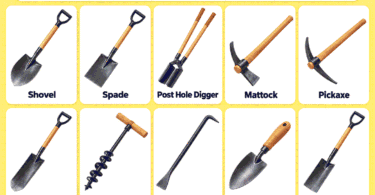
Shovel
A broad-bladed tool used for digging, lifting, and moving soil or loose materials.
Spade
A flat-bladed digging tool used for cutting soil, edging, and transplanting.
Garden Rake
A toothed tool used to level soil and collect garden debris.
Garden Hoe
A long-handled tool used for loosening soil and removing weeds.
Garden Fork
A strong forked tool used to loosen soil, lift compost, and turn garden beds.
Hand Trowel
A small handheld digging tool used for planting and transplanting.
Loppers
Long-handled cutting tools used for pruning thicker branches.
Hedge Shears
Large hand shears used to trim hedges and shape shrubs.
Pruning Saw
A toothed hand saw designed to cut tree limbs and larger branches.
Mechanic and Automotive Tools
Ratchet
A socket-driving tool that turns fasteners without requiring the handle to be removed after each movement.
Socket Wrench
A wrench that uses removable sockets to tighten or loosen nuts and bolts.
Torque Wrench
A precision wrench used to tighten fasteners to a specified torque.
Lug Wrench
A wrench used to remove or tighten wheel lug nuts.
Hydraulic Jack
A lifting tool that uses hydraulic pressure to raise vehicles or heavy loads.
Spark Plug Wrench
A specialized socket tool used to remove and install spark plugs.
Oil Filter Wrench
A gripping tool designed to loosen or tighten engine oil filters.
Feeler Gauge
A set of thin metal blades used to measure narrow gaps or clearances.
Welding and Metalworking Tools
Welding Torch
A tool used to produce heat for welding, brazing, or cutting metal.
Welding Clamp
A clamping tool used to hold metal parts securely during welding.
Center Punch
A pointed metalworking tool used to mark the center of a drilling point.
Tap Wrench
A hand tool used to hold and turn taps when cutting internal screw threads.
Die Stock
A tool used to hold dies for cutting external threads on rods or pipes.
Bench Grinder
A fixed grinding machine used for sharpening, shaping, cleaning, and smoothing metal.

Tools Names by Category
Tools can also be remembered more easily by grouping them according to their main function.
| Category | Common Examples |
|---|---|
| Hand Tools | Hammer, Screwdriver, Pliers, Adjustable Wrench |
| Power Tools | Power Drill, Circular Saw, Angle Grinder, Sander |
| Measuring Tools | Tape Measure, Spirit Level, Caliper, Micrometer |
| Cutting Tools | Utility Knife, Hacksaw, Bolt Cutter, Tin Snips |
| Carpentry Tools | Hand Plane, Wood Chisel, Marking Gauge, Dovetail Saw |
| Construction Tools | Brick Trowel, Caulking Gun, Sledgehammer, Pry Bar |
| Electrical Tools | Multimeter, Wire Stripper, Voltage Tester, Soldering Iron |
| Plumbing Tools | Pipe Wrench, Basin Wrench, Drain Snake, Pipe Bender |
| Gardening Tools | Shovel, Rake, Hoe, Pruning Saw |
| Mechanic Tools | Ratchet, Torque Wrench, Lug Wrench, Hydraulic Jack |
| Welding Tools | Welding Torch, Welding Clamp, Center Punch, Tap Wrench |
These broader groups form useful starting points for learning more specialized tool vocabulary.
Hand Tools vs Power Tools
Hand tools and power tools often perform similar jobs, but they use different sources of force.
| Hand Tools | Power Tools |
|---|---|
| Operated manually | Powered by electricity, batteries, air, or another source |
| Usually simpler in design | Often contain motors or powered mechanisms |
| Hammer | Power Drill |
| Hand File | Orbital Sander |
| Screwdriver | Impact Driver |
| Hacksaw | Reciprocating Saw |
Hand tools are useful for controlled manual work, while power tools can make repetitive, difficult, or large-scale tasks faster.
Tool vs Equipment vs Fastener vs Accessory
Not every object found in a workshop or toolbox is technically a tool.
| Term | Meaning | Example |
|---|---|---|
| Tool | Used directly to perform a task | Hammer |
| Equipment | Larger or supporting item used for work | Workbench |
| Fastener | Joins or secures materials | Screw |
| Accessory | Supports or extends the function of a tool | Drill Bit |
| Protective Equipment | Protects the person using tools | Safety Goggles |
For example, a drill is a tool, while a drill bit is an accessory or cutting attachment used with the drill.
Likewise:
Nail — fastener
Screw — fastener
Bolt — fastener
Toolbox — storage equipment
Workbench — workshop equipment
Safety goggles — protective equipment
Keeping these terms separate makes tool vocabulary more accurate.
FAQs
Common tools include hammer, screwdriver, pliers, wrench, drill, saw, tape measure, spirit level, chisel, file, shovel, rake, ratchet, and pipe wrench.
Common tool categories include hand tools, power tools, measuring tools, cutting tools, carpentry tools, construction tools, electrical tools, plumbing tools, gardening tools, mechanic tools, and welding tools.
Hand tools use manual force, while power tools use electricity, batteries, compressed air, or another external power source.
A basic toolbox may contain a hammer, screwdrivers, pliers, adjustable wrench, Allen keys, tape measure, utility knife, file, and other small hand tools.
A tool is used directly to perform a task, while equipment is a broader item or system that supports the work. For example, a hammer is a tool, while a workbench is workshop equipment.
You May Also Like



Leave a Comment