
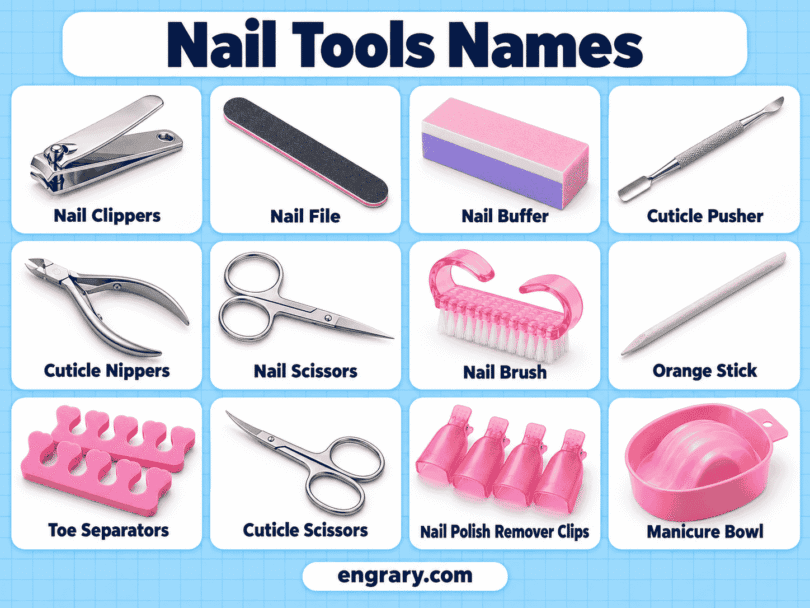
Open a manicure kit and you may recognize the clippers immediately, while the small nippers and double-ended metal sticks look less familiar. Common nail tool names include nail clippers, nail files, buffers, cuticle pushers, and nail brushes. Their working ends—blades, abrasive surfaces, rounded tips, or bristles—help explain what each one does.
Many tools serve both manicures and pedicures, but some belong specifically to foot care or nail art. Learning their names and identifying features helps you distinguish similar implements without confusing tools, accessories, and products.
Common Nail Tool Names
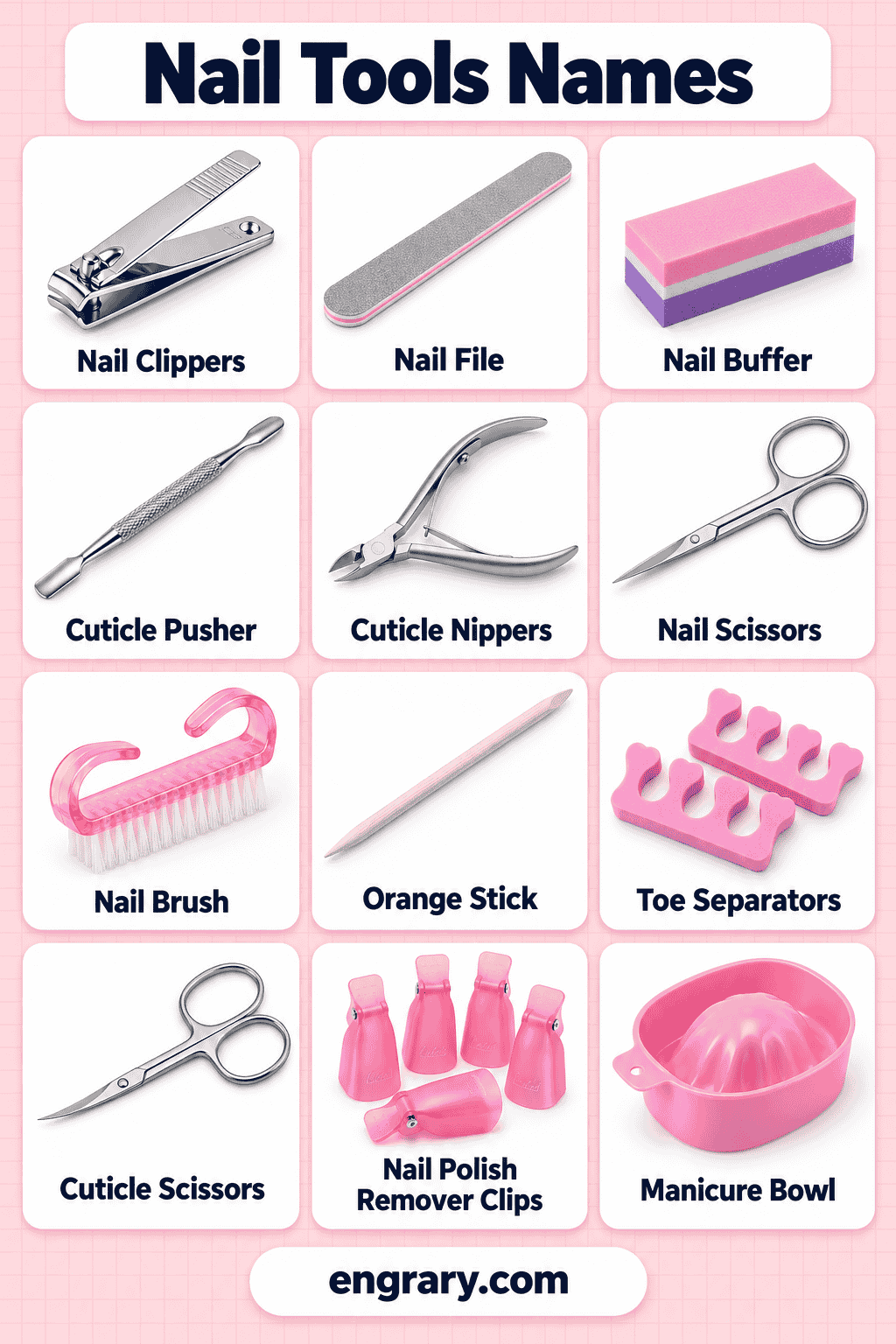
Nail tools handle several jobs, including cutting, shaping, cleaning, and decorating. Although kits often combine them, each implement has a particular purpose. These 20 names cover familiar grooming tools alongside items you may encounter in nail-art sets or salons.
Nail clippers
Nail clippers shorten nails using two opposing blades and a folding lever. Shops also commonly call them nail cutters or nail trimmers, so these labels often refer to the same general tool.
Toenail clippers
Toenail clippers generally have a larger body and wider cutting opening than fingernail clippers. Many also have straight cutting edges, although the exact design varies between products.
Nail scissors
Nail scissors have two finger loops and short blades for trimming nails. Unlike lever-operated clippers, they use a scissor action, with straight or curved blades depending on the model.
Nail nippers
Nail nippers have plier-style handles and substantial jaws for cutting nails. Although they resemble cuticle nippers, their stronger construction suits the harder nail plate.
Nail file
A nail file shapes and smooths the nail’s free edge—the part extending beyond the fingertip or toe. Its abrasive surface removes small amounts of nail, while the supporting body may consist of glass, metal, or board.
Nail buffer
A nail buffer smooths or finishes the nail surface. Some buffers prepare the surface for another product, whereas others create shine; the abrasive grade and product instructions explain the intended job.
Cuticle pusher
A cuticle pusher commonly has a rounded, scoop-shaped, or flattened tip. Many versions also have a second working end, which may provide another pusher shape or a nail-cleaning tip.
Orangewood stick
An orangewood stick is a slender wooden manicure implement, often with one pointed end and one angled end. Besides manicure preparation, it can help tidy polish or position small decorations.
Cuticle nippers
Cuticle nippers have small cutting jaws intended for trimming tissue around the nail. Compared with nail nippers, they usually have finer blades and should not serve as substitutes for nail cutters.
Cuticle scissors
Cuticle scissors have fine blades intended for trimming tissue around the nail. Although they resemble small nail scissors, their narrower cutting parts serve a different purpose.
Nail cleaner
A nail cleaner has a narrow tip for cleaning beneath the nail’s free edge. Sometimes it shares a handle with a cuticle pusher, giving one implement two distinct functions.
Nail-cleaning brush
A nail-cleaning brush has grouped bristles and a small handle or block-shaped back. It assists cleaning during washing, unlike brushes intended for applying polish or drawing designs.
Nail dusting brush
A nail dusting brush sweeps away loose filing dust. Many versions resemble soft cosmetic brushes, while others have a compact handle and shorter bristle head.
Polish cleanup brush
A polish cleanup brush has a small, shaped tip for tidying the outline of applied polish. Its bristles may be flat, rounded, or angled, depending on the design.
Dotting tool
A dotting tool has a small rounded ball at the end of a pen-like handle. It creates dots and dot-based patterns; double-ended versions often provide two different ball sizes.
Liner brush
A liner brush has a narrow bundle of bristles for drawing fine lines and outlines. Unlike a dotting tool’s solid tip, its flexible bristles carry color along the nail surface.
Nail stamper
A nail stamper uses a soft head to transfer a pattern from a stamping plate to the nail. Some versions also have transparent heads and holders to help with positioning.
Stamping scraper
A stamping scraper is a small card or flat-edged implement that clears excess polish from a stamping plate. Despite its name, it works on the plate rather than scraping the nail.
Foot file
A foot file has a broad abrasive surface for smoothing rough foot skin. Compared with a nail file, it usually has a larger working area and a handle that helps reach the heel.
Electric nail file
An electric nail file uses a motor to rotate a removable attachment. People also call it an e-file or nail drill, although the fitted attachment determines its specific function.
Nail Cutting Tools
Clippers, scissors, and nail nippers shorten nails through different cutting mechanisms. Their handles provide useful identification clues, but the blades help distinguish nail-cutting implements from similar grooming tools.
Look for these features when identifying an unfamiliar cutter:
- A folding lever: typical of nail clippers.
- Two finger loops: characteristic of scissors.
- Plier-style handles: common on nippers.
- Substantial cutting jaws: more typical of nail nippers than delicate cuticle nippers.
Size alone does not establish a tool’s purpose. For example, small grooming scissors may target nails, cuticles, or eyebrows, so check the product description when the blades look ambiguous.
For ordinary nail trimming, the American Academy of Dermatology recommends nail clippers or nail scissors for fingernails and toenail clippers for toenails. It also advises trimming toenails straight across.
Nail Files and Buffers
File names often describe materials or formats rather than separate functions. An emery board, for instance, belongs to the nail-file family. Recognizing these relationships helps you understand why several differently named items may perform similar jobs.
Emery board
An emery board is a thin board covered with abrasive material, usually with rounded ends. Because it is a type of nail file, “emery board” is a more specific name within the broader category.
Glass nail file
A glass nail file has a rigid glass body and a textured working surface. However, manufacturers also make glass buffers, so a transparent appearance does not identify the function by itself.
Metal nail file
A metal nail file has a rigid metal body with an abrasive area. Some versions also include a cleaning tip or fold into a compact grooming tool.
Buffer block
A buffer block has several flat working faces, sometimes with different textures. For example, one block may offer separate surfaces for filing, buffing, smoothing, and shining.
The word grit describes the abrasive grade. When checking a file or buffer, also look for whether the product targets natural nails or artificial nail enhancements; those applications can require different abrasive surfaces.
On a multi-sided buffer, follow the printed function labels rather than relying on color. Color systems vary, and some blocks combine jobs that separate tools perform.
Cuticle Pushers and Trimming Tools
Cuticle tools have different working ends for pushing, cleaning, or trimming around the nail. Although their handles may look similar, the shape of each tip helps identify its purpose.
Cuticle Pusher
A cuticle pusher usually has a rounded, scoop-shaped, or flattened tip. Some versions also include a narrower end for detailed work around the nail.
Cuticle Nippers
Cuticle nippers have plier-style handles and small, sharp jaws intended for trimming tissue around the nail. Unlike nail nippers, their finer blades do not suit cutting the nail plate.
Cuticle Scissors
Cuticle scissors have two finger loops and fine blades intended for precise trimming around the nail. However, they differ from nail scissors, which have blades designed to cut nails.
Orangewood Stick
An orangewood stick is a slender wooden implement with a pointed end and an angled end. Besides manicure preparation, it can help tidy polish and position small nail decorations.
Combined Cuticle Pusher and Nail Cleaner
This double-ended tool pairs a broader pusher tip with a narrow cleaning end. Because the ends perform different jobs, check both tips when identifying the implement.
The American Academy of Dermatology advises against cutting cuticles or forcefully pushing them back because they help protect against infection. These descriptions identify the tools rather than recommend cuticle removal.
Nail Cleaning Tools and Brushes
The broad name “nail brush” can describe more than one item. Adding its job—cleaning, dusting, or painting—makes the meaning clearer. Although all these brushes have bristles, their shapes support different tasks.
| Brush | Typical appearance | Main purpose |
|---|---|---|
| Nail-cleaning brush | Compact body with grouped bristles | Assist cleaning during washing |
| Nail dusting brush | Soft bristles, often with a fluffy head | Sweep away loose filing dust |
| Polish cleanup brush | Small, shaped bristle tip | Tidy the polish outline |
| Liner brush | Narrow bundle of fine bristles | Draw lines and details |
A solid nail cleaner belongs to the cleaning group too, although it has no bristles. Its narrow tip distinguishes it from the broader working end of a pusher.
For everyday hygiene, clean nail-grooming tools before use and wash beneath nails with soap and water, using a nail brush when appropriate. Sweeping away filing dust serves a different purpose, so dusting does not replace washing or tool cleaning.
Nail Art Tools
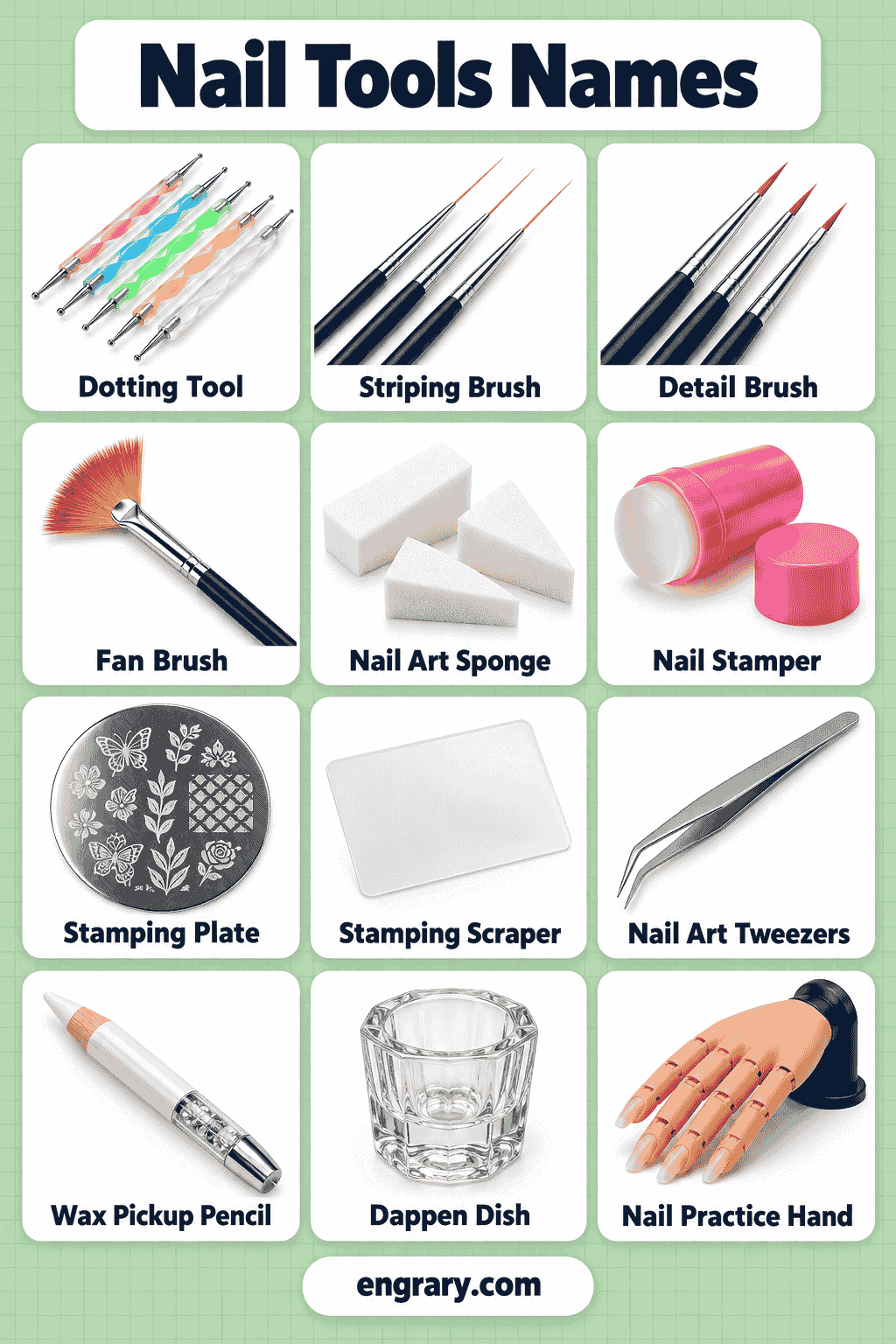
Nail-art implements create marks, transfer patterns, or position decorations. Their tips offer useful clues: rounded balls form dots, fine bristles draw lines, and soft stamping heads transfer images. Brush names sometimes overlap, however, so look at the bristles as well as the label.
Striping brush
A striping brush usually has long, narrow bristles for drawing extended lines. Retailers may also call similar designs liner brushes, making bristle length a useful additional clue.
Detail brush
A detail brush has a small tip for miniature shapes and controlled marks. Compared with a long striping brush, it commonly has shorter bristles for compact details.
Stamping plate
A stamping plate contains recessed designs that hold stamping polish. It supplies the pattern, while a stamper lifts and transfers that pattern to the nail.
Nail-art tweezers
Nail-art tweezers grip small decorative pieces for placement. Their tips may be straight, angled, or curved; unlike nippers, they grip rather than cut.
The pieces in a stamping kit work together in a clear sequence: the plate holds the design, the scraper clears excess polish, and the stamper transfers the pattern. A kit therefore contains several separate tools rather than one tool with several names.
For freehand decoration, the intended mark helps explain the tool choice. A ball-tipped dotting tool suits dots and dot-based flowers, while a fine brush creates strokes and outlines.
Pedicure Tools for Foot Care
Pedicure kits share clippers, nail files, and brushes with manicure kits. However, they also include items for foot skin, toe positioning, and soaking. These additions explain why not every object in a pedicure set works directly on the nail.
Foot rasp
A foot rasp generally has a coarse working surface, often metal. Retailers may group rasps with foot files, so the names can overlap rather than describing entirely separate categories.
Pumice stone
A pumice stone is a porous abrasive stone used in foot care. Its pitted surface helps identify it, although it may come in an oval, rectangular, or handled form.
Toe separators
Toe separators keep neighboring toes apart during polish application. Foam versions often have several rounded gaps, while silicone designs may use individual pieces.
Pedicure basin
A pedicure basin is a container for soaking feet. A plain basin differs from a powered foot-spa unit, although both belong to equipment rather than handheld tools.
A foot-care set may also include creams, scrubs, and soaking products. Those are products rather than implements; similarly, toe separators are accessories, even though retailers often group everything under “pedicure tools.”
Powered Nail Tools and Equipment
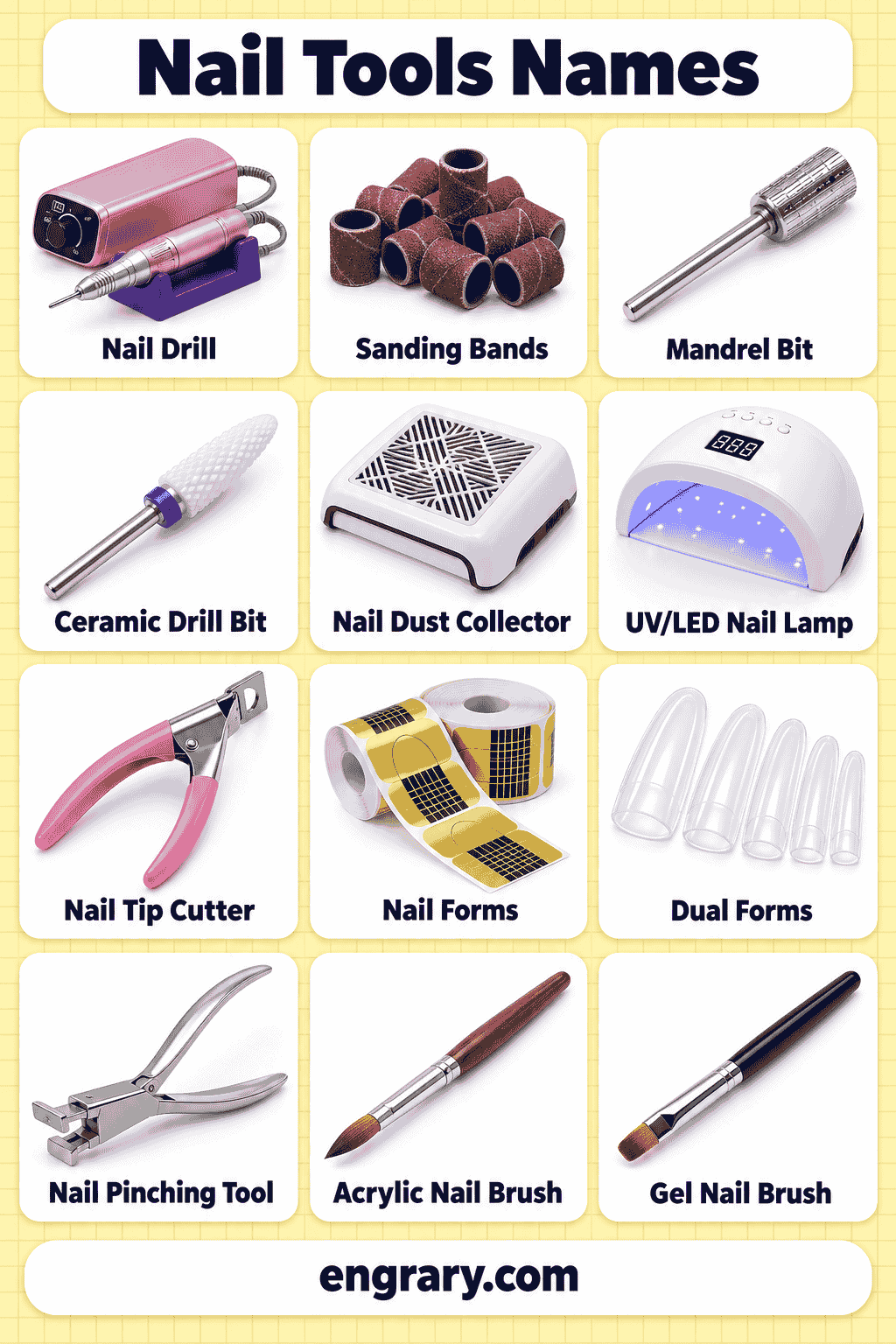
Powered devices handle different jobs at a nail workstation. An electric file rotates an attachment, a lamp cures compatible gel products, and a dust collector gathers filing dust. Understanding the components helps you identify a device without confusing it with its accessories.
E-file bit
An e-file bit is the removable working attachment fitted into an electric file’s handpiece. Bits vary in shape, material, and abrasive grade, so the bit’s description matters as much as the device’s name.
Gel-curing lamp
A gel-curing lamp supplies light to cure compatible gel nail products. Unlike a simple air dryer, it performs a specific curing function; the gel system determines the appropriate lamp and curing instructions.
Nail dust collector
A nail dust collector draws filing dust toward a filter or collection system. Tabletop versions often resemble a low box with a grille, while other designs form part of a salon workstation.
The handpiece is the part of an electric file that the operator holds. The bit fits into it, while a separate control unit may provide power and settings. A photograph of a loose attachment therefore shows an e-file bit, not the complete machine.
Commonly Confused Nail Tools
Some confusing labels describe the same general item, while others identify different tools. This comparison separates alternative names from differences in function.
| Names | What the distinction means |
|---|---|
| Nail clipper and nail cutter | Common alternative names for the same general tool |
| Nail file and emery board | A broad category and one type within it |
| Nail file and nail buffer | Usually edge shaping versus surface finishing; combination products may do both |
| Nail nippers and cuticle nippers | Substantial nail-cutting jaws versus finer jaws intended for tissue around the nail |
| Liner brush and striping brush | Related brush labels that may overlap between brands |
| Dotting tool and liner brush | A solid rounded tip versus flexible bristles |
| Foot file and foot rasp | Related foot-care names whose retail usage may overlap |
When a label remains unclear, compare the working end, handle mechanism, and stated purpose. For example, the word “nipper” alone does not establish whether the manufacturer intends the tool for nails or surrounding tissue.
FAQs About Nail Tools
Common names include nail clippers, nail scissors, nail files, buffers, cuticle pushers, cuticle nippers, and nail-cleaning brushes. Nail-art sets also contain items such as dotting tools, liner brushes, and stampers.
It is often a cuticle pusher. However, check the opposite end because it may provide another pusher shape or a nail-cleaning tip.
Usually, yes. Both names commonly describe a lever-operated nail-cutting tool, although broad retail categories may include other cutters too.
It is commonly called an orangewood stick or orange wood stick. Besides manicure preparation, people use it for polish cleanup and positioning small nail decorations.
No. Nail polish and cuticle oil are products, whereas clippers, files, and brushes are tools. However, a manicure kit may contain both.
You May Also Like



Leave a Comment