
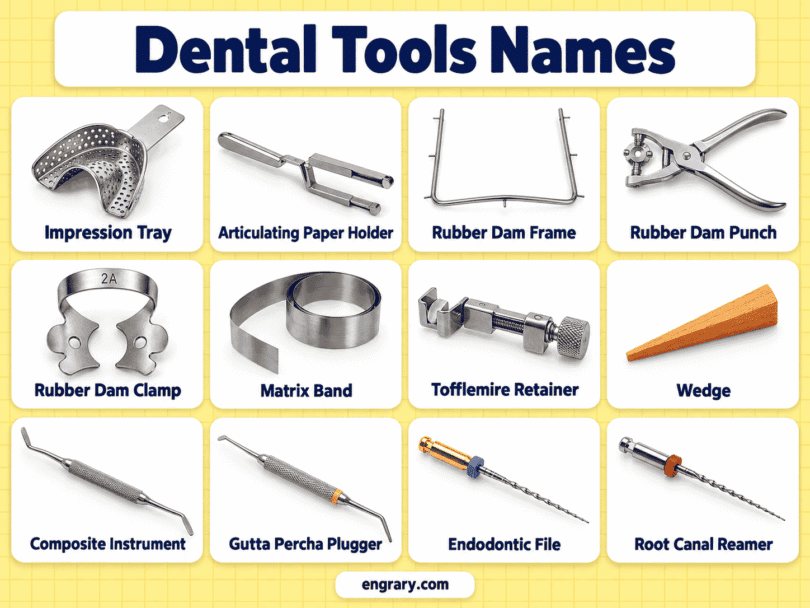
Dentists and dental professionals use specialized instruments to examine teeth, check gums, clean surfaces, place restorations, manage root-canal work, support orthodontic care, and handle other clinical tasks. Each instrument has a distinctive shape that often reveals its general purpose.
Learning dental tools names with pictures and uses makes these instruments easier to recognize in clinics, classrooms, and dental vocabulary guides. Professionals usually call them dental instruments, and this guide covers 58 genuine instruments and pieces of equipment without padding the list with materials or disposable supplies.

Dental Instruments Commonly Seen in a Clinic
A dental tray contains several instruments with very different tips, handles, and working ends. These 20 common examples introduce tools from examination, cleaning, restorative, endodontic, prosthodontic, and surgical dentistry.
1. Mouth Mirror
A mouth mirror has a small round reflective head attached to a slim metal handle. Dental professionals use it to view areas of the mouth that are difficult to see directly.
2. Dental Explorer
A dental explorer has a thin handle with a fine curved or angled tip. Its pointed working end makes it one of the easiest examination instruments to recognize.
3. Periodontal Probe
A periodontal probe has a slender blunt tip marked with measurement lines. Dental professionals use those markings when assessing the gums and surrounding tissues.
4. Cotton Pliers
Cotton pliers look like long angled tweezers. They help dental professionals handle small items inside the clinical working area.
5. Sickle Scaler
A sickle scaler has a curved working end that finishes in a pointed tip. Dental hygienists and dentists use this instrument during professional cleaning.
6. Universal Curette
A universal curette has a curved blade with a rounded toe. Its design allows dental professionals to work around different tooth surfaces during periodontal care.
7. Spoon Excavator
A spoon excavator has a small rounded, spoon-shaped working end. Its distinctive tip makes it easy to separate visually from carvers and burnishers.
8. Amalgam Carrier
An amalgam carrier has a barrel-like body with a small delivery tip. It belongs to the traditional restorative-instrument family.
9. Condenser
A condenser has a small flat or rounded working end. Restorative dentistry uses this compact tip when handling certain filling materials.
10. Ball Burnisher
A ball burnisher has a smooth rounded ball at one or both ends. Dental professionals use its polished surface when refining restorative material.
11. Dental Carver
A dental carver has thin shaped working blades rather than rounded tips. Its edges help distinguish it from condensers and burnishers.
12. Composite Placement Instrument
A composite placement instrument has slender working ends designed for handling restorative material. Many versions have smooth or non-stick surfaces.
13. Cement Spatula
A cement spatula has a flat metal blade attached to a handle. Its broad working surface makes it recognizable among smaller restorative instruments.
14. Endodontic Explorer
An endodontic explorer has very fine angled tips. Dentists use it during professional examination of the internal tooth-treatment area.
15. K-File
A K-file is a thin endodontic instrument with a textured working shaft and small handle. Different sizes share the same recognizable general form.
16. Root Canal Spreader
A root canal spreader has a long, narrow, tapered working end. It belongs to the family of instruments used during root-canal treatment.
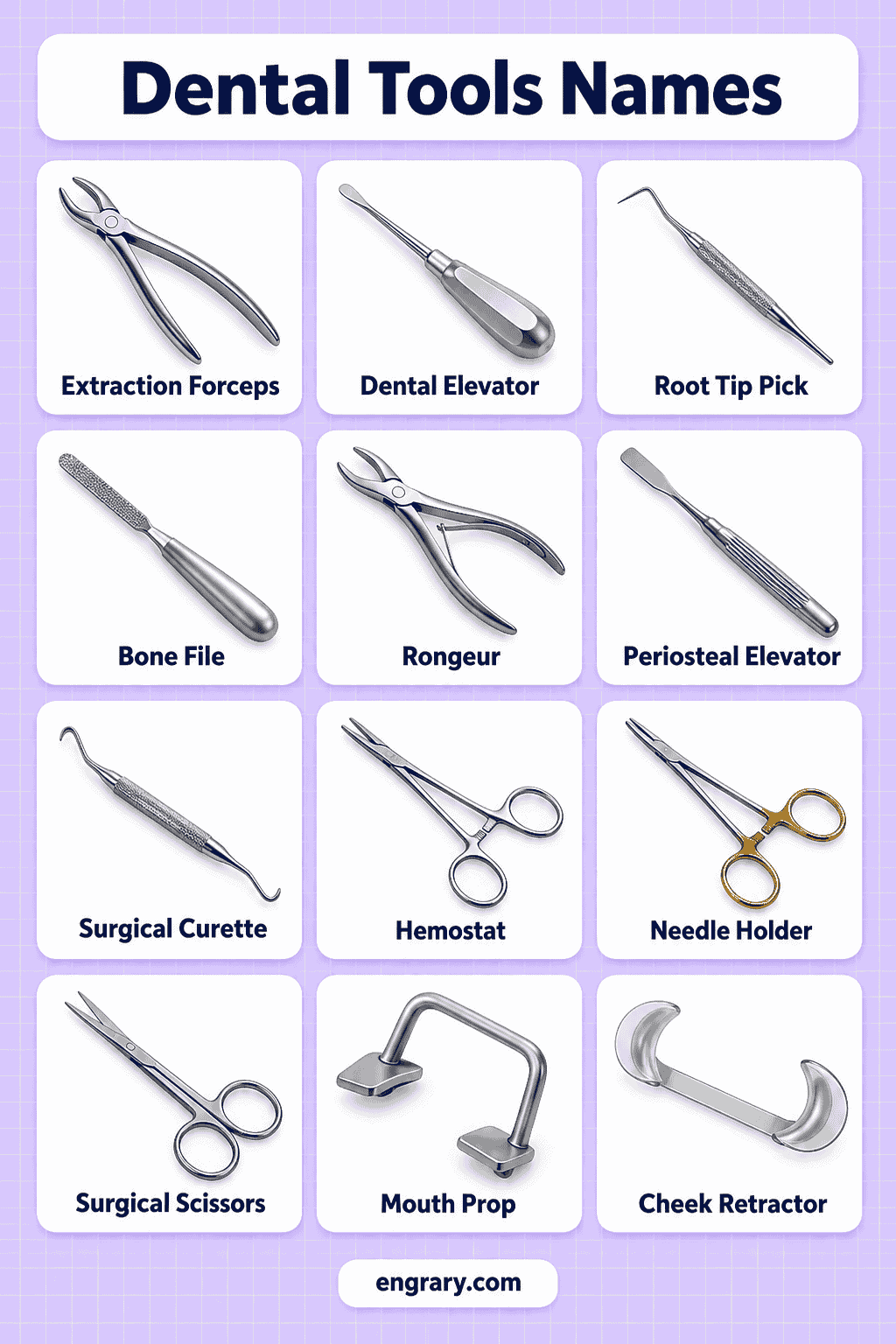
17. Extraction Forceps
Extraction forceps have hinged handles with paired gripping beaks. Different patterns vary in shape, but the basic forceps form remains easy to recognize.
18. Dental Elevator
A dental elevator usually has a thick handle with a strong single working end. It looks very different from the paired jaws of dental forceps.
19. Needle Holder
A needle holder has ring handles and short locking jaws. Dental surgery teams use it as a professional suturing instrument.
20. Impression Tray
An impression tray has a curved tray-shaped body that follows the dental arch. Dentists use trays to support impression material when recording tooth and mouth shapes.
Basic Instruments Used for Dental Examination
Dental examinations rely on slender instruments that help professionals view, inspect, and measure different areas of the mouth.
21. WHO Probe
A WHO probe is a periodontal measuring instrument with a distinctive rounded tip and marked sections along its working end.
22. Nabers Probe
A Nabers probe has a curved calibrated working end. Its curved shape distinguishes it from straighter periodontal probes.
The mouth mirror, explorer, periodontal probe, and cotton pliers from the opening section also form part of the basic examination setup.
Tools for Cleaning Teeth and Checking Gums
Periodontal instruments have specialized blade shapes for professional cleaning and gum care. Small differences in their tips often separate one instrument family from another.
23. Gracey Curette
A Gracey curette has an angled blade and rounded toe. Dental professionals use different patterns for different areas, but all belong to the same broader curette family.
24. Periodontal File
A periodontal file has several small cutting edges arranged across its working end. Its textured head looks very different from the smooth blade of a curette.
25. Periodontal Hoe
A periodontal hoe has a small flat blade set at an angle to the shank. The compact hoe-shaped end gives the instrument its name.
Sickle scalers and universal curettes from the first section also belong to this periodontal group.
Instruments Used for Dental Fillings and Restorations
Restorative instruments include several tools with flat, rounded, spoon-shaped, or bladed ends. Their working tips help distinguish them from examination instruments.
26. Enamel Hatchet
An enamel hatchet has a small flat blade positioned in line with its handle. Its miniature hatchet-like profile gives the instrument its name.
27. Gingival Margin Trimmer
A gingival margin trimmer has a small angled blade with a distinctive curved form. It belongs to the restorative cutting-instrument family.
Excavators, condensers, burnishers, carvers, composite instruments, carriers, and cement spatulas also appear in restorative dentistry.

Root Canal Instruments and Their Names
Endodontic instruments are usually small and slender. Files, reamers, spreaders, and pluggers form some of the most recognizable families.
28. H-File
An H-file has a thin fluted working section attached to a small handle. Its cutting pattern differs from the K-file even though both share a similar overall size.
29. Endodontic Reamer
An endodontic reamer has a narrow twisted working shaft. It belongs to the same broad root-canal instrument family as files.
30. Root Canal Plugger
A root canal plugger has a narrow working end with a flatter tip than a spreader. This difference helps distinguish the two instruments.
31. Lentulo Spiral
A Lentulo spiral has a thin spiral-shaped working section attached to a small handle or rotary connection. Its coil-like appearance makes it highly recognizable.
The endodontic explorer, K-file, and root canal spreader from the opening section complete the main vocabulary group.
Common Orthodontic Pliers and Cutters
Orthodontic instruments often resemble ordinary pliers, but their jaw shapes vary considerably. These differences help professionals identify each type.
32. Weingart Pliers
Weingart pliers have long, narrow, angled jaws. Their slim profile makes them one of the recognizable orthodontic plier patterns.
33. Bird Beak Pliers
Bird beak pliers have two tapered jaws with different cross-sectional shapes. Their distinctive beak-like appearance gives them their name.
34. Ligature Cutter
A ligature cutter has short, fine cutting jaws. Its compact head distinguishes it from larger orthodontic cutters.
35. Distal End Cutter
A distal end cutter has a heavier plier-style body with specialized cutting jaws near the tip.
36. Bracket Placement Tweezers
Bracket placement tweezers have narrow angled tips designed for holding small orthodontic components during professional care.
37. Band Pusher
A band pusher has a sturdy handle and compact working end. Its shape differs clearly from orthodontic pliers and cutters.
38. Band Remover
A band remover has plier-style handles with specially shaped jaws. The head usually looks broader than standard gripping pliers.
Tools Used for Crowns, Impressions, and Dentures
Prosthodontic work uses instruments associated with impressions, crowns, dental waxes, and removable or fixed restorations.
39. Wax Knife
A wax knife has a small metal blade attached to a handle. Dental laboratories and clinics use it when handling dental wax during restorative or prosthetic work.
40. Crown Remover
A crown remover has a specialized working end designed around professional crown-removal procedures. Its form varies between manual designs.
41. Articulating Paper Forceps
Articulating paper forceps have long thin jaws that hold narrow strips of articulating paper during professional bite assessment.
42. Dental Wax Carver
A dental wax carver has one or two shaped metal ends for refining dental wax patterns. Its smaller blades distinguish it from a general wax knife.
The impression tray and cement spatula from the opening section also play important roles in this area.
Dental Surgery and Extraction Instruments
Dental surgical instruments include gripping, retracting, lifting, and tissue-handling tools. The descriptions here focus only on recognition and professional context.
43. Cryer Elevator
A Cryer elevator has a strong angled working tip and substantial handle. Its shape differs from a straight dental elevator.
44. Root Tip Elevator
A root tip elevator has a fine narrow working end and a sturdy handle. It belongs to the specialized dental-elevator family.
45. Periosteal Elevator
A periosteal elevator has a broad, flattened working end rather than the pointed profile seen on many tooth elevators.
46. Rongeur
A rongeur has hinged handles with strong opposing jaws. Its short, heavy head gives it a distinctive surgical appearance.
47. Bone Curette
A bone curette has a small spoon- or scoop-shaped working end attached to a long handle.
48. Tissue Forceps
Tissue forceps resemble tweezers but usually have specialized gripping tips. Dental surgical teams use them as professional tissue-handling instruments.
49. Surgical Retractor
A surgical retractor has a shaped end that helps clinicians maintain visibility of a professional working area.
50. Hemostat
A hemostat has ring handles, locking ratchets, and narrow gripping jaws. Its scissor-like appearance can make it easy to confuse with a needle holder.
Rubber Dam and Isolation Tools
Isolation instruments help dental professionals organize and maintain the clinical working area. Rubber dam systems use several visually distinct reusable tools.
51. Rubber Dam Forceps
Rubber dam forceps have ring handles and narrow curved jaws designed to hold compatible dental clamps.
52. Rubber Dam Frame
A rubber dam frame is a lightweight frame that supports the dam material around the treatment area.
53. Rubber Dam Punch
A rubber dam punch looks like specialized pliers with a rotating hole-selection mechanism near the head.
54. Rubber Dam Clamp
A rubber dam clamp is a small metal retaining device with curved jaws and openings for compatible forceps.
The rubber dam sheet itself is a material rather than a reusable hand instrument.
Powered Dental Tools and Equipment
Dental clinics also use powered devices alongside manual instruments. These tools perform very different functions, so they should remain separate from ordinary hand instruments.
55. High-Speed Handpiece
A high-speed handpiece has a slim angled body with a small working head. Dental professionals connect compatible rotary accessories to the head for clinical treatment.
56. Low-Speed Handpiece
A low-speed handpiece has a similar handheld form but operates within a different speed range and supports different professional dental tasks.
57. Ultrasonic Scaler
An ultrasonic scaler has a powered handpiece with a narrow metal tip. It uses controlled vibration during professional dental cleaning.
58. Dental Curing Light
A dental curing light is a handheld powered device with a small light-emitting tip. Dental professionals use it with compatible light-cured restorative materials.
How to Tell Similar Dental Instruments Apart
Dental instruments can look surprisingly similar at first glance. The working end, markings, handle design, or jaw shape usually provides the clearest identification clue.
| Often Confused | Main Difference |
|---|---|
| Explorer vs Periodontal Probe | Explorer has a fine pointed tip; probe has measurement markings and a blunter tip |
| Sickle Scaler vs Curette | Scaler has a pointed toe; curette has a rounded toe |
| Universal vs Gracey Curette | Universal curette works as a broader pattern; Gracey designs have area-specific blade angles |
| Excavator vs Carver | Excavator has a spoon-like end; carver has a shaped blade |
| Condenser vs Burnisher | Condenser has a compact working tip; burnisher has a smooth rounded surface |
| Spreader vs Plugger | Spreader has a more tapered pointed form; plugger ends more bluntly |
| Forceps vs Elevator | Forceps have hinged gripping jaws; elevators have a single working end |
| Cotton Pliers vs Tissue Forceps | Cotton pliers have a dental tweezer form; tissue forceps have surgical gripping tips |
| Bird Beak vs Weingart Pliers | Their orthodontic jaw shapes and profiles differ |
| Mouth Mirror vs Explorer | Mirror has a reflective head; explorer has a fine pointed end |
| Hemostat vs Needle Holder | Both have ring handles, but their jaw forms and professional roles differ |
| High-Speed vs Low-Speed Handpiece | They share a similar body but operate in different speed ranges |
Other Names Used for Dental Instruments
Dental terminology varies between countries, training programs, clinics, and manufacturers. One instrument may therefore appear under several names.
A mouth mirror may also be called a dental mirror.
A dental explorer may simply appear as an explorer, while a periodontal probe may be called a pocket probe in some contexts.
Cotton pliers may also appear as college tweezers or dressing pliers.
An extraction forceps may be labeled dental forceps, while a dental elevator may appear as a tooth elevator.
A needle holder may also be called a needle driver, and a composite placement instrument may shorten to composite instrument.
These alternate names should not increase the primary count when they refer to the same basic instrument.
Dental Instruments, Materials, and Supplies Explained
Not every object found in a dental clinic counts as a dental instrument. Separating reusable instruments from materials and disposable supplies keeps the terminology accurate.
| Category | What It Includes | Examples |
|---|---|---|
| Dental Instruments | Reusable hand tools | Mirror, Explorer, Curette, Burnisher |
| Powered Equipment | Powered clinical devices | Handpiece, Ultrasonic Scaler, Curing Light |
| Dental Materials | Materials used during dental work | Composite, Cement, Impression Material |
| Consumables | Items that get used and replaced | Cotton Rolls, Gauze, Some Suction Tips |
| Accessories | Components used with instruments or equipment | Burs, Matrix Bands, Rubber Dam Sheets |
For example, a matrix retainer can function as an instrument, while the matrix band itself acts as an accessory. Likewise, a powered handpiece counts as equipment, while many of the small rotary components connected to it belong to an accessory family.
Questions People Ask About Dental Tools
Common examples include a mouth mirror, dental explorer, periodontal probe, cotton pliers, scaler, curette, excavator, burnisher, carver, and dental forceps.
A basic examination commonly involves a mouth mirror, dental explorer, periodontal probe, and cotton pliers, depending on the professional assessment.
A dental explorer has a fine pointed tip for tactile examination, while a periodontal probe has a blunter calibrated tip with measurement markings.
A sickle scaler has a pointed working end, while a curette has a rounded toe and different blade profile. Their visible tip shapes provide the easiest recognition clue.
People often use the terms interchangeably. However, dental instruments is the more precise professional term for specialized hand tools used in dentistry, while dental tools is a broader everyday phrase.
You May Also Like


Leave a Comment