
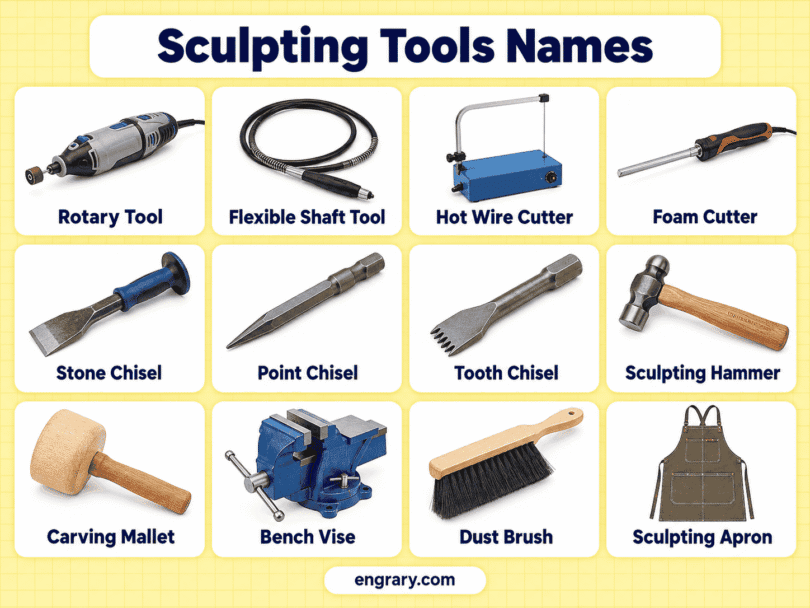
Sculptors use different tools to build forms, remove material, smooth surfaces, carve details, create texture, and check proportions. The exact toolkit changes with the material, but many tools appear regularly in clay, wax, polymer clay, and other modeling work.
Learning sculpting tools names with pictures and uses makes these tools easier to identify in an artist’s studio or modeling workspace. This guide covers 44 distinct sculpting tools and support items without padding the list with clay, wax, armature wire, or other materials.
Common Sculpting Tools Used by Artists
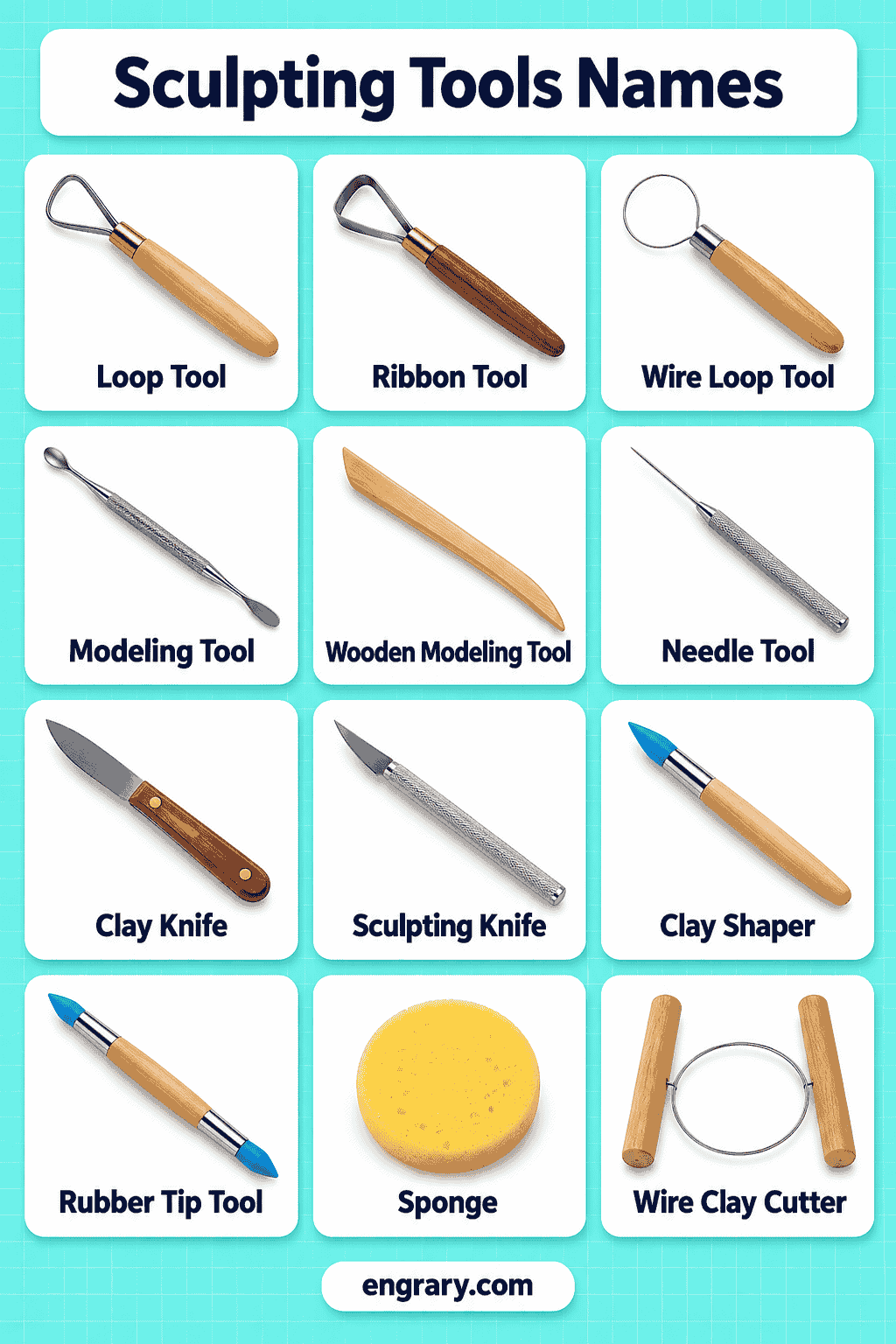
Sculptors often keep a varied collection of hand tools nearby because building a form involves much more than simply shaping material by hand. These 20 tools cover modeling, detailing, texturing, measuring, and supporting sculptural work.
1. Loop Tool
A loop tool has a shaped wire loop attached to a handle. Sculptors use its open metal end while removing, hollowing, and refining modeling material.
2. Ribbon Tool
A ribbon tool has a flattened strip of metal formed into a loop or other profile. Its firmer edge makes it useful for shaping and refining sculpted surfaces.
3. Wooden Modeling Tool
A wooden modeling tool has one or two shaped ends for pushing, smoothing, and adjusting modeling material. Different profiles support different kinds of form-building.
4. Silicone Shaper
A silicone shaper has a flexible rubber-like tip attached to a slim handle. Sculptors use the soft tip when blending and smoothing areas where a rigid tool would leave stronger marks.
5. Ball Stylus
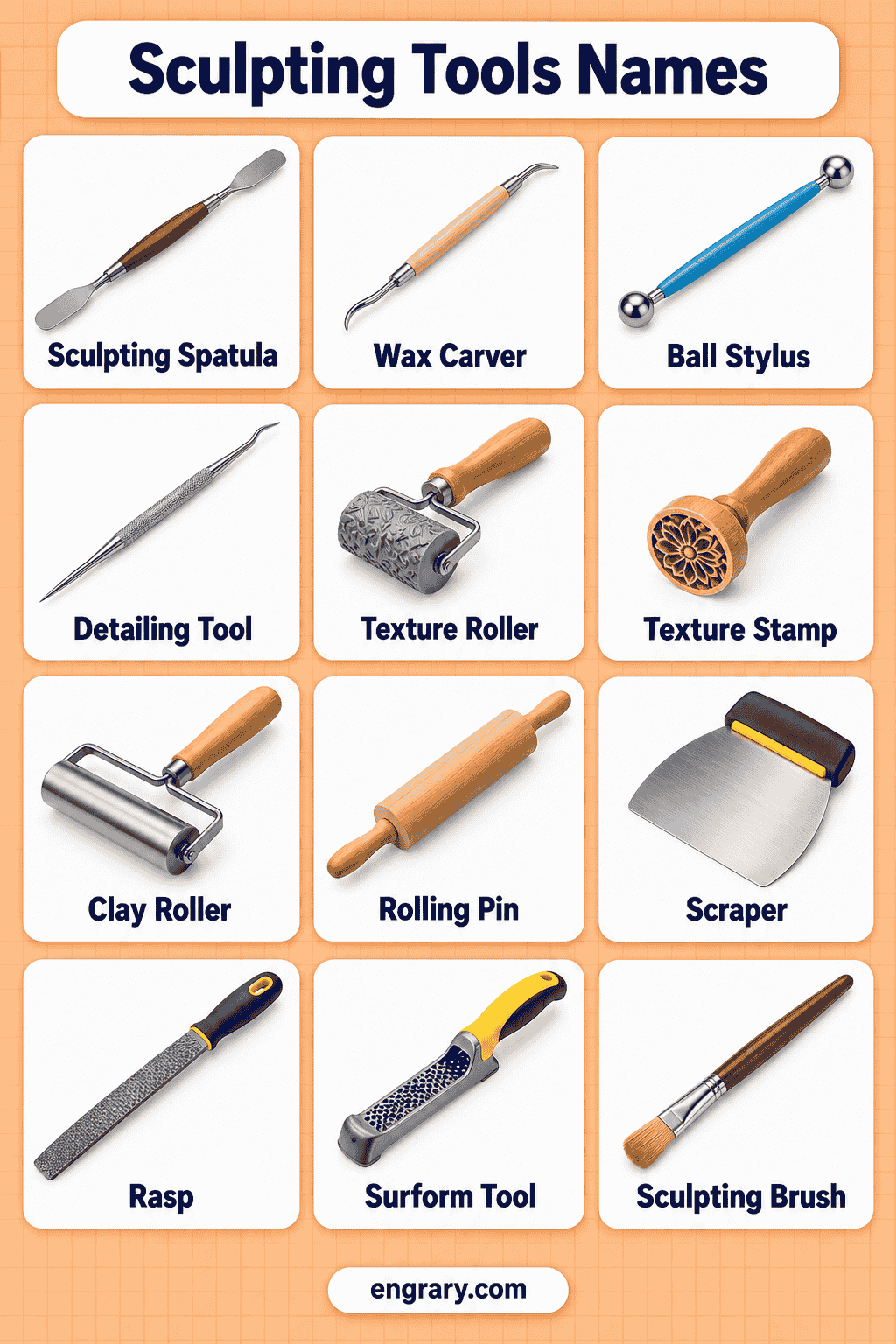
A ball stylus has a smooth metal ball at one or both ends. Its rounded shape helps create curves, shallow impressions, and small modeled details.
6. Needle Tool
A needle tool has a thin pointed metal shaft fixed into a handle. Sculptors use it for fine marking, detail work, and controlled surface lines.
7. Wire Clay Cutter
A wire clay cutter consists of thin wire stretched between two handles. It provides a simple way to separate sections of soft modeling material.
8. Sculpting Knife
A sculpting knife has a small blade and compact handle designed for modeling work. Artists use it for general trimming and shaping of suitable sculpting materials.
9. Spatula Tool
A spatula tool has a narrow flat or curved working end. It supports smoothing, lifting, pressing, and blending small areas.
10. Scraper
A scraper has a broad edge that helps level or refine a sculpted surface. Scrapers may be rigid or slightly flexible depending on their design.
11. Rib
A sculpting rib is a flat shaping tool with straight or curved edges. Artists use its broad surface while smoothing and controlling larger forms.
12. Clay Paddle
A clay paddle has a broad, flat working surface, commonly attached to a short handle. Its shape helps adjust larger areas of a clay form.
13. Texture Roller
A texture roller has a patterned cylindrical surface. Rolling it across suitable modeling material creates a continuous repeated texture.
14. Texture Stamp
A texture stamp has a raised or recessed design on its face. It produces an individual repeated impression rather than a continuous rolled pattern.
15. Texture Comb
A texture comb has several teeth arranged along one edge. It creates parallel lines, grooves, or repeated surface marks.
16. Sculptor’s Calipers
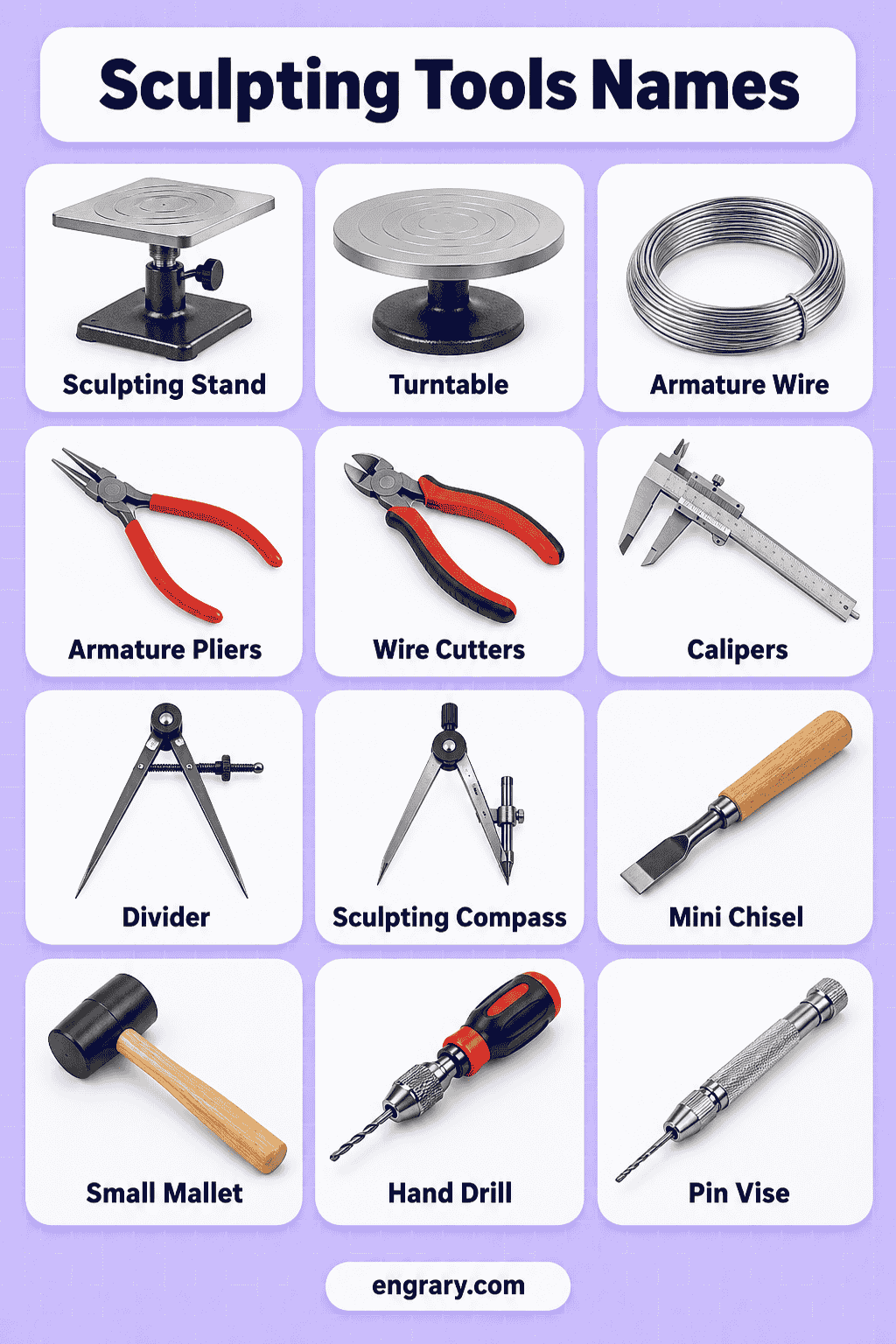
Sculptor’s calipers have two adjustable arms that compare and transfer dimensions. They help artists check relationships between different parts of a sculpture.
17. Divider
A divider has two pointed hinged legs. Sculptors use it to compare spacing and proportions across a model.
18. Modeling Brush
A modeling brush has soft or firm bristles selected for sculpting and surface work. Artists use brushes to soften marks and refine small textured areas.
19. Sculpting Turntable
A sculpting turntable is a rotating platform that supports a sculpture while the artist works around it. It allows the form to turn without moving the entire stand.
20. Armature Stand
An armature stand supports the internal framework of a sculpture. It gives figure and character sculptures a stable working base.
Tools That Remove and Hollow Modeling Material
Some sculpting tools focus on taking material away rather than building it up. Their cutting, looped, abrasive, or toothed surfaces help artists open spaces and refine larger forms.
21. Mini Loop Tool
A mini loop tool is a smaller version of the standard loop tool. Its compact wire end suits tighter areas and smaller sculpted forms.
22. Hollowing Tool
A hollowing tool has a shaped working end designed to remove material from recessed or enclosed areas. Its form makes it especially recognizable in hollow or vessel-like sculpture work.
23. Rasp
A rasp has a rough, toothed surface that removes small amounts of firmer sculpting material. Artists commonly recognize it by its coarse textured working face.
24. Riffler File
A riffler file is a small curved or shaped file designed for detailed surface refinement. Its narrow ends can reach contours that a larger file cannot.
25. Serrated Scraper
A serrated scraper has a toothed edge rather than a smooth one. It leaves a more textured surface while removing or leveling material.
Tools That Push, Pull, and Build Form
General modeling tools help an artist develop the overall volume of a sculpture. Their ends may be pointed, rounded, flat, or curved to affect different parts of the form.
26. Plastic Modeling Tool
A plastic modeling tool has molded ends for pressing, smoothing, and shaping soft modeling material. It provides a lightweight alternative to wood or metal tools.
27. Metal Modeling Tool
A metal modeling tool uses rigid metal tips for controlled shaping and surface adjustment. Its firm construction suits more precise modeling work.
Wooden modeling tools, paddles, ribs, and spatulas from the opening section also belong to this broad form-building group.
Soft-Tip Tools for Blending Sculpted Surfaces
Soft tools help reduce hard marks and blend transitions between adjoining shapes. They are especially useful where a rigid metal or wooden edge would leave unwanted impressions.
The silicone shaper is the main tool in this group. Its flexible tip bends across curved surfaces and reaches narrow transitions.
A modeling brush can also soften fine surface marks without changing the overall form as aggressively as a rigid modeling tool.
Small Tools for Faces, Features, and Fine Details
Small sculptures and facial features require tools with compact ends that give the artist greater control over tiny areas.
28. Detail Stylus
A detail stylus has a narrow working tip designed for small-scale shaping and marking. Sculptors often use it around fine features and precise surface details.
29. Mini Spatula
A mini spatula has a very small flat or curved end. Its compact profile suits miniature forms and confined areas.
30. Fine Modeling Tool
A fine modeling tool has a narrow tip made for delicate adjustments. It supports detail work without disturbing large surrounding areas.
Ball styluses, mini loop tools, needle tools, and silicone shapers also fit naturally into fine-detail sculpting.
Tools That Create Lines, Grooves, and Incised Marks
Sculptors often add deliberate lines after establishing the main form. Some tools make narrow cuts or grooves that become part of the final surface design.
31. Incising Tool
An incising tool has a narrow pointed or edged tip that creates controlled lines and grooves in a sculpted surface.
32. Sgraffito Tool
A sgraffito tool has a fine working tip designed for scratching narrow decorative marks through a surface layer.
Needle tools and texture combs can also produce linear marks, although their shapes and typical results differ.
Tools for Building Texture Into a Sculpture
Texture can imitate natural surfaces, break up a smooth area, or become a decorative feature of the sculpture itself. Sculptors use rolling, stamping, stippling, brushing, and combing tools for these effects.
33. Stippling Tool
A stippling tool has a textured or pointed end that creates clusters of small surface marks rather than long continuous lines.
34. Pattern Wheel
A pattern wheel has a small decorated wheel mounted on a handle. As the wheel rotates, it leaves a narrow repeated pattern.
35. Texture Sponge
A texture sponge has an irregular porous surface that produces softer, less uniform impressions than a stamp or roller.
36. Wire Brush
A wire brush has groups of fine metal bristles. Sculptors use its distinctive bristled surface to create rough or directional texture on suitable materials.
Texture rollers, stamps, and combs from the first section complete this broader texture-tool family.
Tools for Checking Size, Balance, and Proportion
Measuring tools help sculptors compare different parts of a figure or object instead of relying entirely on visual judgment.
37. Ruler
A ruler provides a straight scale for checking length, height, and spacing across a sculpture or reference layout.
38. Proportion Gauge
A proportion gauge has adjustable arms or measurement points that help compare relationships between different dimensions.
39. Measuring Gauge
A measuring gauge provides a repeatable reference for checking dimensions while building similar forms or matching different parts.
Calipers and dividers from the opening section also belong to this measurement group.
Tools Sculptors Use When Working With Wax
Wax modeling uses many general sculpting tools, but it also has specialized tools with small metal ends designed around wax forms and details.
40. Wax Modeling Tool
A wax modeling tool has one or more shaped metal ends for adjusting and refining modeling wax.
41. Wax Spatula
A wax spatula has a flat or slightly curved metal blade at the end of a handle. Its shape supports smoothing and moving small areas of wax.
42. Wax Carver
A wax carver has a narrow shaped metal end designed for detailed wax surface work. Different profiles create different kinds of refinement.
Loop tools, ball styluses, and riffler files can also cross over into wax modeling depending on the sculpture.
Equipment That Supports a Sculpture While You Work
Not every sculpting item changes the material directly. Some tools and equipment hold the sculpture securely or provide a stable surface while the artist builds the form.
43. Sculpting Board
A sculpting board is a flat reusable base placed beneath a sculpture. It provides a stable working surface and makes smaller pieces easier to reposition as a unit.
44. Armature Jig
An armature jig is a support device that helps hold or organize an armature framework while a sculpture develops around it.
Recognizing Similar-Looking Sculpting Tools
Several sculpting tools perform related jobs, but their working ends make them easier to distinguish.
| Often Confused | Main Difference |
|---|---|
| Loop Tool vs Ribbon Tool | Loop tools generally use wire loops; ribbon tools use flatter metal strips |
| Needle Tool vs Ball Stylus | Needle tools end in a fine point; ball styluses have rounded tips |
| Wooden Modeling Tool vs Silicone Shaper | Wooden tools stay firm; silicone tips flex |
| Scraper vs Rib | Scrapers primarily refine surfaces; ribs combine broader smoothing and form control |
| Wire Clay Cutter vs Loop Tool | Cutting wire separates material; loop tools remove or shape material |
| Modeling Tool vs Detail Tool | Modeling tools handle broader shaping; detail tools focus on smaller areas |
| Texture Stamp vs Texture Roller | Stamps make individual impressions; rollers create continuous patterns |
| Pattern Wheel vs Texture Roller | Pattern wheels make narrow repeated bands; texture rollers cover wider areas |
| Sculpting Turntable vs Potter’s Wheel | A turntable supports and rotates sculpture; a potter’s wheel forms rotating clay vessels |
| Calipers vs Divider | Calipers transfer dimensions; dividers compare or divide spacing |
| Rasp vs Riffler File | Rasps handle broader rough refinement; riffler files reach smaller contours |
| Sculpting Tool vs Material | A tool performs a reusable task; material becomes part of the sculpture |
Why the Same Sculpting Tool May Have Different Names
Sculpting terminology changes between art studios, ceramics suppliers, polymer-clay communities, wax modelers, and craft manufacturers.
A loop tool may appear as a wire loop tool, while a ribbon tool may be sold as a ribbon loop tool.
A silicone shaper may also appear as a clay shaper, colour shaper, or soft shaper.
The names ball stylus, ball tool, and dotting tool sometimes describe closely related rounded-tip tools.
A needle tool may appear as a pin tool, while a wire clay cutter may be labeled cutting wire, clay wire, or cut-off wire.
Manufacturers may also call a sculpting turntable a modeling turntable.
These alternate names should not increase the primary tool count when they refer to the same basic implement.
What Counts as a Sculpting Tool—and What Does Not
A sculpting toolkit contains reusable objects that shape, support, measure, or refine a form. Sculpting materials and structural components belong to different categories.
| Category | Examples |
|---|---|
| Sculpting Tools | Loop Tool, Ball Stylus, Silicone Shaper, Scraper |
| Support Equipment | Turntable, Armature Stand, Sculpting Board |
| Sculpting Materials | Clay, Polymer Clay, Wax, Epoxy Putty |
| Structural Materials | Armature Wire, Foil |
| Consumables | Paint, Solvent, Some Surface Media |
For example, an armature stand counts as support equipment, while armature wire forms part of the sculpture’s supporting structure. Likewise, a wax modeling tool counts as a tool, while the wax itself remains the sculpting material.
Questions People Ask About Sculpting Tools
Common examples include loop tools, ribbon tools, wooden modeling tools, silicone shapers, ball styluses, needle tools, spatulas, scrapers, calipers, and texture tools.
A loop tool generally has a rounded wire loop, while a ribbon tool uses a flatter metal strip formed into a shaped working end. Both help remove and refine modeling material.
Ball styluses, needle tools, mini loop tools, detail styluses, mini spatulas, silicone shapers, and fine modeling tools work well for small features and precise surface areas.
Sculptors commonly use calipers, dividers, rulers, proportion gauges, and other measuring gauges to compare dimensions across a form.
Sculpting tools are reusable objects that shape, measure, texture, or support a sculpture. Materials such as clay, wax, polymer clay, and epoxy putty become part of the sculpted form.
You May Also Like

Leave a Comment